Many custom options...


And formats...



Real Beauty is of the Soul in Chinese / Japanese...
Buy a Real Beauty is of the Soul calligraphy wall scroll here!
Personalize your custom “Real Beauty is of the Soul” project by clicking the button next to your favorite “Real Beauty is of the Soul” title below...
Switched to secondary search mode due to lack of results using primary.
These secondary results may not be very accurate. Try a different but similar meaning word or phrase for better results. Or...
Look up Real Beauty is of the Soul in my Japanese Kanji & Chinese Character Dictionary(My dictionary is a different system then the calligraphy search you just tried)
If you want a special phrase, word, title, name, or proverb, feel free to contact me, and I will translate your custom calligraphy idea for you.
1. Awareness
4. Battojutsu
5. Believe
7. Bruce Lee
8. Castillo
9. Cesar
10. Che Guevara
11. Confucius
13. Day
16. Delreal
17. Earth
19. Keep Your Feet on the Ground
20. A Bright Future
21. Geisha
23. Honesty
25. Impermanence
26. Inner Strength
27. Italy / Italia
28. Jesus
29. A Journey of 1000 Miles Begins with a Single Step
30. Katana
31. Kishan
32. Kyojitsu: Falsehood and Truth
34. Listen to Both Sides and be Enlightened, Listen to One Side and be in the Dark
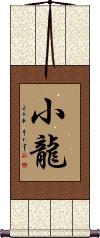
35. Little Dragon
36. Knowledge of Ultimate Truth
38. My True Love
39. Nothingness
40. One frost doesn't make winter
41. Opportunity
43. Reality
46. The Red String
47. Strength and Love in Unity
49. Shinken Shobu
50. True Emptiness Yields Transcendent Existence
52. Most Sincere Friend / Honest Friend / Real Friend / Best Friend
55. The More We Sweat in Training, The Less We Bleed in Battle
56. True Love
58. True Essence
59. True Love
60. Truth
61. Wisdom
Awareness
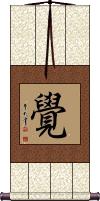
覺 can mean to feel; to figure out; thinking; awake; aware; bodhi; knowing; understanding; enlightenment; illumination; apprehend; perceive; realize.
覺 is a character that is impossible to define in a single word.
This term is often associated with Buddhism where it's understood to be: Illumination, enlightenment, or awakening in regard to the real in contrast to the seeming. However, it can also refer to enlightenment in regard to morality and evil.
Notes:
In Japanese, this can be the personal name Satoru.
In certain context, and only when pronounced as "jiao" in Chinese, it can refer to a nap, sleep or the state of sleeping. However, as a single character on a wall scroll, everyone will read this with the awareness or enlightenment context.
By no means is this the only way to write enlightenment. In fact, you should only choose this character if you are looking more for a word meaning awareness.
See Also: Enlightenment | Wisdom | Knowledge
Awesome / Really Cool
Chinese Slang
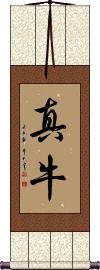
真牛 is Chinese slang for something really cool or awesome.
真牛 is probably not appropriate for a calligraphy wall scroll unless you have a specific reason.
This literally translates as “the real bull” or “the genuine cow.”
Awesome / Awe-Inspiring
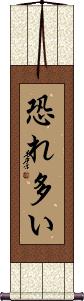
恐れ多い is a Japanese word for something awe-inspiring or awesome (in some odd context, it can refer to August).
恐れ多い is probably not appropriate for a calligraphy wall scroll unless you have a specific reason.
The word awesome is misused a lot in English or used too casually. This Japanese word is the real form of awesome, and it kind of means numerous fears and anxiety that you would feel in response to encountering something truly awesome (such as God, a tornado, a tsunami, etc.).
Note: Because this selection contains some special Japanese Hiragana characters, it should be written by a Japanese calligrapher.
Battojutsu
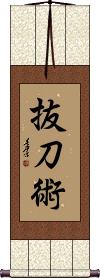
Battōjutsu or 抜刀術 is the art of sword drawing associated closely with the tradition of Kenjutsu.
Battōjutsu typically is done with a real and sharp-bladed katana and is often practiced as a form of kata.
Believe
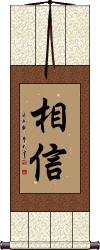
相信 is the Chinese way to say believe.
This specifically means to be convinced that something is true or to accept something as true or real.
This can also be translated as “convinced of,” “have trust in,” or “have faith in.”
Bloodless Victory
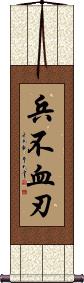
Perhaps a pacifist view or perhaps the best kind of victory; 兵不血刃 reflect this idea:
The edges of the swords not being stained with blood.
You could also translate it as: Win victory without firing a shot.
The first character means army or force. The second character means without or none. The last two characters mean bloodstained knives. So it represents a returning victorious army without bloodstained knives. 兵不血刃 is the very literal sense of this Chinese proverb. The title definition is more accurate to the way this proverb is understood.
Asking yourself why the direct or literal translation is different?
...Think of compound words in English such as “nevertheless” if we break it apart to “never the less,” we will have trouble getting the real definition of “in spite of that.” Similar things happen when multiple characters create a compounded word in Chinese.
Bruce Lee
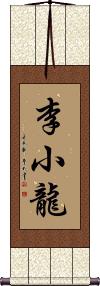
李小龍 is the real full name of Bruce Lee.
 Many people have no idea that Bruce Lee had a “real” Chinese name. In Mandarin and Cantonese, he is known as “Lǐ XiǎoLóng” and “Léi SíuLùng” respectively.
He kept his family name pronunciation (Li = Lee). 李 is a common family name that also means “plum.”
His given name 小龍 (Xiao-Long), literally means “little dragon.” 李小龍 is why you often see the character for dragon associated with Bruce Lee on various posters etc.
For a pronunciation lesson, the “X” in Romanized Mandarin is pronounced like a “sh” sound but with your tongue at the bottom of your mouth. The vowel sound in “Long” is like the English “oh,” not like the “ah” sound in the English word “long.”
If you are a big Bruce Lee fan, you should know this information, and you should have this wall scroll hanging in your room or martial arts studio.
Note: Japanese use these same Chinese characters / Kanji to write Bruce Lee's real name (with different pronunciation - which is a bit like how the name “Bruce Lee” sounds in English).
See Also: Kung Fu | Martial Arts
Castillo
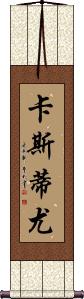
卡斯蒂尤 is the name Castillo in Chinese (Mandarin).
Even though it's not the most commonly-used transliteration, I like this version of Castillo, as it sounds more like the real Spanish pronunciation where the end of Castillo sounds like “Yo.”
Cesar
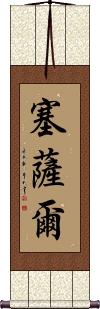
This is a 3-character transliteration to Mandarin Chinese for the Latin / Spanish name César.
I like this version better than the 2-character version, as this one is very close to the real sound of the name Cesar (both English and Spanish pronunciation).
Che Guevara
Latin American / Cuban Revolutionary
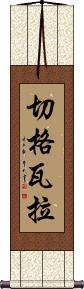
切格瓦拉 is the name “Che Guevara,” as written (transliterated) in Mandarin Chinese.
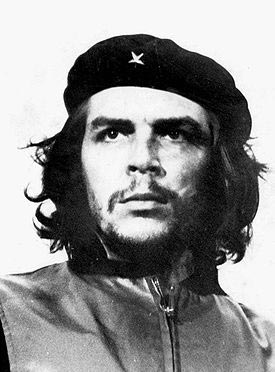 Once revered by Chinese people as a Socialist rebel, he's now just a historical figure that school children briefly learn about in China.
切格瓦拉 is because China used to be a truly-Communist/Socialist nation, and thus, other Communists and Socialists were heroes.
In modern China, with its free-market economy, those former heroes fade a little.
We are not offering the “Che” character alone, as few would associate it with Che Guevara, so you need the full name to be clear (minus Ernesto, which is his real first name).
Confucius
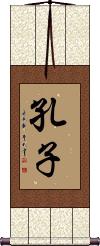
孔子 is how to write the name of the great sage, known in the West as Confucius.
His real name is Kongzi (The name Confucius is a westernized version of his name - his family name is Kong, and “zi” was added as a title of distinction).
He lived some 2500 years ago in Qufu, a town in modern-day Shandong Province of Northern China (about 6 hours south of Beijing by bus). He was a consort to Emperors, and after his death, the impact of his philosophies still served to advise emperors, officials, and common people for generations.
Also during these thousands of years, the Kong family remained powerful in China, and the Kong estate was much like the Vatican in Rome. The Kong estate existed as if on sovereign ground with its own small garrison of guards and the privileges of a kingdom within an empire.
This was true up until the time the Kong family had to flee to Taiwan in 1949 when the Red Army took victory over the Nationalists during the Revolution. The home of Confucius was later razed and all statues were defaced or stolen during the Cultural Revolution. Finally, after years of smearing his name and image, it is once again okay to celebrate the teachings of Confucius in mainland China.
Known as Khổng Tử in Vietnamese.
Construction Crane
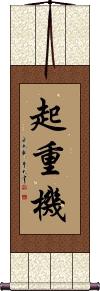
起重機 refers to the huge machine that lifts materials high into the air as crews construct huge buildings.
A customer requested this specifically after some confusion over the bird by the same name.
In an odd twist, while they don't know this name in English sounds like a bird; the building crane is jokingly called “The real national bird of China” because of the accelerated level of construction in Beijing and elsewhere ever since preparations began for the 2008 Olympics. As of 2018, construction has barely slowed.
If you want the type of construction crane that drives down the road, please note that the word is totally different for that kind of “vehicle crane.”
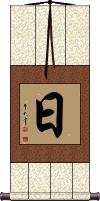
This is how to write “day” in Chinese, Japanese, and Korean Hanja.
This can also mean “Sun,” the star in the middle of the Solar system in which we live. In Japanese, it can also mean “sunshine” or even “Sunday.”
When writing the date in modern Chinese and Japanese, putting a number in front of this character indicates the day of the month. Of course, you need to indicate the month too... The month is expressed with a number followed by the character for the moon. So “three moons ten suns” would be “March 10th” or “3/10.”
Note: This is also the first character for the proper name of Japan. Remember that Japan is “The land of the rising sun”? Well, the first character for Japan means “sun” and the second means “origin” so you get the real meaning now. Sometimes, in China, this sun character can be a short name for Japan or a suffix for something of or from Japan.
Not Long for this World
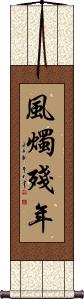
This phrase means “Old and ailing with little time left” or “Not long for this world.”
There is a real suggestion here that someone will die soon.
This was added by a special request of a customer and is perhaps, not the most positive phrase that you could put on a wall scroll.
This would be the most offensive possible gift to give to an older person - please do not do that!
Death Before Surrender
Rather die than compromise
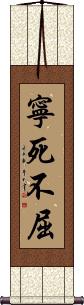
寧死不屈 is often translated as “Death Before Dishonor.”
The literal translation is more like, “Better die than compromise.” The last two characters mean “not to bend” or “not to bow down.” Some might even say that it means “not to surrender.” Thus, you could say this proverb means “Better to die than live on my knees” or simply “no surrender” (with the real idea being that you would rather die than surrender).
Delreal

德爾雷爾 is the name Del Real or Delreal in Chinese (Mandarin).
Delreal

デルリアル is the name Del Real or Delreal in Japanese Katakana.
Note: Because this title is entirely Japanese Katakana, it should be written by a Japanese calligrapher.
Earth
(Used in Japanese version of five elements)
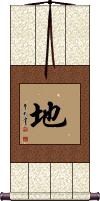
地 is the single-character element and title of the planet Earth in Chinese, old Korean Hanja, and Japanese Kanji.
Because this is a single character, the definition is a little ambiguous and can have many meanings depending on the context in which it is used. These meanings include: earth, ground, land, soil, dirt, place, territory, bottom (of a package, book, etc.), earth (one of the Japanese five elements), the region in question, the local area, skin, texture, fabric, material, weave, base, background, one's true nature, narrative (i.e. descriptive part of a story), real life, actuality, etc.
In Japanese, this Kanji can be pronounced several ways, including chi, ji, tsushi, or tsuchi.
地 is also an element of the Japanese version of the five elements (the original Chinese version uses a different version of earth).
Fantasy / Illusion
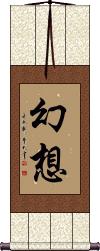
幻想 is illusions or fantasy in Chinese, Japanese Kanji, and old Korean Hanja.
This can also refer to delusion or daydreaming. It sort of means a dream or idea that cannot be true or real ( at least not in this realm).
Keep Your Feet on the Ground
Be Down-to-Earth
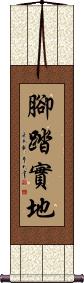
腳踏實地 is a four-character proverb that suggests that you should be practical, realistic, and grounded.
Some translate this as a suggestion to be down-to-earth.
The first character means “feet.”
The second means “step on” or “stand.”
The third means “solid,” “real,” or “true.”
The last character means “ground,” “earth,” or “terra.”
Literally, this means “[keep your] Feet Standing [on] Solid Ground.”
A Bright Future
Incredible 10,000-Mile Flight of the Peng
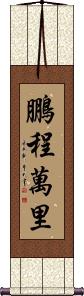
鵬程萬里 is an ancient Chinese proverb used in modern times to wish someone a long and successful career.
It's really about the 10,000 Flight of the Peng (Peng, also known as Roc is a mythical fish that can turn into a bird and take flight).
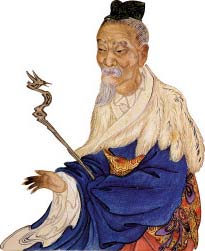
莊子
Zhuangzi or Chuang Tzu
Breaking down each character:
1. Peng or Roc (a kind of bird).
2. Journey (in this case, a flight).
3. 10,000 (Ten Thousand).
4. Li is a unit of distance often referred to as a “Chinese Mile,” though the real distance is about half a kilometer.
Direct Translation: “Peng's Journey [of] 10,000 Li.”
Literal meaning: “The 10,000-Li Flying Range Of The Roc.”
Perceived meaning: “To have a bright future” or “To go far.”
This proverb/idiom comes from the book of Zhuangzi or Chuang Tzu. It tells the tale of a huge fish that could turn into a gigantic bird. This bird was called a “peng” and was many miles long. This legendary size allowed the Peng to fly from the Northern Sea to the Southern Sea in a single bound.
Wishing someone “a Peng's Journey of 10,000 Li” will imply that they can travel far without stopping and will have great success, a long career, and a prosperous future.
Geisha
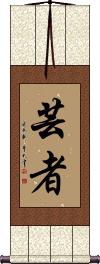
芸者 is the real basis for the way we spell geisha.
However, there are many more ways to refer to a woman that fills the role that westerners think of when they hear the word geisha.
In Japanese, these characters literally mean “artful person.” But in English, it might be better translated as “a person (woman) highly trained/accomplished in the arts.”
However, my Japanese dictionary says “a singing and dancing girl.”
Many will argue as to whether “geisha” = “prostitute” or not. My Japanese friends seem to have the opinion that a geisha is so highly trained in the art of playing musical instruments and dancing that the fact she might also be a prostitute is secondary to her performance on stage.
芸者 is a “Japanese only” term, they use a slightly different first character to express “geisha” in Chinese. Since this is a Japanese term, I have not included the Chinese version.
Guan Gong / Warrior Saint
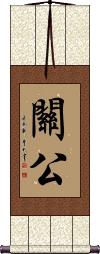
關公 is a Chinese title, Guan Gong, that means Lord Guan (The warrior saint of ancient China).
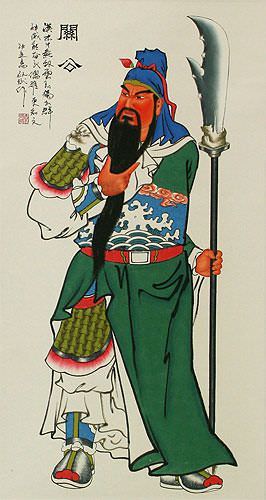 While his real name was Guan Yu / 關羽, he is commonly known by the title of Guan Gong (關公).
Some Chinese soldiers still pray to Guan Gong for protection. They would especially do this before going into battle. Statues of Guan Gong are seen throughout China.
Honesty
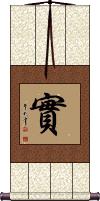
Honesty / Fidelity
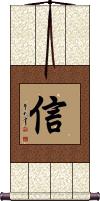
信 is another character that expresses the idea of honesty.
It can also mean truth, faith, belief in, fidelity, sincerity, trust, and/or confidence.
Some have included this in the list for the Bushido, although “makoto” is probably more common/popular.
Note: In some contexts, this character can mean a letter (mail), news, or envoy. However, alone, it will generally be read with the honesty-meaning.
See our page with just Code of the Samurai / Bushido here
See Also: Loyalty Trustworthiness Trustworthy
Impermanence
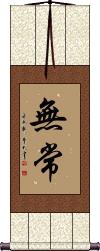
無常 is the state of being “not permanent,” “not enduring,” transitory, or evolving.
It can also mean variable or changeable. In some contexts, it can refer to a ghost that is supposed to take a soul upon death. Following that, this term can also mean to pass away or die.
In the Buddhist context, this is a reminder that everything in this world is ever-changing, and all circumstances of your life are temporary.
If you take the Buddhist philosophy further, none of these circumstances are real, and your existence is an illusion. Thus, the idea of the eternal soul is perhaps just your attachment to your ego. Once you release your attachment to all impermanent things, you will be on your way to enlightenment and Buddhahood.
Language notes for this word when used outside the context of Buddhism:
In Korean Hanja, this means uncertainty, transiency, mutability, or evanescent.
In Japanese, the definition orbits closer to the state of being uncertain.
Inner Strength
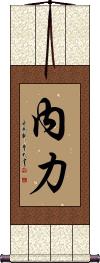
內力 is the shorter version of inner strength (can also be translated as “internal force”). The first character holds the meaning of “inner” or “internal.” The second character means “power,” “force,” or “strength.”
內力 is a Kung Fu way of talking about an inner power or strength from within. This is a way to express “inner chi.” This is something that you might hear in a real Chinese Kung Fu movie.
While understood in Chinese and Japanese, this can have a secondary meaning of “inner stress” in Japanese.
Italy / Italia
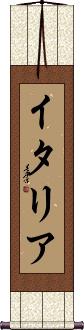
イタリア is the Japanese Katakana name for the country of Italy.
This version is the most common way to write Italy, and actually sounds a bit like the real name of Italy which is Italia.
Note: Because this title is entirely Japanese Katakana, it should be written by a Japanese calligrapher.
See Also: Europe
Jesus
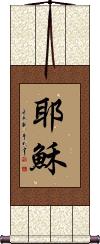
This is simply the name “Jesus” transliterated into Chinese. 耶穌 hold a pronunciation in Mandarin that is closer to the real and original Hebrew Yeshua, instead of the incorrect way we have always pronounced Jesus in English with a hard “J” sound. While this name sounds like the real “Jesus” in Chinese, Christians in China are more likely to say “Christ” (Jidu) which holds more meaning than just sound.
If you are Latino and have been given the name “Jesus,” this is also how to write your name in Chinese.
A Journey of 1000 Miles Begins with a Single Step
senri no michi mo ippo kara
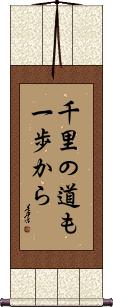
千里の道も一歩から is the Japanese version of an ancient Chinese proverb that means “a journey of a thousand miles begins with a single step.”
Some will also translate this as a 1000-mile road starts with one brick (a small amount).
In this case, the real measurement is an ancient Chinese “li” or 里, which is romanized as “ri” in Japanese. It's about half a kilometer, so three 里 would be a western mile. A journey of 333 miles begins with a single step, just doesn't sound as natural.
Note: Because this selection contains some special Japanese Hiragana characters, it should be written by a Japanese calligrapher.
Katana
Japanese Samurai Sword
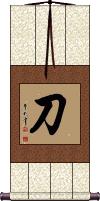
刀 is the Japanese Kanji for “sword.” This refers to the style of sword carried by warriors, samurai, and shogun of ancient Japan.
With the pacification of Japan, such swords are now only used for ceremony and decoration. The true art of sword-smithing is all but lost in Japan with new sword production dedicated to making inexpensive replicas for the tourist and foreign market.
For those of you that want to ask whether I can get you a real antique sword. Let me tell you that most real Asian swords were melted down after WWII in Japan, and during the Great Leap Forward in China. Any remaining swords are family heirlooms that nobody will part with.
Please carefully note that the Japanese kanji character shown above is only for a Japanese audience. In China, this character means “knife.” See our other entry for “sword” in Chinese.
Note: 刀 can mean knife, sword, or blade in Korean, depending on context.
See Also: Sword
Kishan
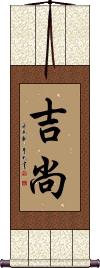
This an alternate transliteration to Mandarin Chinese for the name Kishan.
We like this one better because of the way it sounds, and the good meaning. 吉尚 is also a rare but real family name in Chinese culture.
Kyojitsu: Falsehood and Truth
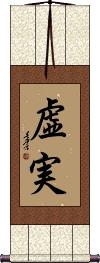
虚実 is a Japanese word that means “falsehood [and] truth” or “fiction [and] fact.”
This concept is used in warfare, gameplay, and martial arts strategies. 虚実 can be a strategy of real and/or deceptive moves. This gets to some Sun Tzu Art of War stuff where in warfare a strategic move is either a real and serious move or it is a deceptive blow.
Let's explore each character in more depth:
虚 was originally written 虛 (there is a very subtle difference in the strokes at the bottom of the character) and means unpreparedness, falsehood, emptiness, void, abstract theory, empty or unoccupied, diffident or timid, false, humble or modest, virtual, or in vain.
In the Buddhist context, 虛 represents the Pali/Sanskrit word “śūnya,” meaning empty, vacant, unreal, unsubstantial, untrue, space, humble, or in vain.
In ancient Eastern/Chinese astronomy, 虛 represents the “Emptiness” constellation (one of the 28 mansions in the sky).
実 was originally 實 in Chinese (they currently write it as 实 in Simplified Chinese) with the meaning, truth, reality, sincerity, honesty, fidelity, and substance.
The Buddhist context is similar, adding real, true, honest, really, solid, definitely, sincere, solid, fixed, full, to fill, fruit, kernel, verily, in fact, the supreme fact, or ultimate reality to the definition.
Life Is But A Dream
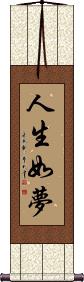
人生如夢 is an old Chinese proverb that suggests, “life is but a dream.”
This kind of follows the Buddhist idea that the world is a temporal place, where reality may not be as real as you think.
Listen to Both Sides and be Enlightened, Listen to One Side and be in the Dark
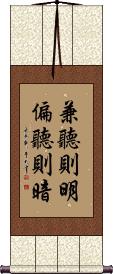
兼聽則明偏聽則暗 is an ancient Chinese proverb about getting all the information from all sides so that you truly understand a situation.
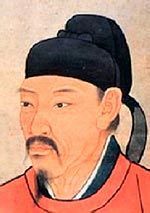
Wei Zheng
A man named Wei Zheng lived between 580-643 AD. He was a noble and wise historian and minister in the court of the early Tang Dynasty. The emperor once asked him, “What should an emperor do to understand the real-world situation, and what makes an emperor out-of-touch with reality?”
Wei Zheng replied, “Listen to both sides and you will be enlightened; listen to only one side and you will be left in the dark.”
Then Wei Zheng went on to cite examples of leaders in history that were victorious after heeding both sides of the story, and other leaders that met their doom because they believed one-sided stories which often came from flattering lips.
Please note that there is an unwritten rule when the same character appears twice in the same phrase, the calligrapher will alter the appearance so that no two characters are exactly alike in the same piece. This calligraphy has two repeating characters that will be written differently than they appear here.
Little Dragon
Knowledge of Ultimate Truth
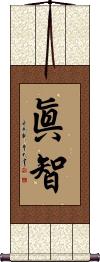
眞智 can mean the wisdom or knowledge of ultimate truth.
眞智 is also the absolute knowledge of the non-thing or that which is immaterial. This makes more sense when you consider that true wisdom includes the knowledge of both the real and unreal, or what is material and immaterial.
In Japan, 眞智 (Masatoshi) can also be a given name.
Monkey Stealing Peaches
Martial arts term
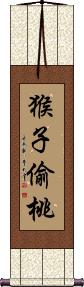
猴子偷桃 is a martial arts term that I find hilarious. I thought Stephen Chow had made this up for his Monkey King movie. After some research, it turns out to be real.
This can be translated as “monkey stealing peaches” or “monkey steals the peach.” It refers to distracting an opponent with one hand and seizing his testicles with the other.
In colloquial Chinese speech, this can refer to grabbing somebody by the balls (without any martial arts technique to the grabbing).
My True Love
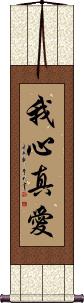
我心真愛 is a slightly poetic way to express this sentiment to someone.
The meaning is “My True Love,” but the characters directly translate as “I/Me/My Heart/Mind True/Real Love.”
Note that Chinese grammar and construction are different, so this sounds very eloquent and artsy in Chinese.
In Korean Hanja, the third character should be written differently. Just let me know when you place your order if you want that version - it will still make sense in Chinese. This phrase makes sense in Korean but is not commonly used.
My True Love
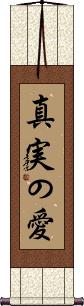
真実の愛 means “true love” or “genuine affection” in Japanese.
The first two Kanji mean true, real, genuine, or authentic.
The third Kanji is a connecting possessive article.
The last character is love or affection.
Nothingness
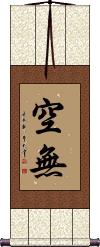
空無 is “nothingness” in a Buddhist context.
The first character means empty but can also mean air or sky (air and sky have no form).
The second character means have not, no, none, not, or to lack.
Together these characters reinforce each other into a word that means “absolute nothingness.”
I know this is a term used in Buddhism, but I have not yet figured out the context in which it is used. I suppose it can be the fact that Buddhists believe that the world is a non-real illusion, or perhaps it's about visualizing yourself as “nothing” and therefore leaving behind your desire and worldliness.
Buddhist concepts and titles often have this element of ambiguity or, rather, “mystery.” Therefore, such ideas can have different meanings to different people, and that's okay. If you don't get it right in this lifetime, there will be plenty more lifetimes to master it (whatever “it” is, and if “it” really exists at all).
Soothill defines this as “Unreality, or immateriality, of things, which is defined as nothing existing of independent or self-contained nature.”
One frost doesn't make winter

一次霜凍不代表整個冬天 is a proverb that means “One frost doesn't make winter.”
The deeper meaning is that a single early sign of cold weather doesn't signify the full onset or severity of winter; it's about the gradual transition of seasons, patience, and not jumping to conclusions.
It's a reminder to stay resilient, wait for the real season to arrive, and not let one small event define the whole experience, similar to how one kind word can warm you for months.
While the origin of this proverb is murky (not originally Chinese, likely a modern adaptation of “One swallow does not a summer make”), this idea aligns with the Chinese solar terms (二十四節氣), which mark subtle shifts, like the transition from "cold dew" (寒露) to "frost falls" (霜降).
Opportunity
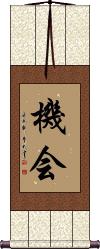
機会 is a common way to express “opportunity” in Japanese.
The first character means “chance,” and the second can be translated as “meeting.”
So in Japanese business, a “chance meeting” represents a real “opportunity.”
Note that this also means opportunity in Chinese, but it's more an oral or informal word in Mandarin. Also, the second Kanji is the same as the simplified version of the hui Chinese character.
The Original Mind
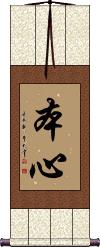
In Zen Buddhism, 本心 means “original mind” or “original heart,” which refers to one's Buddha-nature present from birth.
This can also be translated as true feelings, real intention, one's own heart, one's right mind, one's senses, one's conscience, or fundamental mind.
Note: 心 can mean heart or mind - thought in ancient Asia to be the same organ.
Reality
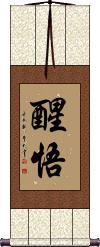
醒悟 is a Chinese word that expresses the idea of reality or coming to understand what is true and real.
The first character means to wake up, awaken, comprehend, introspect, or visit.
The second character means to comprehend or understand (be enlightened).
The meanings of Chinese words are not necessarily the sum of their parts. In this case, at best, you can derive that the characters express “understanding what is real” or “knowing what is real.” Any Chinese person will perceive this word in a similar way to how we use “reality” in English.
 Note: The first character can also be written in a different form as shown to the right. Same meaning in Chinese, either way
it’s
written.
Note: The first character can also be written in a different form as shown to the right. Same meaning in Chinese, either way
it’s
written.
Reality and Illusion
Buddhism Concept
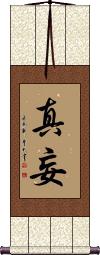
真妄 is a specifically Buddhist term that means “reality and illusion.” Out of Buddhist context, it might be read as “The real and the absurd.”
Separately, the first character means real, true, and genuine, and the second character means absurd, fantastic, or related to fantasy.
Reality / Realistic
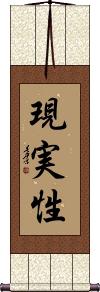
現実性 is a Japanese word that expresses the idea of reality or coming to understand what is true and real.
This can also be translated as realistic, practical, or feasible.
See Also: Illusion
The Red String
Thread of Lover's Destiny / Fate
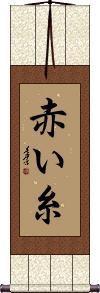
This literally translates as “the red string” or “the red thread” in Japanese, but the real meaning is much deeper...
In Japanese culture, it's believed that fate, destiny, or karma joins lovers by an unseen string, tied around one little finger of each. 赤い糸 is how soul mates find and are drawn to each other.
The Japanese concept of the red thread of fate, by most estimations, comes from Chinese folklore, where it's known as 姻緣紅線. The only difference is that in China, the celestial red thread is tied around the ankles of the lovers (versus what is usually represented as the pinky finger in Japan).
Strength and Love in Unity
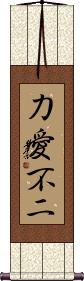
力愛不二 is a proverb that literally means:
“Strength [and] Love [are] Not Two [separate ideas/concepts/things].”
You'll find this proverb translated from Japanese to English as:
Love and strength are not separate.
Power and love are indivisible.
Strength and love in harmony.
Strength and love stand together.
Old Japanese grammar is quite different than English, and so this proverb says a lot within the brevity of just 4 characters. If you just read these characters directly as “Strength Love Not Two,” you'd probably miss the real meaning.
According to the Swedish Shorinji Kempo Federation, this is the second characteristic of Shorinji Kempo.
This post really explains the concept best in my opinion: Bushido by MS: Riki Ai Fu Ni, which states: "Riki Ai Funi" is the philosophy that power (Riki) and love (Ai) are indivisible. More concretely, a person, who is powerful but does not have love, cannot control and misuse his/her power; on the other hand, a person, who has loved ones but is not powerful enough, cannot protect himself/herself nor loved ones.
Intense / Serious
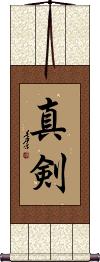
真剣 is a Japanese word that means intense, serious, or earnest. It describes a person who is deep, serious, and a true thinker or dreamer.
Literally, this means “true sword,” as compared to a sharpened wooden practice sword blank. It's real, true, and serious.
Shinken Shobu
Death Match
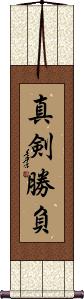
In modern Japanese, 真剣勝負 means to take something very seriously.
The literal and historical meaning is “real sword battle.” In old times, a Samurai apprentice would practice with a wooden practice sword. Once trained and qualified, they would wield a real steel sword made for battle and killing. They were ready for a “death match” or Shinken Shobu.
真剣 is an adjective that has come to mean serious/earnest. The literal translation is “real sword.”
勝負 in the simplest terms, means match, contest, game, or bout. Depending on the context, it could also mean victory or defeat, winning and losing, or the outcome of a battle.
There is a suggestion in Shinken Shobu that you train with serious and real intent, as we should train with the same fervor and dedication as if the battle was real. “Train as we fight.”
See Also: The More We Sweat in Training the Less We Bleed in Battle | Cry in the Dojo - Laugh on the Battlefield
True Emptiness Yields Transcendent Existence
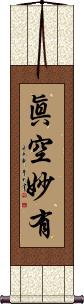
According to Soothill 眞空妙有 means:
The true void is the mysteriously existing, truly void, or immaterial, yet transcendentally existing.
眞空妙有 is the state of being nonexistent after removing all errant worldly influences. 眞空妙有 is achieved when all forms of existence are seen for their real nature.
Shobayashi Shorin-Ryu

小林少林流 is the title Shobayashi Shorin-Ryu in Japanese Kanji.
Shōbayashi Shōrin-Ryū is of real Okinawan karate lineage, but the romanization causes confusion.
小林 = Shōbayashi (can also be read Kobayashi)
少林流 = Shōrin-Ryū (Shaolin style) which means “Small-forest Shaolin School.”
This reflects the lineage that uses 小林 (small forest) instead of 松林 (pine forest) or 少林 (Shaolin) as the branch identifier of the Okinawan martial arts style.
You should use this, 小林流 (Shōbayashi/Kobayashi-Ryū) or “Small-forest style” for the Chibana lineage.
You should use 松林流 (Matsubayashi-Ryū) or “Pine-forest style” for the Nagamine lineage.
Most Sincere Friend / Honest Friend / Real Friend / Best Friend
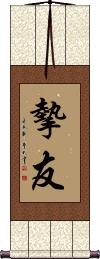
摯友 is one way to say best friend in Chinese.
The first character can mean “honest” or “most sincere.” The second character means “friend” or “friends” (plural forms work differently in Chinese).
See Also: Friendship | Soulmates
Sincere / True Sincerity
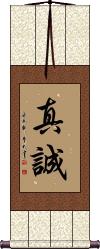
真誠 is the true essence of sincerity.
It takes strength of personality to be truly sincere without overdoing it. Speaking of strength, this is probably the strongest way to convey the idea of sincerity in the Chinese language.
The first character literally means true, real, and genuine. While the second character means sincere and honest.
Sun Wukong / Son Goku
Monkey King
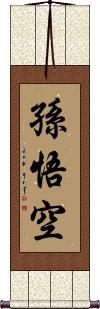
孫悟空 is the name Sun Wukong, also known as the Monkey King. He is the main character with supernatural powers in the ancient Chinese novel Journey to the West.
This title is also known as the real name of the Monkey King in Japanese. This can also be the Son Goku, better known as simply Goku, a fictional character of the Dragon Ball Japanese manga series.
The More We Sweat in Training, The Less We Bleed in Battle
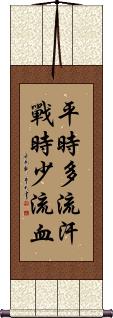
There is more than one way to translate the ancient Chinese military proverb, 平时多流汗战时少流血. Here are a few interpretations:
A drop of sweat spent in a drill is a drop of blood saved in war.
More practice will give one a better chance of success in real situations.
The more you sweat in training, the less you bleed in battle.
I heard this many times when I was a U.S. Marine but I had no idea at the time that it was actually an old Chinese proverb.
See Also: Blood Sweat and Tears
True Love
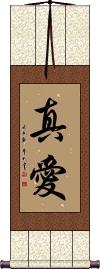
真愛 is literally “True Love” in Chinese.
The first character means “real,” “true,” and “genuine.” The second character means “love” and “affection.”
During the customization of your calligraphy wall scroll, there is a place to add an inscription. You might want that inscription to be your names in Chinese down the side of your wall scroll or perhaps just below these two main characters (just $9 extra). A nice gift to celebrate an anniversary or marriage!
True / Real / Genuine
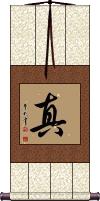
真 is a simple way to express the idea that something is real, true, truth, or genuine.
Occasionally, this character refers to a Buddhist sect that originated in the 13th century.
真 is commonly used as a compound with other characters to create ideas like “true love.” It's also used similarly to the English words “really” or “truly” to say “really good” or “He is really knowledgeable.” Those phrases start with “他真的是... (note the second character is 真).
There are two ways to write this character, shown here is the most common way in China; however, a slight stroke variation is used in Korean Hanja. If you want that version, just let us know when you place your order.
See Also: Honesty
True Essence
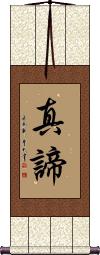
真諦 is a Buddhist term that can be defined as the real meaning, the true essence, or the ultimate truth.
True Love
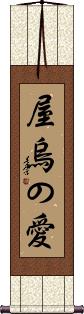
屋烏の愛 is a Japanese way to express true love or deep love.
The phrase literally suggests that this is a love for someone so strong that it can reach a crow perched on that person's roof.
Truth
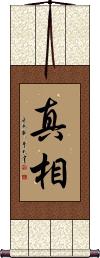
Truth
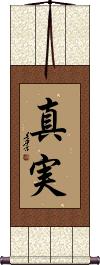
真実 means “truth,” “actual,” or “reality” in Japanese.
The second character is modified or no longer used in Chinese vocabulary - so this is Japanese only.
Wisdom
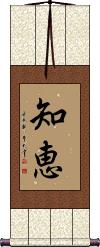
The simple translation of 知惠 is wisdom, but the more expanded version is “to know all things in their entirety.”
The first Kanji represents “to know” or “to realize.” Combined, these two Kanji mean “learn, know, and understand completely.”
Note: While vaguely understood in Chinese, this is only a real word in Japanese.
 Ancient Japanese/Korean version: This is also a word in old Korean Hanja, with a slight difference in the last character - if you want that version (which is also the ancient Japanese version) please click on the character to the right, instead of the button above.
This in-stock artwork might be what you are looking for, and ships right away...
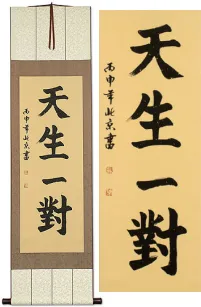
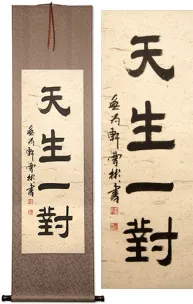
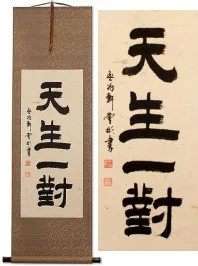
Gallery Price: $200.00
Your Price: $90.88
Gallery Price: $89.00
Your Price: $49.00
Gallery Price: $200.00
Your Price: $88.88

Gallery Price: $89.00
Your Price: $49.00
Gallery Price: $200.00
Your Price: $88.88
Gallery Price: $200.00
Your Price: $88.88
Gallery Price: $108.00
Your Price: $59.88
Gallery Price: $108.00
Your Price: $59.88
Gallery Price: $126.00
Your Price: $69.88
Gallery Price: $232.00
Your Price: $128.88
Gallery Price: $178.00
Your Price: $98.88
The following table may be helpful for those studying Chinese or Japanese...
| Title | Characters | Romaji (Romanized Japanese) | Various forms of Romanized Chinese | |
| Awareness | 覺 觉 | gaku / satoru | jué / jiào jue2 / jiao4 jue / jiao jue/jiao | chüeh chiao chüehchiao |
| Awesome Really Cool | 真牛 | zhēn niú / zhen1 niu2 / zhen niu / zhenniu | chen niu / chenniu | |
| Awesome Awe-Inspiring | 恐れ多い | osore ooi / osoreooi / osore oi | ||
| Battojutsu | 抜刀術 | battou jutsu battoujutsu batto jutsu | ||
| Believe | 相信 | xiāng xìn xiang1 xin4 xiang xin xiangxin | hsiang hsin hsianghsin |
|
| Bloodless Victory | 兵不血刃 | bīng bù xuè rèn bing1 bu4 xue4 ren4 bing bu xue ren bingbuxueren | ping pu hsüeh jen pingpuhsüehjen |
|
| Bruce Lee | 李小龍 李小龙 | bu ruu su ri buruusuri bu ru su ri | lǐ xiǎo lóng li3 xiao3 long2 li xiao long lixiaolong | li hsiao lung lihsiaolung |
| Castillo | 卡斯蒂尤 | kǎ sī dì yóu ka3 si1 di4 you2 ka si di you kasidiyou | k`a ssu ti yu kassutiyu ka ssu ti yu |
|
| Cesar | 塞薩爾 塞萨尔 | sāi sà ěr sai4 sa4 er3 sai sa er saisaer | sai sa erh saisaerh |
|
| Che Guevara | 切格瓦拉 | qiè gé wǎ lā qie4 ge2 wa3 la1 qie ge wa la qiegewala | ch`ieh ko wa la chiehkowala chieh ko wa la |
|
| Confucius | 孔子 | koushi / koshi | kǒng zǐ / kong3 zi3 / kong zi / kongzi | k`ung tzu / kungtzu / kung tzu |
| Construction Crane | 起重機 起重机 | kijuuki / kijuki | qǐ zhòng jī qi3 zhong4 ji1 qi zhong ji qizhongji | ch`i chung chi chichungchi chi chung chi |
| Day | 日 | hi / nichi | rì / ri4 / ri | jih |
| Not Long for this World | 風燭殘年 风烛残年 | fēng zhú cán nián feng1 zhu2 can2 nian2 feng zhu can nian fengzhucannian | feng chu ts`an nien fengchutsannien feng chu tsan nien |
|
| Death Before Surrender | 寧死不屈 宁死不屈 | níng sǐ bù qū ning2 si3 bu4 qu1 ning si bu qu ningsibuqu | ning ssu pu ch`ü ningssupuchü ning ssu pu chü |
|
| Delreal | 德爾雷爾 德尔雷尔 | dé ěr léi ěr de2 er3 lei2 er3 de er lei er deerleier | te erh lei erh teerhleierh |
|
| Delreal | デルリアル | deruriaru | ||
| Earth | 地 | chi / ji / tsushi / tsuchi | dì / di4 / di | ti |
| Fantasy Illusion | 幻想 | gensou / genso | huàn xiǎng huan4 xiang3 huan xiang huanxiang | huan hsiang huanhsiang |
| Keep Your Feet on the Ground | 腳踏實地 脚踏实地 | jiǎo tà shí dì jiao3 ta4 shi2 di4 jiao ta shi di jiaotashidi | chiao t`a shih ti chiaotashihti chiao ta shih ti |
|
| A Bright Future | 鵬程萬里 鹏程万里 | péng chéng wàn lǐ peng2 cheng2 wan4 li3 peng cheng wan li pengchengwanli | p`eng ch`eng wan li pengchengwanli peng cheng wan li |
|
| Geisha | 芸者 | geisha | yún zhě / yun2 zhe3 / yun zhe / yunzhe | yün che / yünche |
| Guan Gong Warrior Saint | 關公 关公 | guān gōng guan1 gong1 guan gong guangong | kuan kung kuankung |
|
| Honesty | 實 实 | shí / shi2 / shi | shih | |
| Honesty Fidelity | 信 | shin | xìn / xin4 / xin | hsin |
| Impermanence | 無常 无常 | mujou / mujo | wú cháng / wu2 chang2 / wu chang / wuchang | wu ch`ang / wuchang / wu chang |
| Inner Strength | 內力 内力 | nai ryoku / nairyoku | nèi lì / nei4 li4 / nei li / neili | |
| Italy Italia | イタリア | itaria | ||
| Jesus | 耶穌 耶稣 | yé sū / ye2 su1 / ye su / yesu | yeh su / yehsu | |
| A Journey of 1000 Miles Begins with a Single Step | 千里の道も一歩から | sen ri no michi mo i-ppo ka ra senrinomichimoi-ppokara sen ri no michi mo i-po ka ra | ||
| Katana | 刀 | katana | dāo / dao1 / dao | tao |
| Kishan | 吉尚 | jí shàng / ji2 shang4 / ji shang / jishang | chi shang / chishang | |
| Kyojitsu: Falsehood and Truth | 虚実 | kyo jitsu / kyojitsu | ||
| Life Is But A Dream | 人生如夢 人生如梦 | rén shēng rú mèng ren2 sheng1 ru2 meng4 ren sheng ru meng renshengrumeng | jen sheng ju meng jenshengjumeng |
|
| Listen to Both Sides and be Enlightened, Listen to One Side and be in the Dark | 兼聽則明偏聽則暗 兼听则明偏听则暗 | jiān tīng zé míng, piān tīng zé àn jian1 ting1 ze2 ming2, pian1 ting1 ze2 an4 jian ting ze ming, pian ting ze an | chien t`ing tse ming, p`ien t`ing tse an chien ting tse ming, pien ting tse an |
|
| Little Dragon | 小龍 小龙 | xiǎo lóng xiao3 long2 xiao long xiaolong | hsiao lung hsiaolung |
|
| Knowledge of Ultimate Truth | 眞智 | masatoshi | zhēn zhì / zhen1 zhi4 / zhen zhi / zhenzhi | chen chih / chenchih |
| Monkey Stealing Peaches | 猴子偷桃 | hóu zi tōu táo hou2 zi5 tou1 tao2 hou zi tou tao houzitoutao | hou tzu t`ou t`ao houtzutoutao hou tzu tou tao |
|
| My True Love | 我心真愛 我心真爱 | wǒ xīn zhēn ài wo3 xin1 zhen1 ai4 wo xin zhen ai woxinzhenai | wo hsin chen ai wohsinchenai |
|
| My True Love | 真実の愛 | shin jitsu no ai shinjitsunoai | ||
| Nothingness | 空無 空无 | kuu mu / kuumu / ku mu | kōng wú / kong1 wu2 / kong wu / kongwu | k`ung wu / kungwu / kung wu |
| One frost doesn't make winter | 一次霜凍不代表整個冬天 一次霜冻不代表整个冬天 | yī cì shuāng dòng bù dài biǎo zhěng gè dōng tiān yi1 ci4 shuang1 dong4 bu4 dai4 biao3 zheng3 ge4 dong1 tian1 yi ci shuang dong bu dai biao zheng ge dong tian | i tz`u shuang tung pu tai piao cheng ko tung t`ien i tzu shuang tung pu tai piao cheng ko tung tien |
|
| Opportunity | 機會 机会 | kikai | jī huì / ji1 hui4 / ji hui / jihui | chi hui / chihui |
| The Original Mind | 本心 | hon shin / honshin | běn xīn / ben3 xin1 / ben xin / benxin | pen hsin / penhsin |
| Reality | 醒悟 / 省悟 醒悟 | xǐng wù / xing3 wu4 / xing wu / xingwu | hsing wu / hsingwu | |
| Reality and Illusion | 真妄 | zhēn wàng zhen1 wang4 zhen wang zhenwang | chen wang chenwang |
|
| Reality Realistic | 現実性 | gen jitsu sei genjitsusei | ||
| The Red String | 赤い糸 | akai ito / akaiito | ||
| Strength and Love in Unity | 力愛不二 力爱不二 | riki ai fu ni rikiaifuni | ||
| Intense Serious | 真剣 | shin ken / shinken | ||
| Shinken Shobu | 真剣勝負 | shinken shoubu shinkenshoubu shinken shobu | ||
| True Emptiness Yields Transcendent Existence | 眞空妙有 | shin kuu myou u shinkuumyouu shin ku myo u | zhēn kōng miào yǒu zhen1 kong1 miao4 you3 zhen kong miao you zhenkongmiaoyou | chen k`ung miao yu chenkungmiaoyu chen kung miao yu |
| Shobayashi Shorin-Ryu | 小林少林流 | shou baya shi shou rin ryuu shoubayashishourinryuu sho baya shi sho rin ryu | ||
| Most Sincere Friend Honest Friend Real Friend Best Friend | 摯友 挚友 | zhì yǒu / zhi4 you3 / zhi you / zhiyou | chih yu / chihyu | |
| Sincere True Sincerity | 真誠 真诚 | zhēn chéng zhen1 cheng2 zhen cheng zhencheng | chen ch`eng chencheng chen cheng |
|
| Sun Wukong Son Goku | 孫悟空 孙悟空 | son go kuu / songokuu / son go ku | sūn wù kōng sun1 wu4 kong1 sun wu kong sunwukong | sun wu k`ung sunwukung sun wu kung |
| The More We Sweat in Training, The Less We Bleed in Battle | 平時多流汗戰時少流血 平时多流汗战时少流血 | píng shí duō liú hàn zhàn shí shǎo liú xuè ping2 shi2 duo1 liu2 han4 zhan4 shi2 shao3 liu2 xue4 ping shi duo liu han zhan shi shao liu xue | p`ing shih to liu shih shao liu hsüeh ping shih to liu shih shao liu hsüeh |
|
| True Love | 真愛 真爱 | shinai | zhēn ài / zhen1 ai4 / zhen ai / zhenai | chen ai / chenai |
| True Real Genuine | 真 or 眞 真 | shin / makoto | zhēn / zhen1 / zhen | chen |
| True Essence | 真諦 真谛 | shintai / shintei | zhēn dì / zhen1 di4 / zhen di / zhendi | chen ti / chenti |
| True Love | 屋烏の愛 | okuunoai / okunoai | ||
| Truth | 真相 | shin sou / shinsou / shin so | zhēn xiàng zhen1 xiang4 zhen xiang zhenxiang | chen hsiang chenhsiang |
| Truth | 真實 真実 | shinjitsu / sana | ||
| Wisdom | 知惠 知恵 | chie | zhī huì / zhi1 hui4 / zhi hui / zhihui | chih hui / chihhui |
| In some entries above you will see that characters have different versions above and below a line. In these cases, the characters above the line are Traditional Chinese, while the ones below are Simplified Chinese. | ||||

Successful Chinese Character and Japanese Kanji calligraphy searches within the last few hours...



