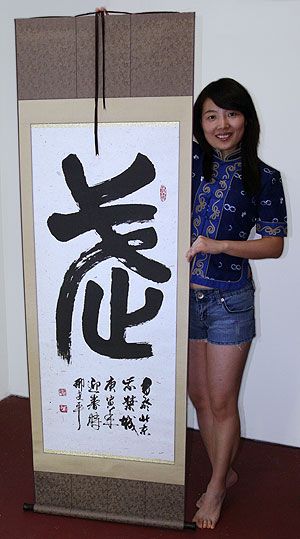
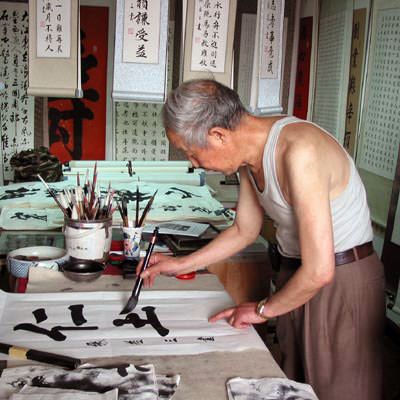
Many custom options


And formats


Not what you want?
Try other similar-meaning words, fewer words, or just one word.
Loyalty Trustworthiness Trustworthy in Chinese / Japanese
Buy a Loyalty Trustworthiness Trustworthy calligraphy wall scroll here!
Personalize your custom “Loyalty Trustworthiness Trustworthy” project by clicking the button next to your favorite “Loyalty Trustworthiness Trustworthy” title below.
Switched to secondary search mode due to lack of results using primary.
These secondary results may not be very accurate. Try a different but similar meaning word or phrase for better results. Or:
Look up Loyalty Trustworthiness Trustworthy in my Japanese Kanji & Chinese Character Dictionary(My dictionary is a different system then the calligraphy search you just tried)
If you want a special phrase, word, title, name, or proverb, feel free to contact me, and I will translate your custom calligraphy idea for you.
1. Bushido / The Way of the Samurai
3. Dependable
4. Faithfulness
5. Giri
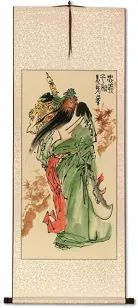
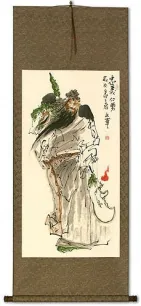
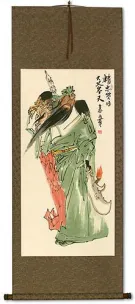
6. Guan Yu
7. Faithful / Honorable / Trustworthy / Fidelity / Loyalty
8. Honesty
9. Integrity: Sincere Honest and Faithful
10. Justice / Rectitude / Right Decision
11. Hoes Before Bros
14. Loyalty
16. Loyalty / Faithful / Devoted
Bushido / The Way of the Samurai
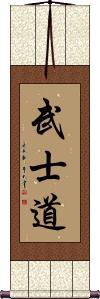
武士道 is the title for “The Code of the Samurai.”
Sometimes called “The Seven Virtues of the Samurai,” “The Bushido Code,” or “The Samurai Code of Chivalry.”
This would be read in Chinese characters, Japanese Kanji, and old Korean Hanja as “The Way of the Warrior,” “The Warrior's Way,” or “The Warrior's Code.”
It's a set of virtues that the Samurai of Japan and ancient warriors of China and Korea had to live and die by. However, while known throughout Asia, this title is mostly used in Japan and thought of as being of Japanese origin.
The seven commonly-accepted tenets or virtues of Bushido are Rectitude 義, Courage 勇, Benevolence 仁, Respect 礼(禮), Honour 名誉, Honesty 誠, and Loyalty 忠実. These tenets were part of oral history for generations, thus, you will see variations in the list of Bushido tenets depending on who you talk to.
See our page with just Code of the Samurai / Bushido here
The Principles of Buddhism
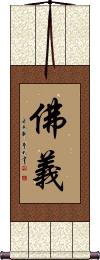
In short, 佛義 is the Principles of Buddhism, but there is more (especially for the second character):
佛 is the character for the Buddha and Buddhism.
義 has deeper meanings including justice, righteousness, morality, honour/honor, teachings, doctrine, right, proper, righteous, loyalty, purpose, or meaning. So the single word “principles” is often used to encompass all these ideas.
Dependable
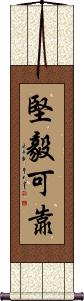
The first two characters mean resolute with firm determination.
The second two characters mean reliable.
Together, this creates a 4-character expression that means dependable.
Faithfulness
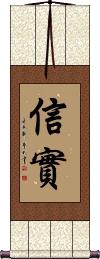
信實 means trustworthy, reliable, to believe something, to be true, and/or to be faithful.
Giri
(obligation or duty in Japanese)
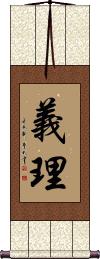
This term means an obligation or a sense of duty that one may have to their employer, country or culture.
義理 is a specifically Japanese term, as in Chinese, these two characters form a word that means “religious doctrine” or refers to the argument presented in an essay.
This term has a similar meaning in Korean, where it can mean justice, sense of duty, loyalty, integrity, or obligation.
義理 is kind of a weird selection for a wall scroll. So this entry is intended more for educational purposes.
Guan Yu
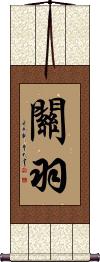
關羽 is the name Guan Yu, Army General for the Kingdom of Shu.
He is also known as Guan Gong (like saying Duke Guan or Sir Guan)
He was immortalized in the novel, “Romance of the Three Kingdoms.”
He was a fearsome fighter, also famous for his virtue and loyalty. He is worshiped by some modern-day soldiers and has the title “Warrior Saint” in China. Some believe he offers safety and protection for military servicemen.
Guan Yu lived until 219 A.D.
Faithful / Honorable / Trustworthy / Fidelity / Loyalty
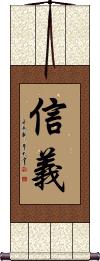
信義 is a word often used to describe a person with an honest and loyal reputation.
Simply put, this applies to somebody you can trust (with your life).
In Chinese, this is often defined as good faith, honor, trust, and justice.
In Korean, This means fidelity, truthfulness, or faithfulness.
In Japanese: faith, fidelity, and loyalty. It's also a Japanese male given name when pronounced “Nobuyoshi.”
Honesty
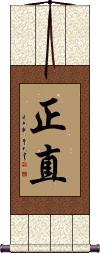
正直 or honesty is being truthful and sincere. It is important because it builds trust. When people are honest, they can be relied on not to lie, cheat or steal. Being honest means that you accept yourself as you are. When you are open and trustworthy, others can believe in you.
正直 is one of the 8 key concepts of Tang Soo Do.
Note: This entry is cross-listed as “integrity” because it also fits that definition.
 Please note that the second Kanji sometimes has an alternate form in Japanese. Let us know if you want the alternate form shown to the right.
See Also: Truth | Trust Your Heart | Integrity
Integrity: Sincere Honest and Faithful
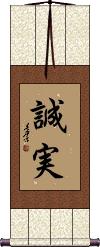
誠実 is the Japanese version of integrity which can also be defined as a combination of “sincere, honest, and faithful.”
Some may also define this as “loyal” or “loyalty.” In some contexts, it can mean “genuine.” Yes, all of this meaning in just one Japanese word!
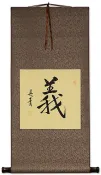
Justice / Rectitude / Right Decision
Also means: honor loyalty morality righteousness
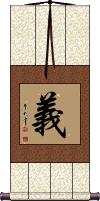
義 is about doing the right thing or making the right decision, not because it's easy but because it's ethically and morally correct.
No matter the outcome or result, one does not lose face if tempering proper justice.
義 can also be defined as righteousness, justice, morality, honor, or “right conduct.” In a more expanded definition, it can mean loyalty to friends, loyalty to the public good, or patriotism. This idea of loyalty and friendship comes from the fact that you will treat those you are loyal to with morality and justice.
義 is also one of the five tenets of Confucius's doctrine.
 There's also an alternate version of this character sometimes seen in Bushido or Korean Taekwondo tenets. It's just the addition of a radical on the left side of the character. If you want this version, click on the image to the right instead of the button above.
This is also a virtue of the Samurai Warrior
See our page with just Code of the Samurai / Bushido here
See Also: Judge | Unselfish: Perfectly Impartial | Ten
Hoes Before Bros
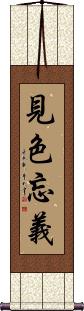
見色忘義 is a modern Chinese idiom that means to put love before loyalty or to forget loyalty when in love.
This would be roughly equivalent to the English, “Hoes before bros.”
Love Loyalty Respect
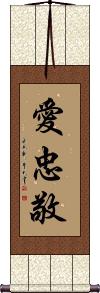
愛忠敬 is a Chinese word list that means love, loyalty, and respect.
愛忠敬 is the shortest way to express these words/ideas. Word lists are not as natural in Chinese as they are in English - phrases or proverbs are more common.
Love Loyalty Respect
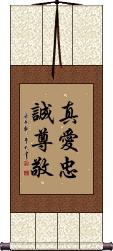
真愛忠誠尊敬 is a Chinese word list that means love, loyalty, and respect.
Loyalty to Duty or Master
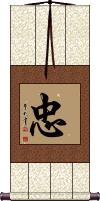
忠 is the simplest way to write the word loyalty in Chinese and Japanese.
A single character like this leaves the meaning open. But alone, a Chinese or Japanese person would think of loyalty to duty or loyalty to one's master (in ancient times). I suppose that it could be loyalty to your boss or company in this day in age.
忠 can also mean fidelity or faithfulness.
This can also be romanized as “chung.”
Loyalty
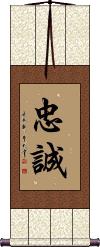
忠誠 is the written form of loyalty that is universal in Chinese, Japanese Kanji, and old Korean Hanja.
Loyalty is staying true to someone. It is standing up for something you believe in without wavering. It is being faithful to your family, country, school, friends, or ideals when the going gets tough and when things are good. With loyalty, you build relationships that last forever.
Notes:
1. There is also a Japanese version that is part of the Bushido Code which may be more desirable depending on whether your intended audience is Japanese or Chinese.
2. This version of loyalty is sometimes translated as devotion, sincerity, fidelity, or allegiance.
See Also: Honor | Trust Your Heart | Integrity | Sincerity and Faithfulness
Loyalty / Devotion
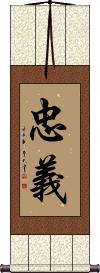
忠義 is another form of loyalty or devotion.
In Chinese, this is more specifically about being loyal and devoted to your friends.
In Japanese, this is more often used to mean loyalty to your country or nation.
Except for the slight difference noted above between Japanese and Chinese, this word is understood universally in Chinese, Japanese Kanji, and old Korean Hanja. It can also be used to describe devotion or fidelity.
It should be noted that this Kanji combination is being used less and less in modern Japan (this is a better choice if your audience is Chinese, though any Japanese person will clearly understand it).
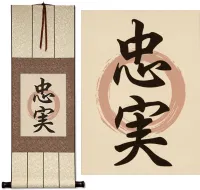
Loyalty / Faithful / Devoted
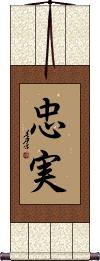
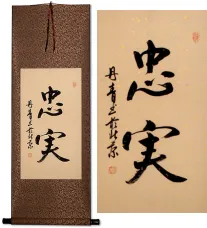
忠実 is a Japanese way to write “Loyalty” - it also contains the ideas of being faithful, devoted, true, and obedient.
The second character is a modified form only used in the Japanese lexicon; however, Chinese speakers can easily guess the meaning.
This is also a virtue of the Samurai Warrior
See our page with just Code of the Samurai / Bushido here
Loyalty and Respect

忠誠尊敬 can be translated as “Loyalty and Respect.”
忠誠 = Loyalty or devotion.
尊敬 = Respect or esteem.
Pillars of Marriage
Respect / Loyalty / Honesty
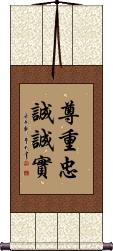
尊重忠誠誠實 is a “word list” consisting of “Respect/Loyalty/Honesty.”
Word lists are not as common in Chinese as they are in English but leaving that concern behind, this has a good meaning.
If you want to customize it more, add an inscription with your wedding date or names (just a small extra fee for translation).
Note: Because these are three separate words, the calligrapher may be inclined to leave a small space between each two-character word. Let us know if you have any preference when you place your order.
Respect and Loyalty
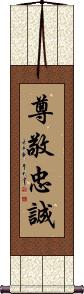
尊敬忠誠 means respect and loyalty in Chinese.
This is a word list (not a normal Chinese or Japanese phrase).
Word lists like this are not very common or natural in Chinese, so try to look for a better phrase to match your idea before you settle on this.
Semper Fidelis / Always Faithful
U.S. Marines Slogan
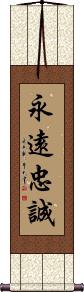
永遠忠誠 is the clearest and most natural way to translate “Semper Fidelis” or “Always Faithful” into Mandarin Chinese. 永遠忠誠 is meant explicitly for U.S. Marines who often use the shortened term “Semper Fi.”
The first two characters are a word that always means, forever, and/or eternally.
The last two characters are a word that means fidelity, loyal, and/or devotion.
I spent 10 years in the Marines, so it was a no-brainer to add this to our calligraphy database.
Semper Fidelis / Always Faithful
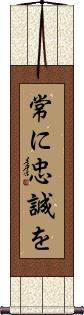
常に忠誠を is “Semper Fidelis” or “Always Faithful” in Japanese. This is specifically meant for U.S. Marines who often use the shortened term “Semper Fi.”
The first two Kanji mean “always” or “constantly.” The last three Kanji mean “faithful,” “loyal,” “devoted,” and/or “diligent.” It's most often read as “faithful.”
Note: Because this selection contains some special Japanese Hiragana characters, it should be written by a Japanese calligrapher.
Semper Fidelis / Always Faithful
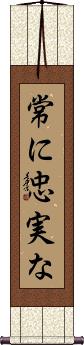
常に忠実な is an alternate way to write “Semper Fidelis” or “Always Faithful” in Japanese.
Note: Because this selection contains some special Japanese Hiragana characters, it should be written by a Japanese calligrapher.
Wise and Virtuous
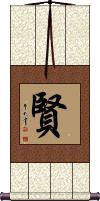
賢 is used to refer to being a wise, trustworthy, and virtuous person. But it also contains the ideas of intelligence, genius, scholarship, virtue, sage, saint, good, and excellent in character.
賢 is used in Chinese, Japanese Kanji, and old Korean Hanja. Also used in a Buddhist context with the same meaning.
Note: Can also be the male given name, Masaru, in Japanese.
Ultimate Loyalty to Your Country
The most famous tattoo in Chinese history
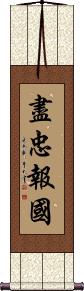
盡忠報國 is a proverb that is the tattoo worn on the back of Yue Fei, a famous Chinese warrior who lived until 1142 A.D.
The tattoo can mean “Serve the country with the utmost loyalty.” More literally, it means “[The] Ultimate Loyalty [is too] Duty [of] Country.”
Legend has it that this tattoo once saved his life when he was accused of treason.
The first two characters have come to create a word that means “serve the country faithfully” or “die for the country.” Note: It's more a willingness to die for one's country than the actual act of dying.
The last two characters have come to mean “Dedicate oneself to the service of one's country.”
Both of these words are probably only in the Chinese lexicon because of this famous tattoo.
If you break it down, character-by-character, here is what you get:
1. To the utmost, to the limit of something, the ultimate.
2. Loyalty or duty (a sense of duty to one's master, lord, country, or job).
3. Report, recompense, give back to (in this case, you are giving yourself to your country as payback).
4. Country, state, nation, kingdom.
This in-stock artwork might be what you are looking for, and ships right away...

The following table may be helpful for those studying Chinese or Japanese:
| Title | Characters | Romaji (Romanized Japanese) | Various forms of Romanized Chinese | |
| Bushido The Way of the Samurai | 武士道 | bu shi do / bushido | wǔ shì dào wu3 shi4 dao4 wu shi dao wushidao | wu shih tao wushihtao |
| The Principles of Buddhism | 佛義 佛义 | butsu gi / butsugi | fó yì / fo2 yi4 / fo yi / foyi | fo i / foi |
| Dependable | 堅毅可靠 坚毅可靠 | jiān yì kě kào jian1 yi4 ke3 kao4 jian yi ke kao jianyikekao | chien i k`o k`ao chienikokao chien i ko kao |
|
| Faithfulness | 信實 信实 | nobuzane | xìn shí / xin4 shi2 / xin shi / xinshi | hsin shih / hsinshih |
| Giri | 義理 义理 | giri | yì lǐ / yi4 li3 / yi li / yili | i li / ili |
| Guan Yu | 關羽 关羽 | guān yǔ / guan1 yu3 / guan yu / guanyu | kuan yü / kuanyü | |
| Faithful Honorable Trustworthy Fidelity Loyalty | 信義 信义 | shingi | xìn yì / xin4 yi4 / xin yi / xinyi | hsin i / hsini |
| Honesty | 正直 | shoujiki / shojiki | zhèng zhí zheng4 zhi2 zheng zhi zhengzhi | cheng chih chengchih |
| Integrity: Sincere Honest and Faithful | 誠實 誠実 | sei jitsu / seijitsu | ||
| Justice Rectitude Right Decision | 義 义 | gi | yì / yi4 / yi | i |
| Hoes Before Bros | 見色忘義 见色忘义 | jiàn sè wàng yì jian4 se4 wang4 yi4 jian se wang yi jiansewangyi | chien se wang i chiensewangi |
|
| Love Loyalty Respect | 愛忠敬 | ài zhōng jìng ai4 zhong1 jing4 ai zhong jing aizhongjing | ai chung ching aichungching |
|
| Love Loyalty Respect | 真愛忠誠尊敬 | zhēn ài zhōng chéng zū jìng zhen1 ai4 zhong1 cheng2 zu1 jing4 zhen ai zhong cheng zu jing zhenaizhongchengzujing | chen ai chung ch`eng tsu ching chenaichungchengtsuching chen ai chung cheng tsu ching |
|
| Loyalty to Duty or Master | 忠 | chuu / chu | zhōng / zhong1 / zhong | chung |
| Loyalty | 忠誠 忠诚 | chuu sei / chuusei / chu sei | zhōng chéng zhong1 cheng2 zhong cheng zhongcheng | chung ch`eng chungcheng chung cheng |
| Loyalty Devotion | 忠義 忠义 | chuu gi / chuugi / chu gi | zhōng yì / zhong1 yi4 / zhong yi / zhongyi | chung i / chungi |
| Loyalty Faithful Devoted | 忠實 忠実 | chuujitsu / chuugi chujitsu / chugi | ||
| Loyalty and Respect | 忠誠尊敬 | chū sei-son kei chūsei-sonkei | zhōng chéng zūn jìng zhong1 cheng2 zun1 jing4 zhong cheng zun jing zhongchengzunjing | chung ch`eng tsun ching chungchengtsunching chung cheng tsun ching |
| Pillars of Marriage | 尊重忠誠誠實 尊重忠诚诚实 | zūn zhòng zhōng chéng chéng shí zun1 zhong4 zhong1 cheng2 cheng2 shi2 zun zhong zhong cheng cheng shi | tsun chung chung ch`eng ch`eng shih tsun chung chung cheng cheng shih |
|
| Respect and Loyalty | 尊敬忠誠 尊敬忠诚 | son kei chu sei sonkeichusei | zūn jìng zhōng chéng zun1 jing4 zhong1 cheng2 zun jing zhong cheng zunjingzhongcheng | tsun ching chung ch`eng tsunchingchungcheng tsun ching chung cheng |
| Semper Fidelis Always Faithful | 永遠忠誠 永远忠诚 | yǒng yuǎn zhōng chéng yong3 yuan3 zhong1 cheng2 yong yuan zhong cheng yongyuanzhongcheng | yung yüan chung ch`eng yungyüanchungcheng yung yüan chung cheng |
|
| Semper Fidelis Always Faithful | 常に忠誠を | tsune ni chuu sei wo tsunenichuuseiwo tsune ni chu sei wo | ||
| Semper Fidelis Always Faithful | 常に忠実な | tsune ni chuu jitsu na tsunenichuujitsuna tsune ni chu jitsu na | ||
| Wise and Virtuous | 賢 贤 | ken | xián / xian2 / xian | hsien |
| Ultimate Loyalty to Your Country | 盡忠報國 尽忠报国 | jìn zhōng bào guó jin4 zhong1 bao4 guo2 jin zhong bao guo jinzhongbaoguo | chin chung pao kuo chinchungpaokuo |
|
| In some entries above you will see that characters have different versions above and below a line. In these cases, the characters above the line are Traditional Chinese, while the ones below are Simplified Chinese. | ||||

Successful Chinese Character and Japanese Kanji calligraphy searches within the last few hours...