Many custom options...


And formats...



Not what you want?
Try other similar-meaning words, fewer words, or just one word.
Action Despite Fear in Chinese / Japanese...
Buy an Action Despite Fear calligraphy wall scroll here!
Personalize your custom “Action Despite Fear” project by clicking the button next to your favorite “Action Despite Fear” title below...
Switched to secondary search mode due to lack of results using primary.
These secondary results may not be very accurate. Try a different but similar meaning word or phrase for better results. Or...
Look up Action Despite Fear in my Japanese Kanji & Chinese Character Dictionary(My dictionary is a different system then the calligraphy search you just tried)
If you want a special phrase, word, title, name, or proverb, feel free to contact me, and I will translate your custom calligraphy idea for you.
1. 3. Right Speech / Right Talk / Perfect Speech
2. 4. Right Action / Perfect Conduct
3. 5. Right Living / Right Livelihood / Perfect Livelihood
4. 1000 good moves ruined by 1 bad
5. Better to Choose Nothing, Rather than Make a Poor Choice
6. Blue Lotus
10. Do not shed a tear until you see the coffin
11. Confidence / Faithful Heart
12. The Confident Helmsman Inspires Confidence in the Passengers
13. Collaboration / Cooperation / Synergy
14. Courage to do what is right
15. Dana: Almsgiving and Generosity
16. Danger
17. Daodejing / Tao Te Ching - Chapter 27
18. Do not fear the task: Cooperation will lead to success
19. Enjoy Life
20. The Mysterious Bond Between People
21. Fear No Evil
22. Fear No Man / Fear Nothing
23. Fear God
25. The one who retreats 50 paces mocks the one to retreats 100
26. Filial Piety / Filial Conduct
27. Courage To Do What Is Right
28. A Deliberate Inaction is Better than a Blind Action
29. Inspired
30. Joshua 1:9
31. Know Your Enemy, Know Yourself, and Win 100 Battles
32. Life in Balance / Balancing Life
33. Life Goes On
34. Never Give Up
35. Fear not long roads; Fear only short ambition
36. Do not fear poverty; Fear low ambitions
37. Do not fear being slow, fear standing still
38. No Fear
39. No Mind / Mushin
40. All Tenets of the Noble Eightfold Path
41. Old, But More Vigorous in Spirit
42. One Heart / One Mind / Heart and Soul
44. Do not take action until the time is right
45. Undaunted After Repeated Setbacks
46. Preparation Yields No Fear or Worries
47. Preparation Yields No Regrets
50. One who is drenched in rain does not fear drops of dew
51. Respect out of fear is never genuine; Reverence out of respect is never false
53. A sly rabbit has three openings to its den
54. Soldiers Adapt Actions to the Situation
58. Overcome: Regardless of the Rain and Wind
59. Regardless of the Weather, We Overcome Troubles Together
3. Right Speech / Right Talk / Perfect Speech
Samyag Vaca / Samma Vaca / Samma Vacha
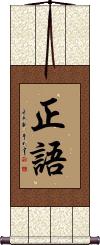
正語 is one of the Noble Eightfold Paths of Buddhism. Right Speech, along with Right Action and Right Living, constitute the path to Virtue.
Right Speech is abstaining from lying, abstaining from divisive speech, abstaining from abusive speech, abstaining from idle chatter, abstaining from slander, abstaining from gossip, or any form of harmful or wrong speech.
This term is exclusively used by devout Buddhists. It is not a common term, and is remains an unknown concept to most Japanese and Chinese people.
See Also: Buddhism | Enlightenment | Noble Eightfold Path
4. Right Action / Perfect Conduct
Samyak Karmanta / Samma Kammanta
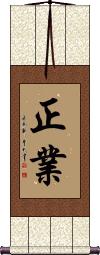
正業 is one of the Noble Eightfold Paths of Buddhism. Right Action, along with Right Speech and Right Living, constitute the path to Virtue.
The five precepts of Right Action are...
1. Refrain from destroying living beings (no murder or any form of taking a life).
2. Refrain from stealing.
3. Refrain from sexual misconduct (adultery, rape, etc.).
4. Refrain from false speech (lying or trickery).
5. Refrain from intoxicants that lead to heedlessness (no drugs or alcohol).
This concept can be summarized as “Avoidance of actions that conflict with moral discipline.”
Note: In Japanese, when read by a non-Buddhist, this will mean “the right job/vocation.”
This term is exclusively used by devout Buddhists. It is not a common term, and is remains an unknown concept to most Japanese and Chinese people.
See Also: Buddhism | Enlightenment | Noble Eightfold Path
5. Right Living / Right Livelihood / Perfect Livelihood
Samyag Ajiva / Samma Ajiva
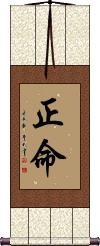
正命 (right living) is one of the Noble Eightfold Paths of Buddhism.
Right Living, along with Right Speech and Right Action, constitute the path to Virtue.
Right Living means that a Buddhist should only take a job or pursue a career in a field that does no harm. Buddhists should not work in the arms trade, as pimps or in the field of prostitution, as a butcher or in a shop that kills or sells meat, in a laboratory that does animal research, or in any other business that involves scheming or unethical behavior.
Another definition: Avoidance of professions that are harmful to sentient beings, such as slaughterer, hunter, dealer in weaponry or narcotics, etc.
This term is exclusively used by devout Buddhists. It is not a common term, and is remains an unknown concept to most Japanese and Chinese people.
See Also: Buddhism | Enlightenment | Noble Eightfold Path
1000 good moves ruined by 1 bad
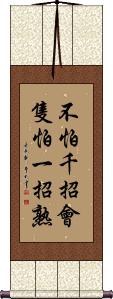
不怕千招会只怕一招熟 is a Chinese proverb that literally translates as: Do not worry about making a thousand clever moves; what [one has to] fear is one bad move.
Figuratively, this means: Even if you have made many clever moves before, one wrong move will ruin the whole game.
I compare this to the English saying, “It takes only one Aw-shit to wipe out a thousand Attaboys.”
Better to Choose Nothing, Rather than Make a Poor Choice
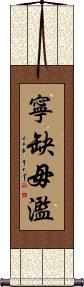
寧缺毋濫 is a Chinese proverb that can be translated as “Better to have nothing (than substandard choice).”
It basically suggests that one should prefer to go without something rather than accept a shoddy option.
See Also: A Deliberate Inaction is Better Than a Blind Action
Blue Lotus
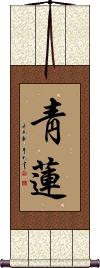
靑蓮 is a common title for Blue Lotus.
靑蓮 is often used in a Buddhist context for blue lotus from the Sanskrit “utpala.” This often refers to the clarity and purity of the lotus blue eyes possessed by a Living Buddha. It can also represent the purity of mind (without desire, suffering, fear, etc.).
Body and Mind
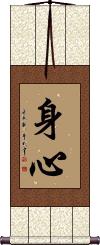
身心 means “body and mind” or “mental and physical” in Chinese and Japanese.
In the Buddhist context, body and mind encompass the five elements (skandha) of a sentient being.
The body is the physical material (rūpa) of life. The mind embraces the other four skandhas, which are consciousness, perception, action, and knowledge.
The Brave Have No Fears
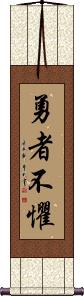
This proverb means “Brave people [are] without fear,” or “The brave are without fear.”
勇者不懼 is a proverb credited to Confucius. It's one of three phrases in a set of things he said.
This phrase is originally Chinese but has penetrated Japanese culture as well (many Confucian phrases have) back when Japan borrowed Chinese characters into their language.
This phrase has also been converted into modern Japanese grammar when written as 勇者は懼れず. If you want this version just click on those characters.
See Also: No Fear
Bravery / Courage
Courage in the face of Fear
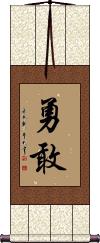
勇敢 is about courage or bravery in the face of fear.
You do the right thing even when it is hard or scary. When you are courageous, you don't give up. You try new things. You admit mistakes. This kind of courage is the willingness to take action in the face of danger and peril.
勇敢 can also be translated as braveness, valor, heroic, fearless, boldness, prowess, gallantry, audacity, daring, dauntless, and/or courage in Japanese, Chinese, and Korean. This version of bravery/courage can be an adjective or a noun. The first character means bravery and courage by itself. The second character means “daring” by itself. The second character emphasizes the meaning of the first but adds the idea that you are not afraid of taking a dare, and you are not afraid of danger.
勇敢 is more about brave behavior and not so much the mental state of being brave. You'd more likely use this to say, “He fought courageously in the battle,” rather than “He is very courageous.”
Do not shed a tear until you see the coffin
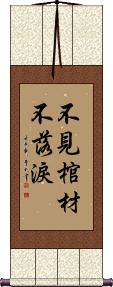
不見棺材不落淚 is a cautionary tale that suggests you are unknowingly (though it should be obvious)on a bad course.
It further suggests that you will not realize your folly until the worst has happened.
This can also be a warning of inaction until it's too late to take action. Again, not realizing your error until it's too late.
In an alternate interpretation, some will suggest this means doing something bad and not looking back - Then the worst happens.
It should be noted that this is one of the oddest selections for a wall scroll in our whole Asian calligraphy database. All of our translators are convinced that no Chinese person would ever hang this on their wall.
Confidence / Faithful Heart
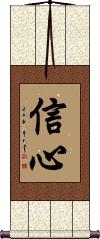
信心 is a Chinese, Japanese, and Korean word that means confidence, faith, or belief in somebody or something.
The first character means faith, and the second can mean heart or soul. Therefore, you could say this means “faithful heart” or “faithful soul.”
In Korean especially, this word has a religious connotation.
In the old Japanese Buddhist context, this was a word for citta-prasāda (clear or pure heart-mind).
In modern Japan (when read by non-Buddhists), this word is usually understood as “faith,” “belief,” or “devotion.”
See Also: Self-Confidence
The Confident Helmsman Inspires Confidence in the Passengers
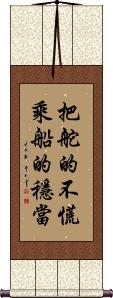
把舵的不慌乘船的稳当 is a Chinese proverb that literally translates as: [If the] helmsman is not nervous, the passengers [will feel] secure.
Figuratively, this means: If the leader appears confident, his/her followers will gain confidence also.
This is a great suggestion that a confident leader inspires confidence in his/her troops or followers. Of course, a nervous leader will create fear in troops or followers.
Collaboration / Cooperation / Synergy
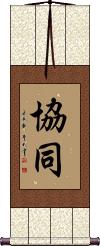
協同 is a Japanese, Chinese, and Korean word that means to cooperate, in coordination with, coordinated, collaborate, collaboration, collaborative, doing together (as equals).
Some will also use this as a short way to express the western idea of synergy (collaboration for a better result). There's a longer word, 協同作用, that adds “action” to this word and more directly means synergy.
Courage to do what is right
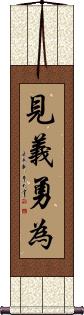
見義勇為 means the courage to do what is right in Chinese.
This could also be translated as “Never hesitate to do what is right.”
This comes from Confucian thought:
Your courage should head in an honorable direction. For example, you should take action when the goal is to attain a just result as, without honorable intent, a person’s gutsy fervor can easily lead them astray.
One who flaunts courage but disregards justice is bound to do wrong; someone who possesses courage and morality is destined to become a hero.
Some text above paraphrased from The World of Chinese - The Character of 勇
See Also: Work Unselfishly for the Common Good | Justice | Bravery
Dana: Almsgiving and Generosity
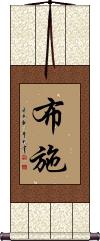
布施 is the Buddhist practice of giving known as Dāna or दान from Pali and Sanskrit.
Depending on the context, this can be alms-giving, acts of charity, or offerings (usually money) to a priest for reading sutras or teachings.
Some will put Dāna in these two categories:
1. The pure or unsullied charity, which looks for no reward here but only in the hereafter.
2. The sullied almsgiving whose object is personal benefit.
The first kind is, of course, the kind that a liberated or enlightened person will pursue.
Others will put Dāna in these categories:
1. Worldly or material gifts.
2. Unworldly or spiritual gifts.
You can also separate Dāna into these three kinds:
1. 財布施 Goods such as money, food, or material items.
2. 法布施 Dharma, as an act to teach or bestow the Buddhist doctrine onto others.
3. 無畏布施 Courage, as an act of facing fear to save someone or when standing up for someone or standing up for righteousness.
The philosophies and categorization of Dāna will vary among various monks, temples, and sects of Buddhism.
Breaking down the characters separately:
布 (sometimes written 佈) means to spread out or announce, but also means cloth. In ancient times, cloth or robs were given to the Buddhist monks annually as a gift of alms - I need to do more research, but I believe there is a relationship here.
施 means to grant, to give, to bestow, to act, to carry out, and by itself can mean Dāna as a single character.
Dāna can also be expressed as 檀那 (pronounced “tán nà” in Mandarin and dan-na or だんな in Japanese). 檀那 is a transliteration of Dāna. However, it has colloquially come to mean some unsavory or unrelated things in Japanese. So, I think 布施 is better for calligraphy on your wall to remind you to practice Dāna daily (or whenever possible).
Danger
A dangerous character in every way
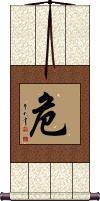
危 means danger, peril, or “to endanger” in Chinese, Japanese, and old Korean.
If you live a dangerous life or want to subtly warn others that you are a dangerous person, this may be the selection for you.
This also means “danger” and sometimes “fear” in Japanese and Korean but is seldom seen outside of compound words in those languages (as a single character, it's kind of like an abbreviation for danger in Japanese and Korean). 危 is also a rather odd selection for a wall scroll anyway. It's only here because people search for danger on our website.
Daodejing / Tao Te Ching - Chapter 27
The Mastery of Effortless Skill

Chapter 27 of the Daodejing reveals a profound truth about mastery: the highest skill leaves no trace, requires no force, and appears almost invisible.
善行無轍跡,
善言無瑕謫,
善數不用籌策,
善閉無關鍵而不可開,
善結無繩約而不可解。
是以聖人常善救人,
故無棄人;
常善救物,
故無棄物。
是謂襲明。
故善人者,不善人之師;
不善人者,善人之資。
不貴其師,不愛其資,
雖智大迷,
是謂要妙。
The sage moves through life with such natural harmony that nothing seems imposed; doors need no locks, knots require no rope, and actions leave no mark behind.
This is the essence of wúwéi (effortless action), where true ability arises from deep alignment with the Tao rather than deliberate effort.
At its heart, this chapter teaches compassion without exception. The sage “abandons no one and nothing,” recognizing value in all people and all things. Even those who seem flawed or unrefined are not rejected, but understood as part of a greater whole with each person both a student and a teacher in the unfolding of life.
Laozi reminds us that wisdom is not about perfection or control, but about subtle awareness. The truly skilled individual does not rely on tools, rules, or rigid structures; instead, they embody an intuitive understanding that makes their actions naturally complete.
In this way, excellence becomes quiet, effortless, and beyond imitation.
This teaching also reflects a deeper philosophical insight: Opposites are interdependent. The “good” person learns from the “not good,” and the “not good” provides the material for growth. To reject either is to misunderstand the balance of existence itself.
As calligraphy, Daodejing Chapter 27 serves as a reminder to cultivate inner mastery rather than outward display. It is a meditation on refinement, humility, and the quiet power of skill perfected through harmony with the natural order.
Note: The Chinese text used here is based on the early Mawangdui silk manuscript tradition (2nd century BCE). The Guodian manuscripts do NOT preserve Chapter 27 in full form.
Do not fear the task: Cooperation will lead to success
Do not fear strong winds waves; just be sure to row in unison
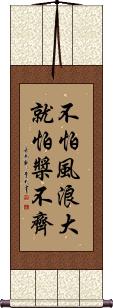
不怕风浪大就怕桨不齐 is a Chinese proverb that literally translates as: Do not fear strong winds [and] high waves; what [one should] worry about whether or not you're rowing in unison.
Figuratively, this means: However difficult the task, the key to success lies in making collective efforts.
I like to translate this as “Don't sweat the details, just get together and get it done.”
Enjoy Life
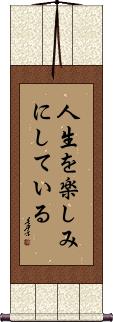
人生を楽しみにしている is one way to write “enjoy life” in Japanese.
The character breakdown:
人生 (jinsei) life (i.e. conception to death) human lifetime, living.
を (o) connecting particle.
楽しみ (tanoshimi) enjoyment; pleasure; anticipation; looking forward to.
に (ni) connecting particle.
し (shi) to do; to cause; to become; to make (into).
て (te) connecting particle.
いる (iru) indicates continuing action or resulting state.
Note: Because this selection contains some special Japanese Hiragana characters, it should be written by a Japanese calligrapher.
The Mysterious Bond Between People
The invisible force that brings people together forever
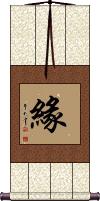
緣 represents the fate that brings and bonds people together.
緣 is a complicated single character. It can mean a lot of different things depending on how you read it.
In Japanese, it can mean fate, destiny, a mysterious force that binds two people together, a relationship between two people, bond, link, connection, family ties, affinity, opportunity, or chance (to meet someone and start a relationship). It can also mean “someone to rely on,” relative, reminder, memento, or the female given name, Yori.
It's the same in Chinese, where it's defined as cause, reason, karma, fate, or predestined affinity.
In the Buddhist context, it's Pratyaya. This is the concept of indirect conditions, as opposed to direct causes. It's when something happens (meeting someone) by circumstance or a contributing environment. Instead of a direct cause or act, it is a conditioning cause without direct input or action by the involved people.
Occasionally, this character is used in a facetious way to say hem, seam, or edge of clothing. In this case, it's the seam that brings or holds the clothing together.
 Note: Japanese will tend to use the variant of this Kanji shown to the right. If you want this version (and are ordering this from the Japanese master calligrapher), click on the Kanji at the right instead of the button above.
Fear No Evil
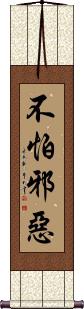
不怕邪惡 literally means “no fear of evil” in Chinese.
Chinese grammar and word order are a little different than English. 不怕邪惡 is the best way to write something that means “fear no evil” in Chinese.
The first character means “not,” “don't” or “no.”
The second means “fear.”
The last two mean “evil” but can also be translated as sinister, vicious, wickedness, or just “bad.”
Fear No Evil
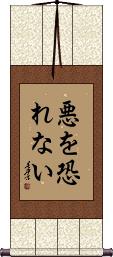
悪を恐れない is “Fear No Evil” in Japanese.
Japanese grammar and phrase construction is different than English, so this literally reads, “Evil Fear Not.”
The “evil” Kanji can also be translated as “wickedness.”
Note: Because this selection contains some special Japanese Hiragana characters, it should be written by a Japanese calligrapher.
Fear No Man / Fear Nothing
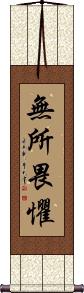
無所畏懼 means “fear nothing,” but it's the closest thing in Chinese to the phrase “fear no man” which many of you have requested.
This would also be the way to say “fear nobody” and can be translated simply as “undaunted.”
Fear God
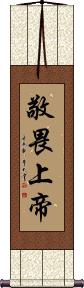
敬畏上帝 is probably the best way to translate the Christian English phrase “Fear God” into Chinese.
The first two characters mean to revere, be in awe of, or a general term of reverence. It can mean fear, but only in the context of respect or fear of authority.
Fearless / Daring
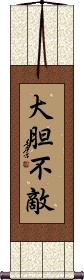
大胆不敵 is a Japanese word that can mean a few things depending on how you read it.
Popular translations include fearless, audacity (the attitude of a) daredevil, or daring.
The first two Kanji create a word that means: bold, fearless, or daring; audacious.
The last two Kanji create a word meaning: no match for, cannot beat, daring, fearless, intrepid, bold, or tough.
As with many Japanese words, the two similar-meaning words work together to multiply the meaning and intensity of the whole 4-Kanji word.
The one who retreats 50 paces mocks the one to retreats 100
The pot calls the kettle black
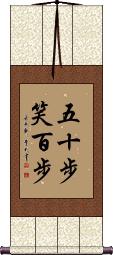
五十步笑百步 is a Chinese proverb that means the one who retreats 50 paces mocks the one who retreats 100 paces.
During the Warring States Period of what is now China (475 - 221 B.C.), the King of Wei was in love with war. He often fought with other kingdoms just for spite or fun.
One day, the King of Wei asked the philosopher Mencius, “I love my people, and all say I do the best for them. I move the people from famine-stricken areas to places of plenty and transport grains from rich areas to the poor. Nobody goes hungry in my kingdom, and I treat my people far better than other kings. But why does the population of my kingdom not increase, and why does the population of other kingdoms not decrease?”
Mencius answered, “Since you love war, I will make this example: When going to war, and the drums beat to start the attack, some soldiers flee for their lives in fear. Some run 100 paces in retreat, and others run 50 steps. Then the ones who retreated 50 paces laugh and taunt those who retreated 100 paces, calling them cowards mortally afraid of death. Do you think this is reasonable?
The King of Wei answered, “Of course not! Those who run 50 paces are just as timid as those who run 100 paces.”
Mencius then said, “You are a king who treats his subjects better than other kings treat their people, but you are so fond of war that your people suffer from great losses in battle. Therefore, your population does not grow. While other kings allow their people to starve to death, you send your people to die in war. Is there any difference?”
This famous conversation led to the six-character proverb shown here. It serves as a warning to avoid hypocrisy. It goes hand-in-hand with the western phrase, “The pot calls the kettle black,” or the Biblical phrase, “Before trying to remove a splinter from your neighbor's eye, first remove the plank from your own eye.”
Filial Piety / Filial Conduct
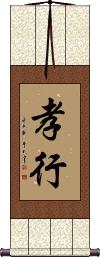
孝行 expresses the idea of filial piety or filial conduct.
While the first character means filial piety by itself, the second character adds “action.” Therefore this represents the actions you take to show your respect and obedience to your elders or ancestors.
Confucius is probably the first great advocate for filial piety.
Courage To Do What Is Right
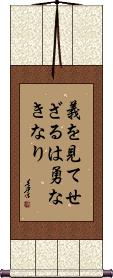
義を見てせざるは勇なきなり is a Japanese proverb that means “Knowing what is right and not doing is a want of courage.”
I've also seen it translated as:
To see what is right, yet fail to do so, is a lack of courage.
To know righteousness, but take no action is cowardice.
You are a coward if you knew what was the right thing to do, but you did not take action.
Knowing what is right without practicing it betrays one's cowardice.
Note: Because this selection contains some special Japanese Hiragana characters, it should be written by a Japanese calligrapher.
A Deliberate Inaction is Better than a Blind Action
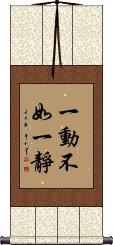
Sometimes 一動不如一靜 is translated by others as “Look before you leap” but the more accurate and direct translation is the one I used in the title.
While somewhat military in its origin, this proverb can apply to any situation where a decision needs to be made, but perhaps there are still some “unknowns.”
This phrase suggests that in our “action-based” world, sometimes the “smarter move” is “no move at all.”
See Also: Better to Choose Nothing Rather Than Make a Poor Choice
Inspired
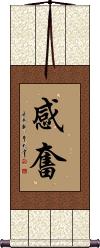
感奮 is a Chinese and Japanese word that means, moved and inspired, fired with enthusiasm, stirred up, moved to action, or state of being inspired.
Joshua 1:9
Do not be afraid, God is always with you
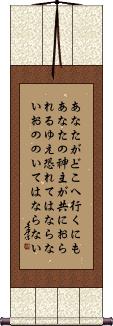
あなたがどこへ行くにもあなたの神主が共におられるゆえ恐れてはならないおののいてはならない is a Japanese translation of a large portion of Joshua 1:9.
The Japanese passage includes, “The Lord God is with you wherever you are; Therefore do not fear or be discouraged.”
Note: Because this selection contains some special Japanese Hiragana characters, it should be written by a Japanese calligrapher.
Know Your Enemy, Know Yourself, and Win 100 Battles
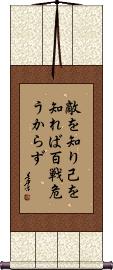
敵を知り己を知れば百戦危うからず is the longer/full Japanese version of this proverb. This means “Know your enemy, know yourself, and you will not fear a hundred battles.”
Others will translate this as “Know thy enemy, know thyself, yields victory in one hundred battles.”
Note: Because this selection contains some special Japanese Hiragana characters, it should be written by a Japanese calligrapher.
Life in Balance / Balancing Life
The art of balancing your life
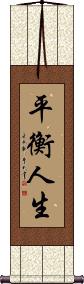
This 平衡人生 title suggests that you are actively trying to keep your life in balance.
Think of this as the action verb of seeking or having a balanced life.
The first two characters mean balance, equilibrium, or keeping things equal.
The last two characters mean “life.” Literally “human life.”
Life Goes On
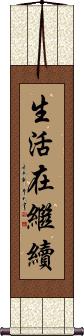
生活在繼續 means “No matter what happens, life goes on” or “For better or worse, life goes on.”
生活在繼續 is kind of modern Chinese proverb, but the meaning is generational.
生活 = to live; life; livelihood.
在 = (used before a verb to indicate an action in progress).
繼續 = to continue; to proceed with; to go on with.
Never Give Up
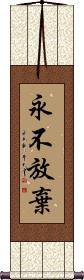
The first character means “eternal” or “forever,” and the second means “not” (together, they mean “never”). The last two characters mean “give up” or “abandon.” Altogether, you can translate this proverb as “never give up” or “never abandon.”
Depending on how you want to read this, 永不放棄 is also a statement that you will never abandon your hopes, dreams, family, or friends.
Fear not long roads; Fear only short ambition
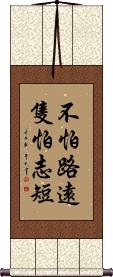
不怕路遠隻怕志短 is a Chinese proverb that literally translates as “Fear not long roads; fear only short ambition,” or “Don't fear that the road is long, only fear that your will/ambition/aspiration is short.”
Figuratively, this means: However difficult the goal is, one can achieve it as long as one is determined to do so.
Others may translate the meaning as “Don't let a lack of willpower stop you from pressing onward in your journey.”
Do not fear poverty; Fear low ambitions
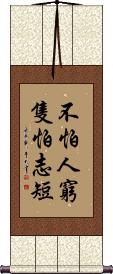
不怕人窮隻怕志短 is a Chinese proverb that literally translates as: It is not poverty that is to be feared; It is low ambition.
Figuratively, this means: It is not poverty but a lack of lofty aspiration that is to be regretted.
Do not fear being slow, fear standing still
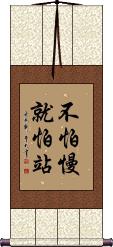
不怕慢就怕站 is a Chinese proverb that translates as: Don't worry about being slow; only worry about standing still.
Figuratively, this means: A slow progress holds some promise but to stand still promises failure.
No Fear
(2 characters)
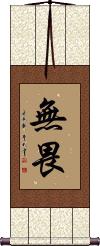
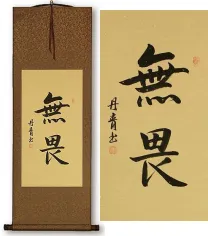
無畏 literally means “No Fear.” But perhaps not the most natural Chinese phrase (see our other “No Fear” phrase for a complete thought). However, this two-character version of “No Fear” seems to be a very popular way to translate this into Chinese when we checked Chinese Google.
Note: This also means “No Fear” in Japanese and Korean, but this character pair is not often used in Japan or Korea.
This term appears in various Chinese dictionaries with definitions like “without fear,” intrepidity, fearless, dauntless, and bold.
In the Buddhist context, this is a word derived from the word Abhaya, meaning: Fearless, dauntless, secure, nothing, and nobody to fear. Also, from vīra meaning: courageous, bold.
See Also: Never Give Up | No Worries | Undaunted | Bravery | Courage | Fear No Man
No Fear
(four-character version)
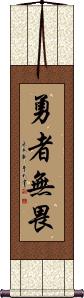
勇者無畏 is a complete sentence that means “Brave People Have No Fear” or “A Brave Person Has No Fear” (plural or singular is not implied).
We translated “No Fear” into the two variations that you will find on our website. Then we checked Chinese Google and found that others had translated “No Fear” in the exact same ways. Pick the one you like best. A great gift for your fearless friend.
See Also: Fear No Man
No Fear
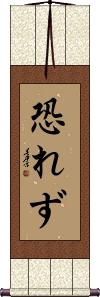
恐れず is probably the best way to express “No Fear” in Japanese.
The first Kanji and the following Hiragana character create a word that means: to fear, to be afraid of, frightened, or terrified.
The last Hiragana character serves to modify and negate the first word (put it in negative form). Basically, they carry a meaning like “without” or “keeping away.” 恐れず is almost like the English modifier “-less.”
Altogether, you get something like “Without Fear” or “Fearless.”
Here's an example of using this in a sentence: 彼女かのじょは思い切ったことを恐れずにやる。
Translation: She is not scared of taking big risks.
Note: Because this selection contains some special Japanese Hiragana characters, it should be written by a Japanese calligrapher.
No Mind / Mushin
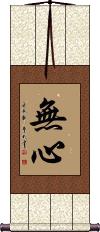
In Japanese, 無心 means innocent or without knowledge of good and evil. It literally means “without mind.”
無心 is one of the five spirits of the warrior (budo) and is often used as a Japanese martial arts tenet. Under that context, places such as the Budo Dojo define it this way: “No mind, a mind without ego. A mind like a mirror which reflects and dos not judge.” The original term was “mushin no shin,” meaning “mind of no mind.” It is a state of mind without fear, anger, or anxiety. Mushin is often described by the phrase “Mizu no Kokoro,” which means “mind like water.” The phrase is a metaphor describing the pond that clearly reflects its surroundings when calm but whose images are obscured once a pebble is dropped into its waters.
This has a good meaning in conjunction with Chan / Zen Buddhism in Japan. However, out of that context, it means mindlessness or absent-mindedness. To non-Buddhists in China, this is associated with doing something without thinking.
In Korean, this usually means indifference.
Use caution and know your audience before ordering this selection.
More info: Wikipedia: Mushin
All Tenets of the Noble Eightfold Path
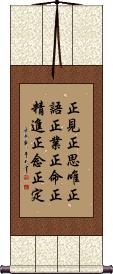
These are the eight tenets of the Buddhist Noble Eightfold Path written altogether.
Here's this list of tenets in English:
1. Right View / Right Understanding / Right Perspective / Perfect View
2. Right Resolve / Right Thought / Right Intention / Perfect Resolve
3. Right Speech / Right Talk / Perfect Speech
4. Right Action / Perfect Conduct
5. Right Living / Right Livelihood / Perfect Livelihood
6. Right Effort / Right Endeavor / Perfect Effort
7. Right Mindfulness / Right Memory / Perfect Mindfulness
8. Right Concentration / Perfect Concentration
Old, But More Vigorous in Spirit
Age is just a number
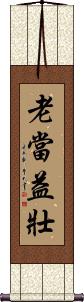
老當益壯 is a Chinese proverb that means “old but vigorous” or “hale and hearty despite the years.”
Said of someone who is more spirited when he/she grows older.
The story behind this Chinese proverb:
In the Eastern Han Dynasty, there was a man named Ma Yuan. He had been planning to herd animals on the frontier since he was young. When he grew up, Ma became a minor official of a county.
Once, he was sending some prisoners to another location. He felt pity for them, so he set them free, and then he fled to another county in the north. He herded animals there, and thus his dream came true. He always said: “If you want to be a great man, the poorer you are, the firmer in spirit you have to be; the older you are, the more spirited you should be.”
Later, when he was even older, Ma Yuan became a famous general of the Eastern Han Dynasty and contributed to many battles.
One Heart / One Mind / Heart and Soul
Isshin
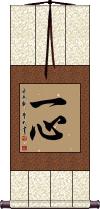
一心 can be translated as “one mind,” “single-minded focus,” or “wholehearted devotion,” from Chinese, Japanese Kanji, and old Korean Hanja.
Colloquially or figuratively, it means: wholeheartedly; heart and soul; of one mind; single-mindedness, wholeheartedness; one's whole heart; with the whole mind or heart; one mind in heart.
I'm not kidding, all of those came right from the dictionary for this one title.
In martial arts usage, this term emphasizes total commitment, where intent, attention, and action are unified without distraction.
In Japanese budō, it often conveys wholehearted dedication to practice or principle, whereas in Chinese usage it tends toward inner mental cultivation.
In Buddhism, this can refer to the bhūtatathatā, or the whole of things; the universe as one mind, or a spiritual unity.
In Japanese, this can be the female given name, Hitomi.
Obaidori / Oubaitori
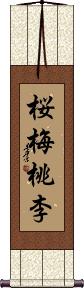
Ōbaidōri or Oubaitori means cherry, apricot, peach, and plum blossoms.
While these four different blossoms look very similar at first glance, they all bloom differently and have their own distinct shapes and smells. Yet despite their differences, each and every blossom is proud and beautiful in its own way.
Do not take action until the time is right
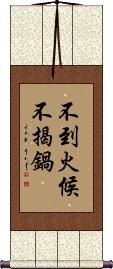
不到火候不揭锅 translates as: Don't take the lid off the pot until the food is done.
Figuratively, this means: Don't take action until the time is right.
You can take this as a call to be patient or pick just the right time to do something (not too early, not too late).
Undaunted After Repeated Setbacks
Persistence to overcome all challenges
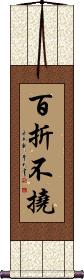
百折不撓 is a Chinese proverb that means “Be undaunted in the face of repeated setbacks.”
More directly translated, it reads, “[Overcome] a hundred setbacks, without flinching.” 百折不撓 is of Chinese origin but is commonly used in Japanese and somewhat in Korean (same characters, different pronunciation).
This proverb comes from a long, and occasionally tragic story of a man that lived sometime around 25-220 AD. His name was Qiao Xuan, and he never stooped to flattery but remained an upright person at all times. He fought to expose the corruption of higher-level government officials at great risk to himself.
Then when he was at a higher level in the Imperial Court, bandits were regularly capturing hostages and demanding ransoms. But when his own son was captured, he was so focused on his duty to the Emperor and the common good that he sent a platoon of soldiers to raid the bandits' hideout, and stop them once and for all even at the risk of his own son's life. While all of the bandits were arrested in the raid, they killed Qiao Xuan's son at first sight of the raiding soldiers.
Near the end of his career, a new Emperor came to power, and Qiao Xuan reported to him that one of his ministers was bullying the people and extorting money from them. The new Emperor refused to listen to Qiao Xuan and even promoted the corrupt Minister. Qiao Xuan was so disgusted that in protest, he resigned from his post as minister (something almost never done) and left for his home village.
His tombstone reads “Bai Zhe Bu Nao” which is now a proverb used in Chinese culture to describe a person of strong will who puts up stubborn resistance against great odds.
My Chinese-English dictionary defines these 4 characters as “keep on fighting despite all setbacks,” “be undaunted by repeated setbacks,” and “be indomitable.”
Our translator says it can mean “never give up” in modern Chinese.
Although the first two characters are translated correctly as “repeated setbacks,” the literal meaning is “100 setbacks” or “a rope that breaks 100 times.” The last two characters can mean “do not yield” or “do not give up.”
Most Chinese, Japanese, and Korean people will not take this absolutely literal meaning but will instead understand it as the title suggests above. If you want a single big word definition, it would be indefatigability, indomitableness, persistence, or unyielding.
See Also: Tenacity | Fortitude | Strength | Perseverance | Persistence
Preparation Yields No Fear or Worries
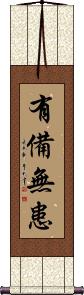
有備無患 means “When you are well-prepared, you have nothing to fear.”
Noting that the third character means “no” or “without” and modifies the last... The last character can mean misfortune, troubles, worries, or fears. It could even be stretched to mean sickness. Therefore you can translate this proverb in a few ways. I've also seen it translated as “Preparedness forestalls calamities.”
有備無患 is comparable to the English idiom, “Better safe than sorry,” but does not directly/literally mean this.
Preparation Yields No Regrets
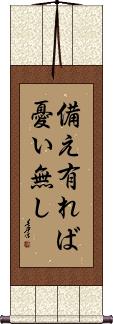
備え有れば憂い無し is as proverb that means “When you are well-prepared, you have nothing to regret” in Japanese.
Note: Because this selection contains some special Japanese Hiragana characters, it should be written by a Japanese calligrapher.
Prudence / Considerate
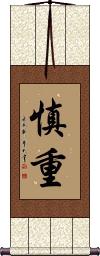
慎重 conveys the idea of being considerate, having prudence, and being thoughtful when taking action.
慎重 can also mean cautious, careful, discreet, deliberate, or taking all things into consideration.
The general meaning is shared across languages. However, in Chinese, this is more about prudence, while in Japanese, this is more about being considerate.
Chinese Catholics use this word to represent “prudence” in the list of the Seven Heavenly Virtues.

 Note: Depending on your choice of Chinese or Japanese calligraphers, the first Kanji will vary slightly.
It is technically the same character. Japanese tend to leave a space between the upper and lower portions of this particular Kanji. See sample images to the right.
Note: Depending on your choice of Chinese or Japanese calligraphers, the first Kanji will vary slightly.
It is technically the same character. Japanese tend to leave a space between the upper and lower portions of this particular Kanji. See sample images to the right.
See Also: Moderation | Modesty | Chastity
Qi Gong / Chi Kung
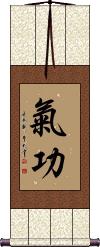
氣功 or Qigong is the title of a technique that is somewhere between medical practice, meditation, and in some cases, religion.
The definition is blurred depending on which school of Qigong you are following. In some cases, it is even incorporated with martial arts.
Some people (even Chinese people) mix this title with Tai Chi (Tai Qi) exercises.
Lately, in China, people will claim to practice Tai Chi rather than Qigong because the Qigong title was recently used as a cover for an illegal pseudo-religious movement in China with the initials F.G. or F.D. (I can not write those names here for fear of our website being banned in China).
You can learn those names and more here: Further info about Qigong
If you are wondering why I wrote “Qi Gong” and “Chi Kung” as the title of this calligraphy entry, I should teach you a little about the various ways in which Chinese can be Romanized. One form writes this as “Chi Kung” or “Chikung” (Taiwan). In the mainland and elsewhere, it is Romanized as “Qi Gong” or “Qigong.” The pronunciation is the same in Taiwan, mainland, and Singapore Mandarin. Neither Romanization is exactly like English. If you want to know how to say this with English rules, it would be something like “Chee Gong” (but the “gong” has a vowel sound like the “O” in “go”).
Romanization is a really confusing topic and has caused many Chinese words to be mispronounced in the west. One example is “Kung Pao Chicken,” which should actually be more like “Gong Bao” with the “O” sounding like “oh” for both characters. Neither the Romanization system in Taiwan nor the Mainland is perfect, in my opinion, and leads to many misunderstandings.
In modern Japan, you may see this written as 気功, but the original 氣功 is still recognized. If you need the Japanese version, please contact me.
One who is drenched in rain does not fear drops of dew
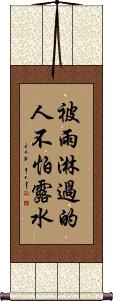
被雨淋過的人不怕露水 is a Chinese proverb that literally translates as “One who has been drenched by the rain is not afraid of dew drops.”
Figuratively, this means:
One who has gone through hardships is not afraid of (minor)setbacks.
Respect out of fear is never genuine; Reverence out of respect is never false
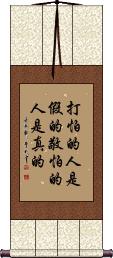
打怕的人是假的敬怕的人是真的 is a proverb that seems to be aimed at world leaders or others in power. Perhaps a suggestion to avoid the practice of “fear-mongering” opting instead for a policy of benevolence and justice.
An example: When the Bush administration told Pakistan they could either join America in the “war on terror,” or expect some bombs to be coming their way, Bush gained this kind of “less-than-genuine respect” from Pakistanis.
Leaders in places like North Korea and even Saudi Arabia reap the same bogus respect from their own citizens.
Note that calligraphers do not like to repeat the same characters in exactly the same way in the same piece of artwork. So expect the characters that are repeated to be written in different forms in the real artwork (unlike the way they are displayed to the left).
The Roar of the Lioness
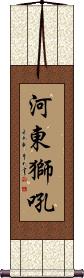
河東獅吼 is actually a proverb and joke about the plight and fear of a hen-pecked husband.
In ancient times, it was used to describe a wife who would berate her husband or go into jealous rages. However, this phrase currently brings about ideas of a husband that cowers in fear and cringes when his wife screams (or roars) at him.
Please only purchase this as a good-natured joke. If your wife or husband does not have a good sense of humor, it's probably not a good idea to hang this on your wall to irritate your mate.
A sly rabbit has three openings to its den
-or- The crafty rabbit has three different entrances to its lair
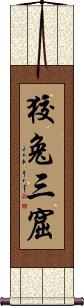
狡兔三窟 speaks to the cunning character of a sly rabbit. Such a rabbit will not have just one hole but rather a few entrances and exits from his liar.
About 2,250 years ago, a rich man told his assistant to go and buy something wonderful that he did not yet possess. He was a man that already had everything, so the assistant went to a local village that owed a great deal of money to the rich man. The assistant told the village elders that all debts were forgiven. All the villagers rejoiced and praised the rich man's name. The assistant returned to the rich man and told him he had purchased “benevolence” for him. The rich man was mildly amused but perhaps slightly confused by the action.
Sometime later, the rich man fell from the favor of the Emperor and was wiped out without a penny to his name. One day he was walking aimlessly and stumbled into the village where the debts had been forgiven. The villagers recognized the man and welcomed him with open arms, clothed, fed him, and gave him a place to live.
Without trying, the man had become like the sly and cunning rabbit. When his exit was blocked, he had another hole to emerge from - and was reborn. This story and idiom come from a book titled “The Amendment” - it's unclear whether this man actually existed or not. But the book did propel this idiom into common use in China.
Still today, this idiom about the rabbit is used in China when suggesting “backup plans,” alternate methods, and anyone with a good escape plan.
Soldiers Adapt Actions to the Situation
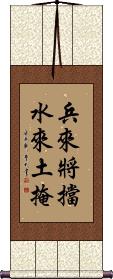
This Chinese military proverb means, counter soldiers with arms and counter water with an earthen dam.
兵來將擋水來土掩 is about how different situations call for different actions. You must adopt measures appropriate to the actual situation.
To explain the actual proverb, one would not attack a flood of water with gunfire, nor would you counter-attack soldiers by building an earth weir. You must be adaptable and counter whatever threatens with relevant action.
Southern Praying Mantis
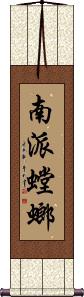
南派螳螂 can be translated literally as “Southern School Praying Mantis” or “Southern Style Praying Mantis.”
Despite its name, the Southern Praying Mantis style of Chinese martial arts is unrelated to the Northern Praying Mantis style. Southern Praying Mantis is instead related most closely to fellow Hakka styles such as Dragon and more distantly to the Fujian family of styles that includes Fujian White Crane, Five Ancestors, and Wing Chun.
This style of martial arts focuses more on fighting skills rather than aesthetics.
Of course, you already knew that if you were looking for this term.
Note: This title can be pronounced and does have meaning in Korean but only to Koreans familiar with Chinese martial arts.
Take Up a Challenge
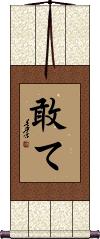
敢て is a Japanese word that can mean a few things related to the idea of taking up a challenge.
It can be defined as daring (to do something), venturing (often overcoming reluctance), or taking action (even in the face of probable failure). It can also be to take upon oneself or take up a challenge.
Carry On, Undaunted
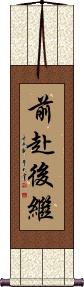
前赴後繼 is a Chinese proverb that figuratively means “to advance dauntlessly in wave upon wave.”
It suggests that you should or can carry on and have the strength to keep going.
While this proverb is a little bit militaristic, it suggests that despite a fallen comrade (or perhaps a loved one), you should keep going and work towards the goal they intended.
Overcome: Regardless of the Rain and Wind
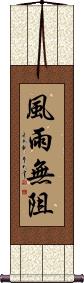
風雨無阻 is a proverb that is often translated as “Go ahead as planned regardless of the weather” or, “[Overcome] despite the rain and wind.”
This is a Chinese proverb that suggests that you are willing (or should be willing) to overcome any adversity, and accomplish your task at hand.
There is a second/optional part to this phrase that suggests that you should do this together with someone (see our other 8-character version if you want the full phrase).
Regardless of the Weather, We Overcome Troubles Together
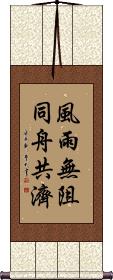
The first four characters are often translated as “Go ahead as planned regardless of the weather” or, “[Overcome] despite the rain and wind.” The last four characters can mean “Stick together” but literally means “Take the same boat [together].”
風雨無阻同舟共濟 is a Chinese proverb that suggests that you are willing (or should be willing) to overcome any adversity, and accomplish your task at hand. The second part (last four characters) is sometimes left off but this second part strongly suggests that you should overcome that adversity together.
Wu Wei / Without Action
Daoist / Taoist Tenet
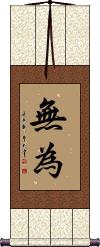
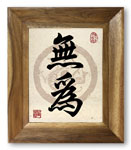
無為 or “Wu Wei” is a Daoist (Taoist) tenet that speaks to the idea of letting nature take its course.
Some will say it's about knowing when to take action and when not to. In reality, it's more about not going against the flow. What will happen is controlled by the Dao (Tao), for which one who follows the Dao will not resist or struggle against.
You can think of 無為 as the Chinese way to express “laissez-faire.”
There is a lot more to this concept, but if you are looking for this entry, you already know the expanded concept.
Warning: Outside of the Daoist context, this means idleness or inactivity (especially in Japanese, where not everyone knows this as a Daoist concept, though it does pair well with the Japanese concept of Wabi-Sabi).
This in-stock artwork might be what you are looking for, and ships right away...

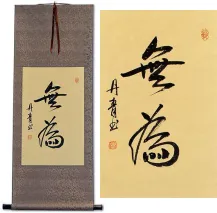
The following table may be helpful for those studying Chinese or Japanese...
| Title | Characters | Romaji (Romanized Japanese) | Various forms of Romanized Chinese | |
| 3. Right Speech Right Talk Perfect Speech | 正語 正语 | sei go / seigo | zhèng yǔ / zheng4 yu3 / zheng yu / zhengyu | cheng yü / chengyü |
| 4. Right Action Perfect Conduct | 正業 正业 | sei gyou / seigyou / sei gyo | zhèng yè / zheng4 ye4 / zheng ye / zhengye | cheng yeh / chengyeh |
| 5. Right Living Right Livelihood Perfect Livelihood | 正命 | sei myou / seimyou / sei myo | zhèng mìng zheng4 ming4 zheng ming zhengming | cheng ming chengming |
| 1000 good moves ruined by 1 bad | 不怕千招會隻怕一招熟 不怕千招会只怕一招熟 | bú pà qiān zhāo huì zhǐ pà yī zhāo shú bu2 pa4 qian1 zhao1 hui4 zhi3 pa4 yi1 zhao1 shu2 bu pa qian zhao hui zhi pa yi zhao shu | pu p`a ch`ien chao hui chih p`a i chao shu pu pa chien chao hui chih pa i chao shu |
|
| Better to Choose Nothing, Rather than Make a Poor Choice | 寧缺毋濫 宁缺毋滥 | nìng quē wú làn ning4 que1 wu2 lan4 ning que wu lan ningquewulan | ning ch`üeh wu lan ningchüehwulan ning chüeh wu lan |
|
| Blue Lotus | 靑蓮 靑莲 | seiren | qing lián / qing lian2 / qing lian / qinglian | ch`ing lien / chinglien / ching lien |
| Body and Mind | 身心 | shin jin / shinjin | shēn xīn / shen1 xin1 / shen xin / shenxin | shen hsin / shenhsin |
| The Brave Have No Fears | 勇者不懼 勇者不惧 | yuu sha fu ku yuushafuku yu sha fu ku | yǒng zhě bú jù yong3 zhe3 bu2 ju4 yong zhe bu ju yongzhebuju | yung che pu chü yungchepuchü |
| Bravery Courage | 勇敢 | yuu kan / yuukan / yu kan | yǒng gǎn / yong3 gan3 / yong gan / yonggan | yung kan / yungkan |
| Do not shed a tear until you see the coffin | 不見棺材不落淚 不见棺材不落泪 | bú jiàn guān cái bú luò lèi bu2 jian4 guan1 cai2 bu2 luo4 lei4 bu jian guan cai bu luo lei bujianguancaibuluolei | pu chien kuan ts`ai pu lo lei puchienkuantsaipulolei pu chien kuan tsai pu lo lei |
|
| Confidence Faithful Heart | 信心 | shin jin / shinjin | xìn xīn / xin4 xin1 / xin xin / xinxin | hsin hsin / hsinhsin |
| The Confident Helmsman Inspires Confidence in the Passengers | 把舵的不慌乘船的穩當 把舵的不慌乘船的稳当 | bǎ tuò de bù huāng chéng chuán de wěn dang ba3 tuo4 de bu4 huang1 cheng2 chuan2 de wen3 dang ba tuo de bu huang cheng chuan de wen dang | pa t`o te pu huang ch`eng ch`uan te wen tang pa to te pu huang cheng chuan te wen tang |
|
| Collaboration Cooperation Synergy | 協同 协同 | kyou dou / kyoudou / kyo do | xié tóng / xie2 tong2 / xie tong / xietong | hsieh t`ung / hsiehtung / hsieh tung |
| Courage to do what is right | 見義勇為 见义勇为 | jiàn yì yǒng wéi jian4 yi4 yong3 wei2 jian yi yong wei jianyiyongwei | chien i yung wei chieniyungwei |
|
| Dana: Almsgiving and Generosity | 布施 | fuse | bù shī / bu4 shi1 / bu shi / bushi | pu shih / pushih |
| Danger | 危 | ki | wēi / wei1 / wei | |
| Daodejing Tao Te Ching - Chapter 27 | 善行無轍跡善言無瑕謫善數不用籌策善閉無關鍵而不可開善結無繩約而不可解是以聖人常善救人故無棄人常善救物故無棄物是謂襲明故善人者不善人之師不善人者善人之資不貴其師不愛其資雖智大迷是謂要妙 善行无辙迹善言无瑕谪善数不用筹策善闭无关键而不可开善结无绳约而不可解是以圣人常善救人故无弃人常善救物故无弃物是谓袭明故善人者不善人之师不善人者善人之资不贵其师不爱其资虽智大迷是谓要妙 | shàn xíng wú zhé jì shàn yán wú xiá zhé shàn shù bù yòng chóu cè shàn bì wú guān jiàn ér bù kě kāi shàn jié wú shéng yuē ér bù kě jiě shì yǐ shèng rén cháng shàn jiù rén gù wú qì rén cháng shàn jiù wù gù wú qì wù shì wèi xí míng gù shàn rén zhě bù shàn rén zhī shī bù shàn rén zhě shàn rén zhī zī bù guì qí shī bù ài qí zī suī zhì dà mí shì wèi yào miào shan4 xing2 wu2 zhe2 ji4 shan4 yan2 wu2 xia2 zhe2 shan4 shu4 bu4 yong4 chou2 ce4 shan4 bi4 wu2 guan1 jian4 er2 bu4 ke3 kai1 shan4 jie2 wu2 sheng2 yue1 er2 bu4 ke3 jie3 shi4 yi3 sheng4 ren2 chang2 shan4 jiu4 ren2 gu4 wu2 qi4 ren2 chang2 shan4 jiu4 wu4 gu4 wu2 qi4 wu4 shi4 wei4 xi2 ming2 gu4 shan4 ren2 zhe3 bu4 shan4 ren2 zhi1 shi1 bu4 shan4 ren2 zhe3 shan4 ren2 zhi1 zi1 bu4 gui4 qi2 shi1 bu4 ai4 qi2 zi1 sui1 zhi4 da4 mi2 shi4 wei4 yao4 miao4 shan xing wu zhe ji shan yan wu xia zhe shan shu bu yong chou ce shan bi wu guan jian er bu ke kai shan jie wu sheng yue er bu ke jie shi yi sheng ren chang shan jiu ren gu wu qi ren chang shan jiu wu gu wu qi wu shi wei xi ming gu shan ren zhe bu shan ren zhi shi bu shan ren zhe shan ren zhi zi bu gui qi shi bu ai qi zi sui zhi da mi shi wei yao miao | shan hsing wu che chi shan yen wu hsia che shan shu pu yung ch`ou ts`e shan pi wu kuan chien erh pu k`o k`ai shan chieh wu sheng yüeh erh pu k`o chieh shih i sheng jen ch`ang shan chiu jen ku wu ch`i jen ch`ang shan chiu wu ku wu ch`i wu shih wei hsi ming ku shan jen che pu shan jen chih shih pu shan jen che shan jen chih tzu pu kuei ch`i shih pu ai ch`i tzu sui chih ta mi shih wei yao miao shan hsing wu che chi shan yen wu hsia che shan shu pu yung chou tse shan pi wu kuan chien erh pu ko kai shan chieh wu sheng yüeh erh pu ko chieh shih i sheng jen chang shan chiu jen ku wu chi jen chang shan chiu wu ku wu chi wu shih wei hsi ming ku shan jen che pu shan jen chih shih pu shan jen che shan jen chih tzu pu kuei chi shih pu ai chi tzu sui chih ta mi shih wei yao miao |
|
| Do not fear the task: Cooperation will lead to success | 不怕風浪大就怕槳不齊 不怕风浪大就怕桨不齐 | bù pà fēng làng dà jiù pà jiǎng bù qí bu4 pa4 feng1 lang4 da4 jiu4 pa4 jiang3 bu4 qi2 bu pa feng lang da jiu pa jiang bu qi | pu p`a feng lang ta chiu p`a chiang pu ch`i pu pa feng lang ta chiu pa chiang pu chi |
|
| Enjoy Life | 人生を楽しみにしている | jin sei o tano shi mi ni shi te i ru | ||
| The Mysterious Bond Between People | 緣 / 縁 缘 | en | yuán / yuan2 / yuan | yüan |
| Fear No Evil | 不怕邪惡 不怕邪恶 | bú pà xié è bu2 pa4 xie2 e4 bu pa xie e bupaxiee | pu p`a hsieh o pupahsieho pu pa hsieh o |
|
| Fear No Evil | 悪を恐れない | aku o osore nai akuoosorenai | ||
| Fear No Man Fear Nothing | 無所畏懼 无所畏惧 | wú suǒ wèi jù wu2 suo3 wei4 ju4 wu suo wei ju wusuoweiju | wu so wei chü wusoweichü |
|
| Fear God | 敬畏上帝 | jìng wèi shàng dì jing4 wei4 shang4 di4 jing wei shang di jingweishangdi | ching wei shang ti chingweishangti |
|
| Fearless Daring | 大膽不敵 大胆不敵 | dai tan fu teki daitanfuteki | ||
| The one who retreats 50 paces mocks the one to retreats 100 | 五十步笑百步 | wù shí bù xiào bǎi bù wu4 shi2 bu4 xiao4 bai3 bu4 wu shi bu xiao bai bu wushibuxiaobaibu | wu shih pu hsiao pai pu wushihpuhsiaopaipu |
|
| Filial Piety Filial Conduct | 孝行 | koukou / koko | xiào xìng xiao4 xing4 xiao xing xiaoxing | hsiao hsing hsiaohsing |
| Courage To Do What Is Right | 義を見てせざるは勇なきなり | giomitesezaruhayuunakinari giomitesezaruhayunakinari | ||
| A Deliberate Inaction is Better than a Blind Action | 一動不如一靜 一动不如一静 | yí dòng bù rú yí jìng yi2 dong4 bu4 ru2 yi2 jing4 yi dong bu ru yi jing yidongburuyijing | i tung pu ju i ching itungpujuiching |
|
| Inspired | 感奮 感奋 | kanpun | gǎn fèn / gan3 fen4 / gan fen / ganfen | kan fen / kanfen |
| Joshua 1:9 | あなたがどこへ行くにもあなたの神主が共におられるゆえ恐れてはならないおののいてはならない | anata ga doko e iku ni mo anata no kami omo ga tomoni ora reru yue osorete wa naranai ononoite wa naranai | ||
| Know Your Enemy, Know Yourself, and Win 100 Battles | 敵を知り己を知れば百戦危うからず | teki o shi ri o no o shi re ba hya ku sen aya u ka ra zu | ||
| Life in Balance Balancing Life | 平衡人生 | hei kou jin sei heikoujinsei hei ko jin sei | píng héng rén shēng ping2 heng2 ren2 sheng1 ping heng ren sheng pinghengrensheng | p`ing heng jen sheng pinghengjensheng ping heng jen sheng |
| Life Goes On | 生活在繼續 生活在继续 | shēng huó zài jì xù sheng1 huo2 zai4 ji4 xu4 sheng huo zai ji xu shenghuozaijixu | sheng huo tsai chi hsü shenghuotsaichihsü |
|
| Never Give Up | 永不放棄 永不放弃 | yǒng bù fàng qì yong3 bu4 fang4 qi4 yong bu fang qi yongbufangqi | yung pu fang ch`i yungpufangchi yung pu fang chi |
|
| Fear not long roads; Fear only short ambition | 不怕路遠隻怕志短 不怕路远只怕志短 | bú pà lù yuǎn zhǐ pà zhì duǎn bu2 pa4 lu4 yuan3 zhi3 pa4 zhi4 duan3 bu pa lu yuan zhi pa zhi duan bupaluyuanzhipazhiduan | pu p`a lu yüan chih p`a chih tuan pu pa lu yüan chih pa chih tuan |
|
| Do not fear poverty; Fear low ambitions | 不怕人窮隻怕志短 不怕人穷只怕志短 | bú pà rén qióng zhǐ pà zhì duǎn bu2 pa4 ren2 qiong2 zhi3 pa4 zhi4 duan3 bu pa ren qiong zhi pa zhi duan buparenqiongzhipazhiduan | pu p`a jen ch`iung chih p`a chih tuan pu pa jen chiung chih pa chih tuan |
|
| Do not fear being slow, fear standing still | 不怕慢就怕站 | bú pà màn jiù pà zhàn bu2 pa4 man4 jiu4 pa4 zhan4 bu pa man jiu pa zhan bupamanjiupazhan | pu p`a man chiu p`a chan pupamanchiupachan pu pa man chiu pa chan |
|
| No Fear | 無畏 无畏 | mui | wú wèi / wu2 wei4 / wu wei / wuwei | |
| No Fear | 勇者無畏 勇者无畏 | yǒng zhě wú wèi yong3 zhe3 wu2 wei4 yong zhe wu wei yongzhewuwei | yung che wu wei yungchewuwei |
|
| No Fear | 恐れず | oso re zu / osorezu | ||
| No Mind Mushin | 無心 无心 | mu shin / mushin | wú xīn / wu2 xin1 / wu xin / wuxin | wu hsin / wuhsin |
| All Tenets of the Noble Eightfold Path | 正見正思唯正語正業正命正精進正念正定 正见正思唯正语正业正命正精进正念正定 | shouken shoushiyui shougo shougo shoumyou shoushoujin shounen shoujou shoken shoshiyui shogo shogo shomyo shoshojin shonen shojo | zhèng jiàn zhèng sī wéi zhèng yǔ zhèng yè zhèng mìng zhèng jīng jìn zhèng niàn zhèng dìng zheng4 jian4 zheng4 si1 wei2 zheng4 yu3 zheng4 ye4 zheng4 ming4 zheng4 jing1 jin4 zheng4 nian4 zheng4 ding4 zheng jian zheng si wei zheng yu zheng ye zheng ming zheng jing jin zheng nian zheng ding | cheng chien cheng ssu wei cheng yü cheng yeh cheng ming cheng ching chin cheng nien cheng ting |
| Old, But More Vigorous in Spirit | 老當益壯 老当益壮 | lǎo dāng yì zhuàng lao3 dang1 yi4 zhuang4 lao dang yi zhuang laodangyizhuang | lao tang i chuang laotangichuang |
|
| One Heart One Mind Heart and Soul | 一心 | isshin / ishin | yī shì dài yi1 shi4 dai4 yi shi dai yishidai | i shih tai ishihtai |
| Obaidori Oubaitori | 桜梅桃李 | oubaidouri / obaidori | ||
| Do not take action until the time is right | 不到火候不揭鍋 不到火候不揭锅 | bù dào huǒ hou bù jiē guō bu4 dao4 huo3 hou bu4 jie1 guo1 bu dao huo hou bu jie guo budaohuohoubujieguo | pu tao huo hou pu chieh kuo putaohuohoupuchiehkuo |
|
| Undaunted After Repeated Setbacks | 百折不撓 百折不挠 | hyaku setsu su tou hyakusetsusutou hyaku setsu su to | bǎi zhé bù náo bai3 zhe2 bu4 nao2 bai zhe bu nao baizhebunao | pai che pu nao paichepunao |
| Preparation Yields No Fear or Worries | 有備無患 有备无患 | yǒu bèi wú huàn you3 bei4 wu2 huan4 you bei wu huan youbeiwuhuan | yu pei wu huan yupeiwuhuan |
|
| Preparation Yields No Regrets | 備え有れば憂い無し | sona e a re ba ure i na shi sonaearebaureinashi | ||
| Prudence Considerate | 慎重 | shin chou / shinchou / shin cho | shèn zhòng shen4 zhong4 shen zhong shenzhong | shen chung shenchung |
| Qi Gong Chi Kung | 氣功 气功 | ki kou / kikou / ki ko | qì gōng / qi4 gong1 / qi gong / qigong | ch`i kung / chikung / chi kung |
| One who is drenched in rain does not fear drops of dew | 被雨淋過的人不怕露水 被雨淋过的人不怕露水 | bèi yǔ lín guò de rén bù pà lù shuǐ bei4 yu3 lin2 guo4 de ren2 bu4 pa4 lu4 shui3 bei yu lin guo de ren bu pa lu shui | pei yü lin kuo te jen pu p`a lu shui pei yü lin kuo te jen pu pa lu shui |
|
| Respect out of fear is never genuine; Reverence out of respect is never false | 打怕的人是假的敬怕的人是真的 | dǎ pà de rén shì jiǎ de jìng pà de rén shì zhēn de da3 pa4 de ren2 shi4 jia3 de jing4 pa4 de ren2 shi4 zhen1 de da pa de ren shi jia de jing pa de ren shi zhen de | ta p`a te jen shih chia te ching p`a te jen shih chen te ta pa te jen shih chia te ching pa te jen shih chen te |
|
| The Roar of the Lioness | 河東獅吼 河东狮吼 | hé dōng shī hǒu he2 dong1 shi1 hou3 he dong shi hou hedongshihou | ho tung shih hou hotungshihhou |
|
| A sly rabbit has three openings to its den | 狡兔三窟 | jiǎo tù sān kū jiao3 tu4 san1 ku1 jiao tu san ku jiaotusanku | chiao t`u san k`u chiaotusanku chiao tu san ku |
|
| Soldiers Adapt Actions to the Situation | 兵來將擋水來土掩 兵来将挡水来土掩 | bīng lái jiàng dǎng shuǐ lái tǔ yǎn bing1 lai2 jiang4 dang3 shui3 lai2 tu3 yan3 bing lai jiang dang shui lai tu yan | ping lai chiang tang shui lai t`u yen ping lai chiang tang shui lai tu yen |
|
| Southern Praying Mantis | 南派螳螂 | nán pài táng láng nan2 pai4 tang2 lang2 nan pai tang lang nanpaitanglang | nan p`ai t`ang lang nanpaitanglang nan pai tang lang |
|
| Take Up a Challenge | 敢て | aete | ||
| Carry On, Undaunted | 前赴後繼 前赴后继 | qián fù hòu jì qian2 fu4 hou4 ji4 qian fu hou ji qianfuhouji | ch`ien fu hou chi chienfuhouchi chien fu hou chi |
|
| Overcome: Regardless of the Rain and Wind | 風雨無阻 风雨无阻 | fēng yǔ wú zǔ feng1 yu3 wu2 zu3 feng yu wu zu fengyuwuzu | feng yü wu tsu fengyüwutsu |
|
| Regardless of the Weather, We Overcome Troubles Together | 風雨無阻同舟共濟 风雨无阻同舟共济 | fēng yǔ wú zǔ tóng zhōu gòng jì feng1 yu3 wu2 zu3 tong2 zhou1 gong4 ji4 feng yu wu zu tong zhou gong ji fengyuwuzutongzhougongji | feng yü wu tsu t`ung chou kung chi feng yü wu tsu tung chou kung chi |
|
| Wu Wei Without Action | 無為 无为 | mui | wú wéi / wu2 wei2 / wu wei / wuwei | |
| In some entries above you will see that characters have different versions above and below a line. In these cases, the characters above the line are Traditional Chinese, while the ones below are Simplified Chinese. | ||||

Successful Chinese Character and Japanese Kanji calligraphy searches within the last few hours...



