Many custom options...


And formats...



Strong Spirit in Chinese / Japanese...
Buy a Strong Spirit calligraphy wall scroll here!
Personalize your custom “Strong Spirit” project by clicking the button next to your favorite “Strong Spirit” title below...
1. Strong-Willed / Strong of Heart
2. Spiritual Strength / Strength of Spirit
4. Free Will
5. Unbreakable
6. Indomitable / Persistence / Fortitude
9. Warrior
10. Dragon
Strong-Willed / Strong of Heart
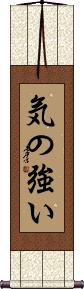
気の強い means strong-willed or strong of heart in Japanese.
Here's the character breakdown of this Japanese title:
気 (ki) spirit; mind; heart; nature; motivation; intention; feelings; essence.
の (no) possessive particle.
強い (tsuyoi) strong; powerful; mighty; potent; resistant; resilient; durable.
Note: Because this selection contains some special Japanese Hiragana characters, it should be written by a Japanese calligrapher.
Spiritual Strength / Strength of Spirit
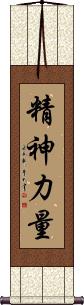
精神力量 is a title that speaks of one's soul or spirit and the capacity or strength that soul possesses.
The first two characters mean mind, heart, spirit, and/or soul.
The last two characters mean strength, capacity, or ability.
Note: Separately, these are two words in Japanese and can be pronounced, but this does not make a natural title in Japanese (best if your audience is Chinese).
Strong and brave

剛健勇猛 can be translated as “Strong and brave.”
剛健 = Strong and healthy, or robust spirit/body.
勇猛 = Valor, fierce, and/or courage.
Free Will
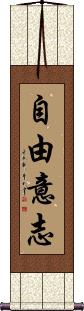
自由意志 is a concept that has existed for thousands of years that humans can understand right and wrong, then make a decision one way or the other (thus affecting their fate).
Sources such as Confucius, Buddhist scriptures, the Qur'an, and the Bible all address this idea.
As for the characters shown here, the first two mean free, freedom, or liberty. The last two mean “will.”
Can be romanized from Japanese as jiyū-ishi, jiyuu-ishi, and sometimes jiyuu-ishii.
It's 자유의지 or jayuu-yiji in Korean and zìyóu yìzhì in Chinese.
See Also: Freedom | Strong Willed | Fate
Unbreakable
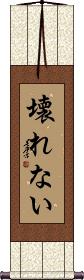
壊れない means unbreakable in Japanese.
The first two characters mean to be broken, to break, to fall through, and to come to nothing. But the last two characters create a negative meaning (like adding “un-” to “breakable”).
Note: Because this selection contains some special Japanese Hiragana characters, it should be written by a Japanese calligrapher.
See Also: Indomitable Spirit
Indomitable / Persistence / Fortitude
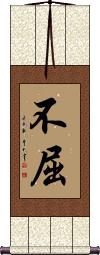
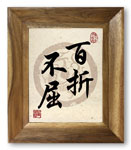
不屈 is the short form of a longer Chinese word and also a word used in Korean and Japanese to express the idea of being indomitable. It literally means “will not bend,” “will not crouch,” “will not yield,” “will not flinch,” or “will not submit.”
Note: Some will translate this as “indomitable spirit”; however, technically, there is no character to suggest the idea of “spirit” in this word.
Immovable Mind
fudoshin
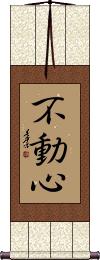
不動心 is one of the five spirits of the warrior (budo) and is often used as a Japanese martial arts tenet.
Under that context, places such as the Budo Dojo define it this way: An unshakable mind and an immovable spirit is the state of fudoshin. It is courage and stability displayed both mentally and physically. Rather than indicating rigidity and inflexibility, fudoshin describes a condition that is not easily upset by internal thoughts or external forces. It is capable of receiving a strong attack while retaining composure and balance. It receives and yields lightly, grounds to the earth, and reflects aggression back to the source.
Other translations of this title include unwavering mind, immovable mind, unwavering composure, imperturbability, steadfastness, keeping a cool head in an emergency, or keeping one's calm (during a fight).
The first two Kanji alone mean immobility, firmness, fixed, steadfastness, motionless, and idle.
The last Kanji means heart, mind, soul, or essence.
Together, these three Kanji create a title defined as “immovable mind” within the context of Japanese martial arts. However, in Chinese, it would mean “motionless heart,” and in Korean Hanja, “wafting heart” or “floating heart.”
Indomitable / Unyielding
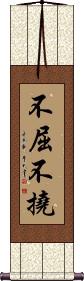
不屈不撓 means “Indomitable” or “Unyielding.”
不屈不撓 is a long word by Chinese standards. At least, it is often translated as a single word into English. It's actually a proverb in Chinese.
If you want to break it down, you can see that the first and third characters are the same. Both mean “not” (they work as a suffix to make a negative or opposite meaning to whatever character follows).
The second character means “bendable.”
The last means “scratched” or “bothered.”
So this really means “Won't be bent, can't be bothered.” I have also seen it written as “Will not crouch, will not submit.” This comes from the fact that the second character can mean “to crouch” and the last can mean “to submit” (as in “to give in” such as “submitting to the rule of someone else”). This may explain better why these four characters mean “indomitable.”
Notes:
Some will translate this as “indomitable spirit”; however, technically, there is no character to suggest the idea of “spirit” in this word.
Other translations include indefatigability, indomitableness, or unremitting tenacity.
The first two characters can be stand-alone words in Chinese.
In Japanese, this is considered two words (with very similar meanings). It's more common to see the word order flipped to 不撓不屈 in Japanese.
The same characters are used in old Korean Hanja. Just like in Japanese, the words are swapped to 不撓不屈 creating a word pronounced “불요불굴” in Korean.
See 不撓不屈
Warrior
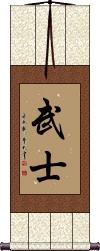
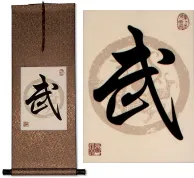
The first character, 武, is the spirit or essence of a warrior. The second character, 士, means soldier, officer, or official. 武士 is also used appropriately enough to describe a piece of a chess game. 武士 can also be translated as a soldier, cavalier, palace guard, or samurai, and sometimes as a knight. I've occasionally seen this translated as strong man or tough man (gender not necessarily implied).
By far, 武士 is the most common way to write warrior in Chinese characters, Japanese Kanji, and old Korean Hanja.
Note: In Japanese, this is Bushi, as in Bushido.
Dragon
Year of the Dragon / Zodiac Sign
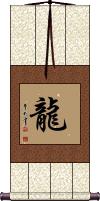
龍 is the character for dragon in Chinese, old Korean Hanja, and Japanese Kanji.
The dragon is a creature of myth and legend that dominates Chinese, Japanese, and even European folklore. In China, the dragon is the symbol of the Emperor, strength, and power, and the Chinese dragon is known as the god of water.
From the Chinese Zodiac, if you were born in the year of the Dragon, you . . .
Have a strong body and spirit.
Are full of energy.
Have vast goals.
Have a deep level of self-awareness.
Will do whatever you can to “save face.”
See also our Chinese Zodiac or Dragon Calligraphy pages.
This in-stock artwork might be what you are looking for, and ships right away...

Gallery Price: $168.00
Your Price: $92.88
Gallery Price: $150.00
Your Price: $82.88

Gallery Price: $177.00
Your Price: $97.88

Gallery Price: $72.00
Your Price: $39.88
Gallery Price: $158.00
Your Price: $87.77
Gallery Price: $200.00
Your Price: $99.88

Gallery Price: $31.00
Your Price: $16.88
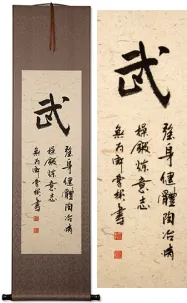
Gallery Price: $158.00
Your Price: $87.77

Gallery Price: $177.00
Your Price: $97.88
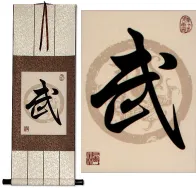
Gallery Price: $90.00
Your Price: $49.88
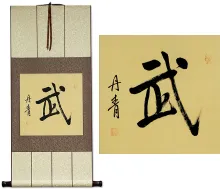
Gallery Price: $90.00
Your Price: $49.88
The following table may be helpful for those studying Chinese or Japanese...
| Title | Characters | Romaji (Romanized Japanese) | Various forms of Romanized Chinese | |
| Strong-Willed Strong of Heart | 氣の強い 気の強い | ki no tsuyo i kinotsuyoi | ||
| Spiritual Strength Strength of Spirit | 精神力量 | seishin rikiryou seishinrikiryou seishin rikiryo | jīng shén lì liàng jing1 shen2 li4 liang4 jing shen li liang jingshenliliang | ching shen li liang chingshenliliang |
| Strong and brave | 剛健勇猛 | gō ken yū mō gōkenyūmō | gāng jiàn yǒng měng gang1 jian4 yong3 meng3 gang jian yong meng gangjianyongmeng | kang chien yung meng kangchienyungmeng |
| Free Will | 自由意志 | jiyuu ishi / jiyuuishi / jiyu ishi | zì yóu yì zhì zi4 you2 yi4 zhi4 zi you yi zhi ziyouyizhi | tzu yu i chih tzuyuichih |
| Unbreakable | 壊れない | kowa re na i kowarenai | ||
| Indomitable Persistence Fortitude | 不屈 | fukutsu | bù qū / bu4 qu1 / bu qu / buqu | pu ch`ü / puchü / pu chü |
| Immovable Mind | 不動心 | fu dou shin fudoushin fu do shin | ||
| Indomitable Unyielding | 不屈不撓 不屈不挠 | fu kutsu fu tou fukutsufutou fu kutsu fu to | bù qū bù náo bu4 qu1 bu4 nao2 bu qu bu nao buqubunao | pu ch`ü pu nao puchüpunao pu chü pu nao |
| Warrior | 武士 | bu shi / bushi | wǔ shì / wu3 shi4 / wu shi / wushi | wu shih / wushih |
| Dragon | 龍 龙 | ryuu / tatsu ryu / tatsu | lóng / long2 / long | lung |
| In some entries above you will see that characters have different versions above and below a line. In these cases, the characters above the line are Traditional Chinese, while the ones below are Simplified Chinese. | ||||

Successful Chinese Character and Japanese Kanji calligraphy searches within the last few hours...



