Many custom options...


And formats...



Not what you want?
Try other similar-meaning words, fewer words, or just one word.
Gratitude Single Character in Chinese / Japanese...
Buy a Gratitude Single Character calligraphy wall scroll here!
Personalize your custom “Gratitude Single Character” project by clicking the button next to your favorite “Gratitude Single Character” title below...
Switched to secondary search mode due to lack of results using primary.
These secondary results may not be very accurate. Try a different but similar meaning word or phrase for better results. Or...
Look up Gratitude Single Character in my Japanese Kanji & Chinese Character Dictionary(My dictionary is a different system then the calligraphy search you just tried)
If you want a special phrase, word, title, name, or proverb, feel free to contact me, and I will translate your custom calligraphy idea for you.
1. One Day Seems Like 1000 Years
2. 100 Years of Happy Marriage
3. Year-In Year-Out Have Abundance
4. Ace / One
5. Acupuncture
6. Adoring Love
7. Adventure
8. Aiki Budo
9. Aikido
10. Aikikai
11. Aiki O'Kami
12. Akuma
13. Ambitious / To Improve Oneself
14. Angel / Messenger of Heaven
15. Animal Kingdom
16. Animals
17. Arata
19. Archer
20. Architect
21. Ardent / Fierce
22. Passionate Love / Ardent Love and Devotion
23. Army / Military
25. Great Aspirations / Ambition
29. Avenger
30. Awareness
31. Baby
32. Badger
33. Unmoved by the Eight Winds
35. Balance / Peace
36. Bamboo
37. Banzai / Wansui
38. Banzai
39. Bat
40. Be Yourself
41. Bean
42. Beau
43. Beauty / Beautiful / Handsome
44. Beautiful Life / Life in Perfect Harmony
46. Beautiful Soul
47. Beautiful Virtue
48. Beautiful Woman
49. Beautiful
50. Bee
53. Bellflower
54. Bellflower / Herb of Bellflower
55. Benevolent Heart
56. Beni
57. Best
58. Best Friends / Closest Friend
59. Best Friends
61. Better to be Happy than Rich
63. Big Wave
64. Bing
65. Black Dragon
68. Blue Dragon
69. Blue / Indigo
70. Bo
71. Bodhi - Awakening Enlightenment
72. Bodhidharma
73. Body
74. Body / Karada
76. Bond
77. Bones
78. Book
79. Bo Staff
80. Boxing
82. Brave Heart
84. English / Briton / Person from England
85. Brown
86. Bruce Lee
89. Buddhism
90. The Principles of Buddhism
91. The Buddha is in Each Sentient Being
92. Butt
One Day Seems Like 1000 Years
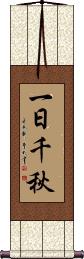
一日千秋 is a Japanese and Chinese proverb about missing someone.
一日千秋 is often used to express how hard it is to wait for someone's return or to be away from someone.
Some will translate this as “one day feels like a very long time” or “waiting for someone (something) is hard.”
You might see this romanized as a single word, Ichijitsusenshuu, or as “Ichijitsu Senshuu” from Japanese.
If you break down the characters one-by-one, we get:
一 = one/a
日 = day/sun (can also represent time or date)
千 = 1000/thousand
秋 = autumn/fall
Together, 千秋 can mean “autumn comes thousand times” (or 1000 years). It can also be read as 1000 periods of time.
However, it relays the idea of heartache as you wait for someone you miss.
100 Years of Happy Marriage
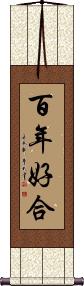
百年好合 is a wish or greeting, often heard at Chinese weddings, for a couple to have 100 good years together.
Some will translate this more naturally into English as: “May you live a long and happy life together.”
The character breakdown:
百 = 100
年 = Years
好 = Good (Happy)
合 = Together
Year-In Year-Out Have Abundance
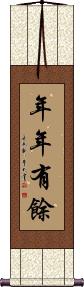
年年有餘 is a common proverb or wish of prosperity you'll hear around the time of Chinese New Year.
Directly translated character by character, it means “Year Year Have Surplus.” A more natural English translation including the deeper meaning would be “Every Year may you Have Abundance in your life.”
On a side note, this phrase often goes with a gift of something related to fish. This is because the last character, “yu” which means surplus or abundance, has exactly the same pronunciation in Mandarin as the word for “fish.”
This is also one of the most common titles for traditional paintings that feature koi fish.
In China, this phrase might make an odd wall scroll - a customer asked especially for this common phrase which is why it appears here. See my other abundance-related words if you want a wall scroll that will seem more comfortable in Chinese culture.
Note: This can be pronounced in Korean, but it's not a commonly used term.
See Also: Prosperity | Good Fortune
Ace / One
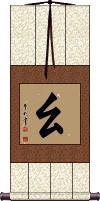
幺 means one, as used on a dice or in a card game.
Thus, in that context, it means Ace.
幺 can also be the surname “Yao” in both Chinese and Japanese.
Note: Rarely if ever used in Korean.
幺 can sometimes be written these ways: 

Acupuncture
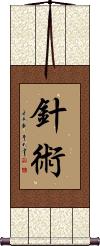
針術 is a way to write acupuncture in Chinese.
The first character means “needle” or “pin.”
The second character means “technique” or “method.”
This is theoretically a Japanese word as well but not commonly used.
Acupuncture
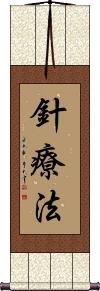
針療法 is one of two ways to write acupuncture in Chinese and Japanese.
The first character means “needle” or “pin.” The second character means “to treat” or “to cure.” The last character means “method” or “way.”
This is the only reasonable selection if your audience is Japanese. This is the formal way to express acupuncture in Chinese, so this version is universal in most of Asia (the best all-around choice in most cases).
Adoring Love
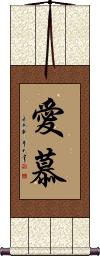
愛慕 means “adoring love” in Chinese, Japanese, and Korean.
I suppose this is the best kind of love to have. 愛慕 has the common character for love. But the second character modifies and reinforces the meaning to become adore, adoring love, or to love and adore.
Ancient Chinese warning:
Adoring someone is fine until you are in the shoes of the Prince of the Kingdom of Wu. This Prince adored a certain beautiful woman (Xi Shi) so much that he neglected his duties and soon let the kingdom fall into ruins.
Adventure
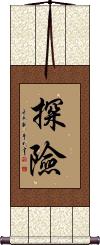
If you lead a life of adventure (like I do), a 探險 wall scroll is for you.
Alone, the first character can mean “to explore,” “to search out,” or “to scout.” The second character holds the meanings of “dangerous” and “rugged.” Together these two characters create the word that means “adventure” or “to explore.”
探険 is a modern Japanese Kanji version, but it more precisely means exploration or expedition rather than adventure. 探險 is the old/ancient Japanese version used before WWII. Let us know if you want the modern Japanese version instead.
See Also: Bon Voyage | Travel
Adventure
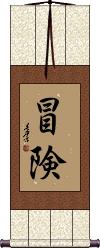
冒険 is a common Japanese way to say “Adventure.”
The first character can mean “to risk,” “to defy” or “to dare.” The second character means “inaccessible place” or “impregnable position.” Together, you get the idea of why these two characters mean adventure when put them together in Japanese.
Note: The second character is a morphed Japanese Kanji. The original Chinese version is also available and holds the same root meaning.
Adventure
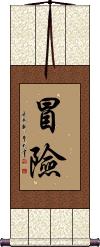
冒險 is another Chinese and Korean word for “Adventure.”
This is more of a “risk-taking” version of adventure.
The first character can mean “brave” and “bold.” The second character means “dangerous” and “rugged.” Together they can be defined as a word meaning “adventure” in Chinese and Korean.
Note: Some dictionaries translate these two characters as “take a risk.”
Aiki Budo
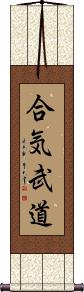
合気武道 is the title Aiki-Budo or “Aiki Martial Arts” in Japanese Kanji.
合 means “union” or “harmony.”
気/氣 means “universal energy” or “spirit.”
武 means “martial” or “military.”
道 means “way” or “method.”
合気武道 is the modern Japanese way to write this. You may also see 合氣武道, where the second character is written in the older traditional (pre-1945) form. If you want this written 合氣武道, just include a note or email with your order.
合氣武道 are all Chinese characters as well, so I included the Chinese pronunciation above. However, while it can be understood in Chinese, this is not a common term in that language and is not used in any Chinese martial arts. Also, 気 is only used in Japan - Chinese will understand 気 to be the Japanese form of 氣.
See Also: Martial Arts | Hapkido
Aikido
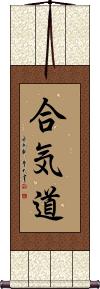
合気道 is the modern Japanese way to write Aikido.
Aikido is often referred to as the defensive martial art.
While Aikido was born in Japan, it has become a somewhat famous form of defensive tactics taught to soldiers and Marines, as well as some law enforcement officers in the West.
Looking at the characters, the first means “union” or “harmony.”
The second character means “universal energy” or “spirit.”
The third means “way” or “method.”
Please note that while the original 合氣道 characters can be pronounced in Chinese, this word is not well-known in China and is not considered part of the Chinese lexicon.
Note: It is somewhat accepted that this is the origin of Hapkido in Korea. And other than a modern simplification to the middle Kanji of this 3-Kanji word, it is written the same in Korean Hanja.
See Also: Martial Arts | Hapkido
Aikikai
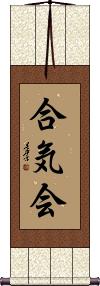
合気会 or “Aikikai” is the original school of Aikido.
Several organizations use this title. The first was established in Japan in 1940 (The Aikikai Foundation or 財団法人合気会).
The only difference between this title and Aikido is the last character, “kai” which means club, group, fraternity, organization, or assembly.
Note: 合気会 may be romanized with a dash like this: Aiki-Kai.
Aiki O'Kami

This is the Japanese martial arts Aiki O'Kami.
The Aiki (合気/合氣) means harmonious energy. While Okami or O'kami (大神) means great spirit.
You will usually see this title written as 合氣大神, though in modern Japanese (after 1945) the second character, 氣, was simplified to 気 in Japan (and 气 in China). I suggest you use 合氣大神, but please let me know when you order if you would prefer 合気大神 instead.
Akuma
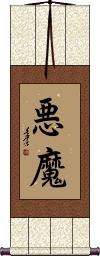
悪魔 is a Japanese word that means Devil, Demon, or Satan.
悪魔 is also the English/Japanese title for a character in Street Fighter.

 Note: In Japan, the Street Fighter is known as Gouki or Goki. This sort of means grand ghost, or great spirit. If you want this instead of the Akuma title, just click on the Goki Kanji to the right.
Ambitious / To Improve Oneself
Advance and Progress
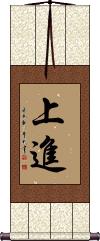
上進 is a Chinese and Japanese Kanji word that means to advance, to make progress, to do better, to be ambitious, to improve oneself, or to move forward.
This can refer to a single person, general things (such as a work project), or a whole country.
In Japanese, this is sometimes used as the given name Joushin.
Angel / Messenger of Heaven
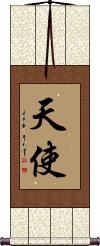
天使 is the meaning of Angel in Chinese, Japanese Kanji, and old Korean Hanja.
The first character means heaven. The second means messenger. Together it makes sense that we are talking about angels as Heaven's Messengers.
If you are an “Angel Junkie,” this may be the wall scroll for you.
I also think it's a great choice if your name happens to be Angel.
See Also: Angel
Animal Kingdom
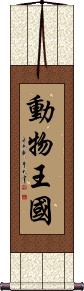
動物王國 is literally what it says.
There is even a TV show in China that is similar to Wild Kingdom or what you would currently see on the Discovery Channel that has this same title.
For your information: In the Chinese way of thinking, the Tiger is the king of the animal kingdom (lions are not native to China, so the tiger took the role that we have given to the lion in our western way of thinking).
The modern Japanese version has a slight variation on the last character (国 instead of 國). Let me know if you want the modern Japanese version (國 would be considered the old or traditional version).
Animals
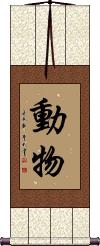
動物 is the way to write “animals” in Chinese characters, Japanese Kanji, and old Korean Hanja.
The first character means “moving,” and the second means “things.”
So animals are “moving things” in these Asian languages.
Arata
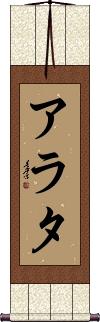
アラタ is the Japanese Katakana name, Arata, as in anime character Arata, the Legend.
Note: Because this title is entirely Japanese Katakana, it should be written by a Japanese calligrapher.
Archangel / Arch Angel
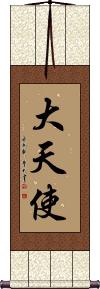
大天使 is the title Archangel in Chinese characters, Japanese Kanji, and old Korean Hanja.
The first character means big or great (in this case, it means “arch”).
The second means heaven (or sky).
The last means messenger.
The second and third characters together make the title for angel, which is literally “Heaven's Messenger.”
This title would be understood as “The Chief of all Angels,” or “The Great Angel.” Some might even say it's the boss of Angels.
See Also: Angel
Archer
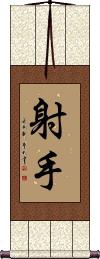
射手 means archer, shooter, or marksman in Chinese, Japanese Kanji, and old Korean Hanja.
Depending on the context, it can also mean “goal-getter” in Chinese. This would also be the word for a bowman.
射手 is modern in Asia, meaning that it's only been in use for a few hundred years. However, the more ancient version of the archer is often not even recognized by the current generation of Chinese and Japanese people.
The first character means “shoot” or “fire” (in the context of a gun or bow). It's also a suffix for radioactive things (in the context of chemistry) - radioactive things “fire off” electrons. In Japanese, the first Kanji is a short name and suffix for archery.
The second character means “hand,” but the hand can also mean a person, in the same way, that a “farmhand” is a person in English.
Architect
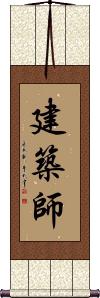
建築師 means Architect in Chinese.
The first two characters mean construction or architecture (of buildings).
The last character means teacher, master, or expert.
Ardent / Fierce
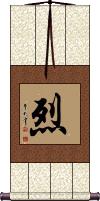
烈 is a Chinese word that means ardent; intense; fierce; stern; upright; to give one's life for a noble cause.
In another context, this character can refer to one's exploits or achievements.
In the Buddhist context, this is burning, fierce, virtuous, and/or heroic.
While technically, it had the same meaning in Japanese, it's usually a female given name, Retsu in Japanese these days.
Passionate Love / Ardent Love and Devotion
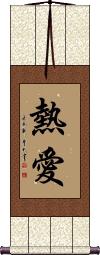
熱愛 means love passionately, ardent love, devotion, adoration.
The literal meaning is “hot love,” as the first character means heat, fervent, hot, and warm. Sometimes it can mean fever, restlessness, or zeal. The second character is, of course, love. If you adore and are devoted to someone with all your love, this is the title for you.
Army / Military
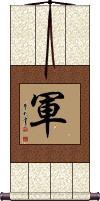
I Climbed the Great Wall

登长城 means to ascend or to climb the Great Wall of China.
登長城 is the poetic and native way to express this feat.
登 means “to ascend” and is a classical verb used in inscriptions, poems, and calligraphy.
长城 is the title of the Great Wall.
This three-character phrase is concise and implies achievement rather than casual travel.
Great Aspirations / Ambition
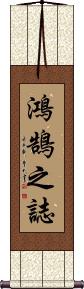
鴻鵠之誌 is a Chinese proverb that implies that having grand ambitions also means that others will not understand your great expectations and ideas.
Though the actual words come from a longer saying of Confucius, which goes, “The little swallows living under the eaves wouldn't understand the lofty ambitions of a swan (who flies far and wide).”
This Confucius quote has led to this idiomatic expression in China that means “think big.” What you'd be saying is “The lofty ambitions of a swan.”
Note that Chinese people sometimes refer to the little swallow as one who does not “think big” but is, instead, stuck in a rut or just leading a mundane life. Therefore, it's a compliment to be called a swan but not a good thing to be called a swallow.
Great Aspirations / Ambition
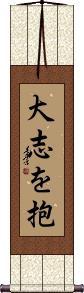
大志を抱 is a single Japanese word that kind of reads like a short proverb.
It suggests that you should have “high aims,” “ambitions,” or “aspirations” in your life.
Aspire / Burning Desire
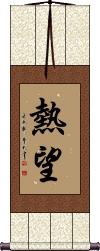
熱望 is a Chinese, Japanese Kanji, and old Korean Hanja word that means, to aspire, longing for, or burning desire.
The first character means hot, heated, or burning.
The second character means hope, expectations, aspiration, or desire.
Great Expectations
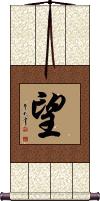
望 holds the ideas of ambition, hope, desire, aspiring to, expectations, looking towards, to gaze (into the distance), and in some contexts, full moon rising.
望 is one of those single characters that is vague but in that vagueness, it also means many things.
望 is a whole word in Chinese and old Korean but is seldom seen alone in Japanese. Still, it holds the meanings noted above in all three languages.
Autumn / Fall Season
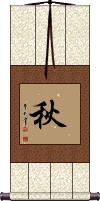
秋 is the word/character used to describe the Autumn or Fall season in Chinese and Japanese.
See Also: Winter | Spring | Summer | Four Seasons
Avenger
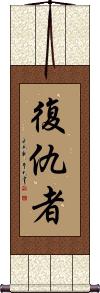
復仇者 is a Chinese title that means avenger or taker of revenge.
The first two characters literally mean avenge, vengeance, reprisal, or revenge.
The last character is a way to say, person. This last character is like adding -er or -ist to subjects like write and art to get writer and artist.
Avenger
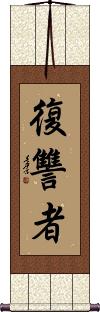
復讐者 is a Japanese Kanji title that means avenger or revenger.
The first two characters literally mean revenge or avenge.
The last character is a way to say a person (or soldier/warrior).
Altogether, you have something like, an “avenging person,” hence avenger.
Awareness
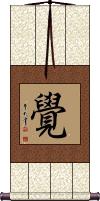
覺 can mean to feel; to figure out; thinking; awake; aware; bodhi; knowing; understanding; enlightenment; illumination; apprehend; perceive; realize.
覺 is a character that is impossible to define in a single word.
This term is often associated with Buddhism where it's understood to be: Illumination, enlightenment, or awakening in regard to the real in contrast to the seeming. However, it can also refer to enlightenment in regard to morality and evil.
Notes:
In Japanese, this can be the personal name Satoru.
In certain context, and only when pronounced as "jiao" in Chinese, it can refer to a nap, sleep or the state of sleeping. However, as a single character on a wall scroll, everyone will read this with the awareness or enlightenment context.
By no means is this the only way to write enlightenment. In fact, you should only choose this character if you are looking more for a word meaning awareness.
See Also: Enlightenment | Wisdom | Knowledge
Baby
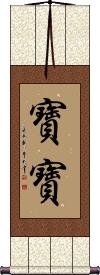
寶寶 is how Chinese people express “baby.”
The word is composed of the same character twice, and therefore literally means “double precious” or “double treasure.”
This would be a nice wall scroll to put either inside or by the door of your baby's room (not on the door, as wall scrolls swing around wildly when hung on doors that open and close a lot).
Badger
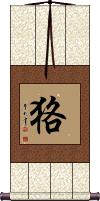
狢 is a Japanese word that means badger or “raccoon dog” (Nyctereutes procyonoides).
I have included the Chinese and Korean pronunciations above. However, this character is rarely used character in modern Chinese and Korean.
Unmoved by the Eight Winds

八風吹不動 is an ancient Buddhist phrase from about 1000 years ago.
Literal meaning: “The Eight Winds cannot move [me].”
The original famous anecdote is from Song Dynasty China, involving the poet-official 蘇東坡 (Su Dongpo / Su Shi, 1037–1101) and Zen master 佛印 (Foyin).
Su Dongpo wrote 八風吹不動,一屁打過江
“The Eight Winds cannot move me; Yet one fart blows me across the river.”
Foyin’s irreverent reply exposed Su Dongpo’s ego, which is kind of a classic Zen/Chan teaching story.
利 gain
衰 loss
毀 disgrace
譽 praise
稱 honor
譏 ridicule
苦 suffering
樂 pleasure
“The Eight Winds cannot move [him / the mind].”
“Unmoved by the Eight Winds.”
“The Eight Winds do not move me.”
“Not moved by the Eight Winds.”
“Unshaken by the Eight Winds.”
“Unaffected by the Eight Winds.”
“Unmoved by worldly forces.”
“Steadfast against the Eight Winds.”
“Remaining unmoved amid the Eight Winds.”
There is a shorter Japanese Zen version, 八風不動, which drops the middle character. Often romanized as happū fudō. The romanization of 八風吹不動 is arguably happū fukedomo ugokazu or happū sui fudō.
White Eagle Style
Bai Ying Pai
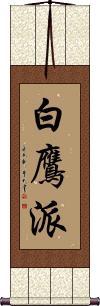
白鷹派 is the title “Bai Ying Pai” or “White Eagle School.”
The first character means white.
The second means eagle, falcon, and/or hawk.
The third means school (as in the school or style of martial arts).
Balance / Peace
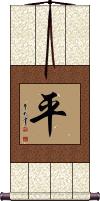
平 is a single character that means balance in Chinese but it's not too direct or too specific about what kind of balance.
Chinese people often like calligraphy art that is a little vague or mysterious. In this way, you can decide what it means to you, and you'll be right.
平 is also part of a word that means peace in Chinese, Japanese, and old Korean.
Some alternate translations of this single character include: balanced, peaceful, calm, equal, even, level, smooth, or flat.
Note that in Japanese, this just means “level” or “flat” by itself (not the best choice for balance if your audience is Japanese).
Bamboo
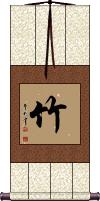
竹 is the character that means bamboo in Chinese, Japanese Kanji, and old Korean Hanja.
In Asian cultures, bamboo is often seen as a symbol of a noble gentleman (tall, straight, and honest).
There are also some multi-character bamboo words that regard individual bamboo plants, species of bamboo, bamboo as lumber, and edible bamboo shoots. However, this single character seems most appropriate for a wall scroll and covers the whole category of Asian bamboo.
Banzai / Wansui
Old Japanese / Traditional Chinese & Korean
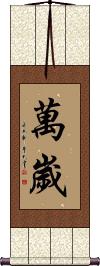
萬歲 is the traditional Chinese, Korean Hanja, and ancient Japanese way of writing banzai.
In modern times, the first character was simplified in Japan and China. So you might want to select the other entry for universal readability.
While it has become a popular, if not an odd, thing to scream as you jump out of an airplane (preferably with a parachute attached), banzai is actually a very old Asian way to say “hooray.” The Japanese word “banzai” comes from the Chinese word “wan sui,” which means “The age of 10,000 years.” It is actually a wish that the Emperor or the Empire live that long.
Imagine long ago when the Emperor made a rare public appearance. 萬歲 is what all people would yell to their leader in respect.
So if you like it as a hooray, or you want to wish someone that they live for 10,000 years, this is the calligraphy for you.
Other translations include Cheers! (not the drinking kind), hurrah!, long live [name]!, and congratulations!
To other things with banzai in their names, I am still waiting for the promised sequel to Buckaroo Banzai.
Notes: Sometimes people confuse banzai with bonsai. A bonsai is a miniature tree. They have nothing to do with each other.
Banzai
Modern Japanese Version
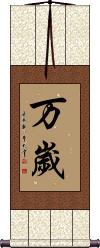
万歲 is the modern Japanese way to write banzai.
We've made two almost identical entries for this word, with just a variation on the first character. In the last century, 萬 was simplified to 万 in Japan and China. The new generation will expect it to be written as 万 but the old generation can still read the more traditional 萬 form. You must make your determination as to what version is best for you. If your audience is mostly Japanese, I suggest 万歲.
While it has become a popular, if not an odd, thing to scream as you jump out of an airplane (preferably with a parachute attached), banzai is actually a very old Asian way to say “hooray.” The Japanese word “banzai” comes from the Chinese word “wan sui” which means “The age of 10,000 years.” It is actually a wish that the Emperor or the Empire live that long.
Imagine long ago when the Emperor made a rare public appearance. This is what all of the people would yell to their leader in respect.
So if you like it as a hooray, or you want to wish someone that they live for 10,000 years, this is the calligraphy for you.
To other things with banzai in their names, I am still waiting for the promised sequel to Buckaroo Banzai.
Other translations: hurrah, long life, congratulations, cheers, live long.
Notes: Sometimes people confuse banzai with bonsai. A bonsai is a miniature tree. They have nothing to do with each other. Further, Bonzai is not a word at all - although it would make a great name for a calcium supplement for older people.
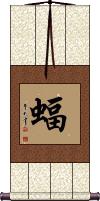
蝠 is the simplest way to write bat in Chinese and old Korean Hanja.
This also means bat in Japanese but is almost never written alone like this (it's often part of other titles for vampire bats or fruit bats).
In Chinese culture, the bat is a good luck charm, as the pronunciation is very similar to the word for “good luck” or “good fortune.” The character for bat (蝠) even looks like the good luck (福) character.
Be Yourself
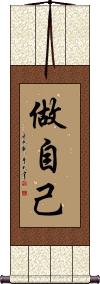
做自己 means “be yourself” in Chinese.
The first character means “to be,” “to become,” or “to act as.”
The last two characters are a word that means “oneself” or “yourself.”
Bean
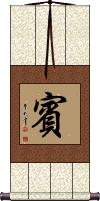
賓 is the name Bean in Chinese (Mandarin).
賓 means honored guest.
Beau
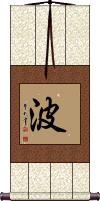
This is a common transliteration to Mandarin Chinese for the name Beau.
This Chinese character means “wave.”
Beauty / Beautiful / Handsome
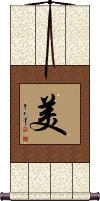
美 is often used to describe the beauty of a woman.
However, when applied to a man, it can mean handsome. It's also the first character in the word for “beauty salon” which you will see all over China and Japan.
This can be used as the given name for a girl (spell it or say it as “Mei” or “May”).
For a bit of trivia: The title for the “USA” in Chinese is “Mei Guo” which literally means “Beautiful Country.” This name was bestowed at a time before Chairman Mao came to power and decided that China didn't like the USA anymore (even though we fought together against the Japanese in WWII). But these days, Chinese people love Americans (but have a distaste for American politics and policy). But I digress...
美 is also how “Beautiful” is written in Japanese Kanji and Korean Hanja. 美 can also mean: very satisfactory; good; to be pleased with oneself; abbreviation for the USA; fine; handsome; admirable; madhura; sweet; and/or pleasant.
See Also: Beautiful Woman | Beautiful Girl
Beautiful Life / Life in Perfect Harmony
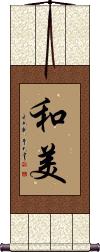
和美 is a word that means “harmonious” or, “in perfect harmony.”
The deeper meaning or more natural translation would be something like, “beautiful life.”
The first character means peace and harmony.
The second character means beautiful. But in this case, when combined with the first character, beautiful refers to being satisfied with what you have in your life. This can be having good relations, good feelings, comfort, and having enough (with no feeling of wanting).
Note: In Japanese, this is often used as the name "Wami." This title is probably more appropriate if your audience is Chinese.
Beautiful Princess
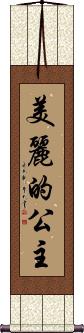
美麗的公主 is how to write beautiful princess in Chinese.
The first two characters mean feminine beauty or rather a way to say beautiful that only applies to women. The middle character is just a connecting character. The last two characters mean princess.
See Also: Queen
Beautiful Soul
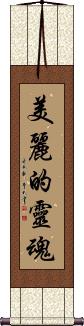
美麗的靈魂 means “Beautiful Soul” in Chinese.
The first two characters mean beautiful, beauty, or gorgeous.
The middle character connects the ideas (a possessive article).
The last two characters mean soul or spirit.
Beautiful Virtue
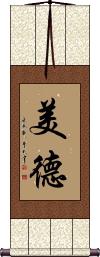
美德 written in Chinese or Korean Hanja can also mean “grace of character” or “noble virtue.”
 There is a slight variation in the modern Japanese Kanji form of the second character. If you want the modern Japanese version, please click on the special Kanji shown to the right instead of the button above. Note that the traditional Chinese form is still readable and understood by Japanese people (
it’s
the ancient Japanese form anyway).
There is a slight variation in the modern Japanese Kanji form of the second character. If you want the modern Japanese version, please click on the special Kanji shown to the right instead of the button above. Note that the traditional Chinese form is still readable and understood by Japanese people (
it’s
the ancient Japanese form anyway).
Beautiful Woman
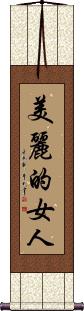
美麗的女人 is the best and most polite way to express “beautiful woman” in Chinese.
Note: Some people may like the simple 2-character 美女 way to express this, but there are some bad connotations with that, so better to stay with this longer and more respectful title.
See Also: Beautiful Girl | Beauty
Beautiful
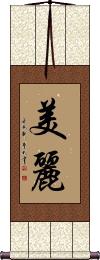
美麗 is a two-character word used often in Chinese, old Korean, and ancient Japanese to express beauty.
I've had a few requests for a “two-character beautiful,” and this is by far the best word. This is not a common word for an Asian person to want on a wall scroll. However, you will see it commonly used as an adjective in phrases, stories, and titles throughout magazines and signage in China.
美麗 can also be translated as gorgeous or lovely.
Note: 美麗 is not commonly used in modern Japan.
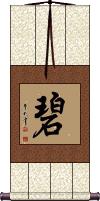
碧 is a common transliteration to Mandarin Chinese for the name Bee.
This has nothing to do with the insect bee. The meaning of the character is actually “fresh and green.”
Mind of the Beginner
Shoshin
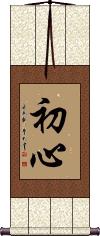
初心 is often translated in Japanese as “beginner's mind” or “beginner's spirit.”
In Chinese, the dictionary definition is “one's original intention.”
The first character means first, initial, primary, junior, beginning, or basic.
The second character means heart, mind, soul, or essence.
初心 is one of the five spirits of the warrior (budo) and is often used as a Japanese martial arts tenet. Under that context, places such as the Budo Dojo define it this way: The state of shoshin is that of a beginners mind. It is a state of awareness that always remains fully conscious, aware, and prepared to see things for the first time. The attitude of shoshin is essential to continued learning.
Believe / Faith / Trust
śraddhā
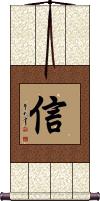
信 can mean to believe, truth, faith, fidelity, sincerity, trust, and confidence in Chinese, old Korean Hanja, and Japanese Kanji.
This single character is often part of other words with similar meanings.
It is one of the five basic tenets of Confucius.
In Chinese, it sometimes has the secondary meaning of a letter (as in the mail) depending on context but it will not be read that way when seen on a wall scroll.
In the Buddhist context, this is śraddhā (faith through hearing or being taught).
Bellflower
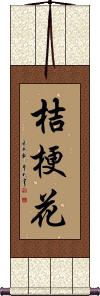
桔梗花 means “Chinese bellflower” in Japanese.
 In Chinese, it refersto the “Platycodon grandiflorus” (Platycodon grandiflorum), “balloon flower,” or “bellflower.”
桔梗花 is the three-character version of this title, which suggests that you are talking about the flower and not the medicinal herb derived from this kind of plant.
Bellflower / Herb of Bellflower
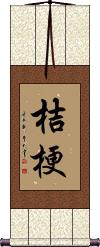
桔梗 means “Chinese bellflower” in Japanese.
In Chinese, it refers to the “Platycodon grandiflorus” (Platycodon grandiflorum), “balloon flower,” or “bellflower.”
Please note that in Chinese, this particular 2-character title suggests that you are talking about the medicinal herb derived from the stem of this flower/plant.
Benevolent Heart
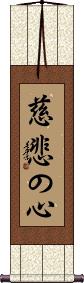
慈悲の心 means benevolent heart, compassionate heart, or merciful heart in Japanese.
This is a Japanese-only phrase and should be ordered from our Japanese master calligrapher. This is because the third character is unique Hiragana.
Chances are you are into Inuyasha and are seeking the title of chapter 471 which is often translated as “Merciful Heart.”
Beni
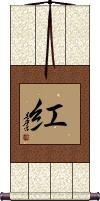
紅 is the Japanese name Beni.
紅 is the name used by Arashiro Beni (安良城紅) a Japanese R&B singer. The actual meaning of this character is “red.”
Best
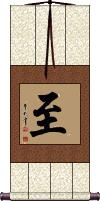
至 is a little strange as calligraphy, but 至 would be the character that means “best” or “extreme” in Chinese and Korean.
The problem is, this is seldom used alone. It's mostly used in combination with other characters to make words like “best friend,” “best food,” and “best love.”
I do not recommend this character for a wall scroll. It's better if you find a more specific term that fits your circumstances.
Note: This can be pronounced in Japanese and has a similar meaning but it is rarely if ever used in modern Japanese.
Best Friends / Closest Friend
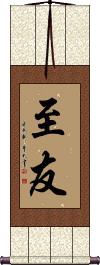
至友 is one way to say best friend in Chinese.
The first character can mean “most,” “extreme,” or “best.”
The second character means “friend” or “friends” (plural forms work differently in China).
Can also be translated as “close friend” or “most intimate friend.”
See Also: Friendship | Soulmates
Best Friends
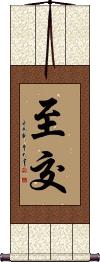
至交 is an alternate way to say best friend in Chinese.
The first character can mean “most,” “extreme” or “best.” The second character means “making friends” or “building friendship.” There's sort of a suggestion with the second character that fate caused you to intersect in life and become friends (that character can mean intersection in some context).
This can also mean “most intimate friend,” “very good friend of long-standing,” or “closest friend.”
See Also: Friendship | Soulmates
Best Friends / Buddies
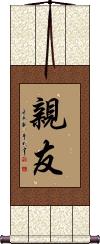
親友 is the Japanese way to say “best friend.”
The first character can mean “relative” or sometimes “parents.” The second character means “friend.” Think about the close relationship that Japanese people have with their parents and relatives, and this starts to mean “close friends.”
Some Japanese-English dictionaries also translate this as “bosom friend,” “old friend,” “intimate friend,” “buddy,” “crony” or “chum.”
Note that in Chinese, this means “relatives and friends.” It's a good meaning in Chinese, but it's not quite the same as “best friends.”
Better to be Happy than Rich
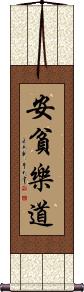
安貧樂道 means “It's better to be happy than rich” in Chinese.
Even if you are poor, you should still feel satisfied in your life...
...Satisfaction, happiness and the meaning of your life come from within yourself and not from money or riches of the world.
In Chinese, there are a lot of four-character proverbs which express some very old philosophies.
Though there are only four characters on this scroll, in Chinese, the meanings often surpass the dictionary definition of each character.
In this case, you should not set your expectations too high for the money or riches you wish to have. One who sets their expectations too high is almost always disappointed. Instead, you should cherish what you have, seek to improve yourself from within, and not measure your worth by the size of your bank account.
Beyond / Exceed / Surpass
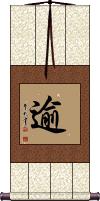
逾 means: to exceed; to go beyond; to transcend; to cross over; to jump over.
You'll see this character used in Buddhism (same meaning).
Technically, this single character is a Japanese word but is seldom used as a single Kanji in modern Japanese.
Big Wave
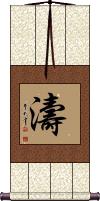
濤 is the Chinese character for “Big Wave.”
It suggests a wave unlike most, strong and powerful.
濤 is technically also a Japanese Kanji, and Korean Hanja but it's not commonly used in those Asian languages. Pronunciation in Japanese and Korean is provided above for reference only. Just order this if your audience is Chinese.
Bing
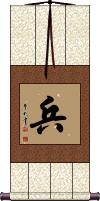
兵 is the name Bing in Chinese (Mandarin).
兵 means soldier.
Black Dragon
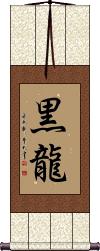
黒龍 is a generic title for “Black Dragon.”
The first character is black color.
The second means dragon.
Sometimes written as 黑龍 (just a minor variation in the first character).
Black Dragon
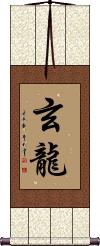
玄龍 is a sophisticated or scholarly way to say “Black Dragon.”
玄龍 is the title you'd expect in ancient Chinese literature.
The first character means black or mysterious.
The second character means dragon.
This black dragon represents a king dwelling in the depths of the mystic waters.
Bloodless Victory
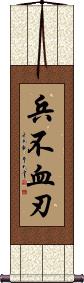
Perhaps a pacifist view or perhaps the best kind of victory; 兵不血刃 reflect this idea:
The edges of the swords not being stained with blood.
You could also translate it as: Win victory without firing a shot.
The first character means army or force. The second character means without or none. The last two characters mean bloodstained knives. So it represents a returning victorious army without bloodstained knives. 兵不血刃 is the very literal sense of this Chinese proverb. The title definition is more accurate to the way this proverb is understood.
Asking yourself why the direct or literal translation is different?
...Think of compound words in English such as “nevertheless” if we break it apart to “never the less,” we will have trouble getting the real definition of “in spite of that.” Similar things happen when multiple characters create a compounded word in Chinese.
Blood Sweat and Tears
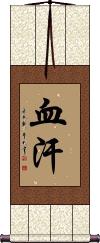
血汗 is a short Chinese and Japanese word that literally means “blood and sweat” but can be used to mean “blood, sweat, and tears.”
The first character means blood, and the second is sweat (but tears can be a category of salty water excreted by the body).
Blue Dragon
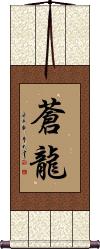
蒼龍 is one of a couple of possible titles for “blue dragon” (occasionally also translated as “green dragon”).
The first character means “deep blue” or “azure.”
The last character is dragon.
Blue / Indigo
Color
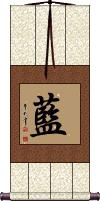
藍 is the single character for the color blue in Chinese.
It can also mean indigo in Japanese Kanji and old Korean Hanja.
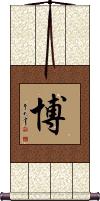
博 is the name Bo in Chinese (Mandarin).
博 means abundant.
Bodhi - Awakening Enlightenment
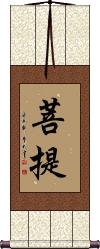
The Bodhi or 菩提 is the moment of completion in Buddhism.
It is when all things become known and you have completed your journey to enlightenment.
The reference is to the Bodhi tree where Siddhartha Gautama (the legendary man who established the Buddhist religion) achieved enlightenment. Sometimes this is referred to as “the tree of enlightenment,” but if you want the full version with the character for a tree at the end, please see the Bodhi Tree entry.
See Also: Buddhism | Buddha | Nirvana | Enlightenment
Bodhidharma
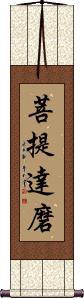
菩提達磨 is the title Bodhidharma in Chinese and Japanese.
Bodhidharma, commonly known as Damo, is reputed as the founder of the Chan (Zen) or Intuitional or Mystic School.
He likely came from south India and spread Mahayana Buddhism throughout China (even meeting the Emperor) and his disciples likely spread this all the way to Korea, Japan, and beyond in the 5th and 6th centuries.
Sometimes the last character varies in Chinese to 摩 instead of 磨 - let me know if you need a certain variation when you order.
Body
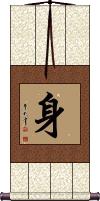
身 is how to write “body” as in your human body, in Chinese, Japanese Kanji, and Korean Hanja.
Depending on the context and certain language issues, this character can also mean: main part, hull, oneself, somebody, person, I, me, sword, lifetime, one's station in life, etc.
While this written word is universal in three languages, it still makes a rather odd selection for a wall scroll. Also, they tend to use 体 (karada) in Japanese for the body (depending on context).
See Also: Karada
Body / Karada
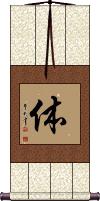
体 is used in Japanese to mean “body.”
体 can also refer to the form, style, corporeal existence, appearance, identity, or state of something or someone. 體 is also used in Buddhism in regard to the corporeal existence of someone (their earthy vessel). It's kind of a broad term that can be used in a lot of different ways.
As a single character, it's usually pronounced “karada” but it can also be pronounced “tai” or “te” (Japanese pronunciation borrowed from the original Chinese).
體 is not a common Kanji to use for a wall scroll. Only select this if you have a personal and meaningful reason to do so. Also, consider this version to be “Japanese only” - see below...
 In Chinese and old Korean Hanja, this character is written in the traditional form shown to the right. If you want this version, click on the character to the right instead of the button above.
Body and Earth in Unity
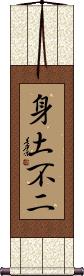
身土不二 (Shindofuni) is originally a Buddhist concept or proverb referring to the inseparability of body-mind and geographical circumstances.
This reads, “Body [and] earth [are] not two.”
Other translations or matching ideas include:
Body and land are one.
Body and earth can not be separated.
Body earth sensory curation.
You are what you eat.
Indivisibility of the body and the land (because the body is made from food and food is made from the land).
Going further, this speaks of our human bodies and the land from which we get our food being closely connected. This phrase is often used when talking about natural and organic vegetables coming directly from the farm to provide the healthiest foods in Japan.
Character notes: 身(shin) in this context does not just mean your physical body but a concept including both body and mind.
土 (do) refers to the soil, earth, clay, land, or in some cases, locality. It's not the proper name of Earth, the planet. However, it can refer to the land or realm we live in.
Japanese note: This has been used in Japan, on and off, since 1907 as a slogan for a governmental healthy eating campaign (usually pronounced as shindofuji instead of the original shindofuni in this context). It may have been hijacked from Buddhism for this propaganda purpose, but at least this is “healthy propaganda.”
Korean note: The phrase 身土不二 was in use by 1610 A.D. in Korea, where it can be found in an early medical journal.
In modern South Korea, it's written in Hangul as 신토불이. Korea used Chinese characters (same source as Japanese Kanji) as their only written standard form of the language until about a hundred years ago. Therefore, many Koreans will recognize this as a native phrase and concept.
See Also: Strength and Love in Unity
Bond
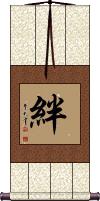
This Kanji represents a bond, as in the bond between mother and daughter, father and son, family ties, or a family bond.
絆 is the kind of character that says, no matter what happens (difficult times), we have this bond that cannot be broken.
If you go to the Japanese dictionary, the definition is the bonds (between people), (emotional) ties, relationship, connection, link, tether, or fetters.
Read this before ordering...
This Kanji is best if your audience is Japanese. While this is also a Chinese character, it has a completely different meaning in Chinese (it means to hinder or stumble in Chinese).
it’s
a very rare character in Korean Hanja but does mean bond in Korean (used in Korean words for certain kinds of glue and sticking plaster).
Bones
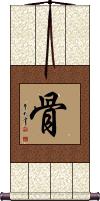
骨 is Chinese, Japanese, and Korean for bone or bones.
If your name happens to be Bone or Bones, this is a cool character for a wall scroll to hang in your home or office.
Book
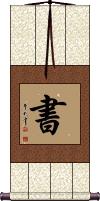
書 is the most simple way to say “book” in Chinese, Japanese, and Korean.
書 is usually read as “book” but can refer to a letter, or document.
In a certain context, it can refer to writing, penmanship, or handwriting. Especially in Chinese, it can be a short way to say calligraphy.
If you love books or want to write books, this is the simple, all-encompassing character for you.
Bo Staff

棒 is the Kanji for bo staff.
In the context of martial arts, this is a bo staff. However, the actual meaning of this character is stick, club, cudgel, pole, rod, baton, or staff.
Boxing
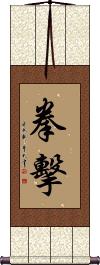
拳擊 is the term used in Chinese to refer to the original Olympic sport of combat and fighting.
If you like to strap on your boxing gloves and go a few rounds or are just a fan of boxing, this could make a nice wall scroll for you.
Note that Japanese use the same first character (which means fist) but a different Kanji for the second. Please see our Japanese boxing entry for that version.
Boxing
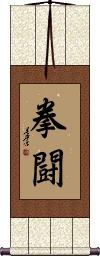
拳闘 is the term used in Japanese Kanji to refer to the original Olympic sport of combat and fighting.
This can also be translated as prizefighting.
The first Kanji means fist. The second means fight. So when literally translated, this means “fistfight” (though understood in Japanese as a more refined sport, versus street fighting).
Note: A completely different second character is used in the Chinese word for boxing but a Chinese person would still be able to guess the meaning of these Kanji.
Boys be Ambitious
Quote from William S. Clark in Japan
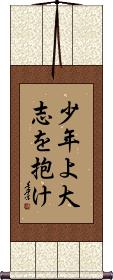
少年よ大志を抱け was a sort of motto or proverb invoked by William Clark after being hired by the Emperor of Japan in 1876 to establish a university in Hokkaido, Japan.
This phrase has been famous across all generations of Japan since that time.
More about William S. Clark's adventures in Japan.
Note: Because this selection contains some special Japanese Hiragana characters, it should be written by a Japanese calligrapher.
Brave Heart
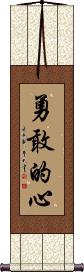
勇敢的心 is the title “Braveheart,” as in the movie starring Mel Gibson.
The character meanings break down this way:
勇敢 brave.
的 possessive particle.
心 heart/mind.
Bravery / Courage
Courage in the face of Fear
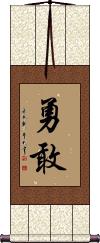
勇敢 is about courage or bravery in the face of fear.
You do the right thing even when it is hard or scary. When you are courageous, you don't give up. You try new things. You admit mistakes. This kind of courage is the willingness to take action in the face of danger and peril.
勇敢 can also be translated as braveness, valor, heroic, fearless, boldness, prowess, gallantry, audacity, daring, dauntless, and/or courage in Japanese, Chinese, and Korean. This version of bravery/courage can be an adjective or a noun. The first character means bravery and courage by itself. The second character means “daring” by itself. The second character emphasizes the meaning of the first but adds the idea that you are not afraid of taking a dare, and you are not afraid of danger.
勇敢 is more about brave behavior and not so much the mental state of being brave. You'd more likely use this to say, “He fought courageously in the battle,” rather than “He is very courageous.”
Bravery / Courage
Single Character for Courage
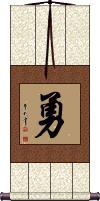
勇 can be translated as bravery, courage, valor, or fearless in Chinese, Japanese and Korean.
勇 is the simplest form to express courage or bravery, as there is also a two-character form that starts with this same character.
勇 can also be translated as brave, daring, fearless, plucky, or heroic.
This is also a virtue of the Samurai Warrior
See our page with just Code of the Samurai / Bushido here
English / Briton / Person from England
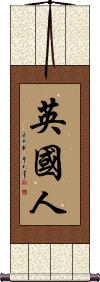
英國人 is the traditional Chinese and Japanese way to write British person, Briton, English person, Englishman, Englishwoman, etc.
In modern Japan, the middle character has been simplified, making it 英国人. This same simplification is used in mainland China as well.
Brown
Single character for brown color
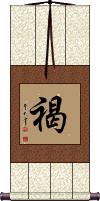
褐 is the most simple way to express brown in Chinese.
It also means brown in Japanese but this character is not often written alone in Japanese (they would tend to write 褐色 (brown color) to refer to brown or the color of tanned skin.
In some contexts, this can refer to gray or a dark color, or coarse hemp cloth.
In the Buddhist context, it can refer to a coarse serge (cheaply sewn clothing) hence poverty.
Note: In Taiwanese Mandarin, this is spoken with the 2nd or rising tone instead of the 4th or falling tone used in the mainland.
Bruce Lee
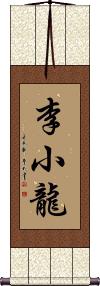
李小龍 is the real full name of Bruce Lee.
 Many people have no idea that Bruce Lee had a “real” Chinese name. In Mandarin and Cantonese, he is known as “Lǐ XiǎoLóng” and “Léi SíuLùng” respectively.
He kept his family name pronunciation (Li = Lee). 李 is a common family name that also means “plum.”
His given name 小龍 (Xiao-Long), literally means “little dragon.” 李小龍 is why you often see the character for dragon associated with Bruce Lee on various posters etc.
For a pronunciation lesson, the “X” in Romanized Mandarin is pronounced like a “sh” sound but with your tongue at the bottom of your mouth. The vowel sound in “Long” is like the English “oh,” not like the “ah” sound in the English word “long.”
If you are a big Bruce Lee fan, you should know this information, and you should have this wall scroll hanging in your room or martial arts studio.
Note: Japanese use these same Chinese characters / Kanji to write Bruce Lee's real name (with different pronunciation - which is a bit like how the name “Bruce Lee” sounds in English).
See Also: Kung Fu | Martial Arts
Buddhism / Buddha
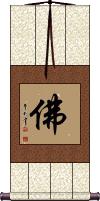
佛 is the essence of the Buddha or Buddhism.
Depending on the context, this word and character can be used to refer to the religion and lifestyle of Buddhism, or in some cases, the Buddha himself.
It is interesting to note that this word is separate from all others in the Chinese language. The sound of “fo” has only this meaning. 佛 is in contrast to many sounds in the Chinese language, which can have one of four tones, and more than 20 possible characters and meanings. This language anomaly shows how significantly Buddhism has affected China since ancient times.
More about Buddhism
佛 is also used with the same meaning in Korean Hanja.
It's used in the very religious context of Buddhism in Japan. It should be noted that there are two forms of this Kanji in use in Japan - this is the more formal/ancient version, but it's rarely seen outside of religious artwork and may not be recognized by all Japanese people.
It also acts as a suffix or first syllable for many Buddhist-related words in Chinese, Japanese, and Korean.
See our Buddhism & Zen page
See Also: Bodhisattva | Enlightenment
Buddha / Buddhism
Hotoke
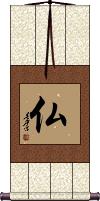
仏 is the single Japanese Kanji that can mean Buddha or Buddhism.
This Kanji was a shorthand way to write 佛 (Buddha) in Chinese (popular around the 13th century). Somehow, this became the version of this Chinese character that was absorbed into Japanese and thus became part of standard Kanji. Centuries later, this character is not recognized in China (except for those from China with a background in Chinese literature or language).
仏 is also a rare or derivative Korean Hanja form - but I doubt you will find any Korean that knows that.
Buddhism
(2 Kanji)
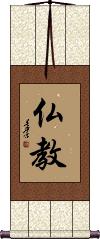
仏教 can mean Buddha or Buddhism in Japanese.
Depending on the context, this word can be used to refer to the religion and lifestyle of Buddhism or in some cases, the Buddha himself.
Note: Until the 5th century, Japan did not have a written language. At that time, Japan absorbed Chinese characters to form their written language (these characters are known as “Kanji” in Japanese). The first character of this Buddhism title was a shorthand way to write 佛 (Buddha) in Chinese (popular around the 13th century). Somehow, this became the version of this character that was absorbed into Japanese and thus became part of standard Kanji. Centuries later, this character is not recognized in China at all.
仏 is also a rare form of Buddha Korean Hanja - though seldom used even when the Korean Hanja writing system was more common 100 years ago.
Buddhism
(2 characters)
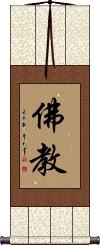
佛教 is the more exact way to express the religion or lifestyle of Buddhism.
It can also be read as “Buddha's Teachings.” 佛教 is Chinese only, as a different character is more commonly used in Japanese to express Buddhism. The same first character is used in Korea, but a slight variation exists in the second character in Korean Hanja. However, it would be fully recognized by any Korean person who can read Hanja.
The Principles of Buddhism
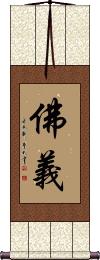
In short, 佛義 is the Principles of Buddhism, but there is more (especially for the second character):
佛 is the character for the Buddha and Buddhism.
義 has deeper meanings including justice, righteousness, morality, honour/honor, teachings, doctrine, right, proper, righteous, loyalty, purpose, or meaning. So the single word “principles” is often used to encompass all these ideas.
The Buddha is in Each Sentient Being
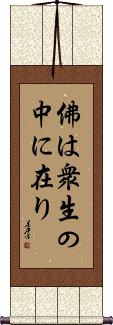
佛は衆生の中に在り is “Butsu wa shujo no naka ni ari” and means that the Buddha (potential for Buddhahood) exists in all beings in the universe.
So yes, your dog has the potential to be a Buddha (but only in a future reincarnation as a human). But all things, from the tiny cricket to the humpback whale have Buddha nature within them. If one takes the time to look and contemplate, one will see the Buddha in all things.
In Japan, sometimes the Buddha character is written 仏 instead of 佛, so you might see the whole phrase written as 仏は衆生の中に在り.
Note: Because this selection contains some special Japanese Hiragana characters, it should be written by a Japanese calligrapher.
Butt
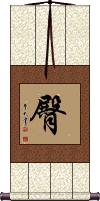
臀 is the most simple way to write butt, buttocks, behind, rump, bottom, last place, or end in Japanese, Chinese and Korean.
臀 is not appropriate for calligraphy. Also, the two-character word 屁股 or pigu, is also very common in China for butt or ass.
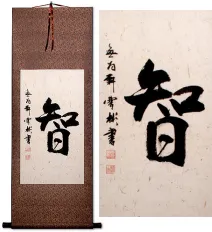
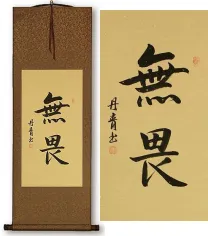
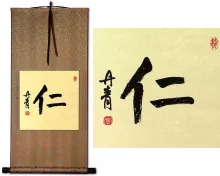
This in-stock artwork might be what you are looking for, and ships right away...

Gallery Price: $36.00
Starting at: $20.00



Gallery Price: $200.00
Your Price: $98.88

Gallery Price: $177.00
Your Price: $97.88


Gallery Price: $72.00
Your Price: $39.88

Gallery Price: $177.00
Your Price: $97.88

Successful Chinese Character and Japanese Kanji calligraphy searches within the last few hours...



