Many custom options...


And formats...



Not what you want?
Try other similar-meaning words, fewer words, or just one word.
Ancient Chinese Scroll in Chinese...
Buy an Ancient Chinese Scroll calligraphy wall scroll here!
Personalize your custom “Ancient Chinese Scroll” project by clicking the button next to your favorite “Ancient Chinese Scroll” title below...
1. Unicorn
6. Fighter
7. Beautiful
8. Wellness
9. Adventure
10. Woman
11. Ronin / Masterless Samurai
12. Japanese Snapping Turtle / Chinese Soft Shell Turtle
13. Sword
14. Tiger Rumor
Unicorn
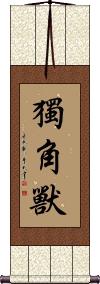
獨角獸 is the Chinese name for the western unicorn (a horse with a spiral horn emerging from the head).
獨角獸 is an unusual title for a Chinese wall scroll, but it's OK if you really love unicorns.
Chinese have their own ancient unicorn-like creature called a “qilin” (or kirin in Japanese).
Love and Hate
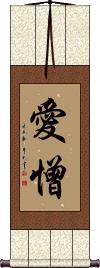
愛憎 is a weird selection for a calligraphy wall scroll. But if you really want it, we'll do it.
This version is most appropriate if your audience is Japanese or Korean (for Koreans who can read the ancient Korean Hanja).
The first character means love or affection.
The second character means hate, dislike, detest, or loathe.
Kowtow - The deepest bow
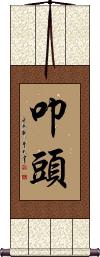
叩頭 is the term that seems to be known worldwide as kowtow.
In Japanese and Chinese, it simply means a deep bow, especially one so low that one's head touches the ground in submission. However, in western culture, it has sometimes come to mean “giving in” or “surrendering to someone else's will.” Sometimes even said of a person who stoops to flattery at the expense of their dignity.
I don't know if you would really want this on a wall scroll, but enough people have searched for this term on our website that I guess it was time to add it. It just feels strange to see such a word on a wall scroll, so please order with caution. 叩頭 is antiquated in both Japanese and Chinese. The act is seldom done anymore and is seen as an ancient ritual.
Hell / Judges of Hell
Ancient way to say Hell
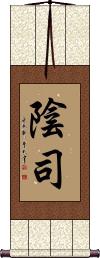
陰司 is the ancient way to say “Hell” or “Netherworld” in Chinese.
This title can also refer to the officials of Hell or the judges of Hades or the Netherworld.
Please note that this is a somewhat terrible selection for a wall scroll. Hanging this in your home is like telling the world that your home is hell. Oddly, a lot of people search for this on my website, so I added it for reference.
Courtesy / Etiquette
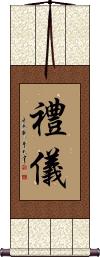
In Chinese, old Korean Hanja, and old Japanese Kanji, 禮儀 means “etiquette” or “courtesy.”
You'll also find a Japanese entry on our website, which uses a modern/simplified first Kanji. The characters shown here compose the best choice if your audience is Chinese or Korean - but also acceptable if you want an ancient-style Japanese scroll (in modern Japanese, it has the same pronunciation, but is written 礼儀).
Note: This can also be translated as propriety, decorum, or formality.
Fighter
Warrior / Soldier
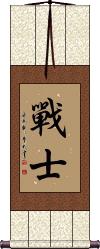
戰士 is how to write “fighter” in Chinese, ancient Japanese Kanji, and old Korean Hanja.
The first character means war, warfare, or battle.
The second character means soldier, officer, man, or pawn.
戰士 can also mean soldier or warrior. Usually this will be read as “fighter” or “one who fights.” 戰士 is an odd selection for a wall scroll unless you are a boxer, ultimate fighter, or otherwise participate in combat sports.
Other translations include combatant or champion.
 Note that after WWII, the first Kanji was reformed/simplified. This modern Japanese version is shown to the right. If you want this version, click on the Kanji to the right, instead of the button above.
Beautiful
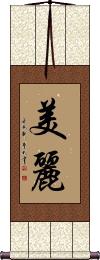
美麗 is a two-character word used often in Chinese, old Korean, and ancient Japanese to express beauty.
I've had a few requests for a “two-character beautiful,” and this is by far the best word. This is not a common word for an Asian person to want on a wall scroll. However, you will see it commonly used as an adjective in phrases, stories, and titles throughout magazines and signage in China.
美麗 can also be translated as gorgeous or lovely.
Note: 美麗 is not commonly used in modern Japan.
Wellness
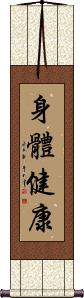
身體健康 is how to express “wellness” in Chinese. The meaning is not much different than the idea of “good health.” The first two characters alone are often translated as “health.” Some will also translate this title as “physical health.”
If you want to fill your room with a feeling of wellness, this is the wall scroll for you.
This is also the ancient way to express wellness in Japanese Kanji and old Korean Hanja. The modern Japanese form is 身体健康 (the only difference is the second Kanji). Let me know if you need your calligraphy written in modern Japanese.
Adventure
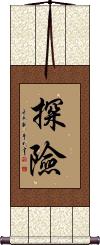
If you lead a life of adventure (like I do), a 探險 wall scroll is for you.
Alone, the first character can mean “to explore,” “to search out,” or “to scout.” The second character holds the meanings of “dangerous” and “rugged.” Together these two characters create the word that means “adventure” or “to explore.”
探険 is a modern Japanese Kanji version, but it more precisely means exploration or expedition rather than adventure. 探險 is the old/ancient Japanese version used before WWII. Let us know if you want the modern Japanese version instead.
See Also: Bon Voyage | Travel
Woman
The ancient way to say Woman
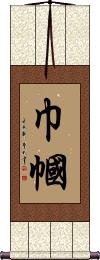
巾幗 is the very old way to say woman in Chinese.
A common title in ancient China, this actually refers to the scarf or head wrapping worn by virtually all women at that time.
巾幗 is kind of a cool way to say Woman now. The actual gender character alone on a wall scroll would actually look like a fancy sign for the woman's restroom (WC).
 If you are curious, the character to the right means female or woman. Knowing 女 is useful information if you are a woman searching for a toilet in China or Japan.
Ronin / Masterless Samurai
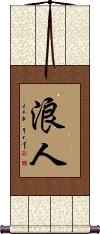
The 浪人 or Ronin have no master - The most famous are the 47 ronin created after their Lord committed suicide. This term was not a positive title for the Samurai of ancient Japan. However, in recent years, movies and video games have glorified the term Ronin.
In Chinese, this term has the original meaning of a hobo, vagabond, or ruffian.
In Korean Hanja, these characters would be read as adventurer, wanderer, someone without a steady job, or someone who is wasting away time.
In modern Japan, this term is used as a nickname for a high school student who has failed a college entry exam (and is trying again).
In Chinese and Korean, the Japanese definition of “Masterless Samurai” is known because of the historical context. Even in Japanese, the literal translation is closer to the Chinese and Korean definitions shown above.
This will make a fine wall scroll if you are a fan of the Ronin or see yourself as a Ronin of sorts. However, please think twice before getting a Ronin tattoo!
Japanese Snapping Turtle / Chinese Soft Shell Turtle
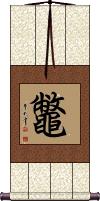
鼈 refers to a species of turtle.
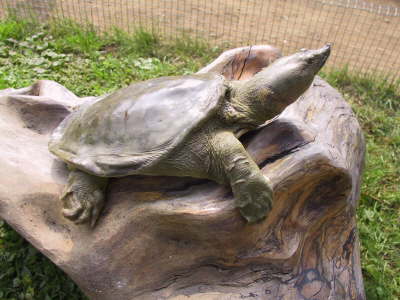
鼈 is Trionyx Sinensis.
鼈 refers to different turtles in different languages. See individual language notes below:
Japanese: 鼈 means “snapping turtle” or “mud turtle.” But rarely used as a single Kanji like this in Japanese.
Chinese: 鼈 means soft-shelled turtle. A specific species, Trionyx Sinensis is native to Asia.
In China, this species is related to the “wang ba,” a soft-shelled turtle sometimes known in English as a banjo turtle (due to its long neck, and general shape). Unfortunately, there is a word, “wang ba dan” which means the egg of this species of turtle. That term has come to mean “bastard” in Chinese (a turtle hatches from an abandoned egg, and does not know who his mother or father is). 鼈 is not a good selection for a wall scroll if your audience is Chinese.
In Korean, this character can be pronounced (though most Koreans would have to look it up in a dictionary). It has not been in common use in Korea for at least a few hundred years.
General notes: You may notice that the bottom half of this character is the same as some other turtle-related titles. That bottom half is actually an ancient character that means “toad.”  Though not seen in this way today, most turtle-related characters hold the meaning of “a toad with a shell” in their ancient origin. That toad character is rarely used alone anymore but you can see what it looks like in the image to the right.
Sword
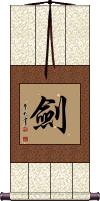
劍 is pronounced “jian” in Chinese. When you say it, imagine that you are making the sound of a sword as it clashes with a metal shield. This might get you closer to the correct pronunciation in Chinese.
I actually wonder if this word came from the metallic ringing sounds of a sword in battle - but such knowledge is lost in history.
The sword is a symbol of a warrior. The one thing that a soldier in ancient China lived and died by. A warrior with his skills and sword proves himself of great value. A warrior who losses his sword instantly becomes worthless.
劍 is an excellent scroll for someone in the military (especially officers of all services - as well as enlisted NCO Marines since they still carry swords even if mainly for ceremonial purposes). Or perhaps someone who practices variations of kung fu or tai chi that involve weapons.
Please note that while this character is understood with the sword meaning in Japanese, you might be looking for the word “katana” which also means sword in Japanese but means “knife” in Chinese.
There are other ways to write sword, and here are a few...


If you are particular about the version you receive, please let me know when you place your order (Note: Special styles are only available from one of our master calligraphers).
Tiger Rumor
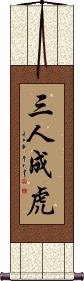
These four characters together relay the meaning that can be expressed in English as “When three people say there's a tiger running in the street, you believe it.”
Of course, there is an ancient story behind this idiom...
三人成虎 is actually a proverb that resulted from a conversation that occurred around 300 B.C.
The conversation was between the king of the Wei kingdom and one of the king's ministers named Pang Cong.
It was near the end of one of many wars, this time with the Zhao kingdom. Pang Cong was to be sent by the king to the Zhao kingdom with the king's son, who was to be held hostage. It was common at the time for a king to make his son a hostage to secure stable peace between warring kingdoms.
Before minister Pang Cong departed, he asked his king, “If one person told you a tiger was running in the street, would you believe it?.”
“No,” the king said.
The minister continued, “What if two people told you?”
The king replied, “Well, I would have my doubts but I might believe it.”
The minister continued, “So, what if three people told you that a tiger is running in the streets?”
The king replied, “Yes, I would believe it. It must be true if three people say it.”
The minister then reminded the king, “Your son and I are now traveling far away to live in the distant Zhao kingdom - much farther from your palace than the street. Rumors may fly about me in my absence, so I hope your majesty will weight such rumors appropriately.”
The king replied, “I have every trust in you, do not worry”
While the minister was gone, the king's enemies gossiped about minister Pang Cong on many occasions. At first, the king thought nothing of these comments and rumors. But slowly, as the rumors mounted, the king began to suspect ill of his minister.
Sometime later, when peace was well-established, the minister and prince were freed and returned to the kingdom of Wei. The king received his son BUT DID NOT EVEN SUMMON MINISTER PANG CONG TO THE PALACE!
Hopefully, this story will help you see how dangerous words can be when used to promote rumors or create ill will. And perhaps will inspire you not to believe everything you hear.
There is also a secondary suggestion in this idiom that gossip is as ferocious as a tiger. Some Chinese people who don't know the ancient story above may believe that this scroll means that rumors are as vicious as three tigers.
Note: This proverb appears in my Korean dictionary but is not well-known in Korea.
Work Unselfishly for the Common Good
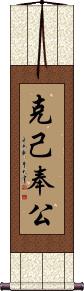
克己奉公 is a Chinese proverb that is often used to express how one should act as a government official. Most of us wish our public officials would hold themselves to higher standards. I wish I could send this scroll, along with the meaning to every member of Congress, and the President (or if I was from the UK, all the members of Parliament, and the PM)
This can also mean: “Place Strict Standards on Oneself in Public Service.”
The story behind this ancient Chinese idiom:
Cai Zun was born in China a little over 2000 years ago. In 24 AD, he joined an uprising led by Liu Xiu, who later became the emperor of the Eastern Han Dynasty.
Later, the new emperor put Cai Zun in charge of the military court. Cai Zun exercised his power in strict accordance with military law, regardless of the offender's rank or background. He even ordered the execution of one of the emperor's close servants after the servant committed a serious crime.
Cai Zun led a simple life but put great demands on himself to do all things honorably. The emperor rewarded him for his honest character and honorable nature by promoting him to the rank of General and granting him the title of Marquis.
Whenever Cai Zun would receive an award, he would give credit to his men and share the reward with them.
Cai Zun was always praised by historians who found many examples of his selfless acts that served the public interest.
Sometime long ago in history, people began to refer to Cai Zun as “ke ji feng gong.”
See Also: Unselfish | Selflessness | Altruism
Mountain Travels Poem by Dumu

This poem was written almost 1200 years ago during the Tang dynasty.
It depicts traveling up a place known as Cold Mountain, where some hearty people have built their homes. The traveler is overwhelmed by the beauty of the turning leaves of the maple forest that surrounds him just as night overtakes the day, and darkness prevails. His heart implores him to stop, and take in all of the beauty around him.
First, before you get to the full translation, I must tell you that Chinese poetry is a lot different than what we have in the west. Chinese words simply don't rhyme in the same way that English or other western languages do. Chinese poetry depends on rhythm and a certain beat of repeated numbers of characters.
I have done my best to translate this poem keeping a certain feel of the original poet. But some of the original beauty of the poem in its original Chinese will be lost in translation.
Far away on Cold Mountain, a stone path leads upwards.
Among white clouds, people's homes reside.
Stopping my carriage I must, as to admire the maple forest at nights fall.
In awe of autumn leaves showing more red than even flowers of early spring.
Hopefully, this poem will remind you to stop, and “take it all in” as you travel through life.
The poet's name is “Du Mu” in Chinese that is: 
 .
.
The title of the poem, “Mountain Travels” is: 

You can have the title, poet's name, and even “Tang Dynasty” written as an inscription on your custom wall scroll if you like.
More about the poet:
Dumu lived from 803-852 AD and was a leading Chinese poet during the later part of the Tang dynasty.
He was born in Chang'an, a city in central China and the former capital of the ancient Chinese empire in 221-206 BC. In present-day China, his birthplace is currently known as Xi'an, the home of the Terracotta Soldiers.
He was awarded his Jinshi degree (an exam administered by the emperor's court which leads to becoming an official of the court) at the age of 25 and went on to hold many official positions over the years. However, he never achieved a high rank, apparently because of some disputes between various factions, and his family's criticism of the government. His last post in the court was his appointment to the office of Secretariat Drafter.
During his life, he wrote scores of narrative poems, as well as a commentary on the Art of War and many letters of advice to high officials.
His poems were often very realistic and often depicted everyday life. He wrote poems about everything, from drinking beer in a tavern to weepy poems about lost love.
The thing that strikes you most is the fact even after 1200 years, not much has changed about the beauty of nature, toils, and troubles of love and beer drinking.
This in-stock artwork might be what you are looking for, and ships right away...
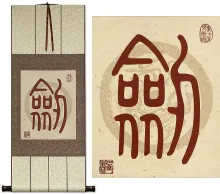
Gallery Price: $200.00
Your Price: $88.88
Gallery Price: $106.00
Your Price: $58.88
Gallery Price: $108.00
Your Price: $59.88
Gallery Price: $83.00
Your Price: $45.88

Gallery Price: $61.00
Your Price: $33.88
Gallery Price: $100.00
Your Price: $58.88
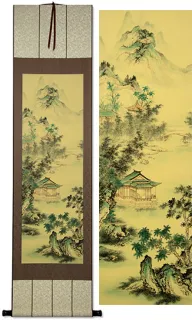
Gallery Price: $83.00
Your Price: $45.88
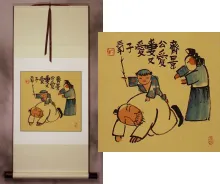
Gallery Price: $72.00
Your Price: $39.88
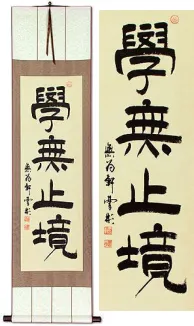
Gallery Price: $180.00
Your Price: $99.88

Gallery Price: $61.00
Your Price: $33.88
Gallery Price: $304.00
Your Price: $168.88
Gallery Price: $100.00
Your Price: $49.88
The following table may be helpful for those studying Chinese or Japanese...
| Title | Characters | Romaji (Romanized Japanese) | Various forms of Romanized Chinese | |
| Unicorn | 獨角獸 独角兽 | dú jiǎo shòu du2 jiao3 shou4 du jiao shou dujiaoshou | tu chiao shou tuchiaoshou |
|
| Love and Hate | 愛憎 爱憎 | ai zou / aizou / ai zo | ài zèng / ai4 zeng4 / ai zeng / aizeng | ai tseng / aitseng |
| Kowtow - The deepest bow | 叩頭 叩头 | koutou / koto | kòu tóu / kou4 tou2 / kou tou / koutou | k`ou t`ou / koutou / kou tou |
| Hell Judges of Hell | 陰司 阴司 | yīn sī / yin1 si1 / yin si / yinsi | yin ssu / yinssu | |
| Courtesy Etiquette | 禮儀 礼仪 | lǐ yì / li3 yi4 / li yi / liyi | li i / lii | |
| Fighter | 戰士 战士 / 戦士 | sen shi / senshi | zhàn shì / zhan4 shi4 / zhan shi / zhanshi | chan shih / chanshih |
| Beautiful | 美麗 美丽 | birei | měi lí / mei3 li2 / mei li / meili | |
| Wellness | 身體健康 身体健康 | shin tai ken kou shintaikenkou shin tai ken ko | shēn tǐ jiàn kāng shen1 ti3 jian4 kang1 shen ti jian kang shentijiankang | shen t`i chien k`ang shentichienkang shen ti chien kang |
| Adventure | 探險 探险 / 探険 | tanken | tàn xiǎn / tan4 xian3 / tan xian / tanxian | t`an hsien / tanhsien / tan hsien |
| Woman | 巾幗 巾帼 | jīn guó / jin1 guo2 / jin guo / jinguo | chin kuo / chinkuo | |
| Ronin Masterless Samurai | 浪人 | rou nin / rounin / ro nin | làng rén / lang4 ren2 / lang ren / langren | lang jen / langjen |
| Japanese Snapping Turtle Chinese Soft Shell Turtle | 鼈 | suppon / supon | biē / bie1 / bie | pieh |
| Sword | 劍 剑 | ken / tsurugi | jiàn / jian4 / jian | chien |
| Tiger Rumor | 三人成虎 | sān rén chéng hǔ san1 ren2 cheng2 hu3 san ren cheng hu sanrenchenghu | san jen ch`eng hu sanjenchenghu san jen cheng hu |
|
| Work Unselfishly for the Common Good | 克己奉公 | kè jǐ fèng gōng ke4 ji3 feng4 gong1 ke ji feng gong kejifenggong | k`o chi feng kung kochifengkung ko chi feng kung |
|
| Mountain Travels Poem by Dumu | 遠上寒山石徑斜白雲生處有人家停車坐愛楓林晚霜葉紅於二月花 远上寒山石径斜白云生处有人家停车坐爱枫林晚霜叶红于二月花 | yuǎn shàng hán shān shí jìng xiá bái yún shēng chù yǒu rén jiā tíng chē zuò ài fēng lín wǎn shuàng yè hóng yú èr yuè huā yuan3 shang4 han2 shan1 shi2 jing4 xia2 bai2 yun2 sheng1 chu4 you3 ren2 jia1 ting2 che1 zuo4 ai4 feng1 lin2 wan3 shuang4 ye4 hong2 yu2 er4 yue4 hua1 yuan shang han shan shi jing xia bai yun sheng chu you ren jia ting che zuo ai feng lin wan shuang ye hong yu er yue hua | yüan shang han shan shih ching hsia pai yün sheng ch`u yu jen chia t`ing ch`e tso ai feng lin wan shuang yeh hung yü erh yüeh hua yüan shang han shan shih ching hsia pai yün sheng chu yu jen chia ting che tso ai feng lin wan shuang yeh hung yü erh yüeh hua |
|
| In some entries above you will see that characters have different versions above and below a line. In these cases, the characters above the line are Traditional Chinese, while the ones below are Simplified Chinese. | ||||

Successful Chinese Character and Japanese Kanji calligraphy searches within the last few hours...



