Many custom options...


And formats...



Older in Chinese / Japanese...
Buy an Older calligraphy wall scroll here!
Personalize your custom “Older” project by clicking the button next to your favorite “Older” title below...
1. Big Brother / Elder Brother
2. Old, But More Vigorous in Spirit
4. Beijing
5. Hyacinth
6. Senpai / The Elder or Master
8. Gemini
10. Guo
11. Ascend
12. Celestial Dragon / Tian Long
14. Manga
15. Lao Tzu / Laozi
18. Shiatsu-Do
19. Sushi
20. Iron Fist
21. Broken Hearted
22. Aiki Budo
23. Hapkido
24. Respect
25. Musashi
28. Banzai
Big Brother / Elder Brother
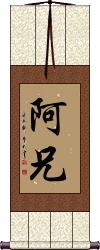
阿兄 is a Chinese and Japanese title for elder brother.
阿兄 is an honorific title, like saying, “my dear brother.” A nice way to pay tribute to your big brother or older brother on your wall.
Old, But More Vigorous in Spirit
Age is just a number
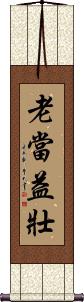
老當益壯 is a Chinese proverb that means “old but vigorous” or “hale and hearty despite the years.”
Said of someone who is more spirited when he/she grows older.
The story behind this Chinese proverb:
In the Eastern Han Dynasty, there was a man named Ma Yuan. He had been planning to herd animals on the frontier since he was young. When he grew up, Ma became a minor official of a county.
Once, he was sending some prisoners to another location. He felt pity for them, so he set them free, and then he fled to another county in the north. He herded animals there, and thus his dream came true. He always said: “If you want to be a great man, the poorer you are, the firmer in spirit you have to be; the older you are, the more spirited you should be.”
Later, when he was even older, Ma Yuan became a famous general of the Eastern Han Dynasty and contributed to many battles.
Firefly / Glow Worm
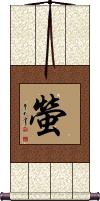
螢 is the Chinese, older Japanese Kanji, and old Korean Hanja way to write firefly, lightning bug, or glow worm (Luciola cruciata).
 Note: After post WWII language reforms in Japan, they started using a more simple version of this Kanji. This version is shown to the right. If you want this modern Japanese version, please click on the Kanji to the right instead of the button above.
Beijing
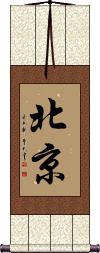
北京 is how to write Beijing, the capital of the People's Republic of China, in Chinese and Japanese.
Occasionally, you will see a romanized version, Peking or Pekin. That's the same place, just an older way to romanize the characters.
Hyacinth
Flower
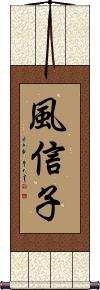
風信子 is the title for the hyacinth flower in Chinese Characters and older Japanese Kanji.
Specifically, this refers to the Hyacinthus orientalis.
This can also be the female given name Fujiko in Japanese.
Senpai / The Elder or Master
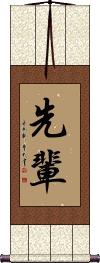
先輩 is a Chinese, Japanese, and old Korean word or title that means elders, senior (at work or school), superior, older graduate, progenitor, or old-timer.
In American dojos, this is sometimes romanized as Sempai.
Journey / Travel
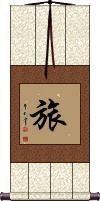
旅 is a single Chinese character, Japanese Kanji, and old Korean Hanja that means trip, travel, or journey.
In an older context, this could refer to an army brigade or a 500-man battalion from the Zhou-dynasty Chinese army.
Gemini Zodiac Symbol / Sign
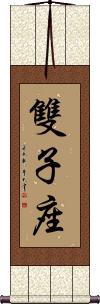
雙子座 is the Chinese way to write Gemini (twins) of western astrology.
This was also the version used in Japan until they simplified the first Kanji to 双 after WWII. If you need the modern Japanese 双子座 instead of the older 雙子座, just let me know when you place your order.
See Also: Chinese Zodiac
American Kenpo
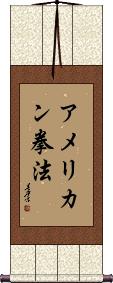
アメリカン拳法 is the most common name for American Kenpo or American Kempo in Japanese.
You may also see this as アメリカ拳法 (dropping the “ン” or “N” sound from American) or 米国拳法 (uses the older Japanese name for America as “Rice Country” along with Kenpō).
Note: Because this selection contains some special Japanese Katakana characters, it should be written by a Japanese calligrapher.

This is one of a few characters that can be a surname that romanizes as Guo from China.
The meaning of the character is country, nation, state, or kingdom.
This is used in Japan for older signs and texts. You will see the more simple 国 form in Japan, and also China in modern times.
Ascend
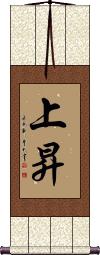
上昇 means to rise up, to go up, or to ascend in Chinese, Japanese Kanji, and old Korean Hanja.
If you are rising, ascending, or climbing, this is the word for you.
In the older Buddhist context, this means to ascend, with the implication that the destination is the heavenly realm.
Celestial Dragon / Tian Long
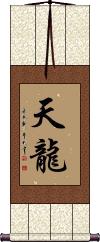
天龍 can mean Heavenly Dragon (Dragon of Heaven), Sky Dragon, Holy Dragon, Celestial Dragon, or Divine Dragon.
This can be a given name in both China and Japan (天龍 is pronounced Tenryū and sometimes written 天竜 in Japanese).
In an older Buddhist context, this can refer to Brahma, Indra, and the devas, together with the nāgas. It can also refer to celestials and snake spirits.
Not Long for this World
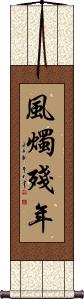
This phrase means “Old and ailing with little time left” or “Not long for this world.”
There is a real suggestion here that someone will die soon.
This was added by a special request of a customer and is perhaps, not the most positive phrase that you could put on a wall scroll.
This would be the most offensive possible gift to give to an older person - please do not do that!
Manga
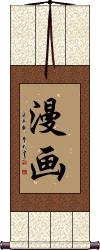
漫画 is the Japanese word for cartoon, comic, caricature, or comic strip.
The older traditional form is 漫畫 and is sometimes still used in Taiwan and China (and occasionally in Japan) when referring specifically to Japanese comics.
You'll see the same 漫画 used in Mainland China as well since 画 is not just the modern Japanese form but also the Simplified Chinese version of the original 畫.
Lao Tzu / Laozi
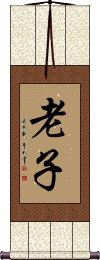
Depending on the romanization scheme you use, this man's name can be spelled Laozi, Lao Tzu, or Lao Tze. In older English usage, he was known as Laocius. He is believed to have lived around 500 B.C.
He was a Chinese philosopher, founder of Daoism/Taoism, credited with being the author of the sacred and wise book of Daoism/Taoism.
There is a theory that Lao Tzu's soul traveled to India and was reborn as the Buddha.
Realization and Knowledge
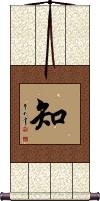
知 means realization or true knowing.
This can also translate as to know, to be aware, wisdom, or higher knowledge.
From older Buddhist ideas, this can represent विद्या (Vidyā or Vidya) or ज्ञान (Jñāna or Jnana) and even the combination Sanskrit word विज्ञान (Vijñāna or Vijnana) which can translate as wisdom arising from perception or knowing.
However, 知 should be distinguished as true knowing versus having a relative understanding or 會.
Physical Strength
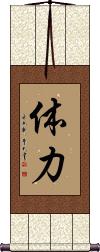
体力 means “physical strength” or “physical power.”
The first character was first simplified in Japan. Later, that simplified version became the standard in mainland China. Just in case you want this version, it is offered here. I suggest it if your audience is Japanese. Most Chinese know the older traditional version, which looks like 體力.
体力 can also be defined: stamina; endurance; physical strength; resilience; resistance to disease; clout; stability.
Shiatsu-Do
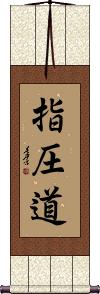
指圧道 is the title for Shiastu-Do, the Japanese way of finger pressure.
Shitsu-Do is about applying special finger pressure to points on the body thought to be connected to pathways called “meridians.” Shiatsu is a healthful way to get your 気 or 氣 (ki energy) flowing properly.
Note: This title can also be written in the older 指壓道 form (just the middle character has an ancient/traditional form used before WWII).
You might even see 指压道 which uses the Simplified Chinese form of the second character.
Sushi
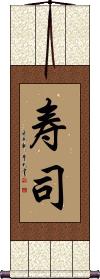
Got a 寿司/sushi restaurant and need an appropriate wall scroll? Or maybe you love sushi enough to have it on your wall. This sushi calligraphy scroll is for you.
Note that the written characters for sushi are the same in Chinese and Japanese. However, the first character is actually a modern Japanese / Simplified Chinese, so in some cases, it will be written differently in Taiwan, Hong Kong, and some older Japanese sushi restaurants where you might see 壽司 instead of 寿司.
Iron Fist
Tie Quan / Tieh Chuan
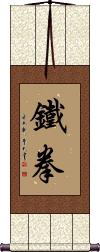
鐵拳 is a common theme used by various schools of martial arts.
鐵 means “iron” but, in some cases, can mean “indisputable.”
拳 means fist.
Some schools use the older/Taiwanese way to Romanize the iron fist, so you may have seen it spelled “Tieh Chuan” instead of “Tie Quan.” Neither way is technically incorrect.
Note that in Mandarin, the first part of the first character sounds like the English word “tea,” blending into a soft “-eh” sound. The second character sounds a lot like “chew on” but as if it is one syllable.
 After WWII in Japan, the Kanji for iron was simplified. This new Kanji form is shown to the right. If you want this modern Japanese version, please click on the Kanji to the right, instead of the button above. The characters shown to the left would still be considered the old or ancient Japanese version of this title.
Broken Hearted
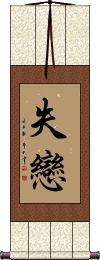
In Chinese, this can mean losing one's love; to breaking up (in a romantic relationship); to feel jilted.
In Japanese Kanji, this means disappointing love, broken heart, unrequited love, or being lovelorn.
失戀 is also valid in old Korean Hanja, which means unrequited love, unreturned love, a disappointment in love, or a broken heart.
Note: In modern Japan, they will tend to write the more simple 失恋 form instead of 失戀. If you order this from the Japanese master calligrapher, expect the more simple modern version to be written (unless you give us instructions to use the older or more traditional version).
Aiki Budo
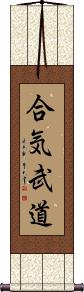
合気武道 is the title Aiki-Budo or “Aiki Martial Arts” in Japanese Kanji.
合 means “union” or “harmony.”
気/氣 means “universal energy” or “spirit.”
武 means “martial” or “military.”
道 means “way” or “method.”
合気武道 is the modern Japanese way to write this. You may also see 合氣武道, where the second character is written in the older traditional (pre-1945) form. If you want this written 合氣武道, just include a note or email with your order.
合氣武道 are all Chinese characters as well, so I included the Chinese pronunciation above. However, while it can be understood in Chinese, this is not a common term in that language and is not used in any Chinese martial arts. Also, 気 is only used in Japan - Chinese will understand 気 to be the Japanese form of 氣.
See Also: Martial Arts | Hapkido
Hapkido
Korean Martial Art of re-directing force
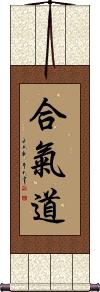
Hapkido or 合氣道 is a mostly-defensive martial art in Korea.
Hapkido has some connection to the Aikido of Japan. They are written with the same characters in both languages. However, it should be noted that the Korean Hanja characters shown here are the traditional Chinese form - but in modern Japan, the middle character was slightly simplified.
Note: You can consider this to be the older Japanese written form of Aikido. Titles on older books and signs about Aikido use this form.
The connection between Japanese Aikido and Korean Hapkido is muddled in history. The issue is probably due to the difficult relationship between the two countries around WWII. Many Koreans became virtual slaves to the Japanese during that period. After WWII, many things in Korea were disassociated from having any Japanese origin. The relationship has greatly mellowed out now.
Looking at the characters, the first means “union” or “harmony.”
The second character means “universal energy” or “spirit.”
The third means “way” or “method.”
One way to translate this into English is the “Harmonizing Energy Method.” This makes sense, as Hapkido has more to do with redirecting energy than fighting strength against strength.
More Hapkido info
More notes:
1. Sometimes Hapkido is Romanized as “hap ki do,” “hapki-do” “hab gi do” or “hapgido.”
2. Korean Hanja characters are actually Chinese characters that usually hold the same meaning in both languages. There was a time when these characters were the standard and only written form of Korean. The development of modern Korean Hangul characters is a somewhat recent event in the greater scope of history. There was a time when Chinese characters were the written form of many languages in places known in modern times as North Korea, South Korea, Japan, Vietnam, Singapore, Hong Kong, Taiwan, Mainland China, and a significant portion of Malaysia. Even today, more people in the world can read Chinese characters than English.
3. While these Korean Hanja characters can be pronounced in Chinese, this word is not well-known in China and is not considered part of the Chinese lexicon.
Respect
Politeness, Gratitude and Propriety
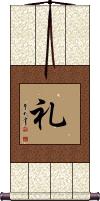
礼 is one of the five tenets of Confucius.
Beyond respect, 礼 can also be translated as propriety, good manners, politeness, rite, worship, or an expression of gratitude.
We show respect by speaking and acting with courtesy. We treat others with dignity and honor the rules of our family, school, and nation. Respect yourself, and others will respect you.
 Please note that Japanese use this simplified 礼 version of the original 禮 character for respect. 礼 also happens to be the same simplification used in mainland China. While 禮 is the traditional and original version, 礼 has been used as a shorthand version for many centuries. Click on the big 禮 character to the right if you want the Traditional Chinese and older Japanese versions.
This is also a virtue of the Samurai Warrior
See our page with just Code of the Samurai / Bushido here
See Also: Confucius
Musashi
The most famous Samurai
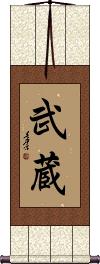
Miyamoto Musashi is probably the most famous Samurai in all of Japanese history.
武蔵 is the short title for a man long in legend. While coming from a lower class, his new sword and fighting techniques put him on par with the best that feudal Japan had to offer. His long career started with his first duel at age 13!
He is credited with using two swords at once and never losing a single battle in his career. After becoming a Buddhist, and getting older, like many old warriors, he took up a peaceful and solitary life until his death around 1645 A.D.
Note: Technically, Musashi is his given name, and Miyamoto is his surname. However, it's suggested that he assumed both of these names and had a few other names in childhood, as well as being given a Buddhist name. It's hard to know what to call him, as with most Kanji, there are multiple pronunciations. The characters for Musashi can also be pronounced Takezō. But everyone in modern times seems to know him by the name Musashi.
Diligent Study Proverb
Drill a hole in the wall to get light to read by.
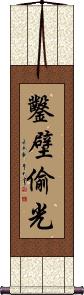
鑿壁偷光 is a Chinese proverb that means “Bore a hole in the wall to make use of the neighbor's light to study.”
This is a nice gift for a very studious person.
Kuang Heng was born during the Western Han period. He has been very fond of reading ever since he was young. However, he could not attend school since his family was poor, and he had to borrow books from people to learn.
To borrow these books, he normally did chores for people who had them. When he became older, he had to work in the field from sunrise to sunset since his family's financial situation did not improve. Thus, he tried to study at night, but he had no lamp.
One day, he noticed the light from the neighbor's house coming through a crack in the wall. This made him very happy, so he dug a larger hole from the crack and read in the light that shone through. This diligent study eventually made him an accomplished person.
Strong / Powerful / Force
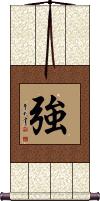
強 is a character that means strong, strength, force, powerful, better, stubborn, and stiff (yes, all of this in one character).
This “strong” has less to do with physical strength and more to do with having a winning attitude, or just having the ability to win at something.
Note that most of the time, this character is pronounced “qiang” but when used with the meaning of stubborn, unyielding, or stiff, it is pronounced “jiang” in Chinese.
Also, sometimes “qiang” is used in modern Chinese to describe people that do crazy things (For example: Bicycling from Beijing to Tibet alone). I sometimes can be found outside my Beijing apartment wearing nothing but shorts and a tee-shirt while eating ice cream during a snow storm, just to hear my neighbors call me “qiang.” Maybe they mean “strong” but perhaps they are using the new meaning of “crazy strong.”
強 can also be a Chinese surname that romanizes as Jiang in the mainland or Chiang if from Taiwan.
強 is a valid Korean Hanja character with the same meaning but is mostly used in compound Korean words.
強 is used in Japanese (though normally in compound words). In Japanese, it has the same meaning but in some contexts can mean “a little more than...” or “a little over [some amount].” Most Japanese would read this as tough, strength, stiff, hard, inflexible, obstinate, or stubborn.
The variant 彊 is sometimes seen in older literature.
Banzai
Modern Japanese Version
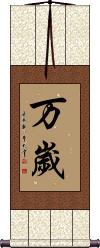
万歲 is the modern Japanese way to write banzai.
We've made two almost identical entries for this word, with just a variation on the first character. In the last century, 萬 was simplified to 万 in Japan and China. The new generation will expect it to be written as 万 but the old generation can still read the more traditional 萬 form. You must make your determination as to what version is best for you. If your audience is mostly Japanese, I suggest 万歲.
While it has become a popular, if not an odd, thing to scream as you jump out of an airplane (preferably with a parachute attached), banzai is actually a very old Asian way to say “hooray.” The Japanese word “banzai” comes from the Chinese word “wan sui” which means “The age of 10,000 years.” It is actually a wish that the Emperor or the Empire live that long.
Imagine long ago when the Emperor made a rare public appearance. This is what all of the people would yell to their leader in respect.
So if you like it as a hooray, or you want to wish someone that they live for 10,000 years, this is the calligraphy for you.
To other things with banzai in their names, I am still waiting for the promised sequel to Buckaroo Banzai.
Other translations: hurrah, long life, congratulations, cheers, live long.
Notes: Sometimes people confuse banzai with bonsai. A bonsai is a miniature tree. They have nothing to do with each other. Further, Bonzai is not a word at all - although it would make a great name for a calcium supplement for older people.
Asian Pride / Oriental Pride / AZN Pryde
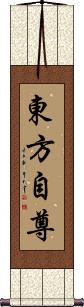
東方自尊 is the universal way to write “Asian Pride.”
We worked on this one for a long time. The effort involved both Chinese and Japanese translators and lengthy discussions. If you have been searching for this term, there is a reason that it's hard to find the way to write “Asian Pride” in Chinese and Japanese - it's because of the inherent difficulties in figuring out a universal combination of characters that can be read in all languages that use forms of Chinese characters.
This final solution that you see to the left creates a reasonable title in Chinese and an exotic (perhaps unusual) title in Japanese (This could be read as “Eastern Self-Respect” in Japanese”).
Although not as natural, it does have the same meaning as Korean Hanja, and the older generation of Vietnamese people will be able to read it.
The first two characters literally mean “Oriental” and the second two mean “pride,” “self-esteem,” or “self-respect” (we chose the most non-arrogant way to say “pride”). If you have “Asian Pride” (sometimes spelled Asian Pryde) these are the characters for you.
Note: For those who wonder, there is nothing technically wrong with the word “Oriental.” It is a correct word, and any bad meanings were created by so-called “Asian Americans” and Caucasians in the United States. To say “Asian” would not completely correct the intended meaning since that would include people from Saudi Arabia, Iraq, Iran, India, and portions of Russia.
For further proof, if you were of East Asian ancestry and born in England, you would be known as a “British Oriental” (The “Oriental stigma” is basically an American creation and, therefore, applies mainly to the American English language - where they get a bit overzealous with political correctness).
Further, since the Chinese and Japanese word for Oriental is not English, they can not be construed as having ill meaning. On one trip to China or Japan, you will find many things titled with these two characters, such as malls, buildings, and business names. These places also use “Oriental” as their English title (much as we do since our Chinese business name starts with these same two characters).
In short, the first two characters have the meaning that Americans attach to “Asian” but is more technically correct.
These search terms might be related to Older:
Big Brother
Big Brother / Elder Brother
Big Dream
Big Dream / Great Hope
Big Wave
Dream Big / Big Dreams
Drink Up! / Cheers!
Elder
Even a Fool May Sometimes Come Up With a Good Idea
Fall Down Seven Times, Get Up Eight
Give Up Desire
Good Good Study, Day Day Up
Never Give Up
One Who Walks by the River May End Up With Wet Feet
Rise Up With Thrift and Diligence
Roar of Laughter / Big Laughs
Senpai / the Elder or Master
Take Up a Challenge
The Big Dipper / Ursa Major
Wake Up to Reality
Without a Big Net, How Can You Catch Fish?
The following table may be helpful for those studying Chinese or Japanese...
| Title | Characters | Romaji (Romanized Japanese) | Various forms of Romanized Chinese | |
| Big Brother Elder Brother | 阿兄 | akei | ā xiōng / a1 xiong1 / a xiong / axiong | a hsiung / ahsiung |
| Old, But More Vigorous in Spirit | 老當益壯 老当益壮 | lǎo dāng yì zhuàng lao3 dang1 yi4 zhuang4 lao dang yi zhuang laodangyizhuang | lao tang i chuang laotangichuang |
|
| Firefly Glow Worm | 螢 萤 | hotaru | yíng / ying2 / ying | |
| Beijing | 北京 | pekin | běi jīng / bei3 jing1 / bei jing / beijing | pei ching / peiching |
| Hyacinth | 風信子 风信子 | fujiko | fēng xìn zǐ feng1 xin4 zi3 feng xin zi fengxinzi | feng hsin tzu fenghsintzu |
| Senpai The Elder or Master | 先輩 先辈 | sen pai / senpai | xiān bèi / xian1 bei4 / xian bei / xianbei | hsien pei / hsienpei |
| Journey Travel | 旅 | ryo / tabi | lǚ / lu:3 / lu: | lü |
| Gemini Zodiac Symbol Sign | 雙子座 双子座 | futago-za | shuāng zǐ zuò shuang1 zi3 zuo4 shuang zi zuo shuangzizuo | shuang tzu tso shuangtzutso |
| American Kenpo | アメリカン拳法 | amerikan kenpou amerikankenpou amerikan kenpo | ||
| Guo | 國 国 | kuni | guó / guo2 / guo | kuo |
| Ascend | 上昇 上升 | joushou / josho | shàng shēng shang4 sheng1 shang sheng shangsheng | |
| Celestial Dragon Tian Long | 天龍 天龙 | tenryuu / tenryu | tiān lóng tian1 long2 tian long tianlong | t`ien lung tienlung tien lung |
| Not Long for this World | 風燭殘年 风烛残年 | fēng zhú cán nián feng1 zhu2 can2 nian2 feng zhu can nian fengzhucannian | feng chu ts`an nien fengchutsannien feng chu tsan nien |
|
| Manga | 漫画 | manga | màn huà / man4 hua4 / man hua / manhua | |
| Lao Tzu Laozi | 老子 | roushi / roshi | lǎo zǐ / lao3 zi3 / lao zi / laozi | lao tzu / laotzu |
| Realization and Knowledge | 知 | chi | zhī / zhi1 / zhi | chih |
| Physical Strength | 體力 体力 | tairyoku | tǐ lì / ti3 li4 / ti li / tili | t`i li / tili / ti li |
| Shiatsu-Do | 指圧道 | shiatsudou / shiatsudo | ||
| Sushi | 壽司 寿司 | su shi / sushi | shòu sī / shou4 si1 / shou si / shousi | shou ssu / shoussu |
| Iron Fist | 鐵拳 铁拳 / 鉄拳 | tekken / teken | tiě quán / tie3 quan2 / tie quan / tiequan | t`ieh ch`üan / tiehchüan / tieh chüan |
| Broken Hearted | 失戀 失恋 | shitsuren | shī liàn / shi1 lian4 / shi lian / shilian | shih lien / shihlien |
| Aiki Budo | 合氣武道 合気武道 | ai ki bu dou aikibudou ai ki bu do | hé qì wǔ dào / / | |
| Hapkido | 合氣道 合气道 | ai ki do / aikido | hé qì dào he2 qi4 dao4 he qi dao heqidao | ho ch`i tao hochitao ho chi tao |
| Respect | 禮 礼 | rei | lǐ / li3 / li | |
| Musashi | 武蔵 | mu sashi / musashi | ||
| Diligent Study Proverb | 鑿壁偷光 凿壁偷光 | záo bì tōu guāng zao2 bi4 tou1 guang1 zao bi tou guang zaobitouguang | tsao pi t`ou kuang tsaopitoukuang tsao pi tou kuang |
|
| Strong Powerful Force | 強 强 | kyou / kyo | qiáng / qiang2 / qiang | ch`iang / chiang |
| Banzai | 万歲 / 萬歲 万岁 | banzai | wàn suì / wan4 sui4 / wan sui / wansui | |
| Asian Pride Oriental Pride AZN Pryde | 東方自尊 东方自尊 | tou hou zi son touhouzison to ho zi son | dōng fāng zì zūn dong1 fang1 zi4 zun1 dong fang zi zun dongfangzizun | tung fang tzu tsun tungfangtzutsun |
| In some entries above you will see that characters have different versions above and below a line. In these cases, the characters above the line are Traditional Chinese, while the ones below are Simplified Chinese. | ||||

Successful Chinese Character and Japanese Kanji calligraphy searches within the last few hours...



