I am shipping orders on Thursday this week. News and More Info

Many custom options...

Tan Paper and Copper Silk Love Wall Scroll
Red Paper and Ivory Silk Love Wall Scroll
Orange Paper Love Scroll
Crazy Blue and Gold Silk Love Scroll


And formats...

Love Vertical Portrait
Love Horizontal Wall Scroll
Love Vertical Portrait

Find the Way in Chinese / Japanese...

Buy a Find the Way calligraphy wall scroll here!

Personalize your custom “Find the Way” project by clicking the button next to your favorite “Find the Way” title below...


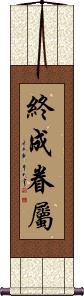
  1. Love Will Find A Way

  2. A Truly Determined Person Will Find a Solution

  3. Achieve Inner Peace; Find Deep Understanding

  4. Mark the boat to find the lost sword / Ignoring the changing circumstances of the world

  5. A House Might be Worth 1 Million Dollars, But Good Neighbors are Worth 10 Million

  6. Tibet

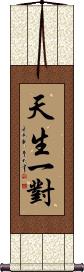
  7. Soul Mates

  8. The two most important days in your life...

  9. Jasmin

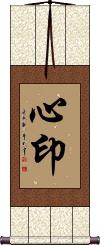
10. Appreciation of Truth by Meditation

11. There is always a way out

12. God Give Me Strength

13. Failure is the Mother of Success

14. Tatu

15. Spirit / Soul

16. Determination to Achieve

17. Grandmaster / Grand Master

18. Mahjong

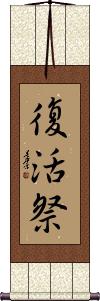
19. Easter

20. Failure is the Mother of Success

21. Goat / Sheep

22. Trust / To Have Faith

23. Choujiao / Chou Jiao

24. In the Abyss of Infinite Bitterness - Turn to the Shore

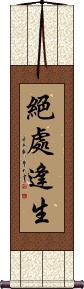
25. Return From Death’s Door

26. Forever Family

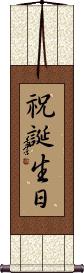
27. Happy Birthday

28. Hella

29. Happy Birthday

30. Jasmine

31. Intense / Serious / Deep / Profound

32. Monkey Stealing Peaches

33. 8. Right Concentration / Perfect Concentration

34. No Fear

35. Chaos

36. Courtesy / Etiquette

37. Best

38. Warriors Adapt and Overcome

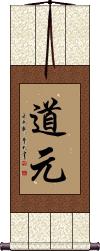
39. Dogen

40. Blue Dragon / Azure Dragon

41. Creativity

42. Optimism / Happy With Your Fate

43. Love and Honor

44. Peaceful Heart / Peace of Mind / Calm Mind

45. Buddha / Buddhism

46. Maintain An Army For 1000 Days, Use It For An Hour

47. Ikigai

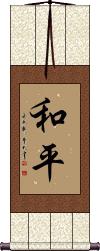
48. Peace of Mind

49. Live Free or Die

50. Wado-Ryu

51. The Red String

52. Strength and Love in Unity

53. Sincere Heart

54. Never Forget Your First Resolution

55. Four Noble Truths

56. Love and Honor

57. Generosity

58. Police / Public Security Bureau

59. Chop Wood, Carry Water

60. Hua Mulan

61. God of Zion / God of Abraham

62. Each Time You Stumble and Fall, You Gain Experience and Wisdom

63. Asian Pride / Oriental Pride / AZN Pryde

64. Learn New Ways From Old / Onkochishin

65. Allah / God of Islam

66. Homosexual Male / Gay Male

67. Flying Tigers AVG

68. One

69. Unselfish: Perfectly Impartial

70. Islam

71. Better Late Than Never


Love Will Find A Way

 zhōng chéng juàn shǔ
Love Will Find A Way Scroll

終成眷屬 is a Chinese proverb that translates roughly as “Love will find a way to come together.”

Love Will Find A Way
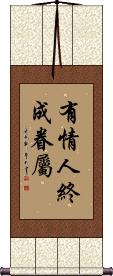
 yǒu qíng rén zhōng chéng juàn shǔ
Love Will Find A Way Scroll

有情人終成眷屬 is the long version of the Chinese proverb that translates as “Where there are lovers, love will find a way (to come together).”

A Truly Determined Person Will Find a Solution
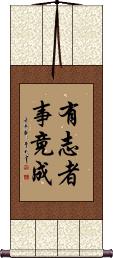
 yǒu zhì zhě shì jìng chéng
A Truly Determined Person Will Find a Solution Scroll

有志者事竟成 is a Chinese proverb that means “A really determined person will find a solution.”

It figuratively means “Where there's a will, there's a way.”

Achieve Inner Peace; Find Deep Understanding

 níng jìng ér zhì yuǎn
Achieve Inner Peace; Find Deep Understanding Scroll

寧靜而致遠 is five characters from a longer ten-character proverb composed by Zhuge Liang about 1800 years ago.

Zhuge Liang

诸葛亮 Zhuge Liang

The proverb means “Your inner peace/tranquility/serenity will help you see or reach far (into the world).”

The last word means “far” but the deeper meaning is that you will surpass what you can currently see or understand. Perhaps even opening up vast knowledge and understanding of complex ideas.

Mark the boat to find the lost sword / Ignoring the changing circumstances of the world
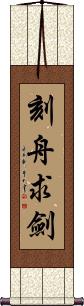
 kè zhōu qiú jiàn
 kokushuukyuuken
Mark the boat to find the lost sword / Ignoring the changing circumstances of the world Scroll

刻舟求劍 is an originally-Chinese proverb that serves as a warning to people that things are always in a state of change.

Thus, you must consider that and not depend on the old ways or a way that may have worked in the past but is no longer valid.

This idiom/proverb comes from the following story:
A man was traveling in a ferry boat across a river. With him, he carried a treasured sword. Along the way, the man became overwhelmed and intoxicated by the beautiful view and accidentally dropped his prized sword into the river. Thinking quickly, he pulled out a knife and marked on the rail of the boat where exactly he had lost his sword.

When the boat arrived on the other side of the river, the man jumped out of the boat and searched for his sword right under where he'd made the mark. Of course, the boat had moved a great distance since he made the mark, and thus, he could not find the sword.

While this man may seem foolhardy, we must take a great lesson from this parable: Circumstances change, so one should use methods to handle the change. In modern China, this is used in business to mean that one should not depend on old business models for a changing market.


This proverb dates back to the Spring and Autumn period (770–476 BC) of the territory now known as China. It has spread and is somewhat known in Japan and Korea.

A House Might be Worth 1 Million Dollars, But Good Neighbors are Worth 10 Million

 bǎi wàn mǎi zhái qiān wàn mǎi lín
A House Might be Worth 1 Million Dollars, But Good Neighbors are Worth 10 Million Scroll

百万买宅千万买邻 is a Chinese proverb that literally translates as:
[It may cost a] million to buy a house, [but] ten million to find [good] neighbors.

Figuratively, this means:
Good neighbors are hard to find.
Good neighbors are even more important than the quality of one's house.

 xī zàng
 seizou / chibetto
Tibet Scroll

西藏 is the Chinese and Japanese name for Tibet.

It is a vast area in southwest China for which the Chinese government has little control (except in the capital of Llasa). During your travels in Tibet (outside of Llasa) you will find it is rough country full of ruthless bandits and honorable and upright Living Buddhas. There are about 2000 Living Buddhas in Tibet, and at least 10 times more bandits ready to ambush you on the road or trail.

On the eastern frontier of Tibet, you will find the place designated to be Shangri-la. It's a friendly village of Tibetans and is the gateway to greater Tibet.

The full official Chinese name is Tibet Autonomous Region or 西藏自治區|西藏自治区. The name here, 西藏 is quite old - from several dynasties ago.


See Also:  China | Nepal | Asia

 tiān shēng yí duì
Soul Mates Scroll

It was tough to find the best way to say “soul mates” in Chinese. We settled on 天生一對 as an old way to say, “A couple selected by heaven.”

The first two characters together mean “natural” or “innate.” Separated, they mean “heaven” and “born.” The last two characters mean “couple.” So this can be translated as “A couple that is together by nature,” or “A couple brought together by heaven's decree.” With a slight stretch, you could say, “A couple born together from heaven.”

It's a struggle to find the best way to describe this idea in English but trust me, it is pretty cool, and it is a great way to say “soulmates.”

If you're in a happy relationship or marriage and think you have found your soul mate, this would be a wonderful wall scroll to hang in your home.

The two most important days in your life...

 Jinsei de ichiban daijina hi wa futsuka aru. Umaretahi to, naze umareta ka o wakatta hi
The two most important days in your life... Scroll

人生で一番大事な日は二日ある。生まれた日と、なぜ生まれたかを分かった日 is Mark Twain's quote, “The two most important days in your life are the day you are born and the day you find out why” in Japanese.


Note: Because this selection contains some special Japanese Hiragana characters, it should be written by a Japanese calligrapher.

 yà sī mǐn
Jasmin Scroll

This is a common Mandarin Chinese transliteration for the male German name Jasmin.

This version has a “y” sound at the beginning, rather than a hard “j” that you find in the English version.

Appreciation of Truth by Meditation

 xīn yìn
 shin nin
Appreciation of Truth by Meditation Scroll

心印 is a Buddhist concept that simply stated is “appreciation of truth by meditation.”

It's a deep subject, but my understanding is that you can find truth through meditation, and once you've found the truth, you can learn to appreciate it more through further meditation. This title is not commonly used outside of the Buddhist community (your Asian friends may or may not understand it). The literal translation would be something like “the mind seal,” I've seen this term translated this way from Japanese Buddhist poetry. But apparently, the seal that is stamped deep in your mind is the truth. You just have to meditate to find it.

Soothill defines it this way: Mental impression, intuitive certainty; the mind is the Buddha-mind in all, which can seal or assure the truth; the term indicates the intuitive method of the Chan (Zen) school, which was independent of the spoken or written word.


Reference: Soothill-Hodous Dictionary of Chinese Buddhism


See Also:  Zen

There is always a way out

Never say die
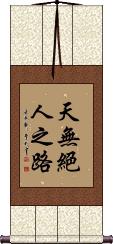
 tiān wú jué rén zhī lù
There is always a way out Scroll

天無絕人之路 is a proverb that means “Heaven never bars one's way,” “Don't despair and you will find a way through,” and “Never give up hope,” and is the Chinese way to say “Never say die.”

God Give Me Strength

 yuàn shàng dì gěi wǒ lì liàng
God Give Me Strength Scroll

願上帝給我力量 is a wish or a prayer that you might call out at a desperate time.

Translated by us for a military serviceman in Iraq. He may need to use this phrase often, though I am not sure where he's going to find a place to hang a wall scroll.

Failure is the Mother of Success

 shī bài shì chéng gōng zhī mǔ
Failure is the Mother of Success Scroll

失败是成功之母 is a Chinese and Korean proverb that means “Every failure that you experience is a chance to learn from it and find success.”

Knowing what does not work is just as important as finding out what does work.


See Also:  Experience is the Mother of Wisdom

 tǎ tú
Tatu Scroll

This is the Mandarin Chinese transliteration of the Finnish name Tatu.

Note: There are a couple ways to write the second character, so don't be alarmed if you order this name, and find the second character looks a little different on your wall scroll than it does to the left.

Spirit / Soul

 líng
 ryou
 
Spirit / Soul Scroll

靈 is spirit or soul in Chinese, Japanese Kanji, and old Korean Hanja.

If you look in the dictionary, you'll also find definitions for this character like:
quick; alert; efficacious; effective; departed soul; coffin; spiritual; energy; effective; clever.


霊There is a modern Japanese version of this character. The button above will get you the traditional/ancient form. But, if you want the modern Japanese, click on the Kanji to the right instead.

Determination to Achieve

 ichi nen ho kki
Determination to Achieve Scroll

一念発起 is a Japanese proverb, “Ichinen Hokki,” which suggests being resolved to do something or having a wholehearted intention to accomplish something.

Some will translate this as “the determination to accomplish something,” or “turning over a new leaf and being determined to find success.”

Grandmaster / Grand Master

 daishihan
Grandmaster / Grand Master Scroll

大師範 is a Japanese title for the master, grandmaster, or senior instructor.

This is a bit of an odd selection for a piece of calligraphy artwork, so proceed with caution. Better to find an appropriate phrase or title (such as the name of the martial art) and then add something like “Grandmaster Smith” as a smaller inscription down the side.

 má jiàng
Mahjong Scroll

麻將 is the Chinese title for the game of mahjong.

Mahjong can also be spelled majiang, mah-jongg, and numerous other variants when played by people of other dialects. While the game originated in China, you will also find it played in Vietnam, South Korea, and Japan.

 fukkatsusai
Easter Scroll

復活祭 is how the holiday of Easter is written in Japanese.

While a not a well-understood holiday in Japan (Christians being about 1% of the population), you will find stuffed Easter bunnies at the shops in the Spring.

復活祭 is a less-used way to write Easter in old Korean.

Failure is the Mother of Success

 shippai wa seikou no haha
Failure is the Mother of Success Scroll

失敗は成功の母 is a Japanese proverb that means exactly what you think.

Every failure that you experience is a chance to learn from it and find success.

Knowing what does not work is just as important as finding out what does work.


Note: This is the Japanese version of an ancient Chinese proverb.


Note: Because this selection contains some special Japanese Hiragana characters, it should be written by a Japanese calligrapher.


See Also:  Experience is the Mother of Wisdom

Goat / Sheep

Year of the Goat / Zodiac Sign

 yáng
 hitsuji
 
Goat  /  Sheep Scroll

羊 is the character for goat or sheep in Chinese, old Korean, and Japanese.

If you were born in the year of the goat (sheep), you . . .

Are sophisticated and considerate
Can always find the best solution to problems.
Are tolerant.
Are not afraid of hardship.
Know how to save money (thrifty).


See also our Chinese Zodiac page.

Trust / To Have Faith

 xìn lài
 shinrai
Trust / To Have Faith Scroll

信賴 can also be translated as confidence, reliance, or dependence; thus, it can also mean “to rely on” or “to depend on.”

Trust is having faith in someone or something. It is a positive attitude about life. You are confident that the right thing will happen without trying to control or make it happen. Even when difficult things happen, trust helps us to find the gift or lesson in it.


頼There is a slight deviation in the Japanese Kanji form of the second character. If you want the modern Japanese version, please click on the special Kanji shown to the right instead of the button above. Note that the traditional Chinese form is still readable and understood by Japanese people.


See Also:  Confidence | Truth | Honor

Choujiao / Chou Jiao

 chuō jiǎo
Choujiao / Chou Jiao Scroll

戳腳 is the title for Choujiao, Chuōjiǎo, or Chou Jiao.

This means poking or stabbing foot. This is a Chinese martial art that falls under the Northern School.

There are many jumps, kicks, and lightning-fist actions in this style.

You'll find Chou Jiao practiced in Liaoning Province, Hebei Province, and Beijing.

In the Abyss of Infinite Bitterness - Turn to the Shore

 kǔ hǎi wú biān huí tóu shì àn
In the Abyss of Infinite Bitterness - Turn to the Shore Scroll

苦海無邊, 回頭是岸 can be translated almost directly as “The sea of bitterness has no bounds, turn your head to see the shore.”

Often this proverb refers to how Buddhist enlightenment can allow one to shed off the abyss of worldly suffering. But it can apply to other religions. If you find yourself trapped in the hardship of this worldly life, take a new turn, and seek a path to salvation.

Return From Death’s Door

 jué chǔ féng shēng
Return From Death’s Door Scroll

絕處逢生 is a Chinese proverb/idiom that talks of coming back from death's door or an unexpected rescue from danger.

Figuratively, this can be to recover from a seemingly impossible situation or to find a way out of a predicament.

If you have survived a near-death experience or severe illness, this might be an appropriate wall scroll for you.

Forever Family

 yǒng yuǎn de jiā
Forever Family Scroll

永遠的家 is a special phrase that we composed for a “family by adoption” or “adoptive family.”

It's the dream of every orphan and foster child to be formally adopted and find their “forever family.”

The first two characters mean forever, eternal, eternity, perpetuity, immortality, and/or permanence. The third character connects this idea with the last character which means “family” and/or “home.”


See Also:  Family

Happy Birthday

 shuku tan jou bi
Happy Birthday Scroll

祝誕生日 is the shortest way to write “Happy Birthday” in Japanese.

The first Kanji means “wish” or “express good wishes,” and the last three characters mean “birthday.”

Because a birthday only lasts one day per year, we strongly suggest that you find an appropriate and personal calligraphy gift that can be hung in the recipient's home year-round.

 tài
 tai
 
Hella Scroll

We struggled to find a word that encompasses the English, “hella” with a meaning like, “really,” “a lot,” “totally,” and/or “very.”

In Chinese, Japanese, and old Korean, 太 is a character that is often said as an adjective in front of other words, to make “good” into “too good,” or “extremely good.”

The meaning of this character from the dictionary is highest, greatest, too (much), very, extremely, fat, grand, magnificent, excellent, or great.

Happy Birthday

 shēng rì kuài lè
Happy Birthday Scroll

生日快樂 is how to write “Happy Birthday” in Chinese.

The first two characters mean “birthday,” and the second two characters mean “happiness,” or rather a wish for happiness.

Because a birthday only lasts one day per year, we strongly suggest that you find an appropriate and personal calligraphy gift that can be hung in the recipient's home year-round.

 mò lì
 matsu ri
Jasmine Scroll

This is the title for “Jasmine” in Chinese.

This title is also used in Japanese but for a specific species known as “Arabian jasmine” (Jasminum sambac).

You will also find a longer version of this title. The longer version just adds a third character which means “flower.” This one is just “jasmine” in Chinese, and the short form of “Arabian jasmine” in Japanese.

Intense / Serious / Deep / Profound

 shēn kè
 shinkoku / misa
Intense / Serious / Deep / Profound Scroll

深刻 is a Chinese word that is the form of intense that describes a person who is deep, serious, and a true thinker.

If you find yourself contemplating the world and coming up with profound ideas, this might be the word for you. In some contexts (especially Korean), it can mean seriousness, gravity, or acuteness.

In Japanese, this can mean “serious problem” or can be a rare given name, Misa. You should not use this if your audience is Japanese.

Monkey Stealing Peaches

Martial arts term

 hóu zi tōu táo
Monkey Stealing Peaches Scroll

猴子偷桃 is a martial arts term that I find hilarious. I thought Stephen Chow had made this up for his Monkey King movie. After some research, it turns out to be real.

This can be translated as “monkey stealing peaches” or “monkey steals the peach.” It refers to distracting an opponent with one hand and seizing his testicles with the other.

In colloquial Chinese speech, this can refer to grabbing somebody by the balls (without any martial arts technique to the grabbing).

8. Right Concentration / Perfect Concentration

Samyak Samadhi / Samma Samadhi

 zhèng dìng
 sei jou
8. Right Concentration / Perfect Concentration Scroll

正定 is one of the Noble Eightfold Paths of Buddhism. Right Concentration, along with Right Effort and Right Mindfulness, constitute the path to Concentration or Perfect Thought.

Right Concentration has to do with leaving behind sensuality, unwholesome states, as well as pleasure and pain. 正定 is a complex idea, but once you have achieved the shedding of worldly sensation, you can truly concentrate and find a higher level of awareness.

Another definition: Concentration of mind that finds its high point in the four absorptions.


This term is exclusively used by devout Buddhists. It is not a common term, and is remains an unknown concept to most Japanese and Chinese people.


See Also:  Buddhism | Enlightenment | Noble Eightfold Path

No Fear

(four-character version)

 yǒng zhě wú wèi
No Fear Scroll

勇者無畏 is a complete sentence that means “Brave People Have No Fear” or “A Brave Person Has No Fear” (plural or singular is not implied).

We translated “No Fear” into the two variations that you will find on our website. Then we checked Chinese Google and found that others had translated “No Fear” in the exact same ways. Pick the one you like best. A great gift for your fearless friend.


See Also:  Fear No Man

 hùn dùn
 konton
Chaos Scroll

混沌 is the Japanese, Korean and Chinese word that means absolute confusion, disorder, and chaos.

This more directly refers to primal chaos or primeval chaos.

When reading something about Chinese mythology, you may find this term used to describe the formless mass before creation.

Chinese scientists sometimes use this word to refer to the nebulous state before the universe was formed or nebulosity.

In some contexts, this could mean “a state of confusion.”

Courtesy / Etiquette

 lǐ yì
Courtesy / Etiquette Scroll

In Chinese, old Korean Hanja, and old Japanese Kanji, 禮儀 means “etiquette” or “courtesy.”

You'll also find a Japanese entry on our website, which uses a modern/simplified first Kanji. The characters shown here compose the best choice if your audience is Chinese or Korean - but also acceptable if you want an ancient-style Japanese scroll (in modern Japanese, it has the same pronunciation, but is written 礼儀).

Note: This can also be translated as propriety, decorum, or formality.

 zhì
 shi
 
Best Scroll

至 is a little strange as calligraphy, but 至 would be the character that means “best” or “extreme” in Chinese and Korean.

The problem is, this is seldom used alone. It's mostly used in combination with other characters to make words like “best friend,” “best food,” and “best love.”

I do not recommend this character for a wall scroll. It's better if you find a more specific term that fits your circumstances.

Note: This can be pronounced in Japanese and has a similar meaning but it is rarely if ever used in modern Japanese.

Warriors Adapt and Overcome

Soldiers need a fluid plan
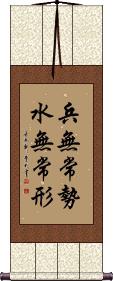
 bīng wú cháng shì shuǐ wú cháng xíng
Warriors Adapt and Overcome Scroll

This literally translates as: Troops/soldiers/warriors have no fixed [battlefield] strategy [just as] water has no constant shape [but adapts itself to whatever container it is in].

Figuratively, this means: One should seek to find whatever strategy or method is best suited to resolving each individual problem.

This proverb is about as close as you can get to the military idea of “adapt improvise overcome.” 兵無常勢水無常形 is the best way to express that idea in both an ancient way, and a very natural way in Chinese.

 dào yuán
 dou gen
Dogen Scroll

Usually, when people are looking for 道元 or “Dogen,” they are referring to the Japanese Zen monk by this name.

He lived from 1200-1253. This Dogen name or title literally means “The Way Origin” or “Beginning of the Path.” It is understood to mean “beginning of right doctrine or faith” in the context of his name and work to establish the Sōtō school of Zen in Japan.

To accomplish that task, this humble monk traveled from Japan and across China to find the more original or pure forms of Buddhism.

Blue Dragon / Azure Dragon

 qīng lóng
 sei ryuu
Blue Dragon / Azure Dragon Scroll

青龍 is a scholarly title for “Blue Dragon” or “Azure Dragon.”

You'll find this title used in ancient Chinese literature and astronomy. This dragon has dominion over the eastern sky or eastern heavens. The Azure Dragon is also noted for representing the spring season. Also seen as an auspicious omen.

Emperor Huizong of the Song Dynasty canonized the five colored dragons as “kings.” The Azure Dragon represents the most compassionate of kings.

In Japanese, this title is known with the same meaning but can also be a given name, Seiryuu or Seiryu.


Note, the first character can be written as 青 OR 靑. Same character, just two ways to write it.

 chuàng zào lì
 souzouryoku
Creativity Scroll

創造力 is a word that means “strength of creativity” or sort of “creativity (is your) strength.”

This can also be translated as “ingenuity.”

Creativity is the power of imagination. It is discovering your own special talents. Daring to see things in new ways and find different ways to solve problems. With your creativity, you can bring something new into the world.

The first character means “to create,” and the second means “to make or build.” Together they mean “creative.” The third character means “strength.”

Optimism / Happy With Your Fate

 lè tiān
 raku ten
Optimism / Happy With Your Fate Scroll

樂天 is about being optimistic and also making the best of whatever life throws at you.

This is hard to define. One dictionary defines this as “acceptance of fate and happy about it.” There is one English word equivalent, which is sanguinity or sanguinary.

You can also say that this means “Be happy with whatever Heaven provides,” or “Find happiness in whatever fate Heaven bestows upon you.” 樂天 suggests being an optimist in life.

Note: This is sometimes a given name in China.


楽 Please note that Japanese tend to write the first character in a slightly-different form (as seen to the right). Let us know if you have a preference when you place your order.

Love and Honor

 shēn qíng hòu yì
Love and Honor Scroll

深情厚義 means to love and honor.

This is more or less the kind of thing you'd find in marriage vows.

The first two characters suggest deep love or deep emotions, passion, and feelings.
The last two characters mean generous justice or thick honor (the third character is an adjective that means generous or thick). It just means that you will honor your lover's wishes and treat them justly and righteously (fairly).


This is the longer four-character version, there is also a short and sweet two character version.


See Also:  Love and Honor

Peaceful Heart / Peace of Mind / Calm Mind

 ān xīn
 an shin
Peaceful Heart / Peace of Mind / Calm Mind Scroll

安心 can be defined as relief, peace of mind, feeling at ease, to be relieved, to set one's mind at rest, and easiness.

安心 is a nice word that encompasses great meanings within just two characters. Some of the other meanings include pacifying, settling the mind, and peace of mind. It's also the idea of feeling a sense of security, safety, and confidence in your state of well-being.

This can be used by everyone, but some consider it to be a Buddhist concept (You'll find it in your Zen dictionary).

Note: Can be romanized as Anshin or Anjin in Japanese.

Buddha / Buddhism

Hotoke

 hotoke / butsu
 
Buddha / Buddhism Scroll

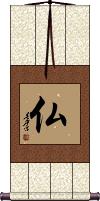
仏 is the single Japanese Kanji that can mean Buddha or Buddhism.

This Kanji was a shorthand way to write 佛 (Buddha) in Chinese (popular around the 13th century). Somehow, this became the version of this Chinese character that was absorbed into Japanese and thus became part of standard Kanji. Centuries later, this character is not recognized in China (except for those from China with a background in Chinese literature or language).

仏 is also a rare or derivative Korean Hanja form - but I doubt you will find any Korean that knows that.

Maintain An Army For 1000 Days, Use It For An Hour

 yǎng bīng qiān rì, yàng bīng yì shí
Maintain An Army For 1000 Days, Use It For An Hour Scroll

Nothing could be more true. When I was in the Marine Corps, we trained for years for combat that often lasts only hours.

養兵千日用兵一時 is a Chinese proverb that, also reminds me of a common phrase used in the military to describe combat: “Weeks of total boredom, punctuated with five minutes of sheer terror.”

This may have some roots in Sun Tzu's The Art of War. Though I can not find this passage in his writings.

On the subject of the Art of War, if you have a favorite passage, we can create a custom calligraphy scroll with that phrase.

 ikigai
Ikigai Scroll

生き甲斐 is a Japanese word that means something one lives for, a reason for being, a purpose in life, or French, raison d'etre.

Everyone has an ikigai. Finding it requires a deep and often lengthy search for self. Finding your Ikigai is the way to also find satisfaction and meaning in life.

Your Ikigai could be almost anything. For some, it is running for president. For others, satisfaction is found in raising children.

Ikigai is why you get up in the morning; bringing meaning to your life and pursuing your Ikigai makes life worthwhile.

Peace of Mind

 hé píng
 wa hei
Peace of Mind Scroll

和平 is the Chinese order for these two characters, which means peace but can also be translated as amicability, specifically, or mildness. 和平 is often translated as a simple way to say “peace of mind.” This combination is used in Korean Hanja to mean “peace and harmony.”

Alone, the first character means peace and harmony.
The second character means balance when read by itself.

Note: 和平 are often seen in the opposite order in Japanese with the same meaning (You'll sometimes find them in this order in Japan, so either way is OK).

Live Free or Die

Give me liberty or give me death
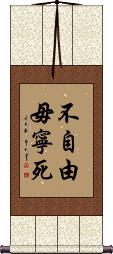
 bú zì yóu wú nìng sǐ
Live Free or Die Scroll

不自由毋寧死 means “Give me liberty or give me death” in Chinese.

This is also the best way to say, “Live free or die.”

The characters break down this way:
不 = Not; none; without.
自由 = Freedom; liberty; freewill; self-determination.
毋寧 = Rather; would rather; rather be.
死 = Dead; death.

This will go nicely next to your “Don't tread on me” flag. This phrase is known well enough in China that it's listed in a few dictionaries. Though I doubt you will find too many Chinese citizens willing to yell this on the steps of the capital in Beijing.


See Also:  Death Before Dishonor

Wado-Ryu

Style of Karate or Jujitsu

 wa dou ryuu
Wado-Ryu Scroll

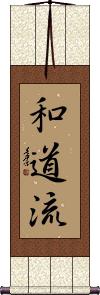
和道流 or Wado-Ryu is a style of Karate or Jujutsu (Jujitsu).
Note: Many will argue whether this is a style of Karate or Jujutsu.

While some find Wado-Ryu similar to Shotokan Karate, enough differences exist in perspective and technique that it stands by itself.

Breaking down the characters into the proper Japanese Romaji, you have “wa dou ryuu” or “wa dō ryū.” The meaning is roughly-translated as “Harmony Way Style” or “Peace Method Style.” The first Kanji should probably be read as harmony rather than peace in this case.


See Also:  Wado-Kai

The Red String

Thread of Lover's Destiny / Fate

 akai ito
The Red String Scroll

This literally translates as “the red string” or “the red thread” in Japanese, but the real meaning is much deeper...

In Japanese culture, it's believed that fate, destiny, or karma joins lovers by an unseen string, tied around one little finger of each. 赤い糸 is how soul mates find and are drawn to each other.

The Japanese concept of the red thread of fate, by most estimations, comes from Chinese folklore, where it's known as 姻緣紅線. The only difference is that in China, the celestial red thread is tied around the ankles of the lovers (versus what is usually represented as the pinky finger in Japan).

Strength and Love in Unity

 riki ai fu ni
Strength and Love in Unity Scroll

力愛不二 is a proverb that literally means:
“Strength [and] Love [are] Not Two [separate ideas/concepts/things].”

You'll find this proverb translated from Japanese to English as:
Love and strength are not separate.
Power and love are indivisible.
Strength and love in harmony.
Strength and love stand together.

Old Japanese grammar is quite different than English, and so this proverb says a lot within the brevity of just 4 characters. If you just read these characters directly as “Strength Love Not Two,” you'd probably miss the real meaning.


According to the Swedish Shorinji Kempo Federation, this is the second characteristic of Shorinji Kempo.

This post really explains the concept best in my opinion: Bushido by MS: Riki Ai Fu Ni, which states: "Riki Ai Funi" is the philosophy that power (Riki) and love (Ai) are indivisible. More concretely, a person, who is powerful but does not have love, cannot control and misuse his/her power; on the other hand, a person, who has loved ones but is not powerful enough, cannot protect himself/herself nor loved ones.

Sincere Heart

 xuě xīn
Sincere Heart Scroll

When you take 血心 apart, you find the sum is slightly different than the parts. The first character means blood, and the second means heart. It is important to note that for thousands of years, it was believed that your heart was both your soul and your mind in Asian culture. When you add blood to the heart, it is your whole being - the pure and clean dedication of your whole soul.

Most Chinese dictionaries define this as the sincerity of heart or a MEDICAL TERM!!!
Please think carefully before ordering this selection - it was only added as others have used this for coffee cups and other novelties (though perhaps naively).

Never Forget Your First Resolution

Never Lose Your Beginner's Spirit

 sho shin wasu ru be ka ra zu
Never Forget Your First Resolution Scroll

初心忘るべからず is an old Japanese proverb that suggests you try to never forget the enthusiasm you had as a child when you try new things (or even face the day-to-day). Basically, avoid having the mundane attitude that many people get with age.

You'll find this Japanese proverb translated in a few different ways. Here are some of them:
Don't forget your first resolution.
Never forget your childlike enthusiasm.
Forget not the beginner's mind.
Try never to lose your initial enthusiasm (freshness of attitude).


Note: This is sometimes written as 初心忘る可からず. The one shown above is used about 10x more often. There’s only one character difference between the two versions.


Note: Because this selection contains some special Japanese Hiragana characters, it should be written by a Japanese calligrapher.

Four Noble Truths (Buddhism)

 sì dì
 shitai
Four Noble Truths (Buddhism) Scroll

四諦 is the title of the Four Noble Truths as taught in virtually all sects of Buddhism.

These truths are suffering (dukkha), desire/attachment (samudaya), release from desire/attachment (nirodha), and the path leading away from suffering (magga).

The suggestion behind these truths is that all things in nature suffer. All things in nature have desire and attachment for things in the physical world. The enlightened can release themselves from the bonds of desire and attachment. And finally, once they release all desire and attachment, the enlightened will find a path that leads away from suffering.


This term is exclusively used by devout Buddhists. It is not a common term, and is remains an unknown concept to most Japanese, Chinese, and Korean people.


See Also:  Buddhism | Enlightenment

Love and Honor

 qíng yì
Love and Honor Scroll

情義 means to love and honor in Chinese. 情義 is more or less the kind of thing you'd find in marriage vows.

The first character suggests emotions, passion, heart, humanity, sympathy, and feelings.

In this context, the second character means to honor your lover's wishes and treat them justly and righteously (fairly). That second character can also be translated as “obligation,” as in the obligation a husband and wife have to love each other even through difficult times.

In the context outside of a couple's relationship, this word can mean “comradeship.”

Japanese may see this more as “humanity and justice” than “love and honor.” It's probably best if your target is Chinese.


This is the short and sweet form, there is also a longer poetic form (you can find it here: Love and Honor if it’s not on the page you are currently viewing).


See Also:  Love and Honor

 kuān dà
 kandai
Generosity Scroll

寬大 is a Chinese, Japanese, and Korean word that means Generosity.

Generosity is giving and sharing. You share freely, not with the idea of receiving something in return. You find ways to give others happiness and give just for the joy of giving. Generosity is one of the best ways to show love and friendship.

寬大 can also be translated as charitable, magnanimity, liberality, or in some contexts, broad-mindedness.

Note: There is a tiny deviation in the first character when written in Japanese. If you choose our Japanese master calligrapher, the little dot on the lower right of the first character will be omitted. With or without the dot, this can be read in Chinese, Japanese Kanji, and old Korean Hanja.


See Also:  Benevolence | Altruism | Charity

Police / Public Security Bureau

 gōng ān
 kou an
Police / Public Security Bureau Scroll

公安 is the Chinese, Japanese Kanji, and old Korean Hanja title for (The Ministry of) Public Security. 公安 can also generally mean public safety, public security, or public welfare. It is a positive term in Japan, where some even name their daughters “Kouan” (this title).

In China, this is the kinder name for the PSB or Public Security Bureau. It's really the national police of China - occasionally brutal and seldom properly-trained or educated. Once in a while, you find a PSB officer who lives up to the title of 公安. Before the 1989 massacre, it was the PSB officers who refused to stop nor kill any of the protesting college students (so they're not all bad). The Chinese government had to call in soldiers from Inner Mongolia to kill thousands of protesters.

Chop Wood, Carry Water

Before enlightenment or after, chores remain.

 dùn wù zhī qián kǎn chái tiāo shuǐ dùn wù zhī hòu kǎn chái tiāo shuǐ
Chop Wood, Carry Water Scroll

頓悟之前砍柴挑水; 頓悟之後砍柴挑水 means “Before enlightenment, chop wood, carry water; After enlightenment, chop wood, carry water.

This is a Chinese proverb that is attributed to 吴力 (Wú Lì) who lived between 1632 and 1718 - living part of his life as a devout Buddhist, and many years as a Catholic Jesuit Priest in China - what an interesting life!

This has been explained many times in many ways. I am a Buddhist, and here is my brief take on this proverb...

Before enlightenment, one may find daily chores mundane, tedious, and boring. However, upon reaching enlightenment one is not relieved of the details of daily life. An enlightened person will, however, see such chores as a joy, and do them mindfully.


There is another version floating around, which is 在你領悟之前砍柴、運水。在你領悟之後,砍柴、運水。
If you want this other version, just contact me. The meaning is the same, just different phrasing.

 huā mù lán
Hua Mulan Scroll

花木蘭 is the name of the famous Chinese woman warrior Hua Mulan.

She was made famous in the west by Disney's animated movie, “Mulan.”

Most of the historical information about her comes from an ancient poem. It starts with a concerned Mulan, as she is told a man from each family is to serve conscription in the army. Her father is too old, and her brother is too young. Mulan decides to take the place of her father. After twelve years of war, the army returns, and the best warriors are awarded great posts in the government and riches. Mulan turns down all offers and asks only for a good horse for the long trip home. When Mulan greets visiting comrades wearing her old clothes, they are shocked to find the warrior they rode into battle with for years is actually a woman.

God of Zion / God of Abraham

 shàng dì
 joutei
God of Zion / God of Abraham Scroll

上帝 is how Chinese Christians and Jews refer to God, AKA The Judeo-Christian God.

There are Chinese Jews whose ancestry dates back to Jewish traders on the silk road. They are known as the Kaifeng Jews. Most have left China for Israel now.

There are also plenty of Christians in China of the Protestant and Catholic varieties. However, the churches are basically run by the government, and the Chinese Catholic church does not recognize the Pope.

Oddly, in my experience, I found the Chinese Protestant church to be much less political compared to Baptist and other Protestant churches that I have visited in America.

上帝 is also the typically-used title for God in Japanese.

While you may find this term in old Korean dictionaries, it is an obscure and rarely-used title for God in modern Korean.


See Also:  Christianity | Jesus Christ

Each Time You Stumble and Fall, You Gain Experience and Wisdom

 chī yí qiàn, zhǎng yí zhì
Each Time You Stumble and Fall, You Gain Experience and Wisdom Scroll

吃一塹長一智 is a Chinese proverb that means “Fall into a moat, and you will gain wisdom from the experience.”

It really suggests that the failures, troubles, frustrations, and setbacks that you encounter in your life are actually helping you to find wisdom. Some would also translate this proverb as “Learn from your mistakes” or “Learn from your experience.”

If you are studying Chinese, you will recognize the first character as “eat,” but in this case, it means to “experience” (as used in this proverb, it is suggesting that you have fallen into a moat and/or had a hard time crossing it).
Translated character by character, this whole proverb is, “Experience one moat, gain one wisdom/knowledge.”

Note: This can be pronounced in Korean, but it's not a commonly used phrase.

Asian Pride / Oriental Pride / AZN Pryde
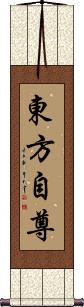
 dōng fāng zì zūn
 dung fong chi juen
 tou hou zi son
Asian Pride / Oriental Pride / AZN Pryde Scroll

東方自尊 is the universal way to write “Asian Pride.”

We worked on this one for a long time. The effort involved both Chinese and Japanese translators and lengthy discussions. If you have been searching for this term, there is a reason that it's hard to find the way to write “Asian Pride” in Chinese and Japanese - it's because of the inherent difficulties in figuring out a universal combination of characters that can be read in all languages that use forms of Chinese characters.

This final solution that you see to the left creates a reasonable title in Chinese and an exotic (perhaps unusual) title in Japanese (This could be read as “Eastern Self-Respect” in Japanese”).
Although not as natural, it does have the same meaning as Korean Hanja, and the older generation of Vietnamese people will be able to read it.

The first two characters literally mean “Oriental” and the second two mean “pride,” “self-esteem,” or “self-respect” (we chose the most non-arrogant way to say “pride”). If you have “Asian Pride” (sometimes spelled Asian Pryde) these are the characters for you.

Note: For those who wonder, there is nothing technically wrong with the word “Oriental.” It is a correct word, and any bad meanings were created by so-called “Asian Americans” and Caucasians in the United States. To say “Asian” would not completely correct the intended meaning since that would include people from Saudi Arabia, Iraq, Iran, India, and portions of Russia.

For further proof, if you were of East Asian ancestry and born in England, you would be known as a “British Oriental” (The “Oriental stigma” is basically an American creation and, therefore, applies mainly to the American English language - where they get a bit overzealous with political correctness).

Further, since the Chinese and Japanese word for Oriental is not English, they can not be construed as having ill meaning. On one trip to China or Japan, you will find many things titled with these two characters, such as malls, buildings, and business names. These places also use “Oriental” as their English title (much as we do since our Chinese business name starts with these same two characters).

In short, the first two characters have the meaning that Americans attach to “Asian” but is more technically correct.

Learn New Ways From Old / Onkochishin

New ideas coming from past history
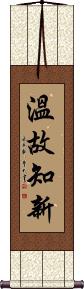
 wēn gù zhī xīn
 on ko chi shin
Learn New Ways From Old / Onkochishin Scroll

溫故知新 is a proverb from Confucius that is used in Chinese, Japanese, and Korean cultures.

It can be translated in several ways:
Coming up with new ideas based on things learned in the past.
Examine things of the past, and obtain new knowledge.
Developing new ideas based on the study of the past.
Gain new insights through restudying old issues.
Understand the present by reviewing the past.
Learning from the past.
Review the old and know the new.
Taking a lesson from the past.
Taking a lesson from the wisdom of the ancients.
Follow the old ways.

The direct translation would be, “By asking old things, know new things.”
The Character meanings breakdown this way:
溫故 = ask old
知新 = know new

Explained: To learn new things that are outside of your experience, you can learn from old things of the past. You can find wisdom in history.


溫 VS. 温

Note: Japanese use a variant of the first Kanji in modern times.
Therefore if you order this from a Japanese calligrapher, expect the first Kanji to look like 温 instead of 溫.

In addition to 温故知新 as mentioned above, this is sometimes written as 温古知新 in Japan.

Allah / God of Islam
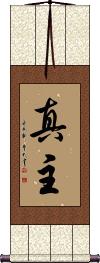
 zhēn zhǔ
Allah / God of Islam Scroll

真主 is how Chinese Muslims refer to God (it literally means “True Master”).

Oddly, in China, two different names for God have emerged. Even though Muslims, Christians, and Jews all worship the same God of Abraham.

In Arabic, the word Allah is just the Arabic way to say, God. Arab Christians pray to Allah, just like Arab Muslims. Somehow in China, the title of God diverged.

If you are curious, there are millions of Muslims throughout China but especially in the northwest portion of China known as Xinjiang. Here you will find descendants of Turkmen, Persian, Arab, and other ethnicities. Some are mixed with Han-Chinese blood; others appear to be pure Turkmen. Many have fair complexions, green eyes, and light hair but all are citizens of China. A visit to Xinjiang will shift your paradigm and blow away all of your stereotypes about what it means to be Chinese.

Homosexual Male / Gay Male
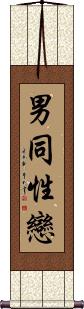
 nán tóng xìng liàn
Homosexual Male / Gay Male Scroll

You need the male character in front of the word for homosexual in Chinese to create this word.

It's a much nicer way to say “Gay Male” than English words like Fag, Fairy, Sissy, Puff, Poof, Poofster, Swish, or Pansy. Although I suppose it could be used as a substitute for Nancy Boy, Queer, or Queen (for which, last time I checked, my gay friends said were OK in the right context).

For those of you who think China is a restrictive society - there are at least two gay discos in Beijing, the capital of China. It's at least somewhat socially acceptable to be a gay male in China. However, lesbians seem to be shunned a bit.

I think the Chinese government has realized that the 60% male population means not everybody is going to find a wife (every gay male couple that exists means two more women in the population are available for the straight guys), and the fact that it is biologically impossible for men to give birth, may be seen as helping to decrease the over-population in China.

Flying Tigers AVG

 fēi hǔ duì
Flying Tigers AVG Scroll

飛虎隊 is the full Chinese title of the “Flying Tigers Group.”

These were the American pilots that volunteered to go to China and fight the Japanese before the entry of the USA into World War Two. These fighter pilots were so esteemed in China that fallen American pilots could always find refuge in villages and safe passage and escape to areas of China that were not occupied by Japan at that time. Chinese villagers helped such fallen pilots with full knowledge that when the Japanese occupation forces found out, all the men, women, and children in the village would be massacred by Japanese troops (there are more than a few known cases of such massacres).

The Flying Tigers successfully kept supply lines to the Chinese resistance open and divided Japanese forces at a crucial time while America prepared to join WWII officially.

A wall scroll like this honors the men who risked or gave their lives as noble volunteers and is a reminder of the best moment in the history of Sino-American relations.

These three characters literally mean “flying tiger(s) group/team/squad.”


Note: Hanging these characters on your wall will not make you any friends with Japanese people who are aware or this history (most Japanese have no idea, as Japan’s involvement in WWII has all but been erased from school textbooks in Japan).

One

The number one

 yī
 ichi
 
One Scroll

一 is “one” or “1” in Chinese, Japanese Kanji, and old Korean Hanja.

People keep searching for “one” but I'm not sure what you want. This would be a strange selection for a wall scroll, so please don't order it. Post a request on our forum if you want a phrase with “one” in it that you can't find on our site.

The “one” character is really simple, it's just one stroke. Two is two strokes and three is three strokes, from four and above, the characters get more complicated.

In some ways, the “one” character is too simple, it could be a stray mark, or added to a banking document. Therefore, the following banking anti-fraud character for “one” has developed over the last 1500 years in China and Japan:
壱 壹 弌

Unselfish: Perfectly Impartial

 dà gōng wú sī
Unselfish: Perfectly Impartial Scroll

大公無私 is a Chinese proverb that comes from an old story from some time before 476 BC. About a man named Qi Huangyang, who was commissioned by the king to select the best person for a certain job in the Imperial Court.

Qi Huangyang selected his enemy for the job. The king was very confused by the selection, but Qi Huangyang explained that he was asked to find the best person for the job, not necessarily someone that he liked or had a friendship with.

Later, Confucius commented on how unselfish and impartial Qi Huangyang was by saying, “Da Gong Wu Si” which, if you look it up in a Chinese dictionary, is generally translated as “Unselfish” or “Just and Fair.”

If you translate each character, you'd have something like

“Big/Deep Justice Without Self.”

Direct translations like this leave out a lot of what the Chinese characters really say. Use your imagination, and suddenly you realize that “without self” means “without thinking about yourself in the decision” - together, these two words mean “unselfish.” The first two characters serve to drive the point home that we are talking about a concept that is similar to “blind justice.”

One of my Chinese-English dictionaries translates this simply as “just and fair.” So that is the short and simple version.

Note: This can be pronounced in Korean, but it's not a commonly used term.


See Also:  Selflessness | Work Unselfishly for the Common Good | Altruism

Islam

(phonetic version)

 yī sī lán jiào
Islam Scroll

伊斯蘭教 both means and sounds like “Islam” in Mandarin Chinese.

The first three characters sound like the word “Islam,” and the last character means “religion” or “teaching.” It's the most general term for “Islam” in China. The highest concentration of Muslims in China is Xinjiang (the vast region in northwest China that was called The East Turkistan Republic until 1949 and is sometimes called Chinese Turkistan, Uyghuristan). Here you will find Uygurs, Kazakhs, Kyrgyz, and others that are descendants of Turkmen (possibly mixed with Persians and Arabs). Many of their ancestors were traders who traveled the silk road to buy and sell spices and silk and exchange other goods from the Orient and the Middle East.

I spent some time in Xinjiang and got to know this community. They are strong people who can endure much. They are friendly and love to have a good time. I was a stranger but was treated by villagers (near China's border with Afghanistan) as if I was a good friend.
However, I have heard that it's best not to cross them, as in this land, the law is the blade, and everything is “eye for an eye.” The Chinese government has little control in Xinjiang, with almost no police officers except in the capital of Urumqi (so it's a 60-hour roundtrip train ride to seek the aid of law enforcement in most cases).

While few seem devout, there are at least small mosques in every village. And you will never see a man or woman outside without a head covering.

It should be noted that these people are all citizens of China, but they are officially of the Caucasian race. A visit to Xinjiang will change your idea of what it means to be Chinese.

Better Late Than Never

It's Never Too Late Too Mend
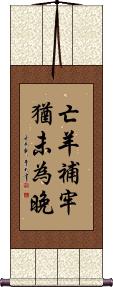
 wáng yáng bǔ láo yóu wèi wéi wǎn
Better Late Than Never Scroll

Long ago in what is now China, there were many kingdoms throughout the land. This time period is known as “The Warring States Period” by historians because these kingdoms often did not get along with each other.

Sometime around 279 B.C. the Kingdom of Chu was a large but not particularly powerful kingdom. Part of the reason it lacked power was the fact that the King was surrounded by “yes men” who told him only what he wanted to hear. Many of the King's court officials were corrupt and incompetent which did not help the situation.

The King was not blameless himself, as he started spending much of his time being entertained by his many concubines.

One of the King's ministers, Zhuang Xin, saw problems on the horizon for the Kingdom, and warned the King, “Your Majesty, you are surrounded by people who tell you what you want to hear. They tell you things to make you happy and cause you to ignore important state affairs. If this is allowed to continue, the Kingdom of Chu will surely perish, and fall into ruins.”

This enraged the King who scolded Zhuang Xin for insulting the country and accused him of trying to create resentment among the people. Zhuang Xin explained, “I dare not curse the Kingdom of Chu but I feel that we face great danger in the future because of the current situation.” The King was simply not impressed with Zhuang Xin's words.
Seeing the King's displeasure with him and the King's fondness for his court of corrupt officials, Zhuang Xin asked permission from the King that he may take leave of the Kingdom of Chu, and travel to the State of Zhao to live. The King agreed, and Zhuang Xin left the Kingdom of Chu, perhaps forever.

Five months later, troops from the neighboring Kingdom of Qin invaded Chu, taking a huge tract of land. The King of Chu went into exile, and it appeared that soon, the Kingdom of Chu would no longer exist.

The King of Chu remembered the words of Zhuang Xin and sent some of his men to find him. Immediately, Zhuang Xin returned to meet the King. The first question asked by the King was “What can I do now?”

Zhuang Xin told the King this story:

A shepherd woke one morning to find a sheep missing. Looking at the pen saw a hole in the fence where a wolf had come through to steal one of his sheep. His friends told him that he had best fix the hole at once. But the Shepherd thought since the sheep is already gone, there is no use fixing the hole.
The next morning, another sheep was missing. And the Shepherd realized that he must mend the fence at once. Zhuang Xin then went on to make suggestions about what could be done to reclaim the land lost to the Kingdom of Qin, and reclaim the former glory and integrity of the Kingdom of Chu.

The Chinese idiom shown above came from this reply from Zhuang Xin to the King of Chu almost 2,300 years ago.
It translates roughly into English as...
“Even if you have lost some sheep, it's never too late to mend the fence.”

This proverb, 亡羊补牢犹未为晚, is often used in modern China when suggesting in a hopeful way that someone change their ways, or fix something in their life. It might be used to suggest fixing a marriage, quitting smoking, or getting back on track after taking an unfortunate path in life among other things one might fix in their life.

I suppose in the same way that we might say, “Today is the first day of the rest of your life” in our western cultures to suggest that you can always start anew.

Note: This does have Korean pronunciation but is not a well-known proverb in Korean (only Koreans familiar with ancient Chinese history would know it). Best if your audience is Chinese.


This in-stock artwork might be what you are looking for, and ships right away...

Gallery Price: $61.00

Your Price: $33.88
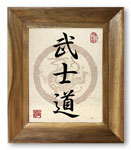
Gallery Price: $130.00

Your Price: $69.88


The following table may be helpful for those studying Chinese or Japanese...

Title CharactersRomaji (Romanized Japanese)Various forms of Romanized Chinese
Love Will Find A Way終成眷屬
终成眷属
zhōng chéng juàn shǔ
zhong1 cheng2 juan4 shu3
zhong cheng juan shu
zhongchengjuanshu
chung ch`eng chüan shu
chungchengchüanshu
chung cheng chüan shu
Love Will Find A Way有情人終成眷屬
有情人终成眷属
yǒu qíng rén zhōng chéng juàn shǔ
you3 qing2 ren2 zhong1 cheng2 juan4 shu3
you qing ren zhong cheng juan shu
yu ch`ing jen chung ch`eng chüan shu
yu ching jen chung cheng chüan shu
A Truly Determined Person Will Find a Solution有志者事竟成yǒu zhì zhě shì jìng chéng
you3 zhi4 zhe3 shi4 jing4 cheng2
you zhi zhe shi jing cheng
youzhizheshijingcheng
yu chih che shih ching ch`eng
yuchihcheshihchingcheng
yu chih che shih ching cheng
Achieve Inner Peace; Find Deep Understanding寧靜而致遠
宁静而致远
níng jìng ér zhì yuǎn
ning2 jing4 er2 zhi4 yuan3
ning jing er zhi yuan
ningjingerzhiyuan
ning ching erh chih yüan
ningchingerhchihyüan
Mark the boat to find the lost sword
Ignoring the changing circumstances of the world
刻舟求劍
刻舟求剑
kokushuukyuuken
kokushukyuken
kè zhōu qiú jiàn
ke4 zhou1 qiu2 jian4
ke zhou qiu jian
kezhouqiujian
k`o chou ch`iu chien
kochouchiuchien
ko chou chiu chien
A House Might be Worth 1 Million Dollars, But Good Neighbors are Worth 10 Million百萬買宅千萬買鄰
百万买宅千万买邻
bǎi wàn mǎi zhái qiān wàn mǎi lín
bai3 wan4 mai3 zhai2 qian1 wan4 mai3 lin2
bai wan mai zhai qian wan mai lin
pai wan mai chai ch`ien wan mai lin
pai wan mai chai chien wan mai lin
Tibet西藏seizou / chibetto
seizo / chibetto
xī zàng / xi1 zang4 / xi zang / xizanghsi tsang / hsitsang
Soul Mates天生一對
天生一对
tiān shēng yí duì
tian1 sheng1 yi2 dui4
tian sheng yi dui
tianshengyidui
t`ien sheng i tui
tienshengitui
tien sheng i tui
The two most important days in your life...人生で一番大事な日は二日ある生まれた日となぜ生まれたかを分かった日Jinsei de ichiban daijina hi wa futsuka aru. Umaretahi to, naze umareta ka o wakatta hi
Jasmin亞斯敏
亚斯敏
yà sī mǐn
ya4 si1 min3
ya si min
yasimin
ya ssu min
yassumin
Appreciation of Truth by Meditation心印shin nin / shinninxīn yìn / xin1 yin4 / xin yin / xinyinhsin yin / hsinyin
There is always a way out天無絕人之路
天无绝人之路
tiān wú jué rén zhī lù
tian1 wu2 jue2 ren2 zhi1 lu4
tian wu jue ren zhi lu
tianwujuerenzhilu
t`ien wu chüeh jen chih lu
tienwuchüehjenchihlu
tien wu chüeh jen chih lu
God Give Me Strength願上帝給我力量
愿上帝给我力量
yuàn shàng dì gěi wǒ lì liàng
yuan4 shang4 di4 gei3 wo3 li4 liang4
yuan shang di gei wo li liang
yuanshangdigeiwoliliang
yüan shang ti kei wo li liang
yüanshangtikeiwoliliang
Failure is the Mother of Success失敗是成功之母
失败是成功之母
shī bài shì chéng gōng zhī mǔ
shi1 bai4 shi4 cheng2 gong1 zhi1 mu3
shi bai shi cheng gong zhi mu
shibaishichenggongzhimu
shih pai shih ch`eng kung chih mu
shih pai shih cheng kung chih mu
Tatu塔圖
塔图
tǎ tú / ta3 tu2 / ta tu / tatut`a t`u / tatu / ta tu
Spirit
Soul

ryou / ryolíng / ling2 / ling
Determination to Achieve一念発起ichi nen ho kki
ichinenhokki
ichi nen ho ki
Grandmaster
Grand Master
大師範daishihan
Mahjong麻將
麻将
má jiàng / ma2 jiang4 / ma jiang / majiangma chiang / machiang
Easter復活祭fukkatsusai
fukatsusai
Failure is the Mother of Success失敗は成功の母shippai wa seikou no haha
shippaiwaseikounohaha
shipai wa seiko no haha
Goat
Sheep
hitsujiyáng / yang2 / yang
Trust
To Have Faith
信賴
信赖
shinraixìn lài / xin4 lai4 / xin lai / xinlaihsin lai / hsinlai
Choujiao
Chou Jiao
戳腳
戳脚
chuō jiǎo
chuo1 jiao3
chuo jiao
chuojiao
ch`o chiao
chochiao
cho chiao
In the Abyss of Infinite Bitterness - Turn to the Shore苦海無邊回頭是岸
苦海无边回头是岸
kǔ hǎi wú biān huí tóu shì àn
ku3 hai3 wu2 bian1 hui2 tou2 shi4 an4
ku hai wu bian hui tou shi an
kuhaiwubianhuitoushian
k`u hai wu pien hui t`ou shih an
kuhaiwupienhuitoushihan
ku hai wu pien hui tou shih an
Return From Death’s Door絕處逢生
绝处逢生
jué chǔ féng shēng
jue2 chu3 feng2 sheng1
jue chu feng sheng
juechufengsheng
chüeh ch`u feng sheng
chüehchufengsheng
chüeh chu feng sheng
Forever Family永遠的家
永远的家
yǒng yuǎn de jiā
yong3 yuan3 de jia1
yong yuan de jia
yongyuandejia
yung yüan te chia
yungyüantechia
Happy Birthday祝誕生日shuku tan jou bi
shukutanjoubi
shuku tan jo bi
Hellataitài / tai4 / tait`ai / tai
Happy Birthday生日快樂
生日快乐
shēng rì kuài lè
sheng1 ri4 kuai4 le4
sheng ri kuai le
shengrikuaile
sheng jih k`uai le
shengjihkuaile
sheng jih kuai le
Jasmine茉莉matsu ri / matsurimò lì / mo4 li4 / mo li / moli
Intense
Serious
Deep
Profound
深刻shinkoku / misashēn kè / shen1 ke4 / shen ke / shenkeshen k`o / shenko / shen ko
Monkey Stealing Peaches猴子偷桃hóu zi tōu táo
hou2 zi5 tou1 tao2
hou zi tou tao
houzitoutao
hou tzu t`ou t`ao
houtzutoutao
hou tzu tou tao
8. Right Concentration
Perfect Concentration
正定sei jou / seijou / sei jozhèng dìng
zheng4 ding4
zheng ding
zhengding
cheng ting
chengting
No Fear勇者無畏
勇者无畏
yǒng zhě wú wèi
yong3 zhe3 wu2 wei4
yong zhe wu wei
yongzhewuwei
yung che wu wei
yungchewuwei
Chaos混沌kontonhùn dùn / hun4 dun4 / hun dun / hundunhun tun / huntun
Courtesy
Etiquette
禮儀
礼仪
lǐ yì / li3 yi4 / li yi / liyili i / lii
Bestshizhì / zhi4 / zhichih
Warriors Adapt and Overcome兵無常勢水無常形
兵无常势水无常形
bīng wú cháng shì shuǐ wú cháng xíng
bing1 wu2 chang2 shi4 shui3 wu2 chang2 xing2
bing wu chang shi shui wu chang xing
ping wu ch`ang shih shui wu ch`ang hsing
ping wu chang shih shui wu chang hsing
Dogen道元dou gen / dougen / do gendào yuán / dao4 yuan2 / dao yuan / daoyuantao yüan / taoyüan
Blue Dragon
Azure Dragon
青龍 / 靑龍
青龙
sei ryuu / seiryuu / sei ryuqīng lóng
qing1 long2
qing long
qinglong
ch`ing lung
chinglung
ching lung
Creativity創造力
创造力
souzouryoku
sozoryoku
chuàng zào lì
chuang4 zao4 li4
chuang zao li
chuangzaoli
ch`uang tsao li
chuangtsaoli
chuang tsao li
Optimism
Happy With Your Fate
樂天 / 楽天
乐天
raku ten / rakutenlè tiān / le4 tian1 / le tian / letianle t`ien / letien / le tien
Love and Honor深情厚義
深情厚义
shēn qíng hòu yì
shen1 qing2 hou4 yi4
shen qing hou yi
shenqinghouyi
shen ch`ing hou i
shenchinghoui
shen ching hou i
Peaceful Heart
Peace of Mind
Calm Mind
安心an shin / anshinān xīn / an1 xin1 / an xin / anxinan hsin / anhsin
Buddha
Buddhism

hotoke / butsu
Maintain An Army For 1000 Days, Use It For An Hour養兵千日用兵一時
养兵千日用兵一时
yǎng bīng qiān rì, yàng bīng yì shí
yang3 bing1 qian1 ri4 yang4 bing1 yi4 shi2
yang bing qian ri yang bing yi shi
yang ping ch`ien jih yang ping i shih
yang ping chien jih yang ping i shih
Ikigai生き甲斐ikigai
Peace of Mind和平wa hei / waheihé píng / he2 ping2 / he ping / hepingho p`ing / hoping / ho ping
Live Free or Die不自由毋寧死
不自由毋宁死
bú zì yóu wú nìng sǐ
bu2 zi4 you2 wu2 ning4 si3
bu zi you wu ning si
buziyouwuningsi
pu tzu yu wu ning ssu
putzuyuwuningssu
Wado-Ryu和道流wa dou ryuu
wadouryuu
wa do ryu
The Red String赤い糸akai ito / akaiito
Strength and Love in Unity力愛不二
力爱不二
riki ai fu ni
rikiaifuni
Sincere Heart血心xuě xīn / xue3 xin1 / xue xin / xuexinhsüeh hsin / hsüehhsin
Never Forget Your First Resolution初心忘るべからず / 初心忘る可からず
初心忘るべからず
sho shin wasu ru be ka ra zu
shoshinwasurubekarazu
Four Noble Truths (Buddhism)四諦
四谛
shitaisì dì / si4 di4 / si di / sidissu ti / ssuti
Love and Honor情義
情义
qíng yì / qing2 yi4 / qing yi / qingyich`ing i / chingi / ching i
Generosity寬大
宽大
kandaikuān dà / kuan1 da4 / kuan da / kuandak`uan ta / kuanta / kuan ta
Police
Public Security Bureau
公安kou an / kouan / ko angōng ān / gong1 an1 / gong an / gongankung an / kungan
Chop Wood, Carry Water頓悟之前砍柴挑水頓悟之后砍柴挑水
顿悟之前砍柴挑水顿悟之后砍柴挑水
dùn wù zhī qián kǎn chái tiāo shuǐ dùn wù zhī hòu kǎn chái tiāo shuǐ
dun4 wu4 zhi1 qian2 kan3 chai2 tiao1 shui3 dun4 wu4 zhi1 hou4 kan3 chai2 tiao1 shui3
dun wu zhi qian kan chai tiao shui dun wu zhi hou kan chai tiao shui
tun wu chih ch`ien k`an ch`ai t`iao shui tun wu chih hou k`an ch`ai t`iao shui
tun wu chih chien kan chai tiao shui tun wu chih hou kan chai tiao shui
Hua Mulan花木蘭
花木兰
huā mù lán
hua1 mu4 lan2
hua mu lan
huamulan
God of Zion
God of Abraham
上帝joutei / joteishàng dì / shang4 di4 / shang di / shangdishang ti / shangti
Each Time You Stumble and Fall, You Gain Experience and Wisdom吃一塹長一智
吃一堑长一智
chī yí qiàn, zhǎng yí zhì
chi1 yi2 qian4 zhang3 yi2 zhi4
chi yi qian zhang yi zhi
chiyiqianzhangyizhi
ch`ih i ch`ien chang i chih
chihichienchangichih
chih i chien chang i chih
Asian Pride
Oriental Pride
AZN Pryde
東方自尊
东方自尊
tou hou zi son
touhouzison
to ho zi son
dōng fāng zì zūn
dong1 fang1 zi4 zun1
dong fang zi zun
dongfangzizun
tung fang tzu tsun
tungfangtzutsun
Learn New Ways From Old
Onkochishin
溫故知新
温故知新
on ko chi shin
onkochishin
wēn gù zhī xīn
wen1 gu4 zhi1 xin1
wen gu zhi xin
wenguzhixin
wen ku chih hsin
wenkuchihhsin
Allah
God of Islam
真主zhēn zhǔ / zhen1 zhu3 / zhen zhu / zhenzhuchen chu / chenchu
Homosexual Male
Gay Male
男同性戀
男同性恋
nán tóng xìng liàn
nan2 tong2 xing4 lian4
nan tong xing lian
nantongxinglian
nan t`ung hsing lien
nantunghsinglien
nan tung hsing lien
Flying Tigers AVG飛虎隊
飞虎队
fēi hǔ duì
fei1 hu3 dui4
fei hu dui
feihudui
fei hu tui
feihutui
Oneichiyī / yi1 / yii
Unselfish: Perfectly Impartial大公無私
大公无私
dà gōng wú sī
da4 gong1 wu2 si1
da gong wu si
dagongwusi
ta kung wu ssu
takungwussu
Islam伊斯蘭教
伊斯兰教
yī sī lán jiào
yi1 si1 lan2 jiao4
yi si lan jiao
yisilanjiao
i ssu lan chiao
issulanchiao
Better Late Than Never亡羊補牢猶未為晚
亡羊补牢犹未为晚
wáng yáng bǔ láo yóu wèi wéi wǎn
wang2 yang2 bu3 lao2 you2 wei4 wei2 wan3
wang yang bu lao you wei wei wan
wang yang pu lao yu wei wei wan
wangyangpulaoyuweiweiwan
In some entries above you will see that characters have different versions above and below a line.
In these cases, the characters above the line are Traditional Chinese, while the ones below are Simplified Chinese.


Dictionary

Lookup Find the Way in my Japanese & Chinese Dictionary


Successful Chinese Character and Japanese Kanji calligraphy searches within the last few hours...


50th AnniversaryAadenAadonAakashAaroAbayaAbbasAbbeyAbbieAbhishekAbigaiAbundance and ProsperityAdamAdamarisAdapt and OvercomeAddieAdejahAdelineAdityaAdnanAdonisAdrianaAdriannaAdrielAguilarAhmadAimiAishaAjayAkbarAkilaAlanaAleishaAlessaAlessandraAlexAlexandraAlexandriaAlfiAliceAlinaAlishaAliyaAllaAllahAllyAlmedaAlmighty OmnipotentAloraAlvinAlyshaAlyssaAlyssiaAmadAmalAmelAminAmirAnasAndreAndreiAndyAngelAnilAnjaniAnne-SophieAntonAntonellaAntonioAnyaArelyAriaArisaArlenArmanArmandoAshrafAslamAubreeAubreyAuraAureliaAvengerAyanAydenAymanAzuraBa Gua ZhangBaileeBaileyBashaBasilBayuBeautyBeauty of NatureBellaBelovedBennettBhumikaBiancaBibekBibiBishalBlack Tiger FistBlairBlessed by GodBradenBradyBraedenBraydenBristolBritneyBrockBryanBrysonBubbaBuddha Dharma SanghaButterflyCallieCamdenCarenCarleenCarmenCasperChantalChanteChelseaChen SurnameCherryChevelleChinoChop Wood Carry WaterChristinaClaireCobraColeCompassionConnieConnorConstanceCorbinCosmoCourageCristianCullenCyanCyrilDamarisDanaDaniDaniealDanielleDaniloDaodejingDaodejing Tao Te Ching - Chapter 54DaphneDariaDark AngelDarrenDarrylDaruDavianDeath Before DishonorDeepikaDefenseDerrickDeterminationDevonDharmaDianaDillowDimaDogenDominicDoveDragonDragon WarriorDrewDuncanDurellDwightEdieEduardoEdwardsElaineEldiEleanorEleonorEliezerElinElishaEllieElmerElsieElviraEmanEmelineEmiliaEmmettEnlightenment

All of our calligraphy wall scrolls are handmade.

When the calligrapher finishes creating your artwork, it is taken to my art mounting workshop in Beijing where a wall scroll is made by hand from a combination of silk, rice paper, and wood.
After we create your wall scroll, it takes at least two weeks for air mail delivery from Beijing to you.

Allow a few weeks for delivery. Rush service speeds it up by a week or two for $10!

When you select your calligraphy, you'll be taken to another page where you can choose various custom options.


A nice Chinese calligraphy wall scroll

The wall scroll that Sandy is holding in this picture is a "large size"
single-character wall scroll.
We also offer custom wall scrolls in small, medium, and an even-larger jumbo size.

A professional Chinese Calligrapher

Professional calligraphers are getting to be hard to find these days.
Instead of drawing characters by hand, the new generation in China merely type roman letters into their computer keyboards and pick the character that they want from a list that pops up.

There is some fear that true Chinese calligraphy may become a lost art in the coming years. Many art institutes in China are now promoting calligraphy programs in hopes of keeping this unique form of art alive.

Trying to learn Chinese calligrapher - a futile effort

Even with the teachings of a top-ranked calligrapher in China, my calligraphy will never be good enough to sell. I will leave that to the experts.

A high-ranked Chinese master calligrapher that I met in Zhongwei

The same calligrapher who gave me those lessons also attracted a crowd of thousands and a TV crew as he created characters over 6-feet high. He happens to be ranked as one of the top 100 calligraphers in all of China. He is also one of very few that would actually attempt such a feat.


Check out my lists of Japanese Kanji Calligraphy Wall Scrolls and Old Korean Hanja Calligraphy Wall Scrolls.

Some people may refer to this entry as Find the Way Kanji, Find the Way Characters, Find the Way in Mandarin Chinese, Find the Way Characters, Find the Way in Chinese Writing, Find the Way in Japanese Writing, Find the Way in Asian Writing, Find the Way Ideograms, Chinese Find the Way symbols, Find the Way Hieroglyphics, Find the Way Glyphs, Find the Way in Chinese Letters, Find the Way Hanzi, Find the Way in Japanese Kanji, Find the Way Pictograms, Find the Way in the Chinese Written-Language, or Find the Way in the Japanese Written-Language.

16 people have searched for Find the Way in Chinese or Japanese in the past year.
Find the Way was last searched for by someone else on Oct 18th, 2025