Many custom options...


And formats...



Name Bird in Chinese / Japanese...
Buy a Name Bird calligraphy wall scroll here!
Personalize your custom “Name Bird” project by clicking the button next to your favorite “Name Bird” title below...
If you would like your name in Chinese calligraphy and it does not appear below, please contact me, and I'll transliterate and add your name to our website database for you.
1. Bird
2. Flying Ace / Aviator / Bird Man
3. Faith is the bird that feels the light when the dawn is still dark
6. Sparrow
8. Black Raven
9. White Crane
11. Suzaku
12. Kingfisher
13. Phoenix Rise from the Ashes
15. A Bright Future
16. Raven / Crow
17. White Stork
18. Kingfisher
19. Crane
20. Falcon
21. Sparrow
22. Bad Experience, Caution Lingers
23. Kun
24. Swallow
25. Beauty of Nature
26. Phoenix
27. Wings
28. Tengu
29. Push or Knock
Bird
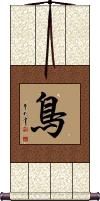
鳥 is simply the word for bird in Chinese, Japanese Kanji, and old Korean Hanja.
鳥 can also mean fowl, poultry, cock, or chicken.
Flying Ace / Aviator / Bird Man
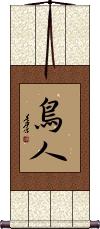
鳥人 means “bird man” or “bird person,” but it is used colloquially in Japanese to mean a flying ace or aviator.
Faith is the bird that feels the light when the dawn is still dark
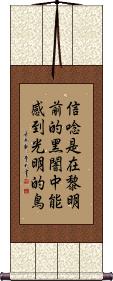
信唸是在黎明前的黑闇中能感到光明的鳥 is a philosophical poem/quote from Indian Poet and Philosopher, Rabindranath Tagore.
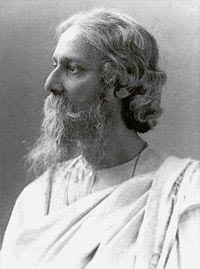
Rabindranath Tagore, 1915
This quote is not sourced, and therefore several variations exist in English. Some suggest the original was in the Bengali language.
This, of course, is the Chinese translation that has the meaning of, “Faith is the bird that feels the light and sings when the dawn is still dark.”
More about Rabindranath Tagore
Black Eagle / Condor
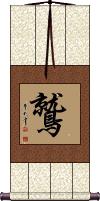
鷲 is the way to write black eagle or condor in Chinese.
It means eagle (sometimes vulture) in Japanese Kanji. 鷲 hasn't been in common use in Korean for hundreds of years, so it's hard to say what bird it represented in old Korean Hanja.
There are other multi-character words that express different specific species of birds of prey (bald eagle, osprey, golden eagle, etc).
If you need a more specific title, just contact me.
Swan / White Crane
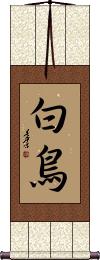
白鳥 is the Japanese Kanji and old Korean Hanja title for white swan (Cygnus Bechstein).
The title literally means white-feathered bird. This title can also be used to refer to a white crane.
This can also be the Japanese surname, Hakuchou.
Sparrow
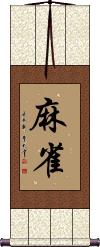
麻雀 is the common and specific name for a hemp sparrow bird in Chinese.
This was also the original name for the game, known commonly as Mahjong. You will still see boxes of Mahjong tiles with the title 麻雀 for sparrow instead of the modern 麻將 in Southern China. This title is also used for Mahjong in Japan.
Eagle / Falcon / Hawk
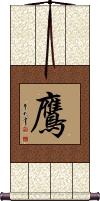
鷹 is the way to write eagle, falcon, or hawk in Chinese.
It means hawk or falcon in Japanese Kanji, and simply “eagle” in old Korean Hanja. Though we have different words for them in English, eagles, falcons, and hawks are all seen as the same general type of bird in Asian languages.
If you are looking for the Dutch surname Valk, or the German surname Falco by meaning, this would be a good character for you.
There are other multi-character words (most of them contain this character) which express different specific species of birds of prey (bald eagle, osprey, golden eagle, etc). If you need a more specific title, just contact me.
Black Raven
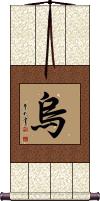
烏 can mean raven or crow but is also used as an alternate way to write the color black.
Therefore, this is a symbol of the black raven (with emphasis on black). This can also mean rook or dark.
Notes: This can be the Japanese surname Karasu, or Chinese surname Wu.
White Crane
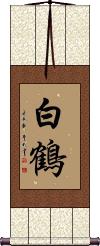
白鶴 means White Crane.
This title directly means “White Crane” in Chinese, but in English, this particular crane is referred to as the “red-crowned crane” or “Grus Japonensis.” This crane is mostly white with a red bill (crown).
Legendary Phoenix
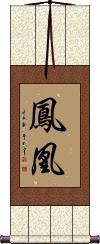
鳳凰 is the word that translates as “Legendary Phoenix” in Chinese.
This refers to the bird that, according to Chinese folklore, rose from the fiery ashes.
The phoenix and dragon are by far the most famous creatures in Chinese mythology.
Suzaku
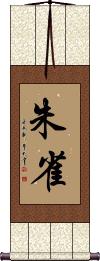
This is a Japanese surname that romanizes as Suzaku.
The meaning in Chinese and Japanese is “Vermilion Bird” or “Red Bird.” This is also the name of a Chinese start constellation (the seven mansions, or the god, who rules the southern sky).
This is not the only Japanese name that romanizes as Suzaku. Make sure you have the right one before you order.
Kingfisher
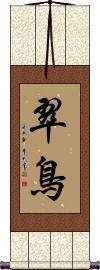
翠鳥 is the title for the kingfisher bird in Chinese.
翠 means bluish-green or green jade.
鳥 means bird.
Phoenix Rise from the Ashes
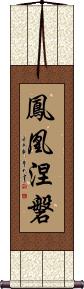
鳳凰涅磐 is a proverb that suggests “Legendary Phoenix rises from the ashes.” It means “Legendary Phoenix [reaches] Nirvana.”
There is a legend in China of a great bird reborn once every 500 years. This bird gathers all the ill will, suffering, desire, and other negative things of the world. The bird then plunges into the fire to burn away all negative things, sacrificing itself in the process (achieving Nirvana, or perhaps allowing others the opportunity to reach Nirvana).
500 years later, the phoenix is reborn from the ashes again, and the cycle repeats.
Construction Crane
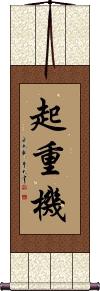
起重機 refers to the huge machine that lifts materials high into the air as crews construct huge buildings.
A customer requested this specifically after some confusion over the bird by the same name.
In an odd twist, while they don't know this name in English sounds like a bird; the building crane is jokingly called “The real national bird of China” because of the accelerated level of construction in Beijing and elsewhere ever since preparations began for the 2008 Olympics. As of 2018, construction has barely slowed.
If you want the type of construction crane that drives down the road, please note that the word is totally different for that kind of “vehicle crane.”
A Bright Future
Incredible 10,000-Mile Flight of the Peng
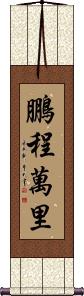
鵬程萬里 is an ancient Chinese proverb used in modern times to wish someone a long and successful career.
It's really about the 10,000 Flight of the Peng (Peng, also known as Roc is a mythical fish that can turn into a bird and take flight).
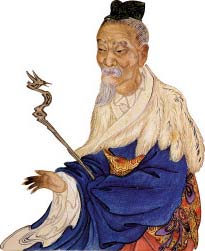
莊子
Zhuangzi or Chuang Tzu
Breaking down each character:
1. Peng or Roc (a kind of bird).
2. Journey (in this case, a flight).
3. 10,000 (Ten Thousand).
4. Li is a unit of distance often referred to as a “Chinese Mile,” though the real distance is about half a kilometer.
Direct Translation: “Peng's Journey [of] 10,000 Li.”
Literal meaning: “The 10,000-Li Flying Range Of The Roc.”
Perceived meaning: “To have a bright future” or “To go far.”
This proverb/idiom comes from the book of Zhuangzi or Chuang Tzu. It tells the tale of a huge fish that could turn into a gigantic bird. This bird was called a “peng” and was many miles long. This legendary size allowed the Peng to fly from the Northern Sea to the Southern Sea in a single bound.
Wishing someone “a Peng's Journey of 10,000 Li” will imply that they can travel far without stopping and will have great success, a long career, and a prosperous future.
Raven / Crow
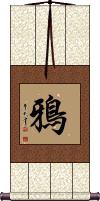
鴉 is raven or crow in Chinese characters, old Korean Hanja, and Japanese Kanji. 鴉 is also an abbreviation for the Corvus species.
If this is your favorite bird, hang this symbol on your wall.
Note: Can also be the surname Karasu in Japanese.
White Stork
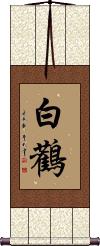
白鸛 means “white stork.”
The scientific name of this Chinese bird species is Ciconia ciconia from the stork family Ciconiidae.
Kingfisher
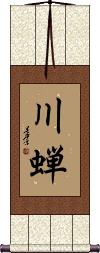
川蝉 is a common Japanese title for the kingfisher (Alcedo atthis).
There are a few ways to name this little greenish bird in Japanese, so be aware this is not the only or absolute kingfisher title.
Crane
Graceful bird of longevity
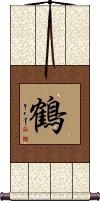
鶴 is a famous bird of China.
Known in China to be a very spiritual creature, the crane is a symbol of both longevity and the journey of the souls and spirits of ancestors.
Note: 鶴 can mean crane or stork in Japanese.
Falcon
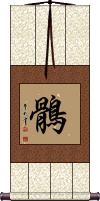
鶻 is a Chinese character that means falcon.
This can also refer to a migratory bird of prey.
If you are looking for the Dutch surname Valk, or the German surname Falco by meaning, this would be a good character for you.
Sparrow
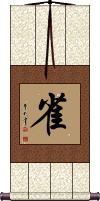
雀 is the shortest way to say small bird, or sparrow in Chinese, Japanese, and Korean.
In Chinese, this can also be a colloquial way to speak of a freckle.
In Japanese, it's a nickname for a talkative person - not a bad thing, as it can also be a knowledgeable person
Bad Experience, Caution Lingers
A bird wounded by an arrow
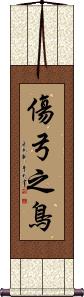
傷弓之鳥 means “bird wounded by an arrow.”
Figuratively, this refers to a wounded or damaged person. It's very similar to the western proverb, “a person once bitten is twice shy.” To explain further, this is about someone who has become overly cautious due to a bad experience.
This phrase is used in Chinese, Japanese, and Korean.
Kun
Sea Creature
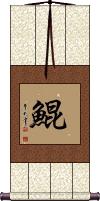
A 鲲 (Kun) is a famous sea monster, often associated or used interchangeably with a 鵬 (Peng).
鯤 is comparable to Leviathan or Jonah's whale.
In Chinese mythology, the Kun is a giant fish said to be able to turn into a bird.
鯤 and the mythological creature is also known in Japanese and Korean. However, in some contexts, this character can refer to fry (fish babies).
Swallow
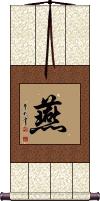
燕 is the single character for the swallow (bird).
If you are a zoologist, this can refer to birds of the family Hirundinidae. Sometimes used to refer to Hirundo rustica (the barn swallow).
燕 is also a surname in China that is romanized as Yan. In fact, there were also several different Yan kingdoms in the ancient history of China (which is the origin of the surname).
Beauty of Nature
Ka-Chou-Fuu-Getsu
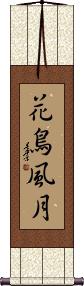
花鳥風月 is the Japanese Kanji proverb for “Beauties of Nature.”
The dictionary definition is “the traditional themes of natural beauty in Japanese aesthetics.”
The Kanji each represents an element of nature that constitutes beauty in traditional Japanese art and culture.
The Kanji breakdown:
花 = ka = flower (also pronounced “hana”)
鳥 = chou = bird (also pronounced “tori”).
風 = fuu = wind (also pronounced “kaze”).
月 = getsu = moon (also pronounced “tsuki”)
Phoenix (male)
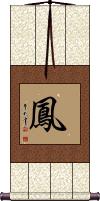
鳳 is the simplest way to write “Phoenix” in Chinese. Because the dragon is usually expressed as a single character, when you see “dragon and phoenix” written in Chinese, you'll often see this single-character version.
Please note, this is also the male element of a phoenix, so it also means “male phoenix bird.” However, some Chinese people may argue that the phoenix has a female characteristic, regardless of which character you use.
Wings
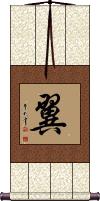
翼 is the shortest way to say “wing” or “wings” in Chinese, Japanese Kanji, and old Korean Hanja.
This can be the wings of a bird or aircraft (including the rotors of a helicopter or rotor wing).
Single characters like this are often ambiguous and have many additional meanings. This character, depending on the context, can mean the following:
Area surrounding the bullseye of a target; to assist; The Chinese surname Yi; “Wings” constellation (one of the 28 mansions of Chinese astronomy).
翼 is also a Japanese name that romanizes as Tsubasa and can refer to the Japanese manga series Tsubasa.
Tengu
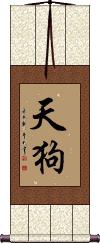
天狗 is the Japanese title for Tengu, which roughly translates as “heavenly dog.”
Tengu is a type of legendary creature found in Japanese folk religion and is also considered a type of Shinto god (kami) or yōkai (supernatural being).
The origin is Chinese, though this term is seldom used in Chinese anymore. It was a dog-like Chinese demon (Tiangou)
Although the title contains the word “dog,” the tengu are often depicted with human and bird-like characteristics. Sometimes they have large noses or beaks like birds.
Push or Knock
To weigh one's words
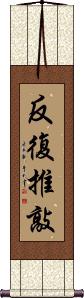
During the Tang Dynasty, a man named Jia Dao (born in the year 779), a well-studied scholar and poet, went to the capital to take the imperial examination.
One day as he rides a donkey through the city streets, a poem begins to form in his mind. A portion of the poem comes into his head like this:
“The bird sits on the tree branch near a pond,
A monk approaches and knocks at the gate...”
At the same time, he wondered if the word “push” would be better than “knock” in his poem.
As he rides down the street, he imagines the monk pushing or knocking. Soon he finds himself making motions of pushing and shaking a fist in a knocking motion as he debates which word to use. He is quite a sight as he makes his way down the street on his donkey with hands and fists flying about as the internal debate continues.
As he amuses people along the street, he becomes completely lost in his thoughts and does not see the mayor's procession coming in the opposite direction. Jia Bao is blocking the way for the procession to continue down the road, and the mayor's guards immediately decide to remove Jia Bao by force. Jia Bao, not realizing that he was in the way, apologizes, explains his poetic dilemma and awaits his punishment for blocking the mayor's way.
The mayor, Han Yu, a scholar and author of prose himself, finds himself intrigued by Jia Dao's poem and problem. Han Yu gets off his horse and addresses Jia Bao, stating, “I think knock is better.” The relieved Jia Bao raises his head and is invited by the mayor to join the procession, and are seen riding off together down the street, exchanging their ideas and love of poetry.
In modern Chinese, this 反復推敲 idiom is used when someone is trying to decide which word to use in their writing or when struggling to decide between two things when neither seems to have a downside.
You may want to check our...
Your name on a Chinese calligraphy scroll page
Your name on a Japanese calligraphy scroll page
...for a list of almost 5000 names.
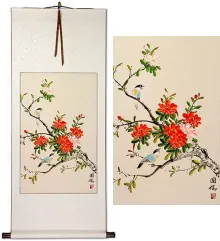
This in-stock artwork might be what you are looking for, and ships right away...



Gallery Price: $60.00
Your Price: $36.88


Gallery Price: $126.00
Your Price: $69.88

Gallery Price: $353.00
Your Price: $195.88
Gallery Price: $240.00
Your Price: $148.88

Gallery Price: $90.00
Your Price: $49.88
Gallery Price: $268.00
Your Price: $148.88
The following table may be helpful for those studying Chinese or Japanese...
| Title | Characters | Romaji (Romanized Japanese) | Various forms of Romanized Chinese | |
| Bird | 鳥 鸟 | tori | niǎo / niao3 / niao | |
| Flying Ace Aviator Bird Man | 鳥人 | chou jin / choujin / cho jin | ||
| Faith is the bird that feels the light when the dawn is still dark | 信唸是在黎明前的黑闇中能感到光明的鳥 信念是在黎明前的黑暗中能感到光明的鸟 | xìn niǎn shì zài lí míng qián de hēi àn zhōng néng gǎn dào guāng míng de niǎo xin4 nian3 shi4 zai4 li2 ming2 qian2 de hei1 an4 zhong1 neng2 gan3 dao4 guang1 ming2 de niao3 xin nian shi zai li ming qian de hei an zhong neng gan dao guang ming de niao | hsin nien shih tsai li ming ch`ien te hei an chung neng kan tao kuang ming te niao hsin nien shih tsai li ming chien te hei an chung neng kan tao kuang ming te niao |
|
| Black Eagle Condor | 鷲 鹫 | washi | jiù / jiu4 / jiu | chiu |
| Swan White Crane | 白鳥 | hakuchou / shirotori hakucho / shirotori | ||
| Sparrow | 麻雀 | maa jan / maajan / ma jan | má què / ma2 que4 / ma que / maque | ma ch`üeh / machüeh / ma chüeh |
| Eagle Falcon Hawk | 鷹 鹰 | taka | yīng / ying1 / ying | |
| Black Raven | 烏 乌 | karasu | wū / wu1 / wu | |
| White Crane | 白鶴 白鹤 | bái hè / bai2 he4 / bai he / baihe | pai ho / paiho | |
| Legendary Phoenix | 鳳凰 凤凰 | houou / ho | fèng huáng feng4 huang2 feng huang fenghuang | |
| Suzaku | 朱雀 | suzaku | zhū què / zhu1 que4 / zhu que / zhuque | chu ch`üeh / chuchüeh / chu chüeh |
| Kingfisher | 翠鳥 翠鸟 | cuì niǎo / cui4 niao3 / cui niao / cuiniao | ts`ui niao / tsuiniao / tsui niao | |
| Phoenix Rise from the Ashes | 鳳凰涅磐 凤凰涅磐 | fèng huáng niè pán feng4 huang2 nie4 pan2 feng huang nie pan fenghuangniepan | feng huang nieh p`an fenghuangniehpan feng huang nieh pan |
|
| Construction Crane | 起重機 起重机 | kijuuki / kijuki | qǐ zhòng jī qi3 zhong4 ji1 qi zhong ji qizhongji | ch`i chung chi chichungchi chi chung chi |
| A Bright Future | 鵬程萬里 鹏程万里 | péng chéng wàn lǐ peng2 cheng2 wan4 li3 peng cheng wan li pengchengwanli | p`eng ch`eng wan li pengchengwanli peng cheng wan li |
|
| Raven Crow | 鴉 鸦 | karasu | yā / ya1 / ya | |
| White Stork | 白鸛 白鹳 | bái guàn / bai2 guan4 / bai guan / baiguan | pai kuan / paikuan | |
| Kingfisher | 川蝉 | kawasemi | ||
| Crane | 鶴 鹤 | gaku / tsuru | hè / he4 / he | ho |
| Falcon | 鶻 鹘 | hú / hu2 / hu | ||
| Sparrow | 雀 | chie / suzume | què / que4 / que | ch`üeh / chüeh |
| Bad Experience, Caution Lingers | 傷弓之鳥 伤弓之鸟 | shou kyuu no tori shoukyuunotori sho kyu no tori | shāng gōng zhī niǎo shang1 gong1 zhi1 niao3 shang gong zhi niao shanggongzhiniao | shang kung chih niao shangkungchihniao |
| Kun | 鯤 鲲 | kon | kūn / kun1 / kun | k`un / kun |
| Swallow | 燕 | yasushi | yàn / yan4 / yan | yen |
| Beauty of Nature | 花鳥風月 | ka chou fuu getsu kachoufuugetsu ka cho fu getsu | ||
| Phoenix (male) | 鳳 凤 | ootori / otori | fèng / feng4 / feng | |
| Wings | 翼 翌 | yoku / tsubasa | yì / yi4 / yi | i |
| Tengu | 天狗 | ten gu / tengu | tiān gǒu / tian1 gou3 / tian gou / tiangou | t`ien kou / tienkou / tien kou |
| Push or Knock | 反復推敲 反复推敲 | fǎn fù tuī qiāo fan3 fu4 tui1 qiao1 fan fu tui qiao fanfutuiqiao | fan fu t`ui ch`iao fanfutuichiao fan fu tui chiao |
|
| In some entries above you will see that characters have different versions above and below a line. In these cases, the characters above the line are Traditional Chinese, while the ones below are Simplified Chinese. | ||||

Successful Chinese Character and Japanese Kanji calligraphy searches within the last few hours...



