Many custom options...


And formats...



Not what you want?
Try other similar-meaning words, fewer words, or just one word.
Bu Do in Chinese / Japanese...
Buy a Bu Do calligraphy wall scroll here!
Personalize your custom “Bu Do” project by clicking the button next to your favorite “Bu Do” title below...
Takemusu Aiki
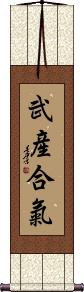
武産合氣 is one of the core spiritual concepts developed by Morihei Ueshiba to support his practice of Aikido.
Breaking down the characters:
武 - Bu (as in Bushido) is read as “Take” here. It means martial.
産 - Musu means innocent or naive, but also refers to the idea of birth and creation.
合氣 - Aiki as in Aikido - unifying spirit.
Forgive and Forget
Confucian Proverb
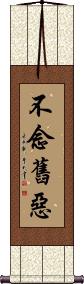
不念舊惡 is a Chinese proverb that can be translated as “Do not recall old grievances,” or more simply as “Forgive and forget.”
The character breakdown:
不 (bù) not; no; don't.
念 (niàn) read aloud.
舊 (jiù) old; former.
惡 (è) wicked deeds; grievances; sins.
This proverb comes from the Analects of Confucius.
Undaunted After Repeated Setbacks
Persistence to overcome all challenges
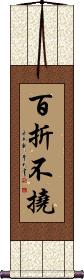
百折不撓 is a Chinese proverb that means “Be undaunted in the face of repeated setbacks.”
More directly translated, it reads, “[Overcome] a hundred setbacks, without flinching.” 百折不撓 is of Chinese origin but is commonly used in Japanese and somewhat in Korean (same characters, different pronunciation).
This proverb comes from a long, and occasionally tragic story of a man that lived sometime around 25-220 AD. His name was Qiao Xuan, and he never stooped to flattery but remained an upright person at all times. He fought to expose the corruption of higher-level government officials at great risk to himself.
Then when he was at a higher level in the Imperial Court, bandits were regularly capturing hostages and demanding ransoms. But when his own son was captured, he was so focused on his duty to the Emperor and the common good that he sent a platoon of soldiers to raid the bandits' hideout, and stop them once and for all even at the risk of his own son's life. While all of the bandits were arrested in the raid, they killed Qiao Xuan's son at first sight of the raiding soldiers.
Near the end of his career, a new Emperor came to power, and Qiao Xuan reported to him that one of his ministers was bullying the people and extorting money from them. The new Emperor refused to listen to Qiao Xuan and even promoted the corrupt Minister. Qiao Xuan was so disgusted that in protest, he resigned from his post as minister (something almost never done) and left for his home village.
His tombstone reads “Bai Zhe Bu Nao” which is now a proverb used in Chinese culture to describe a person of strong will who puts up stubborn resistance against great odds.
My Chinese-English dictionary defines these 4 characters as “keep on fighting despite all setbacks,” “be undaunted by repeated setbacks,” and “be indomitable.”
Our translator says it can mean “never give up” in modern Chinese.
Although the first two characters are translated correctly as “repeated setbacks,” the literal meaning is “100 setbacks” or “a rope that breaks 100 times.” The last two characters can mean “do not yield” or “do not give up.”
Most Chinese, Japanese, and Korean people will not take this absolutely literal meaning but will instead understand it as the title suggests above. If you want a single big word definition, it would be indefatigability, indomitableness, persistence, or unyielding.
See Also: Tenacity | Fortitude | Strength | Perseverance | Persistence
Not the results for bu do that you were looking for?
Below are some entries from our dictionary that may match your bu do search...
| Characters If shown, 2nd row is Simp. Chinese |
Pronunciation Romanization |
Simple Dictionary Definition |
无 see styles |
wú wu2 wu bu む |
(1) nothing; naught; nought; nil; zero; (prefix) (2) un-; non- not, no, none (無) |
侮 see styles |
wǔ wu3 wu bu ぶ |
to insult; to ridicule; to disgrace (something) despised; (something) made light of |
步 see styles |
bù bu4 pu bu |
a step; a pace; walk; march; stages in a process; situation (歩) pada; step, pace. |
沒 没 see styles |
mò mo4 mo motsu |
drowned; to end; to die; to inundate Sunk, gone; not; translit. m, mu, mo, mau, ma, bu, v, etc. |
芙 see styles |
fú fu2 fu bu ぶ |
used in 芙蓉[fu2 rong2], lotus (personal name) Bu |
呂布 吕布 see styles |
lǚ bù lu:3 bu4 lü pu ryofu りょふ |
Lü Bu (-198), general and warlord (person) Lu Bu (?-199 AD; Chinese general) |
打っ see styles |
bu; bu ぶっ; ブッ |
(prefix) (kana only) (verb prefix; used to emphasize the following verb) strongly; violently; quickly; suddenly |
扶根 see styles |
fú gēn fu2 gen1 fu ken bu kon |
physical [sense] organs |
林逋 see styles |
lín bū lin2 bu1 lin pu |
Lin Bu (967-1028), Northern Song poet |
約部 约部 see styles |
yuē bù yue1 bu4 yüeh pu yaku bu |
a teaching, seen from the perspective of its place in temporal sequence |
舞天 see styles |
buuten / buten ぶーてん |
(given name) Bu-ten |
董卓 see styles |
dǒng zhuó dong3 zhuo2 tung cho toutaku / totaku とうたく |
Dong Zhuo (-192), top general of late Han, usurped power in 189, murdered empress dowager and child emperor, killed in 192 by Lü Bu 呂布|吕布 (personal name) Toutaku |
貂蟬 貂蝉 see styles |
diāo chán diao1 chan2 tiao ch`an tiao chan |
Diaochan (-192), one of the four legendary beauties 四大美女[si4 da4 mei3 nu:3], in fiction a famous beauty at the break-up of Han dynasty, given as concubine to usurping warlord Dong Zhuo 董卓[Dong3 Zhuo2] to ensure his overthrow by fighting hero Lü Bu 呂布|吕布[Lu:3 Bu4] |
赤兔 see styles |
chì tù chi4 tu4 ch`ih t`u chih tu |
Red Hare, famous horse of the warlord Lü Bu 呂布|吕布[Lu:3 Bu4] in the Three Kingdoms era |
一說部 一说部 see styles |
yī shuō bù yi1 shuo1 bu4 i shuo pu Issetsu bu |
Ekavyāvahārika 猗柯毘與婆訶利柯 or (Pali) Ekabyohāra 鞞婆訶羅 One of the 20 Hīnayāna schools, a nominalistic school, which considered things as nominal, i.e. names without any underlying reality; also styled 諸法但名宗 that things are but names. |
七丈夫 see styles |
qī zhàng fū qi1 zhang4 fu1 ch`i chang fu chi chang fu shichijō bu |
also 七士夫趣; v. 七賢七聖. |
上坐部 see styles |
shàng zuò bù shang4 zuo4 bu4 shang tso pu Jōza bu |
Sthavira |
二十部 see styles |
èr shí bù er4 shi2 bu4 erh shih pu nijū bu |
The eighteen Hīnayāna sects, together with the two original assemblies of elders. |
作法舞 see styles |
zuò fǎ wǔ zuo4 fa3 wu3 tso fa wu sahō bu |
ritual dance |
僧祇部 see styles |
sēng qí bù seng1 qi2 bu4 seng ch`i pu seng chi pu Sōgi bu |
Sāṅghikāḥ, the Mahāsāṅghikāḥ school, v. 大衆部. |
內供奉 内供奉 see styles |
nèi gōng fèng nei4 gong1 feng4 nei kung feng naigu bu |
inner offerer |
六城部 see styles |
liù chéng bù liu4 cheng2 bu4 liu ch`eng pu liu cheng pu Rokujō bu |
Ṣaṇṇagarikāḥ, 山拖那伽梨柯部; or 密林山部. One of the twenty Hīnayāna sects, connected with the Vātsīputtrīyāḥ 犢子部. |
出世部 see styles |
chū shì bù chu1 shi4 bu4 ch`u shih pu chu shih pu Shusse bu |
Lokôttara-vāda |
勝林部 胜林部 see styles |
shèng lín bù sheng4 lin2 bu4 sheng lin pu Shōrin bu |
Jeta-vanīya |
化地部 see styles |
huà dì bù hua4 di4 bu4 hua ti pu Keji bu |
Mahīśāsakah, 磨醯奢婆迦部; 彌喜捨婆阿; 彌婆塞部, 正地部 an offshoot from the 說一切有部 or Sarvāstivāda school, supposed to have been founded 300 years after the nirvana. The name Mahisasakah is said to be that of a ruler who 'converted his land' or people; or 正地 'rectified his land'. The doctrines of the school are said to be similar to those of the 大衆部 Mahāsāṅghika; and to have maintained, inter alia, the reality of the present, but not of the past and future; also the doctrine of the void and the non-ego; the production of taint 染 by the five 識 perceptions; the theory of nine kinds of non-activity, and so on. It was also called 法無去來宗 the school which denied reality to past and future. |
十二部 see styles |
shí èr bù shi2 er4 bu4 shih erh pu jūni bu |
twelve divisions |
十八部 see styles |
shí bā bù shi2 ba1 bu4 shih pa pu jūhachi bu |
The eighteen schools of Hīnayāna as formerly existing in India; v. 小乘. |
增支部 see styles |
zēng zhī bù zeng1 zhi1 bu4 tseng chih pu Zōshi bu |
Increasing-by-one tradition |
多聞部 多闻部 see styles |
duō wén bù duo1 wen2 bu4 to wen pu Tamon bu |
Bahuśrutīya |
大集部 see styles |
dà jí bù da4 ji2 bu4 ta chi pu Daishū bu |
Mahāsaṃnipāta. A division of the sūtrapiṭaka containing avadānas, i.e. comparisons, metaphors, parables, and stories illustrating the doctrines. |
Click here for more bu do results from our dictionary
The following table may be helpful for those studying Chinese or Japanese...
| Title | Characters | Romaji (Romanized Japanese) | Various forms of Romanized Chinese | |
| Takemusu Aiki | 武産合氣 | take musu ai ki takemusuaiki | ||
| Forgive and Forget | 不念舊惡 不念旧恶 | bú niàn jiù è bu2 nian4 jiu4 e4 bu nian jiu e bunianjiue | pu nien chiu o punienchiuo |
|
| Undaunted After Repeated Setbacks | 百折不撓 百折不挠 | hyaku setsu su tou hyakusetsusutou hyaku setsu su to | bǎi zhé bù náo bai3 zhe2 bu4 nao2 bai zhe bu nao baizhebunao | pai che pu nao paichepunao |
| In some entries above you will see that characters have different versions above and below a line. In these cases, the characters above the line are Traditional Chinese, while the ones below are Simplified Chinese. | ||||

Successful Chinese Character and Japanese Kanji calligraphy searches within the last few hours...



