Many custom options...


And formats...



Not what you want?
Try other similar-meaning words, fewer words, or just one word.
Sei He Ki in Chinese / Japanese...
Buy a Sei He Ki calligraphy wall scroll here!
Personalize your custom “Sei He Ki” project by clicking the button next to your favorite “Sei He Ki” title below...
Switched to secondary search mode due to lack of results using primary.
These secondary results may not be very accurate. Try a different but similar meaning word or phrase for better results. Or...
Look up Sei He Ki in my Japanese Kanji & Chinese Character Dictionary(My dictionary is a different system then the calligraphy search you just tried)
If you want a special phrase, word, title, name, or proverb, feel free to contact me, and I will translate your custom calligraphy idea for you.
1. 1 Peter 3:13
2. Adoring Love
3. Madder
4. No man knows what he owes to his parents until he comes to have children of his own
7. Black Flag Gate / Hek Ki Boen
8. Black or white cat matters not as long as it can catch mice
9. Bodhidharma
14. Bruce Lee
15. Mark the boat to find the lost sword / Ignoring the changing circumstances of the world
16. Che Guevara
17. Confucius
19. The Great Path has No Gate
20. Daodejing / Tao Te Ching - Chapter 33
21. Daodejing / Tao Te Ching - Chapter 81
22. Daruma / Damo
24. Dogen
25. Drain the pond to get all the fish
27. Empress
29. The one who retreats 50 paces mocks the one to retreats 100
30. Fighting Spirit
32. Geisha of Unequaled Talent
33. God of Warcraft
36. Guan Yu
37. Gung Ho
39. Hapkido
40. He
41. Heath
42. Hikari
43. The Whole Room Rocks With Laughter
44. The key to immortality is first living a life worth remembering
45. Ip Man
46. John 3:16
47. John 8:8
48. Ki Ken-Tai Icchi
49. Lao Tzu / Laozi
50. Life Energy / Spiritual Energy
51. Listen to Both Sides and be Enlightened, Listen to One Side and be in the Dark
52. Mencius
53. Energy Sword Body in Concert
55. Mountain Travels Poem by Dumu
56. Where There is a Will, There is a Way
57. Musashi
59. Nichiren
60. Old, But More Vigorous in Spirit
61. Omoi
62. Passions / Feelings / Emotions
63. Past experience is the teacher for the future
64. Undaunted After Repeated Setbacks
66. Push or Knock
68. Seiryoku Zenyo
69. Shiatsu-Do
70. Shito-Ryu Ki-Me-Kan Karate-Do
72. Siddhartha
74. A sly rabbit has three openings to its den
75. Star Lotus
76. Strong-Willed / Strong of Heart
78. Sword Saint
79. Tai Chi Chuan / Tai Ji Quan
80. Tathagata
81. Tea
82. Tea Fate
84. Tiger Rumor
86. Unselfish: Perfectly Impartial
87. Elements of the Tea Ceremony
89. Work Unselfishly for the Common Good
90. Yue Fei
91. Ultimate Loyalty to Your Country
92. Zen Buddhism
93. Zhang Fei
94. Zhong Kui
96. Zhuge Liang
1 Peter 3:13
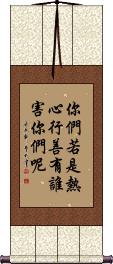
Here is 1 Peter 3:13 in Chinese.
The text with punctuation:
你们若是热心行善,有谁害你们呢?
Hand-painted calligraphy does not retain punctuation.
This translation is from the Chinese Union Bible.
You may know it from the KJV as:
And who is he that will harm you, if ye be followers of that which is good?
Adoring Love
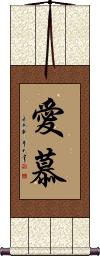
愛慕 means “adoring love” in Chinese, Japanese, and Korean.
I suppose this is the best kind of love to have. 愛慕 has the common character for love. But the second character modifies and reinforces the meaning to become adore, adoring love, or to love and adore.
Ancient Chinese warning:
Adoring someone is fine until you are in the shoes of the Prince of the Kingdom of Wu. This Prince adored a certain beautiful woman (Xi Shi) so much that he neglected his duties and soon let the kingdom fall into ruins.
Madder
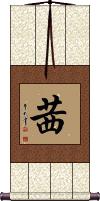
茜 is the name for Rubia cordifolia, Indian madder, munjeet, Japanese madder, Rubia argyi, rose madder or red madder.
This is a flowering plant that since ancient times, the root has been used to create red, pink, and other red-hued dyes.
In Japan, this can be the surname or given names Sen, Sei, or Akane.
No man knows what he owes to his parents until he comes to have children of his own
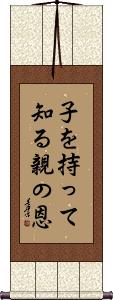
子を持って知る親の恩 literally translates as: Only after you have a baby, you would appreciate your parents (feel the way they do, etc).
This is a bit like the “walk a mile in another man's shoes” saying. Basically, it's about you cannot fully understand the plight of others until you experience it yourself. It also shows appreciation for the plight of parents.
This Japanese proverb can also be translated a few more ways:
No man knows what he owes to his parents till he comes to have children of his own.
One knows not what one owes to one's parents till one comes to have children of one's own.
Only after you have a baby, you will appreciate your parents or feel the way they do.
Only after becoming a parent yourself do you realize how much you owe [how indebted you are] to your own parents.
Note: Because this selection contains some special Japanese Hiragana characters, it should be written by a Japanese calligrapher.
Be Like Water
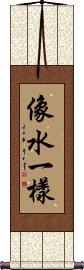
像水一樣 is a short quote from a much longer statement by Bruce Lee.
He summarized how people should be flexible to all circumstances, attacks, or situations. In the end, he exclaims, “Be like water, my friend.” 像水一樣 is the “Be like water” part alone since that seems to be what most people want.
Wisdom from Hard Knocks
The school of hard knocks
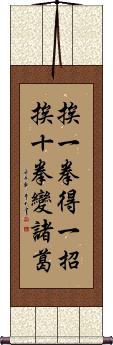
挨一拳得一招挨十拳變諸葛 is a Chinese proverb that literally translates as: Receive one blow, [and one] learns a lesson; Receive ten blows, [and one] becomes a great Zhuge [Liang].
You must first understand that a man named Zhuge Liang was one of the great strategists and philosophers in Chinese history. He's known as a man of great wisdom.
Figuratively, this phrase means:
One can learn much from failure or “hard knocks.”
Black Flag Gate / Hek Ki Boen
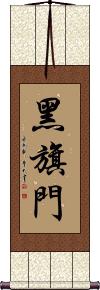
黑旗門 is often romanized as “Hek Ki Boen” in Cantonese, this is the title for a certain branch school of Wing Chun or Eng Chun martial arts.
Black or white cat matters not as long as it can catch mice
Ability is more important than looks
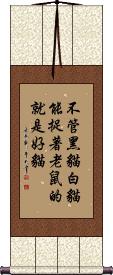
不管黑猫白猫能捉着老鼠的就是好猫 literally translates as: It doesn't matter [if a] cat [is] black [or] white, [as long as it] can catch mice, it's a good cat.
This proverb was either composed or made famous by Deng XiaoPing in 1961 when he exclaimed, “I don't care if it's a white cat or a black cat. It's a good cat so long as it catches mice” when his critics pointed out that his ideas were Capitalistic (free market). The response was meant to say, “It does not matter if it's Communist or Capitalist, as long as it works.”
This is a Chinese proverb that can be used to suggest one should disregard looks or a person's race, as long as they can do the job. It can also be used as a metaphor for many other situations.
Deng XiaoPing probably saved China from collapse (as the Soviet Union experienced). He changed China’s economy from pure Communism to a hybrid where the free market (Capitalism) is encouraged. More about Deng XiaoPing
Bodhidharma
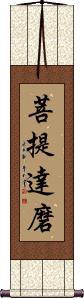
菩提達磨 is the title Bodhidharma in Chinese and Japanese.
Bodhidharma, commonly known as Damo, is reputed as the founder of the Chan (Zen) or Intuitional or Mystic School.
He likely came from south India and spread Mahayana Buddhism throughout China (even meeting the Emperor) and his disciples likely spread this all the way to Korea, Japan, and beyond in the 5th and 6th centuries.
Sometimes the last character varies in Chinese to 摩 instead of 磨 - let me know if you need a certain variation when you order.
Dharma / Damo / Daruma
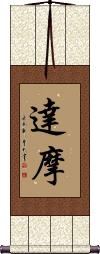
達摩 is the Chinese and Japanese title for Dharma (a short name for Bodhidharma).
He's known in Chinese as Damo and in Japanese as Daruma.
Note: In Japanese, they tend to write the last character as  versus
  . If you choose the Japanese master calligrapher, expect it to be written in the Japanese version.
The Brave Have No Fears
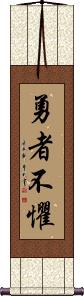
This proverb means “Brave people [are] without fear,” or “The brave are without fear.”
勇者不懼 is a proverb credited to Confucius. It's one of three phrases in a set of things he said.
This phrase is originally Chinese but has penetrated Japanese culture as well (many Confucian phrases have) back when Japan borrowed Chinese characters into their language.
This phrase has also been converted into modern Japanese grammar when written as 勇者は懼れず. If you want this version just click on those characters.
See Also: No Fear
Bravery / Courage
Courage in the face of Fear
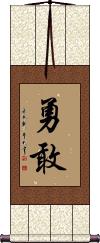
勇敢 is about courage or bravery in the face of fear.
You do the right thing even when it is hard or scary. When you are courageous, you don't give up. You try new things. You admit mistakes. This kind of courage is the willingness to take action in the face of danger and peril.
勇敢 can also be translated as braveness, valor, heroic, fearless, boldness, prowess, gallantry, audacity, daring, dauntless, and/or courage in Japanese, Chinese, and Korean. This version of bravery/courage can be an adjective or a noun. The first character means bravery and courage by itself. The second character means “daring” by itself. The second character emphasizes the meaning of the first but adds the idea that you are not afraid of taking a dare, and you are not afraid of danger.
勇敢 is more about brave behavior and not so much the mental state of being brave. You'd more likely use this to say, “He fought courageously in the battle,” rather than “He is very courageous.”
Broken Mirror Rejoined
Used in modern times for divorced couples that come back together
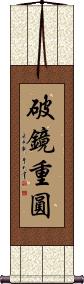
破鏡重圓 is about a husband and wife who were separated and reunited.
About 1500 years ago in China, there lived a beautiful princess named Le Chang. She and her husband Xu De Yan loved each other very much. But when the army of the Sui Dynasty was about to attack their kingdom, disposed of all of their worldly possessions and prepared to flee into exile.
They knew that in the chaos, they might lose track of each other, so the one possession they kept was a bronze mirror which is a symbol of unity for a husband and wife. They broke the mirror into two pieces, and each of them kept half of the mirror. They decided that if separated, they would try to meet at the fair during the 15th day of the first lunar month (which is the lantern festival). Unfortunately, the occupation was brutal, and the princess was forced to become the mistress of the new commissioner of the territory, Yang Su.
At the Lantern Festival the next year, the husband came to the fair to search for his wife. He carried with him his half of the mirror. As he walked through the fair, he saw the other half of the mirror for sale at a junk market by a servant of the commissioner. The husband recognized his wife's half of the mirror immediately, and tears rolled down his face as he was told by the servant about the bitter and loveless life that the princess had endured.
As his tears dripped onto the mirror, the husband scratched a poem into his wife's half of the mirror:
You left me with the severed mirror,
The mirror has returned, but absent are you,
As I gaze in the mirror, I seek your face,
I see the moon, but as for you, I see not a trace.
The servant brought the inscribed half of the mirror back to the princess. For many days, the princess could not stop crying when she found that her husband was alive and still loved her.
Commissioner Yang Su, becoming aware of this saga, realized that he could never obtain the princess's love. He sent for the husband and allowed them to reunite.
This proverb, 破鏡重圓, is now used to describe a couple who has been torn apart for some reason (usually divorce) but have come back together (or remarried).
It seems to be more common these days in America for divorced couples to reconcile and get married to each other again. This will be a great gift if you know someone who is about to remarry their ex.
Bruce Lee
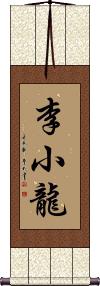
李小龍 is the real full name of Bruce Lee.
 Many people have no idea that Bruce Lee had a “real” Chinese name. In Mandarin and Cantonese, he is known as “Lǐ XiǎoLóng” and “Léi SíuLùng” respectively.
He kept his family name pronunciation (Li = Lee). 李 is a common family name that also means “plum.”
His given name 小龍 (Xiao-Long), literally means “little dragon.” 李小龍 is why you often see the character for dragon associated with Bruce Lee on various posters etc.
For a pronunciation lesson, the “X” in Romanized Mandarin is pronounced like a “sh” sound but with your tongue at the bottom of your mouth. The vowel sound in “Long” is like the English “oh,” not like the “ah” sound in the English word “long.”
If you are a big Bruce Lee fan, you should know this information, and you should have this wall scroll hanging in your room or martial arts studio.
Note: Japanese use these same Chinese characters / Kanji to write Bruce Lee's real name (with different pronunciation - which is a bit like how the name “Bruce Lee” sounds in English).
See Also: Kung Fu | Martial Arts
Mark the boat to find the lost sword / Ignoring the changing circumstances of the world
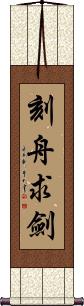
刻舟求劍 is an originally-Chinese proverb that serves as a warning to people that things are always in a state of change.
Thus, you must consider that and not depend on the old ways or a way that may have worked in the past but is no longer valid.
This idiom/proverb comes from the following story:
A man was traveling in a ferry boat across a river. With him, he carried a treasured sword. Along the way, the man became overwhelmed and intoxicated by the beautiful view and accidentally dropped his prized sword into the river. Thinking quickly, he pulled out a knife and marked on the rail of the boat where exactly he had lost his sword.
When the boat arrived on the other side of the river, the man jumped out of the boat and searched for his sword right under where he'd made the mark. Of course, the boat had moved a great distance since he made the mark, and thus, he could not find the sword.
While this man may seem foolhardy, we must take a great lesson from this parable: Circumstances change, so one should use methods to handle the change. In modern China, this is used in business to mean that one should not depend on old business models for a changing market.
This proverb dates back to the Spring and Autumn period (770–476 BC) of the territory now known as China. It has spread and is somewhat known in Japan and Korea.
Che Guevara
Latin American / Cuban Revolutionary
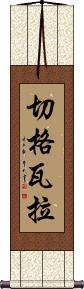
切格瓦拉 is the name “Che Guevara,” as written (transliterated) in Mandarin Chinese.
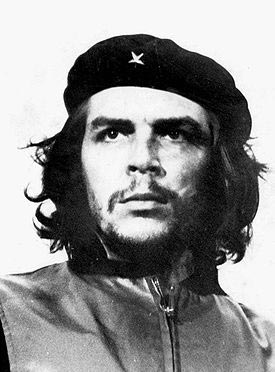 Once revered by Chinese people as a Socialist rebel, he's now just a historical figure that school children briefly learn about in China.
切格瓦拉 is because China used to be a truly-Communist/Socialist nation, and thus, other Communists and Socialists were heroes.
In modern China, with its free-market economy, those former heroes fade a little.
We are not offering the “Che” character alone, as few would associate it with Che Guevara, so you need the full name to be clear (minus Ernesto, which is his real first name).
Confucius
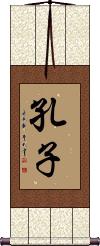
孔子 is how to write the name of the great sage, known in the West as Confucius.
His real name is Kongzi (The name Confucius is a westernized version of his name - his family name is Kong, and “zi” was added as a title of distinction).
He lived some 2500 years ago in Qufu, a town in modern-day Shandong Province of Northern China (about 6 hours south of Beijing by bus). He was a consort to Emperors, and after his death, the impact of his philosophies still served to advise emperors, officials, and common people for generations.
Also during these thousands of years, the Kong family remained powerful in China, and the Kong estate was much like the Vatican in Rome. The Kong estate existed as if on sovereign ground with its own small garrison of guards and the privileges of a kingdom within an empire.
This was true up until the time the Kong family had to flee to Taiwan in 1949 when the Red Army took victory over the Nationalists during the Revolution. The home of Confucius was later razed and all statues were defaced or stolen during the Cultural Revolution. Finally, after years of smearing his name and image, it is once again okay to celebrate the teachings of Confucius in mainland China.
Known as Khổng Tử in Vietnamese.
Bravery / Courage
Courageous Energy
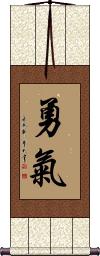
勇氣 is one of several ways to express bravery and courage in Chinese, Japanese, and Korean.
This version is the most spiritual. This is the essence of bravery from deep within your being. This is the mental state of being brave versus actual brave behavior. You'd more likely use this to say, “He is very courageous,” rather than “He fought courageously in the battle.”
The first character also means bravery or courage when it's seen alone. With the second character added, an element of energy or spirit is added. The second character is the same “chi” or “qi” energy that Kung Fu masters focus on when they strike. For this reason, you could say this means “spirit of courage” or “brave spirit.”
This is certainly a stronger word than just the first character alone.
Beyond bravery or courage, dictionaries also translate this word as valor/valour, nerve, audacity, daring, pluck, plucky, gallantry, guts, gutsy, and boldness.
This is also one of the 8 key concepts of tang soo do.
 While the version shown to the left is commonly used in Chinese and Korean Hanja (and ancient Japanese Kanji), please note that the second character is written with slightly fewer strokes in modern Japanese. If you want the modern Japanese version, please click on the character to the right. Both styles would be understood by native Chinese, Japanese, and many (but not all) Korean people. You should make your selection based on the intended audience for your calligraphy artwork. Or pick the single-character form of bravery/courage which is universal.
The Great Path has No Gate
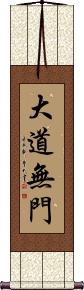
大道無門 is a Buddhist proverb that means “The Great Way has no entrance,” “The Great Way is gateless,” or “The Great Path lacks a gate.”
This can be translated in many other ways.
This concept was authored within a long sacred text by 無門慧開 (known as Wúmén Huìkāi in Chinese or Mumon Ekai in Japanese). He was a Chinese Chan Master (in Japanese, a Zen Master) who lived between 1183 and 1260 AD. His most famous work was a 48-koan collection titled “The Gateless Barrier” or “The Gateless Gate” (無門關 Wú Mén Guān in Chinese, or 無門関 Mu Mon Kan in Japanese). This calligraphy title is a notable line from this collection.
I like this reference to the source of this proverb: The Gateless Gate 無門關
Daodejing / Tao Te Ching - Chapter 33
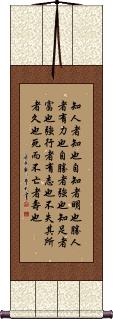
This is referred to as passage or chapter 33 of the Dao De Jing (often Romanized as “Tao Te Ching”).
These are the words of the philosopher Laozi (Lao Tzu).
To know others is wisdom;
To know oneself is acuity/intelligence.
To conquer others is power,
To conquer oneself is strength.
To know contentment is to have wealth.
To act resolutely is to have purpose.
To stay one's ground is to be enduring.
To die and yet not be forgotten is to be long-lived.
To understand others is to be knowledgeable;
To understand yourself is to be wise.
To conquer others is to have strength;
To conquer yourself is to be strong.
To know when you have enough is to be rich.
To go forward with strength is to have ambition.
To not lose your place is to be long-lasting.
To die but not be forgotten -- that's true long life.
He who is content is rich;
He who acts with persistence has will;
He who does not lose his roots will endure;
He who dies physically but preserves the Dao
will enjoy a long after-life.
Notes:
During our research, the Chinese characters shown here are probably the most accurate to the original text of Laozi. These were taken for the most part from the Mawangdui 1973 and Guodan 1993 manuscripts which pre-date other Daodejing texts by about 1000 years.
Grammar was a little different in Laozi’s time. So you should consider this to be the ancient Chinese version. Some have modernized this passage by adding, removing, or swapping articles and changing the grammar (we felt the oldest and most original version would be more desirable). You may find other versions printed in books or online - sometimes these modern texts are simply used to explain to Chinese people what the original text really means.
This language issue can be compared in English by thinking how the King James (known as the Authorized version in Great Britain) Bible from 1611 was written, and comparing it to modern English. Now imagine that the Daodejing was probably written around 403 BCE (2000 years before the King James Version of the Bible). To a Chinese person, the original Daodejing reads like text that is 3 times more detached compared to Shakespeare’s English is to our modern-day speech.
Extended notes:
While on this Biblical text comparison, it should be noted, that just like the Bible, all the original texts of the Daodejing were lost or destroyed long ago. Just as with the scripture used to create the Bible, various manuscripts exist, many with variations or copyist errors. Just as the earliest New Testament scripture (incomplete) is from 170 years after Christ, the earliest Daodejing manuscript (incomplete) is from 100-200 years after the death of Laozi.
The reason that the originals were lost probably has a lot to do with the first Qin Emperor. Upon taking power and unifying China, he ordered the burning and destruction of all books (scrolls/rolls) except those pertaining to Chinese medicine and a few other subjects. The surviving Daodejing manuscripts were either hidden on purpose or simply forgotten about. Some were not unearthed until as late as 1993.
We compared a lot of research by various archeologists and historians before deciding on this as the most accurate and correct version. But one must allow that it may not be perfect, or the actual and original as from the hand of Laozi himself.
Daodejing / Tao Te Ching - Chapter 81
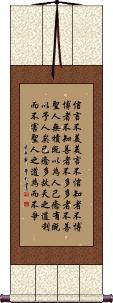
信言不美美言不信知者不博博者不知善者不多多者不善聖人無積既以為人己癒有既以予人矣已癒多故天之道利而不害聖人之道為而不爭 is the Mawangdui version of Daodejing chapter 81.
Credible words are not eloquent;
Eloquent words are not credible.
The wise are not erudite;
The erudite are not wise.
The adept are not all-around;
The all-around are not adept.
The sages do not accumulate things.
Yet the more they have done for others,
The more they have gained themselves;
The more they have given to others,
The more they have gotten themselves.
Thus, the way of tian (heaven) is to benefit without harming;
The way of sages is to do without contending.
Sincere words are not showy;
showy words are not sincere.
Those who know are not “widely learned";
those “widely learned” do not know.
The good do not have a lot;
Those with a lot are not good.
The Sage accumulates nothing.
Having used what he had for others,
he has even more.
Having given what he had to others,
what he has is even greater.
Therefore, the Way of Heaven is to benefit and not cause any harm,
The Way of Man is to act on behalf of others and not to compete with them.
True words aren't charming,
charming words aren't true.
Good people aren't contentious,
contentious people aren't good.
People who know aren't learned,
learned people don't know.
Wise souls don't hoard;
the more they do for others the more they have,
the more they give the richer they are.
The Way of heaven provides without destroying.
Doing without outdoing
is the Way of the wise.
Daruma / Damo

達磨 in Japanese usually refers to Daruma, a tumbling doll with a round red-painted body.
In Japan, Daruma is a good-luck doll which is supposed to in the shape of Bodhidharma, with a blank eye to be completed when a person's wish is granted.
達磨 is also Bodhidharma or Dharma. 達磨 comes from an ancient word that means holding fast and keeping ordinances, statutes, laws, or practice.
This is also a title for Damo, or Bodhidharma, the twenty-eighth Indian and first Chinese patriarch, who arrived in China A.D. 520, the reputed founder of the Chan or Intuitional School in China. He is described as son of a king in southern India. He famously engaged in silent meditation for nine years.
Death Before Dishonor
A soldier can die or kill, but never dishonor or disgrace himself
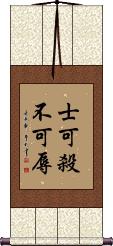
士可殺不可辱 almost directly matches the military idea of “Death Before Dishonor,” while also being an ancient Chinese proverb.
The direct meaning is, “[A] soldier/warrior can die/kill [but he/she] cannot [allow] dishonor/disgrace [upon himself/herself].” Chinese grammar, and especially ancient grammar, is a little different than English. Not nearly as many articles are needed, and a lot is implied.
There are a lot of ways to express ideas similar to “Death Before Dishonor” in Chinese, and I would rate this one in the top two.
This is the original form of this proverb with the character for “soldier/warrior” at the beginning. Most of the time, this character is dropped, becoming a five-character proverb (the soldier/warrior part is implied, even without the character being present in the proverb). We also offer a shorter version.
Dogen
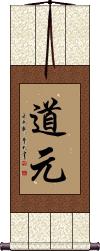
Usually, when people are looking for 道元 or “Dogen,” they are referring to the Japanese Zen monk by this name.
He lived from 1200-1253. This Dogen name or title literally means “The Way Origin” or “Beginning of the Path.” It is understood to mean “beginning of right doctrine or faith” in the context of his name and work to establish the Sōtō school of Zen in Japan.
To accomplish that task, this humble monk traveled from Japan and across China to find the more original or pure forms of Buddhism.
Drain the pond to get all the fish
Kill the goose that lays the golden eggs
In 632 BC, Duke Wen of the Kingdom of Jin was about to lead an army against the forces of the Kingdom of Chu.
The Duke asked one of his advisers, Jiu Fan, how they could win the impending battle, as they were drastically outnumbered.
Jiu Fan said, “All is fair in war,” and suggested a plan of dishonorable tactics (cheating).
The Duke was unsure of this advice, so he asked another adviser, Yong Ji, who replied, “If you catch fish by draining the pond, you can certainly get all the fish. But there will be no fish the following year. You can cheat this one time in battle, but such tactics can only be used once, as the enemy will be wise in future encounters.”
The Duke heard the words of his wiser adviser but cheated to gain victory in the battle. However, he rewarded Yong Ji more than Jiu Fan at the victory celebration, stating that while Jiu Fan's advice gained one victory, the wise words of Yong Ji would last forever.
This Chinese idiom/proverb is still used, over 2600 years later to remind people not to burn bridges, cheat, or dishonor themselves in exchange for a short-term gain while sacrificing the future.
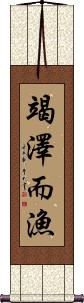
竭澤而漁 is very similar to the meaning of the English phrase, “Kill the goose that lays the golden eggs.”
Diligent Study Proverb
Drill a hole in the wall to get light to read by.
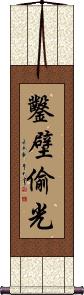
鑿壁偷光 is a Chinese proverb that means “Bore a hole in the wall to make use of the neighbor's light to study.”
This is a nice gift for a very studious person.
Kuang Heng was born during the Western Han period. He has been very fond of reading ever since he was young. However, he could not attend school since his family was poor, and he had to borrow books from people to learn.
To borrow these books, he normally did chores for people who had them. When he became older, he had to work in the field from sunrise to sunset since his family's financial situation did not improve. Thus, he tried to study at night, but he had no lamp.
One day, he noticed the light from the neighbor's house coming through a crack in the wall. This made him very happy, so he dug a larger hole from the crack and read in the light that shone through. This diligent study eventually made him an accomplished person.
Empress
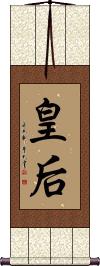
皇后 is the title of empress/emperess, the female form of the emperor.
皇后 is used in Chinese, Japanese Kanji, and old Korean Hanja.
While the emperor's reign was for life, if he died, his wife would hold his power. In this case, a woman was the ultimate ruler of the greater part of East Asia (now China) until her death and the succession of the emperor's firstborn son to lead the empire. Numerous times in various Chinese dynasties, an empress took power in this way.
The first character means emperor by itself.
The second character alone can mean “wife of an emperor or king” (the first character clarifies that we are talking about an empress and not a queen). It can also mean sovereign or last offspring, depending on context.
Note: In some books, this word is translated as queen. While only incorrect if you get technical (because an empress is theoretically a higher level than a queen), the meaning is very similar.
皇后 is sometimes used for the title of queen, but more technically, this is the wife of the emperor (a higher level than a queen).
Energy / Capability
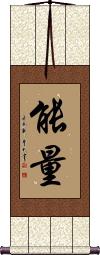
能量 means energy in Chinese and Japanese.
This can also refer to the capability, power, or ability that someone has.
This would also be the word in Chinese that you would use to say, “He/She has a lot of energy.”
The one who retreats 50 paces mocks the one to retreats 100
The pot calls the kettle black
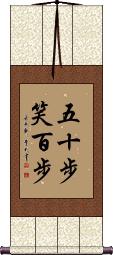
五十步笑百步 is a Chinese proverb that means the one who retreats 50 paces mocks the one who retreats 100 paces.
During the Warring States Period of what is now China (475 - 221 B.C.), the King of Wei was in love with war. He often fought with other kingdoms just for spite or fun.
One day, the King of Wei asked the philosopher Mencius, “I love my people, and all say I do the best for them. I move the people from famine-stricken areas to places of plenty and transport grains from rich areas to the poor. Nobody goes hungry in my kingdom, and I treat my people far better than other kings. But why does the population of my kingdom not increase, and why does the population of other kingdoms not decrease?”
Mencius answered, “Since you love war, I will make this example: When going to war, and the drums beat to start the attack, some soldiers flee for their lives in fear. Some run 100 paces in retreat, and others run 50 steps. Then the ones who retreated 50 paces laugh and taunt those who retreated 100 paces, calling them cowards mortally afraid of death. Do you think this is reasonable?
The King of Wei answered, “Of course not! Those who run 50 paces are just as timid as those who run 100 paces.”
Mencius then said, “You are a king who treats his subjects better than other kings treat their people, but you are so fond of war that your people suffer from great losses in battle. Therefore, your population does not grow. While other kings allow their people to starve to death, you send your people to die in war. Is there any difference?”
This famous conversation led to the six-character proverb shown here. It serves as a warning to avoid hypocrisy. It goes hand-in-hand with the western phrase, “The pot calls the kettle black,” or the Biblical phrase, “Before trying to remove a splinter from your neighbor's eye, first remove the plank from your own eye.”
Fighting Spirit
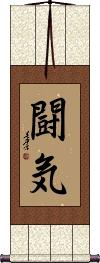
闘気 is an alternate Japanese title for “fighting spirit.”
This one is more like “fighting energy.” The second character is “ki,” the same “ki” in Aikido. This “ki” is the spiritual energy that all martial arts practitioners must master and focus on.
Galatians 5:22-23

Here is Galatians 5:22 and a bit of 23 in Chinese.
The text with punctuation:
圣灵所结的果子,就是仁爱,喜乐,和平,忍耐,恩慈,良善,信实,温柔,节制。
Hand-painted calligraphy does not retain punctuation.
This translation is from the Chinese Union Bible.
You may know it from the KJV as:
5:22 But the fruit of the Spirit is love, joy, peace, longsuffering, gentleness, goodness, faith,
5:23 Meekness, temperance...
Geisha of Unequaled Talent
(Danger: Can mean prostitute!)
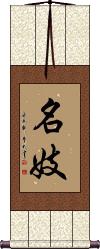
In Japanese, 名妓 means “distinguished/talented/beautiful geisha.”
The meaning in Chinese (and the deeper meaning in Japanese) would be “distinguished/talented/beautiful prostitute.”
I am not sure that our master calligrapher will even write this, so please note that fact if you decide to place the order. Of course, we'll refund your money if he refuses.
God of Warcraft
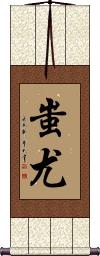
蚩尤 is the name Chi You, legendary creator of metalworking and weapons.
There is also a comet named in his honor. Some refer to him as the Chinese god of war. He is also somewhat-known in Japan as “Shiyu.”
God Give Me Strength
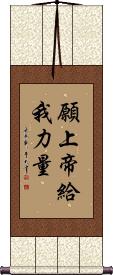
願上帝給我力量 is a wish or a prayer that you might call out at a desperate time.
Translated by us for a military serviceman in Iraq. He may need to use this phrase often, though I am not sure where he's going to find a place to hang a wall scroll.
Guan Gong / Warrior Saint
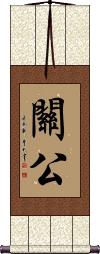
關公 is a Chinese title, Guan Gong, that means Lord Guan (The warrior saint of ancient China).
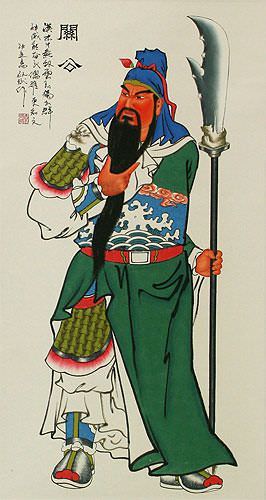 While his real name was Guan Yu / 關羽, he is commonly known by the title of Guan Gong (關公).
Some Chinese soldiers still pray to Guan Gong for protection. They would especially do this before going into battle. Statues of Guan Gong are seen throughout China.
Guan Yu
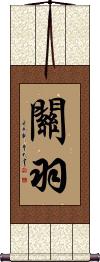
關羽 is the name Guan Yu, Army General for the Kingdom of Shu.
He is also known as Guan Gong (like saying Duke Guan or Sir Guan)
He was immortalized in the novel, “Romance of the Three Kingdoms.”
He was a fearsome fighter, also famous for his virtue and loyalty. He is worshiped by some modern-day soldiers and has the title “Warrior Saint” in China. Some believe he offers safety and protection for military servicemen.
Guan Yu lived until 219 A.D.
Gung Ho
Working Together
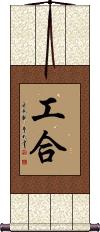
工合 is one of those Asian words that is used more in English than in the original Chinese.
Gung Ho was originally used to speak of Carlson's Raiders, a group of “Gung Ho” U.S. Marines who went on an island-hopping campaign of death during WWII.
A movie called Gung Ho came out in the mid-1940s and was later re-released in the 1950s depicting the 2nd Marine Raider Battalion, and brought this word to the mainstream.
It is still sometimes used today within the U.S. Marine Corps brotherhood to refer to a unit or group that works well together or is otherwise efficient and motivated (has good morals).
In 1986, there was a movie called Gung Ho about a Japanese company taking over an American automotive factory. They completely ignored the fact that this was a Chinese title.
It should be noted that this title actually means a condition, state, manner, or the health of something in Japanese.
Language and pronunciation notes:
Like many Asian words absorbed into common use in English, this one is drastically mispronounced. The official Romanization is “gong he” but that doesn't tell you enough. The vowel sound on the first character is like the English word “own,” now just add the g-sounds to the beginning and end. The second character is misleading, as you might think it is like the English word “he.” In reality, the vowel sound is more like the “u” in “up.”
It should also be noted that the current generation in China no longer uses or recognizes this as a common word or slogan.
Note: This can be pronounced and is a word in Japanese, though seldom used. Japanese will use a variation of "具合" instead. But still, not common.
Hachiman: God of War
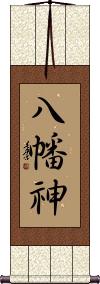
八幡神 is the Japanese God of War.
He is often known by the short name “Hachiman.” This version has the “God” title “jin” at the end, completing the idea of “God of War.”
Hapkido
Korean Martial Art of re-directing force
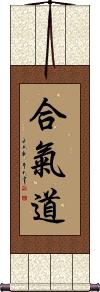
Hapkido or 合氣道 is a mostly-defensive martial art in Korea.
Hapkido has some connection to the Aikido of Japan. They are written with the same characters in both languages. However, it should be noted that the Korean Hanja characters shown here are the traditional Chinese form - but in modern Japan, the middle character was slightly simplified.
Note: You can consider this to be the older Japanese written form of Aikido. Titles on older books and signs about Aikido use this form.
The connection between Japanese Aikido and Korean Hapkido is muddled in history. The issue is probably due to the difficult relationship between the two countries around WWII. Many Koreans became virtual slaves to the Japanese during that period. After WWII, many things in Korea were disassociated from having any Japanese origin. The relationship has greatly mellowed out now.
Looking at the characters, the first means “union” or “harmony.”
The second character means “universal energy” or “spirit.”
The third means “way” or “method.”
One way to translate this into English is the “Harmonizing Energy Method.” This makes sense, as Hapkido has more to do with redirecting energy than fighting strength against strength.
More Hapkido info
More notes:
1. Sometimes Hapkido is Romanized as “hap ki do,” “hapki-do” “hab gi do” or “hapgido.”
2. Korean Hanja characters are actually Chinese characters that usually hold the same meaning in both languages. There was a time when these characters were the standard and only written form of Korean. The development of modern Korean Hangul characters is a somewhat recent event in the greater scope of history. There was a time when Chinese characters were the written form of many languages in places known in modern times as North Korea, South Korea, Japan, Vietnam, Singapore, Hong Kong, Taiwan, Mainland China, and a significant portion of Malaysia. Even today, more people in the world can read Chinese characters than English.
3. While these Korean Hanja characters can be pronounced in Chinese, this word is not well-known in China and is not considered part of the Chinese lexicon.

何 is an ancient Chinese surname that romanizes as He.
This is not the only surname that romanize as He, please note these others:
賀 (celebrate/congratulate).
和 (peace, harmony, together).
赫 (bright/glorious).
河 (river).

ヘ is the name He in Japanese Katakana.
Note: Because this title is entirely Japanese Katakana, it should be written by a Japanese calligrapher.
Heath
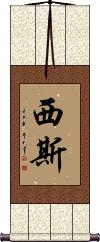
西斯 is the transliteration to Mandarin Chinese for the name Heath.
This name is a little rough in Chinese, as there no sound like, “he” and no “th” sound in Chinese. This Chinese version sounds like “Hsisuh.”
Hikari
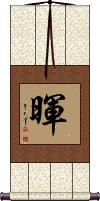
暉 is a Kanji that often represents a Japanese name romanized as Hikari.
The literal meaning can be sunshine, light, or to shine upon. It has the same meaning in Chinese and Korean. From ancient Chinese, it is a variant of 輝/辉.
Other Japanese romanizations include Hikaru, Hikatsu, Teru, Terasu, Ki, and Akira.
The Whole Room Rocks With Laughter
The perfect scroll if you love humor or as a gift for the comedian in your life
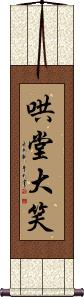
In China, 哄堂大笑 is a proverb that is used in response to a good joke or witty comment.
The story goes that Mr. Feng and Mr. He were both senior officials in the Song Dynasty (about a thousand years ago). One day, Mr. Feng walked into their shared office wearing a new pair of boots. The boots caught the eye of Mr. He who said, “New boots! - how much were they?.” Mr. Feng lifted one of the boots off the ground as if to show it off and responded, “900 coins.”
Astonished, Mr. Feng explained, “900? How can that be? - I paid 1800 coins for my boots!.” Mr. Feng then lifted his other foot off the ground and said, “This boot was also 900 coins.”
It is said that the whole room was shaking from the laughter of all that heard Mr. Feng's joke on Mr. He.
The key to immortality is first living a life worth remembering
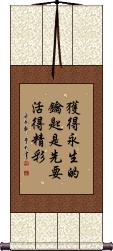
獲得永生的鑰匙是先要活得精彩 is a famous quote from Bruce Lee.
However, when quoted, he was speaking in English. So this is a translation of his English quote into Chinese. Since Bruce spoke both Chinese and English, his quotes sometimes go both ways.
Ip Man
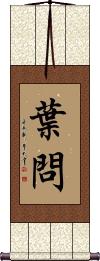
葉問 is the name of “Ip Man” or “Yip Man” (1893-1972).
He was a martial arts practitioner and master. He is perhaps most famous for being the master of Bruce Lee.
John 3:16

神愛世人甚至將他的獨生子賜給他們叫一切信他的不至滅亡反得永生 is the full translation of John 3:16 into Chinese.
This is from the Chinese Union Bible which comes from a revised version of the King James. This Chinese Bible was originally translated and printed in 1919 (several revisions since then).
Because of the origin being the KJV, I'll say that in English, this would be, “For God so loved the world, that he gave his only begotten Son, that whosoever believeth in him should not perish but have everlasting life.”
As with any translation, there are interesting cultural and linguistic issues. For instance, the word used for “world” in Chinese can also mean “common people.” So you could say that it means “For God so loved the common people...”
This does not take away from the text, as it will be understood with the same meaning and connotation.
There is no direct Greek-to-Chinese translation in print (that I know of), so this is the best available. Of course, you can ask any Greek person of faith, and they will claim that a bit is lost from the original Greek of the New Testament to any of the English versions of the Bible in print.
John 3:16
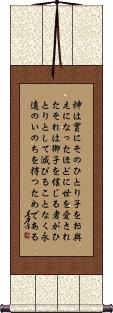
Here is the full translation of John 3:16 into Japanese.
This translation comes from the Shinkaiyaku Bible (a preferred translation by many Japanese Christians).
Just for reference, from the KJV, this reads, “For God so loved the world, that he gave his only begotten Son, that whosoever believeth in him should not perish but have everlasting life.”
Note: Because this selection contains some special Japanese Hiragana characters, it should be written by a Japanese calligrapher.
John 3:16 (first half)
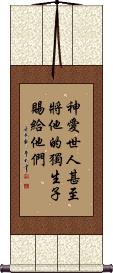
神愛世人甚至將他的獨生子賜給他們 is the first half of John 3:16 in Chinese.
It reads roughly, “For God so loved the world, that he gave his only begotten Son.”
This came directly from the Chinese Union Bible first printed in 1919.
John 8:8
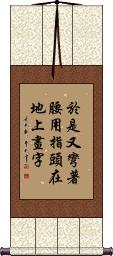
於是又彎著腰用指頭在地上畫字 is John 8:8 in Chinese.
This text is from the 1919 Chinese Union Bible.
You may know it from the KJV as:
And again he stooped down and wrote on the ground.
Ki Ken-Tai Icchi
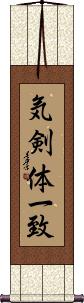
気剣体一致 is the title Ki Ken-Tai Icchi.
気 = energy, 剣 = sword, 体 = body, 一致 = synchronization/unity. So, “energy, sword, and body in unison” would be one way to translate this. Sometimes written with the possessive article, の, making it 気剣体の一致 or “Ki Ken-Tai no Icchi.” Let me know in the special instructions if you want that の character added by the calligrapher.
Lao Tzu / Laozi
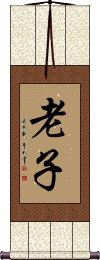
Depending on the romanization scheme you use, this man's name can be spelled Laozi, Lao Tzu, or Lao Tze. In older English usage, he was known as Laocius. He is believed to have lived around 500 B.C.
He was a Chinese philosopher, founder of Daoism/Taoism, credited with being the author of the sacred and wise book of Daoism/Taoism.
There is a theory that Lao Tzu's soul traveled to India and was reborn as the Buddha.
Life Energy / Spiritual Energy
Chi Energy: Essence of Life / Energy Flow
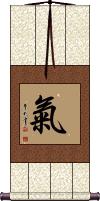
This 氣 energy flow is a fundamental concept of traditional Asian culture.
氣 is romanized as “Qi” or “Chi” in Chinese, “Gi” in Korean, and “Ki” in Japanese.
Chi is believed to be part of everything that exists, as in “life force” or “spiritual energy.” It is most often translated as “energy flow” or literally as “air” or “breath.” Some people will simply translate this as “spirit,” but you must consider the kind of spirit we're talking about. I think this is weighted more toward energy than spirit.
The character itself is a representation of steam (or breath) rising from rice. To clarify, the character for rice looks like this: 
Steam was apparently seen as visual evidence of the release of “life energy” when this concept was first developed. The Qi / Chi / Ki character is still used in compound words to mean steam or vapor.
The etymology of this character is a bit complicated. It's suggested that the first form of this character from bronze script (about 2500 years ago) looked like these samples: 

However, it was easy to confuse this with the character for the number three. So the rice radical was added by 221 B.C. (the exact time of this change is debated). This first version with the rice radical looks like this: 
The idea of Qi / Chi / Ki is really a philosophical concept. It's often used to refer to the “flow” of metaphysical energy that sustains living beings. Yet there is much debate that has continued for thousands of years as to whether Qi / Chi / Ki is pure energy or consists partially or fully of matter.
You can also see the character for Qi / Chi / Ki in common compound words such as Tai Chi / Tai Qi, Aikido, Reiki, and Qi Gong / Chi Kung.
In the modern Japanese Kanji, the rice radical has been changed into two strokes that form an X.
The original and traditional Chinese form is still understood in Japanese, but we can also offer that modern Kanji form in our custom calligraphy. If you want this Japanese Kanji, please click on the character to the right instead of the “Select and Customize” button above.
More language notes: This is pronounced like “chee” in Mandarin Chinese, and like “key” in Japanese.
This is also the same way to write this in Korean Hanja where it is Romanized as “gi” and pronounced like “gee” but with a real G-sound, not a J-sound.
Though Vietnamese no longer use Chinese characters in their daily language, this character is still widely known in Vietnam.
See Also: Energy | Life Force | Vitality | Life | Birth | Soul
Listen to Both Sides and be Enlightened, Listen to One Side and be in the Dark
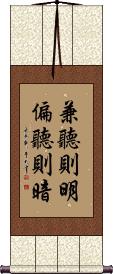
兼聽則明偏聽則暗 is an ancient Chinese proverb about getting all the information from all sides so that you truly understand a situation.
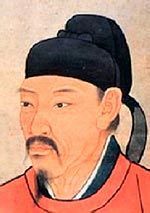
Wei Zheng
A man named Wei Zheng lived between 580-643 AD. He was a noble and wise historian and minister in the court of the early Tang Dynasty. The emperor once asked him, “What should an emperor do to understand the real-world situation, and what makes an emperor out-of-touch with reality?”
Wei Zheng replied, “Listen to both sides and you will be enlightened; listen to only one side and you will be left in the dark.”
Then Wei Zheng went on to cite examples of leaders in history that were victorious after heeding both sides of the story, and other leaders that met their doom because they believed one-sided stories which often came from flattering lips.
Please note that there is an unwritten rule when the same character appears twice in the same phrase, the calligrapher will alter the appearance so that no two characters are exactly alike in the same piece. This calligraphy has two repeating characters that will be written differently than they appear here.
Mencius
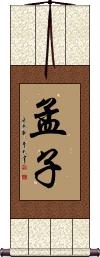
孟子 is the name Mencius in Chinese.
Mencius had the name “Mèng Kē” (孟軻) at birth. This later changed to Mèng Zǐ (孟子). He lived between 372 and 289 BCE.
Mencius was a Chinese Confucian philosopher who has often been referred to as the “Second Sage” following Confucius himself.
For disambiguation, one of the classic books of Confucianism is also titled 孟子.
Romanization of Mencius from Chinese includes Meng Tsu, Mengzi, and his original name Mengke or Meng Ko. In Japanese, he is Mōshi or Moushi.
Energy Sword Body in Concert
Spirit, Sword & Body as One
气剑体一致 often gets translated as “Mind Sword Body,” or “Spirit, Sword, and Body as One.” But I think these translations don't tell you enough about what this is really saying.
In this context, 気, which is the modern Japanese version of 氣, means spiritual and unseen energy or “life energy.” In some cases, 気 can be translated as spirit, feeling, or nature. If defined as the mind, it's more about the invisible or intangible parts of one's mind (or soul).
剣 is the Japanese version of 劍 meaning sword.
体 is the modern Japanese version of 體 meaning body.
The Kanji 一 means one, and in this case, suggests “all in one.”
The Kanji 到 means to send, deliver, or convey. But together, 一到 suggests all these things in agreement, union cooperation, or in concert.
Note: Arguments exist as to whether this should be romanized as Kikentaiitchi, Kikentaiicchi, or kikentaiichi. Technically, if you drop the last character, you get 気剣体一 and kikentaiichi (ki ken tai ichi), which is also a valid phrase.
Mixed Martial Arts
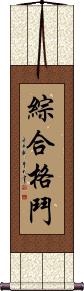
綜合格鬥 is a common Chinese title for “Mixed Martial Arts” or “MMA.”
The characters or words in this title break down this way:
綜合 zōng hé = composite, synthesized, to sum up, to integrate, and/or to synthesize.
格 gé = style, frame, or rule.
斗 dòu = fight, to battle, or to struggle.
Mountain Travels Poem by Dumu

This poem was written almost 1200 years ago during the Tang dynasty.
It depicts traveling up a place known as Cold Mountain, where some hearty people have built their homes. The traveler is overwhelmed by the beauty of the turning leaves of the maple forest that surrounds him just as night overtakes the day, and darkness prevails. His heart implores him to stop, and take in all of the beauty around him.
First, before you get to the full translation, I must tell you that Chinese poetry is a lot different than what we have in the west. Chinese words simply don't rhyme in the same way that English or other western languages do. Chinese poetry depends on rhythm and a certain beat of repeated numbers of characters.
I have done my best to translate this poem keeping a certain feel of the original poet. But some of the original beauty of the poem in its original Chinese will be lost in translation.
Far away on Cold Mountain, a stone path leads upwards.
Among white clouds, people's homes reside.
Stopping my carriage I must, as to admire the maple forest at nights fall.
In awe of autumn leaves showing more red than even flowers of early spring.
Hopefully, this poem will remind you to stop, and “take it all in” as you travel through life.
The poet's name is “Du Mu” in Chinese that is: 
 .
.
The title of the poem, “Mountain Travels” is: 

You can have the title, poet's name, and even “Tang Dynasty” written as an inscription on your custom wall scroll if you like.
More about the poet:
Dumu lived from 803-852 AD and was a leading Chinese poet during the later part of the Tang dynasty.
He was born in Chang'an, a city in central China and the former capital of the ancient Chinese empire in 221-206 BC. In present-day China, his birthplace is currently known as Xi'an, the home of the Terracotta Soldiers.
He was awarded his Jinshi degree (an exam administered by the emperor's court which leads to becoming an official of the court) at the age of 25 and went on to hold many official positions over the years. However, he never achieved a high rank, apparently because of some disputes between various factions, and his family's criticism of the government. His last post in the court was his appointment to the office of Secretariat Drafter.
During his life, he wrote scores of narrative poems, as well as a commentary on the Art of War and many letters of advice to high officials.
His poems were often very realistic and often depicted everyday life. He wrote poems about everything, from drinking beer in a tavern to weepy poems about lost love.
The thing that strikes you most is the fact even after 1200 years, not much has changed about the beauty of nature, toils, and troubles of love and beer drinking.
Where There is a Will, There is a Way
A determined effort can move a mountain
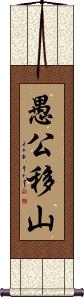
愚公移山 is the Chinese proverb (also somewhat known in Japan and Korea) for “the silly old man moves a mountain.”
Figuratively, this means “where there's a will, there's a way.”
Based on a fable of Lord Yu (愚公). He moved the soil of the mountain in front of his house. After years of effort, he finally moved the entire mountain (some versions of the story have God seeing how determined the man was, and sending two angels to whisk the mountains away).
The moral of the story: Anything can be accomplished if one works at it ceaselessly.
The Japanese version of this is 愚公山を移す (gu kou yama wo utsu su). But better to get the Chinese version, since this is originally a Chinese proverb.
See Also: Nothing is Impossible
Musashi
The most famous Samurai
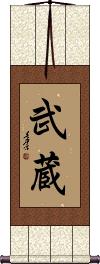
Miyamoto Musashi is probably the most famous Samurai in all of Japanese history.
武蔵 is the short title for a man long in legend. While coming from a lower class, his new sword and fighting techniques put him on par with the best that feudal Japan had to offer. His long career started with his first duel at age 13!
He is credited with using two swords at once and never losing a single battle in his career. After becoming a Buddhist, and getting older, like many old warriors, he took up a peaceful and solitary life until his death around 1645 A.D.
Note: Technically, Musashi is his given name, and Miyamoto is his surname. However, it's suggested that he assumed both of these names and had a few other names in childhood, as well as being given a Buddhist name. It's hard to know what to call him, as with most Kanji, there are multiple pronunciations. The characters for Musashi can also be pronounced Takezō. But everyone in modern times seems to know him by the name Musashi.
Better Late Than Never
It's Never Too Late Too Mend
Long ago in what is now China, there were many kingdoms throughout the land. This time period is known as “The Warring States Period” by historians because these kingdoms often did not get along with each other.
Sometime around 279 B.C. the Kingdom of Chu was a large but not particularly powerful kingdom. Part of the reason it lacked power was the fact that the King was surrounded by “yes men” who told him only what he wanted to hear. Many of the King's court officials were corrupt and incompetent which did not help the situation.
The King was not blameless himself, as he started spending much of his time being entertained by his many concubines.
One of the King's ministers, Zhuang Xin, saw problems on the horizon for the Kingdom, and warned the King, “Your Majesty, you are surrounded by people who tell you what you want to hear. They tell you things to make you happy and cause you to ignore important state affairs. If this is allowed to continue, the Kingdom of Chu will surely perish, and fall into ruins.”
This enraged the King who scolded Zhuang Xin for insulting the country and accused him of trying to create resentment among the people. Zhuang Xin explained, “I dare not curse the Kingdom of Chu but I feel that we face great danger in the future because of the current situation.” The King was simply not impressed with Zhuang Xin's words.
Seeing the King's displeasure with him and the King's fondness for his court of corrupt officials, Zhuang Xin asked permission from the King that he may take leave of the Kingdom of Chu, and travel to the State of Zhao to live. The King agreed, and Zhuang Xin left the Kingdom of Chu, perhaps forever.
Five months later, troops from the neighboring Kingdom of Qin invaded Chu, taking a huge tract of land. The King of Chu went into exile, and it appeared that soon, the Kingdom of Chu would no longer exist.
The King of Chu remembered the words of Zhuang Xin and sent some of his men to find him. Immediately, Zhuang Xin returned to meet the King. The first question asked by the King was “What can I do now?”
Zhuang Xin told the King this story:
A shepherd woke one morning to find a sheep missing. Looking at the pen saw a hole in the fence where a wolf had come through to steal one of his sheep. His friends told him that he had best fix the hole at once. But the Shepherd thought since the sheep is already gone, there is no use fixing the hole.
The next morning, another sheep was missing. And the Shepherd realized that he must mend the fence at once. Zhuang Xin then went on to make suggestions about what could be done to reclaim the land lost to the Kingdom of Qin, and reclaim the former glory and integrity of the Kingdom of Chu.
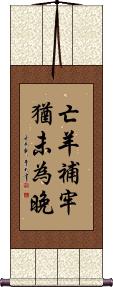
The Chinese idiom shown above came from this reply from Zhuang Xin to the King of Chu almost 2,300 years ago.
It translates roughly into English as...
“Even if you have lost some sheep, it's never too late to mend the fence.”
This proverb, 亡羊补牢犹未为晚, is often used in modern China when suggesting in a hopeful way that someone change their ways, or fix something in their life. It might be used to suggest fixing a marriage, quitting smoking, or getting back on track after taking an unfortunate path in life among other things one might fix in their life.
I suppose in the same way that we might say, “Today is the first day of the rest of your life” in our western cultures to suggest that you can always start anew.
Note: This does have Korean pronunciation but is not a well-known proverb in Korean (only Koreans familiar with ancient Chinese history would know it). Best if your audience is Chinese.
Nichiren
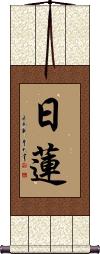
日蓮 is the title Nichiren.
This title refers to a Buddhist priest who lived from 1222 to 1282. He is the founder of the Nichiren sect of Buddhism.
According to historical documents, the Nichiren sect was established in 1252. Adding the character 宗 for sect, this would be 日蓮宗 (Nichiren sect), which is also known as the 法華宗 or Lotus sect.
According to Soothill-Hodous...
Nichiren's chief tenets are the three great mysteries 三大祕法, representing the trikāya:
1. 本尊 or chief object of worship, being the great maṇḍala of the worlds of the ten directions, or universe, i.e., the body or nirmāṇakāya of Buddha.
2. 題目 the title of the Lotus Sutra 妙法蓮華經 Myo-ho-ren-ge-kyo, preceded by Namo, or “Adoration to the scripture of the lotus of the wonderful law,” for it is Buddha's spiritual body.
3. 戒壇 the altar of the law, which is also the title of the Lotus as above; the believer, wherever he is, dwells in the Pure-land of calm light 寂光淨土, the saṃbhogakāya.
Old, But More Vigorous in Spirit
Age is just a number
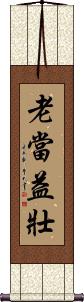
老當益壯 is a Chinese proverb that means “old but vigorous” or “hale and hearty despite the years.”
Said of someone who is more spirited when he/she grows older.
The story behind this Chinese proverb:
In the Eastern Han Dynasty, there was a man named Ma Yuan. He had been planning to herd animals on the frontier since he was young. When he grew up, Ma became a minor official of a county.
Once, he was sending some prisoners to another location. He felt pity for them, so he set them free, and then he fled to another county in the north. He herded animals there, and thus his dream came true. He always said: “If you want to be a great man, the poorer you are, the firmer in spirit you have to be; the older you are, the more spirited you should be.”
Later, when he was even older, Ma Yuan became a famous general of the Eastern Han Dynasty and contributed to many battles.
Omoi
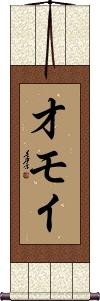
オモイ is the name Omoi in Japanese.
This may refer to the Naruto characters named Omoi. He is a shinobi of Kumogakure, part of the Samui Team, and became the 5th Raikage's personal guard.
Note: Because this title is entirely Japanese Katakana, it should be written by a Japanese calligrapher.
Passions / Feelings / Emotions
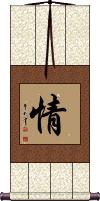
情 means feelings, emotions, passions, and sometimes refers to the situation you are in (with your emotions).
At least, this is the definition in Chinese and Japanese. This word is a bit stronger in Korean Hanja, where it means affection, love, compassion, sympathy, tender feelings, and emotions. Just as in Chinese and Japanese, this can also refer to your circumstances or your facts of life in Korean.
情 is also the original Korean Hanja for the surname Jeong (정).
In Japanese, this can be the surname Sei.
Past experience is the teacher for the future
Past events not forgotten serve as teachers for later events.
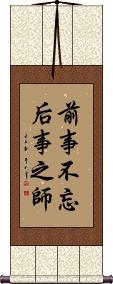
The most literal translation to English of this ancient 前事不忘后事之师 Chinese proverb is:
“Past events not forgotten serve as teachers for later events.”
However, it's been translated several ways:
Don't forget past events, they can guide you in the future.
Benefit from past experience.
Past experience, if not forgotten, is a guide for the future.
Past calamity is my teacher.
A good memory for the past is a teacher for the future.
The remembrance of the past is the teacher of the future.
If one remembers the lessons of the past; They will serve as a guide to avoid mistakes in the future.
The origin:
This proverb comes from the 5th century B.C., just before the Warring States Period in the territory now known as China.
The head of the State of Jin, Zhi Bo, seized power in a coup. He did this with help from the armies of the State of Han and Wei. Instead of being grateful for the help from Han and Wei, he treacherously took the land of Han and Wei. Never satisfied, Zhi Bo employed the armies of Han and Wei to attack and seize the State of Zhao.
The king of Zhao took advice from his minister Zhang Mengtan and secretly contacted the Han and Wei armies to reverse their plans and attack the army of Zhi Bo instead. The plan was successful, and the State of Zhao was not only saved but was set to become a powerful kingdom in the region.
Zhang Mengtan immediately submitted his resignation to a confused king of Zhao. When asked why, Zhang Mengtan said, “I've done my duty to save my kingdom, but looking back at past experience, I know sovereign kings are never satisfied with the power or land at hand. They will join others and fight for more power and more land. I must learn from past experiences, as those experiences are the teachers of future events.”
The king could not dispute the logic in that statement and accepted Zhang Mengtan's resignation.
For generations, the State of Zhao continued to fight for power and land until finally defeated and decimated by the State of Qin (which led to the birth of the Qin Dynasty in 221 B.C.).
Undaunted After Repeated Setbacks
Persistence to overcome all challenges
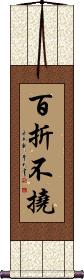
百折不撓 is a Chinese proverb that means “Be undaunted in the face of repeated setbacks.”
More directly translated, it reads, “[Overcome] a hundred setbacks, without flinching.” 百折不撓 is of Chinese origin but is commonly used in Japanese and somewhat in Korean (same characters, different pronunciation).
This proverb comes from a long, and occasionally tragic story of a man that lived sometime around 25-220 AD. His name was Qiao Xuan, and he never stooped to flattery but remained an upright person at all times. He fought to expose the corruption of higher-level government officials at great risk to himself.
Then when he was at a higher level in the Imperial Court, bandits were regularly capturing hostages and demanding ransoms. But when his own son was captured, he was so focused on his duty to the Emperor and the common good that he sent a platoon of soldiers to raid the bandits' hideout, and stop them once and for all even at the risk of his own son's life. While all of the bandits were arrested in the raid, they killed Qiao Xuan's son at first sight of the raiding soldiers.
Near the end of his career, a new Emperor came to power, and Qiao Xuan reported to him that one of his ministers was bullying the people and extorting money from them. The new Emperor refused to listen to Qiao Xuan and even promoted the corrupt Minister. Qiao Xuan was so disgusted that in protest, he resigned from his post as minister (something almost never done) and left for his home village.
His tombstone reads “Bai Zhe Bu Nao” which is now a proverb used in Chinese culture to describe a person of strong will who puts up stubborn resistance against great odds.
My Chinese-English dictionary defines these 4 characters as “keep on fighting despite all setbacks,” “be undaunted by repeated setbacks,” and “be indomitable.”
Our translator says it can mean “never give up” in modern Chinese.
Although the first two characters are translated correctly as “repeated setbacks,” the literal meaning is “100 setbacks” or “a rope that breaks 100 times.” The last two characters can mean “do not yield” or “do not give up.”
Most Chinese, Japanese, and Korean people will not take this absolutely literal meaning but will instead understand it as the title suggests above. If you want a single big word definition, it would be indefatigability, indomitableness, persistence, or unyielding.
See Also: Tenacity | Fortitude | Strength | Perseverance | Persistence
Profound / Powerful Words
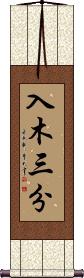
入木三分 is a four-character Chinese proverb that translates in English to a strong form of “profound” or “written with a forceful hand.”
But there is much more to the story...
The deep meaning behind this proverb comes from a man named Wan Xizhi, who lived in the third century.
He was a great writer and calligrapher whose writing style influenced generations of other writers and calligraphers.
He once wrote words on a piece of wood to be taken to an engraver.
When the engraver began to carve the characters into the wood, he found that Wang Xizhi's writing had penetrated the wood about 3/8 of an inch.
Thus people believed that his words were so powerful and profound that they caused the ink from his brush to penetrate the wood deeply.
The proverb literally means “penetrated wood three fen” (A fen is an ancient Chinese measurement of a little over 1/8 of an inch or almost 4mm).
Push or Knock
To weigh one's words
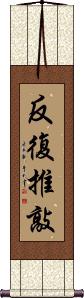
During the Tang Dynasty, a man named Jia Dao (born in the year 779), a well-studied scholar and poet, went to the capital to take the imperial examination.
One day as he rides a donkey through the city streets, a poem begins to form in his mind. A portion of the poem comes into his head like this:
“The bird sits on the tree branch near a pond,
A monk approaches and knocks at the gate...”
At the same time, he wondered if the word “push” would be better than “knock” in his poem.
As he rides down the street, he imagines the monk pushing or knocking. Soon he finds himself making motions of pushing and shaking a fist in a knocking motion as he debates which word to use. He is quite a sight as he makes his way down the street on his donkey with hands and fists flying about as the internal debate continues.
As he amuses people along the street, he becomes completely lost in his thoughts and does not see the mayor's procession coming in the opposite direction. Jia Bao is blocking the way for the procession to continue down the road, and the mayor's guards immediately decide to remove Jia Bao by force. Jia Bao, not realizing that he was in the way, apologizes, explains his poetic dilemma and awaits his punishment for blocking the mayor's way.
The mayor, Han Yu, a scholar and author of prose himself, finds himself intrigued by Jia Dao's poem and problem. Han Yu gets off his horse and addresses Jia Bao, stating, “I think knock is better.” The relieved Jia Bao raises his head and is invited by the mayor to join the procession, and are seen riding off together down the street, exchanging their ideas and love of poetry.
In modern Chinese, this 反復推敲 idiom is used when someone is trying to decide which word to use in their writing or when struggling to decide between two things when neither seems to have a downside.
The Red Thread of Fate
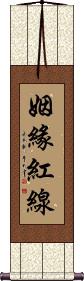
姻緣紅線 is the legendary red string of destiny that binds all soul mates or lovers together.
In ancient Chinese culture, a mythological matchmaker named 月老 (Yuè Lǎo) was the controller of the fate that led lovers to meet. He did this by tying a celestial red string to the ankle of each person. Sometime during their life, they will meet and marry as fate dictates.
While the origin of the red string comes from China, it has spread to other parts of Asia (such as Japan, where it's known as 赤い糸).
Seiryoku Zenyo
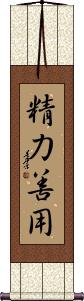
精力善用 means “maximum efficiency” and is often associated with Judo.
It is often matched with “Jita Kyoei” (mutual benefit) to complete the philosophy of Kodokan Judo.
精力 = sei ryoku = energy, vigor, and/or vitality.
善用 = zen yo = to be good at using (something), or to put (something) to good use.
Shiatsu-Do
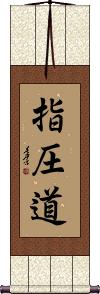
指圧道 is the title for Shiastu-Do, the Japanese way of finger pressure.
Shitsu-Do is about applying special finger pressure to points on the body thought to be connected to pathways called “meridians.” Shiatsu is a healthful way to get your 気 or 氣 (ki energy) flowing properly.
Note: This title can also be written in the older 指壓道 form (just the middle character has an ancient/traditional form used before WWII).
You might even see 指压道 which uses the Simplified Chinese form of the second character.
Shito-Ryu Ki-Me-Kan Karate-Do
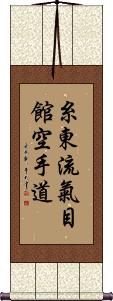
糸東流氣目館空手道 is the title for Shito-Ryu Ki-Me-Kan Karate-Do.
A school of Karate.
Note that while this title can be pronounced in Chinese, it only makes complete sense in Japanese.
Shogun / Japanese General
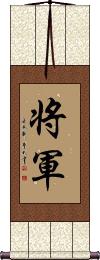
将軍 or Shogun, in the simplest definition, is a General, but you could also use words such as commander, lord, overlord, highest ranking, or commanding officer.
The title “Shogun” has held some slightly ambiguous meanings at times in Japanese history.
In the west, when someone mentions “Shogun,” we may be filled with thoughts of gallant warriors. Some might even think of the TV mini-series with Richard Chamberlain. Often westerners use the words, Samurai and Shogun interchangeably, but that's really not technically correct. In the case of the Samurai, the Shogun was a designated (by the emperor) leader of a gild of Samurai. In this context, the Shogun was a Samurai lord. Or effectively, a commanding officer of a company of Samurai - to put it in modern military terms.
Sometimes a Shogun was a general; other times, he was the leader of a military government in Japan - but not a front-line warrior like a Samurai.
Variants of the same characters are used in China for the rank and title of a General of the People's Liberation Army (and the same term and characters have been used for the last 2200 years since the Qin Dynasty).
Siddhartha
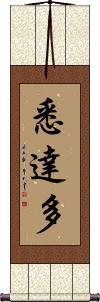
悉達多 is the name Siddhartha (as in Siddhartha Gautama), the personal name for Śākyamuni.
This same Buddha is also known as “Shakyamuni Gautama,” “Gotama Buddha,” or “Tathagata.”
Siddhartha Gautama was a spiritual teacher in the northern region of the Indian subcontinent who founded Buddhism. He is generally seen by Buddhists as the Supreme Buddha (Sammāsambuddha) of known human history.
The actual meaning of this name in Chinese is the realization of all aims, or simply being prosperous.
This name is sometimes romanized from the original Sanskrit or Pali as Siddhattha (from Siddhattha Gotama), Siddharth, Siddhārtha, or Sarvāthasiddha.
Siddhārtha or Sarvāthasiddha can also be written as 悉達, 悉多, 悉多頞他, or 悉陀.
Silent / Solitary
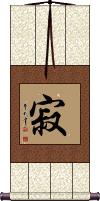
寂 means silent, solitary, quiet, calm, still, rest, or tranquil.
This also has a strong association with Buddhism where it can mean “entering into Nirvana.” In that context, this is sometimes used to refer to the passing of a Buddhist monk (he is silent, as he has entered Nirvana). For the living, this is about tranquility (especially of mind).
Some will also use this to mean “elegant simplicity.”
From Sanskrit, this can represent praśama, vivikta, śānti, or nibbāna (nirvāṇa).
A sly rabbit has three openings to its den
-or- The crafty rabbit has three different entrances to its lair
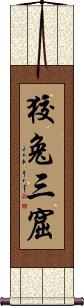
狡兔三窟 speaks to the cunning character of a sly rabbit. Such a rabbit will not have just one hole but rather a few entrances and exits from his liar.
About 2,250 years ago, a rich man told his assistant to go and buy something wonderful that he did not yet possess. He was a man that already had everything, so the assistant went to a local village that owed a great deal of money to the rich man. The assistant told the village elders that all debts were forgiven. All the villagers rejoiced and praised the rich man's name. The assistant returned to the rich man and told him he had purchased “benevolence” for him. The rich man was mildly amused but perhaps slightly confused by the action.
Sometime later, the rich man fell from the favor of the Emperor and was wiped out without a penny to his name. One day he was walking aimlessly and stumbled into the village where the debts had been forgiven. The villagers recognized the man and welcomed him with open arms, clothed, fed him, and gave him a place to live.
Without trying, the man had become like the sly and cunning rabbit. When his exit was blocked, he had another hole to emerge from - and was reborn. This story and idiom come from a book titled “The Amendment” - it's unclear whether this man actually existed or not. But the book did propel this idiom into common use in China.
Still today, this idiom about the rabbit is used in China when suggesting “backup plans,” alternate methods, and anyone with a good escape plan.
Star Lotus
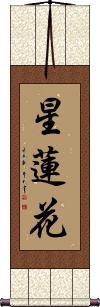
星蓮花 is the title Star Lotus in Chinese.
For star lotus, some may write 星荷 instead - especially in Taiwan for reasons I am not sure of. 星荷 is sometimes romanized as “sing he” or “sing ho” though it would be “xīng hé” in mainland pinyin romanization. If you need a particular version or more info, please get in touch with me.
Strong-Willed / Strong of Heart
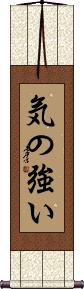
気の強い means strong-willed or strong of heart in Japanese.
Here's the character breakdown of this Japanese title:
気 (ki) spirit; mind; heart; nature; motivation; intention; feelings; essence.
の (no) possessive particle.
強い (tsuyoi) strong; powerful; mighty; potent; resistant; resilient; durable.
Note: Because this selection contains some special Japanese Hiragana characters, it should be written by a Japanese calligrapher.
Sun Wukong / Son Goku
Monkey King
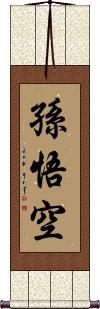
孫悟空 is the name Sun Wukong, also known as the Monkey King. He is the main character with supernatural powers in the ancient Chinese novel Journey to the West.
This title is also known as the real name of the Monkey King in Japanese. This can also be the Son Goku, better known as simply Goku, a fictional character of the Dragon Ball Japanese manga series.
Sword Saint
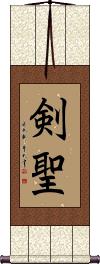
剣聖 can be translated as “Sword Saint,” “God of the Sword,” or “Saint of the Sword.” This is an ancient Japanese title bestowed on a master with the greatest of skills in swordsmanship.
Keep in mind that this is an antiquated term. It will only be understood in the context of martial arts. The pronunciation “kensei” also applies to other words like “constitutional government” and power (these words have different kanji and are completely unrelated).
Notes: This is sometimes Romanized as “kensei,” “ken sei,” and incorrectly as “Kensai.”
Chinese Note: This title is pronounceable in Chinese but seldom, if ever, used in Chinese. Also, the first character is an alternate character form for a sword, currently only used in Japan.
Tai Chi Chuan / Tai Ji Quan
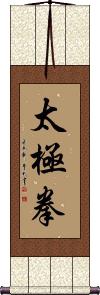
太極拳 is the famous Taoist meditation and martial art exercise. The direct translation of these characters would be something like “grand ultimate fist,” but that does not quite hit the mark for what this title really means.
An early-morning walk through any city in China near a park or an open area will yield a view of Chinese people practicing this ancient technique.
A typical scene is an old man of no less than 80 years on this earth, with a wispy white beard and perhaps a sword in one hand. He makes slow moves that are impossibly smooth. He is steady-footed and always in balance. For him, time is meaningless and proper form, and technique is far more important than speed.
For the younger generation, faster moves may look impressive and seem smooth to the casual observer. But more discipline and mental strength are needed to create perfectly smooth moves in virtual slow motion.
Note: There are two ways to Romanize these Chinese characters, as seen in the title above. The pronunciation and actual characters are the same in Chinese. If you really used English sounds/words to pronounce this, it would be something like “tie jee chew-on” (make the “chew-on” one flowing syllable).
Tathagata
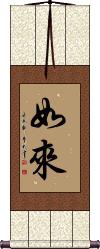
如來 is the name Tathāgata (Buddha's name for himself) in Chinese and Japanese.
This has many layers of meaning: Gone to the absolute, perfected one, he who comes as do all other Buddhas, he who took the absolute way of cause and effect, etc.
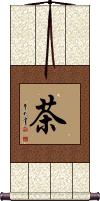
茶 means tea. It can refer to prepared tea (ready-to-drink) or dry tea leaves.
The origin of tea is China but the same character is used in Japanese Kanji, and old Korean Hanja with the exact same meaning. Japanese and Korean even borrowed the pronunciation from Chinese (pronounced “cha” in all three languages).
It's said that an early doctor (or herbologist) in ancient China kept poisoning himself as he tried different new herb concoctions. He invented tea as a means to detoxify himself as he recovered from 1 of the 76 times he nearly poisoned himself to death. Tea is seen not just as a drink but as a form of medicine used to remove impurities from the body.
The word “chai” (used in many languages to refer to various teas) is derived from this Chinese word.
茶 also means camellia, as Asian teas are often based on the leaves of camellia plant varieties.
Tea Fate
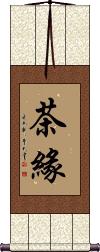
茶緣 is a special title for the tea lover. This kind of means “tea fate,” but it's more spiritual and hard to define. Perhaps the tea brought you in to drink it. Perhaps the tea will bring you and another tea-lover together. Perhaps you were already there, and the tea came to you. Perhaps it's the ah-ha moment you will have when drinking the tea.
I've been told not to explain this further, as it will either dilute or confuse the purposefully-ambiguous idea embedded in this enigma.
I happen to be the owner of a piece of calligraphy written by either the son or nephew of the last emperor of China, which is the title he wrote. It was given to me at a Beijing tea house in 2001. 茶緣 is where I learned to love tea after literally spending weeks tasting and studying everything I could about Chinese tea. I did not understand the significance of the authorship or the meaning of the title at all. Some 10 years later, I realized the gift was so profound and had such providence. Only now do I realize the value of a gift that it is too late to give proper thanks for. It was also years later that I ended up in this business and could have the artwork properly mounted as a wall scroll. It has been borrowed for many exhibitions and shows and always amazes native Chinese and Taiwanese who read the signature. This piece of calligraphy I once thought was just a bit of ink on a thin and wrinkled piece of paper, is now one of my most valued possessions. And fate has taught me to be more thankful for seemingly simple gifts.
Thought / Thinking / Idea
思想 means thought, thinking, or idea in Chinese, Japanese Kanji, and old Korean Hanja. Sometimes it can mean ideology, depending on context.
This can refer to someone's personality - like saying, “he is a thinker.”
Tiger Rumor
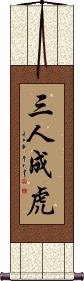
These four characters together relay the meaning that can be expressed in English as “When three people say there's a tiger running in the street, you believe it.”
Of course, there is an ancient story behind this idiom...
三人成虎 is actually a proverb that resulted from a conversation that occurred around 300 B.C.
The conversation was between the king of the Wei kingdom and one of the king's ministers named Pang Cong.
It was near the end of one of many wars, this time with the Zhao kingdom. Pang Cong was to be sent by the king to the Zhao kingdom with the king's son, who was to be held hostage. It was common at the time for a king to make his son a hostage to secure stable peace between warring kingdoms.
Before minister Pang Cong departed, he asked his king, “If one person told you a tiger was running in the street, would you believe it?.”
“No,” the king said.
The minister continued, “What if two people told you?”
The king replied, “Well, I would have my doubts but I might believe it.”
The minister continued, “So, what if three people told you that a tiger is running in the streets?”
The king replied, “Yes, I would believe it. It must be true if three people say it.”
The minister then reminded the king, “Your son and I are now traveling far away to live in the distant Zhao kingdom - much farther from your palace than the street. Rumors may fly about me in my absence, so I hope your majesty will weight such rumors appropriately.”
The king replied, “I have every trust in you, do not worry”
While the minister was gone, the king's enemies gossiped about minister Pang Cong on many occasions. At first, the king thought nothing of these comments and rumors. But slowly, as the rumors mounted, the king began to suspect ill of his minister.
Sometime later, when peace was well-established, the minister and prince were freed and returned to the kingdom of Wei. The king received his son BUT DID NOT EVEN SUMMON MINISTER PANG CONG TO THE PALACE!
Hopefully, this story will help you see how dangerous words can be when used to promote rumors or create ill will. And perhaps will inspire you not to believe everything you hear.
There is also a secondary suggestion in this idiom that gossip is as ferocious as a tiger. Some Chinese people who don't know the ancient story above may believe that this scroll means that rumors are as vicious as three tigers.
Note: This proverb appears in my Korean dictionary but is not well-known in Korea.
True / Real / Genuine
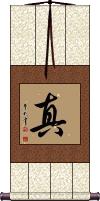
真 is a simple way to express the idea that something is real, true, truth, or genuine.
Occasionally, this character refers to a Buddhist sect that originated in the 13th century.
真 is commonly used as a compound with other characters to create ideas like “true love.” It's also used similarly to the English words “really” or “truly” to say “really good” or “He is really knowledgeable.” Those phrases start with “他真的是... (note the second character is 真).
There are two ways to write this character, shown here is the most common way in China; however, a slight stroke variation is used in Korean Hanja. If you want that version, just let us know when you place your order.
See Also: Honesty
Unselfish: Perfectly Impartial
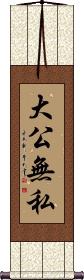
大公無私 is a Chinese proverb that comes from an old story from some time before 476 BC. About a man named Qi Huangyang, who was commissioned by the king to select the best person for a certain job in the Imperial Court.
Qi Huangyang selected his enemy for the job. The king was very confused by the selection, but Qi Huangyang explained that he was asked to find the best person for the job, not necessarily someone that he liked or had a friendship with.
Later, Confucius commented on how unselfish and impartial Qi Huangyang was by saying, “Da Gong Wu Si” which, if you look it up in a Chinese dictionary, is generally translated as “Unselfish” or “Just and Fair.”
If you translate each character, you'd have something like
“Big/Deep Justice Without Self.”
Direct translations like this leave out a lot of what the Chinese characters really say. Use your imagination, and suddenly you realize that “without self” means “without thinking about yourself in the decision” - together, these two words mean “unselfish.” The first two characters serve to drive the point home that we are talking about a concept that is similar to “blind justice.”
One of my Chinese-English dictionaries translates this simply as “just and fair.” So that is the short and simple version.
Note: This can be pronounced in Korean, but it's not a commonly used term.
See Also: Selflessness | Work Unselfishly for the Common Good | Altruism
Elements of the Tea Ceremony
Wa Kei Sei Jaku
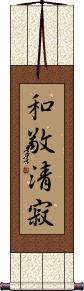
和, 敬, 清, 寂 or Wa, Kei, Sei, Jaku are the principles of the way of tea or 茶道.
The meanings are:
Harmony 和 (wa).
Respect 敬 (kei).
Purity 清 (sei).
Tranquility 寂 (jaku).
These principles or tenets were created by tea master Sen Rikyu (1522-1591). More about these ideas: Chanoyu
See Also: The Way of Tea
Wing Chun Fist Maxims (Part 1)
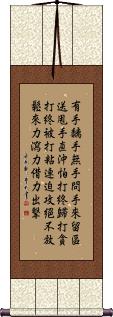
A customer asked me to split these Wing Chun maxims into two parts, so he could order a couplet. I thought this was a good idea, so it's been added here.
1 有手黐手,無手問手
2 來留區送, 甩手直沖
3 怕打終歸打, 貪打終被打
4 粘連迫攻, 絕不放鬆
5 來力瀉力, 借力出擊
A couplet is a set of two wall scrolls that start and finish one phrase or idea. Often, couplets are hung with the first wall scroll on the right side, and the second on the left side of a doorway or entrance. The order in Chinese is right-to-left, so that's why the first wall scroll goes on the right as you face the door.
Of course, couplets can also be hung together on a wall. Often they can be hung to flank an altar, or table with incense, or even flanking a larger central wall scroll. See an example here from the home of Confucius
Be sure to order both parts 1 and 2 together. One without the other is like Eve without Adam.
Wing Chun Fist Maxims (Part 2)
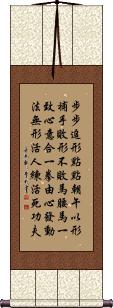
A customer asked me to split these Wing Chun maxims into two parts, so he could order a couplet.
It thought this was a good idea, so it's been added here.
6 步步追形, 點點朝午
7 以形補手, 敗形不敗馬
8 腰馬一致, 心意合一
9 拳由心發, 動法無形
10 活人練活死功夫
Be sure to order both part 1 and part 2 together. They need to be a matched set. It will be incomplete as a single wall scroll. Also, each wall scroll is handmade, so if you order them separately, weeks or months apart, they will vary a little by length, shade of paper, etc.
Work Unselfishly for the Common Good
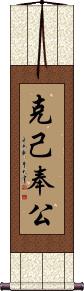
克己奉公 is a Chinese proverb that is often used to express how one should act as a government official. Most of us wish our public officials would hold themselves to higher standards. I wish I could send this scroll, along with the meaning to every member of Congress, and the President (or if I was from the UK, all the members of Parliament, and the PM)
This can also mean: “Place Strict Standards on Oneself in Public Service.”
The story behind this ancient Chinese idiom:
Cai Zun was born in China a little over 2000 years ago. In 24 AD, he joined an uprising led by Liu Xiu, who later became the emperor of the Eastern Han Dynasty.
Later, the new emperor put Cai Zun in charge of the military court. Cai Zun exercised his power in strict accordance with military law, regardless of the offender's rank or background. He even ordered the execution of one of the emperor's close servants after the servant committed a serious crime.
Cai Zun led a simple life but put great demands on himself to do all things honorably. The emperor rewarded him for his honest character and honorable nature by promoting him to the rank of General and granting him the title of Marquis.
Whenever Cai Zun would receive an award, he would give credit to his men and share the reward with them.
Cai Zun was always praised by historians who found many examples of his selfless acts that served the public interest.
Sometime long ago in history, people began to refer to Cai Zun as “ke ji feng gong.”
See Also: Unselfish | Selflessness | Altruism
Yue Fei
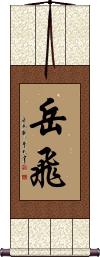
岳飛 is the name of General Yue Fei (1103-1142). He was a famous General of the Song Dynasty army in China. Many legendary stories have been written about him, and passed down through the generations.
In Japanese, this can be the personal name, Gakuhi.
Ultimate Loyalty to Your Country
The most famous tattoo in Chinese history
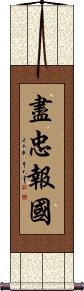
盡忠報國 is a proverb that is the tattoo worn on the back of Yue Fei, a famous Chinese warrior who lived until 1142 A.D.
The tattoo can be translated as “Serve the country with the utmost loyalty.” More literally, it means “[The] Ultimate Loyalty [is too] Duty [of] Country.”
Legend has it that this tattoo once saved his life when he was accused of treason.
The first two characters have come to create a word that means “serve the country faithfully” or “die for the country.” Note: It's more a willingness to die for one's country than the actual act of dying.
The last two characters have come to mean “Dedicate oneself to the service of one's country.”
Both of these words are probably only in the Chinese lexicon because of this famous tattoo.
If you break it down, character-by-character, here is what you get:
1. To the utmost, to the limit of something, the ultimate.
2. Loyalty or duty (a sense of duty to one's master, lord, country, or job).
3. Report, recompense, give back to (in this case, you are giving yourself to your country as payback).
4. Country, state, nation, kingdom.
Zen Buddhism
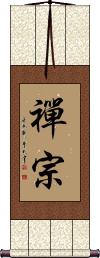
禪宗 is one way to title “Zen Buddhism.” Because the original pronunciation of Zen in Chinese is Chan, you'll also see this expressed as Chan Buddhism.
From the Buddhist Dictionary:
The Chan, meditative or intuitional, sect is usually said to have been established in China by Bodhidharma, the twenty-eighth patriarch, who brought the tradition of the Buddha-mind from India. This sect, believing in direct enlightenment, disregarded ritual and sūtras and depended upon the inner light and personal influence for the propagation of its tenets, founding itself on the esoteric tradition supposed to have been imparted to Kāśyapa by the Buddha, who indicated his meaning by plucking a flower without further explanation. Kāśyapa smiled in apprehension and is supposed to have passed on this mystic method to the patriarchs. The successor of Bodhidharma was 慧可 Huike, and he was succeeded by 僧璨 Sengcan, 道信 Daoxin, 弘忍 Hongren, 慧能 Huineng, and 神秀 Shenxiu, the sect dividing under the two latter into the southern and northern schools: the southern school became prominent, producing 南嶽 Nanyue and 靑原 Qingyuan, the former succeeded by 馬祖 Mazu, the latter by 石頭 Shitou. From Mazu's school arose the five later schools.
Zhang Fei
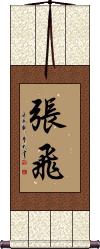
張飛 is the name of General Zhang Fei, of the Shu Kingdom. He was blood-brother of Liu Bei in the semi-historical novel “Romance of the Three Kingdoms.” Zhang Fei is famous for his heroic and fearsome fighting and his love of wine.
In Japanese, this can be the name Chouhi.
Zhong Kui
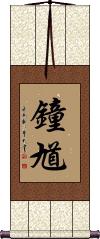
鐘馗 is the name Zhong Kui.
He is a mythological figure who is known to drive away evil spirits (especially from your dreams). Sometimes Zhong Kui is used figuratively to describe a person with the courage to fight against evil.
Zhuangzi / Chuang Tzu
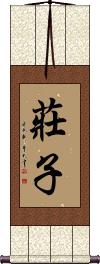
莊子 is the name of Zhuangzi or Chuang Tzu (369-286 BC).
Like Laozi or Lao Tzu, he was a Daoist author, poet, and philosopher.
Zhuge Liang
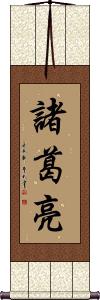
諸葛亮 is the name Zhuge Liang, written in Chinese.
Zhuge Liang lived from 181 to 234 A.D.
He was a military leader and prime minister of Shu Han (蜀漢) during the Three Kingdoms period.
He was the main hero of the fictional Romance of Three Kingdoms.
He is considered a famous sage, philosopher, and military genius.
This in-stock artwork might be what you are looking for, and ships right away...
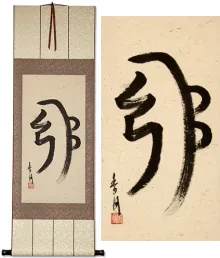
Gallery Price: $300.00
Your Price: $109.88
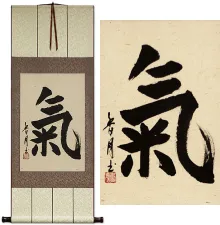
Gallery Price: $300.00
Your Price: $109.88

Gallery Price: $61.00
Your Price: $33.88
The following table may be helpful for those studying Chinese or Japanese...
| Title | Characters | Romaji (Romanized Japanese) | Various forms of Romanized Chinese | |
| 1 Peter 3:13 | 你們若是熱心行善有誰害你們呢 你们若是热心行善有谁害你们呢 | Nǐ men ruò shì rè xīn xíng shàn yǒu shéi hài nǐ men ne ni3 men ruo4 shi4 re4 xin1 xing2 shan4 you3 shei2 hai4 ni3 men ne ni men ruo shi re xin xing shan you shei hai ni men ne | ni men jo shih je hsin hsing shan yu shei hai ni men ne | |
| Adoring Love | 愛慕 爱慕 | ai bou / aibou / ai bo | ài mù / ai4 mu4 / ai mu / aimu | |
| Madder | 茜 | akane / sen / sei | xī / xi1 / xi | |
| No man knows what he owes to his parents until he comes to have children of his own | 子を持って知る親の恩 | ko wo motte shiru oya no on kowomotteshiruoyanoon | ||
| Be Like Water | 像水一樣 | xiàng shuǐ yí yàng xiang4 shui3 yi2 yang4 xiang shui yi yang xiangshuiyiyang | hsiang shui i yang hsiangshuiiyang |
|
| Wisdom from Hard Knocks | 挨一拳得一招挨十拳變諸葛 挨一拳得一招挨十拳变诸葛 | ái yī quán dé yī zhāo ái shí quán biàn zhū gě ai2 yi1 quan2 de2 yi1 zhao1 ai2 shi2 quan2 bian4 zhu1 ge3 ai yi quan de yi zhao ai shi quan bian zhu ge | ai i ch`üan te i chao ai shih ch`üan pien chu ko ai i chüan te i chao ai shih chüan pien chu ko |
|
| Black Flag Gate Hek Ki Boen | 黑旗門 黑旗门 | hēi qí mén hei1 qi2 men2 hei qi men heiqimen | hei ch`i men heichimen hei chi men |
|
| Black or white cat matters not as long as it can catch mice | 不管黑貓白貓能捉著老鼠的就是好貓 不管黑猫白猫能捉着老鼠的就是好猫 | bù guǎn hēi māo bái māo néng zhuō zhe lǎo shǔ de jiù shì hǎo mǎo bu4 guan3 hei1 mao1 bai2 mao1 neng2 zhuo1 zhe lao3 shu3 de jiu4 shi4 hao3 mao3 bu guan hei mao bai mao neng zhuo zhe lao shu de jiu shi hao mao | pu kuan hei mao pai mao neng cho che lao shu te chiu shih hao mao | |
| Bodhidharma | 菩提達磨 菩提达磨 | bodai daruma bodaidaruma | pú tí dá mó pu2 ti2 da2 mo2 pu ti da mo putidamo | p`u t`i ta mo putitamo pu ti ta mo |
| Dharma Damo Daruma | 達摩 / 達磨 达摩 / 达磨 | daru ma / daruma | dá mó / da2 mo2 / da mo / damo | ta mo / tamo |
| The Brave Have No Fears | 勇者不懼 勇者不惧 | yuu sha fu ku yuushafuku yu sha fu ku | yǒng zhě bú jù yong3 zhe3 bu2 ju4 yong zhe bu ju yongzhebuju | yung che pu chü yungchepuchü |
| Bravery Courage | 勇敢 | yuu kan / yuukan / yu kan | yǒng gǎn / yong3 gan3 / yong gan / yonggan | yung kan / yungkan |
| Broken Mirror Rejoined | 破鏡重圓 破镜重圆 | pò jìng chóng yuán po4 jing4 chong2 yuan2 po jing chong yuan pojingchongyuan | p`o ching ch`ung yüan pochingchungyüan po ching chung yüan |
|
| Bruce Lee | 李小龍 李小龙 | bu ruu su ri buruusuri bu ru su ri | lǐ xiǎo lóng li3 xiao3 long2 li xiao long lixiaolong | li hsiao lung lihsiaolung |
| Mark the boat to find the lost sword Ignoring the changing circumstances of the world | 刻舟求劍 刻舟求剑 | kokushuukyuuken kokushukyuken | kè zhōu qiú jiàn ke4 zhou1 qiu2 jian4 ke zhou qiu jian kezhouqiujian | k`o chou ch`iu chien kochouchiuchien ko chou chiu chien |
| Che Guevara | 切格瓦拉 | qiè gé wǎ lā qie4 ge2 wa3 la1 qie ge wa la qiegewala | ch`ieh ko wa la chiehkowala chieh ko wa la |
|
| Confucius | 孔子 | koushi / koshi | kǒng zǐ / kong3 zi3 / kong zi / kongzi | k`ung tzu / kungtzu / kung tzu |
| Bravery Courage | 勇氣 勇气 / 勇気 | yuuki / yuki | yǒng qì / yong3 qi4 / yong qi / yongqi | yung ch`i / yungchi / yung chi |
| The Great Path has No Gate | 大道無門 大道无门 | dai dou mu mon daidoumumon dai do mu mon | dà dào wú mén da4 dao4 wu2 men2 da dao wu men dadaowumen | ta tao wu men tataowumen |
| Daodejing Tao Te Ching - Chapter 33 | 知人者知也自知者明也勝人者有力也自勝者強也知足者富也強行者有志也不失其所者久也死而不亡者壽也 知人者知也自知者明也胜人者有力也自胜者强也知足者富也强行者有志也不失其所者久也死而不亡者寿也 | zhī rén zhě zhī yě zì zhī zhě míng yě shèng rén zhě yǒu lì yě zì shèng zhě qiáng yě zhī zú zhě fù yě qiáng xíng zhě yǒu zhì yě bù zhī qí suǒ zhě jiǔ yě sǐ ér bù wáng zhě shòu yě zhi1 ren2 zhe3 zhi1 ye3 zi4 zhi1 zhe3 ming2 ye3 sheng4 ren2 zhe3 you3 li4 ye3 zi4 sheng4 zhe3 qiang2 ye3 zhi1 zu2 zhe3 fu4 ye3 qiang2 xing2 zhe3 you3 zhi4 ye3 bu4 zhi1 qi2 suo3 zhe3 jiu3 ye3 si3 er2 bu4 wang2 zhe3 shou4 ye3 zhi ren zhe zhi ye zi zhi zhe ming ye sheng ren zhe you li ye zi sheng zhe qiang ye zhi zu zhe fu ye qiang xing zhe you zhi ye bu zhi qi suo zhe jiu ye si er bu wang zhe shou ye | chih jen che chih yeh tzu chih che ming yeh sheng jen che yu li yeh tzu sheng che ch`iang yeh chih tsu che fu yeh ch`iang hsing che yu chih yeh pu chih ch`i so che chiu yeh ssu erh pu wang che shou yeh chih jen che chih yeh tzu chih che ming yeh sheng jen che yu li yeh tzu sheng che chiang yeh chih tsu che fu yeh chiang hsing che yu chih yeh pu chih chi so che chiu yeh ssu erh pu wang che shou yeh |
|
| Daodejing Tao Te Ching - Chapter 81 | 信言不美美言不信知者不博博者不知善者不多多者不善聖人無積既以為人己癒有既以予人矣已癒多故天之道利而不害聖人之道為而不爭 信言不美美言不信知者不博博者不知善者不多多者不善圣人无积既以为人己愈有既以予人矣已愈多故天之道利而不害圣人之道为而不争 | |||
| Daruma Damo | 達磨 达磨 | daruma | dá mó / da2 mo2 / da mo / damo | ta mo / tamo |
| Death Before Dishonor | 士可殺不可辱 士可杀不可辱 | shì kě shā bù kě rǔ shi4 ke3 sha1 bu4 ke3 ru3 shi ke sha bu ke ru shikeshabukeru | shih k`o sha pu k`o ju shihkoshapukoju shih ko sha pu ko ju |
|
| Dogen | 道元 | dou gen / dougen / do gen | dào yuán / dao4 yuan2 / dao yuan / daoyuan | tao yüan / taoyüan |
| Drain the pond to get all the fish | 竭澤而漁 竭泽而渔 | jié zé ér yú jie2 ze2 er2 yu2 jie ze er yu jiezeeryu | chieh tse erh yü chiehtseerhyü |
|
| Diligent Study Proverb | 鑿壁偷光 凿壁偷光 | záo bì tōu guāng zao2 bi4 tou1 guang1 zao bi tou guang zaobitouguang | tsao pi t`ou kuang tsaopitoukuang tsao pi tou kuang |
|
| Empress | 皇后 | kou gou / kougou / ko go | huáng hòu huang2 hou4 huang hou huanghou | |
| Energy Capability | 能量 | nou ryou / nouryou / no ryo | néng liáng neng2 liang2 neng liang nengliang | |
| The one who retreats 50 paces mocks the one to retreats 100 | 五十步笑百步 | wù shí bù xiào bǎi bù wu4 shi2 bu4 xiao4 bai3 bu4 wu shi bu xiao bai bu wushibuxiaobaibu | wu shih pu hsiao pai pu wushihpuhsiaopaipu |
|
| Fighting Spirit | 闘氣 闘気气 | tou ki / touki / to ki | ||
| Galatians 5:22-23 | 聖靈所結的果子就是仁愛喜樂和平忍耐恩慈良善信實溫柔節制 圣灵所结的果子就是仁爱喜乐和平忍耐恩慈良善信实温柔节制 | shèng líng suǒ jié de guǒ zi jiù shì rén ài xǐ lè he píng rěn nài ēn cí liáng shàn xìn shí wēn róu jié zhì sheng4 ling2 suo3 jie2 de guo3 zi jiu4 shi4 ren2 ai4 xi3 le4 he ping2 ren3 nai4 en1 ci2 liang2 shan4 xin4 shi2 wen1 rou2 jie2 zhi4 sheng ling suo jie de guo zi jiu shi ren ai xi le he ping ren nai en ci liang shan xin shi wen rou jie zhi | sheng ling so chieh te kuo tzu chiu shih jen ai hsi le ho p`ing jen nai en tz`u liang shan hsin shih wen jou chieh chih sheng ling so chieh te kuo tzu chiu shih jen ai hsi le ho ping jen nai en tzu liang shan hsin shih wen jou chieh chih |
|
| Geisha of Unequaled Talent | 名妓 | mei gi / meigi | míng jì / ming2 ji4 / ming ji / mingji | ming chi / mingchi |
| God of Warcraft | 蚩尤 | shi yuu / shiyuu / shi yu | chī yóu / chi1 you2 / chi you / chiyou | ch`ih yu / chihyu / chih yu |
| God Give Me Strength | 願上帝給我力量 愿上帝给我力量 | yuàn shàng dì gěi wǒ lì liàng yuan4 shang4 di4 gei3 wo3 li4 liang4 yuan shang di gei wo li liang yuanshangdigeiwoliliang | yüan shang ti kei wo li liang yüanshangtikeiwoliliang |
|
| Guan Gong Warrior Saint | 關公 关公 | guān gōng guan1 gong1 guan gong guangong | kuan kung kuankung |
|
| Guan Yu | 關羽 关羽 | guān yǔ / guan1 yu3 / guan yu / guanyu | kuan yü / kuanyü | |
| Gung Ho | 工合 | guai | gōng hé / gong1 he2 / gong he / gonghe | kung ho / kungho |
| Hachiman: God of War | 八幡神 | hachi man jin hachimanjin | ||
| Hapkido | 合氣道 合气道 | ai ki do / aikido | hé qì dào he2 qi4 dao4 he qi dao heqidao | ho ch`i tao hochitao ho chi tao |
| He | 何 | hé / he2 / he | ho | |
| He | ヘ | he | ||
| Heath | 西斯 | xī sī / xi1 si1 / xi si / xisi | hsi ssu / hsissu | |
| Hikari | 暉 晖 | hikari | huī / hui1 / hui | |
| The Whole Room Rocks With Laughter | 哄堂大笑 | hōng tāng dà xiào hong1 tang1 da4 xiao4 hong tang da xiao hongtangdaxiao | hung t`ang ta hsiao hungtangtahsiao hung tang ta hsiao |
|
| The key to immortality is first living a life worth remembering | 獲得永生的鑰匙是先要活得精彩 获得永生的钥匙是先要活得精彩 | huò dé yǒng shēng de yào shí shì xiān yào huó dé jīng cǎi huo4 de2 yong3 sheng1 de yao4 shi2 shi4 xian1 yao4 huo2 de2 jing1 cai3 huo de yong sheng de yao shi shi xian yao huo de jing cai | huo te yung sheng te yao shih shih hsien yao huo te ching ts`ai huo te yung sheng te yao shih shih hsien yao huo te ching tsai |
|
| Ip Man | 葉問 叶问 | yè wèn / ye4 wen4 / ye wen / yewen | yeh wen / yehwen | |
| John 3:16 | 神愛世人甚至將他的獨生子賜給他們叫一切信他的不至滅亡反得永生 神爱世人甚至将他的独生子赐给他们叫一切信他的不至灭亡反得永生 | shén ài shì rén shèn zhì jiāng tā de dú shēng zǐ cì gè tā mén jiào yí qiè xìn tā de bú zhì miè wáng fǎn dé yǒng shēng shen2 ai4 shi4 ren2 shen4 zhi4 jiang1 ta1 de du2 sheng1 zi3 ci4 gei3 ta1 men2 jiao4 yi2 qie4 xin4 ta1 de bu2 zhi4 mie4 wang2 fan3 de2 yong3 sheng1 shen ai shi ren shen zhi jiang ta de du sheng zi ci gei ta men jiao yi qie xin ta de bu zhi mie wang fan de yong sheng | shen ai shih jen shen chih chiang t`a te tu sheng tzu tz`u kei t`a men chiao i ch`ieh hsin t`a te pu chih mieh wang fan te yung sheng shen ai shih jen shen chih chiang ta te tu sheng tzu tzu kei ta men chiao i chieh hsin ta te pu chih mieh wang fan te yung sheng |
|
| John 3:16 | 神は 實に そのひとり 子をお 與えになったほどに 世を 愛された. それは 御子を 信じる 者が ひとりとして 滅びることなく 永遠のいのちを 持つためである. | kami wa, minoru ni, sono hitori ko o o atae ni natta hodo ni, yo o aisare ta. Sore wa miko o shinjiru mono ga, hitori toshite horobiru koto naku, eien no inochi o motsu tame de aru. | ||
| John 3:16 (first half) | 神愛世人甚至將他的獨生子賜給他們 神爱世人甚至将他的独生子赐给他们 | shén ài shì rén shèn zhì jiāng tā de dú shēng zǐ cì gè tā mén shen2 ai4 shi4 ren2 shen4 zhi4 jiang1 ta1 de du2 sheng1 zi3 ci4 gei3 ta1 men2 shen ai shi ren shen zhi jiang ta de du sheng zi ci gei ta men | shen ai shih jen shen chih chiang t`a te tu sheng tzu tz`u kei t`a men shen ai shih jen shen chih chiang ta te tu sheng tzu tzu kei ta men |
|
| John 8:8 | 於是又彎著腰用指頭在地上畫字 于是又弯着腰用指头在地上画字 | yú shì yòu wān zhe yāo yòng zhǐ tou zài dì shàng huà zì yu2 shi4 you4 wan1 zhe yao1 yong4 zhi3 tou zai4 di4 shang4 hua4 zi4 yu shi you wan zhe yao yong zhi tou zai di shang hua zi | yü shih yu wan che yao yung chih t`ou tsai ti shang hua tzu yü shih yu wan che yao yung chih tou tsai ti shang hua tzu |
|
| Ki Ken-Tai Icchi | 気剣体一致 | ki ken tai icchi kikentaiicchi ki ken tai ichi | ||
| Lao Tzu Laozi | 老子 | roushi / roshi | lǎo zǐ / lao3 zi3 / lao zi / laozi | lao tzu / laotzu |
| Life Energy Spiritual Energy | 氣 气 / 気 | ki | qì / qi4 / qi | ch`i / chi |
| Listen to Both Sides and be Enlightened, Listen to One Side and be in the Dark | 兼聽則明偏聽則暗 兼听则明偏听则暗 | jiān tīng zé míng, piān tīng zé àn jian1 ting1 ze2 ming2, pian1 ting1 ze2 an4 jian ting ze ming, pian ting ze an | chien t`ing tse ming, p`ien t`ing tse an chien ting tse ming, pien ting tse an |
|
| Mencius | 孟子 | mou shi / moushi / mo shi | mèng zi / meng4 zi5 / meng zi / mengzi | meng tzu / mengtzu |
| Energy Sword Body in Concert | 気剣体一致 / 氣劍體一致 气剑体一致 | ki ken tai icchi kikentaiicchi ki ken tai ichi | ||
| Mixed Martial Arts | 綜合格鬥 综合格斗 | zōng hé gé dòu zong1 he2 ge2 dou4 zong he ge dou zonghegedou | tsung ho ko tou tsunghokotou |
|
| Mountain Travels Poem by Dumu | 遠上寒山石徑斜白雲生處有人家停車坐愛楓林晚霜葉紅於二月花 远上寒山石径斜白云生处有人家停车坐爱枫林晚霜叶红于二月花 | yuǎn shàng hán shān shí jìng xiá bái yún shēng chù yǒu rén jiā tíng chē zuò ài fēng lín wǎn shuàng yè hóng yú èr yuè huā yuan3 shang4 han2 shan1 shi2 jing4 xia2 bai2 yun2 sheng1 chu4 you3 ren2 jia1 ting2 che1 zuo4 ai4 feng1 lin2 wan3 shuang4 ye4 hong2 yu2 er4 yue4 hua1 yuan shang han shan shi jing xia bai yun sheng chu you ren jia ting che zuo ai feng lin wan shuang ye hong yu er yue hua | yüan shang han shan shih ching hsia pai yün sheng ch`u yu jen chia t`ing ch`e tso ai feng lin wan shuang yeh hung yü erh yüeh hua yüan shang han shan shih ching hsia pai yün sheng chu yu jen chia ting che tso ai feng lin wan shuang yeh hung yü erh yüeh hua |
|
| Where There is a Will, There is a Way | 愚公移山 | yū gōng yí shān yu1 gong1 yi2 shan1 yu gong yi shan yugongyishan | yü kung i shan yükungishan |
|
| Musashi | 武蔵 | mu sashi / musashi | ||
| Better Late Than Never | 亡羊補牢猶未為晚 亡羊补牢犹未为晚 | wáng yáng bǔ láo yóu wèi wéi wǎn wang2 yang2 bu3 lao2 you2 wei4 wei2 wan3 wang yang bu lao you wei wei wan | wang yang pu lao yu wei wei wan wangyangpulaoyuweiweiwan |
|
| Nichiren | 日蓮 日莲 | nichi ren / nichiren | rì lián / ri4 lian2 / ri lian / rilian | jih lien / jihlien |
| Old, But More Vigorous in Spirit | 老當益壯 老当益壮 | lǎo dāng yì zhuàng lao3 dang1 yi4 zhuang4 lao dang yi zhuang laodangyizhuang | lao tang i chuang laotangichuang |
|
| Omoi | オモイ | omoi | ||
| Passions Feelings Emotions | 情 | jou / nasake jo / nasake | qíng / qing2 / qing | ch`ing / ching |
| Past experience is the teacher for the future | 前事不忘后事之師 前事不忘后事之师 | qián shì bú wàng hòu shí zhī shī qian2 shi4 bu2 wang4 hou4 shi2 zhi1 shi1 qian shi bu wang hou shi zhi shi | ch`ien shih pu wang hou shih chih shih chien shih pu wang hou shih chih shih |
|
| Undaunted After Repeated Setbacks | 百折不撓 百折不挠 | hyaku setsu su tou hyakusetsusutou hyaku setsu su to | bǎi zhé bù náo bai3 zhe2 bu4 nao2 bai zhe bu nao baizhebunao | pai che pu nao paichepunao |
| Profound Powerful Words | 入木三分 | rù mù sān fēn ru4 mu4 san1 fen1 ru mu san fen rumusanfen | ju mu san fen jumusanfen |
|
| Push or Knock | 反復推敲 反复推敲 | fǎn fù tuī qiāo fan3 fu4 tui1 qiao1 fan fu tui qiao fanfutuiqiao | fan fu t`ui ch`iao fanfutuichiao fan fu tui chiao |
|
| The Red Thread of Fate | 姻緣紅線 姻缘红线 | yīn yuán hóng xiàn yin1 yuan2 hong2 xian4 yin yuan hong xian yinyuanhongxian | yin yüan hung hsien yinyüanhunghsien |
|
| Seiryoku Zenyo | 精力善用 | sei ryoku zen yo seiryokuzenyo | ||
| Shiatsu-Do | 指圧道 | shiatsudou / shiatsudo | ||
| Shito-Ryu Ki-Me-Kan Karate-Do | 糸東流氣目館空手道 糸东流気目馆空手道 | shito-ryu ki-me-kan karate-dou shito-ryu ki-me-kan karate-do | mì dōng liú qì mù guǎn kōng shǒu dào mi4 dong1 liu2 qi4 mu4 guan3 kong1 shou3 dao4 mi dong liu qi mu guan kong shou dao | mi tung liu ch`i mu kuan k`ung shou tao mi tung liu chi mu kuan kung shou tao |
| Shogun Japanese General | 將軍 将军 | shougun / shogun | jiāng jūn jiang1 jun1 jiang jun jiangjun | chiang chün chiangchün |
| Siddhartha | 悉達多 悉达多 | shiddatta / shiddaruta | xī dá duō xi1 da2 duo1 xi da duo xidaduo | hsi ta to hsitato |
| Silent Solitary | 寂 | jaku | jì / ji4 / ji | chi |
| A sly rabbit has three openings to its den | 狡兔三窟 | jiǎo tù sān kū jiao3 tu4 san1 ku1 jiao tu san ku jiaotusanku | chiao t`u san k`u chiaotusanku chiao tu san ku |
|
| Star Lotus | 星蓮花 星莲花 | xīng lián huā xing1 lian2 hua1 xing lian hua xinglianhua | hsing lien hua hsinglienhua |
|
| Strong-Willed Strong of Heart | 氣の強い 気の強い | ki no tsuyo i kinotsuyoi | ||
| Sun Wukong Son Goku | 孫悟空 孙悟空 | son go kuu / songokuu / son go ku | sūn wù kōng sun1 wu4 kong1 sun wu kong sunwukong | sun wu k`ung sunwukung sun wu kung |
| Sword Saint | 剣聖 / 剣聖 剣圣 | kensei | jiàn shèng jian4 sheng4 jian sheng jiansheng | chien sheng chiensheng |
| Tai Chi Chuan Tai Ji Quan | 太極拳 太极拳 | tai kyoku ken taikyokuken | tài jí quán tai4 ji2 quan2 tai ji quan taijiquan | t`ai chi ch`üan taichichüan tai chi chüan |
| Tathagata | 如來 如来 | nyorai | rú lái / ru2 lai2 / ru lai / rulai | ju lai / julai |
| Tea | 茶 | cha | chá / cha2 / cha | ch`a / cha |
| Tea Fate | 茶緣 茶缘 | chá yuán / cha2 yuan2 / cha yuan / chayuan | ch`a yüan / chayüan / cha yüan | |
| Thought Thinking Idea | 思想 | shisou / shiso | sī xiǎng / si1 xiang3 / si xiang / sixiang | ssu hsiang / ssuhsiang |
| Tiger Rumor | 三人成虎 | sān rén chéng hǔ san1 ren2 cheng2 hu3 san ren cheng hu sanrenchenghu | san jen ch`eng hu sanjenchenghu san jen cheng hu |
|
| True Real Genuine | 真 or 眞 真 | shin / makoto | zhēn / zhen1 / zhen | chen |
| Unselfish: Perfectly Impartial | 大公無私 大公无私 | dà gōng wú sī da4 gong1 wu2 si1 da gong wu si dagongwusi | ta kung wu ssu takungwussu |
|
| Elements of the Tea Ceremony | 和敬清寂 | wa kei sei jaku wakeiseijaku | ||
| Wing Chun Fist Maxims (Part 1) | 有手黐手無手問手來留區送甩手直沖怕打終歸打貪打終被打粘連迫攻絕不放鬆來力瀉力借力出擊 有手黐手无手问手来留区送甩手直冲怕打终归打贪打终被打粘连迫攻绝不放松来力泻力借力出击 | |||
| Wing Chun Fist Maxims (Part 2) | 步步追形點點朝午以形補手敗形不敗馬腰馬一致心意合一拳由心發動法無形活人練活死功夫 步步追形点点朝午以形补手败形不败马腰马一致心意合一拳由心发动法无形活人练活死功夫 | |||
| Work Unselfishly for the Common Good | 克己奉公 | kè jǐ fèng gōng ke4 ji3 feng4 gong1 ke ji feng gong kejifenggong | k`o chi feng kung kochifengkung ko chi feng kung |
|
| Yue Fei | 岳飛 岳飞 | gakuhi | yuè fēi / yue4 fei1 / yue fei / yuefei | yüeh fei / yüehfei |
| Ultimate Loyalty to Your Country | 盡忠報國 尽忠报国 | jìn zhōng bào guó jin4 zhong1 bao4 guo2 jin zhong bao guo jinzhongbaoguo | chin chung pao kuo chinchungpaokuo |
|
| Zen Buddhism | 禪宗 禅宗 | zen shuu / zenshuu / zen shu | chán zōng chan2 zong1 chan zong chanzong | ch`an tsung chantsung chan tsung |
| Zhang Fei | 張飛 张飞 | chou hi / chouhi / cho hi | zhāng fēi zhang1 fei1 zhang fei zhangfei | chang fei changfei |
| Zhong Kui | 鐘馗 钟馗 | zhōng kuí zhong1 kui2 zhong kui zhongkui | chung k`uei chungkuei chung kuei |
|
| Zhuangzi Chuang Tzu | 莊子 庄子 | Sōshi | zhuāng zǐ zhuang1 zi3 zhuang zi zhuangzi | chuang tzu chuangtzu |
| Zhuge Liang | 諸葛亮 诸葛亮 | zhū gě liàng zhu1 ge3 liang4 zhu ge liang zhugeliang | chu ko liang chukoliang |
|
| In some entries above you will see that characters have different versions above and below a line. In these cases, the characters above the line are Traditional Chinese, while the ones below are Simplified Chinese. | ||||

Successful Chinese Character and Japanese Kanji calligraphy searches within the last few hours...