Many custom options...


And formats...



Not what you want?
Try other similar-meaning words, fewer words, or just one word.
Opportunity Japanese in Japanese...
Buy an Opportunity Japanese calligraphy wall scroll here!
Personalize your custom “Opportunity Japanese” project by clicking the button next to your favorite “Opportunity Japanese” title below...
See also: Selections of just Japanese Kanji Calligraphy
1. Fate / Opportunity / Chance
2. Opportunity
3. Crisis equals Danger plus Opportunity?
5. Optimistic
Fate / Opportunity / Chance
The Buddhist idea of Fate
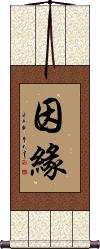
因緣 is the Buddhist concept of a chance meeting or an opportunity that presents itself by fate.
Sometimes this is used to describe a cosmic chain of events or cause and effect.
It also is used to describe predestined relationships between people - and sometimes married couples (although if you want one about marriage, try this: Fate / Destiny of Lovers.
因緣 can also be translated as origin, karma, destiny, affinity, connection, and relation. This all depends on context - seen alone on a wall scroll, this will be read with a “fate/chance” meaning by a Chinese person or a Korean person who can read Hanja.
The more complex definition of this word would be, “Direct causes and indirect conditions, which underlie the actions of all things.”
This concept is known as nidana in the original Sanskrit. Also sometimes presented as hetupratyaya (or “hetu and prataya”), which I believe is Pali.
Note: Japanese will tend to use this version of the second Kanji: 
If you order this from the Japanese master calligrapher, expect that you’ll get this version. However, this word often carries a negative connotation in Japanese (bad things happen), as it is used that way in a certain Japanese idiom. Therefore, this may not be the best choice if Japanese is your target language.
See Also: Buddhism | Opportunity
Opportunity
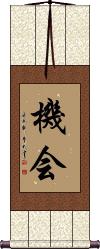
機会 is a common way to express “opportunity” in Japanese.
The first character means “chance,” and the second can be translated as “meeting.”
So in Japanese business, a “chance meeting” represents a real “opportunity.”
Note that this also means opportunity in Chinese, but it's more an oral or informal word in Mandarin. Also, the second Kanji is the same as the simplified version of the hui Chinese character.
Opportunity
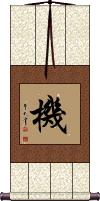
機 is an odd one - I've seen this on coffee cups and posters with the meaning of “opportunity.”
機 is a correct definition but this character also means “machine.” In fact, if you put the character for “flying” in front of this character, you have the Chinese word for “airplane” (literally: flying machine). Alone, on a wall scroll, it will be generally understood as “opportunity” but I want you to know this extra information before you make your selection. Note that in Japanese and Korean, this has a similar meaning but can also mean machine or loom.
See Also: Success
Crisis equals Danger plus Opportunity?
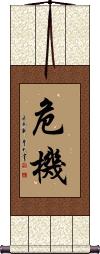
危機 means crisis in Chinese and Japanese.
Separately, the first character here does mean “danger” or “to endanger,” and the second character can mean “opportunity.”
However, I want to debunk a myth that was propagated by some westerners who did not have a clear understanding of Asian languages...
While often, Chinese/Japanese/Korean compound words (words of two or more characters) are the sum of their parts, this is not always the case. The compound is often understood with a completely different meaning than the two characters individually.
Many have said that the Chinese/Japanese/Korean word for Crisis is made up of the characters for “danger” and “opportunity.” 危機 is true when phrased this way.
However, it's not absolutely correct to say that “danger + opportunity = crisis” in Asian cultures.
English example:
If I tell you that...
Bovine creature + Guy behind the plate in baseball = Locomotive train protection

...you would think I was mad. But consider that “cow + catcher = cowcatcher,” which is the device that used to be found on steam engines to protect them if they hit an animal on the tracks. When we hear the word “cowcatcher,” we don't separate the words into their individual meanings (necessarily).
The same is true with the word for crisis in Chinese/Japanese/Korean. While you can separate the characters, few Asian people would automatically do so in their minds.
The final answer:
It is a half-truth to say, “danger plus opportunity equals crisis” in Chinese/Japanese/Korean. Use this statement and concept with caution.
Also, the second character can mean “secret” or “machine,” depending on context so I guess you have to say “a dangerous machine = crisis” or “danger + a secret = crisis.” Both of these are only slightly more ridiculous than the first premise.
PS: 危機 is probably not a great word for a scroll unless you have a special use for it.
Once in a Lifetime
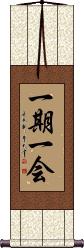
This Japanese title can be translated as “for this time only,” “chance meeting,” “one meeting, one opportunity,” “never again,” or “one chance in a lifetime.”
The characters literally mean “one time one meeting” - of course, the Kanji characters have meaning far beyond a direct translation like this.
Some might use this proverb to talk of an opportunity that presents itself just once in your life. It could also be a one-and-only chance meeting with your true soul mate. An expression of any event that might happen once in a lifetime.
This is primarily a Japanese title, however, there is also a Traditional Chinese (and old Korean) version of this proverb. Just the last character is different. The traditional form was used in Japan before WWII and in Korea prior to 1900. This title is somewhat known in China.
If you want the older traditional form, just click on the character to the right.
Optimistic
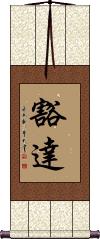
Beyond optimistic, 豁達 can also be defined as sanguine; magnanimous; open-minded; openhearted; broad-minded.
豁達 is appropriate if you are, or want to be, the kind of person who is not bothered by the little things or minor troubles of life. This signifies a person who always feels things will get better. This is great for the person who figuratively sees a window of opportunity opening even as a door closes.
While a valid word in Japanese, this is kind of antiquated, and not in common use in modern Japan.
The Mysterious Bond Between People
The invisible force that brings people together forever
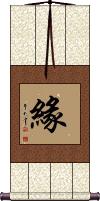
緣 represents the fate that brings and bonds people together.
緣 is a complicated single character. It can mean a lot of different things depending on how you read it.
In Japanese, it can mean fate, destiny, a mysterious force that binds two people together, a relationship between two people, bond, link, connection, family ties, affinity, opportunity, or chance (to meet someone and start a relationship). It can also mean “someone to rely on,” relative, reminder, memento, or the female given name, Yori.
It's the same in Chinese, where it's defined as cause, reason, karma, fate, or predestined affinity.
In the Buddhist context, it's Pratyaya. This is the concept of indirect conditions, as opposed to direct causes. It's when something happens (meeting someone) by circumstance or a contributing environment. Instead of a direct cause or act, it is a conditioning cause without direct input or action by the involved people.
Occasionally, this character is used in a facetious way to say hem, seam, or edge of clothing. In this case, it's the seam that brings or holds the clothing together.
Note: Japanese will tend to use the variant of this Kanji shown to the right. If you want this version (and are ordering this from the Japanese master calligrapher), click on the Kanji at the right instead of the button above.
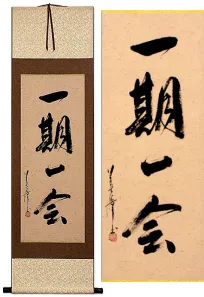
This in-stock artwork might be what you are looking for, and ships right away...
Gallery Price: $268.00
Your Price: $148.77




Gallery Price: $106.00
Your Price: $58.88



Gallery Price: $200.00
Your Price: $98.88

Gallery Price: $65.00
Your Price: $39.88
Not the results for Opportunity Japanese that you were looking for?
Below are some entries from our dictionary that may match your Opportunity Japanese search...
| Characters If shown, 2nd row is Simp. Chinese |
Pronunciation Romanization |
Simple Dictionary Definition |
瀬 see styles |
lài lai4 lai yanagise やなぎせ |
Japanese variant of 瀨|濑 (1) shallows; shoal; (2) rapids; current; torrent; (3) position; place; (4) chance; opportunity; (surname) Yanagise |
The following table may be helpful for those studying Chinese or Japanese...
| Title | Characters | Romaji (Romanized Japanese) | Various forms of Romanized Chinese | |
| Fate Opportunity Chance | 因緣 因缘 / 因縁 | in nen / innen | yīn yuán / yin1 yuan2 / yin yuan / yinyuan | yin yüan / yinyüan |
| Opportunity | 機會 机会 | kikai | jī huì / ji1 hui4 / ji hui / jihui | chi hui / chihui |
| Opportunity | 機 机 | hata | jī / ji1 / ji | chi |
| Crisis equals Danger plus Opportunity? | 危機 危机 | kiki | wēi jī / wei1 ji1 / wei ji / weiji | wei chi / weichi |
| Once in a Lifetime | 一期一會 一期一会 | ichigo ichie ichigoichie | yī qī yī huì yi1 qi1 yi1 hui4 yi qi yi hui yiqiyihui | i ch`i i hui ichiihui i chi i hui |
| Optimistic | 豁達 豁达 | katsudatsu | huò dá / huo4 da2 / huo da / huoda | huo ta / huota |
| The Mysterious Bond Between People | 緣 / 縁 缘 | en | yuán / yuan2 / yuan | yüan |
| In some entries above you will see that characters have different versions above and below a line. In these cases, the characters above the line are Traditional Chinese, while the ones below are Simplified Chinese. | ||||

Successful Chinese Character and Japanese Kanji calligraphy searches within the last few hours...



