Many custom options...


And formats...



Idle in Chinese / Japanese...
Buy an Idle calligraphy wall scroll here!
Personalize your custom “Idle” project by clicking the button next to your favorite “Idle” title below...
3. Right Speech / Right Talk / Perfect Speech
Samyag Vaca / Samma Vaca / Samma Vacha
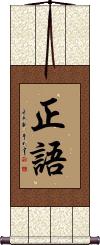
正語 is one of the Noble Eightfold Paths of Buddhism. Right Speech, along with Right Action and Right Living, constitute the path to Virtue.
Right Speech is abstaining from lying, abstaining from divisive speech, abstaining from abusive speech, abstaining from idle chatter, abstaining from slander, abstaining from gossip, or any form of harmful or wrong speech.
This term is exclusively used by devout Buddhists. It is not a common term, and is remains an unknown concept to most Japanese and Chinese people.
See Also: Buddhism | Enlightenment | Noble Eightfold Path
Immovable Mind
fudoshin
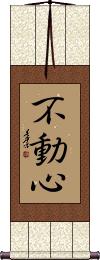
不動心 is one of the five spirits of the warrior (budo) and is often used as a Japanese martial arts tenet.
Under that context, places such as the Budo Dojo define it this way: An unshakable mind and an immovable spirit is the state of fudoshin. It is courage and stability displayed both mentally and physically. Rather than indicating rigidity and inflexibility, fudoshin describes a condition that is not easily upset by internal thoughts or external forces. It is capable of receiving a strong attack while retaining composure and balance. It receives and yields lightly, grounds to the earth, and reflects aggression back to the source.
Other translations of this title include unwavering mind, immovable mind, unwavering composure, imperturbability, steadfastness, keeping a cool head in an emergency, or keeping one's calm (during a fight).
The first two Kanji alone mean immobility, firmness, fixed, steadfastness, motionless, and idle.
The last Kanji means heart, mind, soul, or essence.
Together, these three Kanji create a title defined as “immovable mind” within the context of Japanese martial arts. However, in Chinese, it would mean “motionless heart,” and in Korean Hanja, “wafting heart” or “floating heart.”
Not the results for Idle that you were looking for?
Below are some entries from our dictionary that may match your Idle search...
| Characters If shown, 2nd row is Simp. Chinese |
Pronunciation Romanization |
Simple Dictionary Definition |
正語 正语 see styles |
zhèng yǔ zheng4 yu3 cheng yü shōgo |
More info & calligraphy: 3. Right Speech / Right Talk / Perfect Speech |
さぼる see styles |
saboru さぼる |
(v5r,vi) to be truant; to play hooky; to skip school; to skip out; to be idle; to sabotage by slowness |
八正道 see styles |
bā zhèng dào ba1 zheng4 dao4 pa cheng tao hasshōdō はっしょうどう |
More info & calligraphy: The Noble Eightfold Path(Buddhist term) noble eightfold path (八正道分) Āryamārga. The eight right or correct ways, the "eightfold noble path" for the arhat to nirvāṇa; also styled 八道船, 八正門, 八由行, 八游行, 八聖道支, 八道行, 八直行, 八直道. The eight are: (1) 正見Samyag-dṛṣṭi, correct views in regard to the Four Axioms, and freedom from the common delusion. (2) 正思 Samyak-saṁkalpa, correct thought and purpose. (3) 正語 Samyag-vāc, correct speech, avoidance of false and idle talk. (4) 正業 Samyak-karmānta, correct deed, or conduct, getting rid of all improper action so as to dwell in purity. (5) 正命 Smnyag-ājīva, correct livelihood or occupation, avoiding the five immoral occupations. (6) 正精進 Samyag-vyāyāma, correct zeal, or energy in uninterrupted progress in the way of nirvāṇa. (7) 正念 Samyak-smṛti, correct remembrance, or memory, which retains the true and excludes the false. (8) 正定 Samyak-samadhi, correct meditation, absorption, or abstraction. The 正 means of course Buddhist orthodoxy, anything contrary to this being 邪 or heterodox, and wrong. |
娑 see styles |
suō suo1 so sha |
(phonetic); see 婆娑[po2 suo1] To play, careless, idle, easy going; translit. s, ś, chiefly sa, sā. |
怠 see styles |
dài dai4 tai tai |
idle; lazy; negligent; careless idle |
惰 see styles |
duò duo4 to da |
lazy idle |
懈 see styles |
xiè xie4 hsieh ke |
lax; negligent Idle, lazy, negligent. |
消 see styles |
xiāo xiao1 hsiao masao まさお |
to diminish; to subside; to consume; to reduce; to idle away (the time); (after 不[bu4] or 只[zhi3] or 何[he2] etc) to need; to require; to take (personal name) Masao Melt, disperse, expend, digest, dispose of. |
閑 闲 see styles |
xián xian2 hsien nodoka のどか |
enclosure; (variant of 閒|闲[xian2]) idle; unoccupied; leisure spare time; free time; leisure; (female given name) Nodoka To bar, a barrier; to shut out; trained. |
閒 闲 see styles |
xián xian2 hsien |
idle; unoccupied; leisure |
与太 see styles |
yota; yota よた; ヨタ |
(1) idle talk; nonsense; rubbish; humbug; (2) fool; idiot; good-for-nothing fellow; (noun or adjectival noun) (3) irresponsible; nonsensical |
休錘 see styles |
kyuusui / kyusui きゅうすい |
idle spindles |
休閒 休闲 see styles |
xiū xián xiu1 xian2 hsiu hsien |
leisure; relaxation; not working; idle; to enjoy leisure; to lie fallow |
冗散 see styles |
rǒng sǎn rong3 san3 jung san |
(literary) idle; unemployed; (literary) (of writing) leisurely and verbose |
口説 see styles |
kuzetsu くぜつ |
(1) lovers' tiff; quarrel between lovers; (2) chattering; idle talk |
唾餘 唾余 see styles |
tuò yú tuo4 yu2 t`o yü to yü |
crumbs from the table of one's master; castoffs; bits of rubbish; idle talk; casual remarks |
坐視 坐视 see styles |
zuò shì zuo4 shi4 tso shih zashi ざし |
to stand by and watch; to look on passively (noun/participle) remaining an idle spectator; looking on unconcernedly (doing nothing) |
嬾惰 see styles |
lǎn duò lan3 duo4 lan to randa らんだ |
(adjectival noun) (1) lazy; idle; (2) indolence; laziness; sloth; idleness lazy |
安佚 see styles |
anitsu あんいつ |
(noun or adjectival noun) (idle) ease; idleness; indolence |
安逸 see styles |
ān yì an1 yi4 an i anitsu あんいつ |
easy and comfortable; easy (noun or adjectival noun) (idle) ease; idleness; indolence; (given name) An'itsu |
寐る see styles |
neru ねる |
(out-dated kanji) (v1,vi) (1) to lie down; (2) to go to bed; to lie in bed; (3) to sleep (lying down); (4) to sleep (with someone, i.e. have intercourse); (5) to lie idle |
寝る see styles |
neru ねる |
(v1,vi) (1) to lie down; (2) to go to bed; to lie in bed; (3) to sleep (lying down); (4) to sleep (with someone, i.e. have intercourse); (5) to lie idle |
小乘 see styles |
xiǎo shèng xiao3 sheng4 hsiao sheng shōjō |
Hinayana, the Lesser Vehicle; Buddhism in India before the Mayahana sutras; also pr. [Xiao3 cheng2] Hīnayāna 希那衍. The small, or inferior wain, or vehicle; the form of Buddhism which developed after Śākyamuni's death to about the beginning of the Christian era, when Mahāyāna doctrines were introduced. It is the orthodox school and more in direct line with the Buddhist succession than Mahāyānism which developed on lines fundamentally different. The Buddha was a spiritual doctor, less interested in philosophy than in the remedy for human misery and perpetual transmigration. He "turned aside from idle metaphysical speculations; if he held views on such topics, he deemed them valueless for the purposes of salvation, which was his goal" (Keith). Metaphysical speculations arose after his death, and naturally developed into a variety of Hīnayāna schools before and after the separation of a distinct school of Mahāyāna. Hīnayāna remains the form in Ceylon, Burma, and Siam, hence is known as Southern Buddhism in contrast with Northern Buddhism or Mahāyāna, the form chiefly prevalent from Nepal to Japan. Another rough division is that of Pali and Sanskrit, Pali being the general literary language of the surviving form of Hīnayāna, Sanskrit of Mahāyāna. The term Hīnayāna is of Mahāyānist origination to emphasize the universalism and altruism of Mahāyāna over the narrower personal salvation of its rival. According to Mahāyāna teaching its own aim is universal Buddhahood, which means the utmost development of wisdom and the perfect transformation of all the living in the future state; it declares that Hīnayāna, aiming at arhatship and pratyekabuddhahood, seeks the destruction of body and mind and extinction in nirvāṇa. For arhatship the 四諦Four Noble Truths are the foundation teaching, for pratyekabuddhahood the 十二因緣 twelve-nidānas, and these two are therefore sometimes styled the two vehicles 二乘. Tiantai sometimes calls them the (Hīnayāna) Tripiṭaka school. Three of the eighteen Hīnayāna schools were transported to China: 倶舍 (Abhidharma) Kośa; 成實 Satya-siddhi; and the school of Harivarman, the律 Vinaya school. These are described by Mahāyānists as the Buddha's adaptable way of meeting the questions and capacity of his hearers, though his own mind is spoken of as always being in the absolute Mahāyāna all-embracing realm. Such is the Mahāyāna view of Hīnayāna, and if the Vaipulya sūtras and special scriptures of their school, which are repudiated by Hīnayāna, are apocryphal, of which there seems no doubt, then Mahāyāna in condemning Hīnayāna must find other support for its claim to orthodoxy. The sūtras on which it chiefly relies, as regards the Buddha, have no authenticity; while those of Hīnayāna cannot be accepted as his veritable teaching in the absence of fundamental research. Hīnayāna is said to have first been divided into minority and majority sections immediately after the death of Śākyamuni, when the sthāvira, or older disciples, remained in what is spoken of as "the cave", some place at Rājagṛha, to settle the future of the order, and the general body of disciples remained outside; these two are the first 上坐部 and 大衆部 q. v. The first doctrinal division is reported to have taken place under the leadership of the monk 大天 Mahādeva (q.v.) a hundred years after the Buddha's nirvāṇa and during the reign of Aśoka; his reign, however, has been placed later than this by historians. Mahādeva's sect became the Mahāsāṅghikā, the other the Sthāvira. In time the two are said to have divided into eighteen, which with the two originals are the so-called "twenty sects" of Hīnayāna. Another division of four sects, referred to by Yijing, is that of the 大衆部 (Arya) Mahāsaṅghanikāya, 上座部 Āryasthavirāḥ, 根本說一切有部 Mūlasarvāstivādaḥ, and 正量部 Saṃmatīyāḥ. There is still another division of five sects, 五部律. For the eighteen Hīnayāna sects see 小乘十八部. |
座視 see styles |
zashi ざし |
(noun/participle) remaining an idle spectator; looking on unconcernedly (doing nothing) |
徒ら see styles |
itazura いたずら |
(adjectival noun) (kana only) useless; vain; aimless; idle |
徒食 see styles |
toshoku としょく |
(n,vs,vi) idle life; idleness |
怠情 see styles |
taida たいだ |
(irregular kanji usage) (noun or adjectival noun) lazy; idle; indolent; slothful |
怠惰 see styles |
dài duò dai4 duo4 tai to taida たいだ |
idleness (noun or adjectival noun) lazy; idle; indolent; slothful |
惰眠 see styles |
damin だみん |
(1) idle slumber; (2) indolence; inactivity |
愚痴 see styles |
yú chī yu2 chi1 yü ch`ih yü chih guchi ぐち |
(1) idle complaint; grumble; (noun or adjectival noun) (2) (Buddhist term) moha (ignorance, folly) muḍha; ignorant and unenlightened, v. 痴. |
Click here for more Idle results from our dictionary
The following table may be helpful for those studying Chinese or Japanese...
| Title | Characters | Romaji (Romanized Japanese) | Various forms of Romanized Chinese | |
| 3. Right Speech Right Talk Perfect Speech | 正語 正语 | sei go / seigo | zhèng yǔ / zheng4 yu3 / zheng yu / zhengyu | cheng yü / chengyü |
| Immovable Mind | 不動心 | fu dou shin fudoushin fu do shin | ||
| In some entries above you will see that characters have different versions above and below a line. In these cases, the characters above the line are Traditional Chinese, while the ones below are Simplified Chinese. | ||||

Successful Chinese Character and Japanese Kanji calligraphy searches within the last few hours...



