Many custom options...


And formats...



Not what you want?
Try other similar-meaning words, fewer words, or just one word.
Happy Birth Day in Chinese / Japanese...
Buy a Happy Birth Day calligraphy wall scroll here!
Personalize your custom “Happy Birth Day” project by clicking the button next to your favorite “Happy Birth Day” title below...
Switched to secondary search mode due to lack of results using primary.
These secondary results may not be very accurate. Try a different but similar meaning word or phrase for better results. Or...
Look up Happy Birth Day in my Japanese Kanji & Chinese Character Dictionary(My dictionary is a different system then the calligraphy search you just tried)
If you want a special phrase, word, title, name, or proverb, feel free to contact me, and I will translate your custom calligraphy idea for you.
1. One Day Seems Like 1000 Years
2. 100 Years of Happy Marriage
3. Even a fool may sometimes come up with a good idea
4. Optimism / Happy With Your Fate
5. Massage
6. Be Happy
7. Beauty / Beautiful Princess
8. Better to be Happy than Rich
9. Birth / Life
10. Bonsai / Penzai
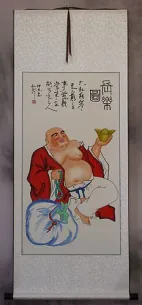
12. Happy Buddha
13. Carpe Diem / Seize the Day
14. Compassionate Heart / Benevolent Heart
15. Confucius
16. Cooperation / Collaboration
17. The Law of Creation and Destruction
18. Give Up Desire
19. Day
20. Doctor
23. Enthusiasm
27. Everyday Life
28. Fast
29. The one who retreats 50 paces mocks the one to retreats 100
30. Fire Horse
32. From This Moment Forward / From This Day Forward
33. 50th Golden Wedding Anniversary
35. Good Good Study, Day Day Up
36. Grace from Heaven / Grace from God
37. Guan Yu
38. Happy / Laughter / Cheerful Bliss
40. Happiness / Fortune / Lucky
42. Double Happiness
44. Happiness
45. Happy Birthday
46. Happy Family
47. Happy Laughter
48. Happy Marriage
49. Happy New Year
50. Perfect Harmony
51. Heaven
52. Hello / Ni Hao
54. The Whole Room Rocks With Laughter
55. Jackie Chan
56. Jesus is My Life
57. Joyful
58. Happy
61. Konichiwa
62. Life Force
63. A Life of Happiness and Prosperity
64. Life Energy / Spiritual Energy
65. Life is Fun
66. Live For The Day
67. Live For The Day / Seize The Day
68. Live In The Moment / Live In The Now
69. Love
70. Love Life
72. The Lord's Prayer / Luke 11:2-4
73. Fatherly Master / Sifu / Shi Fu / Shifu
74. The Lord's Prayer / Mathew 6:9-13
76. Mencius
77. Gold / Metal
78. Moon
79. Mountain Travels Poem by Dumu
80. Nankurunaisa
81. Never Forget Your First Resolution
83. New Beginning
84. New Life
85. Nguyen / Ruan
87. Opportunity
89. Past experience is the teacher for the future
90. Pleasure
92. Prosperous Life
94. Push or Knock
One Day Seems Like 1000 Years
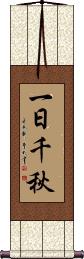
一日千秋 is a Japanese and Chinese proverb about missing someone.
一日千秋 is often used to express how hard it is to wait for someone's return or to be away from someone.
Some will translate this as “one day feels like a very long time” or “waiting for someone (something) is hard.”
You might see this romanized as a single word, Ichijitsusenshuu, or as “Ichijitsu Senshuu” from Japanese.
If you break down the characters one-by-one, we get:
一 = one/a
日 = day/sun (can also represent time or date)
千 = 1000/thousand
秋 = autumn/fall
Together, 千秋 can mean “autumn comes thousand times” (or 1000 years). It can also be read as 1000 periods of time.
However, it relays the idea of heartache as you wait for someone you miss.
100 Years of Happy Marriage
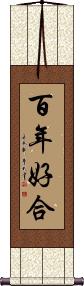
百年好合 is a wish or greeting, often heard at Chinese weddings, for a couple to have 100 good years together.
Some will translate this more naturally into English as: “May you live a long and happy life together.”
The character breakdown:
百 = 100
年 = Years
好 = Good (Happy)
合 = Together
Even a fool may sometimes come up with a good idea
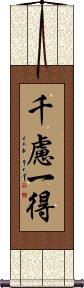
千慮一得 means “1000 tries, one success,” or “[a] thousand tries [leads to] one success.”
This proverb is a humble way to express your success, ideas, or accomplishments. As if you are a fool who just got lucky in inventing or creating something.
Translations for this proverb include:
Even without any notable ability on my part, I may still get it right sometimes by good luck.
Even a fool may sometimes come up with a good idea.
Compare this to the English idiom, “Even a broken clock is right twice a day.”
Optimism / Happy With Your Fate
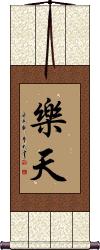
樂天 is about being optimistic and also making the best of whatever life throws at you.
This is hard to define. One dictionary defines this as “acceptance of fate and happy about it.” There is one English word equivalent, which is sanguinity or sanguinary.
You can also say that this means “Be happy with whatever Heaven provides,” or “Find happiness in whatever fate Heaven bestows upon you.” 樂天 suggests being an optimist in life.
Note: This is sometimes a given name in China.
 Please note that Japanese tend to write the first character in a slightly-different form (as seen to the right). Let us know if you have a preference when you place your order.
Massage
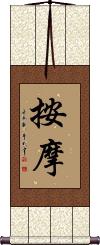
按摩 is a very common word for massage in China, Japan, and Korea.
In many cases, and perhaps traditionally, this is a massage performed by a blind person. However, in modern times, this is a very generic term for any kind of massage. This can range from a massage for health from a blind masseur or masseuse, a proper deep tissue massage by a professional masseuse, or an illicit massage with a “happy ending.”
Be Happy
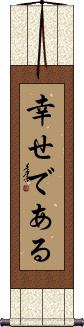
幸せである is a way to express the idea of “be happy” in Japanese.
Japanese grammar is far different than English, so the word order is the opposite of English. If you translated directly, you'd have something like “Happiness henceforth” or “Happiness hereafter.” The idea is to be happy from this moment on.
Note: Because this selection contains some special Japanese Hiragana characters, it should be written by a Japanese calligrapher.
Beauty / Beautiful Princess
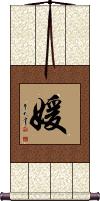
媛 means, a beauty; beautiful (woman); princess; a young lady of noble birth; girl; small & lovely.
媛 is used a bit more commonly in Chinese than in Japanese.
Note: This can be the female given name "Hime" in Japanese.
Better to be Happy than Rich
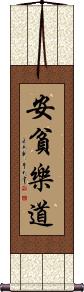
安貧樂道 means “It's better to be happy than rich” in Chinese.
Even if you are poor, you should still feel satisfied in your life...
...Satisfaction, happiness and the meaning of your life come from within yourself and not from money or riches of the world.
In Chinese, there are a lot of four-character proverbs which express some very old philosophies.
Though there are only four characters on this scroll, in Chinese, the meanings often surpass the dictionary definition of each character.
In this case, you should not set your expectations too high for the money or riches you wish to have. One who sets their expectations too high is almost always disappointed. Instead, you should cherish what you have, seek to improve yourself from within, and not measure your worth by the size of your bank account.
Birth / Life
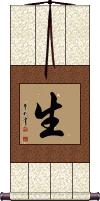
生 is a Chinese word that means “to be born” and “to give birth.”
Also, it's often used to refer to life itself, and sometimes “to grow.”
生 is used in a lot of compound words such as “yi sheng,” which means “doctor” (literally “healer of life”), “sheng ri” which means “birthday” (literally “birth-day”), and “xue sheng” which means student (literally “studying life” or “learner [about] life”). Few Chinese people will think of the literal meaning when this uses words like doctor and student - but it is interesting to note.
生 has the same root meaning in Korean Hanja and Japanese. However, in Japanese, there are many possible pronunciations, and this can be used to mean “raw” or “unprocessed” (as in draft beer). Therefore, not be the best if your audience is Japanese.
See Also: Vitality
Bonsai / Penzai
Dwarf Tree Culture
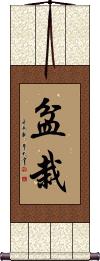
盆栽 is the word that refers to the culture, hobby, and to miniature trees themselves that have become popular around the world.
Like many things, this art migrated from China to Japan some time ago, but we tend to associate it with Japanese culture and even use the Japanese word in English.
Granted, in the present day, this hobby seems to be more popular in Japan but still has a great following in China and even a little in Korea as well.
Note: Many people confuse the title of the bonsai tree with “banzai” which is a form of “hooray” in Japanese. I have also seen it misspelled as “bansai.” The correct Romanization (Romaji) is “bonsai.”
Broken Mirror Rejoined
Used in modern times for divorced couples that come back together
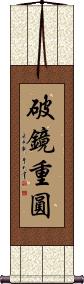
破鏡重圓 is about a husband and wife who were separated and reunited.
About 1500 years ago in China, there lived a beautiful princess named Le Chang. She and her husband Xu De Yan loved each other very much. But when the army of the Sui Dynasty was about to attack their kingdom, disposed of all of their worldly possessions and prepared to flee into exile.
They knew that in the chaos, they might lose track of each other, so the one possession they kept was a bronze mirror which is a symbol of unity for a husband and wife. They broke the mirror into two pieces, and each of them kept half of the mirror. They decided that if separated, they would try to meet at the fair during the 15th day of the first lunar month (which is the lantern festival). Unfortunately, the occupation was brutal, and the princess was forced to become the mistress of the new commissioner of the territory, Yang Su.
At the Lantern Festival the next year, the husband came to the fair to search for his wife. He carried with him his half of the mirror. As he walked through the fair, he saw the other half of the mirror for sale at a junk market by a servant of the commissioner. The husband recognized his wife's half of the mirror immediately, and tears rolled down his face as he was told by the servant about the bitter and loveless life that the princess had endured.
As his tears dripped onto the mirror, the husband scratched a poem into his wife's half of the mirror:
You left me with the severed mirror,
The mirror has returned, but absent are you,
As I gaze in the mirror, I seek your face,
I see the moon, but as for you, I see not a trace.
The servant brought the inscribed half of the mirror back to the princess. For many days, the princess could not stop crying when she found that her husband was alive and still loved her.
Commissioner Yang Su, becoming aware of this saga, realized that he could never obtain the princess's love. He sent for the husband and allowed them to reunite.
This proverb, 破鏡重圓, is now used to describe a couple who has been torn apart for some reason (usually divorce) but have come back together (or remarried).
It seems to be more common these days in America for divorced couples to reconcile and get married to each other again. This will be a great gift if you know someone who is about to remarry their ex.
Happy Buddha
Buddha of Joyful Light
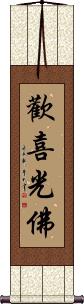
This title is Buddha of Joyful Light.
歡喜光佛 is Amitābha from Sanskrit but pronounced very differently in Chinese and Japanese.
Carpe Diem / Seize the Day
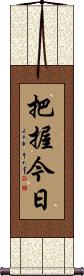
把握今日 is the closest and most natural way to express this proverb in Chinese.
The first two characters mean “to seize” but can also be translated as “take control of.”
The last two characters mean “today.”
Compassionate Heart / Benevolent Heart
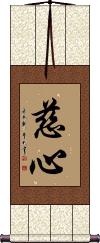
慈心 means “Compassionate Heart” or “Benevolent Heart.”
It's used in day-to-day speech to refer to someone who has the traits of benevolence, mercy, and compassion for their fellow humans.
This title is also used in Buddhism with the same profound meaning.
Confucius
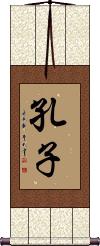
孔子 is how to write the name of the great sage, known in the West as Confucius.
His real name is Kongzi (The name Confucius is a westernized version of his name - his family name is Kong, and “zi” was added as a title of distinction).
He lived some 2500 years ago in Qufu, a town in modern-day Shandong Province of Northern China (about 6 hours south of Beijing by bus). He was a consort to Emperors, and after his death, the impact of his philosophies still served to advise emperors, officials, and common people for generations.
Also during these thousands of years, the Kong family remained powerful in China, and the Kong estate was much like the Vatican in Rome. The Kong estate existed as if on sovereign ground with its own small garrison of guards and the privileges of a kingdom within an empire.
This was true up until the time the Kong family had to flee to Taiwan in 1949 when the Red Army took victory over the Nationalists during the Revolution. The home of Confucius was later razed and all statues were defaced or stolen during the Cultural Revolution. Finally, after years of smearing his name and image, it is once again okay to celebrate the teachings of Confucius in mainland China.
Known as Khổng Tử in Vietnamese.
Cooperation / Collaboration
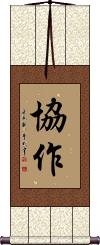
協作 is a Chinese, Japanese, and old Korean word that means cooperation or collaboration.
Cooperation is working together and sharing the load. When we cooperate, we join with others to do things that cannot be done alone. We are willing to follow the rules which keep everyone safe and happy. Together we can accomplish great things.
The first character means “united” or “to coordinate.” The second character means “to do,” “to make,” or “to compose.” Knowing this, you can understand why together, these characters create a word that can be defined as “cooperation” in Chinese, Japanese, and Korean.
It is implied that you are cooperating to create some project or product.
See Also: Partnership
The Law of Creation and Destruction
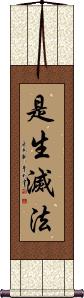
是生滅法 is a Buddhist term for “the law of arising and ceasing,” or, “the law of creation and destruction.”
Everything has a beginning and an end, birth and death, etc. All things follow this law.
Give Up Desire
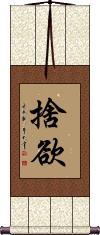
捨欲 is a Buddhist term that means to give up desire or the act of cutting off desire.
In Buddhism, our attachments, greed, and/or desires are the root of our suffering. Release them and live a happy life!
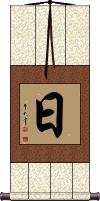
This is how to write “day” in Chinese, Japanese, and Korean Hanja.
This can also mean “Sun,” the star in the middle of the Solar system in which we live. In Japanese, it can also mean “sunshine” or even “Sunday.”
When writing the date in modern Chinese and Japanese, putting a number in front of this character indicates the day of the month. Of course, you need to indicate the month too... The month is expressed with a number followed by the character for the moon. So “three moons ten suns” would be “March 10th” or “3/10.”
Note: This is also the first character for the proper name of Japan. Remember that Japan is “The land of the rising sun”? Well, the first character for Japan means “sun” and the second means “origin” so you get the real meaning now. Sometimes, in China, this sun character can be a short name for Japan or a suffix for something of or from Japan.
Doctor
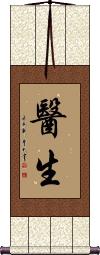
醫生 is the title used to refer to medical doctors or physicians in China.
Note: Sometimes, this same term is used in Korean, but not common.
The meaning is close to “healer [of] life” as the first character, 醫, can mean medicine, the healing art, healing, curing, medical, to cure, or to treat. The second character, 生, means birth or life.

 In Japan, they use a simplified version of the first character (医生 is also used as the Simplified Chinese version of Doctor). If you want this version, please click the characters to the right instead of the button above.
Don't Worry, Be Happy
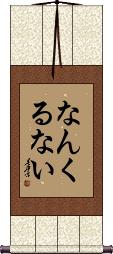
なんくるない or nankurunai is an Okinawan word, written in Japanese that means “Don't worry, be happy.”
沖縄/Okinawa and/or the 琉球/Ryūkyū Islands have a more laid-back “island style” approach to life. So the nankurunai idea is a perfect match for that lifestyle.
Note: Because this title is entirely Japanese Hiragana, it should be written by a Japanese calligrapher.
Diligent Study Proverb
Drill a hole in the wall to get light to read by.
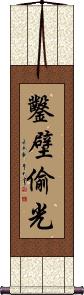
鑿壁偷光 is a Chinese proverb that means “Bore a hole in the wall to make use of the neighbor's light to study.”
This is a nice gift for a very studious person.
Kuang Heng was born during the Western Han period. He has been very fond of reading ever since he was young. However, he could not attend school since his family was poor, and he had to borrow books from people to learn.
To borrow these books, he normally did chores for people who had them. When he became older, he had to work in the field from sunrise to sunset since his family's financial situation did not improve. Thus, he tried to study at night, but he had no lamp.
One day, he noticed the light from the neighbor's house coming through a crack in the wall. This made him very happy, so he dug a larger hole from the crack and read in the light that shone through. This diligent study eventually made him an accomplished person.
Enthusiasm
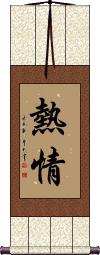
熱情 is a Chinese and Korean word for enthusiasm that can also be translated as passion (for a cause), ardency, ardor/ardour, enthusiasm, or zeal.
Enthusiasm is being warm, cheerful, happy, and full of spirit. It is doing something wholeheartedly and eagerly. When you are enthusiastic, you have a positive attitude.
In some contexts, this could mean being extremely fond of something or having a fondness for a cause or person.
This Chinese word can also be translated as "sincere and warm" or literally "warm sentiment / affection."
See Also: Motivation | Passion | Commitment | Tenacity
Eternal Happiness
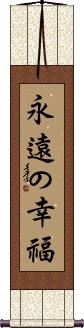
永遠の幸福 means “eternal happiness” in Japanese.
永遠 means eternal, eternity, perpetuity, forever, immortality, and permanence.
の is a possessive article which sort of makes this selection mean “happiness, of the eternal kind.”
幸福 means happiness, though this word can be translated as truly blessed, joy, happy, welfare, well-being, or fortunate.
Learning is Eternal
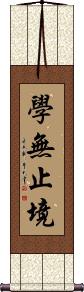
This Chinese philosophy tells of how we continue to learn throughout our lives.
This proverb can be translated in a few ways such as “Study has no end,” “Knowledge is infinite,” “No end to learning,” “There's always something new to study,” or “You live and learn.”
The deeper meaning: Even when we finish school we are still students of the world gaining more knowledge from our surroundings with each passing day.
See Also: An Open Book Benefits Your Mind | Wisdom | Learn From Wisdom
Eternal Happiness
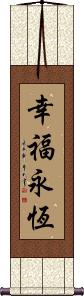
幸福永恆 is a short way to say eternal happiness in Chinese.
Breaking down the parts:
幸福 means happiness, happy, blessed, blessedness, joy, and/or well-being.
永恆 means eternal, everlasting, and/or forever.
Another way to write this is 永恆的幸福. It reverses the word order and adds a possessive article. I prefer the shorter version, which is slightly more natural in Chinese.
Everyday Life
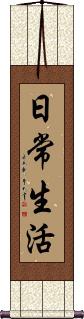
日常生活 simply means everyday life or regular life.
You can also translate it as “Living day to day.”
Fast
Fast, as in a race car
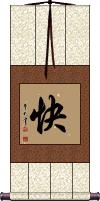
快 is the single character for “fast” in Chinese.
This applies to race cars, airplanes, rockets, etc.
This can also mean rapid, quick, speed, rate, soon, to make haste, clever, or sharp (of knives or wits). In some context it can mean cheerful or happy.
This is not a common choice for a wall scroll but if you're a speed freak, this may work for you.
Note: In Japanese, this usually has a meaning of pleasure, cheerful, delight, enjoyment, or the female given name Yoshi.
The one who retreats 50 paces mocks the one to retreats 100
The pot calls the kettle black
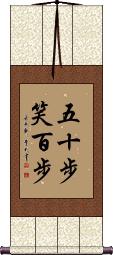
五十步笑百步 is a Chinese proverb that means the one who retreats 50 paces mocks the one who retreats 100 paces.
During the Warring States Period of what is now China (475 - 221 B.C.), the King of Wei was in love with war. He often fought with other kingdoms just for spite or fun.
One day, the King of Wei asked the philosopher Mencius, “I love my people, and all say I do the best for them. I move the people from famine-stricken areas to places of plenty and transport grains from rich areas to the poor. Nobody goes hungry in my kingdom, and I treat my people far better than other kings. But why does the population of my kingdom not increase, and why does the population of other kingdoms not decrease?”
Mencius answered, “Since you love war, I will make this example: When going to war, and the drums beat to start the attack, some soldiers flee for their lives in fear. Some run 100 paces in retreat, and others run 50 steps. Then the ones who retreated 50 paces laugh and taunt those who retreated 100 paces, calling them cowards mortally afraid of death. Do you think this is reasonable?
The King of Wei answered, “Of course not! Those who run 50 paces are just as timid as those who run 100 paces.”
Mencius then said, “You are a king who treats his subjects better than other kings treat their people, but you are so fond of war that your people suffer from great losses in battle. Therefore, your population does not grow. While other kings allow their people to starve to death, you send your people to die in war. Is there any difference?”
This famous conversation led to the six-character proverb shown here. It serves as a warning to avoid hypocrisy. It goes hand-in-hand with the western phrase, “The pot calls the kettle black,” or the Biblical phrase, “Before trying to remove a splinter from your neighbor's eye, first remove the plank from your own eye.”
Fire Horse
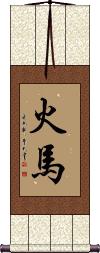
火馬 is the title, “Fire Horse.”
火馬 is not a common title for calligraphy. You might be looking for 丙午, the 43rd year of the sexagenary cycle (the year of the Fire Horse, renowned for disasters and the birth of women destined to kill their husbands).
Always Be Prepared
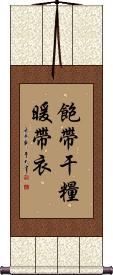
饱带干粮暖带衣 is a proverb that translates as:
Carry [extra] food when [you are] full and [extra] clothes when [you are] warm.
Figuratively, this means:
Always be prepared for a rainy day.
From This Moment Forward / From This Day Forward
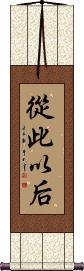
In simple terms, 從此以后 means “from now on,” but you can also interpret it as “Now is the beginning of the future” or “From this day forward.
The first two characters roughly mean “henceforth.” The last two characters mean later, afterward, following, or “in the future.”
50th Golden Wedding Anniversary
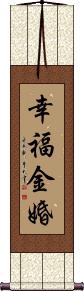
幸福金婚 means “Happy Golden Anniversary” and is a great gift for a couple who is celebrating 50 years together.
The first two characters mean happy, blessed, or happiness.
The last two characters mean “couple's golden anniversary.” It means “golden wedding” or “golden marriage,” but this is only used for the 50-year-mark of a marriage (the same way we use gold to represent 50 years in the west).
幸福金婚 is a nice title to use with an inscription. You could request something like, “Happy 50th Anniversary, Mr. and Mrs. Smith,” to be written down the side of this title in smaller Chinese characters.
Please note: This can be pronounced and understood in Japanese but not as commonly used in Japan. Japanese people who read this will understand it but might tend to feel it’s of Chinese origin.
One Good Deed Each Day
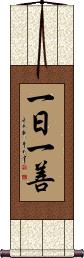
一日一善 is a Chinese, Japanese Kanji, and old Korean Hanja phrase that suggests doing a good deed each day or doing one good turn a day.
It literally reads, “One Day, One Good (Deed).”
Good Good Study, Day Day Up
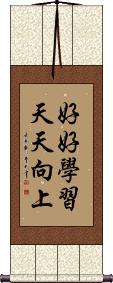
好好學習天天向上 is a famous proverb by Chairman Mao Zedong that sounds really strange when directly translated into English.
I include it in our database of phrases to illustrate how different the construction and grammar can be between Chinese and English. The direct translation is “Good Good Study, Day Day Up.” In Chinese, a repeated character/word can often serve to reinforce the idea (like saying “very” or suggesting “a lot of”). So “good good” really means “a lot of good.” While “day day” can be better translated as “day in day out.” The idea of “up” has a meaning in China of “rising above” or “improving.”
After understanding all of this, we come up with a slightly better translation of “With a lot of good study, day in and day out, we raise above.”
The more natural translation of this proverb would be something like, “study hard, and keep improving.”
Grace from Heaven / Grace from God
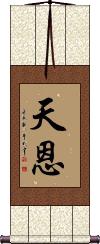
天恩 is the deepest way to say “Heaven's Grace” or “God's Grace” in Chinese.
The first character means Heaven or sky (referring, in this case, to the domain of God).
The second character means grace, blessings, benevolence, favor/favour, acts of kindness, merits, or beneficial influence.
This title can also be defined as:
Blessings of Heaven, Favor of the Emperor, Divination's luckiest day, or blessings of nature. Note: When you see “Emperor” above, remember that the Emperor, like the Pope, is theoretically chosen by God or seen as an emissary or conduit of God in ancient Asian culture. It would only be read that way in a certain context, such as “The Emperor, in his mercy, bestowed upon him Heaven's Grace, and the prisoner was set free.”
Note: Technically, this is a Japanese word too (pronounced "ten-on") but it’s rarely used in Japan anymore. Therefore, this title is best if your audience is Chinese.
Guan Yu
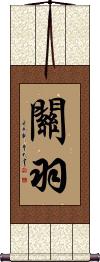
關羽 is the name Guan Yu, Army General for the Kingdom of Shu.
He is also known as Guan Gong (like saying Duke Guan or Sir Guan)
He was immortalized in the novel, “Romance of the Three Kingdoms.”
He was a fearsome fighter, also famous for his virtue and loyalty. He is worshiped by some modern-day soldiers and has the title “Warrior Saint” in China. Some believe he offers safety and protection for military servicemen.
Guan Yu lived until 219 A.D.
Happy / Laughter / Cheerful Bliss
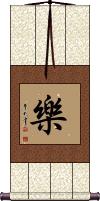
樂 is a single-character form of happiness or bliss that holds the ideas of laughing and having a good time.
This can also be translated as happy, glad, enjoyable, fun, and sometimes, music.
This a really good character if your audience is Chinese.
This is not a word seen alone very often in Korean.
In Japanese, this character is written like the image shown to the right. If you order this from the Japanese master calligrapher, it will look like this instead of the character shown above.
Note: In Japanese, this has a meaning of comfort, ease, and enjoyment.
See Also: Joyfulness
Happiness / Contentment
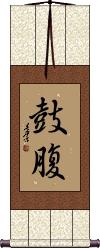
鼓腹 means happiness and contentment in Japanese Kanji.
The first Kanji represents your internal beat or drum.
The second Kanji represents your mind and body.
Together, it suggests that your internal rhythm or beat is regular, soothing, and at the proper tempo.
See Also: Satisfaction | Pleasure | Well-Being
Happiness / Fortune / Lucky
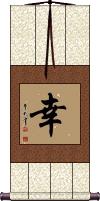
幸 can mean happiness, good fortune, good luck, and in the old days, good harvest or bounty.
Note: From Japanese, this character is sometimes romanized as “sachi,” and is often pronounced “kou” or sometimes “rei” when used in compound words with other Kanji.
Happiness / Contentment
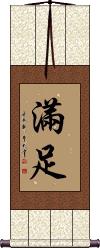
滿足 is the kind of happiness that involves being satisfied and content.
This can also suggest the actions of “to satisfy,” and “to meet the needs of.”
Other single-word definitions include satisfaction, contentment, sufficient, enough, adequate, full, or complete.
 In Japanese, the Kanji for this word is an alternate Chinese form. You can see and select this version at the right (recommended only if your audience is specifically Japanese).
See Also: Satisfaction | Contentment | Pleasure | Well-Being
Double Happiness
(Happy wedding and marriage)
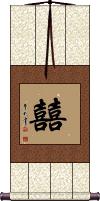
囍 is a common gift for Chinese couples getting married or newly married couples.
As we say in the west, “Two heads are better than one” Well, in the east, two “happinesses” are certainly better than one.
Some will suggest this is a symbol of two happinesses coming together. Others see it as a multiplication of happiness because of the union or marriage.
囍 is not really a character that is pronounced very often - it's almost exclusively used in written form. However, if pressed, most Chinese people will pronounce this “shuang xi” (double happy) although literally there are two “xi” characters combined in this calligraphy (but nobody will say “xi xi”).
 If you select this character, I strongly suggest the festive bright red paper for your calligraphy. Part of my suggestion comes from the fact that red is a good luck color in China, and this will add to the sentiment that you wish to convey with this scroll to the happy couple.
Happiness / Joyful / Joy
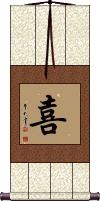
喜 is the Chinese, Japanese Kanji, and Korean Hanja for the kind of happiness known in the west as “joy.”
喜 can also be translated as rejoice, enjoyment, delighted, pleased, or “take pleasure in.” Sometimes it can mean “to be fond of” (in a certain context).
If you write two of these happiness/joy characters side by side, you create another character known in English as “double happiness,” which is a symbol associated with weddings and happy marriages.
There is another version of this character that you will find on our website with an additional radical on the left side (exactly same meaning, just an alternate form). The version of happiness shown here is the commonly written form in China, Japan and South Korea (banned in North Korea).
See Also: Contentment | Happiness | Joy
Happiness
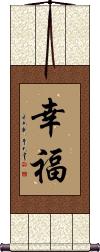
幸福 is a general state of happiness that can also be translated as truly blessed, welfare, well-being, or fortunate.
Happy Birthday
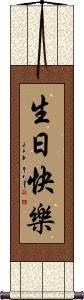
生日快樂 is how to write “Happy Birthday” in Chinese.
The first two characters mean “birthday,” and the second two characters mean “happiness,” or rather a wish for happiness.
Because a birthday only lasts one day per year, we strongly suggest that you find an appropriate and personal calligraphy gift that can be hung in the recipient's home year-round.
Happy Birthday
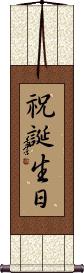
祝誕生日 is the shortest way to write “Happy Birthday” in Japanese.
The first Kanji means “wish” or “express good wishes,” and the last three characters mean “birthday.”
Because a birthday only lasts one day per year, we strongly suggest that you find an appropriate and personal calligraphy gift that can be hung in the recipient's home year-round.
Happy Birthday
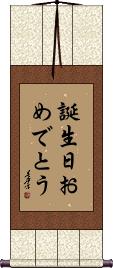
誕生日おめでとう is a verbose way to write “Happy Birthday” in Japanese.
The first part says “birthday” and the last 5 Kanji mean “congratulations.”
Note: Because this selection contains some special Japanese Hiragana characters, it should be written by a Japanese calligrapher.
Happy Family
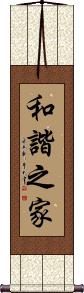
和諧之家 means “harmonious family” or “happy family” in Chinese.
The first two characters relay the idea of happiness and harmony.
The third character is a connecting or possessive article (connects harmony/happiness to family).
The last character means family but can also mean home or household.
Happy Family
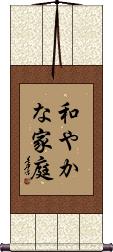
和やかな家庭 means “happy family” or “harmonious family” in Japanese.
The first three Kanji create a word that means mild, calm, gentle, quiet, or harmonious. After that is a connecting article. The last two Kanji mean family, home, or household.
Note: Because this selection contains some special Japanese Hiragana characters, it should be written by a Japanese calligrapher.
Happy Laughter
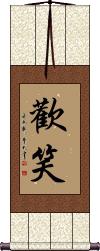
歡笑 translates as “happy laughter.”
The first character means happy or happiness.
The second character means to laugh, laughter or smile.
Happy Marriage
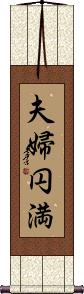
夫婦円満 is a Japanese title that means matrimonial happiness or happy marriage.
If you translate this, you get, “Husband-wife circle complete.”
Happy New Year
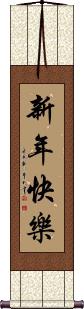
If you want to wish someone a happy new year, 新年快樂 is the way.
You can hang this up during Western New Years (Dec 31st - Jan 1st) and keep it up until after Chinese New Year which happens in either January or February of each year (it changes from year to year because China uses a lunar calendar).
Perfect Harmony
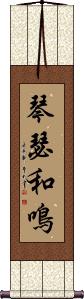
琴瑟和鳴 is a Chinese title that means “in perfect harmony” or “in sync.”
This can translate as “two harps in harmony.” While this more literally means “qin [and] se harmonious sound.”
The qin and se are both types of string instruments (Chinese zithers) that are known to play in perfect harmony. Thus, the two together are often used as a metaphor for marital harmony or a happy marriage.
Heaven
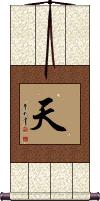
天 means “heaven” or “sky” in Chinese, Japanese Kanji, and old Korean Hanja.
The context determines if you are talking about heaven or the sky above (often they are the same concept).
When combined with other characters, words like “today” and “tomorrow” are created. While sometimes the character for “sun” is used to mean “day,” often “sky” represents “day” in Asian languages.
Example: 今天 (this sky) = “today,” 明天 (next sky) = “tomorrow” in modern Chinese and Japanese.
In Chinese culture, regardless of which religion, it's almost always assumed that God (and any other deities) live up above the sky. The concept of God living in the sky is likely the reason heaven is associated with this character.
The equation goes something like this: God's domain is the sky, thus, the sky is heaven.
Note: As a single character, this is a little ambiguous, so you might want to choose our Kingdom of Heaven selection instead.
Hello / Ni Hao
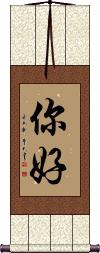
你好 is the day-to-day way to say hello in Chinese.
The characters literally mean, “You good?” It's the equivalent of “What's up?” in English, where nobody expects an actual answer.
This explanation is here for educational purposes only. 你好 is an oral word that is not appropriate for a scroll (not a bad meaning, just very odd for a wall scroll).
No Place Like Home
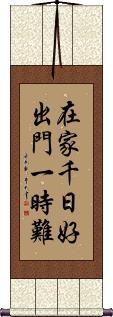
在家千日好出门一时难 is a Chinese proverb that literally means “At home, one can spend a thousand days in comfort but spending a day away from home can be challenging.”
Figuratively, this means “There's no place like home,” or roughly a Chinese version of “Home sweet home.”
The Whole Room Rocks With Laughter
The perfect scroll if you love humor or as a gift for the comedian in your life
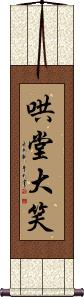
In China, 哄堂大笑 is a proverb that is used in response to a good joke or witty comment.
The story goes that Mr. Feng and Mr. He were both senior officials in the Song Dynasty (about a thousand years ago). One day, Mr. Feng walked into their shared office wearing a new pair of boots. The boots caught the eye of Mr. He who said, “New boots! - how much were they?.” Mr. Feng lifted one of the boots off the ground as if to show it off and responded, “900 coins.”
Astonished, Mr. Feng explained, “900? How can that be? - I paid 1800 coins for my boots!.” Mr. Feng then lifted his other foot off the ground and said, “This boot was also 900 coins.”
It is said that the whole room was shaking from the laughter of all that heard Mr. Feng's joke on Mr. He.
Jackie Chan
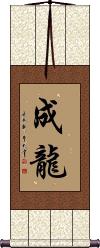
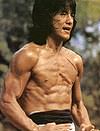 成龍 is the Chinese and Japanese stage name of Jackie Chan, a Kung Fu film and Cantonese pop star icon.
His birth name was 陳港生 (romanized as Chan Kong-sang or Can Gong-sang in Cantonese, or Chén Gǎng-shēng in Mandarin.
Jesus is My Life
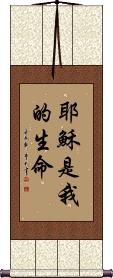
耶穌是我的生命 means Jesus is my life in Chinese.
The first two characters are a transliteration of the name Jesus into Mandarin Chinese.
The third character means, is.
The fourth and fifth mean my or mine.
The last two characters mean life, as in lifespan, or from birth to death.
This is not a common phrase for Chinese Christians, but this is the best way to translate this idea from English to Mandarin Chinese.
Joyful
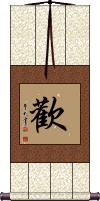
歡 means joyous, happy, delightful, and pleased.
歡 represents external happiness that may have you clapping and cheering.
Please note: The other happiness/joyful which looks like "喜" is more popular.
歡 is the ancient/old version in China and Japan. After WWII in Japan, they started using 歓. Just let us know if you want this modern version instead of the ancient one.
See Also: Happiness
Happy
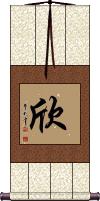
欣 is the type of happiness that you feel on the inside. It is the feeling of being released and delighted as well as being in a state of contentment. 欣 is more the internal happiness that perhaps only shows by the smile on your face. It can also be translated as “to take pleasure in” or “to rejoice.”
Note: 欣 is often used in compound words - especially in Korean Hanja.
As Japanese Kanji, this is so rare, that most Japanese people are not aware of its existence.
See Also: Happiness
Joyfulness / Happiness
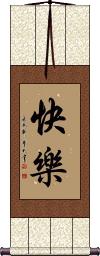
快樂 or joyfulness is an inner sense of peace and happiness.
You appreciate the gifts each day brings. Without joyfulness, when the fun stops, our happiness stops. Joy can carry us through hard times even when we are feeling very sad.
快樂 can also mean pleasure, enjoyment, delight, cheerfulness, or merry. In some ways, this is the essence that makes someone perceived as a charming person.
See Also: Happiness
Happy / Open Heart

In mordern times, 開心 means to feel happy, to rejoice, or to have a great time, but directly translates as open heart.
In the Buddhist context, beyond opening the heart, it can mean to develop the mind, to initiate into truth, or awaken the mind.
開 = Open.
心 = Heart/Mind.
Not commonly used in Japanese where it might be read as open-mindeness.
Konichiwa
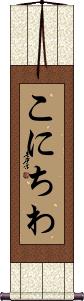
This colloquial Japanese greeting means hello, or good day.
こにちわ is the common greeting for daytime or afternoon (after morning, before the sun sets).
Note: Because this title is entirely Japanese Hiragana, it should be written by a Japanese calligrapher.
Life Force
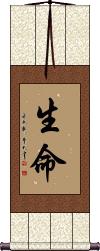
This Chinese, Korean and Japanese word means “life force” or simply “life.”
The first character means “life” or “birth.” The second means “life” or “fate.” Together they create the meaning of “life force,” though some will translate this as “existence” and sometimes “vitality.”
A Life of Happiness and Prosperity
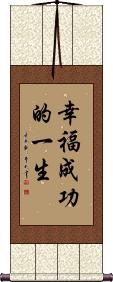
幸福成功的一生 means “A life of happiness and prosperity” or “A life of happiness and success.”
It's a very positive and inspirational wall scroll selection.
See Also: Prosperity
A Life of Happiness and Prosperity
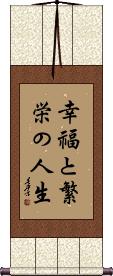
幸福と繁栄の人生 is a Japanese proverb that means “A life of happiness and prosperity” or “A life of happiness and success.”
Note: Because this selection contains some special Japanese Hiragana characters, it should be written by a Japanese calligrapher.
See Also: Prosperity
Life Energy / Spiritual Energy
Chi Energy: Essence of Life / Energy Flow
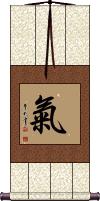
This 氣 energy flow is a fundamental concept of traditional Asian culture.
氣 is romanized as “Qi” or “Chi” in Chinese, “Gi” in Korean, and “Ki” in Japanese.
Chi is believed to be part of everything that exists, as in “life force” or “spiritual energy.” It is most often translated as “energy flow” or literally as “air” or “breath.” Some people will simply translate this as “spirit,” but you must consider the kind of spirit we're talking about. I think this is weighted more toward energy than spirit.
The character itself is a representation of steam (or breath) rising from rice. To clarify, the character for rice looks like this: 
Steam was apparently seen as visual evidence of the release of “life energy” when this concept was first developed. The Qi / Chi / Ki character is still used in compound words to mean steam or vapor.
The etymology of this character is a bit complicated. It's suggested that the first form of this character from bronze script (about 2500 years ago) looked like these samples: 

However, it was easy to confuse this with the character for the number three. So the rice radical was added by 221 B.C. (the exact time of this change is debated). This first version with the rice radical looks like this: 
The idea of Qi / Chi / Ki is really a philosophical concept. It's often used to refer to the “flow” of metaphysical energy that sustains living beings. Yet there is much debate that has continued for thousands of years as to whether Qi / Chi / Ki is pure energy or consists partially or fully of matter.
You can also see the character for Qi / Chi / Ki in common compound words such as Tai Chi / Tai Qi, Aikido, Reiki, and Qi Gong / Chi Kung.
In the modern Japanese Kanji, the rice radical has been changed into two strokes that form an X.
 The original and traditional Chinese form is still understood in Japanese, but we can also offer that modern Kanji form in our custom calligraphy. If you want this Japanese Kanji, please click on the character to the right instead of the “Select and Customize” button above.
More language notes: This is pronounced like “chee” in Mandarin Chinese, and like “key” in Japanese.
This is also the same way to write this in Korean Hanja where it is Romanized as “gi” and pronounced like “gee” but with a real G-sound, not a J-sound.
Though Vietnamese no longer use Chinese characters in their daily language, this character is still widely known in Vietnam.
See Also: Energy | Life Force | Vitality | Life | Birth | Soul
Life is Fun
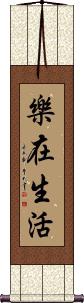
This means “life is fun” in Chinese.
樂 means fun, happy, or in some contexts, joyful music.
在 means at/is.
生活 means life or living.
Live For The Day
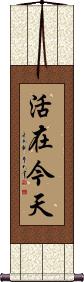
活在今天 is not an eastern concept, so it does not translate into a phrase that seems natural on a wall scroll.
However, if this is your philosophy, the characters shown here do capture your idea of living for today or living in the moment. 活在今天 says “Live in today,” and they are grammatically correct in Chinese.
Note: This kind of makes sense in Korean Hanja but the grammar is Chinese, so it’s not that natural in Korean.
Live For The Day / Seize The Day
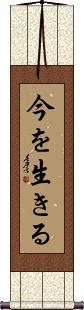
今を生きる is a Japanese phrase that can be translated as “live for the day,” “live for the moment,” “seize the day,” or “make the most of the present.”
You can think of this as the Japanese version of “Carpe Diem.”
Note: Because this selection contains some special Japanese Hiragana characters, it should be written by a Japanese calligrapher.
Live In The Moment / Live In The Now
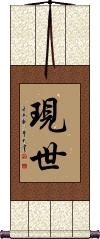
現世 is a very short way to write “live in the moment” or “live in the now” in Japanese.
This short word is open to interpretation. It's used in Japanese Buddhism to mean “the current epoch” or “the current age” (the current age is but a brief moment in the greater scope of existence). In that context, this is pronounced “utsushiyo” or “ustusiyo” in Japanese. Otherwise, it's pronounced “gensei” in Japanese.
Other translation possibilities include:
Earthly world
This world
This life
Present life
Present generation
Present incarnation
This existence
This (momentary) reality
Note: This is also a word in Chinese and old Korean Hanja. While the meaning is more or less the same, this is not recommended for a wall scroll if your audience is Chinese or Korean. This selection is best if your audience is Japanese.
Love
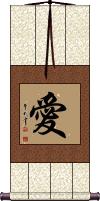
愛 universally means love in Chinese, Japanese Kanji, old Korean Hanja, and old Vietnamese.
愛 is one of the most recognized Asian symbols in the West and is often seen on tee shirts, coffee mugs, tattoos, and more.
愛 can also be defined as affection, to be fond of, to like, or to be keen on. It often refers to romantic love, and is found in phrases like, “I love you.” But in Chinese, one can say, “I love that movie” using this character as well.
This can also be a pet name or part of a pet name in the way we say “dear” or “honey” in English.
This can be a girl’s name “Ai” in both Chinese and Japanese.
More about this character:
This may be hard to imagine as a westerner but the strokes at the top of this love character symbolize family & marriage.
 The symbol in the middle is a little easier to identify. It is the character for "heart" (it can also mean "mind" or "soul"). I guess you can say that no matter if you are from the East or the West, you must put your heart into your love.
 The strokes at the bottom create a modified character that means "friend" or "friendship."
I suppose you could say that the full meaning of this love character is to love your family, spouse, and friends with all of your heart, since all three elements exist in this character.
See Also: I Love You | Caring | Benevolence | Friendliness | Double Happiness Happy Marriage Wall Scroll
Love Life
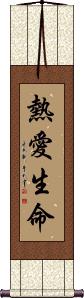
熱愛生命 is the Chinese phrase for “Love Life” or “Love of Life.”
If you love your life or want a reminder on your wall to keep you loving your life each day, this is the selection for you.
To clarify, this is different than “A life full of love,” or “love while you live.” With this phrase, you are loving the state of being alive.
Note: Korean pronunciation is included above, though use of this phrase in Korean has not been verified.
Loyalty to Duty or Master
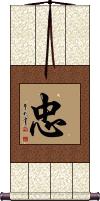
忠 is the simplest way to write the word loyalty in Chinese and Japanese.
A single character like this leaves the meaning open. But alone, a Chinese or Japanese person would think of loyalty to duty or loyalty to one's master (in ancient times). I suppose that it could be loyalty to your boss or company in this day in age.
忠 can also mean fidelity or faithfulness.
This can also be romanized as “chung.”
The Lord's Prayer / Luke 11:2-4
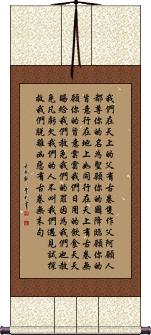
Here is the Lord's Prayer in Chinese from Luke 11:2-4.
The Chinese text with punctuation is:
Part of 11:2 ...我们在天上的父,有古卷只作父阿愿人都尊你的名为圣。愿你的国降临。愿你的旨意行在地上,如同行在天上。有古卷无愿你的旨意云云。
11:3 我们日用的饮食,天天赐给我们。
11:4 赦免我们的罪,因为我们也赦免凡亏欠我们的人。不叫我们遇见试探。救我们脱离凶恶。有古卷无末句。
Note that punctuation is not included in traditional Chinese calligraphy artwork.
From KJV, this is:
Part of 11:2 ...Our Father which art in heaven, Hallowed be thy name. Thy kingdom come. Thy will be done, as in heaven, so in earth.
11:3 Give us day by day our daily bread.
11:4 And forgive us our sins; for we also forgive everyone that is indebted to us. And lead us not into temptation, but deliver us from evil.
Fatherly Master / Sifu / Shi Fu / Shifu
Martial Arts Teacher
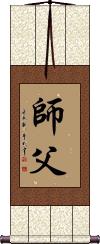
師父 means master in Chinese (occasionally used in Korean Hanja and Japanese). In the context of Martial Arts, this is the master and teacher who instructs students.
The second character by itself means father. Thus, you get the “Fatherly Master” translation. There's an old Chinese saying that goes something like, “One who is your teacher for one day is your father for life.”
Language notes: I've often seen this romanized as “sifu,” this is actually the Cantonese romanization. In Mandarin Chinese, it's “Shifu.” The pronunciation in Mandarin is actually like “sure foo” (using typical English pronunciation). There's an “R-sound” in there, which is not obvious from the romanization. Many martial arts studios incorrectly pronounce this like “she foo” (which is actually the Japanese pronunciation). In Cantonese, it sounds like “Sea foo” (almost like “seafood,” minus the “d” at the end).
師父 is kind of a weird selection for a calligraphy wall scroll; this entry is more for educational purposes. But you are welcome to buy it if it suits your circumstances.
The Lord's Prayer / Mathew 6:9-13
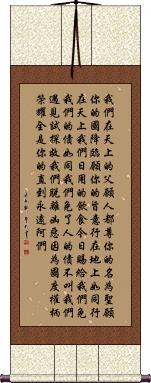
Here is the Lord's Prayer in Chinese from Mathew 6:9-13.
The Chinese text with punctuation is:
Part of 6:9 ...我们在天上的父,愿人都尊你的名为圣。
6:10 愿你的国降临,愿你的旨意行在地上,如同行在天上。
6:11 我们日用的饮食,今日赐给我们。
6:12 免我们的债,如同我们免了人的债。
6:13 不叫我们遇见试探,救我们脱离凶恶,因为国度,权柄,荣耀,全是你的,直到永远,阿们。
Note that punctuation is not included in traditional Chinese calligraphy artwork.
From KJV, this is:
Part of 6:9 ...Our Father which art in heaven, Hallowed be thy name.
6:10 Thy kingdom come. Thy will be done in earth, as it is in heaven.
6:11 Give us this day our daily bread.
6:12 And forgive us our debts, as we forgive our debtors.
6:13 And lead us not into temptation, but deliver us from evil: For thine is the kingdom, and the power, and the glory, forever. Amen.
Fortuitous Meeting
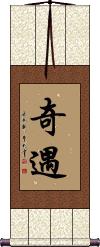
奇遇 can mean happy encounter, fortuitous meeting, adventure, unexpected meeting, or coincidence.
Mencius
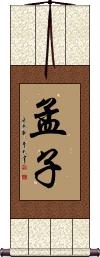
孟子 is the name Mencius in Chinese.
Mencius had the name “Mèng Kē” (孟軻) at birth. This later changed to Mèng Zǐ (孟子). He lived between 372 and 289 BCE.
Mencius was a Chinese Confucian philosopher who has often been referred to as the “Second Sage” following Confucius himself.
For disambiguation, one of the classic books of Confucianism is also titled 孟子.
Romanization of Mencius from Chinese includes Meng Tsu, Mengzi, and his original name Mengke or Meng Ko. In Japanese, he is Mōshi or Moushi.
Gold / Metal
(One of the five elements)
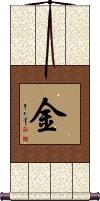
金 is the symbol for metal (often means gold or money) in Chinese, Korean and Japanese.
In an interesting twist, in Japanese, this Kanji can also mean “Friday.” I guess Friday is “the golden day” in Japan.
Gold / Metal is one of the five elements that ancient Chinese believed all things were composed of. These elements are also part of the cycle of Chinese astrology. Every person has both an animal sign, and one of the five elements according to the date of their birth. See also Five Elements and Chinese 12 Animals / Zodiac.
Moon
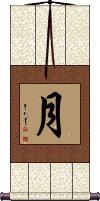
月 is how to write the title for “moon” in Chinese, Korean Hanja, and Japanese Kanji.
月 is also used to refer to the month. This is because China traditionally uses a lunar calendar, so saying “next moon” is the same as saying “next month” etc.
In modern Chinese and Japanese and old Korean, the character for a number is put in front of this moon character to represent western months. So “one moon” is January “two moons” is February etc.
If you are wondering, in the east Asian way to write dates, the character for “sun” or “day” is used with a number in front of it to express the day of the month. So “ten moons, one sun” becomes “October 1st” or “10/1” (this date happens to be Chinese National Day - The equivalent of Independence Day in the USA, Canada Day, or the Queen's Birthday).
In Japanese, 月 can be a surname that romanizes as Tsuki, Tsukizaki, or Takagetsu.
Mountain Travels Poem by Dumu

This poem was written almost 1200 years ago during the Tang dynasty.
It depicts traveling up a place known as Cold Mountain, where some hearty people have built their homes. The traveler is overwhelmed by the beauty of the turning leaves of the maple forest that surrounds him just as night overtakes the day, and darkness prevails. His heart implores him to stop, and take in all of the beauty around him.
First, before you get to the full translation, I must tell you that Chinese poetry is a lot different than what we have in the west. Chinese words simply don't rhyme in the same way that English or other western languages do. Chinese poetry depends on rhythm and a certain beat of repeated numbers of characters.
I have done my best to translate this poem keeping a certain feel of the original poet. But some of the original beauty of the poem in its original Chinese will be lost in translation.
Far away on Cold Mountain, a stone path leads upwards.
Among white clouds, people's homes reside.
Stopping my carriage I must, as to admire the maple forest at nights fall.
In awe of autumn leaves showing more red than even flowers of early spring.
Hopefully, this poem will remind you to stop, and “take it all in” as you travel through life.
The poet's name is “Du Mu” in Chinese that is: 
 .
.
The title of the poem, “Mountain Travels” is: 

You can have the title, poet's name, and even “Tang Dynasty” written as an inscription on your custom wall scroll if you like.
More about the poet:
Dumu lived from 803-852 AD and was a leading Chinese poet during the later part of the Tang dynasty.
He was born in Chang'an, a city in central China and the former capital of the ancient Chinese empire in 221-206 BC. In present-day China, his birthplace is currently known as Xi'an, the home of the Terracotta Soldiers.
He was awarded his Jinshi degree (an exam administered by the emperor's court which leads to becoming an official of the court) at the age of 25 and went on to hold many official positions over the years. However, he never achieved a high rank, apparently because of some disputes between various factions, and his family's criticism of the government. His last post in the court was his appointment to the office of Secretariat Drafter.
During his life, he wrote scores of narrative poems, as well as a commentary on the Art of War and many letters of advice to high officials.
His poems were often very realistic and often depicted everyday life. He wrote poems about everything, from drinking beer in a tavern to weepy poems about lost love.
The thing that strikes you most is the fact even after 1200 years, not much has changed about the beauty of nature, toils, and troubles of love and beer drinking.
Nankurunaisa
Everything will be all right, it will all work out one way or another
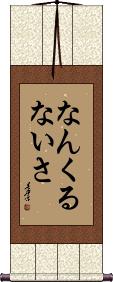
なんくるないさ or Nankurunaisa means “Everything will be all right” and/or “It will all work out one way or another.”
なんくるないさ is an Okinawan (琉球 / Ryūkyū Islands) word written in Japanese.
You might see this romanized with breaks like nankurunai-sa or nankuru-nai-sa. It's the same word either way. However, there is a separate word, なんくるない, in there which is nankurunai, translated as “Don't worry, be happy.” The “sa” or さ part indicates an assertion or interjection.
Note: Because this title is entirely Japanese Hiragana, it should be written by a Japanese calligrapher.
Never Forget Your First Resolution
Never Lose Your Beginner's Spirit
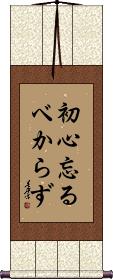
初心忘るべからず is an old Japanese proverb that suggests you try to never forget the enthusiasm you had as a child when you try new things (or even face the day-to-day). Basically, avoid having the mundane attitude that many people get with age.
You'll find this Japanese proverb translated in a few different ways. Here are some of them:
Don't forget your first resolution.
Never forget your childlike enthusiasm.
Forget not the beginner's mind.
Try never to lose your initial enthusiasm (freshness of attitude).
Note: This is sometimes written as 初心忘る可からず. The one shown above is used about 10x more often. There’s only one character difference between the two versions.
Note: Because this selection contains some special Japanese Hiragana characters, it should be written by a Japanese calligrapher.
Better Late Than Never
It's Never Too Late Too Mend
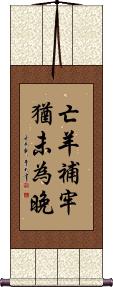
Long ago in what is now China, there were many kingdoms throughout the land. This time period is known as “The Warring States Period” by historians because these kingdoms often did not get along with each other.
Sometime around 279 B.C. the Kingdom of Chu was a large but not particularly powerful kingdom. Part of the reason it lacked power was the fact that the King was surrounded by “yes men” who told him only what he wanted to hear. Many of the King's court officials were corrupt and incompetent which did not help the situation.
The King was not blameless himself, as he started spending much of his time being entertained by his many concubines.
One of the King's ministers, Zhuang Xin, saw problems on the horizon for the Kingdom, and warned the King, “Your Majesty, you are surrounded by people who tell you what you want to hear. They tell you things to make you happy and cause you to ignore important state affairs. If this is allowed to continue, the Kingdom of Chu will surely perish, and fall into ruins.”
This enraged the King who scolded Zhuang Xin for insulting the country and accused him of trying to create resentment among the people. Zhuang Xin explained, “I dare not curse the Kingdom of Chu but I feel that we face great danger in the future because of the current situation.” The King was simply not impressed with Zhuang Xin's words.
Seeing the King's displeasure with him and the King's fondness for his court of corrupt officials, Zhuang Xin asked permission from the King that he may take leave of the Kingdom of Chu, and travel to the State of Zhao to live. The King agreed, and Zhuang Xin left the Kingdom of Chu, perhaps forever.
Five months later, troops from the neighboring Kingdom of Qin invaded Chu, taking a huge tract of land. The King of Chu went into exile, and it appeared that soon, the Kingdom of Chu would no longer exist.
The King of Chu remembered the words of Zhuang Xin and sent some of his men to find him. Immediately, Zhuang Xin returned to meet the King. The first question asked by the King was “What can I do now?”
Zhuang Xin told the King this story:
A shepherd woke one morning to find a sheep missing. Looking at the pen saw a hole in the fence where a wolf had come through to steal one of his sheep. His friends told him that he had best fix the hole at once. But the Shepherd thought since the sheep is already gone, there is no use fixing the hole.
The next morning, another sheep was missing. And the Shepherd realized that he must mend the fence at once. Zhuang Xin then went on to make suggestions about what could be done to reclaim the land lost to the Kingdom of Qin, and reclaim the former glory and integrity of the Kingdom of Chu.
The Chinese idiom shown above came from this reply from Zhuang Xin to the King of Chu almost 2,300 years ago.
It translates roughly into English as...
“Even if you have lost some sheep, it's never too late to mend the fence.”
This proverb, 亡羊补牢犹未为晚, is often used in modern China when suggesting in a hopeful way that someone change their ways, or fix something in their life. It might be used to suggest fixing a marriage, quitting smoking, or getting back on track after taking an unfortunate path in life among other things one might fix in their life.
I suppose in the same way that we might say, “Today is the first day of the rest of your life” in our western cultures to suggest that you can always start anew.
Note: This does have Korean pronunciation but is not a well-known proverb in Korean (only Koreans familiar with ancient Chinese history would know it). Best if your audience is Chinese.
New Beginning
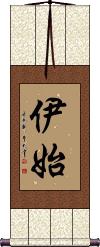
伊始 is a short version of “new beginning” or simply “beginning” in Chinese characters.
You can also translate this as “from this moment on,” “starting now,” or “henceforth.”
In the day-to-day speech, this word can apply to starting a new job, beginning a new career, entering a new chapter of your life, or taking a new position (in politics, scholarship, etc.).
New Life
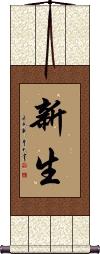
新生 literally means “new life” or “new birth” in Chinese, Japanese Kanji, and old Korean Hanja.
Depending on the context, this word can also mean newborn, new student, rebirth, new birth, or nascent.
In Japanese, this can be the given name Wakaki.
Note: This is not the most common word selection for a calligraphy wall scroll. But if you’re a westerner, you can bend the rules a bit.
Nguyen / Ruan
Surname
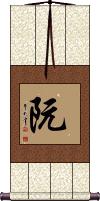
阮 is the original Chinese character that represented the Vietnamese surname Nguyễn before Vietnam stopped using Chinese characters and romanized their language. It is probably the most common surname in all of Vietnam. While romanized as Nguyen, it sounds more like the English word “Win” or “When.” 阮 can also represent the Nguyen Dynasty in Vietnam, which lasted from 1802 to 1945.
阮 is also the Chinese surname Ruan, most Chinese with this surname have ancestors from a small state named Ruan during the Shang Dynasty (1600-1046 BC) located in the southeast of modern-day Gansu Province.
In Japanese, this can be the rare surnames pronounced Min, Gen, Ken, Gan, or En.
Besides a surname, this character also represents an ancient musical instrument.
Every day is a good day
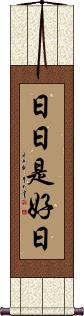
日日是好日 is an old Chinese and Japanese Buddhist proverb.
日日是好日 means “every day is a good day.”
In Japanese, it can be pronounced or romanized as “nichinichi kore koujitsu” or “hibi kore kōjitsu.”
Opportunity
Opportune Time
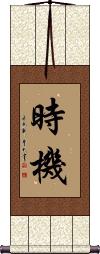
時機 is a common way to express day-to-day opportunities.
It's sometimes used to express “an occasion.”
The Original Mind
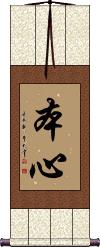
In Zen Buddhism, 本心 means “original mind” or “original heart,” which refers to one's Buddha-nature present from birth.
This can also be translated as true feelings, real intention, one's own heart, one's right mind, one's senses, one's conscience, or fundamental mind.
Note: 心 can mean heart or mind - thought in ancient Asia to be the same organ.
Past experience is the teacher for the future
Past events not forgotten serve as teachers for later events.
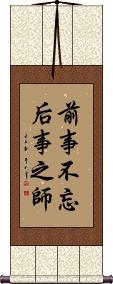
The most literal translation to English of this ancient 前事不忘后事之师 Chinese proverb is:
“Past events not forgotten serve as teachers for later events.”
However, it's been translated several ways:
Don't forget past events, they can guide you in the future.
Benefit from past experience.
Past experience, if not forgotten, is a guide for the future.
Past calamity is my teacher.
A good memory for the past is a teacher for the future.
The remembrance of the past is the teacher of the future.
If one remembers the lessons of the past; They will serve as a guide to avoid mistakes in the future.
The origin:
This proverb comes from the 5th century B.C., just before the Warring States Period in the territory now known as China.
The head of the State of Jin, Zhi Bo, seized power in a coup. He did this with help from the armies of the State of Han and Wei. Instead of being grateful for the help from Han and Wei, he treacherously took the land of Han and Wei. Never satisfied, Zhi Bo employed the armies of Han and Wei to attack and seize the State of Zhao.
The king of Zhao took advice from his minister Zhang Mengtan and secretly contacted the Han and Wei armies to reverse their plans and attack the army of Zhi Bo instead. The plan was successful, and the State of Zhao was not only saved but was set to become a powerful kingdom in the region.
Zhang Mengtan immediately submitted his resignation to a confused king of Zhao. When asked why, Zhang Mengtan said, “I've done my duty to save my kingdom, but looking back at past experience, I know sovereign kings are never satisfied with the power or land at hand. They will join others and fight for more power and more land. I must learn from past experiences, as those experiences are the teachers of future events.”
The king could not dispute the logic in that statement and accepted Zhang Mengtan's resignation.
For generations, the State of Zhao continued to fight for power and land until finally defeated and decimated by the State of Qin (which led to the birth of the Qin Dynasty in 221 B.C.).
Pleasure
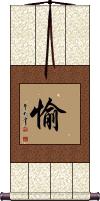
Progress Day by Day
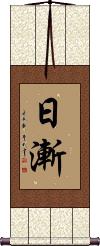
This Chinese word means to progress, increase, or change day by day.
It suggests something getting better one day at a time or with each passing day.
Prosperous Life
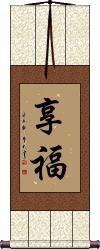
享福 is a Chinese word that means to live comfortably and/or have a happy and prosperous life.
Pursuit of Happiness
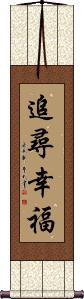
追尋幸福 is the best way to translate the English phrase “pursuit of happiness” into Chinese.
The first two characters mean “to pursue,” “to track down,” or “to search for.”
The last two mean happiness, happy, or being blessed.
See Also: Follow Your Dreams
Pursuit of Happiness
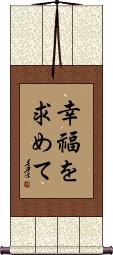
幸福を求めて is “Pursuit of Happiness” or “In Search of Happiness” in Japanese.
Here's how the characters break down:
幸福 (koufuku) happiness; blessedness; joy; well-being.
を (o) particle
求め (motome) to want; to seek; to pursue; to request
て (te) particle
Note: Because this selection contains some special Japanese Hiragana characters, it should be written by a Japanese calligrapher.
See Also: Follow Your Dreams
Push or Knock
To weigh one's words
During the Tang Dynasty, a man named Jia Dao (born in the year 779), a well-studied scholar and poet, went to the capital to take the imperial examination.
One day as he rides a donkey through the city streets, a poem begins to form in his mind. A portion of the poem comes into his head like this:
“The bird sits on the tree branch near a pond,
A monk approaches and knocks at the gate...”
At the same time, he wondered if the word “push” would be better than “knock” in his poem.
As he rides down the street, he imagines the monk pushing or knocking. Soon he finds himself making motions of pushing and shaking a fist in a knocking motion as he debates which word to use. He is quite a sight as he makes his way down the street on his donkey with hands and fists flying about as the internal debate continues.
As he amuses people along the street, he becomes completely lost in his thoughts and does not see the mayor's procession coming in the opposite direction. Jia Bao is blocking the way for the procession to continue down the road, and the mayor's guards immediately decide to remove Jia Bao by force. Jia Bao, not realizing that he was in the way, apologizes, explains his poetic dilemma and awaits his punishment for blocking the mayor's way.
The mayor, Han Yu, a scholar and author of prose himself, finds himself intrigued by Jia Dao's poem and problem. Han Yu gets off his horse and addresses Jia Bao, stating, “I think knock is better.” The relieved Jia Bao raises his head and is invited by the mayor to join the procession, and are seen riding off together down the street, exchanging their ideas and love of poetry.
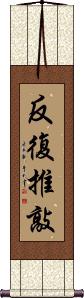
In modern Chinese, this 反復推敲 idiom is used when someone is trying to decide which word to use in their writing or when struggling to decide between two things when neither seems to have a downside.
Homosexual Male / Gay Male
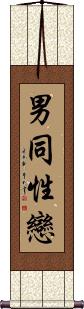
You need the male character in front of the word for homosexual in Chinese to create this word.
It's a much nicer way to say “Gay Male” than English words like Fag, Fairy, Sissy, Puff, Poof, Poofster, Swish, or Pansy. Although I suppose it could be used as a substitute for Nancy Boy, Queer, or Queen (for which, last time I checked, my gay friends said were OK in the right context).
For those of you who think China is a restrictive society - there are at least two gay discos in Beijing, the capital of China. It's at least somewhat socially acceptable to be a gay male in China. However, lesbians seem to be shunned a bit.
I think the Chinese government has realized that the 60% male population means not everybody is going to find a wife (every gay male couple that exists means two more women in the population are available for the straight guys), and the fact that it is biologically impossible for men to give birth, may be seen as helping to decrease the over-population in China.
Re-Birth / Renaissance
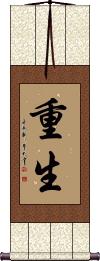
重生 is the Chinese word for rebirth. This can be used literally or metaphorically. As a metaphor, you could use this to say something like, “We are watching the rebirth of New Orleans after the disaster of Katrina.”
重生 is sometimes translated as “renaissance.”
Note: 重生 is not the Buddhist concept of reincarnation or re-birth.
See Also: Reincarnation
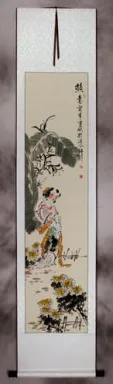
This in-stock artwork might be what you are looking for, and ships right away...
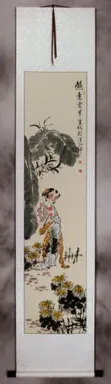
Gallery Price: $90.00
Your Price: $49.88
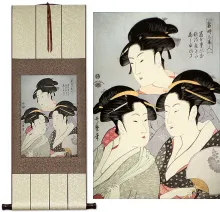
Gallery Price: $108.00
Your Price: $59.88



Successful Chinese Character and Japanese Kanji calligraphy searches within the last few hours...



