Courage Chinese / Japanese Calligraphy Wall Scrolls
You can create a custom courage wall scroll for your home, office, or dojo here!
Start your courage calligraphy project by clicking on the button next you your favorite courage-related title below...
2. Learning leads to Knowledge, Study leads to Benevolence, Shame leads to Courage
3. Courage to do what is right
8. Courage To Do What Is Right
11. Inspire with redoubled courage
13. No Fear
14. Preparation Yields No Fear or Worries
15. Advance Bravely / Indomitable Spirit
16. Brave the Waves
17. Fear No Man / Fear Nothing
20. Undaunted After Repeated Setbacks
21. Preparation Yields No Regrets
22. One who is drenched in rain does not fear drops of dew
23. Serenity Prayer
26. England
Bravery / Courage
Courage in the face of Fear
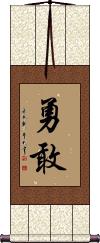
勇敢 is about courage or bravery in the face of fear.
You do the right thing even when it is hard or scary. When you are courageous, you don't give up. You try new things. You admit mistakes. This kind of courage is the willingness to take action in the face of danger and peril.
勇敢 can also be translated as braveness, valor, heroic, fearless, boldness, prowess, gallantry, audacity, daring, dauntless, and/or courage in Japanese, Chinese, and Korean. This version of bravery/courage can be an adjective or a noun. The first character means bravery and courage by itself. The second character means “daring” by itself. The second character emphasizes the meaning of the first but adds the idea that you are not afraid of taking a dare, and you are not afraid of danger.
勇敢 is more about brave behavior and not so much the mental state of being brave. You'd more likely use this to say, “He fought courageously in the battle,” rather than “He is very courageous.”
Bravery / Courage
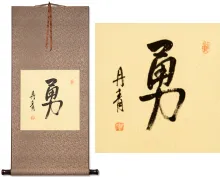
Single Character for Courage
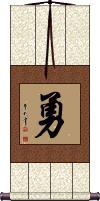
勇 can be translated as bravery, courage, valor, or fearless in Chinese, Japanese and Korean.
勇 is the simplest form to express courage or bravery, as there is also a two-character form that starts with this same character.
勇 can also be translated as brave, daring, fearless, plucky, or heroic.
This is also a virtue of the Samurai Warrior
See our page with just Code of the Samurai / Bushido here
See Also: Bravery
Learning leads to Knowledge, Study leads to Benevolence, Shame leads to Courage
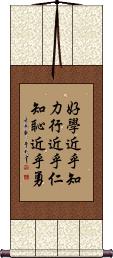
好學近乎知力行近乎仁知恥近乎勇 is a Saying from Confucius which relates certain actions to virtues.
A more verbose translation:
To love learning is akin to knowledge,
to study diligently is akin to benevolence,
to know shame is akin to courage.
Courage to do what is right
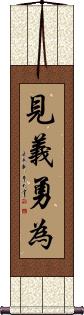
見義勇為 means the courage to do what is right in Chinese.
This could also be translated as “Never hesitate to do what is right.”
This comes from Confucian thought:
Your courage should head in an honorable direction. For example, you should take action when the goal is to attain a just result as, without honorable intent, a person’s gutsy fervor can easily lead them astray.
One who flaunts courage but disregards justice is bound to do wrong; someone who possesses courage and morality is destined to become a hero.
Some text above paraphrased from The World of Chinese - The Character of 勇
See Also: Work Unselfishly for the Common Good | Justice | Bravery
Courage and Strength
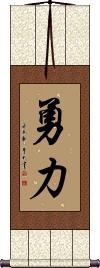
勇力 is a very short way to say “courage and strength” in Chinese and Japanese.
In Japanese, it's read more like “strong courage” or “powerful courage.” This can also be the personal name Yuri or Yuuri in Japanese.
Bravery / Courage
Courageous Energy
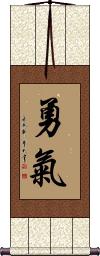
勇氣 is one of several ways to express bravery and courage in Chinese, Japanese, and Korean.
This version is the most spiritual. This is the essence of bravery from deep within your being. This is the mental state of being brave versus actual brave behavior. You'd more likely use this to say, “He is very courageous,” rather than “He fought courageously in the battle.”
The first character also means bravery or courage when it's seen alone. With the second character added, an element of energy or spirit is added. The second character is the same “chi” or “qi” energy that Kung Fu masters focus on when they strike. For this reason, you could say this means “spirit of courage” or “brave spirit.”
This is certainly a stronger word than just the first character alone.
Beyond bravery or courage, dictionaries also translate this word as valor/valour, nerve, audacity, daring, pluck, plucky, gallantry, guts, gutsy, and boldness.
This is also one of the 8 key concepts of tang soo do.
 While the version shown to the left is commonly used in Chinese and Korean Hanja (and ancient Japanese Kanji), please note that the second character is written with slightly fewer strokes in modern Japanese. If you want the modern Japanese version, please click on the character to the right. Both styles would be understood by native Chinese, Japanese, and many (but not all) Korean people. You should make your selection based on the intended audience for your calligraphy artwork. Or pick the single-character form of bravery/courage which is universal.
Courageous Spirit
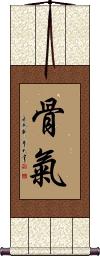
骨氣 is a Chinese title that means “unyielding character,” “courageous spirit,” “integrity,” or “moral backbone.”
Fidelity Honor Courage
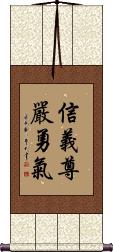
信義尊嚴勇氣 means fidelity, honor, and courage in Chinese.
This is a word list that was requested by a customer. Word lists are not common in Chinese, but we've put this one in the best order/context to make it as natural as possible.
We used the “honor” that leans toward the definition of “dignity” since that seemed the best match for the other two words.
Please note: These are three two-character words. You should choose the single-column format when you get to the options when you order this selection. The two-column option would split one word or be arranged with four characters on one side and two on the other.
Courage To Do What Is Right
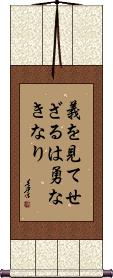
義を見てせざるは勇なきなり is a Japanese proverb that means “Knowing what is right and not doing is a want of courage.”
I've also seen it translated as:
To see what is right, yet fail to do so, is a lack of courage.
To know righteousness, but take no action is cowardice.
You are a coward if you knew what was the right thing to do, but you did not take action.
Knowing what is right without practicing it betrays one's cowardice.
Note: Because this selection contains some special Japanese Hiragana characters, it should be written by a Japanese calligrapher.
Honor Courage
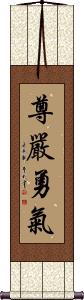
尊嚴勇氣 is a word list that means “Honor [and] Courage.”
Word lists are not common in Chinese, but we've put this one in the best order/context to make it as natural as possible.
We used the “honor” that leans toward the definition of dignity and integrity since that seemed like the best match for courage.
Honor Courage Commitment
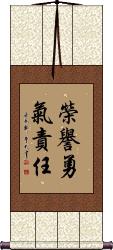
榮譽勇氣責任 is a word list that reads, “榮譽 勇氣 責任” or “honor courage commitment.”
If you are looking for this, it is likely that you are in the military (probably Navy or Marines).
We worked on this for a long time to find the right combination of words in Chinese. However, it should still be noted that word lists are not very natural in Chinese. Most of the time, there would be a subject, verb, and object for a phrase with this many words.
Honor Courage Commitment
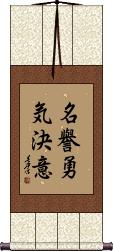
This means “Honor, Courage, Commitment” in Japanese.
名譽勇気決意 is a common military phrase in English used in the Navy and Marines.
This is a word list, which is not the most natural kind of composition in Japanese (usually there is a subject, object, and verb - or a single word).
Inspire with redoubled courage
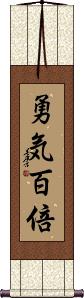
勇気百倍 means to inspire someone with fresh courage or redoubled courage in Japanese.
The Kanji breakdown:
勇気 (yuuki) courage; bravery; valour; valor; nerve; boldness.
百 (hyaku) 100; hundred.
倍 (bai) twice; double; 2-times; 2-fold.
Strength and Courage
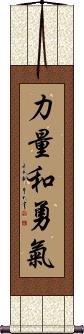
While 力量和勇氣 is not a typical Chinese phrase, this is how to write “strength and courage.”
If this is an important idea for you, we can make a great custom Chinese “strength and courage” wall scroll for you.
Strength and Courage
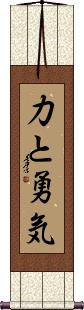
力と勇気 may not be the most common Japanese phrase, but this is how to write “strength and courage” or “power and bravery” in Japanese.
No Fear
(2 characters)
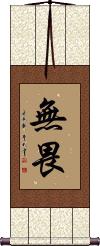
無畏 literally means “No Fear.” But perhaps not the most natural Chinese phrase (see our other “No Fear” phrase for a complete thought). However, this two-character version of “No Fear” seems to be a very popular way to translate this into Chinese when we checked Chinese Google.
Note: This also means “No Fear” in Japanese and Korean, but this character pair is not often used in Japan or Korea.
This term appears in various Chinese dictionaries with definitions like “without fear,” intrepidity, fearless, dauntless, and bold.
In the Buddhist context, this is a word derived from the word Abhaya, meaning: Fearless, dauntless, secure, nothing, and nobody to fear. Also, from vīra meaning: courageous, bold.
See Also: Never Give Up | No Worries | Undaunted | Bravery | Fear No Man
No Fear
(four-character version)
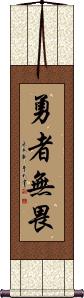
勇者無畏 is a complete sentence that means “Brave People Have No Fear” or “A Brave Person Has No Fear” (plural or singular is not implied).
We translated “No Fear” into the two variations that you will find on our website. Then we checked Chinese Google and found that others had translated “No Fear” in the exact same ways. Pick the one you like best. A great gift for your fearless friend.
See Also: Fear No Man
No Fear
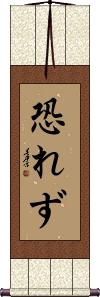
恐れず is probably the best way to express “No Fear” in Japanese.
The first Kanji and the following Hiragana character create a word that means: to fear, to be afraid of, frightened, or terrified.
The last Hiragana character serves to modify and negate the first word (put it in negative form). Basically, they carry a meaning like “without” or “keeping away.” 恐れず is almost like the English modifier “-less.”
Altogether, you get something like “Without Fear” or “Fearless.”
Here's an example of using this in a sentence: 彼女かのじょは思い切ったことを恐れずにやる。
Translation: She is not scared of taking big risks.
Note: Because this selection contains some special Japanese Hiragana characters, it should be written by a Japanese calligrapher.
See Also: Bravery
Preparation Yields No Fear or Worries
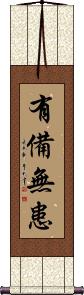
有備無患 means “When you are well-prepared, you have nothing to fear.”
Noting that the third character means “no” or “without” and modifies the last... The last character can mean misfortune, troubles, worries, or fears. It could even be stretched to mean sickness. Therefore you can translate this proverb in a few ways. I've also seen it translated as “Preparedness forestalls calamities.”
有備無患 is comparable to the English idiom, “Better safe than sorry,” but does not directly/literally mean this.
Advance Bravely / Indomitable Spirit
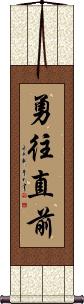
This proverb creates an image of a warrior bravely advancing against an enemy regardless of the odds.
This proverb can also be translated as “indomitable spirit” or “march fearlessly onward.”
See Also: Indomitable | Fortitude
Brave the Waves
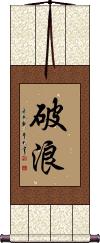
破浪 can be translated from Chinese as “braving the waves” or “bravely setting sail.”
It literally means: “break/cleave/cut [the] waves.”
破浪 is a great title to encourage yourself or someone else not to be afraid of problems or troubles.
Because of the context, this is especially good for sailors or yachtsmen and surfers too.
Note: While this can be understood in Japanese, it's not commonly used in Japan. Therefore, please consider this to be primarily a Chinese proverb.
Fear No Man / Fear Nothing
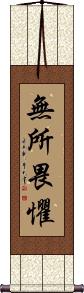
無所畏懼 means “fear nothing,” but it's the closest thing in Chinese to the phrase “fear no man” which many of you have requested.
This would also be the way to say “fear nobody” and can be translated simply as “undaunted.”
Fearless / Daring
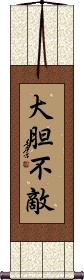
大胆不敵 is a Japanese word that can mean a few things depending on how you read it.
Popular translations include fearless, audacity (the attitude of a) daredevil, or daring.
The first two Kanji create a word that means: bold, fearless, or daring; audacious.
The last two Kanji create a word meaning: no match for, cannot beat, daring, fearless, intrepid, bold, or tough.
As with many Japanese words, the two similar-meaning words work together to multiply the meaning and intensity of the whole 4-Kanji word.
Fortune favors the brave
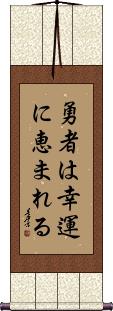
勇者は幸運に恵まれる is a Japanese proverb that suggests that in history, the brave or courageous tend to be the ones who win.
Note: Because this selection contains some special Japanese Hiragana characters, it should be written by a Japanese calligrapher.
Undaunted After Repeated Setbacks
Persistence to overcome all challenges
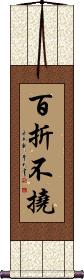
百折不撓 is a Chinese proverb that means “Be undaunted in the face of repeated setbacks.”
More directly translated, it reads, “[Overcome] a hundred setbacks, without flinching.” 百折不撓 is of Chinese origin but is commonly used in Japanese and somewhat in Korean (same characters, different pronunciation).
This proverb comes from a long, and occasionally tragic story of a man that lived sometime around 25-220 AD. His name was Qiao Xuan, and he never stooped to flattery but remained an upright person at all times. He fought to expose the corruption of higher-level government officials at great risk to himself.
Then when he was at a higher level in the Imperial Court, bandits were regularly capturing hostages and demanding ransoms. But when his own son was captured, he was so focused on his duty to the Emperor and the common good that he sent a platoon of soldiers to raid the bandits' hideout, and stop them once and for all even at the risk of his own son's life. While all of the bandits were arrested in the raid, they killed Qiao Xuan's son at first sight of the raiding soldiers.
Near the end of his career, a new Emperor came to power, and Qiao Xuan reported to him that one of his ministers was bullying the people and extorting money from them. The new Emperor refused to listen to Qiao Xuan and even promoted the corrupt Minister. Qiao Xuan was so disgusted that in protest, he resigned from his post as minister (something almost never done) and left for his home village.
His tombstone reads “Bai Zhe Bu Nao” which is now a proverb used in Chinese culture to describe a person of strong will who puts up stubborn resistance against great odds.
My Chinese-English dictionary defines these 4 characters as “keep on fighting despite all setbacks,” “be undaunted by repeated setbacks,” and “be indomitable.”
Our translator says it can mean “never give up” in modern Chinese.
Although the first two characters are translated correctly as “repeated setbacks,” the literal meaning is “100 setbacks” or “a rope that breaks 100 times.” The last two characters can mean “do not yield” or “do not give up.”
Most Chinese, Japanese, and Korean people will not take this absolutely literal meaning but will instead understand it as the title suggests above. If you want a single big word definition, it would be indefatigability, indomitableness, persistence, or unyielding.
See Also: Tenacity | Fortitude | Strength | Perseverance | Persistence
Preparation Yields No Regrets
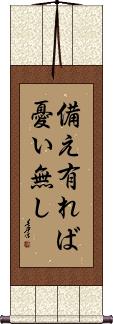
備え有れば憂い無し is as proverb that means “When you are well-prepared, you have nothing to regret” in Japanese.
Note: Because this selection contains some special Japanese Hiragana characters, it should be written by a Japanese calligrapher.
One who is drenched in rain does not fear drops of dew
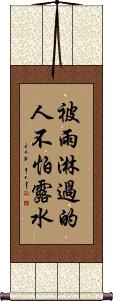
被雨淋過的人不怕露水 is a Chinese proverb that literally translates as “One who has been drenched by the rain is not afraid of dew drops.”
Figuratively, this means:
One who has gone through hardships is not afraid of (minor)setbacks.
Serenity Prayer
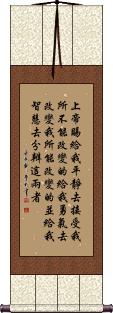
This is the serenity prayer, as used by many 12-step programs and support groups.
In Chinese, this says:
God grant me the serenity to accept the things I cannot change, the courage to change the things I can, and the wisdom to know the difference.
Serenity Prayer
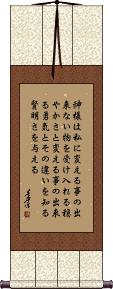
This is a Japanese version of the serenity prayer, as used by many 12-step programs and support groups.
In Japanese, this says:
God grant me the serenity to accept the things I cannot change, the courage to change the things I can, and the wisdom to know the difference.
Note: Because this selection contains some special Japanese Hiragana characters, it should be written by a Japanese calligrapher.
Tough / Unbeatable
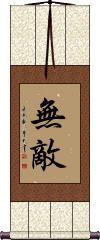
無敵 means tough or unbeatable in Chinese characters, Korean Hanja, and Japanese Kanji.
Other translations for this word include unequaled, without rival, a paragon, invincible, unrivaled/unrivalled, no match for, cannot beat, daring, fearless, intrepid, and/or bold.
In Japanese, this can also be the surname Muteki.
Value of Warrior Generals
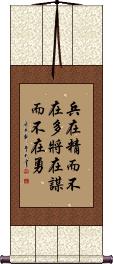
兵在精而不在多將在謀而不在勇 is a proverb that informs how it is better to have warriors of quality, rather than just a large quantity of warriors in your army/force.
This literally means: [Just as] warriors [are valued for their] quality and not [just] for quantity, [so] generals [are valued] for their tactics, not [just] for [their] bravery.
See Also: 兵在精而不在多
England
Can mean: Courage / Bravery
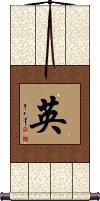
In Chinese, Japanese, and old Korean, 英 can often be confused or read as a short name for England (this character is the first syllable of the word for England, the English language, the British Pound, and other titles from the British Isles).
In some contexts, this can mean “outstanding” or even “flower.” But it will most often read as having something to do with the United Kingdom.
This is not the most common way to say hero, courage or bravery but you may see it used sometimes.
I strongly recommend that you choose another form of courage/bravery.
This in-stock artwork might be what you are looking for, and ships right away...
Gallery Price: $65.00
Your Price: $39.88
The following table may be helpful for those studying Chinese or Japanese...
| Title | Characters | Romaji (Romanized Japanese) | Various forms of Romanized Chinese | |
| Bravery Courage | 勇敢 | yuu kan / yuukan / yu kan | yǒng gǎn / yong3 gan3 / yong gan / yonggan | yung kan / yungkan |
| Bravery Courage | 勇 | isamu / yu- | yǒng / yong3 / yong | yung |
| Learning leads to Knowledge, Study leads to Benevolence, Shame leads to Courage | 好學近乎知力行近乎仁知恥近乎勇 好学近乎知力行近乎仁知耻近乎勇 | hào xué jìn hū zhī lì xíng jìn hū rén zhī chǐ jìn hū yǒng hao4 xue2 jin4 hu1 zhi1 li4 xing2 jin4 hu1 ren2 zhi1 chi3 jin4 hu1 yong3 hao xue jin hu zhi li xing jin hu ren zhi chi jin hu yong | hao hsüeh chin hu chih li hsing chin hu jen chih ch`ih chin hu yung hao hsüeh chin hu chih li hsing chin hu jen chih chih chin hu yung |
|
| Courage to do what is right | 見義勇為 见义勇为 | jiàn yì yǒng wéi jian4 yi4 yong3 wei2 jian yi yong wei jianyiyongwei | chien i yung wei chieniyungwei |
|
| Courage and Strength | 勇力 | yuu ri / yuuri / yu ri | yǒng lì / yong3 li4 / yong li / yongli | yung li / yungli |
| Bravery Courage | 勇氣 勇气 / 勇気 | yuuki / yuki | yǒng qì / yong3 qi4 / yong qi / yongqi | yung ch`i / yungchi / yung chi |
| Courageous Spirit | 骨氣 骨气 | gǔ qì / gu3 qi4 / gu qi / guqi | ku ch`i / kuchi / ku chi | |
| Fidelity Honor Courage | 信義尊嚴勇氣 信义尊严勇气 | xìn yì zūn yán yǒng qì xin4 yi4 zun1 yan2 yong3 qi4 xin yi zun yan yong qi xinyizunyanyongqi | hsin i tsun yen yung ch`i hsinitsunyenyungchi hsin i tsun yen yung chi |
|
| Courage To Do What Is Right | 義を見てせざるは勇なきなり | giomitesezaruhayuunakinari giomitesezaruhayunakinari | ||
| Honor Courage | 尊嚴勇氣 尊严勇气 | zūn yán yǒng qì zun1 yan2 yong3 qi4 zun yan yong qi zunyanyongqi | tsun yen yung ch`i tsunyenyungchi tsun yen yung chi |
|
| Honor Courage Commitment | 榮譽勇氣責任 荣誉勇气责任 | róng yù yǒng qì zé rèn rong2 yu4 yong3 qi4 ze2 ren4 rong yu yong qi ze ren rongyuyongqizeren | jung yü yung ch`i tse jen jungyüyungchitsejen jung yü yung chi tse jen |
|
| Honor Courage Commitment | 名譽, 勇気, 決意 名誉, 勇気, 決意 | meiyo yuuki ketsui meiyoyuukiketsui meiyo yuki ketsui | ||
| Inspire with redoubled courage | 勇気百倍 | yuuki hyaku bai yuukihyakubai yuki hyaku bai | ||
| Strength and Courage | 力量和勇氣 力量和勇气 | lì liàng hé yǒng qì li4 liang4 he2 yong3 qi4 li liang he yong qi liliangheyongqi | li liang ho yung ch`i lilianghoyungchi li liang ho yung chi |
|
| Strength and Courage | 力と勇氣 力と勇気 | riki to yu ki rikitoyuki | ||
| No Fear | 無畏 无畏 | mui | wú wèi / wu2 wei4 / wu wei / wuwei | |
| No Fear | 勇者無畏 勇者无畏 | yǒng zhě wú wèi yong3 zhe3 wu2 wei4 yong zhe wu wei yongzhewuwei | yung che wu wei yungchewuwei |
|
| No Fear | 恐れず | oso re zu / osorezu | ||
| Preparation Yields No Fear or Worries | 有備無患 有备无患 | yǒu bèi wú huàn you3 bei4 wu2 huan4 you bei wu huan youbeiwuhuan | yu pei wu huan yupeiwuhuan |
|
| Advance Bravely Indomitable Spirit | 勇往直前 | yǒng wǎng zhí qián yong3 wang3 zhi2 qian2 yong wang zhi qian yongwangzhiqian | yung wang chih ch`ien yungwangchihchien yung wang chih chien |
|
| Brave the Waves | 破浪 | ha rou / harou / ha ro | pò làng / po4 lang4 / po lang / polang | p`o lang / polang / po lang |
| Fear No Man Fear Nothing | 無所畏懼 无所畏惧 | wú suǒ wèi jù wu2 suo3 wei4 ju4 wu suo wei ju wusuoweiju | wu so wei chü wusoweichü |
|
| Fearless Daring | 大膽不敵 大胆不敵 | dai tan fu teki daitanfuteki | ||
| Fortune favors the brave | 勇者は幸運に恵まれる | yuusha ha kouun ni megumareru yusha ha koun ni megumareru | ||
| Undaunted After Repeated Setbacks | 百折不撓 百折不挠 | hyaku setsu su tou hyakusetsusutou hyaku setsu su to | bǎi zhé bù náo bai3 zhe2 bu4 nao2 bai zhe bu nao baizhebunao | pai che pu nao paichepunao |
| Preparation Yields No Regrets | 備え有れば憂い無し | sona e a re ba ure i na shi sonaearebaureinashi | ||
| One who is drenched in rain does not fear drops of dew | 被雨淋過的人不怕露水 被雨淋过的人不怕露水 | bèi yǔ lín guò de rén bù pà lù shuǐ bei4 yu3 lin2 guo4 de ren2 bu4 pa4 lu4 shui3 bei yu lin guo de ren bu pa lu shui | pei yü lin kuo te jen pu p`a lu shui pei yü lin kuo te jen pu pa lu shui |
|
| Serenity Prayer | 上帝賜給我平靜去接受我所不能改變的給我勇氣去改變我所能改變的並給我智慧去分辨這兩者 上帝赐给我平静去接受我所不能改变的给我勇气去改变我所能改变的并给我智慧去分辨这两者 | shàng dì cì wǒ píng jìng qù jiē shòu wǒ suǒ bù néng gǎi biàn de wǒ yǒng qì qù gǎi biàn wǒ suǒ néng gǎi biàn de bìng wǒ zhì huì qù fēn biàn zhè liǎng zhě shang4 di4 ci4 gei3 wo3 ping2 jing4 qu4 jie1 shou4 wo3 suo3 bu4 neng2 gai3 bian4 de gei3 wo3 yong3 qi4 qu4 gai3 bian4 wo3 suo3 neng2 gai3 bian4 de bing4 gei3 wo3 zhi4 hui4 qu4 fen1 bian4 zhe4 liang3 zhe3 shang di ci gei wo ping jing qu jie shou wo suo bu neng gai bian de gei wo yong qi qu gai bian wo suo neng gai bian de bing gei wo zhi hui qu fen bian zhe liang zhe | shang ti tz`u kei wo p`ing ching ch`ü chieh shou wo so pu neng kai pien te kei wo yung ch`i ch`ü kai pien wo so neng kai pien te ping kei wo chih hui ch`ü fen pien che liang che shang ti tzu kei wo ping ching chü chieh shou wo so pu neng kai pien te kei wo yung chi chü kai pien wo so neng kai pien te ping kei wo chih hui chü fen pien che liang che |
|
| Serenity Prayer | 神様は私に変える事の出来ない物を受け入れる穏やかさと変える事の出来る勇気とその違いを知る賢明さを与える | kamisama ha watashi ni kaeru koto no deki nai mono o ukeireru odayaka sa to kaeru koto no dekiru yuuki to sono chigai o shiru kenmei sa o ataeru kamisama ha watashi ni kaeru koto no deki nai mono o ukeireru odayaka sa to kaeru koto no dekiru yuki to sono chigai o shiru kenmei sa o ataeru | ||
| Tough Unbeatable | 無敵 无敌 | muteki | wú dí / wu2 di2 / wu di / wudi | wu ti / wuti |
| Value of Warrior Generals | 兵在精而不在多將在謀而不在勇 兵在精而不在多将在谋而不在勇 | bīng zài jīng ér bú zài duō jiàng zài móu ér bú zài yǒng bing1 zai4 jing1 er2 bu2 zai4 duo1 jiang4 zai4 mou2 er2 bu2 zai4 yong3 bing zai jing er bu zai duo jiang zai mou er bu zai yong | ping tsai ching erh pu tsai to chiang tsai mou erh pu tsai yung | |
| England | 英 | ei | yīng / ying1 / ying | |
| In some entries above you will see that characters have different versions above and below a line. In these cases, the characters above the line are Traditional Chinese, while the ones below are Simplified Chinese. | ||||




