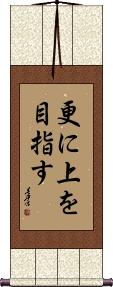
Never Give Up Wall Scroll

"Never Give Up" Chinese / Japanese Wall Scrolls

You can buy Never Give Up characters on a custom wall scroll or portrait here.
Start by clicking on the button next to your favorite title below...

Quick links to words on this page...

  1. Never Give Up
  2. Never Give In / Never Succumb...
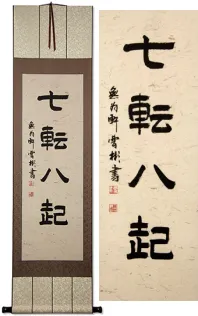
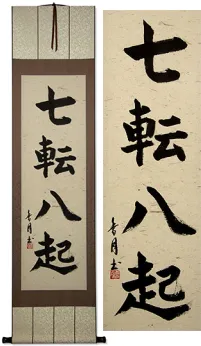
  3. Fall Down Seven Times, Get Up Eight
  4. Tenacious / Tenacity
  5. Bravery / Courage
  6. Confidence
  7. The Confident Helmsman...
  8. Fear No Man / Fear Nothing
  9. Better Late Than Never
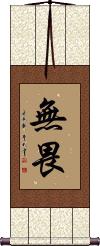
10. No Fear
11. Undaunted After Repeated Setbacks
12. Preparation Yields No Fear or Worries

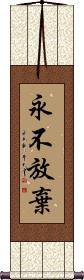
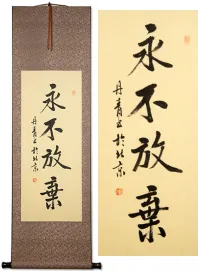
Never Give Up

yǒng bù fàng qì
영불방기
永
不
放
棄

The first character means "eternal" or "forever", the second means "not" (together they mean "never"). The last two characters mean "give up" or "abandon". Altogether, you can translate this phrase as "never give up" or "never abandon".

Depending on how you want to read this, it is also a statement that you will never abandon your hopes, dreams, family or friends.

See Also...  Undaunted | No Fear | Hope

Never Give In / Never Succumb
Never Lose

Japanese Only

kesshite akirameruna
め
る
な
決
し
て
諦

Characters shown
above are read
vertically, starting
from the right

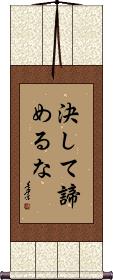
This is a Japanese term that informally means "never give up".

See Also...  Tenacity | Perseverance | Hope

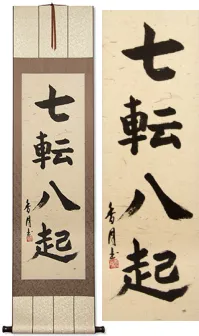
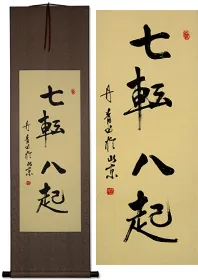
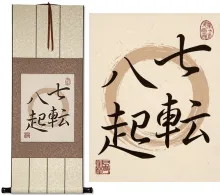
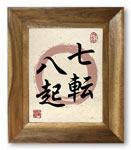
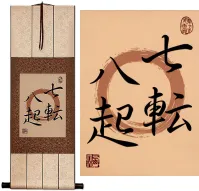
Fall Down Seven Times, Get Up Eight

Always rising after a fall or repeated failures

shichi ten hakki
칠전팔기
七
転
八
起

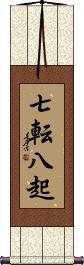
This Japanese proverb relays the vicissitudes of life. Some would more naturally translate it into English as "Always rising after a fall or repeated failures".

The first Kanji is literally "7". The second means "fall down" (sometimes this Kanji means "turn around", "revolve" or "turn over", but in this case, it's holds the meaning of "fall"). The third is "8". And the last is "get up", "rouse", or "rise".

Basically if you fail 7 times, you should recover from those events and be prepared to rise an 8th time. This is also applies if it is the world or circumstances that knock you down seven times...
...just remember that you have the ability to bounce back from any kind of adversity.

Note: This can be pronounced two ways. One is "shichi ten hakki". The other is "nana korobi ya oki" also written, "nanakorobi-yaoki".

Special Note: The second character is a Kanji that is not used in China. Therefore, please only select our Japanese master calligrapher for this selection.

Tenacious / Tenacity

wán qiáng
gan kyou
완강
頑
強

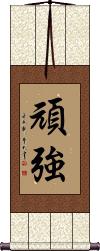
These two characters together mean "Tenacious", "Hard to Defeat", or "Dogged".

Alone, the first character means mischievous, obstinate or stubborn. But it loses some of the mischievous meaning when the second character is added.

The second character means strength, force, powerful or better.

See Also...  Determination | Dedication | Devotion

Bravery / Courage

Courage in the face of Fear

yǒng gǎn
yuu kan
용감
勇
敢

This word is about courage is bravery in the face of fear. You do the right thing even when it is hard or scary. When you are courageous, you don't give up. You try new things. You admit mistakes. This kind of courage is the willingness to take action in the face of danger and peril.

These characters can also be translated as: braveness, valor, heroic, fearless, boldness, prowess, gallantry, audacity, daring, dauntless and/or courage in Japanese, Chinese, and Korean. This version of bravery/courage can be an adjective or a noun. The first character means bravery and courage by itself. The second character means "daring" by itself. The second character just emphasizes the meaning of the first, but adds an idea that you are not afraid of taking a dare, and you are not afraid of danger.

This is about brave behavior versus the mental state of being brave. You'd more likely use this to say, "He fought courageously in the battle", rather than "He is very courageous".

See Also...  Warrior

Confidence

xìn xīn
shinjin
신심
信
心

Confidence is having faith in someone. Self-confidence is trusting that you have what it takes, to handle whatever happens. You feel sure of yourself and enjoy trying new things, without letting doubts or fears hold you back. When you have confidence in others, you rely on them.

The first character means faith, and the second can mean heart or soul. So you could say this means "faithful heart" or "faithful soul". In Korean especially, this word has a religious connotation.

In Japanese, this word can mean "faith", "belief" or "devotion".

See Also...  Self-Confidence

The Confident Helmsman
Inspires Confidence in the Passengers

bǎ tuò de bù huāng chéng chuán de wěn dang
乘
船
的
穩
當
把
舵
的
不
慌

Characters shown
above are read
vertically, starting
from the right

This literally translates as: [If the] helmsman is not nervous, the passengers [will feel] secure.

Figuratively, this means: If the leader appears confident, his/her followers will gain confidence also.

This is a great suggestion that a confident leader inspires confidence in his/her troops or followers. Of course, a nervous leader will create fear in troops or followers.

Back to the top of this page

Fear No Man / Fear Nothing

wú suǒ wèi jù
무소외구
無
所
畏
懼

This literally means "fear nothing", but it's the closest thing in Chinese to the phrase "fear no man" which many of you have requested. This would also be the way to say "fear nobody" and can also be translated simply as "undaunted".

Better Late Than Never

It's Never Too Late Too Mend

wáng yáng bǔ láo yóu wèi wéi wǎn
망양보뢰유미위만
亡
羊
補
牢
猶
未
為
晚

Long ago in what is now China, there were many kingdoms throughout the land. This time period is known as "The Warring States Period" by historians because these kingdoms often did not get along with each other.

Some time around 279 B.C. the Kingdom of Chu was a large, but not particularly powerful kingdom. Part of the reason it lacked power was the fact that the King was surrounded by "yes men" who told him only what he wanted to hear. Many of the King\’s court officials were corrupt and incompetent which did not help the situation.

The King was not blameless himself, as he started spending much of his time being entertained by his many concubines.

One of the King\’s ministers, Zhuang Xin, saw problems on the horizon for the Kingdom, and warned the King, "Your Majesty, you are surrounded by people who tell you what you want to hear. They tell you things to make you happy, and cause you to ignore important state affairs. If this is allowed to continue, the Kingdom of Chu will surely perish, and fall into ruins".

This enraged the King who scolded Zhuang Xin for insulting the country and accused him of trying to create resentment among the people. Zhuang Xin explained, "I dare not curse the Kingdom of Chu, but I feel that we face great danger in the future because of the current situation". The King was simply not impressed with Zhuang Xin\’s words.
Seeing the King\’s displeasure with him and the King\’s fondness for his court of corrupt officials, Zhuang Xin asked permission of the King that he may take leave of the Kingdom of Chu, and travel to the State of Zhao to live. The King agreed, and Zhuang Xin left the Kingdom of Chu, perhaps forever.

Five months later, troops from the neighboring Kingdom of Qin invaded Chu, taking a huge tract of land. The King of Chu went into exile, and it appeared that soon, the Kingdom of Chu would no longer exist.

The King of Chu remembered the words of Zhuang Xin, and sent some of his men to find him. Immediately, Zhuang Xin returned to meet the King. The first question asked by the King was, "What can I do now?"

Zhuang Xin told the King this story:

A shepherd woke one morning to find a sheep missing. Looking at the pen saw a hole in the fence where a wolf had come through to steal one of his sheep. His friends told him that he had best fix the hole at once. But the Shepherd thought since the sheep is already gone, there is no use fixing the hole.
The next morning, another sheep was missing. And the Shepherd realized that he must mend the fence at once. Zhuang Xin then went on to make suggestions about what could be done to reclaim the land lost to the Kingdom of Qin, and reclaim the former glory and integrity in the Kingdom of Chu.

The Chinese idiom shown above came from this reply from Zhuang Xin to the King of Chu almost 2,300 years ago.
It translates roughly into English as...
"Even if you have lost some sheep, it\’s never too late to mend the fence".

This phrase is often used in modern China when suggesting in a hopeful way that someone change their ways, or fix something in their life. It might be used to suggest fixing a marriage, quit smoking, or getting back on track after taking an unfortunate path in life among other things one might fix in their life.

I suppose in the same way that we might say, "Today is the first day of the rest of your life" in our western cultures to suggest that you can always start anew.

Note: This does have Korean pronunciation, but is not a well-known phrase in Korean (only Koreans familiar with ancient Chinese history would know it). Best if your audience is Chinese.

No Fear

(two characters)

wú wèi
mui
무외
無
畏

This literally means "No Fear". But perhaps not the most natural Chinese phrase (see our other "No Fear" phrase for a more complete thought). However, this two-character version of "No Fear" seems to be a very popular way to translate this into Chinese, when we checked Chinese Google.

Note: This also means "No Fear" in Japanese and Korean, but this character pair is not often used in Japan or Korea (used somewhat by Korean Buddhists to mean fearlessness).

In recent years, this term is starting to appear in various Chinese and Japanese dictionaries with definitions like "without fear", intrepidity, fearless, dauntless, and bold.

See Also...  No Worries | Undaunted | Bravery | Courage | Fear No Man

Back to the top of this page

No Fear

(four-character version)

yǒng zhě wú wèi
용자무외
勇
者
無
畏

This is a complete sentence that means literally "Brave People Have No Fear" or "A Brave Person Has No Fear" (plural or singular is not implied). We translated "No Fear" into the two variations that you will find on our website. Then we checked Chinese Google and found that others had translated "No Fear" in the exact same ways. Pick the one you like best. A great gift for your fearless friend.

See Also...  Fear No Man

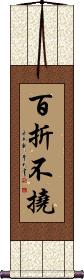
Undaunted After Repeated Setbacks

Persistence to overcome all challenges
bǎi zhé bù náo
hyaku setsu su tou
백절불요
百
折
不
撓

This phrase means "Be undaunted in the face of repeated setbacks".

It comes from a long, and occasionally tragic story of a man that lived sometime around 25-220 AD. His name was Qiao Xuan and he never stooped to flattery, but remained an upright person at all times. He fought to expose corruption of higher-level government officials at great risk to himself.

Then when he was at a higher level in the Imperial Court, bandits were regularly capturing hostages and demanding ransoms. But when his own son was captured, he was so focused on his duty to the Emperor and common good that he sent a platoon of soldiers to raid the bandits' hideout, and stop them once and for all even at the risk of his own son's life. While all of the bandits were arrested in the raid, they killed Qiao Xuan's son at first sight of the raiding soldiers.

Near the end of his career a new Emperor came to power, and Qiao Xuan reported to him that one of his ministers was bullying the people and extorting money from them. The new Emperor refused to listen to Qiao Xuan and even promoted the corrupt Minister. Qiao Xuan was so disgusted that in protest he resigned his post as minister (something almost never done) and left for his home village.

His tombstone reads "Bai Zhe Bu Nao" which is now a phrase used in Chinese culture to describe a person of strong will who puts up stubborn resistance against great odds.

My Chinese-English dictionary defines these 4 characters as, "keep on fighting in spite of all setbacks", "be undaunted by repeated setbacks" and "be indomitable".

Our translator says it can mean, "never give up" in modern Chinese.

Although the first two characters are translated correctly as "repeated setbacks", the literal meaning is "100 setbacks" or "a rope that breaks 100 times". The last two characters can mean "do not yield" or "do not give up".
Most Chinese, Japanese, and Korean people will not take this absolutely literal meaning, but will instead understand it as the title suggests above.

See Also...  Tenacity | Fortitude | Strength | Perseverance

Preparation Yields No Fear or Worries

yǒu bèi wú huàn
유비무환
有
備
無
患

This really means, "When you are well-prepared, you have nothing to fear". Noting that the third character means "no" or "without" and modifies the last... The last character can mean misfortune, troubles, worries, or fears. It could even be stretched to mean sickness. Therefore you can translate this phrase a few ways. I've also seen it translated as "Preparedness forestalls calamities".

This is comparable to the English phrase, "Better safe than sorry", but does not directly/literally mean this.

Back to the top of this page


You should look at these ready-to-ship pieces of artwork:

Never Give Up - Chinese Proverb Calligraphy Wall Scroll

Never Give Up
Chinese Proverb Calligraphy Wall Scroll

Discount Asian Art
Reason for discount: Minor wrinkle.

Typical Gallery Price: $60.00

Your Price: $25.00 

Euro €18.96 
CAD $25.07 

GBP £15.85 
AUD $23.47 


MORE INFO 

Never Give Up - Chinese Proverb Calligraphy Wall Scroll

Never Give Up
Chinese Proverb Calligraphy Wall Scroll

Depending on how you want to read this, it is also a statement that you will never abandon your hopes, dreams, family or friends.

Typical Gallery Price: $100.00

Your Price: $49.88 
Euro €37.82 
CAD $50.02 

GBP £31.63 
AUD $46.82 


MORE INFO 

Never Give Up - Chinese Proverb Calligraphy Wall Scroll

Never Give Up
Chinese Proverb Calligraphy Wall Scroll

Depending on how you want to read this, it is also a statement that you will never abandon your hopes, dreams, family or friends.

Typical Gallery Price: $180.00

Your Price: $78.88 

Euro €59.81 
CAD $79.10 

GBP £50.02 
AUD $74.05 


MORE INFO 

LEARNING is ETERNAL Philosophy Wall Scroll

LEARNING is ETERNAL Philosophy Wall Scroll

Price Reduced!!!
You'll never run out of things to learn in your lifetime, because knowledge is infinite.

Typical Gallery Price: $100.00

Your Price: $49.88 
Euro €37.82 
CAD $50.02 

GBP £31.63 
AUD $46.82 


MORE INFO 

LEARNING is ETERNAL Philosophy Wall Scroll

LEARNING is ETERNAL Philosophy Wall Scroll

Price Reduced!!!
You'll never run out of things to learn in your lifetime, because knowledge is infinite.

Typical Gallery Price: $100.00

Your Price: $48.88 

Euro €37.06 
CAD $49.01 

GBP £30.99 
AUD $45.89 


MORE INFO 

BETTER LATE THAN NEVER Wall Scroll

BETTER LATE THAN NEVER Wall Scroll

Price Reduced!!!
This Chinese Philosophy comes from an ancient story, and now this phase "Even if you have lost some sheep, it is never too late to mend the fence" has become a common idiom in Chinese.

Typical Gallery Price: $100.00

Your Price: $33.88 

Euro €25.69 
CAD $33.97 

GBP £21.48 
AUD $31.80 


MORE INFO 

Listen to Both Sides and be Enlightened... Chinese Calligraphy Scroll

Listen to Both Sides and be Enlightened... Chinese Calligraphy Scroll

Price Reduced!!!
This Chinese Philosophy comes from an ancient story. It means, "Even if you have lost some sheep, it is never too late to mend the fence".

Typical Gallery Price: $100.00

Your Price: $34.88 

Euro €26.45 
CAD $34.98 

GBP £22.12 
AUD $32.74 


MORE INFO 

Companions Asian Cranes Landscape - Small Wall Scroll

Companions Asian Cranes Landscape
Small Wall Scroll

Cranes are known for being faithful to their mate.
They never stray from each other, and are always together.

Typical Gallery Price: $130.00

Your Price: $48.88 

Euro €37.06 
CAD $49.01 

GBP £30.99 
AUD $45.89 


MORE INFO 

The Melon Field in Moonlight

The Melon Field in Moonlight

This painting has a lot of dream-like fantasy in it. At least, I have never seen a bed entwined in a melon patch in real life.

Typical Gallery Price: $70.00

Your Price: $29.95 

Euro €22.71 
CAD $30.03 

GBP £18.99 
AUD $28.12 


MORE INFO 

Companions Asian Cranes Landscape - Small Wall Scroll

Companions Asian Cranes Landscape
Small Wall Scroll

Cranes are known for being faithful to their mate.
They never stray from each other, and are always together.

Typical Gallery Price: $130.00

Your Price: $48.88 

Euro €37.06 
CAD $49.01 

GBP £30.99 
AUD $45.89 


MORE INFO 


A nice Chinese calligraphy wall scroll

The scroll that I am holding in this picture is a "medium size"
4-character wall scroll.
As you can see, it is a great size to hang on your wall.
(We also offer custom wall scrolls in larger sizes)

A professional Chinese Calligrapher

Professional calligraphers are getting to be hard to find these days.
Instead of drawing characters by hand, the new generation in China merely type roman letters into their computer keyboards and pick the character that they want from a list that pops up.

There is some fear that true Chinese calligraphy may become a lost art in the coming years. Many art institutes in China are now promoting calligraphy programs in hopes of keeping this unique form of art alive.

Trying to learn Chinese calligrapher - a futile effort

Even with the teachings of a top-ranked calligrapher in China, my calligraphy will never be good enough to sell. I will leave that to the experts.


A high-ranked Chinese master calligrapher that I met in Zhongwei

The same calligrapher who gave me those lessons also attracted a crowd of thousands and a TV crew as he created characters over 6-feet high. He happens to be ranked as one of the top 100 calligraphers in all of China. He is also one of very few that would actually attempt such a feat.


See: Our list of specifically Japanese Kanji Calligraphy Wall Scrolls. And, check out Our list of specifically old Korean Hanja Calligraphy Wall Scrolls.

The following table is only helpful for those studying Chinese (or Japanese), and perhaps helps search engines to find this page when someone enters Romanized Chinese or Japanese

TitleCharacters
Simplified
Traditional
Japanese Romaji
(Romanized Japanese)
Various forms of Romanized Chinese
Never Give Up永不放弃
永不放棄
n/ayǒng bù fàng qì
yong bu fang qi
yung pu fang ch`i
yong3 bu4 fang4 qi4
yongbufangqi
yungpufangchi
yung pu fang chi
Never Give In / Never Succumb / Never Lose決して諦めるな
決して諦めるな
kesshite akirameruna
kesshiteakirameruna
keshite akirameruna
n/a
Fall Down Seven Times, Get Up Eight七転八起
七転八起
shichi ten hakki
shichitenhakki
shichi ten haki
n/a
Tenacious / Tenacity顽强
頑強
gan kyou
gankyou
gan kyo
wán qiáng
wan qiang
wan ch`iang
wan2 qiang2
wanqiang
wanchiang
wan chiang
Bravery / Courage勇敢
勇敢
yuu kan
yuukan
yu kan
yǒng gǎn
yong gan
yung kan
yong3 gan3
yonggan
Confidence信心
信心
shinjinxìn xīn
xin xin
hsin hsin
xin4 xin1
xinxin
The Confident Helmsman
Inspires Confidence in the Passengers
把舵的不慌乘船的稳当
把舵的不慌乘船的穩當
n/abǎ tuò de bù huāng chéng chuán de wěn dang
ba tuo de bu huang cheng chuan de wen dang
pa t`o te pu huang ch`eng ch`uan te wen tang
ba3 tuo4 de bu4 huang1 cheng2 chuan2 de wen3 dang
pa to te pu huang cheng chuan te wen tang
Fear No Man / Fear Nothing无所畏惧
無所畏懼
n/awú suǒ wèi jù
wu suo wei ju
wu so wei chü
wu2 suo3 wei4 ju4
wusuoweiju
Better Late Than Never亡羊补牢犹未为晚
亡羊補牢猶未為晚
n/awáng yáng bǔ láo yóu wèi wéi wǎn
wang yang bu lao you wei wei wan
wang yang pu lao yu wei wei wan
wang2 yang2 bu3 lao2 you2 wei4 wei2 wan3
No Fear无畏
無畏
muiwú wèi
wu wei
wu2 wei4
wuwei
No Fear勇者无畏
勇者無畏
n/ayǒng zhě wú wèi
yong zhe wu wei
yung che wu wei
yong3 zhe3 wu2 wei4
yongzhewuwei
Undaunted After Repeated Setbacks百折不挠
百折不撓
hyaku setsu su tou
hyakusetsusutou
hyaku setsu su to
bǎi zhé bù náo
bai zhe bu nao
pai che pu nao
bai3 zhe2 bu4 nao2
baizhebunao
Preparation Yields No Fear or Worries有备无患
有備無患
n/ayǒu bèi wú huàn
you bei wu huan
yu pei wu huan
you3 bei4 wu2 huan4
youbeiwuhuan

If you have not set up your computer to display Chinese, the characters in this table probably look like empty boxes or random text garbage.
This is why I spent hundreds of hours making images so that you could view the characters in the "never give up" listings above.
If you want your Windows computer to be able to display Chinese characters you can either head to your Regional and Language options in your Win XP control panel, select the [Languages] tab and click on [Install files for East Asian Languages]. This task will ask for your Win XP CD to complete in most cases. If you don't have your Windows XP CD, or are running Windows 98, you can also download/run the simplified Chinese font package installer from Microsoft which works independently with Win 98, ME, 2000, and XP. It's a 2.5MB download, so if you are on dial up, start the download and go make a sandwich.

Some people may refer to this entry as Kanji, Characters, in Mandarin Chinese, Characters, in Chinese Writing, in Japanese Writing, in Asian Writing, Ideograms, Chinese symbols, Hieroglyphics, Glyphs, in Chinese Letters, Hanzi, in Japanese Kanji, Pictograms, in the Chinese Written-Language, or in the Japanese Written-Language.


Copyright Oriental Outpost 2002-2011   -   All Rights Reserved
Image Use Policy Privacy Policy