Custom Vitality Chinese & Japanese Calligraphy Wall Scroll
We have many options to create artwork with Vitality characters on a wall scroll or portrait.
If you want to create a cool Vitality wall scroll, this is the place. Below you will find a few Asian symbols that express the idea of vitality.
1. Vitality
2. Good Health
3. Good Health / Healthy / Vigor
4. Life Force
6. Life Energy / Spiritual Energy
7. Wellness
8. The Spirit of Dragon and Tiger
10. Spirit
11. Warrior Soul / Heroic Spirit
13. Birth / Life
14. Dynamic Energy / Enthusiasm
15. Three Treasures of Chinese Medicine
16. Stamina / Vigor
17. Power / Strength
20. Seiryoku Zenyo
21. Seishin Budo
Vitality
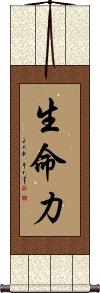
生命力 can mean “vitality” or “libido.”
The first two characters mean “life” or “life force.” The last character is a common word that means “strength.” So together, you get the meaning of “life strength” which is the essence of vitality.
Some will also translate this word as “good health.”
See Also: Life Force | Health
Good Health
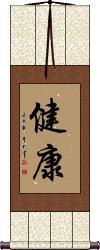
Good Health / Healthy / Vigor
Also suggests being at peace
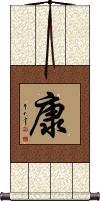
康 is a single character that means good health or vigor in Chinese, Japanese Kanji, and old Korean Hanja.
康 can also mean peaceful, at ease, or abundant in some contexts.
Please note that this is rarely seen alone in Japanese Kanji. In Japanese, it is used both for health-related compound words and to denote the kouhou through koushou eras of Japan.
In Korean, this can also be the family name “Kang” (caution: not the only family name romanized as Kang in Korean).
Life Force
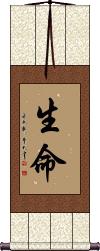
This Chinese, Korean and Japanese word means “life force” or simply “life.”
The first character means “life” or “birth.” The second means “life” or “fate.” Together they create the meaning of “life force,” though some will translate this as “existence” and sometimes “vitality.”
See Also: Birth
Healthy Living
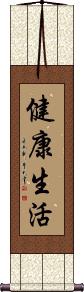
If you are into healthy living, 健康生活 might be an excellent selection for a wall scroll to hang in your home.
The first two characters speak of health, vitality, vigor, and being of sound body. The second two characters mean living or life (daily existence).
Life Energy / Spiritual Energy
Chi Energy: Essence of Life / Energy Flow
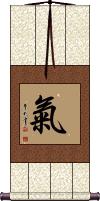
This 氣 energy flow is a fundamental concept of traditional Asian culture.
氣 is romanized as “Qi” or “Chi” in Chinese, “Gi” in Korean, and “Ki” in Japanese.
Chi is believed to be part of everything that exists, as in “life force” or “spiritual energy.” It is most often translated as “energy flow” or literally as “air” or “breath.” Some people will simply translate this as “spirit,” but you must consider the kind of spirit we're talking about. I think this is weighted more toward energy than spirit.
The character itself is a representation of steam (or breath) rising from rice. To clarify, the character for rice looks like this: 
Steam was apparently seen as visual evidence of the release of “life energy” when this concept was first developed. The Qi / Chi / Ki character is still used in compound words to mean steam or vapor.
The etymology of this character is a bit complicated. It's suggested that the first form of this character from bronze script (about 2500 years ago) looked like these samples: 

However, it was easy to confuse this with the character for the number three. So the rice radical was added by 221 B.C. (the exact time of this change is debated). This first version with the rice radical looks like this: 
The idea of Qi / Chi / Ki is really a philosophical concept. It's often used to refer to the “flow” of metaphysical energy that sustains living beings. Yet there is much debate that has continued for thousands of years as to whether Qi / Chi / Ki is pure energy or consists partially or fully of matter.
You can also see the character for Qi / Chi / Ki in common compound words such as Tai Chi / Tai Qi, Aikido, Reiki, and Qi Gong / Chi Kung.
In the modern Japanese Kanji, the rice radical has been changed into two strokes that form an X.
 The original and traditional Chinese form is still understood in Japanese, but we can also offer that modern Kanji form in our custom calligraphy. If you want this Japanese Kanji, please click on the character to the right instead of the “Select and Customize” button above.
More language notes: This is pronounced like “chee” in Mandarin Chinese, and like “key” in Japanese.
This is also the same way to write this in Korean Hanja where it is Romanized as “gi” and pronounced like “gee” but with a real G-sound, not a J-sound.
Though Vietnamese no longer use Chinese characters in their daily language, this character is still widely known in Vietnam.
See Also: Energy | Life Force | Life | Birth | Soul
Wellness
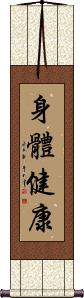
身體健康 is how to express “wellness” in Chinese. The meaning is not much different than the idea of “good health.” The first two characters alone are often translated as “health.” Some will also translate this title as “physical health.”
If you want to fill your room with a feeling of wellness, this is the wall scroll for you.
This is also the ancient way to express wellness in Japanese Kanji and old Korean Hanja. The modern Japanese form is 身体健康 (the only difference is the second Kanji). Let me know if you need your calligraphy written in modern Japanese.
See Also: Health
The Spirit of Dragon and Tiger
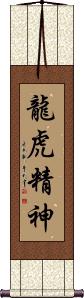
龍虎精神 means the spirit of the dragon and tiger.
It speaks to the vitality and vigor that is the nature of these two creatures.
Beyond “spirit,” the last two characters can also mean mind, soul, or heart. Therefore, you can also say this means “Heart of the Dragon and Tiger,” etc.
龍虎精神 is often titled “Ryukoseishin” in many Japanese martial arts.
Independent Spirit
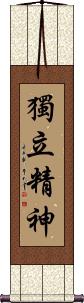
獨立精神 means independent spirit in Chinese.
The first two characters mean independent, independence, or to stand alone.
The last two characters mean spirit, spiritual, vigor, vitality, drive, mind, consciousness, thought, essence, heart, or soul.
With this information, you can make your translation combination such as “independent heart,” “stand-alone spirit,” or more creatively, “the drive to stand alone” in English. There are a lot of ways to interpret 獨立精神.
Spirit
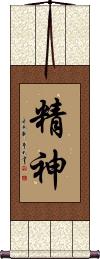
精神 is the kind of spirit you have if you perform well in sports or competitions. It is the idea of having a good attitude and putting your all into something - so much so that others can see or feel your spirit. It is the essence of your being that can only be subjectively described because there are no words that can fully explain what “spirit” really is.
For your information:
My Japanese dictionary further tries to explain this word by comparing it to mind, soul, heart, or intention.
My Chinese dictionary compares these characters to meanings like vigor, vitality, drive, and mentality.
My Korean dictionary defines this as mind, spirit, and soul.
Warrior Soul / Heroic Spirit
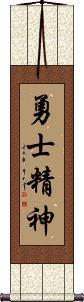
勇士精神 can be translated as the warrior's spirit or warrior's soul. The first two characters can be translated as “warrior” or literally “brave soldier/man,” although some will translate this word as “hero.” Therefore, this is also how to say “heroic spirit.”
The second two characters mean vigor, vitality, drive, spirit, mind, heart, mental essence, and psychological component. Basically “your soul.”
We have two versions of this phrase. The only difference is the first two and last two characters are swapped. The version here suggests that you admire or like the idea of the spirit of a warrior. The other version suggests that you are the warrior or hero.
Strong / Powerful
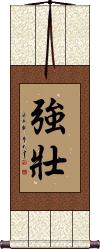
強壯 is an adjective that means powerful or strong.
It can also be translated as able-bodied, robust, or sturdy.
This version of strength also suggests muscularity.
 Note that the second character was simplified in Japan after WWII (also simplified in mainland China but not for calligraphy). If you want the modern Japanese/simplified version, please click on the Kanji shown to the right.
Birth / Life
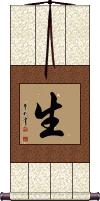
生 is a Chinese word that means “to be born” and “to give birth.”
Also, it's often used to refer to life itself, and sometimes “to grow.”
生 is used in a lot of compound words such as “yi sheng,” which means “doctor” (literally “healer of life”), “sheng ri” which means “birthday” (literally “birth-day”), and “xue sheng” which means student (literally “studying life” or “learner [about] life”). Few Chinese people will think of the literal meaning when this uses words like doctor and student - but it is interesting to note.
生 has the same root meaning in Korean Hanja and Japanese. However, in Japanese, there are many possible pronunciations, and this can be used to mean “raw” or “unprocessed” (as in draft beer). Therefore, not be the best if your audience is Japanese.
Dynamic Energy / Enthusiasm
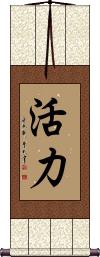
活力 is a Chinese, Japanese, and Korean word that can be defined as energy, vitality, vigor, vital force, enthusiasm, energetic, or dynamism.
Dynamic Energy / Enthusiasm
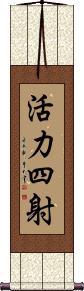
活力四射 is a Chinese word that can be defined as dynamic; enthusiastic; energetic; vitality.
This is the more robust 4-character version of this word. The short version consists of the first two characters: 活力. This 4-character version is commonly used only in Chinese.
Three Treasures of Chinese Medicine
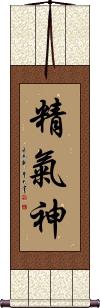
精, 氣, 神 are the characters jing, qi, and shen.
As a set, these three characters are known in English as the treasures of traditional Chinese medicine, the treasures of Qi Gong, or the three treasures of Taoism / Daoism.
Sometimes this set is titled 三寶 (sānbǎo) or “three treasures,” but here, we're writing each treasure out.
Here's how these characters are perceived in this context...
Jing: nutritive essence; refined; perfected; pure
Qi: vitality; energy; force; breath; vigor
Shen: spirit; soul; mind; being
To keep it simple, you can use “essence, vitality, and spirit” to define these.
Stamina / Vigor
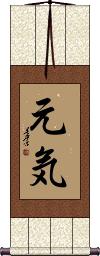
This Japanese word has a broad range of meanings. It can mean healthy, robust, vigor, vitality, stamina, spirit, or pep.
元気 is also used in part of a Japanese greeting, similar to “How are you doing?” but more like “How's your health?.”
Power / Strength
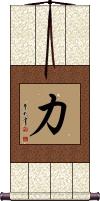
力 is the simplest form of “power” or “strength.”
In Japanese, it is pronounced “chikara” when used alone, and “ryoku” when used in a sentence (there are also a few other possible pronunciations of this Kanji in Japanese).
In some contexts, this can mean ability, force, physical strength, capability, and influence.
Vitality / Virility
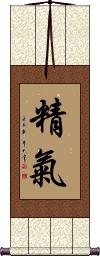
精氣 is a Chinese, Japanese, and Korean word that means vitality or virility.
Depending on the context, this can also mean “mind and spirit,” “life energy,” or “essence.”
This term is often used in Buddhism with the same meaning.
Note: In modern Japanese, they have simplified the last Kanji to look like the version shown to the right. If you want this modern version, please click on this Kanji. Otherwise, if you click the button above, you’ll get the ancient or traditional version (which is also universal between Chinese, old Korean, and old Japanese).
Soul of a Warrior
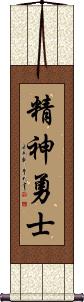
精神勇士 can be translated as the spirit or soul of a warrior. The first two characters can be translated as vigor, vitality, drive, spirit, mind, heart, mental essence, and psychological component. Basically, “your soul.”
The second two characters mean “warrior” or literally “brave soldier/man,” although some will translate this word as “hero.” Therefore, this is also how to say “soul of a hero.”
Note: This title is best for Chinese and old Korean. It does make sense in Japanese but is not a common or natural Kanji combination in Japanese.
We have two versions of this phrase. The only difference is the first two and last two characters are swapped. The version here suggests that you are the warrior or hero. The other version suggests that you admire or like the idea of the spirit of a warrior.
Seiryoku Zenyo
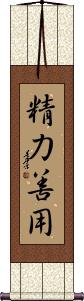
精力善用 means “maximum efficiency” and is often associated with Judo.
It is often matched with “Jita Kyoei” (mutual benefit) to complete the philosophy of Kodokan Judo.
精力 = sei ryoku = energy, vigor, and/or vitality.
善用 = zen yo = to be good at using (something), or to put (something) to good use.
Seishin Budo
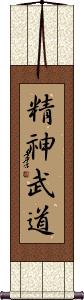
精神武道 is the Japanese martial arts title, Seishin Budo.
The first two characters, 精神, can mean vigor, vitality, drive, spiritual, mind, spirit, soul, heart, ethos, attitude, mentality, will, intention, essence, and fundamental significance.
The last two characters, 武道, are the Japanese word for martial arts (literally the Martial Way).
This title can also be romanized as Seshin Budou or Seishin Budō.
Seiryoku Saizen Katsuyo
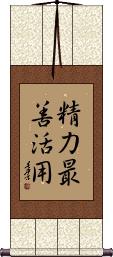
This is Seiryoku Saizen Katsuyō in Japanese.
The meaning is roughly “Optimal Use of Energy” although it can be translated in several other ways.
精力 = Energy/Vigor/Vitality
最善 = Optimal/Best/Utmost
活用 = Use/Employ/Engage
Seishin-Kai / Seishinkai
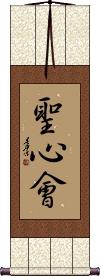
聖心会 is the Japanese martial arts title “Seishinkai” or “Seishin-Kai.”
It literally means “Sacred Heart Association” or “Pure-Heart Club.”
聖 can mean holy, sacred, saint, sage, virtuous, expert, wise and good, upright, or correct.
心 can mean heart, mind, center, core, spirit, soul, or vitality.
聖心 creates a word meaning sacred heart, or the holy mind (that of Buddha).
会 in Japanese means association, club, meeting, assembly, party, gathering, conference, athletic meet, or society.
This in-stock artwork might be what you are looking for, and ships right away...
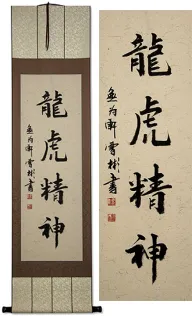
Gallery Price: $200.00
Your Price: $99.88
The following table may be helpful for those studying Chinese or Japanese...
| Title | Characters | Romaji (Romanized Japanese) | Various forms of Romanized Chinese | |
| Vitality | 生命力 | seimeiryoku | shēng mìng lì sheng1 ming4 li4 sheng ming li shengmingli | |
| Good Health | 健康 | kenkou / kenko | jiàn kāng jian4 kang1 jian kang jiankang | chien k`ang chienkang chien kang |
| Good Health Healthy Vigor | 康 | kou / ko | kāng / kang1 / kang | k`ang / kang |
| Life Force | 生命 | seimei / inochi | shēng mìng sheng1 ming4 sheng ming shengming | |
| Healthy Living | 健康生活 | kenkou seikatsu kenkouseikatsu kenko seikatsu | jiàn kāng shēng huó jian4 kang1 sheng1 huo2 jian kang sheng huo jiankangshenghuo | chien k`ang sheng huo chienkangshenghuo chien kang sheng huo |
| Life Energy Spiritual Energy | 氣 气 / 気 | ki | qì / qi4 / qi | ch`i / chi |
| Wellness | 身體健康 身体健康 | shin tai ken kou shintaikenkou shin tai ken ko | shēn tǐ jiàn kāng shen1 ti3 jian4 kang1 shen ti jian kang shentijiankang | shen t`i chien k`ang shentichienkang shen ti chien kang |
| The Spirit of Dragon and Tiger | 龍虎精神 龙虎精神 | ryu ko sei shin ryukoseishin | lóng hǔ jīng shén long2 hu3 jing1 shen2 long hu jing shen longhujingshen | lung hu ching shen lunghuchingshen |
| Independent Spirit | 獨立精神 独立精神 | dú lì jīng shén du2 li4 jing1 shen2 du li jing shen dulijingshen | tu li ching shen tulichingshen |
|
| Spirit | 精神 | sei shin / seishin | jīng shén jing1 shen2 jing shen jingshen | ching shen chingshen |
| Warrior Soul Heroic Spirit | 勇士精神 | yǒng shì jīng shén yong3 shi4 jing1 shen2 yong shi jing shen yongshijingshen | yung shih ching shen yungshihchingshen |
|
| Strong Powerful | 強壯 强壮 | kyousou / kyoso | qiáng zhuàng qiang2 zhuang4 qiang zhuang qiangzhuang | ch`iang chuang chiangchuang chiang chuang |
| Birth Life | 生 | shou / iku / sho / iku | shēng / sheng1 / sheng | |
| Dynamic Energy Enthusiasm | 活力 | katsuryoku | huó lì / huo2 li4 / huo li / huoli | |
| Dynamic Energy Enthusiasm | 活力四射 | huó lì sì shè huo2 li4 si4 she4 huo li si she huolisishe | huo li ssu she huolissushe |
|
| Three Treasures of Chinese Medicine | 精氣神 精气神 | jīng qì shén jing1 qi4 shen2 jing qi shen jingqishen | ching ch`i shen chingchishen ching chi shen |
|
| Stamina Vigor | 元気 | genki | ||
| Power Strength | 力 | chikara / ryoku | lì / li4 / li | |
| Vitality Virility | 精氣 精气 | seiki | jīng qì / jing1 qi4 / jing qi / jingqi | ching ch`i / chingchi / ching chi |
| Soul of a Warrior | 精神勇士 | jīng shén yǒng shì jing1 shen2 yong3 shi4 jing shen yong shi jingshenyongshi | ching shen yung shih chingshenyungshih |
|
| Seiryoku Zenyo | 精力善用 | sei ryoku zen yo seiryokuzenyo | ||
| Seishin Budo | 精神武道 | seishin budou seishinbudou seishin budo | ||
| Seiryoku Saizen Katsuyo | 精力最善活用 | Seiryoku saizen katsuyou Seiryokusaizenkatsuyou Seiryoku saizen katsuyo | ||
| Seishin-Kai Seishinkai | 聖心会 / 聖心會 聖心会 | sei shin kai seishinkai | ||
| In some entries above you will see that characters have different versions above and below a line. In these cases, the characters above the line are Traditional Chinese, while the ones below are Simplified Chinese. | ||||




