I am shipping orders on Thursday this week. News and More Info

Many custom options...

Tan Paper and Copper Silk Love Wall Scroll
Red Paper and Ivory Silk Love Wall Scroll
Orange Paper Love Scroll
Crazy Blue and Gold Silk Love Scroll


And formats...

Love Vertical Portrait
Love Horizontal Wall Scroll
Love Vertical Portrait

Self Reflection in Chinese / Japanese...

Buy a Self Reflection calligraphy wall scroll here!

Personalize your custom “Self Reflection” project by clicking the button next to your favorite “Self Reflection” title below...

 yǐng
 kage
 
Shadow Scroll

影 means shadow in Chinese, Japanese Kanji, and old Korean Hanja.

Depending on the context, this can also mean silhouette, reflection, image, or presence.

Keiko

Shadow / Reflection

 yǐng zi
 keiko
Keiko Scroll

This word means shadow or reflection.

This is a common female given name in Japanese where it's romanized as Keiko or Kēko.

 fǎn xǐng
 hansei / hanse
Reflect Scroll

反省 is the Chinese, Japanese Kanji, and old Korean Hanja means several things, including reflecting upon oneself, examining one's conscience, questioning oneself, searching one's soul, reflection, reconsideration, introspection, meditation, contemplation, regret, repentance, remorse.

Introspection / Self-Awareness

 zì xǐng
 jisei
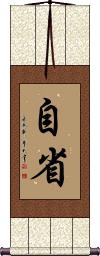
Introspection / Self-Awareness Scroll

自省 is the Chinese, Japanese Kanji, and old Korean Hanja means: to examine oneself; to reflect on one's shortcomings; introspection; self-awareness; self-criticism; self-examination; reflection.

In Japanese, this can be the given name, Jisei.

One who walks by the river may end up with wet feet

 cháng zài hé biān zǒu nǎ néng bù shī xié
One who walks by the river may end up with wet feet Scroll

常在河邊走哪能不濕鞋 is an old Chinese proverb that is sometimes compared to the English saying “Shit Happens.”

It's a reflection that there are risks in life, and you should not be surprised when things don't go your way.

A secondary translation might be, “When walking by a river, often one cannot avoid wet shoes.”


This in-stock artwork might be what you are looking for, and ships right away...

Gallery Price: $140.00

Your Price: $49.88

Gallery Price: $60.00

Your Price: $36.88

Gallery Price: $60.00

Your Price: $36.88

Gallery Price: $60.00

Your Price: $36.88
Gallery Price: $300.00

Your Price: $128.88

Gallery Price: $200.00

Your Price: $88.88

Gallery Price: $60.00

Your Price: $36.88

Gallery Price: $60.00

Your Price: $36.88
Gallery Price: $63.00

Your Price: $35.00

Gallery Price: $63.00

Your Price: $35.00

Gallery Price: $220.00

Your Price: $138.88

Gallery Price: $180.00

Your Price: $99.77


Not the results for self reflection that you were looking for?

Below are some entries from our dictionary that may match your self reflection search...

Characters

If shown, 2nd row is Simp. Chinese

Pronunciation
Romanization
Simple Dictionary Definition

see styles
yǐng
    ying3
ying
 kage
    かげ

More info & calligraphy:

Shadow
picture; image; film; movie; photograph; reflection; shadow; trace
(1) shadow; silhouette; figure; shape; (2) reflection; image; (3) ominous sign; (4) light (stars, moon); (5) trace; shadow (of one's former self); (surname) Kage
Shadow, picture, image, reflection, hint; one of the twelve 'colours'.


see styles
shàn
    shan4
shan
 yuzuri
    ゆずり

More info & calligraphy:

Zen / Chan / Meditation
to abdicate
(out-dated kanji) (1) (Buddhist term) dhyana (profound meditation); (2) (abbreviation) Zen (Buddhism); (surname) Yuzuri
To level a place for an altar, to sacrifice to the hills and fountains; to abdicate. Adopted by Buddhists for dhyāna, 禪 or 禪那, i.e. meditation, abstraction, trance. dhyāna is 'meditation, thought, reflection, especially profound and abstract religious contemplation'. M.W. It was intp. as 'getting rid of evil', etc., later as 靜慮 quiet meditation. It is a form of 定, but that word is more closely allied with samādhi, cf. 禪定. The term also connotes Buddhism and Buddhist things in general, but has special application to the 禪宗 q.v. It is one of the six pāramitās, cf. 波. There are numerous methods and subjects of meditation. The eighteen brahmalokas are divided into four dhyāna regions 'corresponding to certain frames of mind where individuals might be reborn in strict accordance with their spiritual state'. The first three are the first dhyāna, the second three the second dhyāna, the third three the third dhyāna, and the remaining nine the fourth dhyāna. See Eitel. According to Childers' Pali Dictionary, 'The four jhānas are four stages of mystic meditation, whereby the believer's mind is purged from all earthly emotions, and detached as it were from his body, which remains plunged in a profound trance.' Seated cross-legged, the practiser 'concentrates his mind upon a single thought. Gradually his soul becomes filled with a supernatural ecstasy and serenity', his mind still reasoning: this is the first jhāna. Concentrating his mind on the same subject, he frees it from reasoning, the ecstasy and serenity remaining, which is the second jhāna. Then he divests himself of ecstasy, reaching the third stage of serenity. Lastly, in the fourth stage the mind becomes indifferent to all emotions, being exalted above them and purified. There are differences in the Mahāyāna methods, but similarity of aim.

see styles
cài
    cai4
ts`ai
    tsai
 hanako
    はなこ

More info & calligraphy:

Chay
surname Cai
(female given name) Hanako
chāyā, a shadow, reflection; gnomon, dial.

反省

see styles
fǎn xǐng
    fan3 xing3
fan hsing
 hansei / hanse
    はんせい

More info & calligraphy:

Reflect
to reflect upon oneself; to examine one's conscience; to question oneself; to search one's soul
(noun, transitive verb) (1) reflection; reconsideration; introspection; meditation; contemplation; (noun, transitive verb) (2) regret; repentance; remorse; being sorry

影子

see styles
yǐng zi
    ying3 zi5
ying tzu
 keiko / keko
    けいこ

More info & calligraphy:

Keiko
shadow; reflection; (fig.) hint; indication; influence; CL:個|个[ge4]
(female given name) Keiko

自省

see styles
zì xǐng
    zi4 xing3
tzu hsing
 jisei / jise
    じせい

More info & calligraphy:

Introspection / Self-Awareness
to examine oneself; to reflect on one's shortcomings; introspection; self-awareness; self-criticism
(noun, transitive verb) self-examination; reflection; (given name) Jisei

see styles
jǐng
    jing3
ching
 miyoshi
    みよし
(bound form) scenery; circumstance; situation; scene (of a play); (literary) sunlight
(1) vista; view; scene; scenic view; (suf,ctr) (2) counter for scenes (in a play); (female given name) Miyoshi
Prospect, view, circumstances.

see styles
zhào
    zhao4
chao
 hikaru
    ひかる
according to; in accordance with; to shine; to illuminate; to reflect; to look at (one's reflection); to take (a photo); photo; as requested; as before
(given name) Hikaru
To shine, illumine; to superintend; a dispatch, pass; as, according to.

三思

see styles
sān sī
    san1 si1
san ssu
 mitsuji
    みつじ
(n,vs,vi) deep reflection; (personal name) Mitsuji
All action and speech have three mental conditions— reflection, judgment, decision.

三慧

see styles
sān huì
    san1 hui4
san hui
 misato
    みさと
(female given name) Misato
The three modes of attaining moral wisdom: 聞慧 from reading, hearing, instruction; 思慧 from reflection, etc.; 修慧 from practice (of abstract meditation).

三省

see styles
 miyoshi
    みよし
(noun, transitive verb) frequent reflection; frequent meditation; (personal name) Miyoshi

倒影

see styles
dào yǐng
    dao4 ying3
tao ying
 touei / toe
    とうえい
inverted image; reversed image (e.g. upside down)
reflection

像現


像现

see styles
xiàng xiàn
    xiang4 xian4
hsiang hsien
 zōgen
reflection of forms

内省

see styles
 naisei / naise
    ないせい
(noun, transitive verb) introspection; reflection on one's self

写り

see styles
 utsuri
    うつり
(n,n-suf) (1) projection; reflection; image; reception (e.g. TV); picture quality; (2) match; harmony

反射

see styles
fǎn shè
    fan3 she4
fan she
 hansha
    はんしゃ
to reflect; reflection (from a mirror etc); reflex (i.e. automatic reaction of organism)
(n,vs,vt,vi) (1) {physics} reflection; reverberation; (2) {physiol} reflex; reflexes

反影

see styles
 hanei / hane
    はんえい
(noun/participle) (1) reflection (light, image, situation, attitude, etc.); reflecting; (2) influence; application (e.g. of an update)

反思

see styles
fǎn sī
    fan3 si1
fan ssu
to think back over something; to review; to revisit; to rethink; reflection; reassessment

反映

see styles
fǎn yìng
    fan3 ying4
fan ying
 hanei / hane
    はんえい
to mirror; to reflect; mirror image; reflection; (fig.) to report; to make known; to render
(noun/participle) (1) reflection (light, image, situation, attitude, etc.); reflecting; (2) influence; application (e.g. of an update)

反照

see styles
fǎn zhào
    fan3 zhao4
fan chao
 hanshou / hansho
    はんしょう
reflection
(noun/participle) (1) reflection; (noun/participle) (2) evening glow; sunset glow

四衆


四众

see styles
sì zhòng
    si4 zhong4
ssu chung
 shishu; shishuu / shishu; shishu
    ししゅ; ししゅう
(1) four orders of Buddhist followers (monks, nuns, male lay devotees and female lay devotees); (2) four monastic communities (ordained monks, ordained nuns, male novices and female novices); (3) (in Tendai) the four assemblies
The four varga (groups, or orders), i. e. bhikṣu, bhikṣuṇī, upāsaka and upāsikā, monks, nuns, male and female devotees. Another group, according to Tiantai's commentary on the Lotus, is 發起衆 the assembly which, through Śāriputra, stirred the Buddha to begin his Lotus Sutra sermons; 當機衆 the pivotal assembly, those who were responsive to him; 影向衆 the reflection assembly, those like Mañjuśrī, etc., who reflected on, or drew out the Buddha's teaching; and 結緣衆 those who only profited in having seen and heard a Buddha, and therefore whose enlightenment is delayed to a future life.

回想

see styles
huí xiǎng
    hui2 xiang3
hui hsiang
 kaisou / kaiso
    かいそう
to recall; to recollect; to think back
(noun, transitive verb) recollection; retrospection; reflection; reminiscence

後感


后感

see styles
hòu gǎn
    hou4 gan3
hou kan
afterthought; reflection after an event; a review (of a movie etc)

思惟

see styles
sī wéi
    si1 wei2
ssu wei
 shiyui
    しゆい
variant of 思維|思维[si1 wei2]
(n,vs,vt,vi) (1) (esp. しい) thought; thinking; contemplation; consideration; (n,vs,vt,vi) (2) {Buddh} (esp. しゆい) using wisdom to get to the bottom of things; focusing one's mind; deep contemplation; concentrated thought; deliberating; pondering; reflecting; (female given name) Shiyui
To consider or reflect on an object with discrimination; thought, reflection.

思案

see styles
sī àn
    si1 an4
ssu an
 shian
    しあん
(noun, transitive verb) careful thought; consideration; deliberation; reflection; rumination; pondering; (given name) Shian
to think

映り

see styles
 utsuri
    うつり
(n,n-suf) (1) projection; reflection; image; reception (e.g. TV); picture quality; (2) match; harmony

映像

see styles
yìng xiàng
    ying4 xiang4
ying hsiang
 eizou / ezo
    えいぞう
reflection; image (in a mirror)
(1) image (on a screen); picture (e.g. on a TV); (2) video; film; footage; (3) reflection; (4) image (in one's mind); mental picture

暗愁

see styles
 anshuu / anshu
    あんしゅう
sad thought; depressing reflection

水月

see styles
shuǐ yuè
    shui3 yue4
shui yüeh
 mizuki
    みづき
(1) water and the Moon; (2) the Moon reflected on the water; (3) solar plexus (as a pressure point in martial arts); (female given name) Mizuki
udakacandra; jalacandra; the moon reflected in the water, i. e. all is illusory and unreal.

沉澱


沉淀

see styles
chén diàn
    chen2 dian4
ch`en tien
    chen tien
(chemistry) to settle; to precipitate; (chemistry) sediment; precipitate; (fig.) (of emotions, thoughts, experience etc) to settle and be absorbed over time; to take shape gradually (through reflection or maturation)

Click here for more self reflection results from our dictionary

The following table may be helpful for those studying Chinese or Japanese...

Title CharactersRomaji (Romanized Japanese)Various forms of Romanized Chinese
Shadowkageyǐng / ying3 / ying
Keiko影子keikoyǐng zi / ying3 zi5 / ying zi / yingziying tzu / yingtzu
Reflect反省hansei / hansefǎn xǐng / fan3 xing3 / fan xing / fanxingfan hsing / fanhsing
Introspection
Self-Awareness
自省jiseizì xǐng / zi4 xing3 / zi xing / zixingtzu hsing / tzuhsing
One who walks by the river may end up with wet feet常在河邊走哪能不濕鞋
常在河边走哪能不湿鞋
cháng zài hé biān zǒu nǎ néng bù shī xié
chang2 zai4 he2 bian1 zou3 na3 neng2 bu4 shi1 xie2
chang zai he bian zou na neng bu shi xie
ch`ang tsai ho pien tsou na neng pu shih hsieh
chang tsai ho pien tsou na neng pu shih hsieh
In some entries above you will see that characters have different versions above and below a line.
In these cases, the characters above the line are Traditional Chinese, while the ones below are Simplified Chinese.


Dictionary

Lookup Self Reflection in my Japanese & Chinese Dictionary


Successful Chinese Character and Japanese Kanji calligraphy searches within the last few hours...


50th AnniversaryAadenAadonAakashAaroAbayaAbbasAbbeyAbbieAbhishekAbigaiAbundance and ProsperityAdamAdamarisAdapt and OvercomeAddieAddyAdejahAdelineAdityaAdnanAdonisAdrianaAdriannaAdrielAguilarAhmadAileenAimiAishaAjayAkbarAkilaAlanaAleishaAlessaAlessandraAlessioAlexAlexandraAlexandriaAlfiAliaAliceAlinaAlishaAliyaAllaAllahAlliAllyAlmedaAlmighty OmnipotentAloraAlvinAlyshaAlyssaAlyssiaAmadAmalAmelAminAmirAnasAndreAndreiAndyAngelAnilAnjaniAnne-SophieAntonAntonellaAntonioApolloArelyAriaArisaArlenArloArmanArunaAshrafAslamAubreeAubreyAudiAuraAureliaAvengerAyanAydenAymanAzuraBa Gua ZhangBaileeBaileyBashaBasilBayuBeautyBeauty of NatureBellaBelovedBeniBennettBhumikaBiancaBibekBibiBible VerseBillieBishalBlack Tiger FistBlacksmithBlairBlessed by GodBradenBradyBraedenBraydenBristolBritneyBrockBryanBrysonBubbaBuddha Dharma SanghaButterflyCallieCamdenCarenCarleenCarmenCasperCassieCecilienChantalChanteChelseaChen SurnameCherryChevelleChinoChop Wood Carry WaterChristinaClaireCobraColeCompassionConnieConnorConstanceCorbinCosmoCourageCristianCullenCyrilDamarisDanaDaniDaniaDaniealDanielleDaniloDaodejingDaodejing Tao Te Ching - Chapter 54DaphneDariaDark AngelDarrenDarrylDaruDavianDeath Before DishonorDeepikaDefenseDerrickDeterminationDevonDharmaDianaDillowDimaDogenDominicDouglasDoveDragonDrewDuncanDustinDwightEdieEduardoEdwardsEldiEleanorEleonor

All of our calligraphy wall scrolls are handmade.

When the calligrapher finishes creating your artwork, it is taken to my art mounting workshop in Beijing where a wall scroll is made by hand from a combination of silk, rice paper, and wood.
After we create your wall scroll, it takes at least two weeks for air mail delivery from Beijing to you.

Allow a few weeks for delivery. Rush service speeds it up by a week or two for $10!

When you select your calligraphy, you'll be taken to another page where you can choose various custom options.


A nice Chinese calligraphy wall scroll

The wall scroll that Sandy is holding in this picture is a "large size"
single-character wall scroll.
We also offer custom wall scrolls in small, medium, and an even-larger jumbo size.

A professional Chinese Calligrapher

Professional calligraphers are getting to be hard to find these days.
Instead of drawing characters by hand, the new generation in China merely type roman letters into their computer keyboards and pick the character that they want from a list that pops up.

There is some fear that true Chinese calligraphy may become a lost art in the coming years. Many art institutes in China are now promoting calligraphy programs in hopes of keeping this unique form of art alive.

Trying to learn Chinese calligrapher - a futile effort

Even with the teachings of a top-ranked calligrapher in China, my calligraphy will never be good enough to sell. I will leave that to the experts.

A high-ranked Chinese master calligrapher that I met in Zhongwei

The same calligrapher who gave me those lessons also attracted a crowd of thousands and a TV crew as he created characters over 6-feet high. He happens to be ranked as one of the top 100 calligraphers in all of China. He is also one of very few that would actually attempt such a feat.


Check out my lists of Japanese Kanji Calligraphy Wall Scrolls and Old Korean Hanja Calligraphy Wall Scrolls.

Some people may refer to this entry as Self Reflection Kanji, Self Reflection Characters, Self Reflection in Mandarin Chinese, Self Reflection Characters, Self Reflection in Chinese Writing, Self Reflection in Japanese Writing, Self Reflection in Asian Writing, Self Reflection Ideograms, Chinese Self Reflection symbols, Self Reflection Hieroglyphics, Self Reflection Glyphs, Self Reflection in Chinese Letters, Self Reflection Hanzi, Self Reflection in Japanese Kanji, Self Reflection Pictograms, Self Reflection in the Chinese Written-Language, or Self Reflection in the Japanese Written-Language.

104 people have searched for Self Reflection in Chinese or Japanese in the past year.
Self Reflection was last searched for by someone else on Oct 18th, 2025