I am shipping orders on Thursday this week. News and More Info

Many custom options...

Tan Paper and Copper Silk Love Wall Scroll
Red Paper and Ivory Silk Love Wall Scroll
Orange Paper Love Scroll
Crazy Blue and Gold Silk Love Scroll


And formats...

Love Vertical Portrait
Love Horizontal Wall Scroll
Love Vertical Portrait

One Time One Meeting in Chinese / Japanese...

Buy an One Time One Meeting calligraphy wall scroll here!

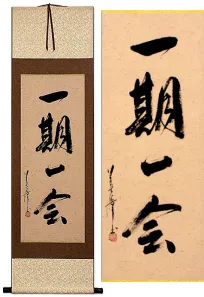
Once in a Lifetime
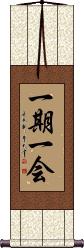
 yī qī yī huì
 ichigo ichie
Once in a Lifetime Scroll

This Japanese title can be translated as “for this time only,” “chance meeting,” “one meeting, one opportunity,” “never again,” or “one chance in a lifetime.”

The characters literally mean “one time one meeting” - of course, the Kanji characters have meaning far beyond a direct translation like this.

Some might use this proverb to talk of an opportunity that presents itself just once in your life. It could also be a one-and-only chance meeting with your true soul mate. An expression of any event that might happen once in a lifetime.


This is primarily a Japanese title, however, there is also a Traditional Chinese (and old Korean) version of this proverb. Just the last character is different.
會The traditional form was used in Japan before WWII and in Korea prior to 1900. This title is somewhat known in China.

If you want the older traditional form, just click on the character to the right.


This in-stock artwork might be what you are looking for, and ships right away...

Gallery Price: $200.00

Your Price: $88.88

Gallery Price: $466.00

Your Price: $258.88

Gallery Price: $60.00

Your Price: $36.88
Gallery Price: $61.00

Your Price: $33.88

Gallery Price: $60.00

Your Price: $36.88

Gallery Price: $60.00

Your Price: $36.88

Gallery Price: $200.00

Your Price: $69.88

Gallery Price: $60.00

Your Price: $39.88

Not the results for one time one meeting that you were looking for?

Below are some entries from our dictionary that may match your one time one meeting search...

Characters

If shown, 2nd row is Simp. Chinese

Pronunciation
Romanization
Simple Dictionary Definition

久慕

see styles
jiǔ mù
    jiu3 mu4
chiu mu
lit. I've admired you for a long time (honorific).; I've been looking forward to meeting you.; It's an honor to meet you at last.

今次

see styles
jīn cì
    jin1 ci4
chin tz`u
    chin tzu
 imatsugu
    いまつぐ
this; the present (meeting etc); this time; this once
(adj-no,n,adv) the present time; new; recent; (surname) Imatsugu

初会

see styles
 shokai
    しょかい
(noun - becomes adjective with の) meeting for the first time; first meeting

初次

see styles
chū cì
    chu1 ci4
ch`u tz`u
    chu tzu
 hatsuji
    はつじ
for the first time; first (meeting, attempt etc)
(given name) Hatsuji

初見

see styles
 hatsumi
    はつみ
(noun, transitive verb) (1) (form) seeing for the first time; first sight; first meeting; (2) {music} sight-reading; (surname, female given name) Hatsumi

小乘

see styles
xiǎo shèng
    xiao3 sheng4
hsiao sheng
 shōjō
Hinayana, the Lesser Vehicle; Buddhism in India before the Mayahana sutras; also pr. [Xiao3 cheng2]
Hīnayāna 希那衍. The small, or inferior wain, or vehicle; the form of Buddhism which developed after Śākyamuni's death to about the beginning of the Christian era, when Mahāyāna doctrines were introduced. It is the orthodox school and more in direct line with the Buddhist succession than Mahāyānism which developed on lines fundamentally different. The Buddha was a spiritual doctor, less interested in philosophy than in the remedy for human misery and perpetual transmigration. He "turned aside from idle metaphysical speculations; if he held views on such topics, he deemed them valueless for the purposes of salvation, which was his goal" (Keith). Metaphysical speculations arose after his death, and naturally developed into a variety of Hīnayāna schools before and after the separation of a distinct school of Mahāyāna. Hīnayāna remains the form in Ceylon, Burma, and Siam, hence is known as Southern Buddhism in contrast with Northern Buddhism or Mahāyāna, the form chiefly prevalent from Nepal to Japan. Another rough division is that of Pali and Sanskrit, Pali being the general literary language of the surviving form of Hīnayāna, Sanskrit of Mahāyāna. The term Hīnayāna is of Mahāyānist origination to emphasize the universalism and altruism of Mahāyāna over the narrower personal salvation of its rival. According to Mahāyāna teaching its own aim is universal Buddhahood, which means the utmost development of wisdom and the perfect transformation of all the living in the future state; it declares that Hīnayāna, aiming at arhatship and pratyekabuddhahood, seeks the destruction of body and mind and extinction in nirvāṇa. For arhatship the 四諦Four Noble Truths are the foundation teaching, for pratyekabuddhahood the 十二因緣 twelve-nidānas, and these two are therefore sometimes styled the two vehicles 二乘. Tiantai sometimes calls them the (Hīnayāna) Tripiṭaka school. Three of the eighteen Hīnayāna schools were transported to China: 倶舍 (Abhidharma) Kośa; 成實 Satya-siddhi; and the school of Harivarman, the律 Vinaya school. These are described by Mahāyānists as the Buddha's adaptable way of meeting the questions and capacity of his hearers, though his own mind is spoken of as always being in the absolute Mahāyāna all-embracing realm. Such is the Mahāyāna view of Hīnayāna, and if the Vaipulya sūtras and special scriptures of their school, which are repudiated by Hīnayāna, are apocryphal, of which there seems no doubt, then Mahāyāna in condemning Hīnayāna must find other support for its claim to orthodoxy. The sūtras on which it chiefly relies, as regards the Buddha, have no authenticity; while those of Hīnayāna cannot be accepted as his veritable teaching in the absence of fundamental research. Hīnayāna is said to have first been divided into minority and majority sections immediately after the death of Śākyamuni, when the sthāvira, or older disciples, remained in what is spoken of as "the cave", some place at Rājagṛha, to settle the future of the order, and the general body of disciples remained outside; these two are the first 上坐部 and 大衆部 q. v. The first doctrinal division is reported to have taken place under the leadership of the monk 大天 Mahādeva (q.v.) a hundred years after the Buddha's nirvāṇa and during the reign of Aśoka; his reign, however, has been placed later than this by historians. Mahādeva's sect became the Mahāsāṅghikā, the other the Sthāvira. In time the two are said to have divided into eighteen, which with the two originals are the so-called "twenty sects" of Hīnayāna. Another division of four sects, referred to by Yijing, is that of the 大衆部 (Arya) Mahāsaṅghanikāya, 上座部 Āryasthavirāḥ, 根本說一切有部 Mūlasarvāstivādaḥ, and 正量部 Saṃmatīyāḥ. There is still another division of five sects, 五部律. For the eighteen Hīnayāna sects see 小乘十八部.

日時

see styles
 nichiji
    にちじ
(1) date and time (of a meeting, departure, etc.); (2) days and hours

三摩耶

see styles
sān mó yé
    san1 mo2 ye2
san mo yeh
 sanmaya
    さんまや
(1) (Buddhist term) time (san: samaya); (2) (Buddhist term) meeting; coming together; (3) (Buddhist term) equality, warning, or riddance of hindrances (esp. in esoteric Buddhism as vows of the buddhas and bodhisattvas)
(or 三摩曳) idem 三昧耶; but 三摩耶 is also explained as a short period, a season of the year.

三昧耶

see styles
sān mèi yé
    san1 mei4 ye2
san mei yeh
 sanmaiya
    さんまや
(1) (Buddhist term) time (san: samaya); (2) (Buddhist term) meeting; coming together; (3) (Buddhist term) equality, warning, or riddance of hindrances (esp. in esoteric Buddhism as vows of the buddhas and bodhisattvas)
samaya is variously defined as 會 coming together, meeting, convention; 時 timely; 宗 in agreement, of the same class; 平等 equal, equalized; 驚覺 aroused, warned; 除垢障 riddance of unclean hindrances. Especially it is used as indicating the vows made by Buddhas and bodhisattvas, hence as a tally, symbol, or emblem of the spiritual quality of a Buddha or bodhisattva.

懸ける

see styles
 kakeru
    かける
(transitive verb) (1) (kana only) to hang (e.g. picture); to hoist (e.g. sail); to raise (e.g. flag); (2) (kana only) to sit; (3) (kana only) to take (time, money); to expend (money, time, etc.); (4) (kana only) to make (a call); (5) (kana only) to multiply; (6) (kana only) to secure (e.g. lock); (7) (kana only) to put on (glasses, etc.); (8) (kana only) to cover; (9) (kana only) to burden someone; (10) (kana only) to apply (insurance); (11) (kana only) to turn on (an engine, etc.); to set (a dial, an alarm clock, etc.); (12) (kana only) to put an effect (spell, anaesthetic, etc.) on; (13) (kana only) to hold an emotion for (pity, hope, etc.); (14) (kana only) to bind; (15) (kana only) to pour (or sprinkle, spray, etc.) onto; (16) (kana only) to argue (in court); to deliberate (in a meeting); to present (e.g. idea to a conference, etc.); (17) (kana only) to increase further; (18) (kana only) to catch (in a trap, etc.); (19) (kana only) to set atop; (20) (kana only) to erect (a makeshift building); (21) (kana only) to hold (a play, festival, etc.); (22) (kana only) to wager; to bet; to risk; to stake; to gamble; (suf,v1) (23) (kana only) to be partway doing ...; to begin (but not complete) ...; to be about to ...; (24) (kana only) indicates (verb) is being directed to (someone)

掛ける

see styles
 kakeru
    かける
(transitive verb) (1) (kana only) to hang (e.g. picture); to hoist (e.g. sail); to raise (e.g. flag); (2) (kana only) to sit; (3) (kana only) to take (time, money); to expend (money, time, etc.); (4) (kana only) to make (a call); (5) (kana only) to multiply; (6) (kana only) to secure (e.g. lock); (7) (kana only) to put on (glasses, etc.); (8) (kana only) to cover; (9) (kana only) to burden someone; (10) (kana only) to apply (insurance); (11) (kana only) to turn on (an engine, etc.); to set (a dial, an alarm clock, etc.); (12) (kana only) to put an effect (spell, anaesthetic, etc.) on; (13) (kana only) to hold an emotion for (pity, hope, etc.); (14) (kana only) to bind; (15) (kana only) to pour (or sprinkle, spray, etc.) onto; (16) (kana only) to argue (in court); to deliberate (in a meeting); to present (e.g. idea to a conference, etc.); (17) (kana only) to increase further; (18) (kana only) to catch (in a trap, etc.); (19) (kana only) to set atop; (20) (kana only) to erect (a makeshift building); (21) (kana only) to hold (a play, festival, etc.); (22) (kana only) to wager; to bet; to risk; to stake; to gamble; (suf,v1) (23) (kana only) to be partway doing ...; to begin (but not complete) ...; to be about to ...; (24) (kana only) indicates (verb) is being directed to (someone)

見面禮


见面礼

see styles
jiàn miàn lǐ
    jian4 mian4 li3
chien mien li
gift given to sb when meeting them for the first time

ミニッツ

see styles
 minittsu
    ミニッツ
(1) minute (unit of time); (2) instant; moment; (3) (See 議事録) (meeting) minutes; record of proceedings

久仰大名

see styles
jiǔ yǎng dà míng
    jiu3 yang3 da4 ming2
chiu yang ta ming
I have been looking forward to meeting you for a long time (idiom)

集合時間

see styles
 shuugoujikan / shugojikan
    しゅうごうじかん
time appointed for meeting (assembling); time one is supposed to meet

Variations:
三昧耶
三摩耶

 sanmaya; samaya; sanmaiya(三昧耶)
    さんまや; さまや; さんまいや(三昧耶)
(1) {Buddh} time (san: samaya); (2) {Buddh} meeting; coming together; (3) {Buddh} equality, warning, or riddance of hindrances (esp. in esoteric Buddhism as vows of the buddhas and bodhisattvas)

Variations:
掛ける
懸ける

 kakeru
    かける
(transitive verb) (1) (kana only) (See 壁にかける) to hang up (e.g. a coat, a picture on the wall); to let hang; to suspend (from); to hoist (e.g. sail); to raise (e.g. flag); (transitive verb) (2) (kana only) to put on (e.g. a blanket); to put on top of; to cover; to lay; to spread; (transitive verb) (3) (kana only) (See 眼鏡を掛ける) to put on (glasses, etc.); to wear (a necklace, etc.); (transitive verb) (4) (kana only) (See 電話を掛ける) to make (a call); (transitive verb) (5) (kana only) (See 時間を掛ける) to spend (time, money); to expend; to use; (transitive verb) (6) (kana only) (See 塩をかける) to pour (liquid) onto; to sprinkle (powder or spices) onto; to splash; to throw (e.g. water) onto; (transitive verb) (7) (kana only) to turn on (an engine, radio, etc.); to set (a dial, alarm clock, etc.); to put on (a DVD, song, etc.); to use (a device, implement, etc.); (transitive verb) (8) (kana only) (See 迷惑を掛ける) to cause (someone inconvenience, trouble, etc.); to burden (someone); to impose; (transitive verb) (9) (kana only) {math} to multiply (arithmetic operation); (transitive verb) (10) (kana only) (See 鍵を掛ける) to secure (e.g. lock); (transitive verb) (11) (kana only) (See 腰を掛ける) to take a seat; to sit; to rest (something on something else); to support (something on something else); (transitive verb) (12) (kana only) (also as 繋ける) to bind; (transitive verb) (13) (kana only) (See 賭ける・かける) to wager; to bet; to risk; to stake; to gamble; (transitive verb) (14) (kana only) to put an effect (spell, anaesthetic, etc.) on; (transitive verb) (15) (kana only) to hold (a play, festival, etc.); (transitive verb) (16) (kana only) to hold an emotion for (pity, hope, etc.); (transitive verb) (17) (kana only) (See 裁判に掛ける) to argue (in court); to deliberate (in a meeting); to present (e.g. idea to a conference, etc.); (transitive verb) (18) (kana only) to increase further; (transitive verb) (19) (kana only) to catch (in a trap, etc.); (transitive verb) (20) (kana only) to set atop; (transitive verb) (21) (kana only) to erect (a makeshift building); (transitive verb) (22) (kana only) (See 保険を掛ける・1) to apply (insurance); (transitive verb) (23) (kana only) (See 掛詞) to pun (on a word); to use (a word) as a pivot word; to play on words; (suf,v1) (24) (kana only) (after -masu stem of verb) (See 話し掛ける・2,治りかける) to be partway doing ...; to begin (but not complete) ...; to be about to ...; (suf,v1) (25) (kana only) (after -masu stem of verb; indicates an action is being directed to someone) (See 話し掛ける・1) to address (someone); to direct (something, to someone); to do (something, to someone)

Variations:
掛ける
懸ける(rK)

 kakeru
    かける
(transitive verb) (1) (kana only) (See 壁にかける) to hang up (e.g. a coat, a picture on the wall); to let hang; to suspend (from); to hoist (e.g. sail); to raise (e.g. flag); (transitive verb) (2) (kana only) to put on (e.g. a blanket); to put on top of; to cover; to lay; to spread; (transitive verb) (3) (kana only) (See 眼鏡を掛ける) to put on (glasses, etc.); to wear (a necklace, etc.); (transitive verb) (4) (kana only) (See 電話を掛ける) to make (a call); (transitive verb) (5) (kana only) (See 時間を掛ける) to spend (time, money); to expend; to use; (transitive verb) (6) (kana only) (See 塩をかける) to pour (liquid) onto; to sprinkle (powder or spices) onto; to splash; to throw (e.g. water) onto; (transitive verb) (7) (kana only) to turn on (an engine, radio, etc.); to set (a dial, alarm clock, etc.); to put on (a DVD, song, etc.); to use (a device, implement, etc.); (transitive verb) (8) (kana only) (See 迷惑を掛ける) to cause (someone inconvenience, trouble, etc.); to burden (someone); to impose; (transitive verb) (9) (kana only) {math} to multiply (arithmetic operation); (transitive verb) (10) (kana only) (See 鍵を掛ける) to secure (e.g. lock); (transitive verb) (11) (kana only) (See 腰を掛ける) to take a seat; to sit; to rest (something on something else); to support (something on something else); (transitive verb) (12) (kana only) (also as 繋ける) to bind; (transitive verb) (13) (kana only) (See 賭ける・かける) to wager; to bet; to risk; to stake; to gamble; (transitive verb) (14) (kana only) to put an effect (spell, anaesthetic, etc.) on; (transitive verb) (15) (kana only) to hold (a play, festival, etc.); (transitive verb) (16) (kana only) to hold an emotion for (pity, hope, etc.); (transitive verb) (17) (kana only) (See 裁判に掛ける) to argue (in court); to deliberate (in a meeting); to present (e.g. idea to a conference, etc.); (transitive verb) (18) (kana only) to increase further; (transitive verb) (19) (kana only) to catch (in a trap, etc.); (transitive verb) (20) (kana only) to set atop; (transitive verb) (21) (kana only) to erect (a makeshift building); (transitive verb) (22) (kana only) (See 保険を掛ける・1) to apply (insurance); (transitive verb) (23) (kana only) (See 掛詞) to pun (on a word); to use (a word) as a pivot word; to play on words; (suf,v1) (24) (kana only) (after -masu stem of verb) (See 話し掛ける・2) to be partway doing ...; to begin (but not complete) ...; to be about to ...; (suf,v1) (25) (kana only) (after -masu stem of verb; indicates an action is being directed to someone) (See 話し掛ける・1) to address (someone); to direct (something, to someone); to do (something, to someone)

Variations:
出ずっぱり
出突っ張り
出ずっ張り

 dezuppari; dezuppari(出突張ri)
    でずっぱり; でづっぱり(出突っ張り)
(1) being on stage without respite; performing continuously; (2) staying out the entire time; being in attendance continuously (e.g. at a meeting)

Variations:
出ずっぱり
出突っ張り
出ずっ張り
出づっぱり(sK)

 dezuppari; dezuppari(出突張ri)
    でずっぱり; でづっぱり(出突っ張り)
(1) being on stage without respite; performing continuously; (2) staying out the entire time; being in attendance continuously (e.g. at a meeting)

Variations:
出会い
出逢い
出合い
出会
出合
出遭い

 deai
    であい
(1) meeting; rendezvous; encounter; (2) meeting for the first time; coming across; (3) (esp. 出合い, 出合) confluence

The following table may be helpful for those studying Chinese or Japanese...

Title CharactersRomaji (Romanized Japanese)Various forms of Romanized Chinese
Once in a Lifetime一期一會
一期一会
ichigo ichie
ichigoichie
yī qī yī huì
yi1 qi1 yi1 hui4
yi qi yi hui
yiqiyihui
i ch`i i hui
ichiihui
i chi i hui
In some entries above you will see that characters have different versions above and below a line.
In these cases, the characters above the line are Traditional Chinese, while the ones below are Simplified Chinese.


Dictionary

Lookup One Time One Meeting in my Japanese & Chinese Dictionary


Successful Chinese Character and Japanese Kanji calligraphy searches within the last few hours...


50th AnniversaryAadenAadonAakashAaroAbayaAbbasAbbeyAbbieAbhishekAbigaiAbundance and ProsperityAdamAdamarisAdapt and OvercomeAddieAdejahAdelineAdityaAdnanAdonisAdrianaAdriannaAdrielAguilarAhmadAimiAishaAjayAkbarAkilaAlanaAleishaAlessaAlessandraAlexAlexandraAlexandriaAlfiAliceAlinaAlishaAliyaAllaAllahAllyAlmedaAlmighty OmnipotentAloraAlvinAlyshaAlyssaAlyssiaAmadAmalAmelAminAmirAnasAndreAndreiAndyAngelAnilAnjaniAnne-SophieAntonAntonellaAntonioAnyaArelyAriaArisaArlenArmanArmandoAshrafAslamAubreeAubreyAuraAureliaAvengerAyanAydenAymanAzuraBa Gua ZhangBaileeBaileyBashaBasilBayuBeautyBeauty of NatureBellaBelovedBennettBhumikaBiancaBibekBibiBishalBlack Tiger FistBlairBlessed by GodBradenBradyBraedenBraydenBristolBritneyBrockBryanBrysonBubbaBuddha Dharma SanghaButterflyCallieCamdenCarenCarleenCarmenCasperChantalChanteChelseaChen SurnameCherryChevelleChinoChop Wood Carry WaterChristinaClaireCobraColeCompassionConnieConnorConstanceCorbinCosmoCourageCristianCullenCyanCyrilDamarisDanaDaniDaniealDanielleDaniloDaodejingDaodejing Tao Te Ching - Chapter 54DaphneDariaDark AngelDarrenDarrylDaruDavianDeath Before DishonorDeepikaDefenseDerrickDeterminationDevonDharmaDianaDillowDimaDogenDominicDoveDragonDragon WarriorDrewDuncanDurellDwightEdieEduardoEdwardsElaineEldiEleanorEleonorEliezerElinElishaEllieElmerElsieElviraEmanEmelineEmiliaEmmettEnlightenment

All of our calligraphy wall scrolls are handmade.

When the calligrapher finishes creating your artwork, it is taken to my art mounting workshop in Beijing where a wall scroll is made by hand from a combination of silk, rice paper, and wood.
After we create your wall scroll, it takes at least two weeks for air mail delivery from Beijing to you.

Allow a few weeks for delivery. Rush service speeds it up by a week or two for $10!

When you select your calligraphy, you'll be taken to another page where you can choose various custom options.


A nice Chinese calligraphy wall scroll

The wall scroll that Sandy is holding in this picture is a "large size"
single-character wall scroll.
We also offer custom wall scrolls in small, medium, and an even-larger jumbo size.

A professional Chinese Calligrapher

Professional calligraphers are getting to be hard to find these days.
Instead of drawing characters by hand, the new generation in China merely type roman letters into their computer keyboards and pick the character that they want from a list that pops up.

There is some fear that true Chinese calligraphy may become a lost art in the coming years. Many art institutes in China are now promoting calligraphy programs in hopes of keeping this unique form of art alive.

Trying to learn Chinese calligrapher - a futile effort

Even with the teachings of a top-ranked calligrapher in China, my calligraphy will never be good enough to sell. I will leave that to the experts.

A high-ranked Chinese master calligrapher that I met in Zhongwei

The same calligrapher who gave me those lessons also attracted a crowd of thousands and a TV crew as he created characters over 6-feet high. He happens to be ranked as one of the top 100 calligraphers in all of China. He is also one of very few that would actually attempt such a feat.


Check out my lists of Japanese Kanji Calligraphy Wall Scrolls and Old Korean Hanja Calligraphy Wall Scrolls.

Some people may refer to this entry as One Time One Meeting Kanji, One Time One Meeting Characters, One Time One Meeting in Mandarin Chinese, One Time One Meeting Characters, One Time One Meeting in Chinese Writing, One Time One Meeting in Japanese Writing, One Time One Meeting in Asian Writing, One Time One Meeting Ideograms, Chinese One Time One Meeting symbols, One Time One Meeting Hieroglyphics, One Time One Meeting Glyphs, One Time One Meeting in Chinese Letters, One Time One Meeting Hanzi, One Time One Meeting in Japanese Kanji, One Time One Meeting Pictograms, One Time One Meeting in the Chinese Written-Language, or One Time One Meeting in the Japanese Written-Language.

105 people have searched for One Time One Meeting in Chinese or Japanese in the past year.
One Time One Meeting was last searched for by someone else on Oct 18th, 2025