Many custom options...


And formats...



Not what you want?
Try other similar-meaning words, fewer words, or just one word.
It Looks Like Indonesian Malasian or Muslim Writing All Over My Cloned Fb in Chinese / Japanese...
Buy an It Looks Like Indonesian Malasian or Muslim Writing All Over My Cloned Fb calligraphy wall scroll here!
Personalize your custom “It Looks Like Indonesian Malasian or Muslim Writing All Over My Cloned Fb” project by clicking the button next to your favorite “It Looks Like Indonesian Malasian or Muslim Writing All Over My Cloned Fb” title below...
Switched to secondary search mode due to lack of results using primary.
These secondary results may not be very accurate. Try a different but similar meaning word or phrase for better results. Or...
Look up It Looks Like Indonesian Malasian or Muslim Writing All Over My Cloned Fb in my Japanese Kanji & Chinese Character Dictionary(My dictionary is a different system then the calligraphy search you just tried)
If you want a special phrase, word, title, name, or proverb, feel free to contact me, and I will translate your custom calligraphy idea for you.
1. One Day Seems Like 1000 Years
3. Adventure
5. Aguila
6. Aikikai
7. AJ
10. Amen
12. Angel
14. No man knows what he owes to his parents until he comes to have children of his own
15. Appreciation of Truth by Meditation
16. Art of War: 5 Points of Analysis
17. Great Aspirations / Ambition
18. August
19. Avenger
20. Blue Dragon / Azure Dragon
21. Balance / Peace
22. Banzai / Wansui
23. Banzai
24. Bat
25. Black Belt
26. Be Happy
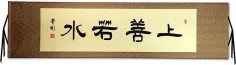
27. Be Like Water
28. Beast / Animal
29. Beauty / Beautiful / Handsome
30. Beautiful Life / Life in Perfect Harmony
31. Beautiful Woman
32. You are always a beauty in your lover’s eyes
33. Beauty Shop / Beauty Salon
34. Beer
36. Best
37. Best Love / Most Sincere Love
38. Betelgeuse
40. Big Dream
41. Birth / Life
42. Black Belt
43. Black or white cat matters not as long as it can catch mice
44. Blue Sky
45. Bonsai / Penzai
46. Book
47. Born To Be Wild
48. Boxing
49. Brotherly and Sisterly Love
50. Brown
51. Bruce Lee
52. Buddhism
53. Butterfly
54. Keep Calm in Face of Adversity
56. Camellia
57. Caramel
58. Castillo
59. Catholic
60. Cesar
61. Chaos / Anarchy / Confusion / Mayhem
62. Chastity
63. Chau
64. Chess
65. Chien
66. Chiew
67. Chinese Traditional Medicine
68. Chiu
69. Cho
71. Christmas
72. Clarity
73. You are who you hang out with
74. Coffee / Café
75. Confucius
76. Confucius: Golden Rule / Ethic of Reciprocity
78. Corinthians 13:4
80. Cowboy
83. Crazy Love
84. Every Creature Has A Domain
85. Crystal
86. Dana: Almsgiving and Generosity
87. Danger
88. Daniel
89. Daoism / Taoism
90. Daodejing / Tao Te Ching - Chapter 54
91. The Night is Darkest Before the Dawn
92. Day
One Day Seems Like 1000 Years
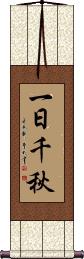
一日千秋 is a Japanese and Chinese proverb about missing someone.
一日千秋 is often used to express how hard it is to wait for someone's return or to be away from someone.
Some will translate this as “one day feels like a very long time” or “waiting for someone (something) is hard.”
You might see this romanized as a single word, Ichijitsusenshuu, or as “Ichijitsu Senshuu” from Japanese.
If you break down the characters one-by-one, we get:
一 = one/a
日 = day/sun (can also represent time or date)
千 = 1000/thousand
秋 = autumn/fall
Together, 千秋 can mean “autumn comes thousand times” (or 1000 years). It can also be read as 1000 periods of time.
However, it relays the idea of heartache as you wait for someone you miss.
Five Red Bats
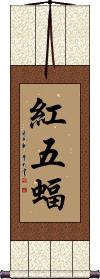
紅五蝠 is a play on words in Chinese because of some homophones.
The first thing you need to know is that the word for bat, 蝠, sounds exactly like the word for good fortune, 福. Thus, bats are often associated with good luck and good fortune in Chinese culture.
Five bats (五福 / 五蝠) means “five fortunes,” referring to luck, prosperity, wealth, happiness, and longevity.
The word red, 红, has the same sound as 宏 meaning vast, great, or magnificent. Therefore, a red bat means “vast fortune.”
Altogether, five red bats represent vast reaches of the five fortunes.
Adventure
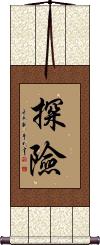
If you lead a life of adventure (like I do), a 探險 wall scroll is for you.
Alone, the first character can mean “to explore,” “to search out,” or “to scout.” The second character holds the meanings of “dangerous” and “rugged.” Together these two characters create the word that means “adventure” or “to explore.”
探険 is a modern Japanese Kanji version, but it more precisely means exploration or expedition rather than adventure. 探險 is the old/ancient Japanese version used before WWII. Let us know if you want the modern Japanese version instead.
See Also: Bon Voyage | Travel
Adventure Lover
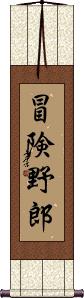
冒険野郎 is a Japanese title that means “adventure lover.”
This literally means something like “adventure wild man.”
This is a funny choice for a wall scroll, but it's a legitimate word in Japanese.
Aguila
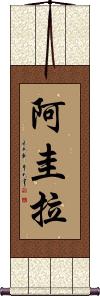
阿圭拉 is the name Aguila in Chinese (Mandarin).
For some reason, 阿吉拉 (sounds like “a-gee-lah” is more common. I like this version because it sounds more like the name is supposed to sound in Spanish.
Aikikai
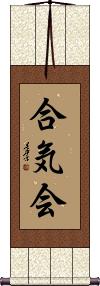
合気会 or “Aikikai” is the original school of Aikido.
Several organizations use this title. The first was established in Japan in 1940 (The Aikikai Foundation or 財団法人合気会).
The only difference between this title and Aikido is the last character, “kai” which means club, group, fraternity, organization, or assembly.
Note: 合気会 may be romanized with a dash like this: Aiki-Kai.
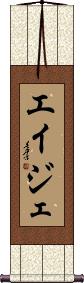
エイジェ is the name AJ in Japanese.
This is kind of a funky name, as there are no letters or initials in Japanese. But, this sounds just like AJ.
Note: Because this title is entirely Japanese Katakana, it should be written by a Japanese calligrapher.
Alone / Solitary Existence
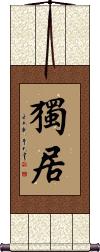
獨居 is a Chinese word that can be translated as to live alone, to live a solitary existence, solitude, solitary life, dwelling alone.
You might use a word like this regarding a hermit.
 In modern Japan, and Simplified Chinese, they use the version of the first character shown to the right. If you want this version please click on the character to the right instead of the button above.
Amazing Grace
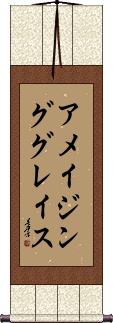
アメイジング・グレイス is the Japanese Katakana for Amazing Grace.
This phonetically sounds like the English, “Amazing Grace” but does not hold that meaning since it is a transliteration versus a translation.
Note: Because this title is entirely Japanese Katakana, it should be written by a Japanese calligrapher.
Amen
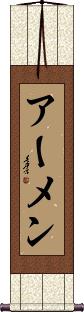
アーメン is the Japanese Katakana (phonetic Japanese) for Amen.
This sounds just like the “Amen” said in English at the end of prayers.
Note: Because this title is entirely Japanese Katakana, it should be written by a Japanese calligrapher.
American Football
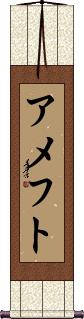
アメフト is a short word that means “American football” in Japanese.
It is supposed to sound like an abbreviated version, “ame futo” which sounds like “ah-may foot-oh” (American Football).
There's not a great standard way to say “football” in Japanese, as the sport is not popular in Japan. Other Japanese terms for football can be confused with soccer or rugby.
Note: Because this title is entirely Japanese Katakana, it should be written by a Japanese calligrapher.
See Also: Soccer
American Football
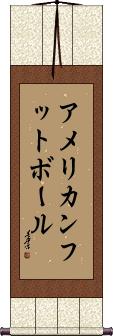
アメリカンフットボール is the full/long title for “American football” in Japanese Katakana.
It is “Amerikan Futtoboru” which is supposed to sound like “American Football.”
Note: Because this title is entirely Japanese Katakana, it should be written by a Japanese calligrapher.
See Also: Soccer
Angel
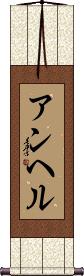
アンヘル is the name Angel in Japanese.
This sounds like “Angel” but does not mean “Angel.”
Note: Because this title is entirely Japanese Katakana, it should be written by a Japanese calligrapher.
Angel
(Name Version 1)
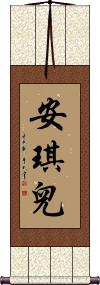
安琪兒 is the most common transliteration to Mandarin Chinese for the name Angel.
It is supposed to sound like Angel but to be honest, this one misses the mark.
I would go with the meaning of Angel if I were you.
Anime / Animation
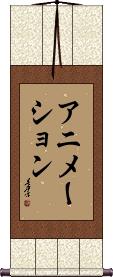
アニメーション is the word “Animation” in Japanese Katakana.
This can refer to any animated film or cartoon.
アニメーション is a loanword from English, which sounds like “Animation.”
Note: Because this title is entirely Japanese Katakana, it should be written by a Japanese calligrapher.
No man knows what he owes to his parents until he comes to have children of his own
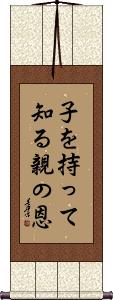
子を持って知る親の恩 literally translates as: Only after you have a baby, you would appreciate your parents (feel the way they do, etc).
This is a bit like the “walk a mile in another man's shoes” saying. Basically, it's about you cannot fully understand the plight of others until you experience it yourself. It also shows appreciation for the plight of parents.
This Japanese proverb can also be translated a few more ways:
No man knows what he owes to his parents till he comes to have children of his own.
One knows not what one owes to one's parents till one comes to have children of one's own.
Only after you have a baby, you will appreciate your parents or feel the way they do.
Only after becoming a parent yourself do you realize how much you owe [how indebted you are] to your own parents.
Note: Because this selection contains some special Japanese Hiragana characters, it should be written by a Japanese calligrapher.
Appreciation of Truth by Meditation
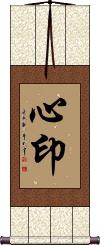
心印 is a Buddhist concept that simply stated is “appreciation of truth by meditation.”
It's a deep subject, but my understanding is that you can find truth through meditation, and once you've found the truth, you can learn to appreciate it more through further meditation. This title is not commonly used outside of the Buddhist community (your Asian friends may or may not understand it). The literal translation would be something like “the mind seal,” I've seen this term translated this way from Japanese Buddhist poetry. But apparently, the seal that is stamped deep in your mind is the truth. You just have to meditate to find it.
Soothill defines it this way: Mental impression, intuitive certainty; the mind is the Buddha-mind in all, which can seal or assure the truth; the term indicates the intuitive method of the Chan (Zen) school, which was independent of the spoken or written word.
Reference: Soothill-Hodous Dictionary of Chinese Buddhism
See Also: Zen
Art of War: 5 Points of Analysis
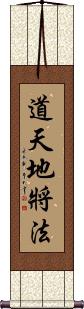
道天地將法 is a list of five key points to analyzing your situation from the first chapter of Sun Tzu's Art of War.
This reads like a 5-part military proverb. Sun Tzu says that to sharpen your skills, you must plan. To plan well, you must know your situation. Therefore, you must consider and discuss the following:
1. Philosophy and Politics: Make sure your way or your policy is agreeable among all of your troops (and the citizens of your kingdom as well). For when your soldiers believe in you and your way, they will follow you to their deaths without hesitation and will not question your orders.
2. Heaven/Sky: Consider climate / weather. This can also mean considering whether God is smiling upon you. In the modern military, this could be waiting for clear skies so that you can have air support for an amphibious landing.
3. Ground/Earth: Consider the terrain in which the battle will take place. This includes analyzing defensible positions, and exit routes, while using varying elevations to your advantage. When you plan an ambush, you must know your terrain and the best location from which to stage that ambush. This knowledge will also help you avoid being ambushed, as you will know where the likely places in which to expect an ambush from your enemy.
4. Leadership: This applies to you as the general and your lieutenants. A leader should be smart and be able to develop good strategies. Leaders should keep their word, and if they break a promise, they should punish themselves as harshly as they would punish subordinates. Leaders should be benevolent to their troops, with almost a fatherly love for them. Leaders must have the ability to make brave and fast decisions. Leaders must have steadfast principles.
5. [Military] Methods: This can also mean laws, rules, principles, models, or systems. You must have an efficient organization in place to manage both your troops and supplies. In the modern military, this would be a combination of how your unit is organized and your SOP (Standard Operating Procedure).
Notes: This is a simplistic translation and explanation. Much more is suggested in the actual text of the Art of War (Bing Fa). It would take a lot of study to master all of these aspects. In fact, these five characters can be compared to the modern military acronyms such as BAMCIS or SMEAC.
CJK notes: I have included the Japanese and Korean pronunciations but in Chinese, Korean and Japanese, this does not make a typical phrase (with subject, verb, and object) it is a list that only someone familiar with Sun Tzu’s writings would understand.
Great Aspirations / Ambition
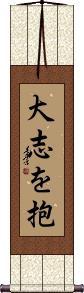
大志を抱 is a single Japanese word that kind of reads like a short proverb.
It suggests that you should have “high aims,” “ambitions,” or “aspirations” in your life.
August
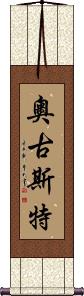
奧古斯特 is a common transliteration to Mandarin Chinese for the name August.
This sounds like “August” but has nothing to do with the month of August in Chinese.
Avenger
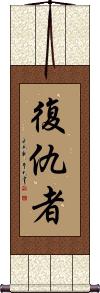
復仇者 is a Chinese title that means avenger or taker of revenge.
The first two characters literally mean avenge, vengeance, reprisal, or revenge.
The last character is a way to say, person. This last character is like adding -er or -ist to subjects like write and art to get writer and artist.
Avenger
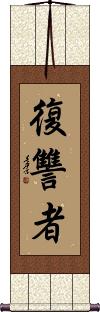
復讐者 is a Japanese Kanji title that means avenger or revenger.
The first two characters literally mean revenge or avenge.
The last character is a way to say a person (or soldier/warrior).
Altogether, you have something like, an “avenging person,” hence avenger.
Blue Dragon / Azure Dragon
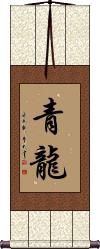
青龍 is a scholarly title for “Blue Dragon” or “Azure Dragon.”
You'll find this title used in ancient Chinese literature and astronomy. This dragon has dominion over the eastern sky or eastern heavens. The Azure Dragon is also noted for representing the spring season. Also seen as an auspicious omen.
Emperor Huizong of the Song Dynasty canonized the five colored dragons as “kings.” The Azure Dragon represents the most compassionate of kings.
In Japanese, this title is known with the same meaning but can also be a given name, Seiryuu or Seiryu.
Note, the first character can be written as  OR
OR  . Same character, just two ways to write it.
Balance / Peace
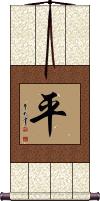
平 is a single character that means balance in Chinese but it's not too direct or too specific about what kind of balance.
Chinese people often like calligraphy art that is a little vague or mysterious. In this way, you can decide what it means to you, and you'll be right.
平 is also part of a word that means peace in Chinese, Japanese, and old Korean.
Some alternate translations of this single character include: balanced, peaceful, calm, equal, even, level, smooth, or flat.
Note that in Japanese, this just means “level” or “flat” by itself (not the best choice for balance if your audience is Japanese).
Banzai / Wansui
Old Japanese / Traditional Chinese & Korean
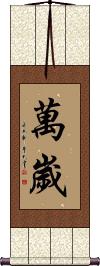
萬歲 is the traditional Chinese, Korean Hanja, and ancient Japanese way of writing banzai.
In modern times, the first character was simplified in Japan and China. So you might want to select the other entry for universal readability.
While it has become a popular, if not an odd, thing to scream as you jump out of an airplane (preferably with a parachute attached), banzai is actually a very old Asian way to say “hooray.” The Japanese word “banzai” comes from the Chinese word “wan sui,” which means “The age of 10,000 years.” It is actually a wish that the Emperor or the Empire live that long.
Imagine long ago when the Emperor made a rare public appearance. 萬歲 is what all people would yell to their leader in respect.
So if you like it as a hooray, or you want to wish someone that they live for 10,000 years, this is the calligraphy for you.
Other translations include Cheers! (not the drinking kind), hurrah!, long live [name]!, and congratulations!
To other things with banzai in their names, I am still waiting for the promised sequel to Buckaroo Banzai.
Notes: Sometimes people confuse banzai with bonsai. A bonsai is a miniature tree. They have nothing to do with each other.
Banzai
Modern Japanese Version
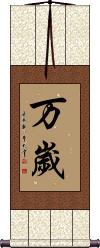
万歲 is the modern Japanese way to write banzai.
We've made two almost identical entries for this word, with just a variation on the first character. In the last century, 萬 was simplified to 万 in Japan and China. The new generation will expect it to be written as 万 but the old generation can still read the more traditional 萬 form. You must make your determination as to what version is best for you. If your audience is mostly Japanese, I suggest 万歲.
While it has become a popular, if not an odd, thing to scream as you jump out of an airplane (preferably with a parachute attached), banzai is actually a very old Asian way to say “hooray.” The Japanese word “banzai” comes from the Chinese word “wan sui” which means “The age of 10,000 years.” It is actually a wish that the Emperor or the Empire live that long.
Imagine long ago when the Emperor made a rare public appearance. This is what all of the people would yell to their leader in respect.
So if you like it as a hooray, or you want to wish someone that they live for 10,000 years, this is the calligraphy for you.
To other things with banzai in their names, I am still waiting for the promised sequel to Buckaroo Banzai.
Other translations: hurrah, long life, congratulations, cheers, live long.
Notes: Sometimes people confuse banzai with bonsai. A bonsai is a miniature tree. They have nothing to do with each other. Further, Bonzai is not a word at all - although it would make a great name for a calcium supplement for older people.
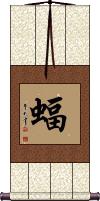
蝠 is the simplest way to write bat in Chinese and old Korean Hanja.
This also means bat in Japanese but is almost never written alone like this (it's often part of other titles for vampire bats or fruit bats).
In Chinese culture, the bat is a good luck charm, as the pronunciation is very similar to the word for “good luck” or “good fortune.” The character for bat (蝠) even looks like the good luck (福) character.
Black Belt
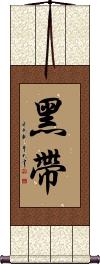
黑帶 is “black belt” in Chinese.
Many will argue whether rank systems that include a “black belt” are used in pure Chinese martial arts systems. The argument goes that it's more a Japanese idea merged into the western versions of Chinese martial arts. However, in Wushu (often referred to as Kung Fu), it's said that all students started with white belts. Over the years of training, the white belt would get dirty until finally appearing black with filth. Thus, more advanced students had darker belts.
If you want this title in Chinese, this would be the form.
 Often, the second character is written like the image to the right. If you like this version, click on this character instead of the button above.
Be Happy
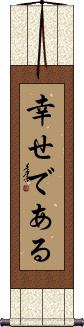
幸せである is a way to express the idea of “be happy” in Japanese.
Japanese grammar is far different than English, so the word order is the opposite of English. If you translated directly, you'd have something like “Happiness henceforth” or “Happiness hereafter.” The idea is to be happy from this moment on.
Note: Because this selection contains some special Japanese Hiragana characters, it should be written by a Japanese calligrapher.
Be Like Water
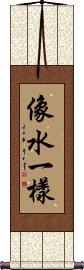
像水一樣 is a short quote from a much longer statement by Bruce Lee.
He summarized how people should be flexible to all circumstances, attacks, or situations. In the end, he exclaims, “Be like water, my friend.” 像水一樣 is the “Be like water” part alone since that seems to be what most people want.
Beast / Animal
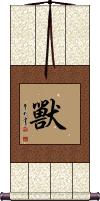
獸 means beast, animal, brute, beastly, or bestial.
Note: A strange selection for a calligraphy wall scroll.
獸 is a very generic term for a beast, so it can be one hunted for food (such as a deer or boar). It can also mean a great animal or someone who acts like a beast.
Note: In Japanese, this can be the personal name Munetada.
 In modern Japan, they use the version of this character shown to the right. If your audience in Japanese, click this special Kanji instead of the button above.
Beauty / Beautiful / Handsome
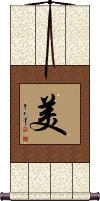
美 is often used to describe the beauty of a woman.
However, when applied to a man, it can mean handsome. It's also the first character in the word for “beauty salon” which you will see all over China and Japan.
This can be used as the given name for a girl (spell it or say it as “Mei” or “May”).
For a bit of trivia: The title for the “USA” in Chinese is “Mei Guo” which literally means “Beautiful Country.” This name was bestowed at a time before Chairman Mao came to power and decided that China didn't like the USA anymore (even though we fought together against the Japanese in WWII). But these days, Chinese people love Americans (but have a distaste for American politics and policy). But I digress...
美 is also how “Beautiful” is written in Japanese Kanji and Korean Hanja. 美 can also mean: very satisfactory; good; to be pleased with oneself; abbreviation for the USA; fine; handsome; admirable; madhura; sweet; and/or pleasant.
See Also: Beautiful Woman | Beautiful Girl
Beautiful Life / Life in Perfect Harmony
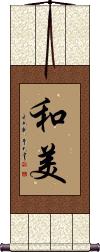
和美 is a word that means “harmonious” or, “in perfect harmony.”
The deeper meaning or more natural translation would be something like, “beautiful life.”
The first character means peace and harmony.
The second character means beautiful. But in this case, when combined with the first character, beautiful refers to being satisfied with what you have in your life. This can be having good relations, good feelings, comfort, and having enough (with no feeling of wanting).
Note: In Japanese, this is often used as the name "Wami." This title is probably more appropriate if your audience is Chinese.
Beautiful Woman
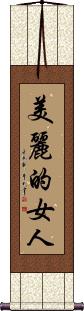
美麗的女人 is the best and most polite way to express “beautiful woman” in Chinese.
Note: Some people may like the simple 2-character 美女 way to express this, but there are some bad connotations with that, so better to stay with this longer and more respectful title.
See Also: Beautiful Girl | Beauty
You are always a beauty in your lover’s eyes
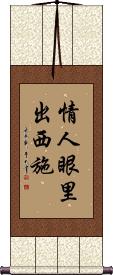
Any woman with affection for Asian art will love a gift of this Chinese proverb calligraphy on a wall scroll.
She will melt in your arms as you tell her the meaning of these characters.
Contained in this phrase is a reference to the most beautiful woman in Chinese history. Her name was Xi Shi, and she was known to have good looks that need not have fine robes or makeup. Her charms were so powerful that she brought down an entire kingdom (in a successful effort to bring honor and pride back to her people).
情人眼里出西施 is a great way to express that the woman in your life is your one love.
Beauty Shop / Beauty Salon
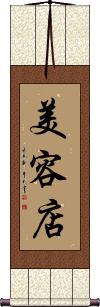
美容店 is how to write “Beauty Shop” or “Beauty Salon.”
If you own such a business, this will make a nice wall scroll to hang up - and many of your Asian customers will be able to read and appreciate it.
When traveling in China, you will see signs like this in the window of any place that offers full services of hair styling, manicures, pedicures, and often shampoo with head and back massage.
However, as a handmade wall scroll, this becomes a very fancy piece of artwork that shows the high class of your business (a great sign for your window if you don't get direct sunlight).
Beer
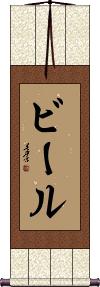
ビール is the Japanese Katakana (phonetic Japanese) for the word beer.
ビール is meant to sound like the English word beer and is thus a loanword in Japanese.
Note: Because this title is entirely Japanese Katakana, it should be written by a Japanese calligrapher.
Kindness / Benevolence
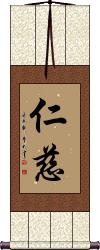
仁慈 word is used in Chinese, Korean, Japanese, and Asian Buddhism to relay the important idea of loving kindness.
仁慈 can also be defined as: benevolent; charitable; kind; merciful; kind-hearted; benevolence; kindness; humanity; mercy.
In Japanese, this can also be the given name Hitoji. This would also be a good Mandarin Chinese given name romanized as Jentzu (in Taiwan) or Renci (which sounds like ren-tsuh).
Best
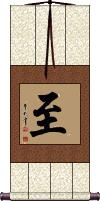
至 is a little strange as calligraphy, but 至 would be the character that means “best” or “extreme” in Chinese and Korean.
The problem is, this is seldom used alone. It's mostly used in combination with other characters to make words like “best friend,” “best food,” and “best love.”
I do not recommend this character for a wall scroll. It's better if you find a more specific term that fits your circumstances.
Note: This can be pronounced in Japanese and has a similar meaning but it is rarely if ever used in modern Japanese.
Best Love / Most Sincere Love
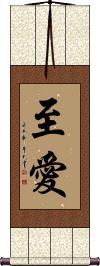
至愛 can mean the best love or most sincere love of your life.
This could be a romantic love such as your love for your spouse or a boyfriend/girlfriend.
It can also apply to the extreme love you have for your children or a parent and maybe a really good friend.
See Also: I Love You
Best Love / Most Sincere Love
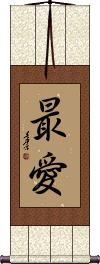
最愛 is a Japanese word that means the best love, beloved, or most sincere love of your life.
This could be a romantic love such as your love for your spouse or a boyfriend/girlfriend.
It can also apply to the extreme love you have for your children or a parent and maybe a really good friend.
Betelgeuse
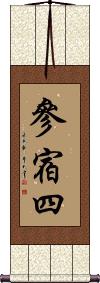
參宿四 is the title for Betelgeuse (star in the constellation Orion) in Chinese.
Also known as “α Orionis” (Alpha Orionis), Alpha Ori, or in Japan the Heike-boshi or Heike-star.
Note: 参宿 (Shēn Xiù) is the name given by ancient Chinese astronomers for a constellation of three stars (the three naked-eye visible belt stars of Orion). Therefore, 參宿四 means the Fourth Star of the constellation of Three Stars (which sounds like a joke). As telescopes got better, it should be noted that there are actually 10 stars in the constellation.
Beyond / Exceed / Surpass
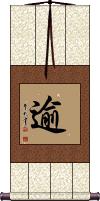
逾 means: to exceed; to go beyond; to transcend; to cross over; to jump over.
You'll see this character used in Buddhism (same meaning).
Technically, this single character is a Japanese word but is seldom used as a single Kanji in modern Japanese.
Big Dream
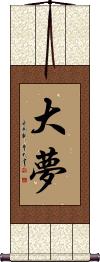
大夢 means “Big Dream” in Chinese and Japanese.
大夢 is primarily a Buddhist term referring to the great dream that represents a long and winding life that feels like a dream (since reality is an illusion anyway in Buddhism).
This can also be a female given name, Hiromu, or Oomu, in Japanese. Also, more rare unisex given names Daimu or Taimu.
Birth / Life
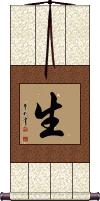
生 is a Chinese word that means “to be born” and “to give birth.”
Also, it's often used to refer to life itself, and sometimes “to grow.”
生 is used in a lot of compound words such as “yi sheng,” which means “doctor” (literally “healer of life”), “sheng ri” which means “birthday” (literally “birth-day”), and “xue sheng” which means student (literally “studying life” or “learner [about] life”). Few Chinese people will think of the literal meaning when this uses words like doctor and student - but it is interesting to note.
生 has the same root meaning in Korean Hanja and Japanese. However, in Japanese, there are many possible pronunciations, and this can be used to mean “raw” or “unprocessed” (as in draft beer). Therefore, not be the best if your audience is Japanese.
See Also: Vitality
Black Belt
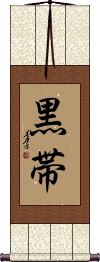
These are the Kanji for “Black Belt” in Japanese.
This would be the gift to buy someone who is about to achieve the rank of black belt, or perhaps for yourself, like a certificate on the wall to subtly show your accomplishment.
It should be mentioned that the title “black belt” is not a typical selection for a calligraphy wall scroll.
Note: with a tiny stroke difference on the second character, this also means black belt in Korean Hanja. Let me know if you need the exact Korean version (though any Korean who can read Hanja will know this is black belt).
Black or white cat matters not as long as it can catch mice
Ability is more important than looks
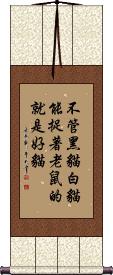
不管黑猫白猫能捉着老鼠的就是好猫 literally translates as: It doesn't matter [if a] cat [is] black [or] white, [as long as it] can catch mice, it's a good cat.
This proverb was either composed or made famous by Deng XiaoPing in 1961 when he exclaimed, “I don't care if it's a white cat or a black cat. It's a good cat so long as it catches mice” when his critics pointed out that his ideas were Capitalistic (free market). The response was meant to say, “It does not matter if it's Communist or Capitalist, as long as it works.”
This is a Chinese proverb that can be used to suggest one should disregard looks or a person's race, as long as they can do the job. It can also be used as a metaphor for many other situations.
Deng XiaoPing probably saved China from collapse (as the Soviet Union experienced). He changed China’s economy from pure Communism to a hybrid where the free market (Capitalism) is encouraged. More about Deng XiaoPing
Blue Sky
The Blue Dome of Heaven
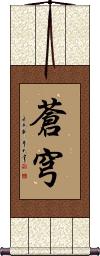
蒼穹 is a poetic way to express “sky” in Chinese and Japanese Kanji.
It's like saying, “The blue dome of heaven,” or a way to say “blue sky” within a poem.
Bonsai / Penzai
Dwarf Tree Culture
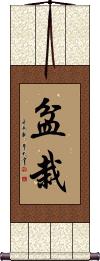
盆栽 is the word that refers to the culture, hobby, and to miniature trees themselves that have become popular around the world.
Like many things, this art migrated from China to Japan some time ago, but we tend to associate it with Japanese culture and even use the Japanese word in English.
Granted, in the present day, this hobby seems to be more popular in Japan but still has a great following in China and even a little in Korea as well.
Note: Many people confuse the title of the bonsai tree with “banzai” which is a form of “hooray” in Japanese. I have also seen it misspelled as “bansai.” The correct Romanization (Romaji) is “bonsai.”
Book
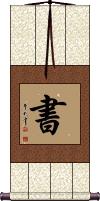
書 is the most simple way to say “book” in Chinese, Japanese, and Korean.
書 is usually read as “book” but can refer to a letter, or document.
In a certain context, it can refer to writing, penmanship, or handwriting. Especially in Chinese, it can be a short way to say calligraphy.
If you love books or want to write books, this is the simple, all-encompassing character for you.
Born To Be Wild
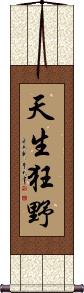
天生狂野 is “Born To Be Wild” (like the Steppenwolf song) in Chinese (Mandarin).
If you get to the deep meaning, the first two characters can mean “born” but refer as much to the nature, disposition, calling, or innate qualities of something or someone.
The last two mean coarse and/or wild.
So it kind of means that it is your nature to be wild.
Boxing
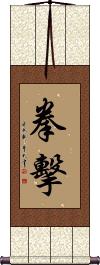
拳擊 is the term used in Chinese to refer to the original Olympic sport of combat and fighting.
If you like to strap on your boxing gloves and go a few rounds or are just a fan of boxing, this could make a nice wall scroll for you.
Note that Japanese use the same first character (which means fist) but a different Kanji for the second. Please see our Japanese boxing entry for that version.
Brotherly and Sisterly Love
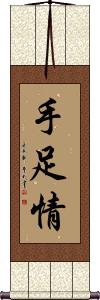
手足情 is the love between siblings.
When you love, protect, care for, and have a deep bond that only brothers or sisters can.
The actual translation is “Hand and Foot,” but the relationship between brothers or sisters is like that of hands and feet. They belong together and complete the body. Even though this says “hand and foot,” it will always be read with the brotherly and sisterly love meaning in Chinese.
Note: During the past 20 years, the “One child policy” in China is slowly making this term obsolete.
Brown
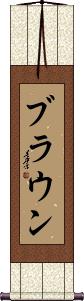
ブラウン is the name Brown in Japanese.
Please note: This sounds like the English word brown using Japanese pronunciation. It does not mean the color brown at all in Japanese.
Note: Because this title is entirely Japanese Katakana, it should be written by a Japanese calligrapher.
Bruce Lee
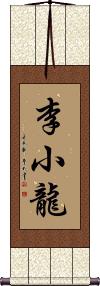
李小龍 is the real full name of Bruce Lee.
 Many people have no idea that Bruce Lee had a “real” Chinese name. In Mandarin and Cantonese, he is known as “Lǐ XiǎoLóng” and “Léi SíuLùng” respectively.
He kept his family name pronunciation (Li = Lee). 李 is a common family name that also means “plum.”
His given name 小龍 (Xiao-Long), literally means “little dragon.” 李小龍 is why you often see the character for dragon associated with Bruce Lee on various posters etc.
For a pronunciation lesson, the “X” in Romanized Mandarin is pronounced like a “sh” sound but with your tongue at the bottom of your mouth. The vowel sound in “Long” is like the English “oh,” not like the “ah” sound in the English word “long.”
If you are a big Bruce Lee fan, you should know this information, and you should have this wall scroll hanging in your room or martial arts studio.
Note: Japanese use these same Chinese characters / Kanji to write Bruce Lee's real name (with different pronunciation - which is a bit like how the name “Bruce Lee” sounds in English).
See Also: Kung Fu | Martial Arts
Buddhism
(2 Kanji)
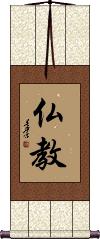
仏教 can mean Buddha or Buddhism in Japanese.
Depending on the context, this word can be used to refer to the religion and lifestyle of Buddhism or in some cases, the Buddha himself.
Note: Until the 5th century, Japan did not have a written language. At that time, Japan absorbed Chinese characters to form their written language (these characters are known as “Kanji” in Japanese). The first character of this Buddhism title was a shorthand way to write 佛 (Buddha) in Chinese (popular around the 13th century). Somehow, this became the version of this character that was absorbed into Japanese and thus became part of standard Kanji. Centuries later, this character is not recognized in China at all.
仏 is also a rare form of Buddha Korean Hanja - though seldom used even when the Korean Hanja writing system was more common 100 years ago.
Butterfly
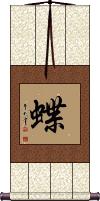
蝶 is the simplest way to write “butterfly” in Chinese, Japanese and Korean.
If you are looking at the Chinese pronunciation and Romanization, please note this is not pronounced like the English “die.”
It actually sounds like “dee-ah.” (Chinese Romanization does not exactly follow English or Latin pronunciation of Roman letters).
Keep Calm in Face of Adversity
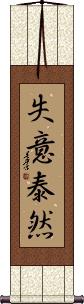
失意泰然 is a very old Japanese proverb that suggests “keeping calm and collected at times of disappointment,” or “maintaining a serene state of mind when faced with adversity.”
It's hard to relate individual character meanings to the overall meaning unless you also understand Japanese grammar. The word order is very different than English. That being said, here's the character meaning breakdown:
失 To miss, lose or fail.
意 Feelings, thoughts, meaning.
泰 Safe, peaceful.
然 Like that, in that way, however, although.
Using these definitions in English, we might say, “Although you may fail or lose, have a feeling of peace and calm.”
Calm / Tranquility
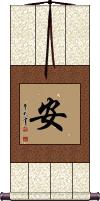
安 is used in a lot of compound words in the CJK world.
Alone, this character has a broad span of possible meanings. These meanings include relaxed, quiet, rested, contented, calm, still, to pacify, peaceful, at peace, soothing, or soothed.
安 and even the pronunciation was borrowed from Chinese and absorbed into both Japanese Kanji and Korean Hanja. In all these languages, this character is pronounced like “an.”
Camellia
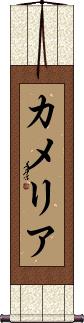
カメリア is the name Camellia in Japanese.
This sounds like Camellia, but does not mean the camellia plant or leaf.
Instead of these characters, you may want to go with the name of the plant. Of course, camellia also means tea, as varieties of camellia plants provide the leaves for many kinds of Chinese and Japanese teas.
Note: Because this title is entirely Japanese Katakana, it should be written by a Japanese calligrapher.
Caramel
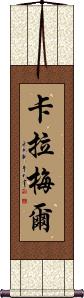
卡拉梅爾 is the name Caramel in Chinese (Mandarin).
This is a transliteration, so it sounds like Caramel, but it does not mean Caramel in Chinese. If you want it by meaning, see the entry about the candy caramel.
Castillo
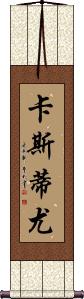
卡斯蒂尤 is the name Castillo in Chinese (Mandarin).
Even though it's not the most commonly-used transliteration, I like this version of Castillo, as it sounds more like the real Spanish pronunciation where the end of Castillo sounds like “Yo.”
Castillo
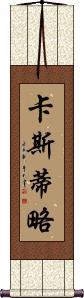
This is a standard form of the name Castillo in Chinese (Mandarin).
I'm not a fan of this version, as it pronounces the “LL” instead of the end sounding more like “Yo” as it does in proper Spanish.
Catholic
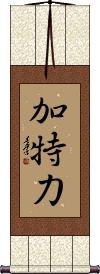
加特力 is the Japanese title for Catholic.
This can refer to a person or the church. It is meant to sound like the western word “Catholic.” It sounds like “cat-toe-ree-cou.”
Cesar
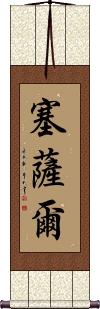
This is a 3-character transliteration to Mandarin Chinese for the Latin / Spanish name César.
I like this version better than the 2-character version, as this one is very close to the real sound of the name Cesar (both English and Spanish pronunciation).
Chaos / Anarchy / Confusion / Mayhem
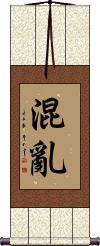
The first character means confused, dirty, muddy, or mixed.
The second character means confusion and disorder.
Together, these characters mean chaos and sometimes extended to mean a type of anarchy.
This term is often used in a less-than-literal term to describe anything in disarray. Someone might use this word in a sentence like, “My kitchen is in a state of chaos” or “my life is so chaotic.”
 Please note that Japanese use an alternate/simplified version of the second character of chaos - it also happens to be the same simplification used in mainland China. Click on the character to the right if you want the Japanese/Simplified version of this two-character chaos calligraphy.
Chastity
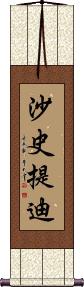
沙史提迪 is a common transliteration to Mandarin Chinese for the name Chastity.
This sounds like Chastity but does not mean chastity. I suggest you choose a Chinese word that means chastity instead.
Chau
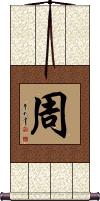
周 is the name Chau in Chinese (Mandarin).
The last name Chau (or Châu) has diverse origins, most prominently as a Vietnamese surname meaning "pearl," linking to Chinese roots, and also as various anglicized forms of Chinese names like Zhou (周), meaning dynasty/circle, or Zhu (朱), meaning vermilion.
If you need 朱 instead of 周, please let me know when ordering.
Chess
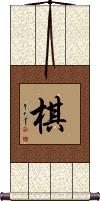
棋 is the most simple or generic way to write “chess” in Asia.
棋 is part of other more specific words for board games of strategy such as the western version of chess, Chinese chess, Weiqi, or Go.
In Japanese, this single character is pronounced “Go” and often refers to the game known in the west as “Go” (not just the 5-in-a-row version but also the complicated encirclement game of strategy known in China as Weiqi).
In Chinese, this can be more ambiguous as to which game of chess you speak.
If you like any version of chess, or games of intense strategy, this can be the character to hang on the wall in your game room.
Chien
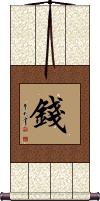
錢 is the Chinese surname Chien.
錢 can be romanized as Qian or Chien with the meaning of money.
There are other characters, like 簡 and 建, that typically romanize as Jian but can also be romanized as Chien depending on the originating Chinese dialect. Be sure you are getting the right character!
Chiew
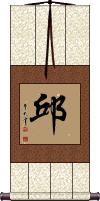
This is the Chinese name Chiew.
This romanization can come from Hokkien, Cantonese, or other dialects. If you are not looking for 邱, several distinct Chinese family names like Zhou (周), Zhao (趙), and Qiu (丘) can be romanized as Chiew. In the previous sentence, those are Pinyin Romanizations from Mandarin.
Chinese Traditional Medicine
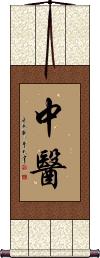
中醫 is how to write “Chinese traditional medicine.”
The original medicine consists of herbal remedies derived from over 3000 years of research.
Chiu
邱 is the most common Chinese character for a surname that romanizes as Chiu in Cantonese.
The surname Chiu (邱) is a common Chinese family name, especially prominent in Cantonese, Hokkien, and Taiwanese communities. However, this romanization can also come from several different Chinese surnames like Qiū (丘), Zhōu (周), Zhào (趙), and Jiāng (蔣), depending on original dialect and geography. Please confirm that this is the correct character before ordering.
Cho
Surname
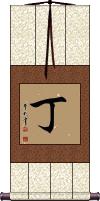
In Japanese, 丁 can be surnames that romanize as Chō or Chou. It can also be more unusual Japanese surnames Rei, Yoroi, Yoboro, Youro, Momoki, Hinoto, Tei, Chiyon, Choudei, Chiyun, or Jiyon.
丁 is also the Mandarin Chinese surname Ding.
丁 can refer to nails or pieces of something. It is also a counter for long thin objects like scissors, spades, hoes, inksticks, palanquins, candles, etc.
Christianity / Christian
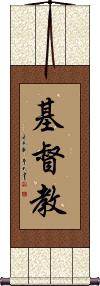
基督教 is the Chinese, Japanese and Korean word for “Christianity.”
Just as in English, this word is often used to mean “Protestant” but includes Catholics in the true definition.
It is the word used to refer to the whole “Christian religion” or “Christian Faith,” and therefore, it can be translated as “Christianity.” However, used as an adjective in regard to a person, it would translate as “Christian.” But more like saying, “His religion is Christianity,” rather than a noun form.
If you break it apart, the characters mean Base/Foundation Leading/Supervising Religion/Teaching. It makes more sense in Japanese, Chinese, and Korean. The first two characters together are translated as “Christ.” So you can also say this means “Christ's Religion” or “Christ's Teachings” when directly translated, or in reverse, “The Religion of Christ” or “The Teaching of Christ.”
Notes: The last character has a slight difference in one stroke - however, in calligraphic form, this will not be apparent. This entry can easily be read by any Korean person who knows Hanja characters (Chinese characters used in Korean).
See Also: Jesus Christ | God of Abraham
Christmas
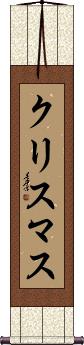
クリスマス is Christmas in Japanese.
This sounds like the English title Christmas, using Japanese sounds. This can also be used to represent the surname Christmas.
Note: Because this title is entirely Japanese Katakana, it should be written by a Japanese calligrapher.
Clarity
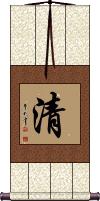
清 is a word that means clarity or clear in Chinese, Japanese Kanji, and old Korean Hanja.
Looking at the parts of this character, you have three splashes of water on the left, “life” on the top right, and the moon on the lower right.
Because of something Confucius said about 2500 years ago, you can imagine that this character means “live life with clarity like bright moonlight piercing pure water.” The Confucian idea is something like “Keep clear what is pure in yourself, and let your pure nature show through.” Kind of like saying, “Don't pollute your mind or body, so that they remain clear.”
This might be stretching the definition of this single Chinese character but the elements are there, and “clarity” is a powerful idea.
Korean note: Korean pronunciation is given above but this character is written with a slight difference in the "moon radical" in Korean. However, anyone who can read Korean Hanja, will understand this character with no problem (this is considered an alternate form in Korean). If you want the more standard Korean Hanja form (which is an alternate form in Chinese), just let me know.
Japanese note: When reading in Japanese, this Kanji has additional meanings of pure, purify, or cleanse (sometimes to remove demons or "exorcise"). Used more in compound words in Japanese than as a stand-alone Kanji.
You are who you hang out with
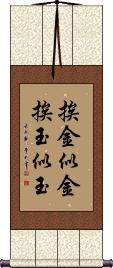
金似金挨玉似玉 is a Chinese proverb that literally translates as: [One who is] close to gold [is] like gold [and one who is] close to jade [is] like jade.
Figuratively, this means:
A good environment produces good people.
People are influenced by the company they keep.
Basically, if you hang out with good people, you are likely to become or stay good yourself. The opposite also is true. 挨This is like the moral version of “You are what you eat.”
Note: In Japanese, they have a similar phrase, 類は友を呼ぶ (rui wa tomo o yobu) Birds of a feather flock together. However, this is not a good meaning, so we’re not offering it for wall scrolls.
Coffee / Café
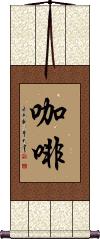
咖啡 is how they write coffee in mainland China (it's 咖逼 in Taiwan).
咖啡 is a loanword from English or Spanish. It's meant to sound like coffee or café rather than to mean coffee.
Coffee / Café
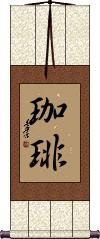
珈琲 is how they write coffee in Japan.
珈琲 is a loanword from English or Spanish. It's meant to sound like coffee or café rather than to mean coffee.
Confucius
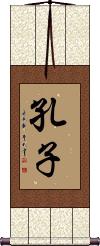
孔子 is how to write the name of the great sage, known in the West as Confucius.
His real name is Kongzi (The name Confucius is a westernized version of his name - his family name is Kong, and “zi” was added as a title of distinction).
He lived some 2500 years ago in Qufu, a town in modern-day Shandong Province of Northern China (about 6 hours south of Beijing by bus). He was a consort to Emperors, and after his death, the impact of his philosophies still served to advise emperors, officials, and common people for generations.
Also during these thousands of years, the Kong family remained powerful in China, and the Kong estate was much like the Vatican in Rome. The Kong estate existed as if on sovereign ground with its own small garrison of guards and the privileges of a kingdom within an empire.
This was true up until the time the Kong family had to flee to Taiwan in 1949 when the Red Army took victory over the Nationalists during the Revolution. The home of Confucius was later razed and all statues were defaced or stolen during the Cultural Revolution. Finally, after years of smearing his name and image, it is once again okay to celebrate the teachings of Confucius in mainland China.
Known as Khổng Tử in Vietnamese.
Confucius: Golden Rule / Ethic of Reciprocity
Do not do to others what you do not want done to yourself
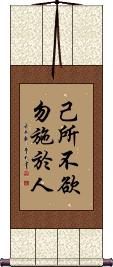
Some may think of this as a “Christian trait,” but actually, it transcends many religions.
This Chinese teaching dates back to about 2,500 years ago in China. Confucius had always taught the belief in being benevolent (ren), but this idea was hard to grasp for some of his students, as benevolence could be kind-heartedness or an essence of humanity itself.
When answering Zhong Gong's question as to what "ren" actually meant, Confucius said:
己所不欲勿施于人 or "When you go out, you should behave as if you were in the presence of a distinguished guest; when people do favors for you, act as if a great sacrifice was made for you. Whatever you wouldn't like done to you, do not do that thing to others. Don't complain at work or home.”
Hearing this, Zhong Gong said humbly, “Although I am not clever, I will do what you say.”
From this encounter, the Chinese version of the “Golden Rule” or “Ethic of Reciprocity” came to be.
The characters you see above express, “Do not do to others whatever you do not want to be done to yourself.”
See Also: Confucius Teachings | Benevolence
I Control My Own Destiny
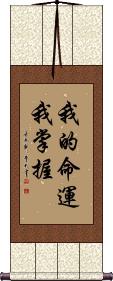
我的命運我掌握 is a way to write “I control my own destiny” in Chinese.
The direct translation is more like, “My destiny, I'm in control.” The meaning is the same, but Chinese grammar and word order vary a bit from English.
There's a few other variations, and if you want any of these, just email me:
我的命运我做主 (wo3 de ming4 yun4 wo3 zuo4 zhu3) "my destiny, I'm in charge"
我的未来我掌握 (wo3 de wei4 lai2 wo3 zhang3 wo4) "my future, I'm in control"
我的未来我做主 (wo3 de wei4 lai2 wo3 zuo4 zhu3) "My future, I'm in charge"
Corinthians 13:4
All you need to know about LOVE
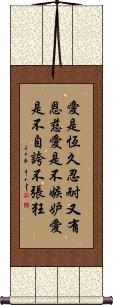
愛是恆久忍耐又有恩慈愛是不嫉妒愛是不自誇不張狂 is 1st Corinthians 13:4 in Chinese.
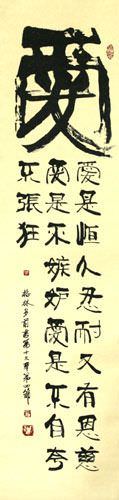
With large “love” character added.
In English, this reads:
1st Corinthians 13:4 (KJV) Charity suffereth long, and is kind; charity envieth not; charity vaunteth not itself, is not puffed up...
1st Corinthians 13:4 (NIV) Love is patient, love is kind. It does not envy, it does not boast, it is not proud.
1st Corinthians 13:4 (Basic English) Love is never tired of waiting; love is kind; love has no envy; love has no high opinion of itself, love has no pride.
The Chinese translation follows the love meaning, rather than the King James' use of “charity.” I was a little confused when writing this description with the significant differences between the NIV vs. KJV translations. After speaking to a Greek scholar about this, it would seem that the KJV has an almost errant translation with the use of “charity” in place of “love.”
We used the most popular Christian Chinese Bible, which is the Chinese Union Version (CUV). The CUV was first published in 1919. We use this so that the Chinese translation would be as accurate and standard as possible. Any Chinese Christian worth their salt will easily be able to identify this verse when they see these characters.
If you want a big “love” character written above the verse on your artwork, just make a note in the “special instructions” tab when you are customizing your artwork. There is no extra charge for that service on this special verse.
Courage and Strength
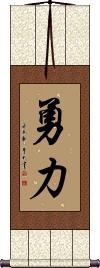
勇力 is a very short way to say “courage and strength” in Chinese and Japanese.
In Japanese, it's read more like “strong courage” or “powerful courage.” This can also be the personal name Yuri or Yuuri in Japanese.
Cowboy
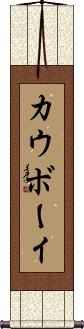
カウボーイ is how cowboy is in Japanese.
This is meant to sound like the English word “cowboy.”
Note: Because this title is entirely Japanese Katakana, it should be written by a Japanese calligrapher.
Construction Crane
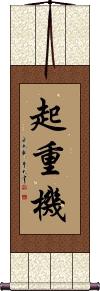
起重機 refers to the huge machine that lifts materials high into the air as crews construct huge buildings.
A customer requested this specifically after some confusion over the bird by the same name.
In an odd twist, while they don't know this name in English sounds like a bird; the building crane is jokingly called “The real national bird of China” because of the accelerated level of construction in Beijing and elsewhere ever since preparations began for the 2008 Olympics. As of 2018, construction has barely slowed.
If you want the type of construction crane that drives down the road, please note that the word is totally different for that kind of “vehicle crane.”
Crazy / Mad / Wild
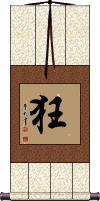
狂 is a single character that means “crazy” in Chinese, Japanese Kanji, and old Korean Hanja.
狂 means crazy, unrestrained, lunatic, insane, confused, deranged, wild, or mad.
This can also refer to an extreme enthusiast (like a football fan). But then, it can also refer to a person possessing a mental abnormality.
In some contexts, this can mean conceited (it probably won't be read that way on a wall scroll).
A warning: 狂 is an odd selection for a wall scroll. You should only order this if you plan to bewilder or confuse those who see it. It kind of says something about you, something that most native Asian people will not view in a good light.
Crazy Love
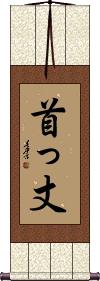
首っ丈 is a Japanese word that means “deeply in love with,” “madly in love with,” “heads over heels in love with,” or “to be crazy about.”
Every Creature Has A Domain
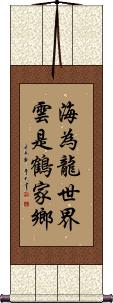
海為龍世界雲是鶴家鄉 is a somewhat poetic way to say that everyone and everything has its place in the world.
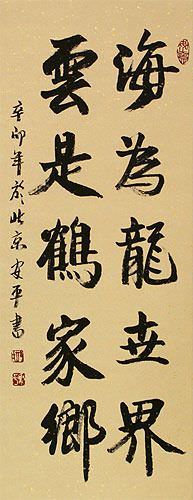 The first line (which is the column on the right) says, “The Ocean is the World of the Dragon.” The next column says, “The Clouds are the Domain of the Cranes.”
The image to the right is what this calligraphy can look like in xing-kaishu style by a Master Calligrapher.
Crystal
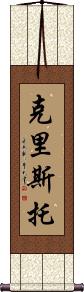
This is a common transliteration to Mandarin Chinese for the names Crystal or Krystal.
Consider also going with the meaning of crystal. The characters shown to the left sound like crystal in Mandarin but do not mean crystal (of course, the word for crystal in Chinese does not sound at all like the English word crystal).
Dana: Almsgiving and Generosity
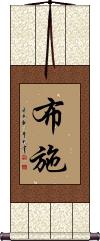
布施 is the Buddhist practice of giving known as Dāna or दान from Pali and Sanskrit.
Depending on the context, this can be alms-giving, acts of charity, or offerings (usually money) to a priest for reading sutras or teachings.
Some will put Dāna in these two categories:
1. The pure or unsullied charity, which looks for no reward here but only in the hereafter.
2. The sullied almsgiving whose object is personal benefit.
The first kind is, of course, the kind that a liberated or enlightened person will pursue.
Others will put Dāna in these categories:
1. Worldly or material gifts.
2. Unworldly or spiritual gifts.
You can also separate Dāna into these three kinds:
1. 財布施 Goods such as money, food, or material items.
2. 法布施 Dharma, as an act to teach or bestow the Buddhist doctrine onto others.
3. 無畏布施 Courage, as an act of facing fear to save someone or when standing up for someone or standing up for righteousness.
The philosophies and categorization of Dāna will vary among various monks, temples, and sects of Buddhism.
Breaking down the characters separately:
布 (sometimes written 佈) means to spread out or announce, but also means cloth. In ancient times, cloth or robs were given to the Buddhist monks annually as a gift of alms - I need to do more research, but I believe there is a relationship here.
施 means to grant, to give, to bestow, to act, to carry out, and by itself can mean Dāna as a single character.
Dāna can also be expressed as 檀那 (pronounced “tán nà” in Mandarin and dan-na or だんな in Japanese). 檀那 is a transliteration of Dāna. However, it has colloquially come to mean some unsavory or unrelated things in Japanese. So, I think 布施 is better for calligraphy on your wall to remind you to practice Dāna daily (or whenever possible).
Danger
A dangerous character in every way
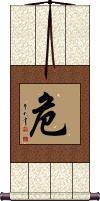
危 means danger, peril, or “to endanger” in Chinese, Japanese, and old Korean.
If you live a dangerous life or want to subtly warn others that you are a dangerous person, this may be the selection for you.
This also means “danger” and sometimes “fear” in Japanese and Korean but is seldom seen outside of compound words in those languages (as a single character, it's kind of like an abbreviation for danger in Japanese and Korean). 危 is also a rather odd selection for a wall scroll anyway. It's only here because people search for danger on our website.
Daniel
Alternate form
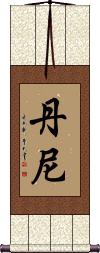
This is another common transliteration to Mandarin Chinese for the name Daniel.
This version drops off the third character, so it sounds a bit more like Danny than Daniel. I think our main version of Daniel is better but this is a popular transliteration according to our research on Chinese Google.
Daoism / Taoism
Literally: The Way or Road
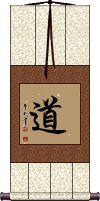
道 is the character “dao” which is sometimes written as “tao” but pronounced like “dow” in Mandarin.
道 is the base of what is known as “Taoism.” If you translate this literally, it can mean “the way” or “the path.”
Dao is believed to be that which flows through all things and keeps them in balance. It incorporates the ideas of yin and yang (e.g. there would be no love without hate, no light without dark, no male without female.)
The beginning of Taoism can be traced to a mystical man named
Lao Zi (604-531 BC), who followed, and added to the teachings of Confucius.
More about Taoism / Daoism here.
Note that this is pronounced “dou” and sometimes “michi” when written alone in Japanese but pronounced “do” in word compounds such as Karate-do and Bushido. It's also “do” in Korean.
Alternate translations and meanings: road, way, path; truth, principle province.
Important Japanese note: In Japanese, this will generally be read with the road, way, or path meaning. Taoism is not as popular or well-known in Japan so Daoist/Taoist philosophy is not the first thing a Japanese person will think of when they read this character.
See our Taoism Page
Daodejing / Tao Te Ching - Chapter 54
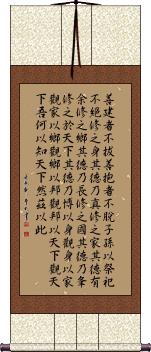
This is the Mawangdui version of Daodejing chapter 54.
By its virtue alone can one generation after another carry on the ancestral sacrifice.
Apply it to yourself, and by its power, you will be freed from dross.
Apply it to your household, and your household shall thereby have abundance.
Apply it to the village, and the village will be made secure.
Apply it to the kingdom, and the kingdom shall thereby be made to flourish.
Apply it to an empire, and the empire shall thereby be extended.
Therefore just as through oneself, one may contemplate Oneself;
So through the household one may contemplate the Household;
And through the village, one may contemplate the Village;
And through the kingdom, one may contemplate the Kingdom;
And through the empire, one may contemplate the Empire.
How do I know that the empire is so? By this.
What is firmly rooted cannot be pulled out;
What is tightly held in the arms will not slip loose;
Through this, the offering of sacrifice by descendants will never come to an end.
Cultivate it in your person, and its virtue will be genuine;
Cultivate it in the family, and its virtue will be more than sufficient;
Cultivate it in the hamlet, and its virtue will endure;
Cultivate it in the state, and its virtue will abound;
Cultivate it in the empire, and its virtue will be pervasive.
Hence look at the person through the person;
Look at the family through the family;
Look at the hamlet through the hamlet;
Look at the state through the state;
Look at the empire through the empire.
How do I know that the empire is like that?
By means of this.
The Night is Darkest Before the Dawn
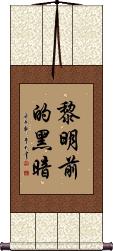
黎明前的黑暗 is the most natural way to write “The night is darkest before the dawn,” in Chinese.
The words break down this way by meaning this way:
1.黎明 dawn or daybreak
2.前 before, in front, ago, former, previous, and/or earlier
3.的 (possessive particle) of
4.黑暗 dark, darkly, or darkness
If you try to understand the Chinese word order and grammar, it's like, “Before dawn is the darkest [time].”
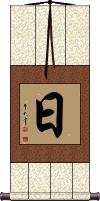
This is how to write “day” in Chinese, Japanese, and Korean Hanja.
This can also mean “Sun,” the star in the middle of the Solar system in which we live. In Japanese, it can also mean “sunshine” or even “Sunday.”
When writing the date in modern Chinese and Japanese, putting a number in front of this character indicates the day of the month. Of course, you need to indicate the month too... The month is expressed with a number followed by the character for the moon. So “three moons ten suns” would be “March 10th” or “3/10.”
Note: This is also the first character for the proper name of Japan. Remember that Japan is “The land of the rising sun”? Well, the first character for Japan means “sun” and the second means “origin” so you get the real meaning now. Sometimes, in China, this sun character can be a short name for Japan or a suffix for something of or from Japan.
Death Before Surrender
Rather die than compromise
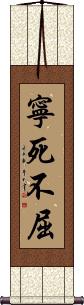
寧死不屈 is often translated as “Death Before Dishonor.”
The literal translation is more like, “Better die than compromise.” The last two characters mean “not to bend” or “not to bow down.” Some might even say that it means “not to surrender.” Thus, you could say this proverb means “Better to die than live on my knees” or simply “no surrender” (with the real idea being that you would rather die than surrender).
Death Before Dishonor
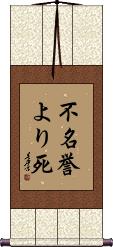
不名誉より死 is the Japanese version of “Death Before Dishonor.”
Japanese grammar is a bit different than English, so this really means something like “Rather die than to be dishonored.” However, “dishonor” is the first three Kanji, and death is the last Kanji. There are two Hiragana (より) which indicate the preference is death when comparing dishonor to death.
Note: Because this selection contains some special Japanese Hiragana characters, it should be written by a Japanese calligrapher.
Death Before Surrender
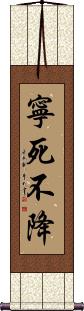
寧死不降 is an ancient Chinese proverb that can be translated as “Rather die than surrender,” “Prefer death over surrender,” “To prefer death to surrender,” or simply “No surrender.”
This is probably the closest proverb to the English proverb “Better to die on your feet than to live on your knees.”
I've noticed you are searching for "it looks like indonesian malasian or muslim writing all over my cloned fb". If you are interested, I can have your favorite verse from the Qur'an translated into Chinese and written on a wall scroll for you. You can contact me siting the verse or verses you want.
This in-stock artwork might be what you are looking for, and ships right away...





Successful Chinese Character and Japanese Kanji calligraphy searches within the last few hours...



