I am shipping orders on Thursday this week. News and More Info
Not what you want?
Try other similar-meaning words, fewer words, or just one word.
Buy an Everything is Temporary calligraphy wall scroll here!
Personalize your custom “Everything is Temporary” project by clicking the button next to your favorite “Everything is Temporary” title below...
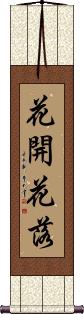
1. Flowers Bloom and Flowers Fall
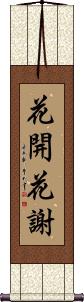
2. Flowers Bloom and Flowers Wither
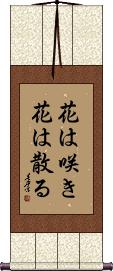
4. Flowers Bloom and Flowers Fall
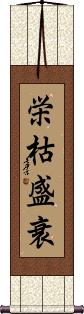
6. Rise and Fall / Ups and Downs
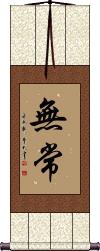
7. Impermanence
花開花落 is a complete proverb that lightly speaks of the cycle of life, or how things come and go in life.
This is used as a metaphor to suggest that youth is a temporary state that in time will pass.
This can also be used to suggest that fortunes can come and go (everything is temporary).
Note: There are two very similar versions of this proverb. The other uses a word that means wither instead of fall.
花開花謝 is a complete proverb that lightly speaks of the cycle of life, or how things come and go in life.
This is used as a metaphor to suggest that youth is a temporary state, which in time, will pass.
This proverb can be used to suggest that fortunes can come and go (everything is temporary).
Note: There are two very similar versions of this proverb. The other uses a word that means fall instead of wither.
大乘無上法 means the supreme Mahāyāna truth.
This refers to the ultimate reality in contrast with the temporary and apparent. Other translations include “the reliance on the power of the vow of the bodhisattva” or “the peerless great vehicle teaching.”
Note: This may suggest that Mahayana Buddhism, as practiced in China, Japan, Korea, Vietnam, and other regions is superior (with subtle arrogance) to the original Theravada (or old school) Buddhism. Mahayana and Theravada Buddhists generally get along better than Catholics and Protestants, but there have been schisms.
花は咲き花は散る is a Japanese proverb about the cycle of life, or how things come and go in life.
This can be used to suggest that youth, fortune, and life can come and go (everything is temporary).
Note: Because this selection contains some special Japanese Hiragana characters, it should be written by a Japanese calligrapher.
三諦 is a Buddhist term that means “threefold truth” or “three dogmas.”
The three truths are:
1. All things are void (卽空).
2. All things are temporary (卽假).
3. All things are in the middle state between these two (卽中).
Eiko-Seisui
This Japanese proverb can be translated as “flourish and wither, prosper and perish,” “life is full of fortune and misfortune,” or simply “vicissitudes of life.”
栄枯盛衰 / 榮枯盛衰 is about the rise and fall of human affairs or the ups and downs of life. Prosperity comes and goes, everything is fleeting and temporary, but like waves, another swell of prosperity may come.
Here's how the Kanji break down in this proverb:
栄 = prosper; thrive; flourish; boom.
枯 = wither; die.
盛 = prosperous; flourishing; thriving; successful; energetic; vigorous; enthusiastic.
衰 = become weaker; decline; get weak; die down; subside; abate; fail.
Notes: The original version of the first character looks like the image to the right. In modern Japan, they simplified that Kanji a bit into the version shown above. If you have a preference for which style is used for your calligraphy, please let me know when you place your order.
Apparently, with that original version of the first character, this is also used in Korean Hanja. However, I have not confirmed that
it’s
used in the same way or is widely-known in Korean.
無常 is the state of being “not permanent,” “not enduring,” transitory, or evolving.
It can also mean variable or changeable. In some contexts, it can refer to a ghost that is supposed to take a soul upon death. Following that, this term can also mean to pass away or die.
In the Buddhist context, this is a reminder that everything in this world is ever-changing, and all circumstances of your life are temporary.
If you take the Buddhist philosophy further, none of these circumstances are real, and your existence is an illusion. Thus, the idea of the eternal soul is perhaps just your attachment to your ego. Once you release your attachment to all impermanent things, you will be on your way to enlightenment and Buddhahood.
Language notes for this word when used outside the context of Buddhism:
In Korean Hanja, this means uncertainty, transiency, mutability, or evanescent.
In Japanese, the definition orbits closer to the state of being uncertain.
Below are some entries from our dictionary that may match your everything is temporary search...
| Characters If shown, 2nd row is Simp. Chinese |
Pronunciation Romanization |
Simple Dictionary Definition |
三諦 三谛 see styles |
sān dì san1 di4 san ti santai; sandai さんたい; さんだい |
More info & calligraphy: The Three TruthsThe three dogmas. The "middle" school of Tiantai says 卽空, 卽假. 卽中 i.e. 就是空, 假, 中; (a) by 空śūnya is meant that things causally produced are intheir essential nature unreal (or immaterial) 實空無; (b) 假, though thingsare unreal in their essential nature their derived forms are real; (c) 中;but both are one, being of the one 如 reality. These three dogmas arefounded on a verse of Nāgārjuna's— 因緣所生法, 我說卽是空 亦爲是假名, 亦是中道義 "All causally produced phenomena, I say, areunreal, Are but a passing name, and indicate the 'mean'." There are otherexplanations— the 圓教 interprets the 空 and 假 as 中; the 別教 makes 中 independent. 空 is the all, i.e. the totality of all things, and is spokenof as the 眞 or 實 true, or real; 假 is the differentiation of all thingsand is spoken of as 俗 common, i.e. things as commonly named; 中 is theconnecting idea which makes a unity of both, e.g. "all are but parts of onestupendous whole." The 中 makes all and the all into one whole, unifying thewhole and its parts. 空 may be taken as the immaterial, the undifferentiatedall, the sum of existences, by some as the tathāgatagarbha 如來藏; 假as theunreal, or impermanent, the material or transient form, the temporal thatcan be named, the relative or discrete; 中 as the unifier, which places eachin the other and all in all. The "shallower" 山外 school associated 空 and 中 with the noumenal universe as opposed to the phenomenal and illusoryexistence represented by 假. The "profounder" 山内 school teaches that allthree are aspects of the same. |
大乘無上法 大乘无上法 see styles |
dà shèng wú shàng fǎ da4 sheng4 wu2 shang4 fa3 ta sheng wu shang fa daijō mujō hō |
More info & calligraphy: The Supreme Mahayana Truth |
厝 see styles |
cuò cuo4 ts`o tso |
to lay in place; to put; to place a coffin in a temporary location pending burial |
暫 暂 see styles |
zàn zan4 tsan zan |
temporary; Taiwan pr. [zhan4] Temporarily, briefly, meanwhile, suddenly. |
權 权 see styles |
quán quan2 ch`üan chüan gon ごん |
authority; power; right; (literary) to weigh; expedient; temporary (surname) Gon The weight (on a steelyard), weight, authority, power; to balance, adjudge; bias, expediency, partial, provisional, temporary, positional; in Buddhist scriptures it is used like 方便 expediency, or temporary; it is the adversative of 實 q.v. |
浮 see styles |
fú fu2 fu uki うき |
to float; superficial; floating; unstable; movable; provisional; temporary; transient; impetuous; hollow; inflated; to exceed; superfluous; excessive; surplus (surname) Uki Floating, drifting, unsettled. |
行 see styles |
xíng xing2 hsing yukue ゆくえ |
(bound form) to walk; to go; to travel; (literary) trip; journey; visit; (bound form) temporary; makeshift; (bound form) current; in circulation; (bound form) to do; to perform; capable; competent; all right; OK!; will do; behavior; conduct (Taiwan pr. [xing4]); (literary) about to; soon (n,n-suf) (1) going; travelling; traveling; journey; trip; (2) act; action; (suffix noun) (3) bank; (counter) (4) counter for banks; (counter) (5) counter for groups or parties of people; (6) type of classical Chinese verse (usu. an epic from the Tang period onwards); (7) (hist) shopping district (of similar merchants; in the Sui and Tang periods); (8) (hist) merchants' guild (in the Tang period); (female given name) Yukue Go; act; do; perform; action; conduct; functioning; the deed; whatever is done by mind, mouth, or body, i.e. in thought, word, or deed. It is used for ayana, going, road, course; a march, a division of time equal to six months; also for saṁskāra, form, operation, perfecting, as one of the twelve nidānas, similar to karma, action, work, deed, especially moral action, cf. 業. |
一時 一时 see styles |
yī shí yi1 shi2 i shih kazutoki かずとき |
a period of time; a while; for a short while; temporary; momentary; at the same time (n,adv) (1) one o'clock; (n,adv) (2) once; at one time; formerly; before; (n,adv,adj-no) (3) (in weather forecasts, indicates that a given condition will hold for less than one-quarter of the forecast period) for a time; for a while; for the time being; for the present; for the moment; temporarily; (4) (See 一時に) a time; one time; once; (personal name) Kazutoki ekasmin samaye (Pali: ekaṃ samayaṃ); "on one occasion,' part of the usual opening phrase of a sūtra— "Thus have I heard, once,' etc. A period, e.g. a session of expounding a sūtra. |
三宗 see styles |
sān zōng san1 zong1 san tsung mimune みむね |
(surname) Mimune The three Schools of 法相宗, 破相宗 , and 法性宗 q.v., representing the ideas of 空, 假, and 不空假, i.e. unreality, temporary reality, and neither; or absolute, relative, and neither. |
上屋 see styles |
kamiya かみや |
shed; shelter; terminal (e.g. cargo, airport, etc.); temporary covering of a building being built; (place-name, surname) Kamiya |
中入 see styles |
nakairi なかいり |
(irregular okurigana usage) (noun/participle) (1) intermission during a performance (e.g. variety show, play, sumo, etc.); (2) temporary departure of an actor (between the first and second halves of a noh or kyogen performance, during which time they change costumes, etc.); (surname) Nakairi |
中諦 中谛 see styles |
zhōng dì zhong1 di4 chung ti chuutai / chutai ちゅうたい |
{Buddh} (See 三諦) truth of the middle (all things are in a middle state, being void yet having temporary existence) The third of the 三諦 three postulates of the Tiantai school, i. e. 空, 假, and 中 q. v. |
二教 see styles |
èr jiào er4 jiao4 erh chiao nikyō |
Dual division of the Buddha's teaching. There are various definitions: (1) Tiantai has (a) 顯教 exoteric or public teaching to the visible audience, and (b) 密教 at the same time esoteric teaching to an audience invisible to the other assembly. (2) The 眞言 Shingon School by "exoteric" means all the Buddha's preaching, save that of the 大日經 which it counts esoteric. (3) (a) 漸教 and (b) 頓教 graduated and immediate teaching, terms with various uses, e.g. salvation by works Hīnayāna, and by faith, Mahāyāna, etc.; they are applied to the Buddha's method, to the receptivity of hearers and to the teaching itself. (4) Tiantai has (a) 界内教 and (b) 界外教 teachings relating to the 三界 or realms of mortality and teachings relating to immortal realms. (5) (a) 半字教 and (b) 滿字教 Terms used in the Nirvāṇa sūtra, meaning incomplete word, or letter, teaching and complete word teaching, i.e. partial and complete, likened to Hīnayāna and Mahāyāna. (6) (a) 捃收教 and (b) 扶律談常教 of the Nirvāṇa sūtra, (a) completing those who failed to hear the Lotus; (b) "supporting the law, while discoursing on immortality," i.e. that the keeping of the law is also necessary to salvation. (7) Tiantai's division of (a) 偏教 and (b) 圓教 the partial teaching of the 藏, 通, and schools as contrasted with the perfect teaching of the 圓 school. (8) Tiantai's division of (a) 構教 and (6) 實教 temporary and permanent, similar to the last two. (9) (a) 世間教 The ordinary teaching of a moral life here; (b) 出世間教 the teaching of Buddha-truth of other-worldly happiness in escape from mortality. (10) (a) 了義教 the Mahāyāna perfect or complete teaching, and (b) 不了義教 Hīnayāna incompleteness. (11) The Huayan division of (a) 屈曲教 indirect or uneven teaching as in the Lotus and Nirvāṇa sūtras, and (b) 平道教 direct or levelled up teaching as in the Huayan sūtra. (12) The Huayan division of (a) 化教 all the Buddha's teaching for conversion and general instruction, and (b) 制教 his rules and commandments for the control and development of his order. |
二空 see styles |
èr kōng er4 kong1 erh k`ung erh kung nikū |
The two voids, unrealities, or immaterialities; v. 空. There are several antitheses: (1) (a) 人空; 我空 The non-reality of the atman, the soul, the person; (6) 法空 the non-reality of things. (2) (a) 性空 The Tiantai division that nothing has a nature of its own; (b) 相空 therefore its form is unreal, i.e. forms are temporary names. (3) (a) 但空 Tiantai says the 藏 and 通 know only the 空; (b) 不但空 the 別 and 圓 have 空, 假, and 中 q.v. (4) (a) 如實空 The division of the 起信論 that the 眞如 is devoid of all impurity; (b) 如實不空 and full of all merit, or achievement. |
人空 see styles |
rén kōng ren2 kong1 jen k`ung jen kung ningū |
Man is only a temporary combination formed by the five skandhas and the twelve nidānas, being the product of previous causes, and without a real self or permanent soul. Hīnayāna is said to end these causes and consequent reincarnation by discipline in subjection of the passions and entry into nirvana by the emptying of the self. Mahāyāna fills the "void" with the Absolute, declaring that when man has emptied himself of the ego he realizes his nature to be that of the absolute, bhūtatathatā; v. 二空. |
仮り see styles |
kari かり |
(irregular okurigana usage) (adj-no,pref) (1) temporary; provisional; interim; (can be adjective with の) (2) fictitious; assumed (name); alias; (3) hypothetical; theoretical |
仮住 see styles |
karizumai かりずまい |
(noun/participle) temporary residence |
仮免 see styles |
karimen かりめん |
(abbreviation) (See 仮免許) temporary licence; temporary license; provisional licence; provisional license |
仮初 see styles |
karisome かりそめ |
(irregular okurigana usage) (adj-no,adj-na) (1) (kana only) temporary; transient; (2) trifling; slight; negligent |
仮宅 see styles |
karitaku かりたく |
temporary dwelling |
仮宮 see styles |
karimiya かりみや |
temporary shrine; (place-name) Karimiya |
仮家 see styles |
kariya かりや |
temporary house; (surname) Kariya |
仮寓 see styles |
kaguu / kagu かぐう |
(n,vs,vi) temporary residence |
仮屋 see styles |
kariyazaki かりやざき |
temporary residence or shelter; (surname) Kariyazaki |
仮役 see styles |
kariyaku かりやく |
temporary post |
仮有 see styles |
keu けう |
temporary existence |
仮植 see styles |
kashoku かしょく |
(noun, transitive verb) temporary planting |
仮橋 see styles |
karibashi かりばし |
temporary bridge; makeshift bridge |
仮殿 see styles |
karidono かりどの |
(Shinto) temporary shrine (houses the object in which the deity resides when main shrine is under repairs) |
仮称 see styles |
kashou / kasho かしょう |
(noun, transitive verb) temporary name; provisional name; (surname) Kashou |
The following table may be helpful for those studying Chinese or Japanese...
| Title | Characters | Romaji (Romanized Japanese) | Various forms of Romanized Chinese | |
| Flowers Bloom and Flowers Fall | 花開花落 花开花落 | huā kāi huā luò hua1 kai1 hua1 luo4 hua kai hua luo huakaihualuo | hua k`ai hua lo huakaihualo hua kai hua lo |
|
| Flowers Bloom and Flowers Wither | 花開花謝 花开花谢 | huā kāi huā xiè hua1 kai1 hua1 xie4 hua kai hua xie huakaihuaxie | hua k`ai hua hsieh huakaihuahsieh hua kai hua hsieh |
|
| The Supreme Mahayana Truth | 大乘無上法 大乘无上法 | dai jou mu jou hou daijoumujouhou dai jo mu jo ho | dà shèng wú shàng fǎ da4 sheng4 wu2 shang4 fa3 da sheng wu shang fa dashengwushangfa | ta sheng wu shang fa tashengwushangfa |
| Flowers Bloom and Flowers Fall | 花は咲き花は散る | hana wa sa ki hana wa chi ru hanawasakihanawachiru | ||
| The Three Truths | 三諦 三谛 | san dai / san tai sandai / santai | sān dì / san1 di4 / san di / sandi | san ti / santi |
| Rise and Fall Ups and Downs | 栄枯盛衰 / 榮枯盛衰 荣枯盛衰 | ei ko sei sui eikoseisui | ||
| Impermanence | 無常 无常 | mujou / mujo | wú cháng / wu2 chang2 / wu chang / wuchang | wu ch`ang / wuchang / wu chang |
| In some entries above you will see that characters have different versions above and below a line. In these cases, the characters above the line are Traditional Chinese, while the ones below are Simplified Chinese. | ||||
Successful Chinese Character and Japanese Kanji calligraphy searches within the last few hours...

All of our calligraphy wall scrolls are handmade.
When the calligrapher finishes creating your artwork, it is taken to my art mounting workshop in Beijing where a wall scroll is made by hand from a combination of silk, rice paper, and wood.
After we create your wall scroll, it takes at least two weeks for air mail delivery from Beijing to you.
Allow a few weeks for delivery. Rush service speeds it up by a week or two for $10!
When you select your calligraphy, you'll be taken to another page where you can choose various custom options.
The wall scroll that Sandy is holding in this picture is a "large size"
single-character wall scroll.
We also offer custom wall scrolls in small, medium, and an even-larger jumbo size.
Professional calligraphers are getting to be hard to find these days.
Instead of drawing characters by hand, the new generation in China merely type roman letters into their computer keyboards and pick the character that they want from a list that pops up.
There is some fear that true Chinese calligraphy may become a lost art in the coming years. Many art institutes in China are now promoting calligraphy programs in hopes of keeping this unique form
of art alive.
Even with the teachings of a top-ranked calligrapher in China, my calligraphy will never be good enough to sell. I will leave that to the experts.
The same calligrapher who gave me those lessons also attracted a crowd of thousands and a TV crew as he created characters over 6-feet high. He happens to be ranked as one of the top 100 calligraphers in all of China. He is also one of very few that would actually attempt such a feat.
Check out my lists of Japanese Kanji Calligraphy Wall Scrolls and Old Korean Hanja Calligraphy Wall Scrolls.
Some people may refer to this entry as Everything is Temporary Kanji, Everything is Temporary Characters, Everything is Temporary in Mandarin Chinese, Everything is Temporary Characters, Everything is Temporary in Chinese Writing, Everything is Temporary in Japanese Writing, Everything is Temporary in Asian Writing, Everything is Temporary Ideograms, Chinese Everything is Temporary symbols, Everything is Temporary Hieroglyphics, Everything is Temporary Glyphs, Everything is Temporary in Chinese Letters, Everything is Temporary Hanzi, Everything is Temporary in Japanese Kanji, Everything is Temporary Pictograms, Everything is Temporary in the Chinese Written-Language, or Everything is Temporary in the Japanese Written-Language.
106 people have searched for Everything is Temporary in Chinese or Japanese in the past year.
Everything is Temporary was last searched for by someone else on Oct 18th, 2025