Many custom options...


And formats...



Dying in Chinese / Japanese...
Buy a Dying calligraphy wall scroll here!
Personalize your custom “Dying” project by clicking the button next to your favorite “Dying” title below...
Men Die for Wealth, Birds Die for Food
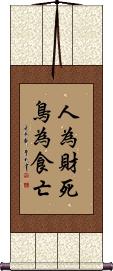
人為財死鳥為食亡 is a Chinese proverb that literally states that human beings will die for riches, just as birds will for food.
Figuratively it means that man will do anything in his means to become rich. Personally, I think dying for food is a more noble cause.
Often translated as “Men die in pursuit of wealth, birds die in pursuit of food. The 人 in this proverb just means human, so “men” is a placeholder for human with that translation - an English language problem that we have no easy gender-neutral nouns.
This proverb is meant to serve as a warning about the follies of greed.
Ultimate Loyalty to Your Country
The most famous tattoo in Chinese history
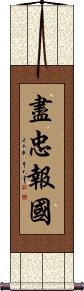
盡忠報國 is a proverb that is the tattoo worn on the back of Yue Fei, a famous Chinese warrior who lived until 1142 A.D.
The tattoo can be translated as “Serve the country with the utmost loyalty.” More literally, it means “[The] Ultimate Loyalty [is too] Duty [of] Country.”
Legend has it that this tattoo once saved his life when he was accused of treason.
The first two characters have come to create a word that means “serve the country faithfully” or “die for the country.” Note: It's more a willingness to die for one's country than the actual act of dying.
The last two characters have come to mean “Dedicate oneself to the service of one's country.”
Both of these words are probably only in the Chinese lexicon because of this famous tattoo.
If you break it down, character-by-character, here is what you get:
1. To the utmost, to the limit of something, the ultimate.
2. Loyalty or duty (a sense of duty to one's master, lord, country, or job).
3. Report, recompense, give back to (in this case, you are giving yourself to your country as payback).
4. Country, state, nation, kingdom.
These search terms might be related to Dying:
Knowledge of Ultimate Truth
Tathata / Ultimate Nature of All Things
Ultimate Goodness of Water
Ultimate Loyalty to Your Country
Ultimate Reality
Ultimate Truth
Not the results for dying that you were looking for?
Below are some entries from our dictionary that may match your dying search...
| Characters If shown, 2nd row is Simp. Chinese |
Pronunciation Romanization |
Simple Dictionary Definition |
五福 see styles |
wǔ fú wu3 fu2 wu fu gofuku ごふく |
More info & calligraphy: The Five Fortunesfive blessings |
永生 see styles |
yǒng shēng yong3 sheng1 yung sheng hisaki ひさき |
More info & calligraphy: Eternal Life / Everlasting Life / Immortalityeternal life; immortality; (personal name) Hisaki Eternal life; immortality; nirvana is defined as 不生 not being born, i. e. not reborn, and therefore 不滅 not dying; 永生 is also perpetual life; the Amitābha cult says in the Pure Land. |
一死 see styles |
isshi いっし |
(1) dying; laying down one's life; (2) {baseb} one out |
三尊 see styles |
sān zūn san1 zun1 san tsun sanzon; sanson さんぞん; さんそん |
(1) (さんぞん only) {Buddh} Buddha triad; image of a Buddha attended by two Bodhisattvas; (2) (さんぞん only) {Buddh} (See 三宝) The Three Jewels; Buddha, the teachings of Buddha, and the community of monks and nuns; (3) (さんぞん only) (See 三尊天井) head and shoulders (stock price, etc. chart pattern); (4) the three people one must esteem: master, father, teacher The three honoured ones: Buddha, the Law, the Ecclesia or Order. Others are: Amitābha, Avalokiteśvara, and Mahāsthāmaprāpta, who, according to the Pure-land sect, come to welcome the dying invoker. Another group is Bhaiṣajya, Vairocana, and Candraprabha; and another, Śākyamunī, Mañjuśrī, and Samantabhadra. |
下品 see styles |
xià pǐn xia4 pin3 hsia p`in hsia pin shimoshina しもしな |
(noun or adjectival noun) vulgar; indecent; coarse; crude; (place-name) Shimoshina The three lowest of the nine classes born in the Amitābha Pure Land, v. 無量壽經. These three lowest grades are (1) 下品上生 The highest of the three lowest classes who enter the Pure Land of Amitābha, i.e. those who have committed all sins except dishonouring the sūtras. If at the end of life the sinner clasps hands and says "Namo Amitābha", such a one will be born in His precious lake. (2) 下品中生 The middle class consists of those who have broken all the commandments, even stolen from monks and abused the law. If at death such a one hears of the great power of Amitābha, and assents with but a thought, he will be received into paradise. (3) 下品下生 The lowest class, because of their sins, should have fallen into the lowest gati, but by invoking the name of Amitābha, they can escape countless ages of reincarnation and suffering and on dying will behold a lotus flower like the sun, and, by the response of a single thought, will enter the Pure Land of Amitābha. |
不帰 see styles |
fuki ふき |
(noun - becomes adjective with の) (See 不帰の客となる) returning no more (usu. of a person who has died); dying |
中夭 see styles |
zhōng yāo zhong1 yao1 chung yao chuuyou / chuyo ちゅうよう |
dying young premature death |
亡卒 see styles |
bousotsu / bosotsu ぼうそつ |
(1) (archaism) dead soldier; (2) (archaism) deserter; (n,vs,vi) (3) (archaism) dying |
今わ see styles |
imawa いまわ |
one's dying moment or hour |
今際 see styles |
imawa いまわ |
one's dying moment or hour |
來迎 来迎 see styles |
lái yíng lai2 ying2 lai ying raikou / raiko らいこう |
(surname) Raikou The coming of Buddhas to meet the dying believer and bid welcome to the Pure Land; the three special welcomers are Amitābha, Avalokiteśvara, and Mahāsthāmaprāpta. |
倒事 see styles |
sakasamagoto さかさまごと |
(1) (obscure) (kana only) child dying before parents; (2) (obscure) occurrence out of sequence; wrong order |
倒死 see styles |
toushi / toshi とうし |
dying by the wayside |
北枕 see styles |
běi zhěn bei3 zhen3 pei chen kitamakura; kitamakura きたまくら; キタマクラ |
(1) lying with one's head to the north (trad. position for dead bodies; taboo for sleeping); (2) (kana only) brown-lined puffer (Canthigaster rivulata) The northern pillow, i. e. Śākyamuni, when dying, pillowed his head to the north, pointing the way for the extension of his doctrine. |
十恩 see styles |
shí ēn shi2 en1 shih en jūon |
Ten kinds of the Buddha's grace: his (1) initial resolve to universalize (his salvation); (2) self-sacrifice (in previous lives); (3) complete altruism; (4) his descent into all the six states of existence for their salvation; (5) relief of the living from distress and mortality; (6) profound pity; (7) revelation of himself in human and glorified form; (8) teaching in accordance with the capacity of his hearers, first hīnayāna, then māhayāna doctrine; (9) revealing his nirvāṇa to stimulate his disciples; (10) pitying thought for all creatures, in that dying at 80 instead of at 100 he left twenty years of his own happiness to his disciples; and also the tripiṭaka for universal salvation. |
垂死 see styles |
chuí sǐ chui2 si3 ch`ui ssu chui ssu suishi すいし |
dying on the verge of dying |
失命 see styles |
shitsumei / shitsume しつめい |
(noun/participle) losing one's life; dying |
客死 see styles |
kè sǐ ke4 si3 k`o ssu ko ssu kakushi; kyakushi かくし; きゃくし |
to die in a foreign land; to die abroad (n,vs,vi) dying while traveling; dying while abroad |
徒死 see styles |
toshi とし |
(n,vs,vi) dying in vain |
怕死 see styles |
pà sǐ pa4 si3 p`a ssu pa ssu |
to be scared of dying |
恋死 see styles |
koijini こいじに |
(noun/participle) dying of love |
愛潤 爱润 see styles |
ài rùn ai4 run4 ai jun auru あうる |
(female given name) Auru The fertilizing of desire; i.e. when dying the illusion of attachment fertilizes the seed of future karma, producing the fruit of further suffering. |
愧死 see styles |
kishi きし |
(n,vs,vi) (See 慙死) dying of shame; being so ashamed one wants to die |
慙死 see styles |
zanshi ざんし |
(noun/participle) dying of shame; being so ashamed one wants to die |
慚死 see styles |
zanshi ざんし |
(noun/participle) dying of shame; being so ashamed one wants to die |
憤死 see styles |
funshi ふんし |
(n,vs,vi) dying in a fit of anger or indignation |
成仏 see styles |
joubutsu / jobutsu じょうぶつ |
(n,vs,vi) (1) attaining Buddhahood; becoming a Buddha; entering Nirvana; (n,vs,vi) (2) going to heaven; resting in peace; dying (peacefully); (place-name) Jōbutsu |
抜く see styles |
nuku ぬく |
(transitive verb) (1) to pull out; to draw out; to extract; to unplug; to weed; (transitive verb) (2) to omit; to leave out; to go without; to skip; (suf,v5k) (3) (after the -masu stem of a verb) to do to the end; to do thoroughly; to do completely; to do severely; (transitive verb) (4) to let out (e.g. air from a tyre); to drain (e.g. water from a bath); to empty; (transitive verb) (5) to pick out; to choose; to select; to extract; (transitive verb) (6) to pilfer; to steal; (transitive verb) (7) to remove; to get rid of; to take out; (transitive verb) (8) to pass; to overtake; to outstrip; to get ahead of; (transitive verb) (9) (also written 貫く) to pierce; to break through; to go through; (transitive verb) (10) to cut out (a shape); to create (a pattern) by dying the surrounding area; (transitive verb) (11) to seize; to capture; to reduce; (transitive verb) (12) to scoop (a story); (transitive verb) (13) to take out (an opponent's stones; in go); (transitive verb) (14) (slang) (vulgar) to masturbate (of a male); to ejaculate (while masturbating); (transitive verb) (15) (slang) to take (a photo); to record (video) |
授手 see styles |
shòu shǒu shou4 shou3 shou shou jushu |
To proffer the hand, to come in person to welcome the dying, as e.g. does Guanyin in certain cases. |
搬鋪 搬铺 see styles |
bān pù ban1 pu4 pan p`u pan pu |
to arrange (for the dying) |
Click here for more dying results from our dictionary
The following table may be helpful for those studying Chinese or Japanese...
| Title | Characters | Romaji (Romanized Japanese) | Various forms of Romanized Chinese | |
| Men Die for Wealth, Birds Die for Food | 人為財死鳥為食亡 人为财死鸟为食亡 | rén wèi cái sǐ niǎo wèi shí wáng ren2 wei4 cai2 si3 niao3 wei4 shi2 wang2 ren wei cai si niao wei shi wang | jen wei ts`ai ssu niao wei shih wang jen wei tsai ssu niao wei shih wang |
|
| Ultimate Loyalty to Your Country | 盡忠報國 尽忠报国 | jìn zhōng bào guó jin4 zhong1 bao4 guo2 jin zhong bao guo jinzhongbaoguo | chin chung pao kuo chinchungpaokuo |
|
| In some entries above you will see that characters have different versions above and below a line. In these cases, the characters above the line are Traditional Chinese, while the ones below are Simplified Chinese. | ||||

Successful Chinese Character and Japanese Kanji calligraphy searches within the last few hours...



