Many custom options...


And formats...



Not what you want?
Try other similar-meaning words, fewer words, or just one word.
Do Not Speak in Chinese / Japanese...
Buy a Do Not Speak calligraphy wall scroll here!
Personalize your custom “Do Not Speak” project by clicking the button next to your favorite “Do Not Speak” title below...
Five Precepts
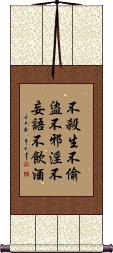
不殺生不偷盜不邪淫不妄語不飲酒 is the full list of the five precepts of Buddhism in Chinese.
There are many ways to translate or express these.
The following is one basic way:
1. Do not kill/murder.
2. Do not steal.
3. Do not commit adultery and/or sexual misconduct.
4. Do not lie or speak falsehoods.
5. Do not become intoxicated (with drugs/alcohol).
Here is another take from my favorite magazine: Lion's Roar: Five Precepts
Sparrow
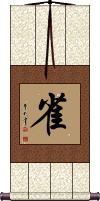
雀 is the shortest way to say small bird, or sparrow in Chinese, Japanese, and Korean.
In Chinese, this can also be a colloquial way to speak of a freckle.
In Japanese, it's a nickname for a talkative person - not a bad thing, as it can also be a knowledgeable person
Hurt
ache / pain / sore / love fondly
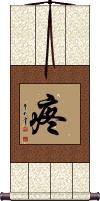
疼 can mean hurt, ache, pain or sore in Chinese and old Korean Hanja.
It's also used to speak of the pain of love, and thus its definition also includes “love fondly.” This also means ache, hurt, tingle, or pain in Japanese but is not often seen as a lone Kanji like this in Japanese.
There is no god but Allah, and Muhammad is His Messenger
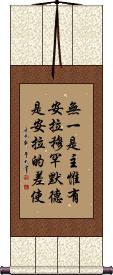
無一是主惟有安拉穆罕默德是安拉的差使 is one of the key creeds of Islam.
While perhaps more often seen in Arabic as
there are many native Chinese Muslims (especially the Hui ethnicity) that do not speak Arabic.
Instead, they use this Chinese phrase to express this idea or statement of faith.
Chess
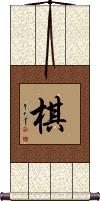
棋 is the most simple or generic way to write “chess” in Asia.
棋 is part of other more specific words for board games of strategy such as the western version of chess, Chinese chess, Weiqi, or Go.
In Japanese, this single character is pronounced “Go” and often refers to the game known in the west as “Go” (not just the 5-in-a-row version but also the complicated encirclement game of strategy known in China as Weiqi).
In Chinese, this can be more ambiguous as to which game of chess you speak.
If you like any version of chess, or games of intense strategy, this can be the character to hang on the wall in your game room.
In Wine there is Truth
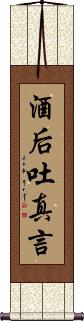
酒后吐真言 / 酒後吐真言 is a nice Asian proverb if you know a vintner or wine seller - or wine lover - although the actual meaning might not be exactly what you think or hope.
The literal meaning is that someone drinking wine is more likely to let the truth slip out. It can also be translated as “People speak their true feelings after drinking alcohol.”
It's long believed in many parts of Asia that one can not consciously hold up a facade of lies when getting drunk, and therefore the truth will come out with a few drinks.
I've had the experience where a Korean man would not trust me until I got drunk with him (I was trying to gain access to the black market in North Korea which is tough to do as an untrusted outsider) - so I think this idea is still well-practiced in many Asian countries.
 VS
VS 
Please note that there are two common ways to write the second character of this phrase. The way it's written will be left up to the mood of the calligrapher, unless you let us know that you have a certain preference.
Brief and to the Point
Speak simply, while expressing your idea completely
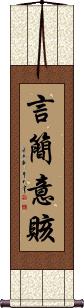
言簡意賅 is a Chinese proverb that suggests it is better to be brief and use fewer words while still expressing your main point or idea.
In another way to explain this, one should not use 100 words when 50 will do, or being more concise with your speech.
This can also be translated as concise, compendious, “brief in form but comprehensive in scope” or succinct.
This is a bit more positive than our other proverb for brevity.
Not the results for do not speak that you were looking for?
Below are some entries from our dictionary that may match your do not speak search...
| Characters If shown, 2nd row is Simp. Chinese |
Pronunciation Romanization |
Simple Dictionary Definition |
戒 see styles |
jiè jie4 chieh kai; ingoto(ok) かい; いんごと(ok) |
to guard against; to exhort; to admonish or warn; to give up or stop doing something; Buddhist monastic discipline; ring (for a finger) (1) (かい only) {Buddh} admonition; commandment; (2) sila (precept) śīla, 尸羅. Precept, command, prohibition, discipline, rule; morality. It is applied to the five, eight, ten, 250, and other commandments. The five are: (1) not to kill; (2 ) not to steal; (3) not to commit adultery; (4) not to speak falsely; (5) not to drink wine. These are the commands for lay disciples; those who observe them will be reborn in the human realm. The Sarvāstivādins did not sanction the observance of a limited selection from them as did the 成實宗 Satyasiddhi school. Each of the five precepts has five guardian spirits, in all twenty-five, 五戒二十五神. The eight for lay disciples are the above five together with Nos. 7, 8, and 9 of the following; the ten commands for the ordained, monks and nuns, are the above five with the following: (6) not to use adornments of flowers, nor perfumes; (7) not to perform as an actor, juggler, acrobat, or go to watch and hear them; (8) not to sit on elevated, broad, and large divans (or beds); (9) not to eat except in regulation hours; (10) not to possess money, gold or silver, or precious things. The 具足戒full commands for a monk number 250, those for a nun are 348, commonly called 500. Śīla is also the first of the 五分法身, i.e. a condition above all moral error. The Sutra of Brahma's Net has the following after the first five: (6) not to speak of the sins of those in orders; (7) not to vaunt self and depreciate others; (8) not to be avaricious; (9) not to be angry; (10) not to slander the triratna. |
不語 不语 see styles |
bù yǔ bu4 yu3 pu yü fugo ふご |
(literary) not to speak silence |
八戒 see styles |
bā jiè ba1 jie4 pa chieh hakkai; hachikai はっかい; はちかい |
the eight precepts (Buddhism) {Buddh} (See 五戒) the eight precepts (the five precepts with the addition of prohibitions against lying in a luxurious bed, self-decoration, song and dance, and eating after noon) (八戒齋) The first eight of the ten commandments, see 戒; not to kill; not to take things not given; no ignoble (i.e. sexual) conduct; not to speak falsely; not to drink wine; not to indulge in cosmetics, personal adornments, dancing, or music; not to sleep on fine beds, but on a mat on the ground; and not to eat out of regulation hours, i.e. after noon. Another group divides the sixth into two―against cosmetics and adornments and against dancing and music; the first eight are then called the eight prohibitory commands and the last the 齋 or fasting commandment. Also 八齋戒; 八關齋 (八支齋) ; cf. 八種勝法. |
况や see styles |
iwanya いわんや |
(adverb) (kana only) much more; not to mention; not to speak of; to say nothing of; let alone |
処か see styles |
dokoroka どころか |
(suffix) (1) (kana only) far from; anything but; not at all; (2) let alone; to say nothing of; not to speak of; much less |
況や see styles |
iwanya いわんや |
(adverb) (kana only) much more; not to mention; not to speak of; to say nothing of; let alone |
莫講 莫讲 see styles |
mò jiǎng mo4 jiang3 mo chiang |
let alone; not to speak of (all the others) |
大梵天 see styles |
dà fàn tiān da4 fan4 tian1 ta fan t`ien ta fan tien Daibon ten |
Mahābrahman; Brahma; 跋羅吸摩; 波羅賀磨; 梵覽摩; 梵天王; 梵王; 梵. Eitel says: "The first person of the Brahminical Trimūrti, adopted by Buddhism, but placed in an inferior position, being looked upon not as Creator, but as a transitory devatā whom every Buddhistic saint surpasses on obtaining bodhi. Notwithstanding this, the Saddharma-puṇḍarīka calls Brahma 'the father of all living beings'" 一切衆生之父. Mahābrahman is the unborn or uncreated ruler over all, especially according to Buddhism over all the heavens of form, i.e. of mortality. He rules over these heavens, which are of threefold form: (a) Brahma (lord), (b) Brahma-purohitas (ministers), and (c) Brahma-pāriṣadyāh (people). His heavens are also known as the middle dhyāna heavens, i.e. between the first and second dhyānas. He is often represented on the right of the Buddha. According to Chinese accounts the Hindus speak of him (1) as born of Nārāyaṇa, from Brahma's mouth sprang the brahmans, from his arms the kṣatriyas, from his thighs the vaiśyas, and from his feet the śūdras; (2) as born from Viṣṇu; (3) as a trimūrti, evidently that of Brahma, Viṣṇu, and Śiva, but Buddhists define Mahābrahma's dharmakāya as Maheśvara (Śiva), his saṃbhogakāya as Nārāyaṇa, and his nirmāṇakāya as Brahmā. He is depicted as riding on a swan, or drawn by swans. |
況んや see styles |
iwanya いわんや |
(adverb) (kana only) much more; not to mention; not to speak of; to say nothing of; let alone |
三猿主義 see styles |
sanenshugi さんえんしゅぎ |
the principle of see no evil, hear no evil, speak no evil; the policy of "see-not, hear-not, and speak-not" |
不說一字 不说一字 see styles |
bù shuō yī zì bu4 shuo1 yi1 zi4 pu shuo i tzu fusetsu ichiji |
does not speak a single word |
八不正觀 八不正观 see styles |
bā bù zhèng guān ba1 bu4 zheng4 guan1 pa pu cheng kuan happu shōkan |
Meditation on the eight negations 八不. These eight, birth, death, etc., are the 八迷 eight misleading ideas, or 八計 eight wrong calculations. No objection is made to the terms in the apparent, or relative, sense 俗諦, but in the real or absolute sense 眞諦 these eight ideas are incorrect, and the truth lies between them ; in the relative, mortality need not be denied, but in the absolute we cannot speak of mortality or immortality. In regard to the relative view, beings have apparent birth and apparent death from various causes, but are not really born and do not really die, i.e. there is the difference of appearance and reality. In the absolute there is no apparent birth and apparent death. The other three pairs are similarly studied. |
沙彌尼戒 沙弥尼戒 see styles |
shā mí ní jiè sha1 mi2 ni2 jie4 sha mi ni chieh shamini kai |
The ten commandments taken by the śrāmaṇerikā: not to kill living beings, not to steal, not to lie or speak evil, not to have sexual intercourse, not to use perfumes or decorate oneself with flowers, not to occupy high beds, not to sing or dance, not to possess wealth, not to eat out of regulation hours, not to drink wine. |
直言不諱 直言不讳 see styles |
zhí yán bù huì zhi2 yan2 bu4 hui4 chih yen pu hui |
to speak bluntly (idiom); not to mince words |
鼈不愼ロ see styles |
biē bù shèn bie1 bu4 shen4 pieh pu shen |
The tortoise, clinging to a stick with its mouth, being carried in fight, warned not to open its mouth to speak, yet did, fell and perished; moral, guard your lips. |
鼈不愼口 see styles |
biē bù shèn xì bie1 bu4 shen4 xi4 pieh pu shen hsi |
the tortoise not daring to speak |
言葉を濁す see styles |
kotobaonigosu ことばをにごす |
(exp,v5s) (idiom) to be vague; to speak ambiguously; to be evasive; to not commit oneself |
不可同日而語 不可同日而语 see styles |
bù kě tóng rì ér yǔ bu4 ke3 tong2 ri4 er2 yu3 pu k`o t`ung jih erh yü pu ko tung jih erh yü |
lit. mustn't speak of two things on the same day (idiom); not to be mentioned in the same breath; incomparable |
敢怒而不敢言 see styles |
gǎn nù ér bù gǎn yán gan3 nu4 er2 bu4 gan3 yan2 kan nu erh pu kan yen |
angry, but not daring to speak out (idiom); obliged to remain silent about one's resentment; unable to voice objections |
未可同日而語 未可同日而语 see styles |
wèi kě tóng rì ér yǔ wei4 ke3 tong2 ri4 er2 yu3 wei k`o t`ung jih erh yü wei ko tung jih erh yü |
lit. mustn't speak of two things on the same day (idiom); not to be mentioned in the same breath; incomparable |
一家人不說兩家話 一家人不说两家话 see styles |
yī jiā rén bù shuō liǎng jiā huà yi1 jia1 ren2 bu4 shuo1 liang3 jia1 hua4 i chia jen pu shuo liang chia hua |
lit. family members speak frankly with one another, not courteously, as if they were from two different families (idiom); fig. people don't need to be deferential when they ask a family member for help; people from the same family should stick together (and good friends likewise) |
名人は人を謗らず see styles |
meijinhahitoososhirazu / mejinhahitoososhirazu めいじんはひとをそしらず |
(expression) (proverb) an accomplished person does not find fault with others; it is petty to criticize; speak ill of no man |
Variations: |
iwanya いわんや |
(adverb) (kana only) much more; not to mention; not to speak of; to say nothing of; let alone |
物も言い様で角が立つ see styles |
monomoiiyoudekadogatatsu / monomoiyodekadogatatsu ものもいいようでかどがたつ |
(exp,v5t) (idiom) Harsh words make the going rough; People may be offended (or not) by the way you speak |
固いことは言いっこなし see styles |
kataikotohaiikkonashi / kataikotohaikkonashi かたいことはいいっこなし |
(expression) let's put formalities aside; let's not speak so stiffly |
物も言いようで角が立つ see styles |
monomoiiyoudekadogatatsu / monomoiyodekadogatatsu ものもいいようでかどがたつ |
(exp,v5t) (idiom) Harsh words make the going rough; People may be offended (or not) by the way you speak |
硬いことは言いっこなし see styles |
kataikotohaiikkonashi / kataikotohaikkonashi かたいことはいいっこなし |
(expression) let's put formalities aside; let's not speak so stiffly |
かたいことは言いっこなし see styles |
kataikotohaiikkonashi / kataikotohaikkonashi かたいことはいいっこなし |
(expression) let's put formalities aside; let's not speak so stiffly |
知る者は言わず言う者は知らず see styles |
shirumonohaiwazuiumonohashirazu しるものはいわずいうものはしらず |
(expression) (proverb) he who knows, does not speak; he who speaks, does not know; those who know do not talk; those who talk do not know |
Variations: |
okubanimonogahasamaru おくばにものがはさまる |
(exp,v5r) (idiom) to beat around the bush; to not speak frankly; to talk in a roundabout way |
Click here for more do not speak results from our dictionary
The following table may be helpful for those studying Chinese or Japanese...
| Title | Characters | Romaji (Romanized Japanese) | Various forms of Romanized Chinese | |
| Five Precepts | 不殺生不偷盜不邪淫不妄語不飲酒 不杀生不偷盗不邪淫不妄语不饮酒 | bù shā shēng bù tōu dào bù xié yín bù wàng yǔ bù yǐn jiǔ bu4 sha1 sheng1 bu4 tou1 dao4 bu4 xie2 yin2 bu4 wang4 yu3 bu4 yin3 jiu3 bu sha sheng bu tou dao bu xie yin bu wang yu bu yin jiu | pu sha sheng pu t`ou tao pu hsieh yin pu wang yü pu yin chiu pu sha sheng pu tou tao pu hsieh yin pu wang yü pu yin chiu |
|
| Sparrow | 雀 | chie / suzume | què / que4 / que | ch`üeh / chüeh |
| Hurt | 疼 | tou / uzuku to / uzuku | téng / teng2 / teng | t`eng / teng |
| There is no god but Allah, and Muhammad is His Messenger | 無一是主惟有安拉穆罕默德是安拉的差使 无一是主惟有安拉穆罕默德是安拉的差使 | wú yī shì zhǔ wéi yǒu ān lā mù hǎn mò dé shì ān lā de chāi shǐ wu2 yi1 shi4 zhu3 wei2 you3 an1 la1 mu4 han3 mo4 de2 shi4 an1 la1 de chai1 shi3 wu yi shi zhu wei you an la mu han mo de shi an la de chai shi | wu i shih chu wei yu an la mu han mo te shih an la te ch`ai shih wu i shih chu wei yu an la mu han mo te shih an la te chai shih |
|
| Chess | 棋 | go | qí / qi2 / qi | ch`i / chi |
| In Wine there is Truth | 酒后吐真言 / 酒後吐真言 酒后吐真言 | jiǔ hòu tǔ zhēn yán jiu3 hou4 tu3 zhen1 yan2 jiu hou tu zhen yan jiuhoutuzhenyan | chiu hou t`u chen yen chiuhoutuchenyen chiu hou tu chen yen |
|
| Brief and to the Point | 言簡意賅 言简意赅 | yán jiǎn yì gāi yan2 jian3 yi4 gai1 yan jian yi gai yanjianyigai | yen chien i kai yenchienikai |
|
| In some entries above you will see that characters have different versions above and below a line. In these cases, the characters above the line are Traditional Chinese, while the ones below are Simplified Chinese. | ||||

Successful Chinese Character and Japanese Kanji calligraphy searches within the last few hours...



