Many custom options...


And formats...



Swordsmanship in Chinese / Japanese...
Buy a Swordsmanship calligraphy wall scroll here!
Personalize your custom “Swordsmanship” project by clicking the button next to your favorite “Swordsmanship” title below...
Kendo / The Way of the Sword
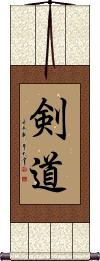
Often associated with Kenjutsu, 剱道/劍道 means “The way of the sword” in Japanese (and Korean with an alternate form of the first character).
This is also the term used for swordsmanship and even fencing in Japanese and Korean, depending on context.
Note: These same characters are also used separately in Chinese, but this exact combination yields a common title in Japanese only (perhaps someone who is really into swords would use this in China).
Note: There is more than one way to write the “sword” character (shown above is the Japanese version - if you want the Korean version, please let me know when you place your order).
Kenjutsu / Kenjitsu
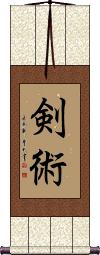
In Japanese, the modern definition, using simple terms, 剣術 is “A martial art involving swords” or “The art of the sword.”
However, in Chinese, this is the word for fencing (as in the Olympic sport).
I will suppose that you want this for the Japanese definition, which comes from skills and techniques developed in the 15th century. At that time, Kenjutsu (or swordsmanship) was a strictly military art taught to Samurai and Bushi (soldiers). The fact that swords are rarely used in military battles anymore, and with the pacification of Japan after WWII, Kenjutsu is strictly a ceremonial practice often studied as a form of martial art (more for the discipline aspect rather than practical purpose).
Language note: The Korean definition is close to the Japanese version described above. However, it should be noted that this can mean “fencing” depending on the context in Japanese, Chinese, and Korean.

 Character variation notes: There are slight variations possible with the second character. Either way is correct and understood by both Japanese and Chinese folks.
Since there are about 5 common ways to write the sword character, if you are particular about which version you want, please note that in the “special instructions” when you place your order.
Romanization note: This term is often Romanized as Kenjitsu; however, following the rules of Japanese Romaji, it should be Kenjutsu.
Toyama-Ryu

戸山流 or Toyama-Ryu is a relatively modern Japanese swordsmanship style (gendai budo) developed in the early 20th century at the Toyama Military Academy in Japan.
It was designed to efficiently train Imperial Japanese Army officers in swordsmanship, with a focus on practical application for battlefield use.
Bajutsu

馬術 (Bajutsu) is a Japanese form of military equestrianism.
Bajutsu involves techniques of swordsmanship, tactical advance, archery, and even the care of horses.
This is also a Chinese title where it means equestrianism, horsemanship, or equestrian art (the art of riding a horse).
Sword Saint
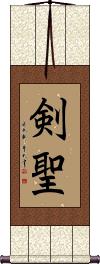
剣聖 can be translated as “Sword Saint,” “God of the Sword,” or “Saint of the Sword.” This is an ancient Japanese title bestowed on a master with the greatest of skills in swordsmanship.
Keep in mind that this is an antiquated term. It will only be understood in the context of martial arts. The pronunciation “kensei” also applies to other words like “constitutional government” and power (these words have different kanji and are completely unrelated).
Notes: This is sometimes Romanized as “kensei,” “ken sei,” and incorrectly as “Kensai.”
Chinese Note: This title is pronounceable in Chinese but seldom, if ever, used in Chinese. Also, the first character is an alternate character form for a sword, currently only used in Japan.
This in-stock artwork might be what you are looking for, and ships right away...
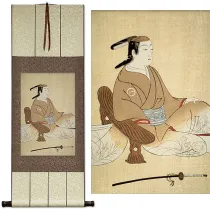
Gallery Price: $108.00
Your Price: $59.88
Not the results for Swordsmanship that you were looking for?
Below are some entries from our dictionary that may match your Swordsmanship search...
| Characters If shown, 2nd row is Simp. Chinese |
Pronunciation Romanization |
Simple Dictionary Definition |
剣 see styles |
jiàn jian4 chien mayaka まやか |
More info & calligraphy: Swordsword (originally esp. a doubled-edged sword); sabre; saber; blade; (1) sword (originally esp. a doubled-edged sword); sabre; saber; blade; (2) bayonet; (3) swordsmanship; (4) stinger; ovipositor; dart; (female given name) Mayaka |
劍 剑 see styles |
jiàn jian4 chien ken つるぎ |
More info & calligraphy: Sword(out-dated kanji) sword (originally esp. a doubled-edged sword); sabre; saber; blade; (out-dated kanji) (1) sword (originally esp. a doubled-edged sword); sabre; saber; blade; (2) bayonet; (3) swordsmanship; (4) stinger; ovipositor; dart A sword, a two-edged sword.; A sword, two-edged sword. |
剣術 see styles |
kenjutsu けんじゅつ |
More info & calligraphy: Kenjutsu / Kenjitsu |
劒 剑 see styles |
jiàn jian4 chien tsurugi つるぎ |
variant of 劍|剑[jian4] (out-dated kanji) sword (originally esp. a doubled-edged sword); sabre; saber; blade; (out-dated kanji) (1) sword (originally esp. a doubled-edged sword); sabre; saber; blade; (2) bayonet; (3) swordsmanship; (4) stinger; ovipositor; dart; (surname) Tsurugi |
剣技 see styles |
kengi けんぎ |
(See 剣術・けんじゅつ) sword skills; swordsmanship |
剣法 see styles |
kenpou / kenpo けんぽう |
(art of) fencing; swordsmanship |
剣筋 see styles |
kensuji けんすじ |
(1) (See 太刀筋) swordsmanship; (2) line drawn by the tip of a sword when slashing |
劍術 剑术 see styles |
jiàn shù jian4 shu4 chien shu |
swordsmanship |
秘剣 see styles |
hiken ひけん |
secret swordsmanship (of a specific school); secret traditions of fencing |
使い手 see styles |
tsukaite つかいて |
(1) user; consumer; employer; (2) master (e.g. of swordsmanship); (3) prodigal; spendthrift |
剣の道 see styles |
kennomichi けんのみち |
(exp,n) (See 道・みち・8) way of the sword; swordsmanship |
太刀筋 see styles |
tachisuji たちすじ |
swordsmanship |
遣い手 see styles |
tsukaite つかいて |
(1) user; consumer; employer; (2) master (e.g. of swordsmanship); (3) prodigal; spendthrift |
二天一流 see styles |
nitenichiryuu / nitenichiryu にてんいちりゅう |
style of classical Japanese swordsmanship involving use of two swords |
太刀捌き see styles |
tachisabaki たちさばき |
swordplay; swordsmanship |
弓馬刀槍 see styles |
kyuubatousou / kyubatoso きゅうばとうそう |
archery, horsemanship, spearsmanship, and swordsmanship; martial arts in general |
弓馬槍剣 see styles |
kyuubasouken / kyubasoken きゅうばそうけん |
archery, horsemanship, spearsmanship, and swordsmanship; martial arts in general |
文武不岐 see styles |
bunbufuki ぶんぶふき |
(expression) (yoji) scholarship and swordsmanship are one and the same; the literary and the military are the same path |
太刀さばき see styles |
tachisabaki たちさばき |
swordplay; swordsmanship |
Variations: |
tsukaite つかいて |
(1) user; consumer; employer; (2) master (e.g. of swordsmanship); (3) prodigal; spendthrift |
Variations: |
tachisabaki たちさばき |
swordplay; swordsmanship |
Variations: |
tsukaite つかいて |
(1) user; consumer; employer; (2) (esp. 遣い手) master (e.g. of swordsmanship); (3) prodigal; spendthrift |
Variations: |
ken(p); tsurugi けん(P); つるぎ |
(1) sword (esp. a large, double-edged one); blade; (2) (けん only) bayonet; (3) (けん only) swordsmanship; (4) (けん only) {zool} stinger; ovipositor; dart |
The following table may be helpful for those studying Chinese or Japanese...
| Title | Characters | Romaji (Romanized Japanese) | Various forms of Romanized Chinese | |
| Kendo The Way of the Sword | 剱道 / 劍道 剣道 | kendou / kendo | jiàn dào / jian4 dao4 / jian dao / jiandao | chien tao / chientao |
| Kenjutsu Kenjitsu | 剣術 剑术 | kenjutsu | jiàn shù / jian4 shu4 / jian shu / jianshu | chien shu / chienshu |
| Toyama-Ryu | 戸山流 | to yama ryuu toyamaryuu to yama ryu | ||
| Bajutsu | 馬術 | ba ju tsu / bajutsu | mǎ shù / ma3 shu4 / ma shu / mashu | |
| Sword Saint | 剣聖 / 剣聖 剣圣 | kensei | jiàn shèng jian4 sheng4 jian sheng jiansheng | chien sheng chiensheng |
| In some entries above you will see that characters have different versions above and below a line. In these cases, the characters above the line are Traditional Chinese, while the ones below are Simplified Chinese. | ||||

Successful Chinese Character and Japanese Kanji calligraphy searches within the last few hours...



