Many custom options...


And formats...



Safety Well Being in Chinese / Japanese...
Buy a Safety Well Being calligraphy wall scroll here!
Personalize your custom “Safety Well Being” project by clicking the button next to your favorite “Safety Well Being” title below...
Safety and Well-Being of the Family
Kanai Anzen
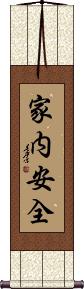
家內安全 is the Japanese way of saying “Family First.”
It's a Japanese proverb about the safety and well-being of your family and/or peace and prosperity in the household.
Some Japanese will hang an amulet in their home with these Kanji. The purpose is to keep your family safe from harm.
According to Shinto followers, hanging this in your home is seen as an invocation to God to always keep family members free from harm.
We were looking for a way to say “family first” in Japanese when this proverb came up in the conversation and research. While it doesn't say “family first,” it shows that the safety and well-being of your family is your first or most important priority. So, this proverb is the most natural way to express the idea that you put your family first.
See Also: Peace and Prosperity
Safe and Sound
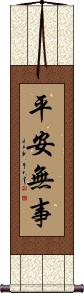
This proverb means “safe and sound without toil or trouble.”
It kind of means that all is well with a feeling of complete safety. The ideas contained in these characters include well-being, peace, tranquility, quietness, calmness, and non-problematic.
Peaceful Heart / Peace of Mind / Calm Mind
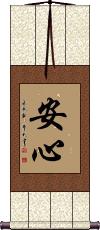
安心 can be defined as relief, peace of mind, feeling at ease, to be relieved, to set one's mind at rest, and easiness.
安心 is a nice word that encompasses great meanings within just two characters. Some of the other meanings include pacifying, settling the mind, and peace of mind. It's also the idea of feeling a sense of security, safety, and confidence in your state of well-being.
This can be used by everyone, but some consider it to be a Buddhist concept (You'll find it in your Zen dictionary).
Note: Can be romanized as Anshin or Anjin in Japanese.
This in-stock artwork might be what you are looking for, and ships right away...
Gallery Price: $300.00
Your Price: $109.88

Gallery Price: $60.00
Your Price: $39.88
Not the results for Safety Well Being that you were looking for?
Below are some entries from our dictionary that may match your Safety Well Being search...
| Characters If shown, 2nd row is Simp. Chinese |
Pronunciation Romanization |
Simple Dictionary Definition |
家内安全 see styles |
kanaianzen かないあんぜん |
More info & calligraphy: Safety and Well-Being of the Family |
安否 see styles |
anpi(p); anpu; anbu(ok); anbi(ok) あんぴ(P); あんぷ; あんぶ(ok); あんび(ok) |
safety; welfare; well-being |
機嫌 机嫌 see styles |
jī xián ji1 xian2 chi hsien kigen きげん |
(1) humour; humor; temper; mood; spirits; (2) safety; health; well-being; one's situation; (adjectival noun) (3) in a good mood; in high spirits; happy; cheery; merry; chipper disliked by people |
気嫌 see styles |
kigen きげん |
(irregular kanji usage) (1) humour; humor; temper; mood; spirits; (2) safety; health; well-being; one's situation; (adjectival noun) (3) in a good mood; in high spirits; happy; cheery; merry; chipper |
譏嫌 讥嫌 see styles |
jī xián ji1 xian2 chi hsien kigen きげん |
(out-dated kanji) (1) humour; humor; temper; mood; spirits; (2) safety; health; well-being; one's situation; (adjectival noun) (3) in a good mood; in high spirits; happy; cheery; merry; chipper To hold in contempt; to satirize. |
ご機嫌 see styles |
gokigen ごきげん |
(1) (honorific or respectful language) (polite language) humour; humor; temper; mood; spirits; (2) (honorific or respectful language) (polite language) safety; health; well-being; one's situation; (adjectival noun) (3) in a good mood; in high spirits; happy; cheery; merry; chipper |
御機嫌 see styles |
gokigen ごきげん |
(1) (honorific or respectful language) (polite language) humour; humor; temper; mood; spirits; (2) (honorific or respectful language) (polite language) safety; health; well-being; one's situation; (adjectival noun) (3) in a good mood; in high spirits; happy; cheery; merry; chipper |
安否不明 see styles |
anpifumei / anpifume あんぴふめい |
fate (safety) of a person (persons) being unknown |
Variations: |
gokigen ごきげん |
(1) (honorific or respectful language) (polite language) (See 機嫌・1) humour; humor; temper; mood; spirits; (2) (honorific or respectful language) (polite language) safety; health; well-being; one's situation; (adjectival noun) (3) in a good mood; in high spirits; happy; cheery; merry; chipper |
Variations: |
kigen きげん |
(1) humour; humor; temper; mood; spirits; (2) safety; health; well-being; one's situation; (adjectival noun) (3) (usu. as ご機嫌) (See ご機嫌・ごきげん・3) in a good mood; in high spirits; happy; cheery; merry; chipper |
The following table may be helpful for those studying Chinese or Japanese...
| Title | Characters | Romaji (Romanized Japanese) | Various forms of Romanized Chinese | |
| Safety and Well-Being of the Family | 家內安全 家内安全 | ka nai an zen kanaianzen | ||
| Safe and Sound | 平安無事 平安无事 | heian buji / heianbuji | píng ān wú shì ping2 an1 wu2 shi4 ping an wu shi pinganwushi | p`ing an wu shih pinganwushih ping an wu shih |
| Peaceful Heart Peace of Mind Calm Mind | 安心 | an shin / anshin | ān xīn / an1 xin1 / an xin / anxin | an hsin / anhsin |
| In some entries above you will see that characters have different versions above and below a line. In these cases, the characters above the line are Traditional Chinese, while the ones below are Simplified Chinese. | ||||

Successful Chinese Character and Japanese Kanji calligraphy searches within the last few hours...



