Many custom options...


And formats...



Resistance in Chinese / Japanese...
Buy a Resistance calligraphy wall scroll here!
Personalize your custom “Resistance” project by clicking the button next to your favorite “Resistance” title below...
Physical Strength
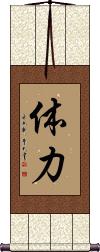
体力 means “physical strength” or “physical power.”
The first character was first simplified in Japan. Later, that simplified version became the standard in mainland China. Just in case you want this version, it is offered here. I suggest it if your audience is Japanese. Most Chinese know the older traditional version, which looks like 體力.
体力 can also be defined: stamina; endurance; physical strength; resilience; resistance to disease; clout; stability.
Flying Tigers AVG
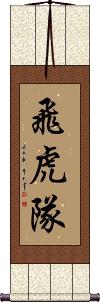
飛虎隊 is the full Chinese title of the “Flying Tigers Group.”
These were the American pilots that volunteered to go to China and fight the Japanese before the entry of the USA into World War Two. These fighter pilots were so esteemed in China that fallen American pilots could always find refuge in villages and safe passage and escape to areas of China that were not occupied by Japan at that time. Chinese villagers helped such fallen pilots with full knowledge that when the Japanese occupation forces found out, all the men, women, and children in the village would be massacred by Japanese troops (there are more than a few known cases of such massacres).
The Flying Tigers successfully kept supply lines to the Chinese resistance open and divided Japanese forces at a crucial time while America prepared to join WWII officially.
A wall scroll like this honors the men who risked or gave their lives as noble volunteers and is a reminder of the best moment in the history of Sino-American relations.
These three characters literally mean “flying tiger(s) group/team/squad.”
Note: Hanging these characters on your wall will not make you any friends with Japanese people who are aware or this history (most Japanese have no idea, as Japan’s involvement in WWII has all but been erased from school textbooks in Japan).
Undaunted After Repeated Setbacks
Persistence to overcome all challenges
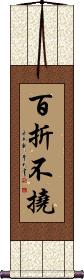
百折不撓 is a Chinese proverb that means “Be undaunted in the face of repeated setbacks.”
More directly translated, it reads, “[Overcome] a hundred setbacks, without flinching.” 百折不撓 is of Chinese origin but is commonly used in Japanese and somewhat in Korean (same characters, different pronunciation).
This proverb comes from a long, and occasionally tragic story of a man that lived sometime around 25-220 AD. His name was Qiao Xuan, and he never stooped to flattery but remained an upright person at all times. He fought to expose the corruption of higher-level government officials at great risk to himself.
Then when he was at a higher level in the Imperial Court, bandits were regularly capturing hostages and demanding ransoms. But when his own son was captured, he was so focused on his duty to the Emperor and the common good that he sent a platoon of soldiers to raid the bandits' hideout, and stop them once and for all even at the risk of his own son's life. While all of the bandits were arrested in the raid, they killed Qiao Xuan's son at first sight of the raiding soldiers.
Near the end of his career, a new Emperor came to power, and Qiao Xuan reported to him that one of his ministers was bullying the people and extorting money from them. The new Emperor refused to listen to Qiao Xuan and even promoted the corrupt Minister. Qiao Xuan was so disgusted that in protest, he resigned from his post as minister (something almost never done) and left for his home village.
His tombstone reads “Bai Zhe Bu Nao” which is now a proverb used in Chinese culture to describe a person of strong will who puts up stubborn resistance against great odds.
My Chinese-English dictionary defines these 4 characters as “keep on fighting despite all setbacks,” “be undaunted by repeated setbacks,” and “be indomitable.”
Our translator says it can mean “never give up” in modern Chinese.
Although the first two characters are translated correctly as “repeated setbacks,” the literal meaning is “100 setbacks” or “a rope that breaks 100 times.” The last two characters can mean “do not yield” or “do not give up.”
Most Chinese, Japanese, and Korean people will not take this absolutely literal meaning but will instead understand it as the title suggests above. If you want a single big word definition, it would be indefatigability, indomitableness, persistence, or unyielding.
See Also: Tenacity | Fortitude | Strength | Perseverance | Persistence
Not the results for Resistance that you were looking for?
Below are some entries from our dictionary that may match your Resistance search...
| Characters If shown, 2nd row is Simp. Chinese |
Pronunciation Romanization |
Simple Dictionary Definition |
体力 see styles |
tairyoku たいりょく |
More info & calligraphy: Physical Strength |
虛空 虚空 see styles |
xū kōng xu1 kong1 hsü k`ung hsü kung kokū |
More info & calligraphy: Nothingness / Empty / Voidśūnya; empty, void, space; ākāśa, in the sense of space, or the ether; gagana, the sky, atmosphere, heaven; kha, space, sky, ether, 虛 is defined as that which is without shape or substantiality, 空 as that which has no resistance. The immaterial universe behind all phenomena. |
色 see styles |
shǎi shai3 shai shiki しき |
(coll.) color; used in 色子[shai3 zi5] (counter) counter for colours; (female given name) Shiki rūpa, outward appearance, form, colour, matter, thing; the desirable, especially feminine attraction. It is defined as that which has resistance; or which changes and disappears, i. e. the phenomenal; also as 顯, 形 and 表色 colour and quality, form or the measurable, and mode or action. There are divisions of two, i. e. inner and outer, as the organs and objects of sense; also colour and form; of three, i. e. the visible object, e. g. colour, the invisible object, e. g. sound, the invisible and immaterial; of eleven, i. e. the five organs and five objects of sense and the immaterial object; of fourteen, the five organs and five objects of sense and the four elements, earth, water, fire, air. rūpa is one of the six bāhya-āyatana, the 六塵; also one of the five skandhas, 五蘊, i. e. the 色身. Keith refers to rūpa as 'material form or matter which is underived (no-utpādā) and which is derived (utpādā)', the underived or independent being the tangible; the derived or dependent being the senses, e. g. of hearing; most of their objects, e. g. sound; the qualities or faculties of feminity, masculinity, vitality; intimation by act and speech, space; qualities of matter, e. g. buoyancy and physical nutriment. |
三有 see styles |
sān yǒu san1 you3 san yu san'u |
The three kinds of bhava, or existence; idem 三界 q. v. The three states of mortal existence in the trailokya, i. e. in the realms of desire, of form, and beyond form. Another definition is 現有 present existence, or the present body and mind; 當有 in a future state; 中有 antara-bhava, in the intermediate state. 三有對 The three sets of limitation on freedom: (a) direct resistance or opposition; (b) environment or condition; (c) attachment. 三有爲法 The three active) functioning dharmas: (1) pratigha, matter or form, i. e. that which has ' substantial resistance'; (2) mind; and (3) 非色非心 entities neither of matter nor mind; cf. 七十五法. 三有爲相 The three forms of all phenomena, birth, stay (i. e. 1ife), death; utpāda, sthiti, and nirvana. |
余党 see styles |
yotou / yoto よとう |
remnants; survivors; refugees; pocket (of resistance) |
分級 分级 see styles |
fēn jí fen1 ji2 fen chi bunkyuu / bunkyu ぶんきゅう |
to rank; to grade; to classify; rank; grade; classification (noun/participle) classification (of particles, using fluid resistance) |
反俗 see styles |
hanzoku はんぞく |
resistance to convention |
反対 see styles |
hantai はんたい |
(n,vs,vi,adj-no,adj-na) (1) (ant: 賛成) opposition; resistance; antagonism; hostility; objection; dissent; (noun - becomes adjective with の) (2) reverse; opposite; inverse; contrary |
反抗 see styles |
fǎn kàng fan3 kang4 fan k`ang fan kang hankou / hanko はんこう |
to resist; to rebel (n,vs,vi) opposition; resistance; insubordination; defiance; hostility; rebellion |
反撥 see styles |
hanpatsu はんぱつ |
(noun/participle) (1) opposition; rebellion; revolt; resistance; backlash; refusal; (2) rebounding; recoiling; repulsion; (3) rally (e.g. in stock prices); recovery |
反発 see styles |
hanpatsu はんぱつ |
(noun/participle) (1) opposition; rebellion; revolt; resistance; backlash; refusal; (2) rebounding; recoiling; repulsion; (3) rally (e.g. in stock prices); recovery |
名色 see styles |
míng sè ming2 se4 ming se nashiki なしき |
{Buddh} (See 十二因縁) namarupa; name and form; (place-name) Nashiki nāmarūpa, name-form, or name and form, one of the twelve nidānas. In Brahminical tradition it served 'to denote spirit and matter', 'the concrete individual', Keith; in Buddhism it is intp. as the 五蘊 five skandhas or aggregates, i, e. a 'body', 受, 想, 行, and 識 vedana, saṃjñā, karman, and vijñāna being the 'name' and 色 rupa the 'form'; the first-named four are mental and the last material. 色 Rupa is described as the minutest particle of matter, that which has resistance; the embryonic body or foetus is a nāmarūpa, something that can be named. |
心法 see styles |
xīn fǎ xin1 fa3 hsin fa shinpou / shinpo しんぽう |
(surname) Shinpou Mental dharmas, idea— all 'things' are divided into two classes 色 and 心 physical and mental; that which has 質礙 substance and resistance is physical, that which is devoid of these is mental; or the root of all phenomena is mind 緣起諸法之根本者爲心法. The exoteric and esoteric schools differ in their interpretation: the exoterics hold that mental ideas or 'things' are 無色無形 unsubstantial and invisible, the esoterics that they 有色有形 have both substance and form. |
抗争 see styles |
kousou / koso こうそう |
(n,vs,vi) rivalry; feud; conflict; dispute; struggle; strife; contention; resistance |
抗力 see styles |
kouryoku / koryoku こうりょく |
(1) {physics} drag; fluid resistance; (2) {physics} (surface) reaction force (i.e. normal force and frictional force) |
抗性 see styles |
kàng xìng kang4 xing4 k`ang hsing kang hsing |
resistance; capability of resisting |
抗戦 see styles |
kousen / kosen こうせん |
(n,vs,vi) resistance |
抗戰 抗战 see styles |
kàng zhàn kang4 zhan4 k`ang chan kang chan |
war of resistance, especially the war against Japan (1937-1945) |
抗抵 see styles |
koutei / kote こうてい |
(noun/participle) (archaism) (See 抵抗・1) resistance; opposition |
抗拒 see styles |
kàng jù kang4 ju4 k`ang chü kang chü koukyo / kokyo こうきょ |
to resist; to defy; to oppose (n,vs,vt,vi) resistance; opposition |
抗敵 抗敌 see styles |
kàng dí kang4 di2 k`ang ti kang ti kouteki / koteki こうてき |
to resist the enemy (noun/participle) (rare) opposition; resistance |
抗日 see styles |
kàng rì kang4 ri4 k`ang jih kang jih kounichi / konichi こうにち |
to resist Japan (esp. during WW2); anti-Japanese (esp. wartime activities) resistance against Japanese aggression; anti-Japanese (campaign, movement, etc.) |
抗藥 抗药 see styles |
kàng yào kang4 yao4 k`ang yao kang yao |
drug-resistance (of a pathogen) |
抵制 see styles |
dǐ zhì di3 zhi4 ti chih |
to resist; to boycott; to refuse (to cooperate); to reject; resistance; refusal |
抵抗 see styles |
dǐ kàng di3 kang4 ti k`ang ti kang teikou / teko ていこう |
to resist; resistance (n,vs,vi) (1) resistance; opposition; standing up to; (n,vs,vi) (2) reluctance; repulsion; repugnance; (3) {physics} resistance; drag; friction; (4) (abbreviation) {elec} (See 電気抵抗) electrical resistance; (5) (abbreviation) {elec} (See 抵抗器) resistor |
有對 有对 see styles |
yǒu duì you3 dui4 yu tui utai |
pratigha, sapratigha; resistance, opposition, whatever is capable of offering resistance, an object; material; opposing, opposite. |
正氣 正气 see styles |
zhèng qì zheng4 qi4 cheng ch`i cheng chi seiki / seki せいき |
healthy atmosphere; moral spirit; unyielding integrity; probity; (TCM) vital energy (resistance to diseases) (personal name) Seiki |
残党 see styles |
zantou / zanto ざんとう |
remnants; survivors; refugees; pocket (of resistance) |
無礙 无碍 see styles |
wú ài wu2 ai4 wu ai muge むげ |
without inconvenience; unimpeded; unhindered; unobstructed; unfettered; unhampered (noun or adjectival noun) free from obstacles apratihata. Unhindered, without obstacle, resistless, without resistance, permeating everywhere, all pervasive, dynamic omnipresence which enters everywhere without hindrance like the light of a candle. |
耐圧 see styles |
taiatsu たいあつ |
resistance to pressure; resisting pressure |
Click here for more Resistance results from our dictionary
The following table may be helpful for those studying Chinese or Japanese...
| Title | Characters | Romaji (Romanized Japanese) | Various forms of Romanized Chinese | |
| Physical Strength | 體力 体力 | tairyoku | tǐ lì / ti3 li4 / ti li / tili | t`i li / tili / ti li |
| Flying Tigers AVG | 飛虎隊 飞虎队 | fēi hǔ duì fei1 hu3 dui4 fei hu dui feihudui | fei hu tui feihutui |
|
| Undaunted After Repeated Setbacks | 百折不撓 百折不挠 | hyaku setsu su tou hyakusetsusutou hyaku setsu su to | bǎi zhé bù náo bai3 zhe2 bu4 nao2 bai zhe bu nao baizhebunao | pai che pu nao paichepunao |
| In some entries above you will see that characters have different versions above and below a line. In these cases, the characters above the line are Traditional Chinese, while the ones below are Simplified Chinese. | ||||

Successful Chinese Character and Japanese Kanji calligraphy searches within the last few hours...



