Many custom options...


And formats...



Relieve in Chinese / Japanese...
Buy a Relieve calligraphy wall scroll here!
Personalize your custom “Relieve” project by clicking the button next to your favorite “Relieve” title below...
Peaceful Heart / Peace of Mind / Calm Mind
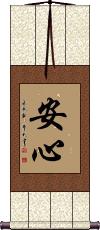
安心 can be defined as relief, peace of mind, feeling at ease, to be relieved, to set one's mind at rest, and easiness.
安心 is a nice word that encompasses great meanings within just two characters. Some of the other meanings include pacifying, settling the mind, and peace of mind. It's also the idea of feeling a sense of security, safety, and confidence in your state of well-being.
This can be used by everyone, but some consider it to be a Buddhist concept (You'll find it in your Zen dictionary).
Note: Can be romanized as Anshin or Anjin in Japanese.
Push or Knock
To weigh one's words
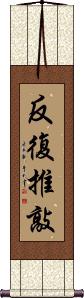
During the Tang Dynasty, a man named Jia Dao (born in the year 779), a well-studied scholar and poet, went to the capital to take the imperial examination.
One day as he rides a donkey through the city streets, a poem begins to form in his mind. A portion of the poem comes into his head like this:
“The bird sits on the tree branch near a pond,
A monk approaches and knocks at the gate...”
At the same time, he wondered if the word “push” would be better than “knock” in his poem.
As he rides down the street, he imagines the monk pushing or knocking. Soon he finds himself making motions of pushing and shaking a fist in a knocking motion as he debates which word to use. He is quite a sight as he makes his way down the street on his donkey with hands and fists flying about as the internal debate continues.
As he amuses people along the street, he becomes completely lost in his thoughts and does not see the mayor's procession coming in the opposite direction. Jia Bao is blocking the way for the procession to continue down the road, and the mayor's guards immediately decide to remove Jia Bao by force. Jia Bao, not realizing that he was in the way, apologizes, explains his poetic dilemma and awaits his punishment for blocking the mayor's way.
The mayor, Han Yu, a scholar and author of prose himself, finds himself intrigued by Jia Dao's poem and problem. Han Yu gets off his horse and addresses Jia Bao, stating, “I think knock is better.” The relieved Jia Bao raises his head and is invited by the mayor to join the procession, and are seen riding off together down the street, exchanging their ideas and love of poetry.
In modern Chinese, this 反復推敲 idiom is used when someone is trying to decide which word to use in their writing or when struggling to decide between two things when neither seems to have a downside.
Let It Be / Be Relieved
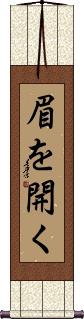
眉を開く is a Japanese proverb and expression that means “to feel relieved,” “to forget about one's troubles,” or “to settle into peace of mind.”
The literal words suggest relaxing your eyebrows or face. Allow worry or concern to go away, and just be content with “letting it be.”
Note: Because this selection contains some special Japanese Hiragana characters, it should be written by a Japanese calligrapher.
Chop Wood, Carry Water
Before enlightenment or after, chores remain.
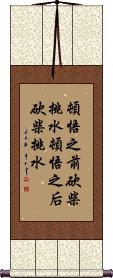
頓悟之前砍柴挑水; 頓悟之後砍柴挑水 means “Before enlightenment, chop wood, carry water; After enlightenment, chop wood, carry water.
This is a Chinese proverb that is attributed to 吴力 (Wú Lì) who lived between 1632 and 1718 - living part of his life as a devout Buddhist, and many years as a Catholic Jesuit Priest in China - what an interesting life!
This has been explained many times in many ways. I am a Buddhist, and here is my brief take on this proverb...
Before enlightenment, one may find daily chores mundane, tedious, and boring. However, upon reaching enlightenment one is not relieved of the details of daily life. An enlightened person will, however, see such chores as a joy, and do them mindfully.
There is another version floating around, which is 在你領悟之前砍柴、運水。在你領悟之後,砍柴、運水。
If you want this other version, just contact me. The meaning is the same, just different phrasing.
Not the results for Relieve that you were looking for?
Below are some entries from our dictionary that may match your Relieve search...
| Characters If shown, 2nd row is Simp. Chinese |
Pronunciation Romanization |
Simple Dictionary Definition |
抒 see styles |
shū shu1 shu jo |
to express; to give expression to; variant of 紓|纾[shu1]; to relieve to extend |
濟 济 see styles |
jì ji4 chi wataru わたる |
to cross a river; to aid or relieve; to be of help (personal name) Wataru To cross a stream; aid; cause, bring about. |
紓 纾 see styles |
shū shu1 shu |
abundant; ample; at ease; relaxed; to free from; to relieve |
代る see styles |
kawaru かわる |
(v5r,vi) (1) to succeed; to relieve; to replace; (2) to take the place of; to substitute for; to take over for; to represent; (3) to be exchanged; to change (places with); to switch |
便利 see styles |
biàn lì bian4 li4 pien li benri べんり |
convenient; easy; to facilitate (adjectival noun) (ant: 不便) convenient; handy; useful Convenient and beneficial; to urinate or evacuate the bowels; a latrine. |
免職 免职 see styles |
miǎn zhí mian3 zhi2 mien chih menshoku めんしょく |
to relieve sb of his post; to sack; to demote; dismissal; sacking (noun, transitive verb) dismissal; sacking; discharge |
免除 see styles |
miǎn chú mian3 chu2 mien ch`u mien chu menjo めんじょ |
to prevent; to avoid; to excuse; to exempt; to relieve; (of a debt) to remit (noun, transitive verb) exemption; exoneration; discharge |
卸責 卸责 see styles |
xiè zé xie4 ze2 hsieh tse |
to avoid responsibility; to shift the responsibility onto others; (Tw) to relieve sb of their responsibilities (e.g. upon retirement) |
安神 see styles |
ān shén an1 shen2 an shen yasukami やすかみ |
to calm (soothe) the nerves; to relieve uneasiness of body and mind (adj-na,n,vs) relief; peace of mind; (surname) Yasukami |
寬心 宽心 see styles |
kuān xīn kuan1 xin1 k`uan hsin kuan hsin |
relieved; comforted; to relieve anxieties; at ease; relaxed; reassuring; happy |
寬解 宽解 see styles |
kuān jiě kuan1 jie3 k`uan chieh kuan chieh |
to relieve anxieties |
恤匱 恤匮 see styles |
xù kuì xu4 kui4 hsü k`uei hsü kuei |
to relieve the distressed |
慰除 see styles |
wèi chú wei4 chu2 wei ch`u wei chu ijo |
to console and relieve (one from sorrow) |
換る see styles |
kawaru かわる |
(v5r,vi) (1) to succeed; to relieve; to replace; (2) to take the place of; to substitute for; to take over for; to represent; (3) to be exchanged; to change (places with); to switch |
換崗 换岗 see styles |
huàn gǎng huan4 gang3 huan kang |
to relieve a sentry; to change the guard |
換班 换班 see styles |
huàn bān huan4 ban1 huan pan |
to change shift; the next work shift; to relieve (a workman on the previous shift); to take over the job |
換防 换防 see styles |
huàn fáng huan4 fang2 huan fang |
to relieve a garrison; to change guard complement |
揪痧 see styles |
jiū shā jiu1 sha1 chiu sha |
folk remedy involving repeatedly pinching the neck, throat, back etc to increase blood flow to the area and relieve inflammation |
援救 see styles |
yuán jiù yuan2 jiu4 yüan chiu |
to come to the aid of; to save; to rescue from danger; to relieve |
救災 救灾 see styles |
jiù zāi jiu4 zai1 chiu tsai |
to relieve disaster; to help disaster victims |
敗毒 败毒 see styles |
bài dú bai4 du2 pai tu |
(TCM) to relieve inflamation and internal heat; to detoxify |
敗火 败火 see styles |
bài huǒ bai4 huo3 pai huo |
relieve inflammation or internal heat |
散心 see styles |
sàn xīn san4 xin1 san hsin sanshin |
to drive away cares; to relieve boredom A distracted or unsettled mind; inattentive. |
方便 see styles |
fāng biàn fang1 bian4 fang pien houben / hoben ほうべん |
convenient; suitable; to facilitate; to make things easy; having money to spare; (euphemism) to relieve oneself (1) means; expedient; instrument; (2) {Buddh} upaya (skillful means, methods of teaching); (surname) Houben upāya. Convenient to the place, or situation, suited to the condition, opportune, appropriate; but 方 is interpreted as 方法 method, mode, plan, and 便 as 便用 convenient for use, i. e. a convenient or expedient method; also 方 as 方正 and 便 as 巧妙, which implies strategically correct. It is also intp. as 權道智 partial, temporary, or relative (teaching of) knowledge of reality, in contrast with 般若智 prajñā, and 眞實 absolute truth, or reality instead of the seeming. The term is a translation of 傴和 upāya, a mode of approach, an expedient, stratagem, device. The meaning is— teaching according to the capacity of the hearer, by any suitable method, including that of device or stratagem, but expedience beneficial to the recipient is understood. Mahāyāna claims that the Buddha used this expedient or partial method in his teaching until near the end of his days, when he enlarged it to the revelation of reality, or the preaching of his final and complete truth; Hīnayāna with reason denies this, and it is evident that the Mahāyāna claim has no foundation, for the whole of its 方等 or 方廣 scriptures are of later invention. Tiantai speaks of the 三乘 q. v. or Three Vehicles as 方便 expedient or partial revelations, and of its 一乘 or One Vehicle as the complete revelation of universal Buddhahood. This is the teaching of the Lotus Sutra, which itself contains 方便 teaching to lead up to the full revelation; hence the terms 體内 (or 同體 ) 方便, i. e. expedient or partial truths within the full revelation, meaning the expedient part of the Lotus, and 體外方便 the expedient or partial truths of the teaching which preceded the Lotus; see the 方便品 of that work, also the second chapter of the 維摩經. 方便 is also the seventh of the ten pāramitās. |
替る see styles |
kawaru かわる |
(v5r,vi) (1) to succeed; to relieve; to replace; (2) to take the place of; to substitute for; to take over for; to represent; (3) to be exchanged; to change (places with); to switch |
止痛 see styles |
zhǐ tòng zhi3 tong4 chih t`ung chih tung |
to relieve pain; to stop pain; analgesic |
消す see styles |
kesu けす |
(transitive verb) (1) to erase; to rub out; to rub off; to cross out; to delete; (transitive verb) (2) to turn off (a light, TV, heater, etc.); to switch off; (transitive verb) (3) to extinguish (a fire, candle, etc.); to put out; (transitive verb) (4) to remove (a smell, pain, etc.); to eliminate; to get rid of; to relieve (pain, anxiety, etc.); to neutralize (poison); (transitive verb) (5) to drown out (a sound); to deaden; to absorb; to muffle; (transitive verb) (6) (colloquialism) to kill; to murder; to bump off; to rub out |
濟助 济助 see styles |
jì zhù ji4 zhu4 chi chu |
to relieve and help |
濟拔 济拔 see styles |
jǐ bá ji3 ba2 chi pa saibachi |
to relieve |
疏解 see styles |
shū jiě shu1 jie3 shu chieh |
to mediate; to mitigate; to ease; to relieve |
Click here for more Relieve results from our dictionary
The following table may be helpful for those studying Chinese or Japanese...
| Title | Characters | Romaji (Romanized Japanese) | Various forms of Romanized Chinese | |
| Peaceful Heart Peace of Mind Calm Mind | 安心 | an shin / anshin | ān xīn / an1 xin1 / an xin / anxin | an hsin / anhsin |
| Push or Knock | 反復推敲 反复推敲 | fǎn fù tuī qiāo fan3 fu4 tui1 qiao1 fan fu tui qiao fanfutuiqiao | fan fu t`ui ch`iao fanfutuichiao fan fu tui chiao |
|
| Let It Be Be Relieved | 眉を開く | mayu o hira ku mayuohiraku | ||
| Chop Wood, Carry Water | 頓悟之前砍柴挑水頓悟之后砍柴挑水 顿悟之前砍柴挑水顿悟之后砍柴挑水 | dùn wù zhī qián kǎn chái tiāo shuǐ dùn wù zhī hòu kǎn chái tiāo shuǐ dun4 wu4 zhi1 qian2 kan3 chai2 tiao1 shui3 dun4 wu4 zhi1 hou4 kan3 chai2 tiao1 shui3 dun wu zhi qian kan chai tiao shui dun wu zhi hou kan chai tiao shui | tun wu chih ch`ien k`an ch`ai t`iao shui tun wu chih hou k`an ch`ai t`iao shui tun wu chih chien kan chai tiao shui tun wu chih hou kan chai tiao shui |
|
| In some entries above you will see that characters have different versions above and below a line. In these cases, the characters above the line are Traditional Chinese, while the ones below are Simplified Chinese. | ||||

Successful Chinese Character and Japanese Kanji calligraphy searches within the last few hours...



