Many custom options


And formats



Post in Chinese / Japanese
Buy a Post calligraphy wall scroll here!
Personalize your custom “Post” project by clicking the button next to your favorite “Post” title below.
Post

ポスト is the name Post in Japanese Katakana.
Note: Because this title is entirely Japanese Katakana, it should be written by a Japanese calligrapher.
Post

波斯特 is the name Post in Chinese (Mandarin).
Sakuragi
sakuraki
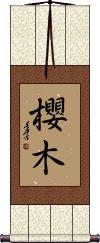
櫻木 is the Japanese surname Sakuragi or Sakuraki in the traditional form.
Post-WWII language reforms simplified the first Kanji making it now written as 桜木.
Kai Zen / Kaizen
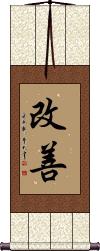
改善 means betterment, improvement, to make better, or to improve - specifically incremental and continuous improvement.
改善 became very important in post-war Japan when Edwards Deming came to Japan to teach concepts of incremental and continuous improvement (for which the big 3 auto-makers did not want to hear about at the time - even kicking Deming out of their offices). The Japanese workforce absorbed this concept when their culture was in flux and primed for change.
This kaizen term is closely associated with the western title “Total Quality Management.” Perhaps dear to my heart since I spent years studying this at university before I moved to China where TQM did not seem to exist. Slowly, this concept has entered China as well (I've actually given lectures on the subject in Beijing).
If you are trying to improve processes at your business or need to remind yourself of your continuous TQM goals, this would be a great wall scroll to hang behind your desk or in your workplace.
See Also: Kansei Engineering / Sense Engineering
One
The number one
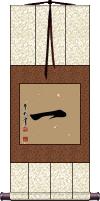
一 is “one” or “1” in Chinese, Japanese Kanji, and old Korean Hanja.
People keep searching for “one” but I'm not sure what you want. This would be a strange selection for a wall scroll, so please don't order it. Post a request on our forum if you want a phrase with “one” in it that you can't find on our site.
The “one” character is really simple, it's just one stroke. Two is two strokes and three is three strokes, from four and above, the characters get more complicated.
In some ways, the “one” character is too simple, it could be a stray mark, or added to a banking document. Therefore, the following banking anti-fraud character for “one” has developed over the last 1500 years in China and Japan:


Undaunted After Repeated Setbacks
Persistence to overcome all challenges
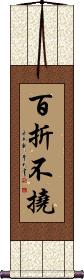
百折不撓 is a Chinese proverb that means “Be undaunted in the face of repeated setbacks.”
More directly translated, it reads, “[Overcome] a hundred setbacks, without flinching.” 百折不撓 is of Chinese origin but is commonly used in Japanese and somewhat in Korean (same characters, different pronunciation).
This proverb comes from a long, and occasionally tragic story of a man that lived sometime around 25-220 AD. His name was Qiao Xuan, and he never stooped to flattery but remained an upright person at all times. He fought to expose the corruption of higher-level government officials at great risk to himself.
Then when he was at a higher level in the Imperial Court, bandits were regularly capturing hostages and demanding ransoms. But when his own son was captured, he was so focused on his duty to the Emperor and the common good that he sent a platoon of soldiers to raid the bandits' hideout, and stop them once and for all even at the risk of his own son's life. While all of the bandits were arrested in the raid, they killed Qiao Xuan's son at first sight of the raiding soldiers.
Near the end of his career, a new Emperor came to power, and Qiao Xuan reported to him that one of his ministers was bullying the people and extorting money from them. The new Emperor refused to listen to Qiao Xuan and even promoted the corrupt Minister. Qiao Xuan was so disgusted that in protest, he resigned from his post as minister (something almost never done) and left for his home village.
His tombstone reads “Bai Zhe Bu Nao” which is now a proverb used in Chinese culture to describe a person of strong will who puts up stubborn resistance against great odds.
My Chinese-English dictionary defines these 4 characters as “keep on fighting despite all setbacks,” “be undaunted by repeated setbacks,” and “be indomitable.”
Our translator says it can mean “never give up” in modern Chinese.
Although the first two characters are translated correctly as “repeated setbacks,” the literal meaning is “100 setbacks” or “a rope that breaks 100 times.” The last two characters can mean “do not yield” or “do not give up.”
Most Chinese, Japanese, and Korean people will not take this absolutely literal meaning but will instead understand it as the title suggests above. If you want a single big word definition, it would be indefatigability, indomitableness, persistence, or unyielding.
See Also: Tenacious / Tenacity | Perseverance / Indomitable / Invincible Fortitude | With All the Strength of Your Heart | Perseverance | Persistence
Mountain Travels Poem by Dumu

This poem was written almost 1200 years ago during the Tang dynasty.
It depicts traveling up a place known as Cold Mountain, where some hearty people have built their homes. The traveler is overwhelmed by the beauty of the turning leaves of the maple forest that surrounds him just as night overtakes the day, and darkness prevails. His heart implores him to stop, and take in all of the beauty around him.
First, before you get to the full translation, I must tell you that Chinese poetry is a lot different than what we have in the west. Chinese words simply don't rhyme in the same way that English or other western languages do. Chinese poetry depends on rhythm and a certain beat of repeated numbers of characters.
I have done my best to translate this poem keeping a certain feel of the original poet. But some of the original beauty of the poem in its original Chinese will be lost in translation.
Far away on Cold Mountain, a stone path leads upwards.
Among white clouds, people's homes reside.
Stopping my carriage I must, as to admire the maple forest at nights fall.
In awe of autumn leaves showing more red than even flowers of early spring.
Hopefully, this poem will remind you to stop, and “take it all in” as you travel through life.
The poet's name is “Du Mu” in Chinese that is: 
 .
.
The title of the poem, “Mountain Travels” is: 

You can have the title, poet's name, and even “Tang Dynasty” written as an inscription on your custom wall scroll if you like.
More about the poet:
Dumu lived from 803-852 AD and was a leading Chinese poet during the later part of the Tang dynasty.
He was born in Chang'an, a city in central China and the former capital of the ancient Chinese empire in 221-206 BC. In present-day China, his birthplace is currently known as Xi'an, the home of the Terracotta Soldiers.
He was awarded his Jinshi degree (an exam administered by the emperor's court which leads to becoming an official of the court) at the age of 25 and went on to hold many official positions over the years. However, he never achieved a high rank, apparently because of some disputes between various factions, and his family's criticism of the government. His last post in the court was his appointment to the office of Secretariat Drafter.
During his life, he wrote scores of narrative poems, as well as a commentary on the Art of War and many letters of advice to high officials.
His poems were often very realistic and often depicted everyday life. He wrote poems about everything, from drinking beer in a tavern to weepy poems about lost love.
The thing that strikes you most is the fact even after 1200 years, not much has changed about the beauty of nature, toils, and troubles of love and beer drinking.
These search terms might be related to Post:
Accept the Situation and Move On
Enigma / Unpredictable Situation
From This Moment Forward
From This Moment Forward / From This Day Forward
If You Love Your Child, Send Them Out Into the World
Looking Forward / Hoping
Marker
No Place Like Home
Soldiers Adapt Actions to the Situation
There’s No Place Like Home
Not the results for Post that you were looking for?
Below are some entries from our dictionary that may match your Post search:
| Characters If shown, 2nd row is Simp. Chinese |
Pronunciation Romanization |
Simple Dictionary Definition |
任 see styles |
rèn ren4 jen makoto まこと |
to assign; to appoint; to take up a post; office; responsibility; to let; to allow; to give free rein to; no matter (how, what etc); classifier for terms served in office, or for spouses, girlfriends etc (as in 前任男友) obligation; duty; charge; responsibility; (given name) Makoto Bear, endure, let; office; it is used to connote laisser-faire; one of the 四病, as 任運 implies laisser-aller; it is intp. by let things follow their own course, or by 自然 naturally, without intervention. |
アンカ see styles |
anka アンカ |
More info & calligraphy: Anka |
コール see styles |
gooru ゴール |
More info & calligraphy: Kole |
ホスト see styles |
posuto ポスト |
(1) postbox; mailbox; mail box; pillar box; (2) post; position; (3) post (e.g. goalpost); (noun, transitive verb) (4) {internet} post (on a blog, social media, etc.); (can act as adjective) (5) post- (e.g. post-Cold War); (personal name) Post |
頑張る see styles |
ganbaru がんばる |
More info & calligraphy: Fortitude / Steadfast |
アフレコ see styles |
afureko アフレコ |
(abbreviation) (See アフターレコーディング) postrecording (dialogue or sounds); post-synchronization; dubbing; automated dialogue replacement; ADR |
アンカー see styles |
angaa / anga アンガー |
More info & calligraphy: Anker |
ホースト see styles |
poosuto ポースト |
More info & calligraphy: Horst |
侏 see styles |
zhū zhu1 chu shu しゅ |
dwarf actor; supporting post (in a roof truss) |
埜 野 see styles |
yě ye3 yeh nozaki のざき |
old variant of 野[ye3] (1) plain; field; (prefix noun) (2) lacking a political post; (1) plain; field; (2) hidden (structural) member; (prefix noun) (3) wild; (out-dated or obsolete kana usage) plain; field; (surname) Nozaki |
官 see styles |
guān guan1 kuan tsukasa つかさ |
government official; governmental; official; public; organ of the body; CL:個|个[ge4] (1) government; government service; the bureaucracy; (2) government post; government official; (female given name) Tsukasa Official, public. |
寄 see styles |
jì ji4 chi yorizaki よりざき |
to entrust; to place in sb's care; (bound form) to depend on; to attach oneself to; to reside temporarily; (bound form) foster (as in 寄女[ji4 nu : 3] foster daughter); to send by post; to mail (surname) Yorizaki To go or put under cover, lodge, confide to, deliver, convey, transfer; to enter, put in a list. |
崗 岗 see styles |
gǎng gang3 kang okazaki おかざき |
(bound form) hillock; mound; sentry post; policeman's beat; (bound form) job; post (surname) Okazaki |
席 see styles |
xí xi2 hsi seki せき |
woven mat; seat; banquet; place in a democratic assembly; classifier for banquets, conversations etc (1) seat; (2) location (of a gathering, etc.); place; (3) position; post; (surname) Seki |
役 see styles |
yì yi4 i mamoru まもる |
forced labor; corvée; obligatory task; military service; to use as servant; to enserf; servant (old); war; campaign; battle (1) role; assignment; responsibility; duty; function; job; service; (2) position (of responsibility); post; office; (3) part (in a play, film, etc.); role; character; (4) {mahj;cards;hanaf} scoring combination; hand; yaku; meld; (given name) Mamoru |
後 后 see styles |
hòu hou4 hou nochi のち |
back; behind; rear; afterwards; after; later; post- (n,n-suf,adv) after; (surname) Nochi After, behind, 1ater, posterior. |
拄 see styles |
zhǔ zhu3 chu chu |
to lean on; to prop on A prop, a post. |
杙 see styles |
yì yi4 i akiko あきこ |
post for tethering animals (out-dated or obsolete kana usage) stump; (1) stake; post; pile; picket; (2) (abbreviation) (archaism) stump; (personal name) Akiko |
束 see styles |
shù shu4 shu tsugane つがね |
to bind; bunch; bundle; classifier for bunches, bundles, beams of light etc; to control (1) strut; short vertical post; (2) thickness (of a book minus the cover, a sheaf of paper, etc.); (3) (archaism) (See 束・そく・1,束・そく・2,束・そく・3) handbreadth; bundle; (given name) Tsugane a bundle; a band |
杭 see styles |
háng hang2 hang wataru わたる |
surname Hang; abbr. for Hangzhou 杭州[Hang2 zhou1] (out-dated or obsolete kana usage) stump; (1) stake; post; pile; picket; (2) (abbreviation) (archaism) stump; (given name) Wataru |
枊 see styles |
àng ang4 ang |
(literary) post for tethering a horse |
柱 see styles |
zhù zhu4 chu mihashira みはしら |
pillar; CL:根[gen1] (1) pillar; post; (2) support; prop; mainstay; (suf,ctr) (3) counter for buddhas, gods, nobles, etc.; (personal name) Mihashira Pillar, post, support. |
栱 see styles |
gǒng gong3 kung |
post |
桓 see styles |
huán huan2 huan kan かん |
Chinese soapberry (Sapindus mukurossi); big; pillar (old) (given name) Kan A tree whose hard, black seeds are used for beads; a pillar, post, tablet. |
棖 枨 see styles |
chéng cheng2 ch`eng cheng |
door post |
樘 see styles |
táng tang2 t`ang tang |
pillar; door post; door or window frame; classifier for doors or windows |
橛 see styles |
jué jue2 chüeh ketsu |
a peg; low post nail |
缺 see styles |
quē que1 ch`üeh chüeh ken けつ |
deficiency; lack; scarce; vacant post; to run short of (out-dated kanji) lack; deficiency; vacancy Broken; deficient, lacking; a vacancy, a post. |
脱 see styles |
datsu だつ |
(prefix) de- (indicating reversal, removal, etc.); post-; (surname) Datsu |
謫 谪 see styles |
zhé zhe2 che taku |
to relegate a high official to a minor post in an outlying region (punishment in imperial China); to banish or exile; (of immortals) to banish from Heaven; to censure; to blame to condemn |
Click here for more Post results from our dictionary
The following table may be helpful for those studying Chinese or Japanese:
| Title | Characters | Romaji (Romanized Japanese) | Various forms of Romanized Chinese | |
| Post | ポスト | posuto | ||
| Post | 波斯特 | bō sī tè bo1 si1 te4 bo si te bosite | po ssu t`e possute po ssu te |
|
| Sakuragi | 櫻木 | sakuragi sakuraki | ||
| Kai Zen Kaizen | 改善 | kai zen / kaizen | gǎi shàn / gai3 shan4 / gai shan / gaishan | kai shan / kaishan |
| One | 一 | ichi | yī / yi1 / yi | i |
| Undaunted After Repeated Setbacks | 百折不撓 百折不挠 | hyaku setsu su tou hyakusetsusutou hyaku setsu su to | bǎi zhé bù náo bai3 zhe2 bu4 nao2 bai zhe bu nao baizhebunao | pai che pu nao paichepunao |
| Mountain Travels Poem by Dumu | 遠上寒山石徑斜白雲生處有人家停車坐愛楓林晚霜葉紅於二月花 远上寒山石径斜白云生处有人家停车坐爱枫林晚霜叶红于二月花 | yuǎn shàng hán shān shí jìng xiá bái yún shēng chù yǒu rén jiā tíng chē zuò ài fēng lín wǎn shuàng yè hóng yú èr yuè huā yuan3 shang4 han2 shan1 shi2 jing4 xia2 bai2 yun2 sheng1 chu4 you3 ren2 jia1 ting2 che1 zuo4 ai4 feng1 lin2 wan3 shuang4 ye4 hong2 yu2 er4 yue4 hua1 yuan shang han shan shi jing xia bai yun sheng chu you ren jia ting che zuo ai feng lin wan shuang ye hong yu er yue hua | yüan shang han shan shih ching hsia pai yün sheng ch`u yu jen chia t`ing ch`e tso ai feng lin wan shuang yeh hung yü erh yüeh hua yüan shang han shan shih ching hsia pai yün sheng chu yu jen chia ting che tso ai feng lin wan shuang yeh hung yü erh yüeh hua |
|
| In some entries above you will see that characters have different versions above and below a line. In these cases, the characters above the line are Traditional Chinese, while the ones below are Simplified Chinese. | ||||

Successful Chinese Character and Japanese Kanji calligraphy searches within the last few hours...



