I am shipping orders on Thursday this week. News and More Info

Many custom options...

Tan Paper and Copper Silk Love Wall Scroll
Red Paper and Ivory Silk Love Wall Scroll
Orange Paper Love Scroll
Crazy Blue and Gold Silk Love Scroll


And formats...

Love Vertical Portrait
Love Horizontal Wall Scroll
Love Vertical Portrait

Mind Like Moon in Chinese / Japanese...

Buy a Mind Like Moon calligraphy wall scroll here!

Personalize your custom “Mind Like Moon” project by clicking the button next to your favorite “Mind Like Moon” title below...

Tsuki no Kokoro / Mind like the Moon
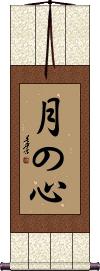
 tsuki no kokoro
Tsuki no Kokoro / Mind like the Moon Scroll

月の心 means “Mind like the Moon” or, more directly translated, “Moon of Mind.”

月の心 is a phrase used in Zen Buddhism and some Japanese martial arts.

 qīng
 sei
 
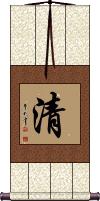
Clarity Scroll

清 is a word that means clarity or clear in Chinese, Japanese Kanji, and old Korean Hanja.

Looking at the parts of this character, you have three splashes of water on the left, “life” on the top right, and the moon on the lower right.

Because of something Confucius said about 2500 years ago, you can imagine that this character means “live life with clarity like bright moonlight piercing pure water.” The Confucian idea is something like “Keep clear what is pure in yourself, and let your pure nature show through.” Kind of like saying, “Don't pollute your mind or body, so that they remain clear.”

This might be stretching the definition of this single Chinese character but the elements are there, and “clarity” is a powerful idea.


Korean note: Korean pronunciation is given above but this character is written with a slight difference in the "moon radical" in Korean. However, anyone who can read Korean Hanja, will understand this character with no problem (this is considered an alternate form in Korean). If you want the more standard Korean Hanja form (which is an alternate form in Chinese), just let me know.

Japanese note: When reading in Japanese, this Kanji has additional meanings of pure, purify, or cleanse (sometimes to remove demons or "exorcise"). Used more in compound words in Japanese than as a stand-alone Kanji.


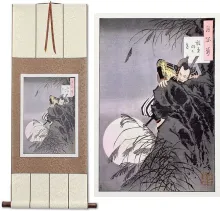
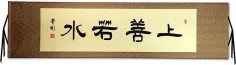
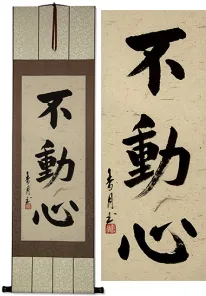
This in-stock artwork might be what you are looking for, and ships right away...
Gallery Price: $108.00

Your Price: $59.88
Gallery Price: $126.00

Your Price: $69.88

Gallery Price: $232.00

Your Price: $128.88

Gallery Price: $232.00

Your Price: $128.88

Gallery Price: $200.00

Your Price: $88.88

Gallery Price: $168.00

Your Price: $92.88

Gallery Price: $200.00

Your Price: $118.88

Gallery Price: $200.00

Your Price: $118.88

Gallery Price: $90.00

Your Price: $49.88

Gallery Price: $202.00

Your Price: $111.88
Gallery Price: $106.00

Your Price: $58.88

Gallery Price: $202.00

Your Price: $111.88

Gallery Price: $79.00

Your Price: $43.88

Gallery Price: $126.00

Your Price: $69.88


Not the results for Mind Like Moon that you were looking for?

Below are some entries from our dictionary that may match your Mind Like Moon search...

Characters

If shown, 2nd row is Simp. Chinese

Pronunciation
Romanization
Simple Dictionary Definition


see styles
xiǎn
    xian3
hsien
 sen
to hunt in autumn (archaic)
markaṭa, 獮猴 a monkey, typical of the mind of illusion, pictured as trying to pluck the moon out of the water; also of the five desires; of foolishness; of restlessness.

四禪


四禅

see styles
sì chán
    si4 chan2
ssu ch`an
    ssu chan
 shizen
(四禪天) The four dhyāna heavens, 四靜慮 (四靜慮天), i. e. the division of the eighteen brahmalokas into four dhyānas: the disciple attains to one of these heavens according to the dhyāna he observes: (1) 初禪天 The first region, 'as large as one whole universe' comprises the three heavens, Brahma-pāriṣadya, Brahma-purohita, and Mahābrahma, 梵輔, 梵衆, and 大梵天; the inhabitants are without gustatory or olfactory organs, not needing food, but possess the other four of the six organs. (2) 二禪天 The second region, equal to 'a small chiliocosmos' 小千界, comprises the three heavens, according to Eitel, 'Parīttābha, Apramāṇābha, and Ābhāsvara, ' i. e. 少光 minor light, 無量光 infinite light, and 極光淨 utmost light purity; the inhabitants have ceased to require the five physical organs, possessing only the organ of mind. (3) 三禪天 The third region, equal to 'a middling chiliocosmos '中千界, comprises three heavens; Eitel gives them as Parīttaśubha, Apramāṇaśubha, and Śubhakṛtsna, i. e. 少淨 minor purity, 無量淨 infinite purity, and 徧淨 universal purity; the inhabitants still have the organ of mind and are receptive of great joy. (4) 四禪天 The fourth region, equal to a great chiliocosmos, 大千界, comprises the remaining nine brahmalokas, namely, Puṇyaprasava, Anabhraka, Bṛhatphala, Asañjñisattva, Avṛha, Atapa, Sudṛśa, Sudarśana, and Akaniṣṭha (Eitel). The Chinese titles are 福生 felicitous birth, 無雲 cloudless, 廣果 large fruitage, 無煩 no vexations, atapa is 無熱 no heat, sudṛśa is 善見 beautiful to see, sudarśana is 善現 beautiful appearing, two others are 色究竟 the end of form, and 無想天 the heaven above thought, but it is difficult to trace avṛha and akaniṣṭha; the inhabitants of this fourth region still have mind. The number of the dhyāna heavens differs; the Sarvāstivādins say 16, the 經 or Sutra school 17, and the Sthavirāḥ school 18. Eitel points out that the first dhyāna has one world with one moon, one mem, four continents, and six devalokas; the second dhyāna has 1, 000 times the worlds of the first; the third has 1, 000 times the worlds of the second; the fourth dhyāna has 1, 000 times those of the third. Within a kalpa of destruction 壞劫 the first is destroyed fifty-six times by fire, the second seven by water, the third once by wind, the fourth 'corresponding to a state of absolute indifference' remains 'untouched' by all the other evolutions; when 'fate (天命) comes to an end then the fourth dhyāna may come to an end too, but not sooner'.

心月

see styles
xīn yuè
    xin1 yue4
hsin yüeh
 mizuki
    みづき
(female given name) Mizuki
Mind (as the) moon, the natural mind or heart pure and bright as the full moon.

心月輪


心月轮

see styles
xīn yuè lún
    xin1 yue4 lun2
hsin yüeh lun
 shingachi rin
The mind' s or heart' s moon-revolutions, i. e. the moon' s varying stages, typifying the grades of enlightenment from beginner to saint.

月輪觀


月轮观

see styles
yuè lún guān
    yue4 lun2 guan1
yüeh lun kuan
 gatsurinkan
(or 月輪三昧) The moon contemplation ( or samādhi) in regard to its sixteen nights of waxing to the full, and the application of this contemplation to the development of bodhi within, especially of the sixteen kinds of bodhisattva mind of the lotus and of the human heart.

金剛界


金刚界

see styles
jīn gāng jiè
    jin1 gang1 jie4
chin kang chieh
 kongoukai / kongokai
    こんごうかい
(1) {Buddh} (See 胎蔵界・たいぞうかい・1) Vajradhatu; Diamond Realm; (2) (abbreviation) {Buddh} (See 金剛界曼荼羅・こんごうかいまんだら) Vajradathu Mandala; Diamond Realm Mandala
vajradhātu, 金界 The 'diamond', or vajra, element of the universe; it is the 智 wisdom of Vairocana in its indestructibility and activity; it arises from the garbhadhātu 胎藏界q.v., the womb or store of the Vairocana 理 reason or principles of such wisdom, v. 理智. The two, garbhadhātu and vajradhātu, are shown by the esoteric school, especially in the Japanese Shingon, in two maṇḍalas, i.e. groups or circles, representing in various portrayals the ideas arising from the two, fundamental concepts. vajradhātu is intp. as the 智 realm of intellection, and garbhadhātu as the 理 substance underlying it, or the matrix; the latter is the womb or fundamental reason of all things, and occupies the eastern position as 'cause' of the vajradhātu, which is on the west as the resultant intellectual or spiritual expression. But both are one as are Reason and Wisdom, and Vairocana (the illuminator, the 大日 great sun) presides over both, as source and supply. The vajradhātu represents the spiritual world of complete enlightenment, the esoteric dharmakāya doctrine as contrasted with the exoteric nirmāṇakāya doctrine. It is the sixth element 識 mind, and is symbolized by a triangle with the point downwards and by the full moon, which represents 智 wisdom or understanding; it corresponds to 果 fruit, or effect, garbhadhātu being 因 or cause. The 金剛王五部 or five divisions of the vajradhātu are represented by the Five dhyāni-buddhas, thus: centre 大日Vairocana; east 阿閦 Akṣobhya; south 寶生Ratnasambhava; west 阿彌陀 Amitābha; north 不 空 成就 Amoghasiddhi, or Śākyamuni. They are seated respectively on a lion, an elephant, a horse, a peacock, and a garuda. v. 五佛; also 胎.

The following table may be helpful for those studying Chinese or Japanese...

Title CharactersRomaji (Romanized Japanese)Various forms of Romanized Chinese
Tsuki no Kokoro
Mind like the Moon
月の心tsuki no kokoro
tsukinokokoro
Clarityseiqīng / qing1 / qingch`ing / ching


Dictionary

Lookup Mind Like Moon in my Japanese & Chinese Dictionary


Successful Chinese Character and Japanese Kanji calligraphy searches within the last few hours...


50th AnniversaryAadenAadonAakashAaroAbayaAbbasAbbeyAbbieAbhishekAbigaiAbundance and ProsperityAdamAdamarisAdapt and OvercomeAddieAdejahAdelineAdityaAdnanAdonisAdrianaAdriannaAdrielAguilarAhmadAimiAishaAjayAkbarAkilaAlanaAleishaAlessaAlessandraAlexAlexandraAlexandriaAlfiAliceAlinaAlishaAliyaAllaAllahAllyAlmedaAlmighty OmnipotentAloraAlvinAlyshaAlyssaAlyssiaAmadAmalAmelAminAmirAnasAndreAndreiAndyAngelAnilAnjaniAnne-SophieAntonAntonellaAntonioAnyaArelyAriaArisaArlenArmanArmandoAshrafAslamAubreeAubreyAuraAureliaAvengerAyanAydenAymanAzuraBa Gua ZhangBaileeBaileyBashaBasilBayuBeautyBeauty of NatureBellaBelovedBennettBhumikaBiancaBibekBibiBishalBlack Tiger FistBlairBlessed by GodBradenBradyBraedenBraydenBristolBritneyBrockBryanBrysonBubbaBuddha Dharma SanghaButterflyCallieCamdenCarenCarleenCarmenCasperChantalChanteChelseaChen SurnameCherryChevelleChinoChop Wood Carry WaterChristinaClaireCobraColeCompassionConnieConnorConstanceCorbinCosmoCourageCristianCullenCyanCyrilDamarisDanaDaniDaniealDanielleDaniloDaodejingDaodejing Tao Te Ching - Chapter 54DaphneDariaDark AngelDarrenDarrylDaruDavianDeath Before DishonorDeepikaDefenseDerrickDeterminationDevonDharmaDianaDillowDimaDogenDominicDoveDragonDragon WarriorDrewDuncanDurellDwightEdieEduardoEdwardsElaineEldiEleanorEleonorEliezerElinElishaEllieElmerElsieElviraEmanEmelineEmiliaEmmettEnlightenment

All of our calligraphy wall scrolls are handmade.

When the calligrapher finishes creating your artwork, it is taken to my art mounting workshop in Beijing where a wall scroll is made by hand from a combination of silk, rice paper, and wood.
After we create your wall scroll, it takes at least two weeks for air mail delivery from Beijing to you.

Allow a few weeks for delivery. Rush service speeds it up by a week or two for $10!

When you select your calligraphy, you'll be taken to another page where you can choose various custom options.


A nice Chinese calligraphy wall scroll

The wall scroll that Sandy is holding in this picture is a "large size"
single-character wall scroll.
We also offer custom wall scrolls in small, medium, and an even-larger jumbo size.

A professional Chinese Calligrapher

Professional calligraphers are getting to be hard to find these days.
Instead of drawing characters by hand, the new generation in China merely type roman letters into their computer keyboards and pick the character that they want from a list that pops up.

There is some fear that true Chinese calligraphy may become a lost art in the coming years. Many art institutes in China are now promoting calligraphy programs in hopes of keeping this unique form of art alive.

Trying to learn Chinese calligrapher - a futile effort

Even with the teachings of a top-ranked calligrapher in China, my calligraphy will never be good enough to sell. I will leave that to the experts.

A high-ranked Chinese master calligrapher that I met in Zhongwei

The same calligrapher who gave me those lessons also attracted a crowd of thousands and a TV crew as he created characters over 6-feet high. He happens to be ranked as one of the top 100 calligraphers in all of China. He is also one of very few that would actually attempt such a feat.


Check out my lists of Japanese Kanji Calligraphy Wall Scrolls and Old Korean Hanja Calligraphy Wall Scrolls.

Some people may refer to this entry as Mind Like Moon Kanji, Mind Like Moon Characters, Mind Like Moon in Mandarin Chinese, Mind Like Moon Characters, Mind Like Moon in Chinese Writing, Mind Like Moon in Japanese Writing, Mind Like Moon in Asian Writing, Mind Like Moon Ideograms, Chinese Mind Like Moon symbols, Mind Like Moon Hieroglyphics, Mind Like Moon Glyphs, Mind Like Moon in Chinese Letters, Mind Like Moon Hanzi, Mind Like Moon in Japanese Kanji, Mind Like Moon Pictograms, Mind Like Moon in the Chinese Written-Language, or Mind Like Moon in the Japanese Written-Language.

105 people have searched for Mind Like Moon in Chinese or Japanese in the past year.
Mind Like Moon was last searched for by someone else on Oct 18th, 2025