Didn't find what you want?
Try these methods:
1. Make your search more specific.
2. Use other similar-meaning words.
3. Use less words or just one word.
4. Post your request on our forum so that we can translate/create what you want.
We'll build you a handmade custom "Christianity" calligraphy wall scroll if you wish!
Quick links to words on this page...
Check out all the Custom Calligraphy Options
Click on a![]()
to select your calligraphy and start customizing your artwork project...


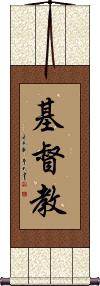
This is the Chinese, Japanese and Korean word for "Christianity". Just as in English, this word is often used to mean "Protestant" but includes Catholics in the true definition.
It is the word used to refer to the whole "Christian religion" or "Christian Faith" and therefore it can be translated as "Christianity". However, used as an adjective in regards to a person, it would translate as "Christian". But more like saying "His religion is Christianity" rather than a noun form.
If you break it apart, the characters mean Base/Foundation Leading/Supervising Religion/Teaching. It makes more sense in Japanese, Chinese, and Korean. The first two characters together are translated as "Christ". So you can also say this means "Christ's Religion" or "Christ's Teachings" when directly translated, or in reverse, "The Religion of Christ" or "The Teaching of Christ".
Notes: The last character has a slight difference in one stroke - however, in calligraphic form, this will not be apparent. This entry can easily be read by any Korean person who knows Hanja characters (Chinese characters used in Korean).
See Also... Jesus Christ | God Of Abraham
Score: 100/100


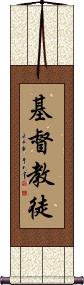
This is the most verbose (longest) word for "Christian" in the Chinese and Japanese languages.
The literal translation of the first two characters is Christ. Third Character means "Religion" or "Teaching". The last character means "apprentice" or "disciple".
Altogether these three characters mean "Christ's Teaching Disciple" or "Christ's Religion Apprentice".
Note: The last two characters are sometimes translated together as "follower (of a religion)", so you could also say it means "Follower of Christ".
This four-character title makes it very clear what you are talking about in Chinese.
See Also... Jesus Christ | God Of Abraham
Score: 100/100


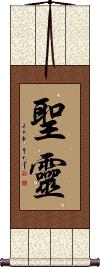
This is the title for the Holy Spirit or Holy Ghost as used by Jewish, Catholic and Protestant (and other Christian) Chinese people. And yes, Chinese Jews do exist, but there are not many of them.
The first character means Holy, Sacred, Saint or Sage. The second means ghost, spirit, efficacious or intelligence.
Score: 100/100


This is how Chinese Christians and Jews refer to God. Yes, there are Chinese Jews whose ancestry dates back to Jewish traders on the silk road. Most have left China for I presume, Israel now. There are also plenty of Christians in China of both the Protestant and Catholic variety. However, the churches are basically run by the government, and the Chinese Catholic church does not recognize the Pope.
Oddly, in my experience, I found the Chinese Protestant church to be much less political compared to Baptist and other Protestant churches that I have attended in America.
This is also the typically-used title for God in Japanese.
However, while you may find this term in old Korean dictionaries, it is an obscure, and rarely-used title for God in modern Korean.
See Also... Jesus Christ
Score: 98/100


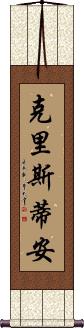
This is the transliteration to Mandarin Chinese for the given name Christian.
Score: 97/100


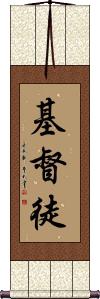
This is a very strong and direct word in Chinese for "Christian".
The literal translation of the first two characters is "Christ". The last character means apprentice, follower, or disciple. Altogether these three characters mean "Christ's Disciple" or "Christ's Apprentice". This is a pretty cool title to hang on your wall if you are a devout Christian.
Also used by Japanese Christians (but may be unfamiliar to non-Christian Japanese people).
See Also... Jesus Christ | God Of Abraham
Score: 57/100


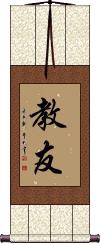
Depending on context, this word can mean Christian or "friend of the same religion". While technically it could be any religion, this is used mostly within the Christian faith. You can also translate this as "Christian friend" and in some cases "Church member".
Score: 56/100


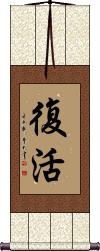
This is the Chinese, Japanese and Korean word for resurrection or rebirth. Basically this means "return to life".
It is the term used in most Asian Bibles to refer to the resurrection of Christ. In Japanese, it is sometimes used to mean a Christian Revival. In some context it can mean resuscitation.
See Also... Jesus Christ | God Of Abraham
Score: 46/100


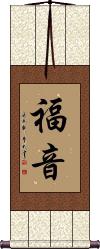
This is the Chinese, Korean and Japanese word for "Gospel" or "Word of God". This is a specifically Christian word in Asia (not used for any other religion).
The first character means "blessing", "good fortune" or "good luck". This first character is a special character used throughout China to bring good tidings and fortune - especially during Chinese New Years. The second character means "sound", "noise" or "news".
Together, these characters create a word that means "The Good News" or "The Sound of Good Fortune".
When read by a Chinese or Japanese person, this word is always perceived as "The Christian Gospel", "Word of God", or even "The Voice of God".
See Also... Jesus Christ | God Of Abraham
Score: 36/100


This is how to write Bible in Chinese.
The first character means Holy, sacred, saint, or sage.
The second character means sacred book or scripture.
Each Sunday morning, if you are near a Catholic or Protestant Church, you will see plenty of Chinese people carrying their Bibles. Virtually every large or medium city in China has at least one Christian church. Beijing has about 14 Christian churches of Catholic and various Protestant denominations. That number more than doubles if you count all the church services that are for foreigners only, and doubles again if you count all of the underground Christian Churches. Many Embassies (Canadian, Italian, French, etc.) offer Protestant and Catholic services, however, the U.S. Embassy is the most unfriendly Embassy in all of China, and offers no such religious services and regularly denies entry and kicks out Americans and others, whether or not they have official business.
See Also... Christian | Disciple
Score: 26/100


Characters shown
above are read
vertically, starting
from the right
This is a religious phrase, which means exactly what the title suggests.
See Also... Christian
Score: 23/100


This is how to write Bible in Japanese.
The first character means Holy, sacred, saint, or sage.
The second character means book (can also mean scroll or letter).
See Also... Christian | Disciple
Score: 23/100


In short, temperance is knowing when to say "when".
Temperance is the practice of moderation and restraint (in fact, this Asian word is often translated as moderation or restraint).
It was one of the five tenets held to be vital to society in Hellenic culture. It is also one of the Four Cardinal Virtues considered central to Christian behavior by the Catholic Church.
Note: Also considered to be one of the Seven Heavenly Virtues.
Score: 14/100


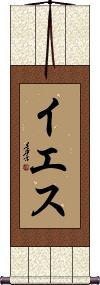
This how to write "Christ" in Chinese characters, Korean Hanja, and Japanese Kanji. This is the word used in the Chinese Union Bible (the only readily-available translation of the Bible into Chinese that I know of - published about 100 years ago). For Chinese Christians, this is the most common way to refer to Jesus Christ.
This is also the way that "Christ" is written in Japanese. But since the Japanese language is very flexible about the sounds that can be assigned to various Kanji, these characters have been assigned a pronunciation that sounds a lot like "Christ" or actually closer to the original "Christos". In Japanese (if you don't know how the Romaji shown above in the gray box works) it sounds like "key ree sue toe" using English words/sounds. Say those four words really fast and you'll get it.
It should be noted that only Japanese Christians will be familiar with this word.
This word is best defined, read and understood with the characters together, but if you take this word for Christ apart, the first character means "fundamentals" or "foundation". The second character can mean "leader" or "boss".
Score: 15/100


This is how Chinese Muslims refer to God (it literally means "True Master"). Oddly, in China, two different names for God have emerged. Even though Muslims, Christians, and Jews all worship the same God of Abraham.
In Arabic, the word Allah is just the Arabic way to say God. Arab Christians pray to Allah, just like Arab Muslims. Somehow in China the title of God diverged.
If you are curious, there are millions of Muslims throughout China, but especially in the northwest portion of China known as Xinjiang. Here you will find descendants of Turkmen, Persian, Arab, and other ethnicities. Some are mixed with Han-Chinese blood; others appear to be pure Turkmen. Many have fair complexions, green eyes, and light hair, but all are citizens of China. A visit to Xinjiang will shift your paradigm and blow away all of your stereotypes about what it means to be Chinese.
Score: 15/100


This is a blessing exchanged between Chinese Christians.
The first two characters literally mean God (The God of Zion). The second two characters express the idea of giving protection. Another way to translate this is "May God protect you".
See Also... Guardian Angel
Score: 14/100
Do not do to others what you
do not want done to yourself
Mandarin: jǐ suǒ bú yù, wù shī yú rén
Korean: 기소불욕물시어인


Some may think of this as a "Christian trait" but actually it transcends many religions.
This Chinese teaching dates back to about 2,500 years ago in China. Confucius had always taught the belief in being benevolent (ren) but this idea was hard to grasp for some of his students, as benevolence could be kind-heartedness, or an essence of humanity itself.
When answering Zhong Gong's question as to what "ren" actually meant, Confucius said:
"When you go out, you should behave as if you were in the presents of a distinguished guest, when people do favors for you, act as if a great sacrifice was made for you. Whatever you wouldn't like done to you, do not do that thing to others. Don't complain at work or at home."
Hearing this, Zhong Gong said humbly, "Although I am not clever, I will do what you say."
From this encounter, the Chinese version of the Golden Rule came to be.
The characters you see above express, "Do not do to others whatever you do not want done to yourself."
See Also... Confucius Teachings | Benevolence
Score: 14/100


This is how to write community in Chinese. This can mean the neighborhood you live in. It can also be used in the same way we use the word community in English.
Examples: African-American community, Christian community, Asian community etc.
If you need a special calligraphy wall scroll to describe your community, just post your request on our Asian calligraphy forum, and we'll translate it and make it for you.
Score: 14/100

This is the simplest way to express the idea of compassion. It can also mean love for your fellow humans, humanity, or living creatures. Sometimes this is extended to mean charity.
This term is often used with Buddhist or Christian context. The concept was also spoken of by Laozi (Lao Tze) in the Dao De Jing (Tao Te Ching).
This Chinese character is understood in Japanese, but is usually used in compound words (not seen alone). Also used in Korean Hanja, so it's very universal.
See Also... Mercy | Benevolence | Forgiveness | Kindness
Score: 14/100


These are the last two words from John 3:16 in the Chinese Union Bible.
Although not specifically Christian, this is the way to express ever-lasting life or eternal life in Chinese.
In Japanese this can either mean eternal life or immortality.
See Also... Eternity | Rebirth | Reincarnation | Immortality
Score: 14/100


This is simply the name "Jesus" transliterated into Chinese. These characters hold a pronunciation in Mandarin that is closer to the real and original Hebrew Yeshua, instead of the incorrect way we have always pronounced Jesus in English with a hard "J" sound. While this name sounds like the real "Jesus" in Chinese, Christians in China are more likely to say "Christ" (Jidu) which holds more meaning than just sound.
If you are Latino and have been given the name "Jesus", this is also how to write your name in Chinese.
Score: 14/100


This is the very Christian way to refer to the "Kingdom of Heaven" in Chinese, old Korean and Japanese. This is also the translation for "paradise".
The first character means "Heaven". The second character means "kingdom", but in modern times has been extended to mean "country" (but no one will translate this particular character combination as "Heaven Country"). This is the ancient version of this word, as in modern times (after WWII) the second character was simplified in mainland China and Japan.
Score: 14/100


This is the noun that describes the act of praying to God. This term generally applies only to western religions that pray to the God of Abraham (Christians, Jews, and Muslims).
Score: 14/100

This is another common name for Gautama Buddha derived from Sanskrit. This is sort of a short way to say Sakyamuni.
Important Japanese note: This character has evolved out of the original meaning during the past thousand years. It now means nurse or attendant in Japanese, and has all but lost the Buddhist context.
Important Korean note: This means temple (often a Buddhist temple) in Korean Hanja. My Korean translator is Christian, so he's not sure if this still has the "Shakyamuni Buddha" meaning alone.
Score: 3/100
Mandarin: zhì yú wǒ hé wǒ jiā wǒ men bì dìng shì fèng yē hé huá


Depending on which English translation you like, here are the full English language version of Joshua 24:15

What your
calligraphy
might look like
from our
Chinese Master
Calligrapher
Joshua 24:15 (KJV) And if it seem evil unto you to serve the LORD, choose you this day whom ye will serve; whether the gods which your fathers served that were on the other side of the flood, or the gods of the Amorites, in whose land ye dwell: but as for me and my house, we will serve the LORD.
Joshua 24:15 (NIV) But if serving the LORD seems undesirable to you, then choose for yourselves this day whom you will serve, whether the gods your forefathers served beyond the River, or the gods of the Amorites, in whose land you are living. But as for me and my household, we will serve the LORD.
The characters shown here just dwell on the last line of the verse, "...as for me and my household, we will serve the LORD."
We used the only official Christian Chinese Bible that I know of so that the translation would be as accurate and standard as possible. Any Chinese Christian worth their salt will easily be able to identify this verse from the Chinese words on this scroll.
I think it is a bit like having a secret code on your wall that quietly expresses to whom your are faithful.
A great gift for your devout Christian or Jewish friend if they happen to be fond of Asian art.
Or perhaps a wonderful "conversation starter" for your own home.
Note: If you are curious, the last three characters represent they way "LORD" is used in most English Bibles. In Chinese, this is actually the phonetic name in Mandarin Chinese for "Jehovah".
Score: 16/100


This is a second way to write "prayer". It is a little more formal than "dao gao", but the general meaning is the same. This Chinese/Japanese/Korean word can be translated as "to pray", "to say one's prayers" or simply "prayer". Like the other common term for prayer, this term generally applies only to western religions that pray to the God of Abraham (Christians, Jews, and Muslims).
Score: 14/100


Characters shown
above are read
vertically, starting
from the right
This is an excerpt from Revelations 22:20. It says "Surely, I am coming quickly" or "Surely I come quickly" depending on which Bible translation you use.
The Chinese translation here comes from the Chinese Union Bible which has been around for almost 100 years and it the standard for Chinese Christians.
Score: 14/100
Wall scroll artwork shown on this page is priced as follows:
1 character $29.88 each
2-3 characters $39.88 each
4 characters $49.88 each
5-10 characters $59.88 each
11 or more characters $69.88 each
After you select your calligraphy, our website will take you through the process of customizing your artwork.
Options for other mounting such as portraits are available for $13 less.
We also offer the services of a famous master calligrapher for a $40 fee on any scroll if you are looking for investment-quality calligraphy.
If you chose our famous master-calligrapher, you also get more choices for silk and paper colors and the option for larger artwork.
All of our calligraphy is completely done by hand in the ancient way.
When the calligrapher finishes creating your artwork, it is taken to our art mounting workshop in Beijing where a wall scroll is made by hand from a combination of silk, rice paper, and wood.
After we create your wall scroll, it takes at least two weeks for air mail delivery from Beijing to you.
Therefore, allow at least 3 weeks for delivery from the time you place your order.
When you select your calligraphy, you'll be taken to another page where you can choose various custom options.
The scroll that I am holding in this picture is a "regular size"
4-character wall scroll.
As you can see, it is a great size to hang on your wall.
(We also offer custom wall scrolls in larger sizes)
Professional calligraphers are getting to be hard to find these days.
Instead of drawing characters by hand, the new generation in China merely type roman letters into their computer keyboards and pick the character that they want from a list that pops up.
There is some fear that true Chinese calligraphy may become a lost art in the coming years. Many art institutes in China are now promoting calligraphy programs in hopes of keeping this unique form
of art alive.
Even with the teachings of a top-ranked calligrapher in China, my calligraphy will never be good enough to sell. I will leave that to the experts.
The same calligrapher who gave me those lessons also attracted a crowd of thousands and a TV crew as he created characters over 6-feet high. He happens to be ranked as one of the top 100 calligraphers in all of China. He is also one of very few that would actually attempt such a feat.
Successful Chinese and Japanese calligraphy searches within the last few hours...If your search is not successful, just post your request on our forum, and we'll be happy to do research or translation for any reasonable request. | ||||||
|
believe budo cat chen concentration courage cristina death derek determination dragon elizabeth | family fearless fei fire forever girl guardian angel hate heather hong jennifer jesus | joe joseph kai kevin king kurt life little live live without regret love luck | master mind natalia natasha ninja patrick pillar power renee respect roberto semper fi | serenity shadow sharon sky spirit storm strength susana tao tiger ting trust | wang wedding wisdom wolf yang year of the tiger | |
| With so many searches, we had to upgrade to our own Linux server. Of course, only one in 500 searches results in a purchase - Hey buy a wall scroll!!! | ||||||
The following table is only helpful for those studying Chinese (or Japanese), and perhaps helps search engines to find this page when someone enters Romanized Chinese or Japanese
| Title | Characters Simplified Traditional |
Japanese Romaji (Romanized Japanese) | Various forms of Hanyu-Pinyin (Romanized Chinese) | |||
| Christianity / Christian | 基督教 基督教 | kirisutokyou kirisutokyo | jī dū jiào ji du jiao | ji1 du1 jiao4 jidujiao | ||
| Disciple of Christianity | 基督教徒 基督教徒 | kirisutokyouto kirisutokyoto | jī dū jiào tú ji du jiao tu | ji1 du1 jiao4 tu2 jidujiaotu | ||
| Holy Spirit / Holy Ghost | 圣灵 聖靈 | n/a | shèng líng sheng ling | sheng4 ling2 shengling | ||
| God of Zion / God of Abraham / The Judeo-Christian God | 上帝 上帝 | joutei jotei | shàng dì shang di | shang4 di4 shangdi | ||
| Christian | 克里斯蒂安 克裡斯蒂安 | n/a | kè lǐ sī dì ān ke li si di an | ke4 li3 si1 di4 an1 kelisidian | ||
| Christian / Christ's Disciple | 基督徒 基督徒 | kirisuto | jī dū tú | |||
| Christian Friend | 教友 教友 | n/a | jiào yǒu jiao you | jiao4 you3 jiaoyou | ||
| Resurrection / Re-Birth | 复活 復活 | hukkatsu hukatsu | fù huó fu huo | fu4 huo2 fuhuo | ||
| Word of God / The Gospel | 福音 福音 | fukuin | fú yīn fu yin | fu2 yin1 fuyin | ||
| Holy Bible | 圣经 聖經 | n/a | shèng jīng sheng jing | sheng4 jing1 shengjing | ||
| Forgive Me of My Sins | 原谅我的罪孽 原諒我的罪孽 | n/a | yuán liàng wǒ de zuì niè yuan liang wo de zui nie | yuan2 liang4 wo3 de zui4 nie4 yuanliangwodezuinie | ||
| Holy Bible (Japanese) | 圣书 聖書 | seisho | n/a | |||
| Temperance | 节制 節制 | sessei sesei | jié zhì jie zhi | jie2 zhi4 jiezhi | ||
| Christ | 基督 基督 | kirisuto | jī dū ji du | ji1 du1 jidu | ||
| Allah / God of Islam | 真主 真主 | n/a | zhēn zhǔ zhen zhu | zhen1 zhu3 zhenzhu | ||
| God Bless You / May God Protect You | 上帝保佑 上帝保佑 | n/a | shàng dì bǎo yòu shang di bao you | shang4 di4 bao3 you4 shangdibaoyou | ||
| Confucius: Golden Rule | 己所不欲勿施于人 己所不欲勿施於人 | n/a | jǐ suǒ bú yù, wù shī yú rén ji suo bu yu, wu shi yu ren | ji3 suo3 bu2 yu4, wu4 shi1 yu2 ren2 jisuobuyu,wushiyuren | ||
| Community | 社区 社區 | n/a | shè qū she qu | she4 qu1 shequ | ||
| Mercy / Compassion / Love | 慈 慈 | ji | cí ci | ci2 ci | ||
| Eternal Life / Everlasting Life / Immortality | 永生 永生 | eisei | yǒng shēng yong sheng | yong3 sheng1 yongsheng | ||
| Jesus | 耶稣 耶穌 | n/a | yē sū ye su | ye1 su1 yesu | ||
| Kingdom of Heaven | 天国 天國 | tengoku | tiān guó tian guo | tian1 guo2 tianguo | ||
| Prayer | 祷告 禱告 | n/a | dǎo gào dao gao | dao3 gao4 daogao | ||
| Buddha / Shakyamuni | 伽 伽 | togi | jiā jia | jia1 jia | ||
| Joshua 24:15 - This House Serves the LORD | 至于我和我家我们必定事奉耶和华 至於我和我家我們必定事奉耶和華 | n/a | zhì yú wǒ hé wǒ jiā wǒ men bì dìng shì fèng yē hé huá zhi yu wo he wo jia wo men bi ding shi feng ye he hua | zhi4 yu2 wo3 he2 wo3 jia1 wo3 men bi4 ding4 shi4 feng4 ye1 he2 hua2 | ||
| Prayer / Praying | 祈祷 祈禱 | kitou kito | qǐ dǎo qi dao | qi3 dao3 qidao | ||
| Surely I come quickly | 是了我必快来 是了我必快來 | n/a | shì le wǒ bì kuài lái shi le wo bi kuai lai | shi4 le wo3 bi4 kuai4 lai2 shilewobikuailai | ||
| If you have not set up your computer to display Chinese, the characters in this table probably look like empty boxes or random text garbage.
This is why we spent hundreds of hours making images so that you could view the characters in the "christianity" listings above. If you want your Windows computer to be able to display Chinese characters you can either head to your Regional and Language options in your Win XP control panel, select the [Languages] tab and click on [Install files for East Asian Languages]. This task will ask for your Win XP CD to complete in most cases. If you don't have your Windows XP CD, or are running Windows 98, you can also download/run the simplified Chinese font package installer from Microsoft which works independently with Win 98, ME, 2000, and XP. It's a 2.5MB download, so if you are on dial up, start the download and go make a sandwich. | ||||||
Some people may refer to this entry as Christianity Kanji, Christianity Characters, Christianity in Chinese Writing, Christianity in Japanese Writing, Christianity in Asian Writing, Christianity Ideograms, Chinese Christianity symbols, Christianity Hieroglyphics, Christianity Glyphs, Christianity in Chinese Letters, Christianity Hanzi, Christianity in Japanese Kanji, Christianity Pictograms, Christianity in the Chinese Written-Language, or Christianity in the Japanese Written-Language.
All custom calligraphy items are made-to-order in our little Beijing artwork-mounting workshop.
Normal delivery isjust over 3 weeksfor these handmade items.
Copyright Oriental Outpost 2002-2009 - All Rights Reserved
Image Use Policy | Privacy Policy
This page of christianity Chinese calligraphy dictionary search results was generated in 0.54135799408seconds.