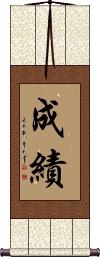
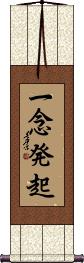
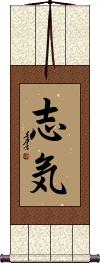
Didn't find what you want?
Try these methods:
1. Make your search more specific.
2. Use other similar-meaning words.
3. Use less words or just one word.
4. Post your request on our forum so that we can translate/create what you want.
We'll build you a handmade custom "Achievement" calligraphy wall scroll if you wish!
Quick links to words on this page...
Check out all the Custom Calligraphy Options
Click on a![]()
to select your calligraphy and start customizing your artwork project...


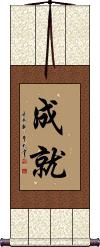
This is the word most often used in Chinese, Korean and Japanese to mean accomplishment or achievement. This word can also be used to mean success, attain a result, fulfillment, realization, or completion.
Score: 100/100
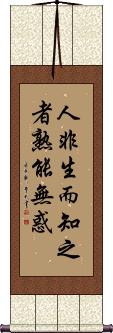
Without a teacher, how can we learn/mature?
Mandarin: rén fēi shēng ér zhī zhī zhě shú néng wú huò


Characters shown
above are read
vertically, starting
from the right
This is a philosophic pondering by Han Yu, a Tang Dynasty essayist and philosopher (618–907 A.D.). It can be translated as, "Knowledge is not innate to man, how can we overcome doubt?" or, "We are not born with knowledge, how does one achieve maturity?".
This infers that we need the guidance of a teacher if we wish to learn, mature, and become better.
Score: 65/100


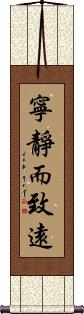
This is five characters from a longer ten-character phase composed by Zhuge Liang about 1800 years ago. The phrase means "Your inner peace / tranquility / serenity will help you see or reach far (into the world)". The last word means "far", but the deeper meaning is that you will surpass what you can currently see or understand. Perhaps even the idea of opening up vast knowledge and understanding of complex ideas.
Score: 64/100


This term transcends a few religions, including Taoism and Buddhism. This title refers to the inner bliss and peace that you can achieve from meditation. It can also be translated as "joy of the mystic trance" or simply "meditative bliss".
Amazing that such a complex idea can be expressed in just two Chinese characters. Note that the first character is Chan/Zen (Chinese/Japanese) which means "meditation" in both languages.
Score: 14/100


Used to refer to someone who puts forth maximum effort and achieves much. We might call this kind of person a "go-getter" in English.
See Also... Dedication | Tenacious | Devotion
Score: 14/100


These three characters are the full title of the Bodhi tree (a fig tree) under which Siddhartha Gautama (the legendary man and who established the Buddhist religion), achieved enlightenment. Sometimes this is referred to as "the tree of enlightenment". If you don't have a Bodhi tree to sit under, maybe you can achieve your enlightenment under a wall scroll with this title.
Score: 15/100


This Chinese and Japanese word for "success" is often used to refer to "career success", but is also used for other successes in life.
It matches the western dictionary definition of "The achievement of something desired, planned, or attempted". And it's also used it this old Chinese proverb:
which means Failure is the Mother of Success.
Sometimes this word is translated as prosperity, but success, succeed, or successfully are more correct definitions.
See Also... Prosperity
Score: 10/100


These are the Kanji for "Black Belt" in Japanese.
This would be the gift to buy someone who is about to achieve the rank of black belt, or perhaps for yourself, like a certificate on the wall to subtly show your accomplishment.
Note: with a tiny stroke difference on the second character, this also means black belt in Korean Hanja. Let me know if you need the exact Korean version (though any Korean who can read Hanja will know this is black belt).
Score: 14/100
The One Who has Achieved Rank in Martial Arts
Mandarin: yǒu duàn zhě
Japanese: yuu dan sha
Korean: 유단자


This is a Japanese term for someone who holds rank in karate, judo, etc.
This term theoretically applies to anyone with rank (above white belt). However, some schools or dojos may reserve this title for a holder of a black belt.
I'd suggest that you only order this phrase if you have honestly reached this level.
This title does kind of make sense in Chinese, but only to those Chinese who practice "kong shou dao" (karate) or when used in the context of martial arts.
Score: 13/100
A deity in Buddhism that exists to
help you reach enlightenment
Mandarin: pú sà
Japanese: bosatsu
Korean: 보살


In Buddhist beliefs, a bodhisattva (bodhisatta) is a being who is dedicated to helping us achieve enlightenment. Bodhisattva literally means enlightenment truth which is bodhi sattva in Sanskrit.
I am not a Buddhist, so I am not sure if this is appropriate to hang on your wall. But a lot of people have been searching our website for bodhisattva, so I figured it is time to add it.
Sometimes used to refer to a kindhearted person.
See Also... Buddha | Namo Amitabha
Score: 14/100


Once you eliminate desire or attachment to worldly things, only then can you achieve enlightenment.
This term is exclusively used by devout Buddhists. It is not a common term, and is remains an unknown concept to most Japanese, Korean, and Chinese people.
See Also... Buddhism | Enlightenment
Score: 14/100


Characters shown
above are read
vertically, starting
from the right
This literally translates as: [Even a] one-hundred foot [tall] bamboo [can] progress even one [more] step.
Figuratively, this means: After having achieved a fair degree of success, one should try to do still better.
Score: 14/100


This suggests "Legendary Phoenix rises from the ashes". Literally, it means, "Legendary Phoenix [reaches] Nirvana".
There is a legend in China of a great bird which is reborn once every 500 years. This bird gathers all the ill-will, suffering, desire, and other negative things of the whole world. The bird then plunges into the fire to burn away all negative things, sacrificing itself in the process (achieving Nirvana, or perhaps allowing others the opportunity to reach Nirvana).
500 years later, the phoenix is reborn from the ashes again, and the cycle repeats.
Score: 4/100


One of the most famous types of martial arts in the world - and not just because of Bruce Lee.
Some translate the meaning as "Accomplishment by Great Effort". I think this is partially true, but directly translated it literally means "Merit/Achievement/Accomplishment Man". The word "fu" can sometimes mean "husband" or "porter", but in this case, it can only mean "man". However, few in China will think "man" when they hear the word "Gong Fu" spoken.
This term is also used for things other than martial arts. In fact, it's used to refer to a person with excellent skills in crafts that require a great deal of effort such as cooking, tea ceremonies, and calligraphy.
What a lot of people don't know is that the spelling of "Kung Fu" was actually taken from the old Wade Giles form of Romanization. Using this method, the sounds of the English "G" and "K" were both written as "K" and an apostrophe after the "K" told you whether it was supposed to sound like a "G" or not. Nobody in the west knew this rule, so most people pronounce it with a "K-sound". And so Gong Fu will always be Kung Fu for most westerners.
Also, just to educate you a little more, the "O" in "Gong" has a sound like the English word "oh".
The popular Chinese dish "Kung Pao Chicken" suffers from the same problem. It should actually be "Gong Bao Chicken".
Historical note: Many will claim that Kung Fu was invented by the monks of the Shaolin monastery. This fact is argued in both directions by scholars of Chinese history. Perhaps it is more accurate to say that the Shaolin Monks brought the original fame to Kung Fu many generations ago.
Japanese note: While this does mean Jung Fu in Japanese, in most cases, Japanese will use Katakana to approximate the pronunciation of "Kung Fu". However, virtually any Japanese person who is into martial arts will recognize and understand these characters.
Score: 10/100


Characters shown
above are read
vertically, starting
from the right
This is a lifelong suggestion for expanding your horizons by gaining knowledge, experience, and seeing the world.
Of course, this was written long ago when it was hard to travel 10,000 miles.
With air travel and the business I'm in, I often achieve that lifetime goal on a monthly basis.
However, I am a little behind in the book count.
Note: An ancient Chinese mile (lǐ) referred to in this phrase is a bit shorter than a British/American mile.
Score: 4/100
Mandarin: yuǎn shàng hán shān shí jìng xiá bái yún shēng chù yǒu rén jiā tíng chē zuò ài fēng lín wǎn shuàng yè hóng yú èr yuè huā


This poem was written almost 1200 years ago during the Tang dynasty. It depicts traveling up a place known as Cold Mountain, where some hearty people have built their homes. The traveler is overwhelmed by the beauty of the turning leaves of the maple forest that surrounds him just as night overtakes the day, and darkness prevails. His heart implores him to stop, and take in all of the beauty around him.
First before you get to the full translation, I must tell you that Chinese poetry is a lot different than what we have in the west. Chinese words simply don't rhyme in the same way that English, or other western languages do. Chinese poetry depends on rhythm and a certain beat of repeated numbers of characters.
I have done my best to translate this poem keeping a certain feel of the original poet. But some of the original beauty of the poem in it's original Chinese will be lost in translation.
Far away on Cold Mountain, a stone path leads upwards.
Among white clouds peoples homes reside.
Stopping my carriage I must, as to admire the maple forest at nights fall.
In awe of autumn leaves showing more red than even flowers of early spring.
Hopefully, this poem will remind you to stop, and "take it all in" as you travel through life.
The poet's name is "Du Mu" in Chinese that is: 
.
The title of the poem, "Mountain Travels" is: 

You can have the title, poet's name, and even Tang Dynasty written as an inscription on your custom wall scroll if you like.
More about the poet:
Dumu lived from 803-852 AD and was a leading Chinese poet during the later part of the Tang dynasty.
He was born in Chang'an, a city of central China and former capital of the ancient Chinese empire in 221-206 BC. In present day China, his birthplace is currently known as Xi'an, the home of the Terracotta Soldiers.
He was awarded his Jinshi degree (an exam administered by the emperor's court which leads to becoming an official of the court) at the age of 25, and went on to hold many official positions over the years. However, he never achieved a high rank, apparently because of some disputes between various factions, and his family's criticism of the government. His last post in the court was his appointment to the office of Secretariat Drafter.
During his life, he wrote scores of narrative poems, as well as a commentary on the Art of War and many letters of advice to high officials.
His poems were often very realistic, and often depicted every day life. He wrote poems about everything, from drinking beer in a tavern to weepy poems about lost love.
The thing that strikes you most is the fact even after 1200 years, not much has changed about the beauty of nature, toils and troubles of love and beer drinking.
Score: 4/100
Samyak Samadhi / Samma Samadhi
Mandarin: zhèng dìng
Japanese: sei jou
Korean: 정정


This is one of the Noble Eightfold Paths of Buddhism. Right Concentration, along with Right Effort and Right Mindfulness constitute the path to Concentration or Perfect Thought.
Right Concentration has to do with leaving behind sensuality, unwholesome states, as well as pleasure and pain. This is a complex idea, but once you have achieved the shedding of worldly sensation, you can truly concentrate and find a higher level of awareness.
Another definition: Concentration of mind that finds its highpoint in the four absorptions.
This term is exclusively used by devout Buddhists. It is not a common term, and is remains an unknown concept to most Japanese and Chinese people.
See Also... Buddhism | Enlightenment
Score: 4/100


If you've taken even a single karate class in your life, you know this term. This is sensei, which is associated in the west with a master or instructor of karate, aikido, judo, and other Japanese martial arts.
In reality, this is a term of respect for almost any professional or skilled person (doctor, lawyer, teacher, etc). In some cases, it is used for musicians and artists who have achieved a certain level of fame, skill, or accomplishment.
It should be noted that this is also a courtesy title in Chinese, but more like calling someone "mister" or "gentleman". It doesn't really have the "master" or "teacher" meaning in Chinese - see our Chinese "Master / Sifu / Shi Fu" entry if your audience is Chinese.
In Korean Hanja, this means teacher, instructor, schoolmaster, or schoolmistress.
This entry is more for educational purposes. This is kind of a strange thing to put on a wall scroll. It's a title that is used more orally to show respect, rather than something written in calligraphy. If you feel that it is appropriate in your circumstances, we are very willing to create a piece of sensei Japanese calligraphy artwork for you.
Score: 4/100
Ashtangika Marga / Astangika-Marga / Atthangika Magga
Mandarin: bā zhèng dào
Japanese: ha sshou dou
Korean: 팔정도


This is a complex set of steps that Buddhists much take to cleanse karma, achieve enlightenment, eventually cease the cycle of rebirth and live in a state of Nirvana.
If the idea of 8 separate wall scrolls plus this title is too much for you, we can custom-arrange all eight of these concepts on a single wall scroll. Just post your request on our Asian calligraphy forum, and we can discuss options.
Note: This term is exclusively used by devout Buddhists. It is not a common term, and is remains an unknown concept to most Japanese and Chinese people.
See Also... Buddhism | Enlightenment
Score: 4/100


These two characters literally mean opening flowers (a verb). This word is also associated with Springtime, the beginning of something, or youth.
If you like flowers and the Springtime, this is a great selection for you.
In Korean Hanja, this can be a metaphor for achieving enlightenment or becoming civilized (blooming civilization).
See Also... Flowers Fall
Score: 4/100


This is a word used to describe someone that is very proud, and holds themselves above others, but with a valid (earned) reason to do so. This is what you would use to describe the way a mighty general of ancient China like Cao Cao acted or a more modern person like General Patton carried himself.
If you hang this word on your wall it suggests that you hope to achieve that same level of pride from accomplishment.
Score: 4/100


This title is used in Taoism and Qi Gong to describe the state you can reach while sitting quietly in meditation. It contains the ideas of achieving a highly-tranquil and peaceful state. Some may describe this state as "sleeping while still awake".
If you have a relaxation or meditation room, this is the calming wall scroll that you would want hanging in that room.
Score: 4/100


The Bodhi is the moment of completion in Buddhism. It is when all things become known, and you have completed your journey to enlightenment.
The reference is to the Bodhi tree where Siddhartha Gautama (the legendary man and who established the Buddhist religion), achieved enlightenment. Sometimes this is referred to as "the tree of enlightenment", but if you want the full version with the character for tree on the end, please see our other entry.
See Also... Buddhism | Buddha | Nirvana | Enlightenment
Score: 14/100


This form of martial arts can be translated in several ways. Some will call it "fist principles" or "the way of the fist", or even "law of the fist". The first character literally means fist. The second can mean law, method, way, principle or Buddhist teaching.
Kempo is really a pot luck of martial arts. Often a combination of Chinese martial arts such as Shaolin Kung Fu with Japanese martial arts such as Karate, Jujutsu (Jujitsu), Aikido, and others. You may see the term "Kempo Karate" which basically means Karate with other disciplines added. In this way, Kempo becomes an adjective rather than a title or school of martial arts.
These facts will long be argued by various masters and students of Kempo. Even the argument as to whether it should be spelled "kenpo" or "Kempo" ensues at dojos around the world (the correct Romaji should actually be "kenpou" if you precisely follow the rules).
The benefit of Kempo is that the techniques are easier to learn and master compared to pure Kung Fu (wu shu). Students are often taught basic Karate moves, kicks, and punches before augmenting the basic skills with complex Kung Fu techniques. This allows students of Kempo achieve a level where they can defend themselves or fight in a relatively short amount of time (a few years rather than a decade or more).
Because the definition of this word is so fluid, I should make some notes here:
1. Purists in Okinawa will claim that "Okinawa Kenpo" or "Ryukyu Hon Kenpo" is the original and true version of this martial art from the old kingdom. There is actually little or no connection between Okinawa Kenpo and the way the word is used elsewhere.
2. In Chinese, where these characters are pronounced "quan fa" (sometimes Romanized as "chuan fa" because the Chinese-pinyin "q" actually sounds like an English "ch" sound), these characters do not hold the connotation of being a mixed martial art. It is simply defined as "the law of the fist".
3. In my Japanese dictionary, it oddly defines Kenpo as "Chinese art of self-defense". I personally don't feel this is the most common way that people perceive the word, but just something you should know.
Score: 14/100


There's not a perfect match to the English word "unity" in Chinese. But this word is pretty close. It speaks to the idea of joining forces, and working as one. It could even mean to rally together to achieve a goal, or defeat a common enemy.
Score: 4/100
Wall scroll artwork shown on this page is priced as follows:
2-3 characters $39.88 each
4 characters $49.88 each
5-10 characters $59.88 each
11 or more characters $69.88 each
After you select your calligraphy, our website will take you through the process of customizing your artwork.
Options for other mounting such as portraits are available for $13 less.
We also offer the services of a famous master calligrapher for a $40 fee on any scroll if you are looking for investment-quality calligraphy.
If you chose our famous master-calligrapher, you also get more choices for silk and paper colors and the option for larger artwork.
All of our calligraphy is completely done by hand in the ancient way.
When the calligrapher finishes creating your artwork, it is taken to our art mounting workshop in Beijing where a wall scroll is made by hand from a combination of silk, rice paper, and wood.
After we create your wall scroll, it takes at least two weeks for air mail delivery from Beijing to you.
Therefore, allow at least 3 weeks for delivery from the time you place your order.
When you select your calligraphy, you'll be taken to another page where you can choose various custom options.
More ACHIEVEMENT Asian artwork can be found here.
The scroll that I am holding in this picture is a "regular size"
4-character wall scroll.
As you can see, it is a great size to hang on your wall.
(We also offer custom wall scrolls in larger sizes)
Professional calligraphers are getting to be hard to find these days.
Instead of drawing characters by hand, the new generation in China merely type roman letters into their computer keyboards and pick the character that they want from a list that pops up.
There is some fear that true Chinese calligraphy may become a lost art in the coming years. Many art institutes in China are now promoting calligraphy programs in hopes of keeping this unique form
of art alive.
Even with the teachings of a top-ranked calligrapher in China, my calligraphy will never be good enough to sell. I will leave that to the experts.
The same calligrapher who gave me those lessons also attracted a crowd of thousands and a TV crew as he created characters over 6-feet high. He happens to be ranked as one of the top 100 calligraphers in all of China. He is also one of very few that would actually attempt such a feat.
Successful Chinese and Japanese calligraphy searches within the last few hours...If your search is not successful, just post your request on our forum, and we'll be happy to do research or translation for any reasonable request. | ||||||
|
abbey abundance alex aman amanda angelo bear believe bible bliss blossom boat brave caitlin chelsea clarity | confucius crazy 福 day desire destiny devotion dog dragon faith family felipe fire fish football gemini | good luck happiness harmony honor hope i love you japan jenni jesus john 3 john 3:6 josue judy laugh leo life | life in harmony light live live strong love luck lucky meet melissa michael mike moon music nice night pablo | passion patience peace prayer pride rabbit rain respect ryan sarah star stars stephanie strength strong woman success | the art of war the chosen one true understanding wind wish wolf wu wei yuki | |
| With so many searches, we had to upgrade to our own Linux server. Of course, only one in 500 searches results in a purchase - Hey buy a wall scroll!!! | ||||||
The following table is only helpful for those studying Chinese (or Japanese), and perhaps helps search engines to find this page when someone enters Romanized Chinese or Japanese
| Title | Characters Simplified Traditional |
Japanese Romaji (Romanized Japanese) | Various forms of Hanyu-Pinyin (Romanized Chinese) | |||
| Achievement / Accomplishment | 成就 成就 | jouju joju | chéng jiù cheng jiu | cheng2 jiu4 chengjiu | ||
| We are not born with knowledge, how does one achieve maturity? | 人非生而知之者熟能無惑 人非生而知之者熟能無惑 | n/a | rén fēi shēng ér zhī zhī zhě shú néng wú huò ren fei sheng er zhi zhi zhe shu neng wu huo | ren2 fei1 sheng1 er2 zhi1 zhi1 zhe3 shu2 neng2 wu2 huo4 | ||
| Achieve Inner Peace; Find Deep Understanding | 宁静而致远 寧靜而致遠 | n/a | níng jìng ér zhì yuǎn ning jing er zhi yuan | ning2 jing4 er2 zhi4 yuan3 ningjingerzhiyuan | ||
| Inner Bliss and Peace from Meditation | 禅悦 禪悅 | n/a | chán yuè chan yue | chan2 yue4 chanyue | ||
| Industrious / Hard Working | 爱岗敬业 愛崗敬業 | n/a | ài gǎng jìng yè ai gang jing ye | ai4 gang3 jing4 ye4 aigangjingye | ||
| The Tree of Enlightenment The Bodhi Tree | 菩提树 菩提樹 | bodaiju | pú tí shù pu ti shu | pu2 ti2 shu4 putishu | ||
| Success | 成功 成功 | seikou seiko | chéng gōng cheng gong | cheng2 gong1 chenggong | ||
| Black Belt | 黑帯 黒帯 | kuroobi kurobi | n/a | |||
| Rank Holder | 有段者 有段者 | yuu dan sha yuudansha yu dan sha | yǒu duàn zhě you duan zhe | you3 duan4 zhe3 youduanzhe | ||
| Bodhisattva | 菩萨 菩薩 | bosatsu | pú sà pu sa | pu2 sa4 pusa | ||
| Four Noble Truths: Elimination of Desire (Nirodha) | 灭谛 滅諦 | mettai | miè dì mie di | mie4 di4 miedi | ||
| Even The 100-Foot Bamboo Can Grow One More Foot | 百尺竿头更进一步 百尺竿頭更進一步 | n/a | bǎi chǐ gān tóu gèng jìng yī bù bai chi gan tou geng jing yi bu | bai3 chi3 gan1 tou2 geng4 jing4 yi1 bu4 baichigantougengjingyibu | ||
| Phoenix Rising from the Ashes | 凤凰涅磐 鳳凰涅磐 | n/a | fèng huáng niè pán feng huang nie pan | feng4 huang2 nie4 pan2 fenghuangniepan | ||
| Kung Fu / Gong Fu | 功夫 功夫 | kanfu | gōng fu gong fu | gong1 fu gongfu | ||
| Read 10,000 Books, Travel 10,000 Miles | 读万卷书行万里路 讀萬卷書行萬裡路 | n/a | dú wàn juǎn shū, xíng wàn lǐ lù du wan juan shu xing wan li lu | du2 wan4 juan3 shu1 xing2 wan4 li3 lu4 duwanjuanshuxingwanlilu | ||
| Mountain Travels Poem by Dumu | 远上寒山石径斜白云生处有人家停车坐爱枫林晚霜叶红于二月花 遠上寒山石徑斜白雲生處有人家停車坐愛楓林晚霜葉紅於二月花 | n/a | yuǎn shàng hán shān shí jìng xiá bái yún shēng chù yǒu rén jiā tíng chē zuò ài fēng lín wǎn shuàng yè hóng yú èr yuè huā yuan shang han shan shi jing xia bai yun sheng chu you ren jia ting che zuo ai feng lin wan shuang ye hong yu er yue hua | yuan3 shang4 han2 shan1 shi2 jing4 xia2 bai2 yun2 sheng1 chu4 you3 ren2 jia1 ting2 che1 zuo4 ai4 feng1 lin2 wan3 shuang4 ye4 hong2 yu2 er4 yue4 hua1 | ||
| 8. Right Concentration / Perfect Concentration | 正定 正定 | sei jou seijou sei jo | zhèng dìng zheng ding | zheng4 ding4 zhengding | ||
| Sensei / Master / Teacher / Mister | 先生 先生 | sensei | xiān shēng xian sheng | xian1 sheng1 xiansheng | ||
| The Noble Eightfold Path | 八正道 八正道 | ha sshou dou hasshoudou ha sho do | bā zhèng dào ba zheng dao | ba1 zheng4 dao4 bazhengdao | ||
| Opening / Blooming Flowers | 开花 開花 | kai ka kaika | kāi huā kai hua | kai1 hua1 kaihua | ||
| Proud / Pride / Lofty-Minded | 傲世 傲世 | n/a | ào shì ao shi | ao4 shi4 aoshi | ||
| Sit Quietly in Meditation (a state of mind) | 入静 入靜 | n/a | rù jìng ru jing | ru4 jing4 rujing | ||
| Bodhi - Awakening Enlightenment | 菩提 菩提 | bodai | pú tí pu ti | pu2 ti2 puti | ||
| Kenpo / Kempo / Quan Fa / Chuan Fa | 拳法 拳法 | kenpou kenpo | quán fǎ quan fa | quan2 fa3 quanfa | ||
| Unity / United | 团结 團結 / 糰結 | n/a | tuán jié tuan jie | tuan2 jie2 tuanjie | ||
| If you have not set up your computer to display Chinese, the characters in this table probably look like empty boxes or random text garbage.
This is why we spent hundreds of hours making images so that you could view the characters in the "achievement" listings above. If you want your Windows computer to be able to display Chinese characters you can either head to your Regional and Language options in your Win XP control panel, select the [Languages] tab and click on [Install files for East Asian Languages]. This task will ask for your Win XP CD to complete in most cases. If you don't have your Windows XP CD, or are running Windows 98, you can also download/run the simplified Chinese font package installer from Microsoft which works independently with Win 98, ME, 2000, and XP. It's a 2.5MB download, so if you are on dial up, start the download and go make a sandwich. | ||||||
Some people may refer to this entry as Achievement Kanji, Achievement Characters, Achievement in Chinese Writing, Achievement in Japanese Writing, Achievement in Asian Writing, Achievement Ideograms, Chinese Achievement symbols, Achievement Hieroglyphics, Achievement Glyphs, Achievement in Chinese Letters, Achievement Hanzi, Achievement in Japanese Kanji, Achievement Pictograms, Achievement in the Chinese Written-Language, or Achievement in the Japanese Written-Language.
All custom calligraphy items are made-to-order in our little Beijing artwork-mounting workshop.
Please note: Rush service can be as fast as two weeks, but regular service is over a month for delivery.
Copyright Oriental Outpost 2002-2009 - All Rights Reserved
Image Use Policy | Privacy Policy
This page of achievement Chinese calligraphy dictionary search results was generated in 0.53432393074seconds.