Many custom options


And formats

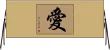

No Fear in Chinese & Japanese Calligraphy
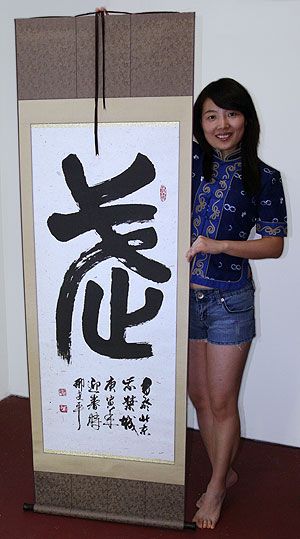
Compare the meanings and pronunciations of the entries related to No Fear below. Choose “Customize & Buy” next to your preferred entry to personalize your calligraphy wall scroll.
1. No Fear
4. Fear No Evil
5. Preparation Yields No Fear or Worries
7. Confidence / Faithful Heart
8. The Confident Helmsman Inspires Confidence in the Passengers
10. Fear not long roads; Fear only short ambition
11. Undaunted After Repeated Setbacks
12. Do not fear being slow, fear standing still
13. Do not fear poverty; Fear low ambitions
14. No Mind / Mushin
15. Preparation Yields No Regrets
16. Never Give Up
17. Psalm 23:1-6
No Fear
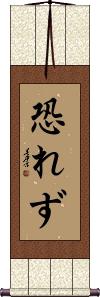
恐れず is probably the best way to express “No Fear” in Japanese.
The first Kanji and the following Hiragana character create a word that means: to fear, to be afraid of, frightened, or terrified.
The last Hiragana character serves to modify and negate the first word (put it in negative form). they carry a meaning like “without” or “keeping away.” 恐れず is almost like the English modifier “-less.”
Altogether, you get something like “Without Fear” or “Fearless.”
Here's an example of using this in a sentence: 彼女かのじょは思い切ったことを恐れずにやる。
Translation: She is not scared of taking big risks.
Note: Because this selection contains some special Japanese Hiragana characters, it should be written by a Japanese calligrapher.
See Also: Bravery / Courage | Encourage
No Fear
(2 characters)
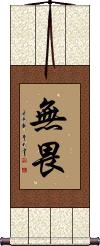
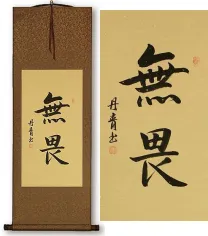
無畏 literally means “No Fear.” But perhaps not the most natural Chinese phrase (see our other “No Fear” phrase for a complete thought). However, this two-character version of “No Fear” seems to be a very popular way to translate this into Chinese when we checked Chinese Google.
Note: This also means “No Fear” in Japanese and Korean, but this character pair is not often used in Japan or Korea.
This term appears in various Chinese dictionaries with definitions like “without fear,” intrepidity, fearless, dauntless, and bold.
In the Buddhist context, this is a word derived from the word Abhaya, meaning: Fearless, dauntless, secure, nothing, and nobody to fear. Also, from vīra meaning: courageous, bold.
See Also: Never Give Up | No Worries | Carry On | Undaunted | Bravery / Courage | Encourage | Fear No Man / Fear Nothing
No Fear
(four-character version)
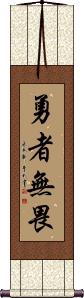
勇者無畏 is a complete sentence that means “Brave People Have No Fear” or “A Brave Person Has No Fear” (plural or singular is not implied).
We translated “No Fear” into the two variations that you will find on our website. Then we checked Chinese Google and found that others had translated “No Fear” in the exact same ways. Pick the one you like best. A great gift for your fearless friend.
See Also: Fear No Man / Fear Nothing
Fear No Man / Fear Nothing
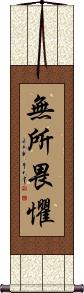
無所畏懼 means “fear nothing,” but it's the closest thing in Chinese to the phrase “fear no man” which many of you have requested.
This would also be the way to say “fear nobody” and can be translated simply as “undaunted.”
The Brave Have No Fears
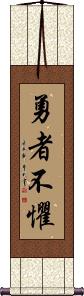
This proverb means “Brave people [are] without fear,” or “The brave are without fear.”
勇者不懼 is a proverb credited to Confucius. It's one of three phrases in a set of things he said.
This phrase is originally Chinese but has penetrated Japanese culture as well (many Confucian phrases have) back when Japan borrowed Chinese characters into their language.
This phrase has also been converted into modern Japanese grammar when written as 勇者は懼れず. If you want this version just click on those characters.
Fear No Evil
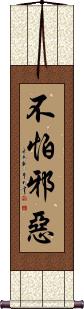
不怕邪惡 literally means “no fear of evil” in Chinese.
Chinese grammar and word order are a little different than English. 不怕邪惡 is the best way to write something that means “fear no evil” in Chinese.
The first character means “not,” “don't” or “no.”
The second means “fear.”
The last two mean “evil” but can also be translated as sinister, vicious, wickedness, or just “bad.”
Fear No Evil
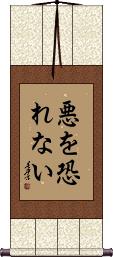
悪を恐れない is “Fear No Evil” in Japanese.
Japanese grammar and phrase construction is different than English, so this literally reads, “Evil Fear Not.”
The “evil” Kanji can also be translated as “wickedness.”
Note: Because this selection contains some special Japanese Hiragana characters, it should be written by a Japanese calligrapher.
Preparation Yields No Fear or Worries
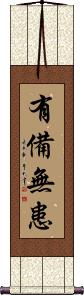
有備無患 means “When you are well-prepared, you have nothing to fear.”
Noting that the third character means “no” or “without” and modifies the last... The last character can mean misfortune, troubles, worries, or fears. It could even be stretched to mean sickness. Therefore you can translate this proverb in a few ways. I've also seen it translated as “Preparedness forestalls calamities.”
有備無患 is comparable to the English idiom, “Better safe than sorry,” but does not directly/literally mean this.
Fearless / Daring
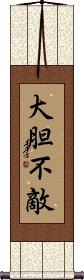
大胆不敵 is a Japanese word that can mean a few things depending on how you read it.
Popular translations include fearless, audacity (the attitude of a) daredevil, or daring.
The first two Kanji create a word that means: bold, fearless, or daring; audacious.
The last two Kanji create a word meaning: no match for, cannot beat, daring, fearless, intrepid, bold, or tough.
As with many Japanese words, the two similar-meaning words work together to multiply the meaning and intensity of the whole 4-Kanji word.
Confidence / Faithful Heart
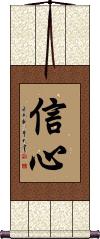
信心 is a Chinese, Japanese, and Korean word that means confidence, faith, or belief in somebody or something.
The first character means faith, and the second can mean heart or soul. Therefore, you could say this means “faithful heart” or “faithful soul.”
In Korean especially, this word has a religious connotation.
In the old Japanese Buddhist context, this was a word for citta-prasāda (clear or pure heart-mind).
In modern Japan (when read by non-Buddhists), this word is usually understood as “faith,” “belief,” or “devotion.”
See Also: Self-Confidence
The Confident Helmsman Inspires Confidence in the Passengers
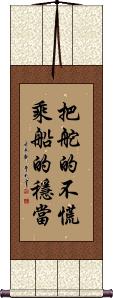
把舵的不慌乘船的稳当 is a Chinese proverb that literally translates as: [If the] helmsman is not nervous, the passengers [will feel] secure.
Figuratively, this means: If the leader appears confident, their followers will gain confidence also.
This is a great suggestion that a confident leader inspires confidence in their troops or followers. Of course, a nervous leader will create fear in troops or followers.
Bravery / Courage
Courage in the face of Fear
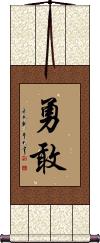
勇敢 is about courage or bravery in the face of fear.
You do the right thing even when it is hard or scary. When you are courageous, you don't give up. You try new things. You admit mistakes. This kind of courage is the willingness to take action in the face of danger and peril.
勇敢 can also be translated as braveness, valor, heroic, fearless, boldness, prowess, gallantry, audacity, daring, dauntless, and/or courage in Japanese, Chinese, and Korean. This version of bravery/courage can be an adjective or a noun. The first character means bravery and courage by itself. The second character means “daring” by itself. The second character emphasizes the meaning of the first but adds the idea that you are not afraid of taking a dare, and you are not afraid of danger.
勇敢 is more about brave behavior and not so much the mental state of being brave. You'd more likely use this to say, “He fought courageously in the battle,” rather than “He is very courageous.”
See Also: Bravery / Courage | Encourage
Fear not long roads; Fear only short ambition
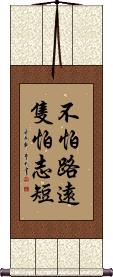
不怕路遠隻怕志短 is a Chinese proverb that literally translates as “Fear not long roads; fear only short ambition,” or “Don't fear that the road is long, only fear that your will/ambition/aspiration is short.”
Figuratively, this means: However difficult the goal is, one can achieve it as long as one is determined to do so.
Others may translate the meaning as “Don't let a lack of willpower stop you from pressing onward in your journey.”
Undaunted After Repeated Setbacks
Persistence to overcome all challenges
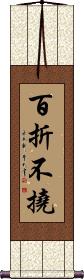
百折不撓 is a Chinese proverb that means “Be undaunted in the face of repeated setbacks.”
More directly translated, it reads, “[Overcome] a hundred setbacks, without flinching.” 百折不撓 is of Chinese origin but is commonly used in Japanese and somewhat in Korean (same characters, different pronunciation).
This proverb comes from a long, and occasionally tragic story of a man that lived sometime around 25-220 AD. His name was Qiao Xuan, and he never stooped to flattery but remained an upright person at all times. He fought to expose the corruption of higher-level government officials at great risk to himself.
Then when he was at a higher level in the Imperial Court, bandits were regularly capturing hostages and demanding ransoms. But when his own son was captured, he was so focused on his duty to the Emperor and the common good that he sent a platoon of soldiers to raid the bandits' hideout, and stop them once and for all even at the risk of his own son's life. While all of the bandits were arrested in the raid, they killed Qiao Xuan's son at first sight of the raiding soldiers.
Near the end of his career, a new Emperor came to power, and Qiao Xuan reported to him that one of his ministers was bullying the people and extorting money from them. The new Emperor refused to listen to Qiao Xuan and even promoted the corrupt Minister. Qiao Xuan was so disgusted that in protest, he resigned from his post as minister (something almost never done) and left for his home village.
His tombstone reads “Bai Zhe Bu Nao” which is now a proverb used in Chinese culture to describe a person of strong will who puts up stubborn resistance against great odds.
My Chinese-English dictionary defines these 4 characters as “keep on fighting despite all setbacks,” “be undaunted by repeated setbacks,” and “be indomitable.”
Our translator says it can mean “never give up” in modern Chinese.
Although the first two characters are translated correctly as “repeated setbacks,” the literal meaning is “100 setbacks” or “a rope that breaks 100 times.” The last two characters can mean “do not yield” or “do not give up.”
Most Chinese, Japanese, and Korean people will not take this absolutely literal meaning but will instead understand it as the title suggests above. If you want a single big word definition, it would be indefatigability, indomitableness, persistence, or unyielding.
See Also: Tenacious / Tenacity | Perseverance / Indomitable / Invincible Fortitude | With All the Strength of Your Heart | Perseverance | Persistence
Do not fear being slow, fear standing still
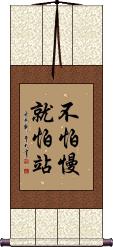
不怕慢就怕站 is a Chinese proverb that translates as: Don't worry about being slow; only worry about standing still.
Figuratively, this means: A slow progress holds some promise but to stand still promises failure.
Do not fear poverty; Fear low ambitions
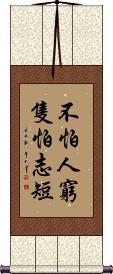
不怕人窮隻怕志短 is a Chinese proverb that literally translates as: It is not poverty that is to be feared; It is low ambition.
Figuratively, this means: It is not poverty but a lack of lofty aspiration that is to be regretted.
No Mind / Mushin
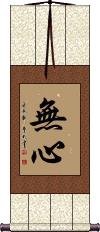
In Japanese, 無心 means innocent or without knowledge of good and evil. It literally means “without mind.”
無心 is one of the five spirits of the warrior (budo) and is often used as a Japanese martial arts tenet. Under that context, places such as the Budo Dojo define it this way: “No mind, a mind without ego. A mind like a mirror which reflects and dos not judge.” The original term was “mushin no shin,” meaning “mind of no mind.” It is a state of mind without fear, anger, or anxiety. Mushin is often described by the phrase “Mizu no Kokoro,” which means “mind like water.” The phrase is a metaphor describing the pond that clearly reflects its surroundings when calm but whose images are obscured once a pebble is dropped into its waters.
This has a good meaning in conjunction with Chan / Zen Buddhism in Japan. However, out of that context, it means mindlessness or absent-mindedness. To non-Buddhists in China, this is associated with doing something without thinking.
In Korean, this usually means indifference.
Use caution and know your audience before ordering this selection.
More info: Wikipedia: Mushin
Preparation Yields No Regrets
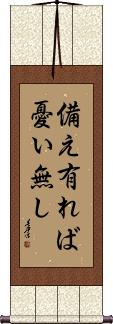
備え有れば憂い無し is as proverb that means “When you are well-prepared, you have nothing to regret” in Japanese.
Note: Because this selection contains some special Japanese Hiragana characters, it should be written by a Japanese calligrapher.
Never Give Up
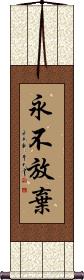
The first character means “eternal” or “forever,” and the second means “not” (together, they mean “never”). The last two characters mean “give up” or “abandon.” Altogether, you can translate this proverb as “never give up” or “never abandon.”
Depending on how you want to read this, 永不放棄 is also a statement that you will never abandon your hopes, dreams, family, or friends.
Psalm 23:1-6

This is Psalm 23:1-6 in Chinese, from the Chinese Union Version (和合本).
In English, the King James Version reads, “The LORD is my shepherd; I shall not want. He maketh me to lie down in green pastures: he leadeth me beside the still waters. He restoreth my soul: he leadeth me in the paths of righteousness for his name’s sake. Yea, though I walk through the valley of the shadow of death, I will fear no evil: for thou art with me; thy rod and thy staff they comfort me. Thou preparest a table before me in the presence of mine enemies: thou anointest my head with oil; my cup runneth over. Surely goodness and mercy shall follow me all the days of my life: and I will dwell in the house of the LORD for ever.”
Psalm 23:1-6

This is Psalm 23:1-6 in Japanese, from the 1954–55 Japanese Kōgo-yaku (口語訳).
In English, the King James Version reads, “The LORD is my shepherd; I shall not want. He maketh me to lie down in green pastures: he leadeth me beside the still waters. He restoreth my soul: he leadeth me in the paths of righteousness for his name’s sake. Yea, though I walk through the valley of the shadow of death, I will fear no evil: for thou art with me; thy rod and thy staff they comfort me. Thou preparest a table before me in the presence of mine enemies: thou anointest my head with oil; my cup runneth over. Surely goodness and mercy shall follow me all the days of my life: and I will dwell in the house of the LORD for ever.”
Note: Because this selection contains some special Japanese Hiragana characters, it should be written by a Japanese calligrapher.
Dana: Almsgiving and Generosity
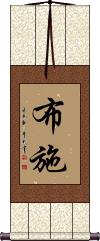
布施 is the Buddhist practice of giving known as Dāna or दान from Pali and Sanskrit.
Depending on the context, this can be alms-giving, acts of charity, or offerings (usually money) to a priest for reading sutras or teachings.
Some will put Dāna in these two categories:
1. The pure or unsullied charity, which looks for no reward here but only in the hereafter.
2. The sullied almsgiving whose object is personal benefit.
The first kind is, of course, the kind that a liberated or enlightened person will pursue.
Others will put Dāna in these categories:
1. Worldly or material gifts.
2. Unworldly or spiritual gifts.
You can also separate Dāna into these three kinds:
1. 財布施 Goods such as money, food, or material items.
2. 法布施 Dharma, as an act to teach or bestow the Buddhist doctrine onto others.
3. 無畏布施 Courage, as an act of facing fear to save someone or when standing up for someone or standing up for righteousness.
The philosophies and categorization of Dāna will vary among various monks, temples, and sects of Buddhism.
Breaking down the characters separately:
布 (sometimes written 佈) means to spread out or announce, but also means cloth. In ancient times, cloth or robs were given to the Buddhist monks annually as a gift of alms - I need to do more research, but I believe there is a relationship here.
施 means to grant, to give, to bestow, to act, to carry out, and by itself can mean Dāna as a single character.
Dāna can also be expressed as 檀那 (pronounced “tán nà” in Mandarin and dan-na or だんな in Japanese). 檀那 is a transliteration of Dāna. However, it has colloquially come to mean some unsavory or unrelated things in Japanese. So, I think 布施 is better for calligraphy on your wall to remind you to practice Dāna daily (or whenever possible).
This in-stock artwork might be what you are looking for, and ships right away...





The following table may be helpful for those studying Chinese or Japanese:
| Title | Characters | Romaji (Romanized Japanese) | Various forms of Romanized Chinese | |
| No Fear | 恐れず | oso re zu / osorezu | ||
| No Fear | 無畏 无畏 | mui | wú wèi / wu2 wei4 / wu wei / wuwei | |
| No Fear | 勇者無畏 勇者无畏 | yǒng zhě wú wèi yong3 zhe3 wu2 wei4 yong zhe wu wei yongzhewuwei | yung che wu wei yungchewuwei |
|
| Fear No Man Fear Nothing | 無所畏懼 无所畏惧 | wú suǒ wèi jù wu2 suo3 wei4 ju4 wu suo wei ju wusuoweiju | wu so wei chü wusoweichü |
|
| The Brave Have No Fears | 勇者不懼 勇者不惧 | yuu sha fu ku yuushafuku yu sha fu ku | yǒng zhě bú jù yong3 zhe3 bu2 ju4 yong zhe bu ju yongzhebuju | yung che pu chü yungchepuchü |
| Fear No Evil | 不怕邪惡 不怕邪恶 | bú pà xié è bu2 pa4 xie2 e4 bu pa xie e bupaxiee | pu p`a hsieh o pupahsieho pu pa hsieh o |
|
| Fear No Evil | 悪を恐れない | aku o osore nai akuoosorenai | ||
| Preparation Yields No Fear or Worries | 有備無患 有备无患 | yǒu bèi wú huàn you3 bei4 wu2 huan4 you bei wu huan youbeiwuhuan | yu pei wu huan yupeiwuhuan |
|
| Fearless Daring | 大膽不敵 大胆不敵 | dai tan fu teki daitanfuteki | ||
| Confidence Faithful Heart | 信心 | shin jin / shinjin | xìn xīn / xin4 xin1 / xin xin / xinxin | hsin hsin / hsinhsin |
| The Confident Helmsman Inspires Confidence in the Passengers | 把舵的不慌乘船的穩當 把舵的不慌乘船的稳当 | bǎ tuò de bù huāng chéng chuán de wěn dang ba3 tuo4 de bu4 huang1 cheng2 chuan2 de wen3 dang ba tuo de bu huang cheng chuan de wen dang | pa t`o te pu huang ch`eng ch`uan te wen tang pa to te pu huang cheng chuan te wen tang |
|
| Bravery Courage | 勇敢 | yuu kan / yuukan / yu kan | yǒng gǎn / yong3 gan3 / yong gan / yonggan | yung kan / yungkan |
| Fear not long roads; Fear only short ambition | 不怕路遠隻怕志短 不怕路远只怕志短 | bú pà lù yuǎn zhǐ pà zhì duǎn bu2 pa4 lu4 yuan3 zhi3 pa4 zhi4 duan3 bu pa lu yuan zhi pa zhi duan bupaluyuanzhipazhiduan | pu p`a lu yüan chih p`a chih tuan pu pa lu yüan chih pa chih tuan |
|
| Undaunted After Repeated Setbacks | 百折不撓 百折不挠 | hyaku setsu su tou hyakusetsusutou hyaku setsu su to | bǎi zhé bù náo bai3 zhe2 bu4 nao2 bai zhe bu nao baizhebunao | pai che pu nao paichepunao |
| Do not fear being slow, fear standing still | 不怕慢就怕站 | bú pà màn jiù pà zhàn bu2 pa4 man4 jiu4 pa4 zhan4 bu pa man jiu pa zhan bupamanjiupazhan | pu p`a man chiu p`a chan pupamanchiupachan pu pa man chiu pa chan |
|
| Do not fear poverty; Fear low ambitions | 不怕人窮隻怕志短 不怕人穷只怕志短 | bú pà rén qióng zhǐ pà zhì duǎn bu2 pa4 ren2 qiong2 zhi3 pa4 zhi4 duan3 bu pa ren qiong zhi pa zhi duan buparenqiongzhipazhiduan | pu p`a jen ch`iung chih p`a chih tuan pu pa jen chiung chih pa chih tuan |
|
| No Mind Mushin | 無心 无心 | mu shin / mushin | wú xīn / wu2 xin1 / wu xin / wuxin | wu hsin / wuhsin |
| Preparation Yields No Regrets | 備え有れば憂い無し | sona e a re ba ure i na shi sonaearebaureinashi | ||
| Never Give Up | 永不放棄 永不放弃 | yǒng bù fàng qì yong3 bu4 fang4 qi4 yong bu fang qi yongbufangqi | yung pu fang ch`i yungpufangchi yung pu fang chi |
|
| Psalm 23:1-6 | 耶和華是我的牧者我必不致缺乏他使我躺臥在青草地上領我在可安歇的水邊他使我的靈魂甦醒為自己的名引導我走義路我雖然行過死蔭的幽谷也不怕遭害因為你與我同在你的杖你的竿都安慰我在我敵人面前你為我擺設筵席你用油膏了我的頭使我的福杯滿溢我一生一世必有恩惠慈愛隨著我我且要住在耶和華的殿中直到永遠 耶和华是我的牧者我必不致缺乏他使我躺卧在青草地上领我在可安歇的水边他使我的灵魂苏醒为自己的名引导我走义路我虽然行过死荫的幽谷也不怕遭害因为你与我同在你的杖你的竿都安慰我在我敌人面前你为我摆设筵席你用油膏了我的头使我的福杯满溢我一生一世必有恩惠慈爱随着我我且要住在耶和华的殿中直到永远 | yē hé huá shì wǒ de mù zhě wǒ bì bú zhì quē fá tā shǐ wǒ tǎng wò zài qīng cǎo dì shàng lǐng wǒ zài kě ān xiē de shuǐ biān tā shǐ wǒ de líng hún sū xǐng wèi zì jǐ de míng yǐn dǎo wǒ zǒu yì lù wǒ suī rán xíng guò sǐ yìn de yōu gǔ yě bú pà zāo hài yīn wèi nǐ yǔ wǒ tóng zài nǐ de zhàng nǐ de gān dōu ān wèi wǒ zài wǒ dí rén miàn qián nǐ wèi wǒ bǎi shè yán xí nǐ yòng yóu gào le wǒ de tóu shǐ wǒ de fú bēi mǎn yì wǒ yì shēng yí shì bì yǒu ēn huì cí ài suí zhe wǒ wǒ qiě yào zhù zài yē hé huá de diàn zhōng zhí dào yǒng yuǎn ye1 he2 hua2 shi4 wo3 de mu4 zhe3 wo3 bi4 bu2 zhi4 que1 fa2 ta1 shi3 wo3 tang3 wo4 zai4 qing1 cao3 di4 shang4 ling3 wo3 zai4 ke3 an1 xie1 de shui3 bian1 ta1 shi3 wo3 de ling2 hun2 su1 xing3 wei4 zi4 ji3 de ming2 yin3 dao3 wo3 zou3 yi4 lu4 wo3 sui1 ran2 xing2 guo4 si3 yin4 de you1 gu3 ye3 bu2 pa4 zao1 hai4 yin1 wei4 ni3 yu3 wo3 tong2 zai4 ni3 de zhang4 ni3 de gan1 dou1 an1 wei4 wo3 zai4 wo3 di2 ren2 mian4 qian2 ni3 wei4 wo3 bai3 she4 yan2 xi2 ni3 yong4 you2 gao4 le wo3 de tou2 shi3 wo3 de fu2 bei1 man3 yi4 wo3 yi4 sheng1 yi2 shi4 bi4 you3 en1 hui4 ci2 ai4 sui2 zhe wo3 wo3 qie3 yao4 zhu4 zai4 ye1 he2 hua2 de dian4 zhong1 zhi2 dao4 yong3 yuan3 ye he hua shi wo de mu zhe wo bi bu zhi que fa ta shi wo tang wo zai qing cao di shang ling wo zai ke an xie de shui bian ta shi wo de ling hun su xing wei zi ji de ming yin dao wo zou yi lu wo sui ran xing guo si yin de you gu ye bu pa zao hai yin wei ni yu wo tong zai ni de zhang ni de gan dou an wei wo zai wo di ren mian qian ni wei wo bai she yan xi ni yong you gao le wo de tou shi wo de fu bei man yi wo yi sheng yi shi bi you en hui ci ai sui zhe wo wo qie yao zhu zai ye he hua de dian zhong zhi dao yong yuan | yeh ho hua shih wo te mu che wo pi pu chih ch`üeh fa t`a shih wo t`ang wo tsai ch`ing ts`ao ti shang ling wo tsai k`o an hsieh te shui pien t`a shih wo te ling hun su hsing wei tzu chi te ming yin tao wo tsou i lu wo sui jan hsing kuo ssu yin te yu ku yeh pu p`a tsao hai yin wei ni yü wo t`ung tsai ni te chang ni te kan tou an wei wo tsai wo ti jen mien ch`ien ni wei wo pai she yen hsi ni yung yu kao le wo te t`ou shih wo te fu pei man i wo i sheng i shih pi yu en hui tz`u ai sui che wo wo ch`ieh yao chu tsai yeh ho hua te tien chung chih tao yung yüan yeh ho hua shih wo te mu che wo pi pu chih chüeh fa ta shih wo tang wo tsai ching tsao ti shang ling wo tsai ko an hsieh te shui pien ta shih wo te ling hun su hsing wei tzu chi te ming yin tao wo tsou i lu wo sui jan hsing kuo ssu yin te yu ku yeh pu pa tsao hai yin wei ni yü wo tung tsai ni te chang ni te kan tou an wei wo tsai wo ti jen mien chien ni wei wo pai she yen hsi ni yung yu kao le wo te tou shih wo te fu pei man i wo i sheng i shih pi yu en hui tzu ai sui che wo wo chieh yao chu tsai yeh ho hua te tien chung chih tao yung yüan |
|
| Psalm 23:1-6 | 主はわたしの牧者であって、わたしには乏しいことがない。主はわたしを緑の牧場に伏させ、いこいのみぎわに伴われる。主はわたしの魂をいきかえらせ、み名のためにわたしを正しい道に導かれる。たといわたしは死の陰の谷を歩むとも、わざわいを恐れません。あなたがわたしと共におられるからです。あなたのむちと、あなたのつえはわたしを慰めます。あなたはわたしの敵の前で、わたしの前に宴を設け、わたしのこうべに油をそそがれる。わたしの杯はあふれます。わたしの生きているかぎりは必ず恵みといつくしみとが伴うでしょう。わたしはとこしえに主の宮に住むでしょう。 | Shu wa watashi no bokusha de atte, watashi ni wa toboshii koto ga nai. Shu wa watashi o midori no makiba ni fusase, ikoi no migiwa ni tomonawareru. Shu wa watashi no tamashii o ikikaerase, mina no tame ni watashi o tadashii michi ni michibikareru. Tatoi w Shu wa watashi no bokusha de atte, watashi ni wa toboshi koto ga nai. Shu wa watashi o midori no makiba ni fusase, ikoi no migiwa ni tomonawareru. Shu wa watashi no tamashi o ikikaerase, mina no tame ni watashi o tadashi michi ni michibikareru. Tatoi w | ||
| Dana: Almsgiving and Generosity | 布施 | fuse | bù shī / bu4 shi1 / bu shi / bushi | pu shih / pushih |
| In some entries above you will see that characters have different versions above and below a line. In these cases, the characters above the line are Traditional Chinese, while the ones below are Simplified Chinese. | ||||

Successful Chinese Character and Japanese Kanji calligraphy searches within the last few hours...