Many custom options...


And formats...



Not what you want?
Try other similar-meaning words, fewer words, or just one word.
Wing Chun Tiger in Chinese / Japanese...
Buy a Wing Chun Tiger calligraphy wall scroll here!
Personalize your custom “Wing Chun Tiger” project by clicking the button next to your favorite “Wing Chun Tiger” title below...
Switched to secondary search mode due to lack of results using primary.
These secondary results may not be very accurate. Try a different but similar meaning word or phrase for better results. Or...
Look up Wing Chun Tiger in my Japanese Kanji & Chinese Character Dictionary(My dictionary is a different system then the calligraphy search you just tried)
If you want a special phrase, word, title, name, or proverb, feel free to contact me, and I will translate your custom calligraphy idea for you.
1. Earth Tiger
3. Water Tiger
4. Fire Tiger
5. Wood Tiger
7. Black Flag Gate / Hek Ki Boen
9. Chun Ku Do
10. Crouching Tiger Hidden Dragon
11. The Spirit of the Dragon Horse
12. The Spirit of the Dragon Horse and Power of a Tiger
13. The Five Animals
14. The Spirit of Dragon and Tiger
16. Fierce Tiger
17. Fire Tiger
19. Hidden Dragon Crouching Tiger
20. Hu
21. Nobleman
22. Lau Gar Kung Fu
23. Protection
24. Shark
25. Si Gung
29. How can you catch tiger cubs without entering the lair of the tiger?
30. Tiger Heart
31. Tiger Rumor
32. Water Tiger
33. White Tiger
34. Wings
37. Wing Chun
38. Wing Chun Fist
40. Wu Xing Fist
41. Zheng / Tei / Jeong / Trinh
42. Tiger
Earth Tiger
The Year of the Earth Tiger
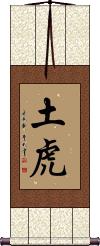
土虎 is Earth Tiger in Chinese.
In the Chinese zodiac and sexagenary (60-year) cycle, this combination occurs in years that include 1878, 1938, 1998, and 2058.
In the sexagenary cycle, this year is represented by 戊寅.
See Also: Tiger
Golden/Metal Tiger
The Year of the Golden/Metal Tiger
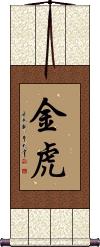
金虎 is Golden/Metal Tiger in Chinese.
In the Chinese zodiac and sexagenary (60-year) cycle, this combination occurs in years that include 1890, 1950, 2010, and 2070.
In the sexagenary cycle, this year is represented by 庚寅.
See Also: Tiger
Water Tiger
The Year of the Water Tiger
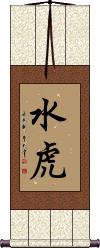
水虎 is Water Tiger in Chinese.
In the Chinese zodiac and sexagenary (60-year) cycle, this combination occurs in years that include 1902, 1962, 2022, and 2082.
In the sexagenary cycle, this year is represented by 壬寅.
See Also: Tiger
Fire Tiger
The Year of the Fire Tiger
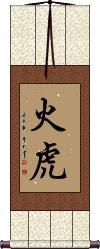
火虎 is Fire Tiger in Chinese.
In the Chinese zodiac and sexagenary (60-year) cycle, this combination occurs in years that include 1866, 1926, 1986, and 2046.
In the sexagenary cycle, this year is represented by 丙寅.
See Also: Tiger
Wood Tiger
The Year of the Wood Tiger
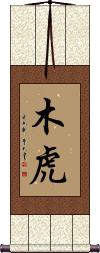
木虎 is Wood Tiger in Chinese.
In the Chinese zodiac and sexagenary (60-year) cycle, this combination occurs in years that include 1914, 1974, 2034, and 2094.
In the sexagenary cycle, this year is represented by 甲寅.
See Also: Tiger
Animal Kingdom
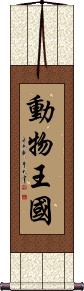
動物王國 is literally what it says.
There is even a TV show in China that is similar to Wild Kingdom or what you would currently see on the Discovery Channel that has this same title.
For your information: In the Chinese way of thinking, the Tiger is the king of the animal kingdom (lions are not native to China, so the tiger took the role that we have given to the lion in our western way of thinking).
The modern Japanese version has a slight variation on the last character (国 instead of 國). Let me know if you want the modern Japanese version (國 would be considered the old or traditional version).
Black Flag Gate / Hek Ki Boen
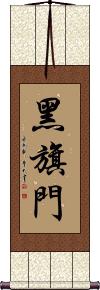
黑旗門 is often romanized as “Hek Ki Boen” in Cantonese, this is the title for a certain branch school of Wing Chun or Eng Chun martial arts.
Black Tiger Fist
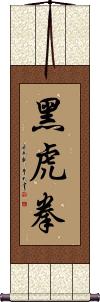
黑虎拳 is Hei Hu Quan or “Black Tiger Fist” - a school of Chinese Martial Arts.
Chun Ku Do

天國道 (or 천국도) is Chun Kuk Do, Korean and American martial arts hybrid system created by Chuck Norris.
Note: Chun Ku Do is now known as the Chuck Norris System.
If you want this in Korean Hangul, please click on the Korean Hangul, please click here instead of the button above: 천국도
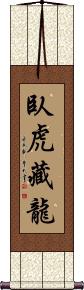
臥虎藏龍 is the movie title of the Kung Fu epic that was very popular in the west a few years back.
This is a re-ordering of an ancient Chinese proverb that refers to undiscovered talents.
The movie was one of the most popular Chinese foreign films to ever debut in the USA but received a lukewarm reception in China.
Note: This can be pronounced in Korean, but it's not a commonly used term.
The Spirit of the Dragon Horse
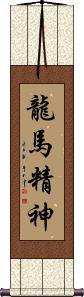
龍馬精神 is an old proverb that is used to wish someone good health and success combined as a great compliment.
The meaning is “The vigor and spirit of the legendary dragon-horse.” These four characters are often accompanied by four more which mean “...and the power and prestige of the tiger.” Here we are just offering the first part which is considered the short version.
By giving a wall scroll like this to someone, you were either wishing or telling them that they have an amazing quality. There is also a suggestion of good health - at least anyone with the vigor of a dragon horse would seem to also be in good health.
Note: In Japanese, this would be read as the spirit of 坂本龍馬 (Sakamoto_Ryōma), a beloved rebel who help abolish the old Japanese feudal system. This can be confusing, so I am declaring this proverb to be Chinese only.
The Spirit of the Dragon Horse and Power of a Tiger
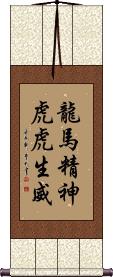
龍馬精神虎虎生威 is an old proverb that is used to wish someone great health and success combined as a great compliment.
The meaning is “The vigor and spirit of the legendary dragon-horse and the power and prestige of the tiger.”
By giving a wall scroll like this to someone, you were either wishing or telling them that they have these qualities. There is also a suggestion of good health - at least anyone with the vigor of a dragon horse would seem to also be in good health.
The Five Animals
Dragon Snake Tiger Leopard Crane
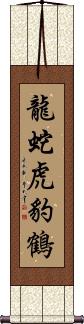
龍蛇虎豹鶴 is a list of the Chinese characters for the five animals of Shaolin Kung Fu in a comfortable order (meaning that they are in the proper order and will “feel right” to a Chinese person who views this arrangement).
The Spirit of Dragon and Tiger
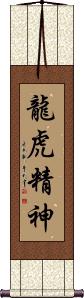
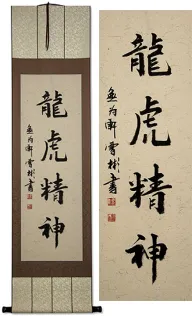
龍虎精神 means the spirit of the dragon and tiger.
It speaks to the vitality and vigor that is the nature of these two creatures.
Beyond “spirit,” the last two characters can also mean mind, soul, or heart. Therefore, you can also say this means “Heart of the Dragon and Tiger,” etc.
龍虎精神 is often titled “Ryukoseishin” in many Japanese martial arts.
Dragon Crane Tiger
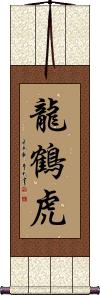
龍鶴虎 is Dragon Crane Tiger in Chinese.
Fierce Tiger
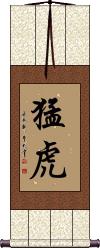
猛虎 means “fierce tiger” or “ferocious tiger” in Chinese, Japanese Kanji, and old Korean Hanja.
Fire Tiger
火虎 is the Chinese and Japanese title for “fire tiger.”
If you were born between 9 Feb 1986 and 28 Jan 1987, or between 13 Feb 1926 and 1 Feb 1927, you are a fire tiger according to the Chinese Zodiac.
There are 12 animals and 5 elements in the cycle. Therefore, the fire tiger comes around once every 60 years. The next will be in 2046.
The branch of the zodiac for tiger is written 寅 when dating ancient documents and artwork, but 虎 is the way to write the character for an actual tiger.
Flying Tigers AVG
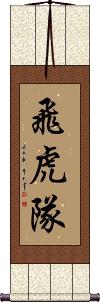
飛虎隊 is the full Chinese title of the “Flying Tigers Group.”
These were the American pilots that volunteered to go to China and fight the Japanese before the entry of the USA into World War Two. These fighter pilots were so esteemed in China that fallen American pilots could always find refuge in villages and safe passage and escape to areas of China that were not occupied by Japan at that time. Chinese villagers helped such fallen pilots with full knowledge that when the Japanese occupation forces found out, all the men, women, and children in the village would be massacred by Japanese troops (there are more than a few known cases of such massacres).
The Flying Tigers successfully kept supply lines to the Chinese resistance open and divided Japanese forces at a crucial time while America prepared to join WWII officially.
A wall scroll like this honors the men who risked or gave their lives as noble volunteers and is a reminder of the best moment in the history of Sino-American relations.
These three characters literally mean “flying tiger(s) group/team/squad.”
Note: Hanging these characters on your wall will not make you any friends with Japanese people who are aware or this history (most Japanese have no idea, as Japan’s involvement in WWII has all but been erased from school textbooks in Japan).
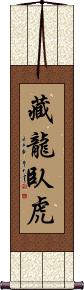
The meaning of 藏龍臥虎 is that both the tiger and dragon have amazing talents, but if they are out of view, you may not have discovered them.
This old Chinese idiom/proverb is appropriate for someone with an amazing ability that keeps that ability hidden.
You might think this title is in reverse, but actually, this is the original Chinese proverb.
The movie Crouching Tiger, Hidden Dragon, popularized this alternate version.

胡 is a common Chinese surname with ancient origins, often linked to noble lineages (like Duke Hu of Chen, a descendant of Emperor Shun), or the ancient State of Hu.
Other rare surnames such as 虎 (tiger), and 黃 or 許 romanize as Hu in some dialects.
Nobleman
Junzi / chun-tzu / gunja / kunshi
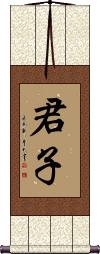
This means nobleman, person of noble character, man of virtue; wise man, or a true gentleman
君子 can be romanized as chün-tzu or jūnzǐ from Chinese and gunja from Korean. This has the same meaning in Japanese, but in another context, can be the female given name Kunshi.
Lau Gar Kung Fu
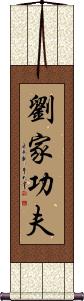
劉家功夫 are the characters for the Lau Gar Kung Fu style of martial arts.
The romanization of “Lau Gar” comes from Cantonese. “Kung Fu” is the common romanization for English from the Mandarin “Gōng Fu” or Cantonese “Gung Fu” pronunciations.
Lau gar = Lau family.
Protection
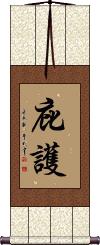
庇護 is not the most common word for a wall scroll, but this is the word for protection in Chinese, Japanese Kanji, and old Korean Hanja.
庇護 is the non-religious, non-superstitious form of protection.
庇護 can be translated as shelter, shield, defend, safeguard, take under one's wing, to put under protection. In a certain context, it means to grant asylum or give refuge and sanctuary.
See Also: Guardian Angel
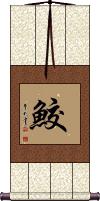
鮫 means shark in Japanese in a single Kanji. 鮫 is often used in Japanese along with a Kanji adjective. This would be the base Kanji for titles like “Tiger Shark,” “Hammerhead Shark,” “Thresher Shark,” etc.
This character can be pronounced in Chinese but is only used in combination with other characters to create shark-related titles. This Kanji is best if your audience is Japanese.
Si Gung
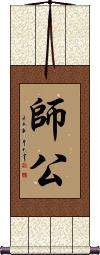
This is a term for “teacher” that is primarily used in Wing Chun martial arts schools.
In very old Buddhist context this can be “thaumaturge” meaning a worker of wonders and/or performer of miracles.
Southern Praying Mantis
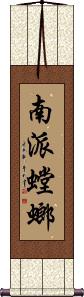
南派螳螂 can be translated literally as “Southern School Praying Mantis” or “Southern Style Praying Mantis.”
Despite its name, the Southern Praying Mantis style of Chinese martial arts is unrelated to the Northern Praying Mantis style. Southern Praying Mantis is instead related most closely to fellow Hakka styles such as Dragon and more distantly to the Fujian family of styles that includes Fujian White Crane, Five Ancestors, and Wing Chun.
This style of martial arts focuses more on fighting skills rather than aesthetics.
Of course, you already knew that if you were looking for this term.
Note: This title can be pronounced and does have meaning in Korean but only to Koreans familiar with Chinese martial arts.
Sticky Hands / Chi Sau
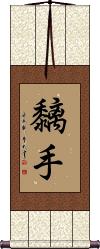
The first character means “wood glue” or can be understood as “sticky” or “sticking.”
The second character means “hand” (or “hands”).
This term can be romanized as “Chi Sau,” “Chi Sao,” or from Mandarin, “Chi Shou.”
黐手 is a concept that comes from the Wing Chun (AKA: Ving Tsun, Wing Tsun, or Yong Chun) style of martial arts. If you are looking for this term, chances are, you already know the meaning within the context of Wing Chun.
Tai Chi Wing Chun Kung Fu
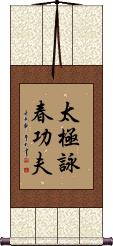
太極詠春功夫 is the title Tai Chi Wing Chun Kung Fu.
Please note that it can be romanized in a variety of ways such as:
Tai Chi Ving Tsun Kung Fu
Tai Qi Yong Chun Gong Fu
Taai Gik Wing Ceon Gung Fu
Be sure this is the right title for what you are looking for before you order.
How can you catch tiger cubs without entering the lair of the tiger?
Nothing ventured, nothing gained
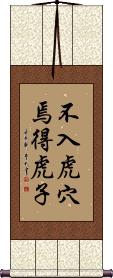
While perhaps no longer politically correct, this Chinese proverb is a reminder that you must take risks if you want rewards.
不入虎穴焉得虎子 is similar to the English proverb, “Nothing ventured, nothing gained.”
The literal word order of the Chinese is, “If (you) don't enter the tiger's lair/cave, how can (you) get/obtain tiger cubs?.”
How can you catch tiger cubs without entering the lair of the tiger?
Nothing ventured, nothing gained
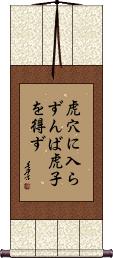
虎穴に入らずんば虎子を得ず is the Japanese version of an ancient Chinese proverb. 虎穴に入らずんば虎子を得ず is a reminder that you must take risks if you want the reward.
虎穴に入らずんば虎子を得ず is similar to the English proverb, “Nothing ventured, nothing gained.”
Note: Because this selection contains some special Japanese Hiragana characters, it should be written by a Japanese calligrapher.
Tiger Heart
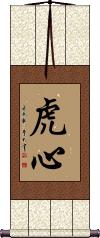
虎心 is “Tiger Heart” in Chinese and Japanese.
This can be a name and is also a rare and exotic gourmet dish served on occasion in southern China.
Tiger Rumor
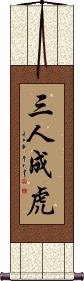
These four characters together relay the meaning that can be expressed in English as “When three people say there's a tiger running in the street, you believe it.”
Of course, there is an ancient story behind this idiom...
三人成虎 is actually a proverb that resulted from a conversation that occurred around 300 B.C.
The conversation was between the king of the Wei kingdom and one of the king's ministers named Pang Cong.
It was near the end of one of many wars, this time with the Zhao kingdom. Pang Cong was to be sent by the king to the Zhao kingdom with the king's son, who was to be held hostage. It was common at the time for a king to make his son a hostage to secure stable peace between warring kingdoms.
Before minister Pang Cong departed, he asked his king, “If one person told you a tiger was running in the street, would you believe it?.”
“No,” the king said.
The minister continued, “What if two people told you?”
The king replied, “Well, I would have my doubts but I might believe it.”
The minister continued, “So, what if three people told you that a tiger is running in the streets?”
The king replied, “Yes, I would believe it. It must be true if three people say it.”
The minister then reminded the king, “Your son and I are now traveling far away to live in the distant Zhao kingdom - much farther from your palace than the street. Rumors may fly about me in my absence, so I hope your majesty will weight such rumors appropriately.”
The king replied, “I have every trust in you, do not worry”
While the minister was gone, the king's enemies gossiped about minister Pang Cong on many occasions. At first, the king thought nothing of these comments and rumors. But slowly, as the rumors mounted, the king began to suspect ill of his minister.
Sometime later, when peace was well-established, the minister and prince were freed and returned to the kingdom of Wei. The king received his son BUT DID NOT EVEN SUMMON MINISTER PANG CONG TO THE PALACE!
Hopefully, this story will help you see how dangerous words can be when used to promote rumors or create ill will. And perhaps will inspire you not to believe everything you hear.
There is also a secondary suggestion in this idiom that gossip is as ferocious as a tiger. Some Chinese people who don't know the ancient story above may believe that this scroll means that rumors are as vicious as three tigers.
Note: This proverb appears in my Korean dictionary but is not well-known in Korea.
Water Tiger
水虎 means “water tiger” in Chinese and Japanese.
White Tiger
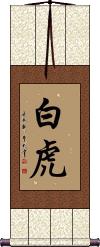
白虎 is the title “White Tiger” in Chinese, Japanese, and old Korean Hanja.
In Chinese folklore, the White Tiger rules or represents the seven mansions (constellations) of the western sky. However, in modern Chinese, a “white tiger” is also slang for hairless female genitalia (be careful about this, as Chinese men might secretly laugh or snicker when they see your white tiger wall scroll).
In Japanese folklore, the White Tiger is a god said to rule over the western heavens. They also know of the Chinese seven mansions of the western heavens. In Japanese, this can also be the given name Byakko.
Wings
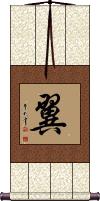
翼 is the shortest way to say “wing” or “wings” in Chinese, Japanese Kanji, and old Korean Hanja.
This can be the wings of a bird or aircraft (including the rotors of a helicopter or rotor wing).
Single characters like this are often ambiguous and have many additional meanings. This character, depending on the context, can mean the following:
Area surrounding the bullseye of a target; to assist; The Chinese surname Yi; “Wings” constellation (one of the 28 mansions of Chinese astronomy).
翼 is also a Japanese name that romanizes as Tsubasa and can refer to the Japanese manga series Tsubasa.
Wing Chun Fist Maxims
Wing Chun Kuen Kuit
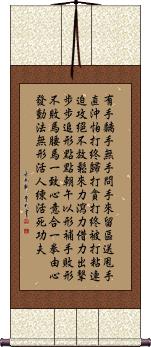
This text is the chant or poem of Wing Chun.
I call it a “chant” because it was meant to be a somewhat rhythmic poem to help practitioners memorize many aspects of Wing Chun.
1 有手黐手,無手問手
2 來留區送, 甩手直沖
3 怕打終歸打, 貪打終被打
4 粘連迫攻, 絕不放鬆
5 來力瀉力, 借力出擊
6 步步追形, 點點朝午
7 以形補手, 敗形不敗馬
8 腰馬一致, 心意合一
9 拳由心發, 動法無形
10 活人練活死功夫
You will see this referred to as “Wing Chun Kuem Kuit.” This Cantonese romanization is popular in the west (and there is no official way to romanize Cantonese, so many variations exist). In Mandarin, it would be, “Yong Chun Quan Jue.” The last character (kuit or kyut from Cantonese, jue or chüeh from Mandarin) kind of means “secrets of the art.” It's a short way to write 口訣, meaning “mnemonic chant” or “rhyme for remembering.”
In the west (especially in the military), we often use acronyms to remember things. There are no initials to make acronyms in Chinese, so in ancient times, chants like this are used to remember vast amounts of information.
I will presume you already know the meaning of the 10 maxims, so I will skip that to keep this calligraphy entry from getting too large.
Some think 练拳者必记 is the title but that just says, “(When) training (the) fist, people should remember:.” Therefore, I've not included that in the calligraphy. However, you can put a note in the special instructions if you want it added.
Note: On a traditional calligraphy wall scroll, the characters will be written in vertical columns, starting from the right, and proceeding left.
Note: This is an except and variation from a huge 口訣. These 10 maxims are used extensively in Wing Chun training, and you’ll find them all over the internet. Just know there is a much longer version out there, along with several variations and excepts like this one. If you know of, or want a different version, just contact me, and I will add it for you.
Wing Chun Fist Maxims (Part 1)
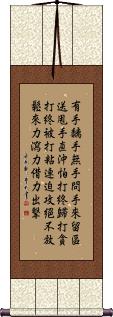
A customer asked me to split these Wing Chun maxims into two parts, so he could order a couplet. I thought this was a good idea, so it's been added here.
1 有手黐手,無手問手
2 來留區送, 甩手直沖
3 怕打終歸打, 貪打終被打
4 粘連迫攻, 絕不放鬆
5 來力瀉力, 借力出擊
A couplet is a set of two wall scrolls that start and finish one phrase or idea. Often, couplets are hung with the first wall scroll on the right side, and the second on the left side of a doorway or entrance. The order in Chinese is right-to-left, so that's why the first wall scroll goes on the right as you face the door.
Of course, couplets can also be hung together on a wall. Often they can be hung to flank an altar, or table with incense, or even flanking a larger central wall scroll. See an example here from the home of Confucius
Be sure to order both parts 1 and 2 together. One without the other is like Eve without Adam.
Wing Chun Fist Maxims (Part 2)
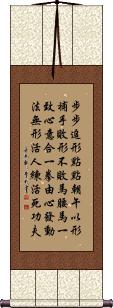
A customer asked me to split these Wing Chun maxims into two parts, so he could order a couplet.
It thought this was a good idea, so it's been added here.
6 步步追形, 點點朝午
7 以形補手, 敗形不敗馬
8 腰馬一致, 心意合一
9 拳由心發, 動法無形
10 活人練活死功夫
Be sure to order both part 1 and part 2 together. They need to be a matched set. It will be incomplete as a single wall scroll. Also, each wall scroll is handmade, so if you order them separately, weeks or months apart, they will vary a little by length, shade of paper, etc.
Wing Chun Kung Fu
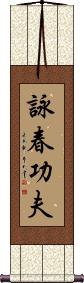
詠春功夫 is Wing Chun Kung Fu.
The first two characters literally mean “Singing Spring” (as in springtime).
The last two are “Kung Fu” (high skill).
Wing Chun
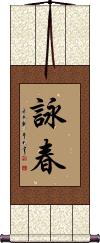
詠春 is a martial arts technique that has an oral history (versus a written one) so very little can be said for sure about its origins.
Wing Chun (or Wing Cheun) is a Chinese martial art that emphasizes short combat strokes.
The characters 詠春 literally mean “Singing Spring” (as in springtime).
If you are wondering, the spelling and pronunciation of this martial arts style in English come from the Cantonese pronunciation of these characters. The second character sounds similar in both Mandarin and Cantonese, but the first is quite different.
Note: This title can be pronounced in Japanese, but only a Japanese practitioner of Wing Chun would recognize or understand this title. It is not considered a Japanese word or martial art at all.
Wing Chun Fist
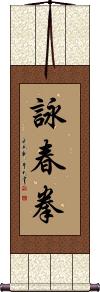
詠春拳 is the title for the “Wing Chun” school of martial arts but with the addition of the character for “fist” at the end. So this is “Wing Chun Fist” or literally “Singing Spring Fist.”
There are lots of alternate Cantonese romanizations for this, such as “Wing Chun Kuen,” “Wing Tsun Cheun,” “Eng Chun Pai,” and “Wing Ceon Kyun.” The characters are the same; just the lack of a standard Cantonese romanization means that people make up their own based on what they think it sounds like.
Wing Chun Fist Law

咏春拳法 can be translated as “Wing Chun Martial Arts,” or “Wing Chun Fist Law.”
咏春 = Wing Chun.
拳法 = Fist method, fist law, Kempo/Kenpo.
Wu Xing Fist
Five Forms Fist of Kung Fu
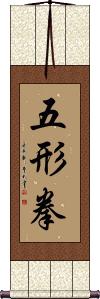
五形拳 is “Wu Xing Fist” or “Five Form Fist.”
The forms refer to Dragon, Snake, Tiger, Crane, and Leopard.
This term is used in Kung Fu, and is recognized by both Chinese and Japanese practitioners of martial arts.
Zheng / Tei / Jeong / Trinh
Chinese Japanese Korean Vietnamese Surname
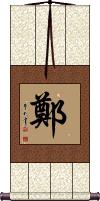
鄭 is the Chinese surname Zheng, Japanese surname Tei, Korean surname Jeong, and Vietnamese surname Trịnh.
This can also refer to the state of Zheng during the Warring States period of China.
In Korea, this can be the original way to write the surname Jeong in the old days (now it's 정 in modern Korea). Can also romanize from Korean as Chung or Jung.
In Japanese, this is the surname Tei. But can romanize as the following Japanese names/surnames: Ti; Te; Tsun; Dziyon; Chiyon; Chon; Chou; Chun; Chuu; Chien; Zen; Jiyon; Jon; Jou; Jun.
In Vietnamese, this is the name Trịnh from the time before Vietnam romanized the language.
Tiger
Year of the Tiger / Zodiac Sign
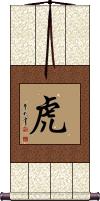
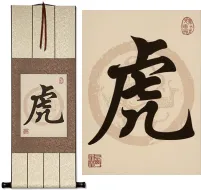
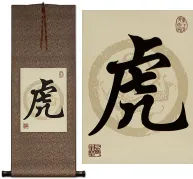
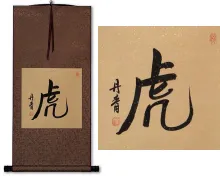
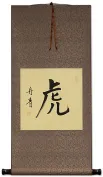
虎 is the character for tiger in Chinese, old Korean Hanja, and Japanese Kanji.
Since you already know what a tiger is, here's some trivia: If you look at the Japanese pronunciation, you might remember a movie called “Tora Tora Tora” which was the code word used to initiate the attack on Pearl Harbor. It simply means “Tiger Tiger Tiger.”
In Chinese culture, the tiger is considered to be the king of all animals (in much the way we see the lion in western culture).
From the Chinese Zodiac, if you were born in the year of the tiger, you . . .
Have a strong personality.
Are full of self-confidence.
Love adventure
Don't like to obey others.
See also our Chinese Zodiac or Tiger Calligraphy pages.
This in-stock artwork might be what you are looking for, and ships right away...

Gallery Price: $106.00
Your Price: $58.88

Gallery Price: $40.00
Your Price: $16.88
Gallery Price: $65.00
Your Price: $39.88
Gallery Price: $65.00
Your Price: $39.88
Gallery Price: $200.00
Your Price: $99.88

Gallery Price: $106.00
Your Price: $58.88
Gallery Price: $322.00
Your Price: $178.88
Gallery Price: $322.00
Your Price: $178.88
Gallery Price: $400.00
Your Price: $158.88
The following table may be helpful for those studying Chinese or Japanese...
| Title | Characters | Romaji (Romanized Japanese) | Various forms of Romanized Chinese | |
| Earth Tiger | 土虎 | tǔ hǔ / tu3 hu3 / tu hu / tuhu | t`u hu / tuhu / tu hu | |
| Golden/Metal Tiger | 金虎 | jīn hǔ / jin1 hu3 / jin hu / jinhu | chin hu / chinhu | |
| Water Tiger | 水虎 | shuǐ hǔ / shui3 hu3 / shui hu / shuihu | ||
| Fire Tiger | 火虎 | huǒ hǔ / huo3 hu3 / huo hu / huohu | ||
| Wood Tiger | 木虎 | mù hǔ / mu4 hu3 / mu hu / muhu | ||
| Animal Kingdom | 動物王國 动物王国 | doubutsu oukoku doubutsuoukoku dobutsu okoku | dòng wù wáng guó dong4 wu4 wang2 guo2 dong wu wang guo dongwuwangguo | tung wu wang kuo tungwuwangkuo |
| Black Flag Gate Hek Ki Boen | 黑旗門 黑旗门 | hēi qí mén hei1 qi2 men2 hei qi men heiqimen | hei ch`i men heichimen hei chi men |
|
| Black Tiger Fist | 黑虎拳 | hēi hǔ quán hei1 hu3 quan2 hei hu quan heihuquan | hei hu ch`üan heihuchüan hei hu chüan |
|
| Chun Ku Do | 天國道 天国道 | ten goku dou tengokudou ten goku do | tiān guó dào tian1 guo2 dao4 tian guo dao tianguodao | t`ien kuo tao tienkuotao tien kuo tao |
| Crouching Tiger Hidden Dragon | 臥虎藏龍 卧虎藏龙 | wò hǔ cáng lóng wo4 hu3 cang2 long2 wo hu cang long wohucanglong | wo hu ts`ang lung wohutsanglung wo hu tsang lung |
|
| The Spirit of the Dragon Horse | 龍馬精神 龙马精神 | lóng mǎ jīng shén long2 ma3 jing1 shen2 long ma jing shen longmajingshen | lung ma ching shen lungmachingshen |
|
| The Spirit of the Dragon Horse and Power of a Tiger | 龍馬精神虎虎生威 龙马精神虎虎生威 | lóng mǎ jīng shén hǔ hǔ shēng wēi long2 ma3 jing1 shen2 hu3 hu3 sheng1 wei1 long ma jing shen hu hu sheng wei | lung ma ching shen hu hu sheng wei | |
| The Five Animals | 龍蛇虎豹鶴 龙蛇虎豹鹤 | ryuu hebi tora hyou tsuru ryuuhebitorahyoutsuru ryu hebi tora hyo tsuru | lóng shé hǔ bào hè long2 she2 hu3 bao4 he4 long she hu bao he longshehubaohe | lung she hu pao ho lungshehupaoho |
| The Spirit of Dragon and Tiger | 龍虎精神 龙虎精神 | ryu ko sei shin ryukoseishin | lóng hǔ jīng shén long2 hu3 jing1 shen2 long hu jing shen longhujingshen | lung hu ching shen lunghuchingshen |
| Dragon Crane Tiger | 龍鶴虎 龙鹤虎 | lóng hè hǔ long2 he4 hu3 long he hu longhehu | lung ho hu lunghohu |
|
| Fierce Tiger | 猛虎 | mou ko / mouko / mo ko | měng hǔ / meng3 hu3 / meng hu / menghu | |
| Fire Tiger | 火虎 | hi tora / hitora | huǒ hǔ / huo3 hu3 / huo hu / huohu | |
| Flying Tigers AVG | 飛虎隊 飞虎队 | fēi hǔ duì fei1 hu3 dui4 fei hu dui feihudui | fei hu tui feihutui |
|
| Hidden Dragon Crouching Tiger | 藏龍臥虎 藏龙卧虎 | cáng lóng wò hǔ cang2 long2 wo4 hu3 cang long wo hu canglongwohu | ts`ang lung wo hu tsanglungwohu tsang lung wo hu |
|
| Hu | 胡 | hú / hu2 / hu | ||
| Nobleman | 君子 | kun shi / kunshi | jūn zǐ / jun1 zi3 / jun zi / junzi | chün tzu / chüntzu |
| Lau Gar Kung Fu | 劉家功夫 刘家功夫 | liú jiā gōng fu liu2 jia1 gong1 fu liu jia gong fu liujiagongfu | liu chia kung fu liuchiakungfu |
|
| Protection | 庇護 庇护 | hi go / higo | bì hù / bi4 hu4 / bi hu / bihu | pi hu / pihu |
| Shark | 鮫 鲛 | same | jiāo / jiao1 / jiao | chiao |
| Si Gung | 師公 师公 | shi kou / shikou / shi ko | shī gōng / shi1 gong1 / shi gong / shigong | shih kung / shihkung |
| Southern Praying Mantis | 南派螳螂 | nán pài táng láng nan2 pai4 tang2 lang2 nan pai tang lang nanpaitanglang | nan p`ai t`ang lang nanpaitanglang nan pai tang lang |
|
| Sticky Hands Chi Sau | 黐手 | chī shǒu / chi1 shou3 / chi shou / chishou | ch`ih shou / chihshou / chih shou | |
| Tai Chi Wing Chun Kung Fu | 太極詠春功夫 太极咏春功夫 | tài jí yǒng chūn gōng fu tai4 ji2 yong3 chun1 gong1 fu tai ji yong chun gong fu taijiyongchungongfu | t`ai chi yung ch`un kung fu taichiyungchunkungfu tai chi yung chun kung fu |
|
| How can you catch tiger cubs without entering the lair of the tiger? | 不入虎穴焉得虎子 | bú rù hǔ xué yān dé hǔ zǐ bu2 ru4 hu3 xue2 yan1 de2 hu3 zi3 bu ru hu xue yan de hu zi buruhuxueyandehuzi | pu ju hu hsüeh yen te hu tzu pujuhuhsüehyentehutzu |
|
| How can you catch tiger cubs without entering the lair of the tiger? | 虎穴に入らずんば虎子を得ず | koketsu ni haira zun ba tora ko o e zu | ||
| Tiger Heart | 虎心 | tora kokoro torakokoro | hǔ xīn / hu3 xin1 / hu xin / huxin | hu hsin / huhsin |
| Tiger Rumor | 三人成虎 | sān rén chéng hǔ san1 ren2 cheng2 hu3 san ren cheng hu sanrenchenghu | san jen ch`eng hu sanjenchenghu san jen cheng hu |
|
| Water Tiger | 水虎 | sui ko / suiko | shuǐ hǔ / shui3 hu3 / shui hu / shuihu | |
| White Tiger | 白虎 | byakko / hakko byako / hako | bái hǔ / bai2 hu3 / bai hu / baihu | pai hu / paihu |
| Wings | 翼 翌 | yoku / tsubasa | yì / yi4 / yi | i |
| Wing Chun Fist Maxims | 有手黐手無手問手來留區送甩手直沖怕打終歸打貪打終被打粘連迫攻絕不放鬆來力瀉力借力出擊步步追形點點朝午以形補手敗形不敗馬腰馬一致心意合一拳由心發動法無形活人練活死功夫 有手黐手无手问手来留区送甩手直冲怕打终归打贪打终被打粘连迫攻绝不放松来力泻力借力出击步步追形点点朝午以形补手败形不败马腰马一致心意合一拳由心发动法无形活人练活死功夫 | |||
| Wing Chun Fist Maxims (Part 1) | 有手黐手無手問手來留區送甩手直沖怕打終歸打貪打終被打粘連迫攻絕不放鬆來力瀉力借力出擊 有手黐手无手问手来留区送甩手直冲怕打终归打贪打终被打粘连迫攻绝不放松来力泻力借力出击 | |||
| Wing Chun Fist Maxims (Part 2) | 步步追形點點朝午以形補手敗形不敗馬腰馬一致心意合一拳由心發動法無形活人練活死功夫 步步追形点点朝午以形补手败形不败马腰马一致心意合一拳由心发动法无形活人练活死功夫 | |||
| Wing Chun Kung Fu | 詠春功夫 咏春功夫 | yǒng chūn gōng fu yong3 chun1 gong1 fu yong chun gong fu yongchungongfu | yung ch`un kung fu yungchunkungfu yung chun kung fu |
|
| Wing Chun | 詠春 咏春 | ei haru / eiharu | yǒng chūn yong3 chun1 yong chun yongchun | yung ch`un yungchun yung chun |
| Wing Chun Fist | 詠春拳 咏春拳 | yǒng chūn quán yong3 chun1 quan2 yong chun quan yongchunquan | yung ch`un ch`üan yungchunchüan yung chun chüan |
|
| Wing Chun Fist Law | 詠春拳法 咏春拳法 | ei shun ken pō eishunkenpō | yǒng chūn quán fǎ yong3 chun1 quan2 fa3 yong chun quan fa yongchunquanfa | yung ch`un ch`üan fa yungchunchüanfa yung chun chüan fa |
| Wu Xing Fist | 五形拳 | gokeiken | wǔ xíng quán wu3 xing2 quan2 wu xing quan wuxingquan | wu hsing ch`üan wuhsingchüan wu hsing chüan |
| Zheng Tei Jeong Trinh | 鄭 郑 | tei | zhèng / zheng4 / zheng | cheng |
| Tiger | 虎 | tora | hǔ / hu3 / hu | |
| In some entries above you will see that characters have different versions above and below a line. In these cases, the characters above the line are Traditional Chinese, while the ones below are Simplified Chinese. | ||||

Successful Chinese Character and Japanese Kanji calligraphy searches within the last few hours...