Many custom options...


And formats...



Training in Chinese / Japanese...
Buy a Training calligraphy wall scroll here!
Personalize your custom “Training” project by clicking the button next to your favorite “Training” title below...
2. Training / Practice / Cultivation
3. Discipline / Training / Tempering Character
4. Fierce and courageous training defeats the strong and protects the body.
5. Skill Acquired Through Hard Training
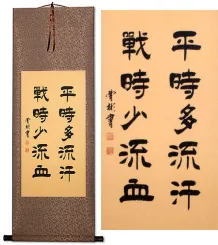
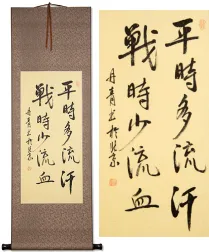
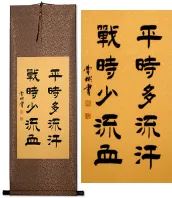
6. The More We Sweat in Training, The Less We Bleed in Battle
7. Cry in the Dojo - Laugh on the Battlefield
10. Discipline
11. Ken Zen Ichi Nyo
13. Goju Dojo
15. Shitsuke
16. Isshin Academy
17. Friendship Dojo
18. Isshin Dojo
20. Keiko Shin
21. Zen Dojo
22. Dojo Kun
23. The Bodhi Mind
25. Shugyo
26. Immovable Mind Hall / Fudoshin Dojo
27. Self-Discipline Martial Arts
28. Unwavering Hall / Fudoshinkan
29. Warriors: Quality Over Quantity
32. Shihan
34. Black Belt
Training / Drill
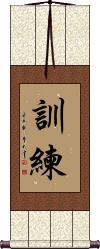
If training or drill is important to you (especially for military drill and training), 訓練 might be just the thing for a drill master to hang behind his/her desk.
This term is universal in Chinese, Japanese Kanji, and old Korean Hanja. It can also mean practice or exercise, depending on context.
Training / Practice / Cultivation
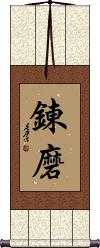
錬磨 is a Japanese word that means training, practice/practise, or cultivation.
Discipline / Training / Tempering Character
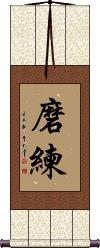
磨鍊 is a form of discipline which suggests training of the mind and character, aimed at producing self-control, obedience, etc.
One of my Chinese-English dictionaries even translates this as “tempering oneself” or turning yourself into hardened steel.
In old Korean Hanja, they use these characters in reverse order but with the same meaning. If you want the Korean version, please click this link instead of the button above: Korean version.
Fierce and courageous training defeats the strong and protects the body.

This is a martial arts phrase that roughly translates as, “Fierce and courageous training defeats the strong and protects the body,” or “Brave and fierce training result in victory over the strong and defend the body.”
Skill Acquired Through Hard Training
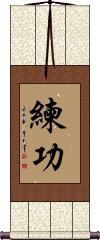
練功 is a martial arts term that can mean to practice and attain working skills, feats of practice/practise, or skills acquired through hard training.
練功 is often used as a martial arts term but can apply to other skills (or professions).
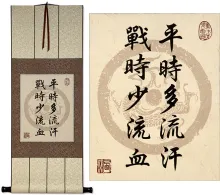
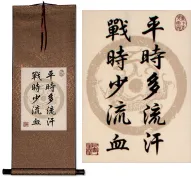
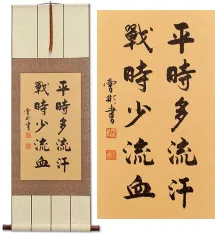
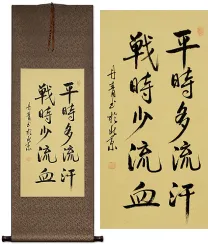
The More We Sweat in Training, The Less We Bleed in Battle
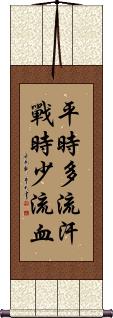
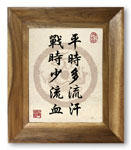
There is more than one way to translate the ancient Chinese military proverb, 平时多流汗战时少流血. Here are a few interpretations:
A drop of sweat spent in a drill is a drop of blood saved in war.
More practice will give one a better chance of success in real situations.
The more you sweat in training, the less you bleed in battle.
I heard this many times when I was a U.S. Marine but I had no idea at the time that it was actually an old Chinese proverb.
See Also: Blood Sweat and Tears
Cry in the Dojo - Laugh on the Battlefield
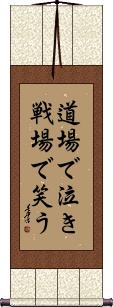
道場で泣き戦場で笑う is a Japanese phrase that means “Cry in the dojo, laugh on the battlefield.”
You'll see this phrase in a lot of dojos as a kind of philosophical joke.
Note: Because this selection contains some special Japanese Hiragana characters, it should be written by a Japanese calligrapher.
See Also: The More We Sweat in Training the Less We Bleed in Battle
Shinken Shobu
Death Match
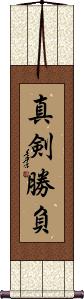
In modern Japanese, 真剣勝負 means to take something very seriously.
The literal and historical meaning is “real sword battle.” In old times, a Samurai apprentice would practice with a wooden practice sword. Once trained and qualified, they would wield a real steel sword made for battle and killing. They were ready for a “death match” or Shinken Shobu.
真剣 is an adjective that has come to mean serious/earnest. The literal translation is “real sword.”
勝負 in the simplest terms, means match, contest, game, or bout. Depending on the context, it could also mean victory or defeat, winning and losing, or the outcome of a battle.
There is a suggestion in Shinken Shobu that you train with serious and real intent, as we should train with the same fervor and dedication as if the battle was real. “Train as we fight.”
See Also: The More We Sweat in Training the Less We Bleed in Battle | Cry in the Dojo - Laugh on the Battlefield
Self-Improvement
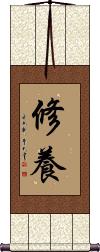
修養 means self-improvement in Chinese, Japanese Kanji, and old Korean Hanja.
Other translations for this word include accomplishment, training, self-cultivation, (mental) training, self-discipline, cultivation, or cultivating moral character.
Discipline

鍛練 is the Japanese Kanji and Korean Hanja word used for discipline.
This has a meaning like “forging or creating something from lots of training and practice.” My Japanese dictionary translates this as “tempering, forging, hardening, disciplining, training.”
This is for Japanese and Korean only. In Chinese, these characters might be translated as (physical) “exercise.”


The modern form of the second Japanese Kanji looks like the first image to the right. There’s also an alternate modern form after that, and finally, an alternate traditional form. Because calligraphy is an art, the calligrapher could choose any of these possible forms. Let us know if you have a preference.
See Also: Self-Control | Will-Power
Discipline
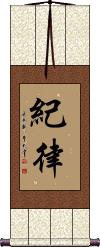
紀律 is a Chinese and Korean word that conveys the idea of extreme self-control and perhaps self-sacrifice, and obedience.
This word matches the kind of “discipline” I was in the Marine Corps. There is also an additional idea of maintaining order or being orderly in your tasks.
This idea would also fit an athlete training for the Olympics who gives up many pleasures to stay focused on their training.
See Also: Self-Control | Will-Power
Ken Zen Ichi Nyo
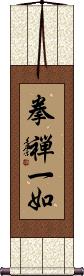
拳禪一如 is a Japanese phrase that is often translated as “train both body and spirit.”
Here's the breakdown of the words in this phrase:
拳 means fist.
禅 is zen, which means meditation.
一如 is a word that means “to be just like,” “oneness,” “true nature,” or “true character.”
So to get to the translation of “train both body and spirit,” you must understand that “fist” is representing “body” and the idea of meditation is representing “mind.”
I have to say, this is not how I would translate this. To me, it's really about training with your mind and remembering that meditation is a huge part of training, not just your fist. As the Shaolin Buddhist monks show us, meditation is just as important as physical training in martial arts.
Teach / Education
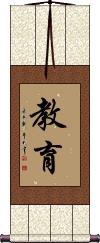
教育 is a Chinese and Japanese word that means to educate, teaching, educating, and/or training.
Goju Dojo

剛柔道場 can be translated as “Goju Dojo,” or “Soft-Hard Training Hall.”
Indomitable Courage

不屈勇氣 can be translated as “Unyielding,” “Unstoppable Bravery,” or “Indomitable Courage.”
In martial contexts, this phrase is often used as a motto emphasizing mindset, conduct, or training attitude.
Shitsuke

躾 is shitsuke which means to discipline, to train, training, or teach manners in Japanese.
躾 means the same thing in Chinese, but not as commonly used.
Isshin Academy

一心学院 can be translated as “Isshin Academy.”
In martial arts usage, this term is typically chosen to express a training mindset, ethical conduct, or personal cultivation. It is commonly used in dojo culture, mottos, and calligraphy titles.
Cross-language note: while the core meaning is broadly shared across Chinese and Japanese usage, nuance and frequency can differ by tradition.
Friendship Dojo

友愛道場 can be translated as “Friendship Dojo.”
友愛 = Friendship or fraternity.
道場 = Training hall.
Isshin Dojo

一心道場 can be translated as “Isshin Dojo.”
In martial arts usage, this term is typically chosen to express a training mindset, ethical conduct, or personal cultivation. It is commonly used in dojo culture, mottos, and calligraphy titles.
Unyielding Self-Reliance

不屈自律 can be translated as “Indomitable Self-Discipline,” “Tenacious Self-Control,” or “Unyielding Self-Discipline.”
In martial contexts, this phrase is often used as a motto emphasizing mindset, conduct, or training attitude.
Keiko Shin
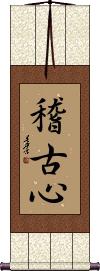
稽古心 is Keiko Shin in Japanese Kanji.
The first two characters, 稽古 mean to learn from the ancients, to study the classic texts, practice, training, or study.
The last character, 心, means heart or mind.
Zen Dojo

禅道場 can be translated as “Zen Dojo.”
禅/禪 = Zen or meditation. If you prefer 禪 over 禅, let me know when you order.
道場 = Dojo (training hall).
Dojo Kun
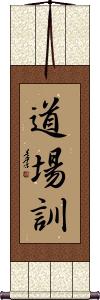
道場訓 or Dōjō-kun is a Japanese martial arts term meaning “training hall rules.”
道場訓 is the rules or doctrine of the dojo.
You will see this often in the form of a list of roles and expectations posted near the front entrance of a dojo.
The Bodhi Mind
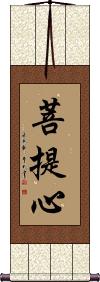
菩提心 means Bodhi-mind or Bodhi-heart.
This title represents the will to realize supreme enlightenment. The awakening of the Bodhi-mind is of utmost importance in Buddhist training.
Other definitions include the mind for or of bodhi, the awakened, enlightened mind, or having Buddha-nature.
Goju Martial Arts

剛柔武道 can be translated as “Goju Martial Arts,” or “Goju Martial Way.”
剛柔 = Hard and soft or balanced power and yielding.
武道 = Martial way, martial arts, or an ethical/lifelong path of training.
Shugyo
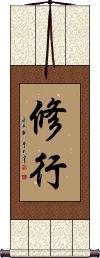
修行 is shugyō or shugyou in Japanese. It refers to ascetic practices, training, practice, discipline, and study.
修行 is also a word in the original Chinese, referring more to religious studies and practices.
In the Buddhist context, this represents caryā. In Buddhism, this relates to one's conduct, observing and doing, cultivating oneself in the right practice, and/or being pious.
Immovable Mind Hall / Fudoshin Dojo

不動心道場 can be translated as “Fudoshin Dojo,” or “Immovable Mind Hall,” depending on usage.
不動心 = Fudoshin or immovable mind.
道場 = Dojo or training hall.
Self-Discipline Martial Arts

克己武道 can be translated as “Self-Discipline Martial Way,” or “Self-Discipline Martial Arts.”
克己 = Self-mastery, or overcome the self.
武道 = Martial way, suggesting an ethical/lifelong path of training.
Martial way; ethical/lifelong path of training.
Unwavering Hall / Fudoshinkan

不動心館 can be translated as “Fudoshinkan,” or “Immovable Mind Hall.”
Fudoshinkan (不動心館) refers to various Japanese martial arts schools, primarily focusing on Aikido, Iaido (sword art), and Jodo (short staff), emphasizing the concept of Fudoshin (不動心) – a calm, immovable mind in the face of challenge, reflecting traditional samurai spirit through dynamic training and inner peace
Immovable mind; unwavering composure. Hall/school (as in -kan / -gwan).
Warriors: Quality Over Quantity
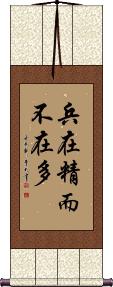
兵在精而不在多 is a Chinese proverb that means: [The value of] soldiers/warriors lies in [their] quality, not [just] in [their] quantity.
In simple terms, this says that regarding warriors, quality is better than quantity.
Most tacticians will agree that this can aid in the factor known as “force multiplication.” Having good troops of high morale, excellent training, and good discipline is like having a force that is three times larger.
See Also: 兵在精
Five Reflections / Gosei
ki ryo ku ni ka ku ru na ka ri shi ka? do ryo ku ni u ra mi na ka ri shi ka?
bu sho u ni wa ta ru na ka ri shi ka?
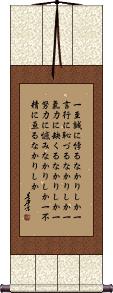
These are the “Five Reflections” of Vice Admiral Hajime Matsushita of the Japanese Imperial Navy.
These days, the Five Reflections are recited or contemplated daily by Japan Maritime Self-Defense Force recruits in training. This long proverb is popularly translated into English this way:
Hast thou not gone against sincerity?
Hast thou not felt ashamed of thy words and deeds?
Hast thou not lacked vigor?
Hast thou not exerted all possible efforts?
Hast thou not become slothful?
Note: Because this selection contains some special Japanese Hiragana characters, it should be written by a Japanese calligrapher.
Perseverance is the Key
Skills cannot be perfected without perseverance in practice
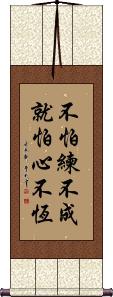
不怕练不成就怕心不恒 literally translates as: Do not worry about not being able to master [a skill]; What [one should] be concerned about is lack of perseverance.
Figuratively, this means: One's skills cannot be perfected without perseverance in practice.
For me, I've learned that you can only get so much from school or studying. You've really got to do “on-the-job training” to perfect your ability and skill.
For martial arts students: You can read about a kick in a book, or someone can tell you about a certain kick but until you practice the kick, there's no way you'll master it.
Shihan
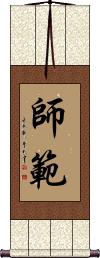
師範 or Shihan is a Japanese term, often used in Japanese martial arts.
In typical Japanese language, it can refer to a teacher or instructor. However, in martial arts, it's often an honorific title for an expert or master instructor.
Example: In Aikido the title can refer to someone with the rank of 7th dan. But other schools use it to mean a master who has earned the right to award black belts.
This term is also used in Chinese, where it refers to teacher-training or the art of teaching by example. It's used within the proper name of certain types of universities in China.
Pushing Hands / Tui Sau
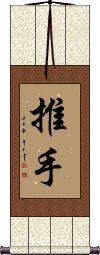
推手 is the martial arts title “Pushing Hands.”
推手 is the title for two-person training routines practiced in internal Chinese martial arts such as Baguazhang, Xingyiquan, Tai Chi Chuan (Taijiquan), Liuhebafa, Chuan Fa, and Yiquan.
The first character means “pushing.”
The second character means “hand” (or “hands”).
This term can be romanized as “Tui Sau,” “Tui Sao,” or from Mandarin, “Tui Shou.”
If you are looking for this term, chances are, you already know the meaning within the context of Tai Chi and other martial arts.
Black Belt
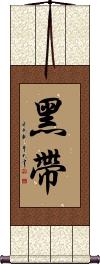
黑帶 is “black belt” in Chinese.
Many will argue whether rank systems that include a “black belt” are used in pure Chinese martial arts systems. The argument goes that it's more a Japanese idea merged into the western versions of Chinese martial arts. However, in Wushu (often referred to as Kung Fu), it's said that all students started with white belts. Over the years of training, the white belt would get dirty until finally appearing black with filth. Thus, more advanced students had darker belts.
If you want this title in Chinese, this would be the form.
 Often, the second character is written like the image to the right. If you like this version, click on this character instead of the button above.
Ninjutsu / Ninjitsu
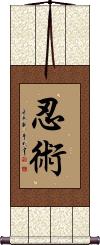
忍術 is the “art of the ninja” in Japanese. Most Japanese people associate ninjas with romance and reverence for Japan's ancient past. But most will accept that the ninja is an idea or way of life whose time has passed. However, this has not stopped floods of movies about ninjas and dojos offering Ninjutsu training from keeping the idea of the ninja alive in modern times.
My modern Japanese dictionary defines this as “assassination, stealth, and combat techniques” or “fighting art of the ninja.”
 Note that when writing this as Kanji, Japanese tend to write the first character in the form shown to the right. Because this is specifically a Japanese title, we only suggest a Japanese calligrapher for this selection - and you will get the form shown to the right if you do that (please ignore the fact that some of the images you see during the following pages in the options process will be the Chinese/alternate form).
Wing Chun Fist Maxims
Wing Chun Kuen Kuit
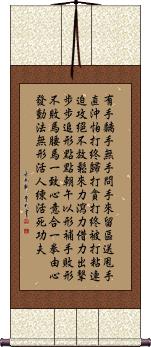
This text is the chant or poem of Wing Chun.
I call it a “chant” because it was meant to be a somewhat rhythmic poem to help practitioners memorize many aspects of Wing Chun.
1 有手黐手,無手問手
2 來留區送, 甩手直沖
3 怕打終歸打, 貪打終被打
4 粘連迫攻, 絕不放鬆
5 來力瀉力, 借力出擊
6 步步追形, 點點朝午
7 以形補手, 敗形不敗馬
8 腰馬一致, 心意合一
9 拳由心發, 動法無形
10 活人練活死功夫
You will see this referred to as “Wing Chun Kuem Kuit.” This Cantonese romanization is popular in the west (and there is no official way to romanize Cantonese, so many variations exist). In Mandarin, it would be, “Yong Chun Quan Jue.” The last character (kuit or kyut from Cantonese, jue or chüeh from Mandarin) kind of means “secrets of the art.” It's a short way to write 口訣, meaning “mnemonic chant” or “rhyme for remembering.”
In the west (especially in the military), we often use acronyms to remember things. There are no initials to make acronyms in Chinese, so in ancient times, chants like this are used to remember vast amounts of information.
I will presume you already know the meaning of the 10 maxims, so I will skip that to keep this calligraphy entry from getting too large.
Some think 练拳者必记 is the title but that just says, “(When) training (the) fist, people should remember:.” Therefore, I've not included that in the calligraphy. However, you can put a note in the special instructions if you want it added.
Note: On a traditional calligraphy wall scroll, the characters will be written in vertical columns, starting from the right, and proceeding left.
Note: This is an except and variation from a huge 口訣. These 10 maxims are used extensively in Wing Chun training, and you’ll find them all over the internet. Just know there is a much longer version out there, along with several variations and excepts like this one. If you know of, or want a different version, just contact me, and I will add it for you.
This in-stock artwork might be what you are looking for, and ships right away...



These search terms might be related to Training:
Confucius: Universal Education
Education / Refinement
Exercise
Patience and Preparation
Preparation Yields No Fear or Worries
Preparation Yields No Regrets
Teach / Education
The following table may be helpful for those studying Chinese or Japanese...
| Title | Characters | Romaji (Romanized Japanese) | Various forms of Romanized Chinese | |
| Training Drill | 訓練 训练 | kunren | xùn liàn / xun4 lian4 / xun lian / xunlian | hsün lien / hsünlien |
| Training Practice Cultivation | 錬磨 | ren ma / renma | ||
| Discipline Training Tempering Character | 磨練 / 磨鍊 / 磨鍊 磨练 | mó liàn / mo2 lian4 / mo lian / molian | mo lien / molien | |
| Fierce and courageous training defeats the strong and protects the body. | 剛勇之猛練勝強而保體 刚勇之猛练胜强而保体 | gāng yǒng zhī měng liàn shèng qiáng ér bǎo tǐ gang1 yong3 zhi1 meng3 lian4 sheng4 qiang2 er2 bao3 ti3 gang yong zhi meng lian sheng qiang er bao ti | kang yung chih meng lien sheng ch`iang erh pao t`i kang yung chih meng lien sheng chiang erh pao ti |
|
| Skill Acquired Through Hard Training | 練功 练功 | renkou / renko | liàn gōng lian4 gong1 lian gong liangong | lien kung lienkung |
| The More We Sweat in Training, The Less We Bleed in Battle | 平時多流汗戰時少流血 平时多流汗战时少流血 | píng shí duō liú hàn zhàn shí shǎo liú xuè ping2 shi2 duo1 liu2 han4 zhan4 shi2 shao3 liu2 xue4 ping shi duo liu han zhan shi shao liu xue | p`ing shih to liu shih shao liu hsüeh ping shih to liu shih shao liu hsüeh |
|
| Cry in the Dojo - Laugh on the Battlefield | 道場で泣き戦場で笑う | doujou de naki senjou de warau dojo de naki senjo de warau | ||
| Shinken Shobu | 真剣勝負 | shinken shoubu shinkenshoubu shinken shobu | ||
| Self-Improvement | 修養 修养 | shuuyou / shuyo shuyo / shuyo | xiū yǎng / xiu1 yang3 / xiu yang / xiuyang | hsiu yang / hsiuyang |
| Discipline | 鍛練 / 鍛錬 锻练 | tan ren / tanren | duàn liàn duan4 lian4 duan lian duanlian | tuan lien tuanlien |
| Discipline | 紀律 纪律 | jì lǜ / ji4 lv4 / ji lv / jilv | chi lü / chilü | |
| Ken Zen Ichi Nyo | 拳禪一如 拳禅一如 | ken zen ichi nyo kenzenichinyo | ||
| Teach Education | 教育 | kyouiku / kyoiku | jiào yù / jiao4 yu4 / jiao yu / jiaoyu | chiao yü / chiaoyü |
| Goju Dojo | 剛柔道場 | gō jū dō jō gōjūdōjō | gāng róu dào chǎng gang1 rou2 dao4 chang3 gang rou dao chang gangroudaochang | kang jou tao ch`ang kangjoutaochang kang jou tao chang |
| Indomitable Courage | 不屈勇氣 不屈勇气 | fukutsu-yūki | bù qū yǒng qì bu4 qu1 yong3 qi4 bu qu yong qi buquyongqi | pu ch`ü yung ch`i puchüyungchi pu chü yung chi |
| Shitsuke | 躾 | shitsuke | měi / mei3 / mei | |
| Isshin Academy | 一心學院 一心学院 | isshin-gakuin ishin-gakuin | yī xīn xué yuàn yi1 xin1 xue2 yuan4 yi xin xue yuan yixinxueyuan | i hsin hsüeh yüan ihsinhsüehyüan |
| Friendship Dojo | 友愛道場 | yū ai dō jō yūaidōjō | yǒu ài dào chǎng you3 ai4 dao4 chang3 you ai dao chang youaidaochang | yu ai tao ch`ang yuaitaochang yu ai tao chang |
| Isshin Dojo | 一心道場 | isshin-dōjō ishin-dōjō | yī xīn dào chǎng yi1 xin1 dao4 chang3 yi xin dao chang yixindaochang | i hsin tao ch`ang ihsintaochang i hsin tao chang |
| Unyielding Self-Reliance | 不屈自律 | fukutsu-jiritsu | bù qū zì lǜ bu4 qu1 zi4 lv4 bu qu zi lv buquzilv | pu ch`ü tzu lü puchützulü pu chü tzu lü |
| Keiko Shin | 稽古心 | keiko shin / keikoshin | ||
| Zen Dojo | 禅道場 / 禪道場 禅道場 | zen dō jō zendōjō | chán dào chǎng chan2 dao4 chang3 chan dao chang chandaochang | ch`an tao ch`ang chantaochang chan tao chang |
| Dojo Kun | 道場訓 道場训 | dou jou kun doujoukun do jo kun | ||
| The Bodhi Mind | 菩提心 | bo dai shin bodaishin | pú tí xīn pu2 ti2 xin1 pu ti xin putixin | p`u t`i hsin putihsin pu ti hsin |
| Goju Martial Arts | 剛柔武道 | gō jū bu dō gōjūbudō | gāng róu wǔ dào gang1 rou2 wu3 dao4 gang rou wu dao gangrouwudao | kang jou wu tao kangjouwutao |
| Shugyo | 修行 | shu gyou / shugyou / shu gyo | xiū xíng / xiu1 xing2 / xiu xing / xiuxing | hsiu hsing / hsiuhsing |
| Immovable Mind Hall Fudoshin Dojo | 不動心道場 | fudōshin-dōjō | bù dòng xīn dào chǎng bu4 dong4 xin1 dao4 chang3 bu dong xin dao chang budongxindaochang | pu tung hsin tao ch`ang putunghsintaochang pu tung hsin tao chang |
| Self-Discipline Martial Arts | 克己武道 | kokki bu dō kokkibudō koki bu dō | kè jǐ wǔ dào ke4 ji3 wu3 dao4 ke ji wu dao kejiwudao | k`o chi wu tao kochiwutao ko chi wu tao |
| Unwavering Hall Fudoshinkan | 不動心館 | fudōshin-kan | bù dòng xīn guǎn bu4 dong4 xin1 guan3 bu dong xin guan budongxinguan | pu tung hsin kuan putunghsinkuan |
| Warriors: Quality Over Quantity | 兵在精而不在多 | bīng zài jīng ér bú zài duō bing1 zai4 jing1 er2 bu2 zai4 duo1 bing zai jing er bu zai duo bingzaijingerbuzaiduo | ping tsai ching erh pu tsai to pingtsaichingerhputsaito |
|
| Five Reflections Gosei | 一至誠に悖るなかりしか一言行に恥づるなかりしか一氣力に缺くるなかりしか一努力に憾みなかりしか一不精に亘るなかりしか | shi se i ni moto ru na ka ri shi ka? gen kou ni ha zu ru na ka ri shi ka? ki ryo ku ni ka ku ru na ka ri shi ka? do ryo ku ni u ra mi na ka ri shi ka? bu sho u ni wa ta ru na ka ri shi ka? shi se i ni moto ru na ka ri shi ka? gen ko ni ha zu ru na ka ri shi ka? ki ryo ku ni ka ku ru na ka ri shi ka? do ryo ku ni u ra mi na ka ri shi ka? bu sho u ni wa ta ru na ka ri shi ka? | ||
| Perseverance is the Key | 不怕練不成就怕心不恆 不怕练不成就怕心不恒 | bú pà liàn bù chéng jiù pà xīn bù héng bu2 pa4 lian4 bu4 cheng2 jiu4 pa4 xin1 bu4 heng2 bu pa lian bu cheng jiu pa xin bu heng | pu p`a lien pu ch`eng chiu p`a hsin pu heng pu pa lien pu cheng chiu pa hsin pu heng |
|
| Shihan | 師範 师范 | shi han / shihan | shī fàn / shi1 fan4 / shi fan / shifan | shih fan / shihfan |
| Pushing Hands Tui Sau | 推手 | tuī shǒu / tui1 shou3 / tui shou / tuishou | t`ui shou / tuishou / tui shou | |
| Black Belt | 黑帶 黑带 | hēi dài / hei1 dai4 / hei dai / heidai | hei tai / heitai | |
| Ninjutsu Ninjitsu | 忍術 忍术 | ninjutsu | rěn shù / ren3 shu4 / ren shu / renshu | jen shu / jenshu |
| Wing Chun Fist Maxims | 有手黐手無手問手來留區送甩手直沖怕打終歸打貪打終被打粘連迫攻絕不放鬆來力瀉力借力出擊步步追形點點朝午以形補手敗形不敗馬腰馬一致心意合一拳由心發動法無形活人練活死功夫 有手黐手无手问手来留区送甩手直冲怕打终归打贪打终被打粘连迫攻绝不放松来力泻力借力出击步步追形点点朝午以形补手败形不败马腰马一致心意合一拳由心发动法无形活人练活死功夫 | |||
| In some entries above you will see that characters have different versions above and below a line. In these cases, the characters above the line are Traditional Chinese, while the ones below are Simplified Chinese. | ||||

Successful Chinese Character and Japanese Kanji calligraphy searches within the last few hours...



