Many custom options...


And formats...



Think in Chinese / Japanese...
Buy a Think calligraphy wall scroll here!
Personalize your custom “Think” project by clicking the button next to your favorite “Think” title below...
1. Mindfulness
3. Panda Bear
4. Ramona
5. Thibaud
7. Great Aspirations / Ambition
9. Spencer
11. The Beatles
13. Live For The Day / Seize The Day
14. Homosexual Male / Gay Male
15. Thankfulness
17. Responsibility
18. Failure is the Mother of Success
19. Choose Life
20. Daniel
22. You are only as old as you feel
24. Angel / Messenger of Heaven
26. Giant Panda
27. Life in Balance / Balancing Life
28. Easter
29. Kaili
30. Daisy
31. Fujin
32. Desire
34. Dog
35. Wing Chun Fist
36. Sumo Wrestler
37. Hidden Dragon Crouching Tiger
40. Tolerance
41. Inner Peace
43. Heart of Judo
44. Kirin / Giraffe / Mythical Creature
45. Joshua 24:15
46. Sincere Heart
47. Men Die for Wealth, Birds Die for Food
48. Monkey Fist
49. King
50. Meet the Buddha, Kill the Buddha
51. Spirit / Spiritual Essence
52. Smooth Sailing
54. Birth / Life
55. Soul Mates
56. Walking 100 Miles: Stopping at 90 miles, is the same as stopping half-way
57. Furinkazan
58. Inspiration
59. Teacher / Master / Old Sage
61. Geisha
62. Energy Sword Body in Concert
63. Ronin / Masterless Samurai
66. Enso - Japanese Zen Circle
67. Confucius: Golden Rule / Ethic of Reciprocity
68. An Open Book Benefits Your Mind
69. Joshua 24:15
70. Daoism / Taoism
71. Gung Ho
72. Taekwondo
73. Turtle
75. Dana: Almsgiving and Generosity
76. Crisis equals Danger plus Opportunity?
77. Push or Knock
78. The one who retreats 50 paces mocks the one to retreats 100
Mindfulness
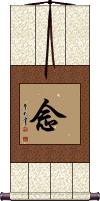
念 is the simplest way to write “mindfulness” in Chinese, Japanese Kanji, and old Korean Hanja.
念 can be defined these ways: To read; to study (a degree course); to read aloud; to miss somebody (keeping them in your mind); idea; remembrance; sense; thought; feeling; desire; concern; attention; recollection; memory; to think on/about; reflect; repeat, intone; a moment.
Obviously, the context in which the character is used determines which definition or meaning is perceived. As a single character, it's open and perhaps ambiguous. Thus, it can be read with any or all of these meanings.
念 is used in a Buddhist context (often written as 正念 or “right mindfulness”) with similar meanings of thought and contemplation.
In Japanese, this character is sometimes used as the name “Nen.”
See Also: Buddhism | Enlightenment
Longing for Lover
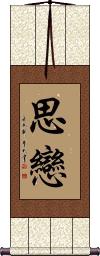
思戀 is a term used for when you miss a lover.
It suggests that you are separated (not by choice) and have longed for each other. It's a strong feeling of missing your lover.
Panda Bear
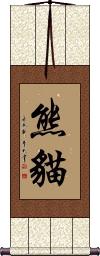
熊貓 is how to write “panda” in Chinese.
熊貓 is kind of a generic term that is applied to all pandas. When most people think of panda bears, they are really thinking of the “giant panda,” which has black and white fur.
The literal meaning of these characters is “bear cat.” Chinese do think of pandas as “cat-like bears.”
Ramona
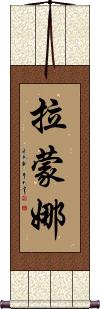
拉蒙娜 is the transliteration to Mandarin Chinese that I think sounds closest to the original pronunciation of the name Ramona.
Thibaud
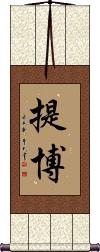
I think this transliteration to Mandarin Chinese for the name Thibaud sounds more correct than the most common form.
Holy Mother / Saint Mary
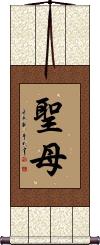
聖母 is the title for the Holy Mother, Madonna, or Virgin Mary used by Catholic Chinese, Korean, and Japanese people.
I think this would be a very cool wall scroll for a devout Catholic who also appreciates Asian artwork and language.
Note: Koreans often put a third character after these two, which creates a title that means “Hail Mary”; however, this character is not added or used in the same way in Japanese or Chinese. If you want that Korean title, just let me know, and we'll add that character for you. The two-character title shown to the left is universal, so I think it's the best choice.
Great Aspirations / Ambition
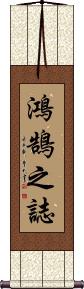
鴻鵠之誌 is a Chinese proverb that implies that having grand ambitions also means that others will not understand your great expectations and ideas.
Though the actual words come from a longer saying of Confucius, which goes, “The little swallows living under the eaves wouldn't understand the lofty ambitions of a swan (who flies far and wide).”
This Confucius quote has led to this idiomatic expression in China that means “think big.” What you'd be saying is “The lofty ambitions of a swan.”
Note that Chinese people sometimes refer to the little swallow as one who does not “think big” but is, instead, stuck in a rut or just leading a mundane life. Therefore, it's a compliment to be called a swan but not a good thing to be called a swallow.
Gratitude / Thanks
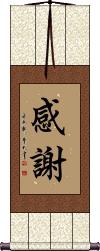
感謝 is gratitude; the feeling of being grateful or thankful.
You can think of this as being a formal way of expressing thankfulness in Chinese, Japanese Kanji, and old Korean Hanja.
Spencer
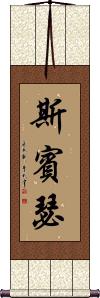
斯賓瑟 is an alternate transliteration to Mandarin Chinese for the name Spencer.
I think this one actually sounds more like Spencer but is not as common as our other version.
Life Is But A Dream
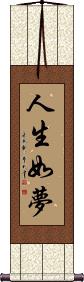
人生如夢 is an old Chinese proverb that suggests, “life is but a dream.”
This kind of follows the Buddhist idea that the world is a temporal place, where reality may not be as real as you think.
The Beatles
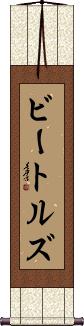
ビートルズ is the title of The Beatles in Japanese Katakana.
Sometimes written as ザ・ビートルズ with ザ (za) being a placeholder for the English word “The” - I think just the name Beatles is enough.
Note: Because this title is entirely Japanese Katakana, it should be written by a Japanese calligrapher.
Osu / Affirmative
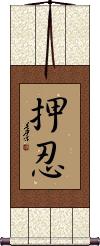
押忍 is a Japanese verbal interjection. In martial arts, it's used like “yes sir!” or “affirmative!.”
This can also be a greeting between close male friends. It can be romanized as “ossu” or “osu” (おっすor おす), though many English speakers think it's “oss.”
Live For The Day / Seize The Day
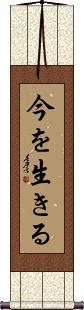
今を生きる is a Japanese phrase that can be translated as “live for the day,” “live for the moment,” “seize the day,” or “make the most of the present.”
You can think of this as the Japanese version of “Carpe Diem.”
Note: Because this selection contains some special Japanese Hiragana characters, it should be written by a Japanese calligrapher.
Homosexual Male / Gay Male
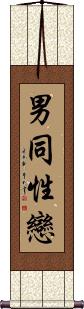
You need the male character in front of the word for homosexual in Chinese to create this word.
It's a much nicer way to say “Gay Male” than English words like Fag, Fairy, Sissy, Puff, Poof, Poofster, Swish, or Pansy. Although I suppose it could be used as a substitute for Nancy Boy, Queer, or Queen (for which, last time I checked, my gay friends said were OK in the right context).
For those of you who think China is a restrictive society - there are at least two gay discos in Beijing, the capital of China. It's at least somewhat socially acceptable to be a gay male in China. However, lesbians seem to be shunned a bit.
I think the Chinese government has realized that the 60% male population means not everybody is going to find a wife (every gay male couple that exists means two more women in the population are available for the straight guys), and the fact that it is biologically impossible for men to give birth, may be seen as helping to decrease the over-population in China.
Thankfulness
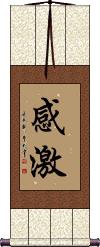
感激 is thankfulness or being grateful for what you have.
It is an attitude of gratitude for learning, loving, and being. Appreciate the little things that happen around you and within you every day. Think positively. Thankfulness brings contentment.
Different meaning in Japanese - more like "deep emotion," "impression," "inspiration" - not recommended for a Japanese audience.
I walk my own path
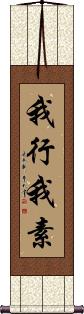
我行我素 is a way to say, “I walk my own path,” or “to continue in one's own way,” in Chinese.
This does not always have a completely positive connotation. It can mean ignoring advice or to persist in your path, no matter what others say or think.
Responsibility
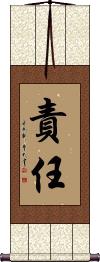
責任 is the Chinese, Japanese, and Korean word for “responsibility.”
責任 can also refer to someone who is willing to take the blame when things go wrong (instead of making excuses or passing the blame to someone else). While this is a noble idea, I think it is getting rare these days in both eastern and western cultures.
Also associated with the idea of "duty."
Failure is the Mother of Success
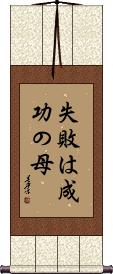
失敗は成功の母 is a Japanese proverb that means exactly what you think.
Every failure that you experience is a chance to learn from it and find success.
Knowing what does not work is just as important as finding out what does work.
Note: This is the Japanese version of an ancient Chinese proverb.
Note: Because this selection contains some special Japanese Hiragana characters, it should be written by a Japanese calligrapher.
See Also: Experience is the Mother of Wisdom
Choose Life
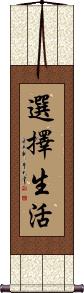
選擇生活 can mean to choose life instead of death (or suicide) or to choose to live life to the fullest.
I think of it as the key phrase used by Renton (Ewan McGregor) in the movie Trainspotting. While Chinese people will not think of Trainspotting when they see this phrase, for me, it will always be what comes near the end of this colorful rant:
Choose life. Choose a job. Choose a career. Choose a family. Choose a fucking big television. Choose washing machines, cars, compact disc players, and electrical tin can openers. Choose good health, low cholesterol, and dental insurance. Choose fixed-interest mortgage repayments. Choose a starter home. Choose your friends. Choose leisure wear and matching luggage. Choose a three-piece suite on-hire purchase in a range of fucking fabrics. Choose DIY and wondering who the fuck you are on a Sunday morning. Choose sitting on that couch watching mind-numbing, spirit-crushing game shows, stuffing fucking junk food into your mouth. Choose rotting away at the end of it all, pissing your last in a miserable home, nothing more than an embarrassment to the selfish, fucked-up brats you have spawned to replace yourself. Choose your future. Choose life.
Daniel
Alternate form
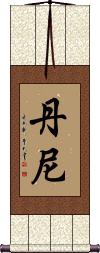
This is another common transliteration to Mandarin Chinese for the name Daniel.
This version drops off the third character, so it sounds a bit more like Danny than Daniel. I think our main version of Daniel is better but this is a popular transliteration according to our research on Chinese Google.
Garden / Orchard / Park
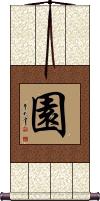
園 is a single character that means garden in Chinese, Japanese Kanji, and old Korean Hanja.
This can also mean an orchard or park.
園 is not a common single character for a wall scroll but nothing is wrong with it. A lot of customers asked for a single character for a garden, so I've provided what I think is the best option here.
You are only as old as you feel
You're only old if you think you're old
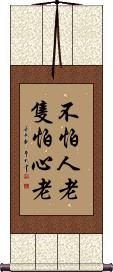
不怕人老只怕心老 literally translates as: Do not be concerned about being old; be concerned about a mind which is old.
Figuratively, this means: You are not as old as you look, you are only as old as you think you are.
Opportunity / Good Luck
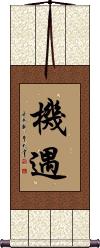
機遇 is the kind of opportunity that comes via good luck or good fortune.
This word is sometimes translated as “stroke of good luck.”
While there are other ways to express “opportunity,” I think this version is best for a calligraphy wall scroll or portrait.
Note: In Korean Hanja, this would also mean “Meeting someone under strange circumstances.”
See Also: Good Luck
Angel / Messenger of Heaven
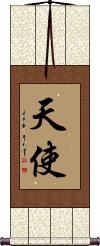
天使 is the meaning of Angel in Chinese, Japanese Kanji, and old Korean Hanja.
The first character means heaven. The second means messenger. Together it makes sense that we are talking about angels as Heaven's Messengers.
If you are an “Angel Junkie,” this may be the wall scroll for you.
I also think it's a great choice if your name happens to be Angel.
See Also: Angel
Loyalty to Duty or Master
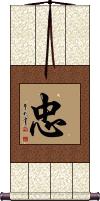
忠 is the simplest way to write the word loyalty in Chinese and Japanese.
A single character like this leaves the meaning open. But alone, a Chinese or Japanese person would think of loyalty to duty or loyalty to one's master (in ancient times). I suppose that it could be loyalty to your boss or company in this day in age.
忠 can also mean fidelity or faithfulness.
This can also be romanized as “chung.”
Giant Panda
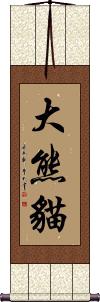
大熊貓 is how to write “giant panda” in Chinese.
大熊貓 is specific to the “giant panda,” which has black and white fur. Not to be confused with other types of smaller pandas in China.
The literal meaning of these characters is “great/big bear cat.” Chinese do think of pandas as “cat-like bears.”
Note: In Japanese, they only express Giant Panda in Katakana, which is ジャイアント パンダ” (Jaianto Panda). So we have not included that for wall scroll orders.
Life in Balance / Balancing Life
The art of balancing your life
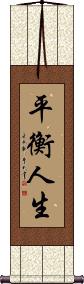
This 平衡人生 title suggests that you are actively trying to keep your life in balance.
Think of this as the action verb of seeking or having a balanced life.
The first two characters mean balance, equilibrium, or keeping things equal.
The last two characters mean “life.” Literally “human life.”
Easter
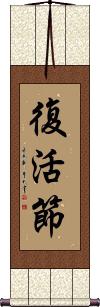
復活節 is the Chinese and old Korean way to write Easter.
Easter is not a well-known holiday in China, but Chinese Christians tend to follow the American tradition of the Easter egg ritual, etc. Non-Christians may think it's a celebration of rabbits that can lay eggs.
South Korea has a higher percentage of Christians than any other Asian country, so they celebrate Easter with plenty of enthusiasm.
Kaili
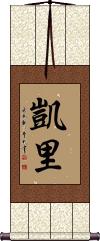
This is a common transliteration to Mandarin Chinese for the name Kaili.
It's also the name of Kaili city in Guizhou province.
I named my first daughter Kaili after visiting Kaili city and finding very friendly people there. I think this is a great English-Chinese baby name, as it is pronounceable in both languages, and the name works as a given name in both languages as well.
Daisy
The yellow flower
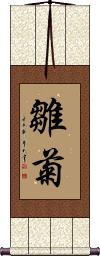
雛菊 is how they write “daisy” in Chinese and Japanese.
This is a good choice if you love daisies, or your name is Daisy. If you translated it directly, this means “chick flower” (as in baby chickens) or “baby chrysanthemum.” Of course, when an Asian person reads this, they just think “daisy.”
If you're into botany, this title represents “Bellis Perennis.”
In Japanese, this can be the female given name, Hinagiku.
Fujin
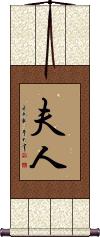
夫人 is a Japanese word that romanizes as Fujin.
I added this because several people have searched for Fujin. 夫人 can mean: lady; madam; Mrs.; consort of the emperor; wife; wife of a nobleman (aristocrat, etc.); the wife of a king. 夫人 means the same thing in Chinese, Japanese, and old Korean.
夫人 is an odd choice for a wall scroll, but I have fulfilled your search for Fujin, I think.
Desire
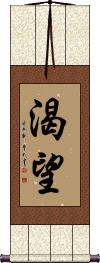
This Chinese word can mean desirous, wishful, or desire.
The first character means to thirst for [something] or to be thirsty. The second character means to hope for, to expect, to gaze (into the distance), or to look for something. The combined meaning of these two characters changes a bit, but I think it's nice to know the individual meanings to give you a better understanding of where a word comes from.
Korean definitions of this word include craving, longing, and thirst for knowledge.
In Wine there is Truth
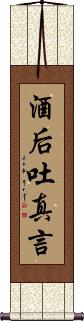
酒后吐真言 / 酒後吐真言 is a nice Asian proverb if you know a vintner or wine seller - or wine lover - although the actual meaning might not be exactly what you think or hope.
The literal meaning is that someone drinking wine is more likely to let the truth slip out. It can also be translated as “People speak their true feelings after drinking alcohol.”
It's long believed in many parts of Asia that one can not consciously hold up a facade of lies when getting drunk, and therefore the truth will come out with a few drinks.
I've had the experience where a Korean man would not trust me until I got drunk with him (I was trying to gain access to the black market in North Korea which is tough to do as an untrusted outsider) - so I think this idea is still well-practiced in many Asian countries.
 VS
VS 
Please note that there are two common ways to write the second character of this phrase. The way it's written will be left up to the mood of the calligrapher, unless you let us know that you have a certain preference.
Dog
Year of the Dog / Zodiac Sign
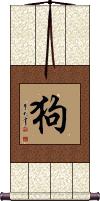
狗 is the character for dog, canine, or hound in Chinese.
If you were born in the year of the dog, you . . .
Are strong-willed
Loyal to your friends and mate.
Never compromise when you think you are right.
Note: Can be pronounced, and means dog in Japanese but feels like a very old word (see our other dog if you need a Japanese dog).
See also our Chinese Zodiac page.
Wing Chun Fist
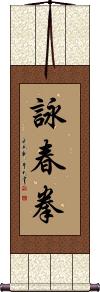
詠春拳 is the title for the “Wing Chun” school of martial arts but with the addition of the character for “fist” at the end. So this is “Wing Chun Fist” or literally “Singing Spring Fist.”
There are lots of alternate Cantonese romanizations for this, such as “Wing Chun Kuen,” “Wing Tsun Cheun,” “Eng Chun Pai,” and “Wing Ceon Kyun.” The characters are the same; just the lack of a standard Cantonese romanization means that people make up their own based on what they think it sounds like.
Sumo Wrestler
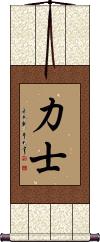
力士 literally means “strong man” but is more commonly used as a title for sumo wrestlers.
In Japanese, this is a Rikishi.
力士 is also used in Chinese and old Korean with the same meaning. Occasionally, this will also be used to refer to a strong or mighty man, hero, demigod, etc. But anyone in the CJK world will first think of a sumo wrestler before the more literary usage as a strong man or demigod.
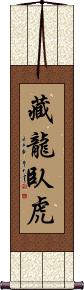
The meaning of 藏龍臥虎 is that both the tiger and dragon have amazing talents, but if they are out of view, you may not have discovered them.
This old Chinese idiom/proverb is appropriate for someone with an amazing ability that keeps that ability hidden.
You might think this title is in reverse, but actually, this is the original Chinese proverb.
The movie Crouching Tiger, Hidden Dragon, popularized this alternate version.
Kung Fu / Gong Fu
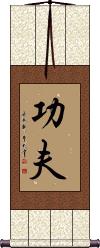
功夫 or Kung Fu is one of the most famous types of martial arts in the world - and not just because of Bruce Lee.
Some translate the meaning as “Accomplishment by Great Effort.” I think this is partially true, but directly translated, it literally means “Merit/Achievement/Accomplishment Man.” The word “fu” can sometimes mean “husband” or “porter,” but in this case, it can only mean “man.” However, few in China will think “man” when they hear the word “Gong Fu” spoken.
This term is also used for things other than martial arts. In fact, it's used to refer to a person with excellent skills in crafts that require a lot of effort to master, such as cooking, tea ceremonies, and calligraphy.
What a lot of people don't know is that the spelling of “Kung Fu” was actually taken from the old Wade Giles form of Romanization. Using this method, the sounds of the English “G” and “K” were both written as “K” and an apostrophe after the “K” told you it was supposed to sound like a “G.” Nobody in the west knew this rule, so most people pronounce it with a “K-sound.” And so, Gong Fu will always be Kung Fu for most westerners.
Also, just to educate you a little more, the “O” in “Gong” has a sound like the English word “oh.”
The popular Chinese dish “Kung Pao Chicken” suffers from the same problem. It should actually be “Gong Bao Chicken.”
Historical note: Many will claim that Kung Fu was invented by the monks of the Shaolin monastery. This fact is argued in both directions by scholars of Chinese history. Perhaps it is more accurate to say that the Shaolin Monks brought the original fame to Kung Fu many generations ago.
Japanese note: While most Japanese martial artists will recognize these characters, Katakana is more often used to approximate the pronunciation of "Kung Fu" with "カンフー." Some will argue as to whether this should be considered a Japanese word at all.
See Also: Bruce Lee
Songahm Taekwondo
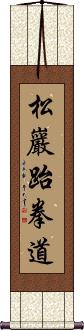
松巖跆拳道 is the title Songahm Taekwondo.
If you want this written in Korean Hangul instead of Hanja, click on the Hangul characters below the Korean flag above.
Note, Songahm is usually written in Hanja as 松巖. However, in Traditional Chinese, it would be 鬆巖, and in modern Japanese, it can be 松岩 (but not known in this context - I think it's a small train station and place in Japan).
Technically, all of these can also be Korean Hanja so that you might see these variations in use. If you need a version other than 松巖, just let me know when you order.
Tolerance
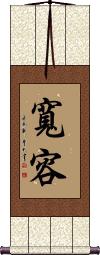
Being tolerant is accepting differences. You don't expect others to think, look, speak or act just like you. You are free of prejudice, knowing that all people have feelings, needs, hopes, and dreams. Tolerance is also accepting things you wish were different with patience and flexibility.
寬容 can also be translated as magnanimity, generosity, or leniency.
Note: There is a tiny deviation in the first character when written in Japanese. If you choose our Japanese master calligrapher, the little dot on the lower right of the first character will be omitted. With or without the dot, this can be read in Chinese, Japanese, and old Korean.
See Also: Patience
Inner Peace
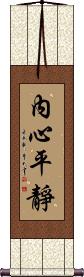
內心平靜 is a Chinese and Japanese phrase that is a direct translation of the western idea of inner peace.
The first two characters contain the idea of “heart,” “innermost being,” or “deep in the/your inner mind.”
The last two characters mean “tranquil” and “serene.”
I have seen this phrase used as “inner peace” for art prints and even on the side of coffee cups. But I think the translation is too literal. It feels like a direct translation from English rather than a nicely composed Chinese or Japanese phrase. See my other entries for “inner peace.”
See Also: Serenity | Simplicity | Peace
Best Friends / Buddies
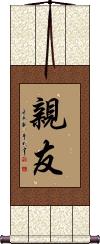
親友 is the Japanese way to say “best friend.”
The first character can mean “relative” or sometimes “parents.” The second character means “friend.” Think about the close relationship that Japanese people have with their parents and relatives, and this starts to mean “close friends.”
Some Japanese-English dictionaries also translate this as “bosom friend,” “old friend,” “intimate friend,” “buddy,” “crony” or “chum.”
Note that in Chinese, this means “relatives and friends.” It's a good meaning in Chinese, but it's not quite the same as “best friends.”
Heart of Judo
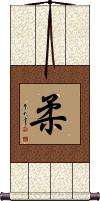
This 柔 Kanji literally means flexible, pliable, gentle, or yielding.
柔 is also the first Kanji of the Japanese martial arts titles of Judo and Jujutsu (Jujitsu). In those cases, it's pronounced “ju” in Japanese. However, alone, the classic pronunciation is “yawara.” Some translate this Kanji (in the context of martial arts) as “The Heart of Judo.”
Please note that this just means pliable, gentle, and yielding in Chinese and old Korean Hanja. They do know what Judo and Jujitsu are but if this character is seen alone in China or Korea, people generally will not think of the martial arts context.
Kirin / Giraffe / Mythical Creature
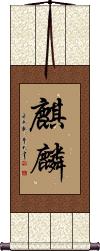
麒麟 is the title of a mythical beast of Asia.
The animal is thought to be related to the giraffe, and in some ways, it is a giraffe. However, it is often depicted with the horns of a dragon or deer and sometimes with the body like a horse, but many variations exist.
In Japanese, it is pronounced “Kirin” as in “Kirin Ichiban” beer.
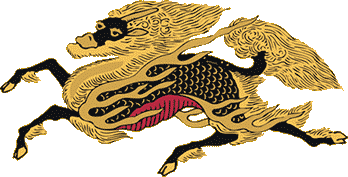
Notes:
1. This is sometimes spelled as “kylin.”
2. In Japanese, this is the only Kanji word for giraffe. Therefore in Japan, this word needs context to know whether you are talking about the mythical creature or the long-necked giraffe of Africa.
3. Apparently, this was the first word used for regular giraffes in China (some were brought from Africa to China during the Ming Dynasty - probably around the year 1400). Though the mythical creature may have existed before, the name “qilin” was given to the “new giraffe.” This is because, more than 600 years ago, giraffes somewhat matched the mythical creature's description when Chinese people saw them for the first time. Later, to avoid such an ambiguous title, a three-character word was devised to mean a “giraffe of Africa.” The characters for “qilin” shown here are only for the mythological version in modern Chinese.
4. More information about the qilin / kirin from Wikipedia.
5. This creature is sometimes translated as the “Chinese Unicorn,” although it is generally portrayed with two horns. I think this is done more for the fantasy aspect of the unicorn and because most westerners don't know what a qilin or kirin is (this avoids a long explanation by the translator).
6. In Korean, this can mean kirin or simply giraffe (usually, the mythological creature is what they would think of when seeing these characters alone on a wall scroll).
Joshua 24:15
This House Serves the LORD
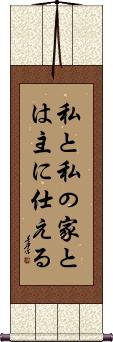
私と私の家とは、主に仕える is the last bit of Joshua 24:15 in Japanese.
Joshua 24:15 (KJV) ...as for me and my house, we will serve the LORD.
Joshua 24:15 (NIV) ...as for me and my household, we will serve the LORD.
This came from the Shinkaiyaku Japanese Bible. This is the most commonly-used Bible translation in Japan for both Protestants and Catholic Japanese folks.
I think it is a bit like having a secret code on your wall that quietly expresses to whom you are faithful.
This will be a nice gift for a friend or a wonderful expression of faith for your own home.
Note: Because this selection contains some special Japanese Hiragana characters, it should be written by a Japanese calligrapher.
Sincere Heart
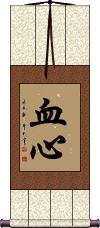
When you take 血心 apart, you find the sum is slightly different than the parts. The first character means blood, and the second means heart. It is important to note that for thousands of years, it was believed that your heart was both your soul and your mind in Asian culture. When you add blood to the heart, it is your whole being - the pure and clean dedication of your whole soul.
Most Chinese dictionaries define this as the sincerity of heart or a MEDICAL TERM!!!
Please think carefully before ordering this selection - it was only added as others have used this for coffee cups and other novelties (though perhaps naively).
Men Die for Wealth, Birds Die for Food
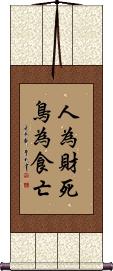
人為財死鳥為食亡 is a Chinese proverb that literally states that human beings will die for riches, just as birds will for food.
Figuratively it means that man will do anything in his means to become rich. Personally, I think dying for food is a more noble cause.
Often translated as “Men die in pursuit of wealth, birds die in pursuit of food. The 人 in this proverb just means human, so “men” is a placeholder for human with that translation - an English language problem that we have no easy gender-neutral nouns.
This proverb is meant to serve as a warning about the follies of greed.
Monkey Fist
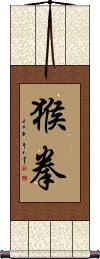
猴拳 literally means what you think, it's the “Monkey Fist” school of Kung Fu. A style that mimics the punches and movements of monkeys and apes.
Becoming popular during the Qing Dynasty, this style can trace its origins back to as early as the Song Dynasty. Some of the romance and popularity of this style comes from the novel “Journey to the West” which features the Monkey King and his fighting skills.
This novel and martial arts style has spawned a stream of Hong Kong movies featuring the Monkey King and other Kung Fu style variations such as “Drunken Monkey” and “Monkey Stealing Peaches” (a technique of disabling your opponent by grabbing and yanking on his testicles).
Note: This kind of makes sense in Korean Hanja and Japanese Kanji but probably unknown by all Koreans and Japanese except those who have an interest in this form of Kung Fu.
King
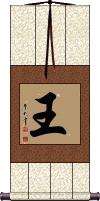
王 is wang which means king. It is not pronounced the way you think in Chinese. It is more like English speakers would want to pronounce wong. It has roughly the same vowel sound as tong, song, or long in English.
Note that this means king only, not the emperor. An emperor is higher than a king, and theoretically is chosen by God, according to ancient Chinese culture. However, the definition is often blurred at various points in Asian history.
王 can also be defined as ruler, sovereign, monarch, or magnate. It is also can refer to a game piece in the chess-like Japanese strategic game of shoji.
Note: This can also be a family name in Chinese, Korean and Vietnamese (in Vietnamese it's Vương).
See Also: Queen
Meet the Buddha, Kill the Buddha
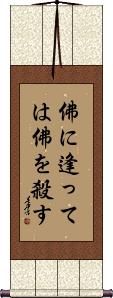
This controversial Buddhist koan means “On encountering Buddha, you should kill him.”
This is the short concise Japanese version of an original statement by ninth-century Chinese Buddhist monk Linji Yixuan, “If You Meet The Buddha On The Road, Kill Him.”
This takes some explaining... The concept here is that if you think you have seen, experienced, or achieved true enlightenment, the chances that you really have are so slim that you should kill or dismiss that idea.
Another suggestion is that one's path to becoming a Buddha is one's own, and one should not get caught up in religious fervor, and avoid “showing off” that they are a Buddhist.
Helpful references for this concept:
Lion's Roar addresses "If You Meet The Buddha On The Road, Kill Him"
Kill the Buddha
Note: Because this selection contains some special Japanese Hiragana characters, it should be written by a Japanese calligrapher.
Spirit / Spiritual Essence
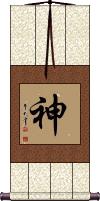
神 is the simplest way to write spirit in Chinese, Japanese Kanji, and old Korean.
This single character alone will conjure up ideas of the spiritual world. 神 can also be translated as “vital awareness” as in the fact that one must know they exist to exist (I think, therefore, I am).
Other translations include:
God, deity, mysterious, divine essence, lively, spiritual being, divinity, supernatural, soul, mind, nerves, and energy. In some extended context, it can mean genius or unusual.
Japanese romanizations vary a lot when this character is combined into other words. However, shin is the original pronunciation taken from Chinese into Japanese. You'll also see it romanized as kami, gami, jin, and a few others, depending on context.
Smooth Sailing
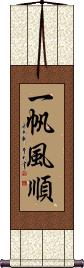
一帆風順 is just what you think it means. It suggests that you are on a trouble-free voyage through life, or literally on a sailing ship or sailboat. It is often used in China as a wish for good luck on a voyage or as you set out on a new quest or career in your life. Some may use this in place of “bon voyage.”
The literal meaning is “Once you raise your sail, you will get the wind you need, and it will take you where you want to go.” Another way to translate it is “Your sail and the wind follow your will.”
This is a great gift for a mariner, sailor, adventurer, or someone starting a new career.
Note: Can be understood in Korean Hanja but is rarely used.
See Also: Bon Voyage | Adventure | Travel
Wu Wei / Without Action
Daoist / Taoist Tenet
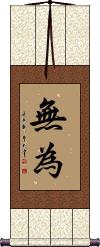
無為 or “Wu Wei” is a Daoist (Taoist) tenet that speaks to the idea of letting nature take its course.
Some will say it's about knowing when to take action and when not to. In reality, it's more about not going against the flow. What will happen is controlled by the Dao (Tao), for which one who follows the Dao will not resist or struggle against.
You can think of 無為 as the Chinese way to express “laissez-faire.”
There is a lot more to this concept, but if you are looking for this entry, you already know the expanded concept.
Warning: Outside of the Daoist context, this means idleness or inactivity (especially in Japanese, where not everyone knows this as a Daoist concept, though it does pair well with the Japanese concept of Wabi-Sabi).
Birth / Life
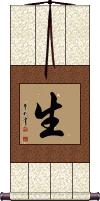
生 is a Chinese word that means “to be born” and “to give birth.”
Also, it's often used to refer to life itself, and sometimes “to grow.”
生 is used in a lot of compound words such as “yi sheng,” which means “doctor” (literally “healer of life”), “sheng ri” which means “birthday” (literally “birth-day”), and “xue sheng” which means student (literally “studying life” or “learner [about] life”). Few Chinese people will think of the literal meaning when this uses words like doctor and student - but it is interesting to note.
生 has the same root meaning in Korean Hanja and Japanese. However, in Japanese, there are many possible pronunciations, and this can be used to mean “raw” or “unprocessed” (as in draft beer). Therefore, not be the best if your audience is Japanese.
See Also: Vitality
Soul Mates
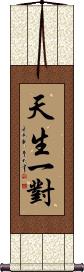
It was tough to find the best way to say “soul mates” in Chinese. We settled on 天生一對 as an old way to say, “A couple selected by heaven.”
The first two characters together mean “natural” or “innate.” Separated, they mean “heaven” and “born.” The last two characters mean “couple.” So this can be translated as “A couple that is together by nature,” or “A couple brought together by heaven's decree.” With a slight stretch, you could say, “A couple born together from heaven.”
It's a struggle to find the best way to describe this idea in English but trust me, it is pretty cool, and it is a great way to say “soulmates.”
If you're in a happy relationship or marriage and think you have found your soul mate, this would be a wonderful wall scroll to hang in your home.
Walking 100 Miles: Stopping at 90 miles, is the same as stopping half-way
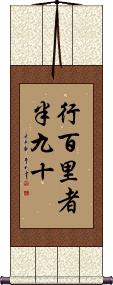
行百里者半九十 is an old Chinese proverb that speaks to the act of giving up. This phrase suggests that no matter how close you are to finishing your task or journey, giving up just before you finish is just as bad as giving up halfway.
50% finished or 90% finished, the result is the same: “You are not finished.”
You can take what you want from this proverb, but I think it suggests that you should finish what you start, and especially finish that last 10% of your journey or project so that you can honestly say “it's finished.”
Some notes: The character, 里, that I am translating as “mile” is an ancient “Chinese mile” which is actually about half a kilometer - it just doesn't sound right to say “When walking 100 half-kilometers...”
Furinkazan
military strategy
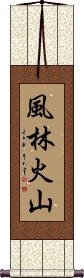
風林火山 is the battle strategy and proverb of Japanese feudal lord Takeda Shingen (1521-1573 AD).
This came from the Art of War by Chinese strategist and tactician Sun Tzu (Sunzi).
You can think of this as an abbreviation to remind officers and troops how to conduct battle.
風林火山 is a word list: Wind, Forest, Fire, Mountain.
The more expanded meaning is supposed to be...
“Swift as the wind, quiet as the forest, fierce as fire, and immovable as a mountain”
“As fast as the wind, as quiet as the forest, as daring as fire, and immovable as the mountain”
“Move as swift as the wind, stay as silent as a forest, attack as fierce as fire, undefeatable defense like a mountain”
“Move swiftly like the wind, stay silent like the forest, attack fiercely like fire, take a tactical position on the mountain”
See Also: Art of War
Inspiration
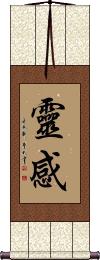
靈感 is the Chinese word closest to hitting the mark for the English word inspiration.
In a more extended context, I have even seen this translated as “brain wave.”
The first character means alert, departed soul, efficacious, quick, effective, or intelligent.
The second character means to feel, to move, to touch, or to affect.
The combined meaning of these two characters changes a bit, but I think it's nice to know the individual meanings to give you a better understanding of where a word comes from.
You could describe this word as “the thought that pops into your head just before you patent the greatest widget ever invented that everyone in the world will want.”
At least, that's the idea.
This term can also mean “intelligent thought” if you translate it directly from each character. If you are looking for inspiration or need to be inspired, this is the word for you.
 When the first character was absorbed into Japanese from Chinese, an alternate form became the standard in Japan. The Kanji shown to the right is the form currently used in Japan. This is still considered an alternate form in China to this day.
it’s
readable by both Chinese and Japanese people but if your audience is Japanese, I recommend the Kanji shown to the right - just click on that Kanji to order that version.
When the first character was absorbed into Japanese from Chinese, an alternate form became the standard in Japan. The Kanji shown to the right is the form currently used in Japan. This is still considered an alternate form in China to this day.
it’s
readable by both Chinese and Japanese people but if your audience is Japanese, I recommend the Kanji shown to the right - just click on that Kanji to order that version.
Teacher / Master / Old Sage
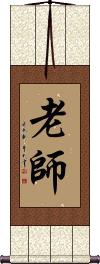
老師 directly translates as “old teacher,” “old master,” or “old sage.”
Together, they are understood as “teacher.” When you think about that, also realize that with age comes respect in Asian cultures. So calling someone old is a term of respect (not like the way we mean it in English). You could replace “old” with “respected” and be closer to how this is meant in Chinese.
Teachers, in general, are more respected by their students and the population in China. When I was a teacher in China, I certainly felt that.
This term is also used for masters of certain fields. For instance, a master calligrapher would respectfully be addressed as a “teacher.” In this case, “master” and “teacher” are synonymous.
Other artists (especially those who are famous or accomplished) should be addressed with this term. Also, some martial arts schools use this term of respect for their masters/teachers/instructors.
This title is recognized in Japanese as "roushi" with the same meaning but it’s rarely used in Japan.
Bloodless Victory
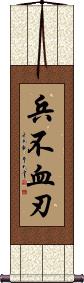
Perhaps a pacifist view or perhaps the best kind of victory; 兵不血刃 reflect this idea:
The edges of the swords not being stained with blood.
You could also translate it as: Win victory without firing a shot.
The first character means army or force. The second character means without or none. The last two characters mean bloodstained knives. So it represents a returning victorious army without bloodstained knives. 兵不血刃 is the very literal sense of this Chinese proverb. The title definition is more accurate to the way this proverb is understood.
Asking yourself why the direct or literal translation is different?
...Think of compound words in English such as “nevertheless” if we break it apart to “never the less,” we will have trouble getting the real definition of “in spite of that.” Similar things happen when multiple characters create a compounded word in Chinese.
Geisha
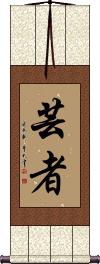
芸者 is the real basis for the way we spell geisha.
However, there are many more ways to refer to a woman that fills the role that westerners think of when they hear the word geisha.
In Japanese, these characters literally mean “artful person.” But in English, it might be better translated as “a person (woman) highly trained/accomplished in the arts.”
However, my Japanese dictionary says “a singing and dancing girl.”
Many will argue as to whether “geisha” = “prostitute” or not. My Japanese friends seem to have the opinion that a geisha is so highly trained in the art of playing musical instruments and dancing that the fact she might also be a prostitute is secondary to her performance on stage.
芸者 is a “Japanese only” term, they use a slightly different first character to express “geisha” in Chinese. Since this is a Japanese term, I have not included the Chinese version.
Energy Sword Body in Concert
Spirit, Sword & Body as One
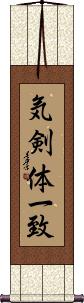
气剑体一致 often gets translated as “Mind Sword Body,” or “Spirit, Sword, and Body as One.” But I think these translations don't tell you enough about what this is really saying.
In this context, 気, which is the modern Japanese version of 氣, means spiritual and unseen energy or “life energy.” In some cases, 気 can be translated as spirit, feeling, or nature. If defined as the mind, it's more about the invisible or intangible parts of one's mind (or soul).
剣 is the Japanese version of 劍 meaning sword.
体 is the modern Japanese version of 體 meaning body.
The Kanji 一 means one, and in this case, suggests “all in one.”
The Kanji 到 means to send, deliver, or convey. But together, 一到 suggests all these things in agreement, union cooperation, or in concert.
Note: Arguments exist as to whether this should be romanized as Kikentaiitchi, Kikentaiicchi, or kikentaiichi. Technically, if you drop the last character, you get 気剣体一 and kikentaiichi (ki ken tai ichi), which is also a valid phrase.
Ronin / Masterless Samurai
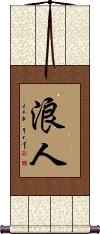
The 浪人 or Ronin have no master - The most famous are the 47 ronin created after their Lord committed suicide. This term was not a positive title for the Samurai of ancient Japan. However, in recent years, movies and video games have glorified the term Ronin.
In Chinese, this term has the original meaning of a hobo, vagabond, or ruffian.
In Korean Hanja, these characters would be read as adventurer, wanderer, someone without a steady job, or someone who is wasting away time.
In modern Japan, this term is used as a nickname for a high school student who has failed a college entry exam (and is trying again).
In Chinese and Korean, the Japanese definition of “Masterless Samurai” is known because of the historical context. Even in Japanese, the literal translation is closer to the Chinese and Korean definitions shown above.
This will make a fine wall scroll if you are a fan of the Ronin or see yourself as a Ronin of sorts. However, please think twice before getting a Ronin tattoo!
Shogun / Japanese General
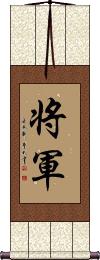
将軍 or Shogun, in the simplest definition, is a General, but you could also use words such as commander, lord, overlord, highest ranking, or commanding officer.
The title “Shogun” has held some slightly ambiguous meanings at times in Japanese history.
In the west, when someone mentions “Shogun,” we may be filled with thoughts of gallant warriors. Some might even think of the TV mini-series with Richard Chamberlain. Often westerners use the words, Samurai and Shogun interchangeably, but that's really not technically correct. In the case of the Samurai, the Shogun was a designated (by the emperor) leader of a gild of Samurai. In this context, the Shogun was a Samurai lord. Or effectively, a commanding officer of a company of Samurai - to put it in modern military terms.
Sometimes a Shogun was a general; other times, he was the leader of a military government in Japan - but not a front-line warrior like a Samurai.
Variants of the same characters are used in China for the rank and title of a General of the People's Liberation Army (and the same term and characters have been used for the last 2200 years since the Qin Dynasty).
Master / Skilled Worker
Secondary version of Sifu
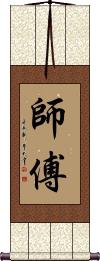
師傅 is “sifu” as in the “master” in the context of martial arts.
But two sifu titles are floating around. This one can simply mean “skilled worker.”
Historically, this term has been used for many things, such as “The tutor of a king or emperor.” But now it's more commonly used to mean master worker or qualified worker.
Currently, within the field of skilled labor, a master (Shifu) is higher than a journeyman and is considered to be one worthy of teaching others.
Note: In the 1970s and 1980s, this term was used as a common form of polite address between people. You might say, “master, do you know where Tian'anmen Square is?” to a person on the street at that time. This usage has almost passed; however, for some reason, people still often refer to taxi cab drivers as “master” in China (though I think/hope this is fading).
In Mandarin Chinese, this is pronounced like “Sure Foo,” and in Cantonese, like “See Foo.”
The second character is the difference between this sifu and the other. In this case, the second character by itself means tutor, instructor, or teacher.
Enso - Japanese Zen Circle
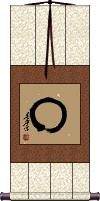
〇 is the famous Enso symbol, which you will see widely used by Japanese Zen Buddhists.
In a twist, I am starting to see Enso used more and more by Chinese Buddhists.
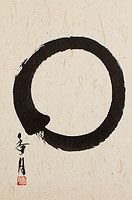
Here is the typical appearance of Enso artwork by Japanese calligrapher Kougetsu.
Enso is not a Japanese Kanji character. It falls more into the category of a symbol. There is some debate, but many consider Enso to be a religious symbol.
Some call this “The Circle of Enlightenment.” Others call it the “Infinity Circle.” If you actually took the meanings of the two Kanji (円相) that make up the word “En-so,” you could read it as “Mutual Circle” or “Circle of Togetherness.” I think the Enso symbol can simply mean different things to different people. Therefore, you should let it have the meaning that you perceive.
The appearance of your Enso will be determined by the artist's personal style, feeling, mood, etc.
Confucius: Golden Rule / Ethic of Reciprocity
Do not do to others what you do not want done to yourself
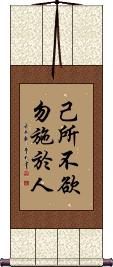
Some may think of this as a “Christian trait,” but actually, it transcends many religions.
This Chinese teaching dates back to about 2,500 years ago in China. Confucius had always taught the belief in being benevolent (ren), but this idea was hard to grasp for some of his students, as benevolence could be kind-heartedness or an essence of humanity itself.
When answering Zhong Gong's question as to what "ren" actually meant, Confucius said:
己所不欲勿施于人 or "When you go out, you should behave as if you were in the presence of a distinguished guest; when people do favors for you, act as if a great sacrifice was made for you. Whatever you wouldn't like done to you, do not do that thing to others. Don't complain at work or home.”
Hearing this, Zhong Gong said humbly, “Although I am not clever, I will do what you say.”
From this encounter, the Chinese version of the “Golden Rule” or “Ethic of Reciprocity” came to be.
The characters you see above express, “Do not do to others whatever you do not want to be done to yourself.”
See Also: Confucius Teachings | Benevolence
An Open Book Benefits Your Mind
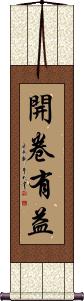
There are several ways to translate this ancient proverb. Translated literally and directly, it says, “Open roll has/yields benefit.”
To understand that, you must know a few things...
First, Chinese characters and language have deeper meanings that often are not spoken but are understood - especially with ancient texts like this. Example: It's understood that the “benefit” referred to in this proverb is to the reader's mind. Just the last character expresses that whole idea.
Second, Chinese proverbs are supposed to make you think and leave a bit of mystery to figure out.
Third, for this proverb, it should be noted that roll = book. When this proverb came about (about two thousand years ago), books were rolls of bamboo slips strung together. The first bound books like the ones we use today did not come about until about a thousand years after this proverb when they invented paper in China.
開卷有益 is a great gift for a bookworm who loves to read and increase their knowledge. Or for any friend that is or wants to be well-read.
Some other translations of this phrase:
Opening a book is profitable
The benefits of education.
Joshua 24:15
This House Serves the LORD
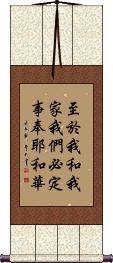
至於我和我家我們必定事奉耶和華 is the last sentence of Joshua 24:15 in Chinese.
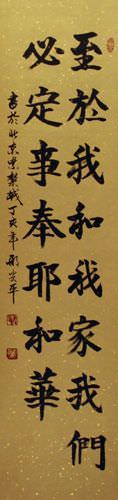
What your
calligraphy
might look like
from our
Chinese Master
Calligrapher
Joshua 24:15 (KJV) ...as for me and my house, we will serve the LORD.
Joshua 24:15 (NIV) ...as for me and my household, we will serve the LORD.
We used the only official Christian Chinese Bible that I know of so that the translation would be as accurate and standard as possible. Any Chinese Christian worth their salt will easily be able to identify this verse from the Chinese words on this scroll.
I think it is a bit like having a secret code on your wall that quietly expresses to whom you are faithful.
A great gift for your devout Christian or Jewish friend if they happen to be fond of Asian art.
Or perhaps a wonderful “conversation starter” for your own home.
Note: If you are curious, the last three characters represent the way “LORD” is used in most English Bibles. In Chinese, this is actually the phonetic name from Mandarin Chinese for “Jehovah.”
Daoism / Taoism
Literally: The Way or Road
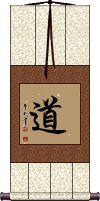
道 is the character “dao” which is sometimes written as “tao” but pronounced like “dow” in Mandarin.
道 is the base of what is known as “Taoism.” If you translate this literally, it can mean “the way” or “the path.”
Dao is believed to be that which flows through all things and keeps them in balance. It incorporates the ideas of yin and yang (e.g. there would be no love without hate, no light without dark, no male without female.)
The beginning of Taoism can be traced to a mystical man named
Lao Zi (604-531 BC), who followed, and added to the teachings of Confucius.
More about Taoism / Daoism here.
Note that this is pronounced “dou” and sometimes “michi” when written alone in Japanese but pronounced “do” in word compounds such as Karate-do and Bushido. It's also “do” in Korean.
Alternate translations and meanings: road, way, path; truth, principle province.
Important Japanese note: In Japanese, this will generally be read with the road, way, or path meaning. Taoism is not as popular or well-known in Japan so Daoist/Taoist philosophy is not the first thing a Japanese person will think of when they read this character.
See our Taoism Page
Gung Ho
Working Together
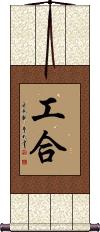
工合 is one of those Asian words that is used more in English than in the original Chinese.
Gung Ho was originally used to speak of Carlson's Raiders, a group of “Gung Ho” U.S. Marines who went on an island-hopping campaign of death during WWII.
A movie called Gung Ho came out in the mid-1940s and was later re-released in the 1950s depicting the 2nd Marine Raider Battalion, and brought this word to the mainstream.
It is still sometimes used today within the U.S. Marine Corps brotherhood to refer to a unit or group that works well together or is otherwise efficient and motivated (has good morals).
In 1986, there was a movie called Gung Ho about a Japanese company taking over an American automotive factory. They completely ignored the fact that this was a Chinese title.
It should be noted that this title actually means a condition, state, manner, or the health of something in Japanese.
Language and pronunciation notes:
Like many Asian words absorbed into common use in English, this one is drastically mispronounced. The official Romanization is “gong he” but that doesn't tell you enough. The vowel sound on the first character is like the English word “own,” now just add the g-sounds to the beginning and end. The second character is misleading, as you might think it is like the English word “he.” In reality, the vowel sound is more like the “u” in “up.”
It should also be noted that the current generation in China no longer uses or recognizes this as a common word or slogan.
Note: This can be pronounced and is a word in Japanese, though seldom used. Japanese will use a variation of "具合" instead. But still, not common.
Taekwondo
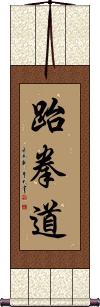
跆拳道 is one of the most widespread types of martial arts in the world as well as being an Olympic sport. Taekwondo was born in Korea with influences of Chinese and Japanese styles combined with traditional Korean combat skills. Some will define it as the “Korean art of empty-handed self-defense.”
In the simplest translation, the first character means “kick,” the second character can mean either “fist” or “punching,” and the third means “way” or “method.” Altogether, you could say this is the “Kick Punch Method.” When heard or read in various Asian languages, all will automatically think of this famous Korean martial art. It is written the same in Japanese Kanji, Chinese, and Korean Hanja characters - so the appearance of the characters is universal. However, you should note that there is another way to write this in modern Korean Hangul characters, which looks like the image to the right. 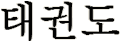
We suggest the original Korean Hanja (Chinese characters) for a wall scroll, but if you need the Hangul version, you must use master calligrapher Cao Bin: Order Taekwondo in Korean Hangul
Note: Taekwondo is sometimes Romanized as Tae-Kwondo, Tae Kwon Do, Taekwon-do, Taegwondo, Tae Gweon Do, Tai Kwon Do, Taikwondo, Taekwando, Tae Kwan Do and in Chinese Taiquandao, Tai Quan Dao, Taichuando, or Tai Chuan Tao.
Turtle
...also means tortoise
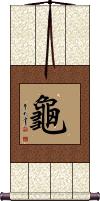
龜 is the generic term for turtle in Chinese and old Korean Hanja. It's like saying “turtle” (or “tortoise”) without being specific about the species of turtle.
Please note that there are many special characters in Chinese and a few in Japanese that denote specific species of turtle and do not include this character. We can't possibly cover all of these species, but if you want a certain one, such as “loggerhead” or a “leatherback,” just contact me, and I'll do my best to research your special species.
If you noticed, I said species names that do not include this character. This is because, in much the same way we can do it in English by just saying, “loggerhead” instead of “loggerhead turtle,” the same can be done in Chinese and Japanese.
 This may be hard to believe, but the image shown to the right is an alternate version of this character, which is currently used in Japan. This was originally an alternate form in ancient China for turtle - but it's so obscure now that most Chinese people would just think this is the Japanese version of turtle (I did a lot of research on this). The version shown in the upper left is traditional Chinese (also used in Korea 100+ years ago). It will generally not be recognized by the new generation of Japanese people. If your audience is Japanese, please click on the Kanji image shown to the right to have the calligrapher write that version (instead of clicking the button above).
Note: In Japanese, this Kanji is also a representation of long life. This is related to the fact that a tortoise can live for hundreds of years.
Wing Chun Fist Maxims
Wing Chun Kuen Kuit
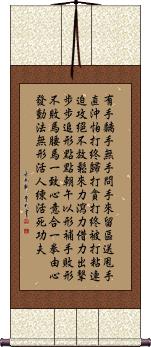
This text is the chant or poem of Wing Chun.
I call it a “chant” because it was meant to be a somewhat rhythmic poem to help practitioners memorize many aspects of Wing Chun.
1 有手黐手,無手問手
2 來留區送, 甩手直沖
3 怕打終歸打, 貪打終被打
4 粘連迫攻, 絕不放鬆
5 來力瀉力, 借力出擊
6 步步追形, 點點朝午
7 以形補手, 敗形不敗馬
8 腰馬一致, 心意合一
9 拳由心發, 動法無形
10 活人練活死功夫
You will see this referred to as “Wing Chun Kuem Kuit.” This Cantonese romanization is popular in the west (and there is no official way to romanize Cantonese, so many variations exist). In Mandarin, it would be, “Yong Chun Quan Jue.” The last character (kuit or kyut from Cantonese, jue or chüeh from Mandarin) kind of means “secrets of the art.” It's a short way to write 口訣, meaning “mnemonic chant” or “rhyme for remembering.”
In the west (especially in the military), we often use acronyms to remember things. There are no initials to make acronyms in Chinese, so in ancient times, chants like this are used to remember vast amounts of information.
I will presume you already know the meaning of the 10 maxims, so I will skip that to keep this calligraphy entry from getting too large.
Some think 练拳者必记 is the title but that just says, “(When) training (the) fist, people should remember:.” Therefore, I've not included that in the calligraphy. However, you can put a note in the special instructions if you want it added.
Note: On a traditional calligraphy wall scroll, the characters will be written in vertical columns, starting from the right, and proceeding left.
Note: This is an except and variation from a huge 口訣. These 10 maxims are used extensively in Wing Chun training, and you’ll find them all over the internet. Just know there is a much longer version out there, along with several variations and excepts like this one. If you know of, or want a different version, just contact me, and I will add it for you.
Dana: Almsgiving and Generosity
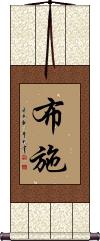
布施 is the Buddhist practice of giving known as Dāna or दान from Pali and Sanskrit.
Depending on the context, this can be alms-giving, acts of charity, or offerings (usually money) to a priest for reading sutras or teachings.
Some will put Dāna in these two categories:
1. The pure or unsullied charity, which looks for no reward here but only in the hereafter.
2. The sullied almsgiving whose object is personal benefit.
The first kind is, of course, the kind that a liberated or enlightened person will pursue.
Others will put Dāna in these categories:
1. Worldly or material gifts.
2. Unworldly or spiritual gifts.
You can also separate Dāna into these three kinds:
1. 財布施 Goods such as money, food, or material items.
2. 法布施 Dharma, as an act to teach or bestow the Buddhist doctrine onto others.
3. 無畏布施 Courage, as an act of facing fear to save someone or when standing up for someone or standing up for righteousness.
The philosophies and categorization of Dāna will vary among various monks, temples, and sects of Buddhism.
Breaking down the characters separately:
布 (sometimes written 佈) means to spread out or announce, but also means cloth. In ancient times, cloth or robs were given to the Buddhist monks annually as a gift of alms - I need to do more research, but I believe there is a relationship here.
施 means to grant, to give, to bestow, to act, to carry out, and by itself can mean Dāna as a single character.
Dāna can also be expressed as 檀那 (pronounced “tán nà” in Mandarin and dan-na or だんな in Japanese). 檀那 is a transliteration of Dāna. However, it has colloquially come to mean some unsavory or unrelated things in Japanese. So, I think 布施 is better for calligraphy on your wall to remind you to practice Dāna daily (or whenever possible).
Crisis equals Danger plus Opportunity?
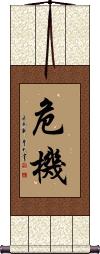
危機 means crisis in Chinese and Japanese.
Separately, the first character here does mean “danger” or “to endanger,” and the second character can mean “opportunity.”
However, I want to debunk a myth that was propagated by some westerners who did not have a clear understanding of Asian languages...
While often, Chinese/Japanese/Korean compound words (words of two or more characters) are the sum of their parts, this is not always the case. The compound is often understood with a completely different meaning than the two characters individually.
Many have said that the Chinese/Japanese/Korean word for Crisis is made up of the characters for “danger” and “opportunity.” 危機 is true when phrased this way.
However, it's not absolutely correct to say that “danger + opportunity = crisis” in Asian cultures.
English example:
If I tell you that...
Bovine creature + Guy behind the plate in baseball = Locomotive train protection

...you would think I was mad. But consider that “cow + catcher = cowcatcher,” which is the device that used to be found on steam engines to protect them if they hit an animal on the tracks. When we hear the word “cowcatcher,” we don't separate the words into their individual meanings (necessarily).
The same is true with the word for crisis in Chinese/Japanese/Korean. While you can separate the characters, few Asian people would automatically do so in their minds.
The final answer:
It is a half-truth to say, “danger plus opportunity equals crisis” in Chinese/Japanese/Korean. Use this statement and concept with caution.
Also, the second character can mean “secret” or “machine,” depending on context so I guess you have to say “a dangerous machine = crisis” or “danger + a secret = crisis.” Both of these are only slightly more ridiculous than the first premise.
PS: 危機 is probably not a great word for a scroll unless you have a special use for it.
Push or Knock
To weigh one's words
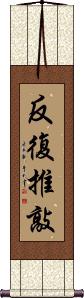
During the Tang Dynasty, a man named Jia Dao (born in the year 779), a well-studied scholar and poet, went to the capital to take the imperial examination.
One day as he rides a donkey through the city streets, a poem begins to form in his mind. A portion of the poem comes into his head like this:
“The bird sits on the tree branch near a pond,
A monk approaches and knocks at the gate...”
At the same time, he wondered if the word “push” would be better than “knock” in his poem.
As he rides down the street, he imagines the monk pushing or knocking. Soon he finds himself making motions of pushing and shaking a fist in a knocking motion as he debates which word to use. He is quite a sight as he makes his way down the street on his donkey with hands and fists flying about as the internal debate continues.
As he amuses people along the street, he becomes completely lost in his thoughts and does not see the mayor's procession coming in the opposite direction. Jia Bao is blocking the way for the procession to continue down the road, and the mayor's guards immediately decide to remove Jia Bao by force. Jia Bao, not realizing that he was in the way, apologizes, explains his poetic dilemma and awaits his punishment for blocking the mayor's way.
The mayor, Han Yu, a scholar and author of prose himself, finds himself intrigued by Jia Dao's poem and problem. Han Yu gets off his horse and addresses Jia Bao, stating, “I think knock is better.” The relieved Jia Bao raises his head and is invited by the mayor to join the procession, and are seen riding off together down the street, exchanging their ideas and love of poetry.
In modern Chinese, this 反復推敲 idiom is used when someone is trying to decide which word to use in their writing or when struggling to decide between two things when neither seems to have a downside.
The one who retreats 50 paces mocks the one to retreats 100
The pot calls the kettle black
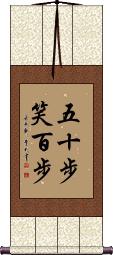
五十步笑百步 is a Chinese proverb that means the one who retreats 50 paces mocks the one who retreats 100 paces.
During the Warring States Period of what is now China (475 - 221 B.C.), the King of Wei was in love with war. He often fought with other kingdoms just for spite or fun.
One day, the King of Wei asked the philosopher Mencius, “I love my people, and all say I do the best for them. I move the people from famine-stricken areas to places of plenty and transport grains from rich areas to the poor. Nobody goes hungry in my kingdom, and I treat my people far better than other kings. But why does the population of my kingdom not increase, and why does the population of other kingdoms not decrease?”
Mencius answered, “Since you love war, I will make this example: When going to war, and the drums beat to start the attack, some soldiers flee for their lives in fear. Some run 100 paces in retreat, and others run 50 steps. Then the ones who retreated 50 paces laugh and taunt those who retreated 100 paces, calling them cowards mortally afraid of death. Do you think this is reasonable?
The King of Wei answered, “Of course not! Those who run 50 paces are just as timid as those who run 100 paces.”
Mencius then said, “You are a king who treats his subjects better than other kings treat their people, but you are so fond of war that your people suffer from great losses in battle. Therefore, your population does not grow. While other kings allow their people to starve to death, you send your people to die in war. Is there any difference?”
This famous conversation led to the six-character proverb shown here. It serves as a warning to avoid hypocrisy. It goes hand-in-hand with the western phrase, “The pot calls the kettle black,” or the Biblical phrase, “Before trying to remove a splinter from your neighbor's eye, first remove the plank from your own eye.”
Life Energy / Spiritual Energy
Chi Energy: Essence of Life / Energy Flow
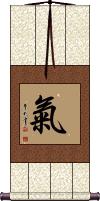
This 氣 energy flow is a fundamental concept of traditional Asian culture.
氣 is romanized as “Qi” or “Chi” in Chinese, “Gi” in Korean, and “Ki” in Japanese.
Chi is believed to be part of everything that exists, as in “life force” or “spiritual energy.” It is most often translated as “energy flow” or literally as “air” or “breath.” Some people will simply translate this as “spirit,” but you must consider the kind of spirit we're talking about. I think this is weighted more toward energy than spirit.
The character itself is a representation of steam (or breath) rising from rice. To clarify, the character for rice looks like this: 
Steam was apparently seen as visual evidence of the release of “life energy” when this concept was first developed. The Qi / Chi / Ki character is still used in compound words to mean steam or vapor.
The etymology of this character is a bit complicated. It's suggested that the first form of this character from bronze script (about 2500 years ago) looked like these samples: 

However, it was easy to confuse this with the character for the number three. So the rice radical was added by 221 B.C. (the exact time of this change is debated). This first version with the rice radical looks like this: 
The idea of Qi / Chi / Ki is really a philosophical concept. It's often used to refer to the “flow” of metaphysical energy that sustains living beings. Yet there is much debate that has continued for thousands of years as to whether Qi / Chi / Ki is pure energy or consists partially or fully of matter.
You can also see the character for Qi / Chi / Ki in common compound words such as Tai Chi / Tai Qi, Aikido, Reiki, and Qi Gong / Chi Kung.
In the modern Japanese Kanji, the rice radical has been changed into two strokes that form an X.
 The original and traditional Chinese form is still understood in Japanese, but we can also offer that modern Kanji form in our custom calligraphy. If you want this Japanese Kanji, please click on the character to the right instead of the “Select and Customize” button above.
More language notes: This is pronounced like “chee” in Mandarin Chinese, and like “key” in Japanese.
This is also the same way to write this in Korean Hanja where it is Romanized as “gi” and pronounced like “gee” but with a real G-sound, not a J-sound.
Though Vietnamese no longer use Chinese characters in their daily language, this character is still widely known in Vietnam.
See Also: Energy | Life Force | Vitality | Life | Birth | Soul
These search terms might be related to Think:
A Deliberate Inaction is Better Than a Blind Action
Believe
Believe / Faith / Trust
Believe in Yourself
Deem
Everything Happens for a Reason
Feel at Ease Anywhere / the World is My Home
God is My Judge
Imagine / Imagination
Judge
Kansei Engineering / Sense Engineering
Love Without Reason
Make Guests Feel at Home
Only God Can Judge Me
Ponder
Reflect
Sense of Humor
Sense of Shame / Sense of Honor / Integrity / Modesty (Korean)
Sixth Sense / Intuition
Sorry / Feel Apologetic / Regret
You Are Only as Old as You Feel
The following table may be helpful for those studying Chinese or Japanese...
| Title | Characters | Romaji (Romanized Japanese) | Various forms of Romanized Chinese | |
| Mindfulness | 念 | nen | niàn / nian4 / nian | nien |
| Longing for Lover | 思戀 思恋 | sī liàn / si1 lian4 / si lian / silian | ssu lien / ssulien | |
| Panda Bear | 熊貓 熊猫 | xióng māo xiong2 mao1 xiong mao xiongmao | hsiung mao hsiungmao |
|
| Ramona | 拉蒙娜 | lā méng nà la1 meng2 na4 la meng na lamengna | ||
| Thibaud | 提博 | tí bó / ti2 bo2 / ti bo / tibo | t`i po / tipo / ti po | |
| Holy Mother Saint Mary | 聖母 圣母 | seibo | shèng mǔ / sheng4 mu3 / sheng mu / shengmu | |
| Great Aspirations Ambition | 鴻鵠之誌 鸿鹄之志 | hóng hú zhī zhì hong2 hu2 zhi1 zhi4 hong hu zhi zhi honghuzhizhi | hung hu chih chih hunghuchihchih |
|
| Gratitude Thanks | 感謝 | kan sha / kansha | gǎn xiè / gan3 xie4 / gan xie / ganxie | kan hsieh / kanhsieh |
| Spencer | 斯賓瑟 斯宾瑟 | sī bīn sè si1 bin1 se4 si bin se sibinse | ssu pin se ssupinse |
|
| Life Is But A Dream | 人生如夢 人生如梦 | rén shēng rú mèng ren2 sheng1 ru2 meng4 ren sheng ru meng renshengrumeng | jen sheng ju meng jenshengjumeng |
|
| The Beatles | ビートルズ | biitoruzu / bitoruzu | ||
| Osu Affirmative | 押忍 | ossu / osu / osu / osu | ||
| Live For The Day Seize The Day | 今を生きる | ima wo i ki ru imawoikiru | ||
| Homosexual Male Gay Male | 男同性戀 男同性恋 | nán tóng xìng liàn nan2 tong2 xing4 lian4 nan tong xing lian nantongxinglian | nan t`ung hsing lien nantunghsinglien nan tung hsing lien |
|
| Thankfulness | 感激 | kangeki | gǎn jī / gan3 ji1 / gan ji / ganji | kan chi / kanchi |
| I walk my own path | 我行我素 | wǒ xíng wǒ sù wo3 xing2 wo3 su4 wo xing wo su woxingwosu | wo hsing wo su wohsingwosu |
|
| Responsibility | 責任 责任 | sekinin | zé rèn / ze2 ren4 / ze ren / zeren | tse jen / tsejen |
| Failure is the Mother of Success | 失敗は成功の母 | shippai wa seikou no haha shippaiwaseikounohaha shipai wa seiko no haha | ||
| Choose Life | 選擇生活 选择生活 | xuǎn zé shēng huó xuan3 ze2 sheng1 huo2 xuan ze sheng huo xuanzeshenghuo | hsüan tse sheng huo hsüantseshenghuo |
|
| Daniel | 丹尼 | dān ní / dan1 ni1 / dan ni / danni | tan ni / tanni | |
| Garden Orchard Park | 園 园 | sono | yuán / yuan2 / yuan | yüan |
| You are only as old as you feel | 不怕人老隻怕心老 不怕人老只怕心老 | bú pà rén lǎo zhǐ pà xīn lǎo bu2 pa4 ren2 lao3 zhi3 pa4 xin1 lao3 bu pa ren lao zhi pa xin lao buparenlaozhipaxinlao | pu p`a jen lao chih p`a hsin lao pupajenlaochihpahsinlao pu pa jen lao chih pa hsin lao |
|
| Opportunity Good Luck | 機遇 机遇 | jī yù / ji1 yu4 / ji yu / jiyu | chi yü / chiyü | |
| Angel Messenger of Heaven | 天使 | ten shi / tenshi | tiān shǐ / tian1 shi3 / tian shi / tianshi | t`ien shih / tienshih / tien shih |
| Loyalty to Duty or Master | 忠 | chuu / chu | zhōng / zhong1 / zhong | chung |
| Giant Panda | 大熊貓 大熊猫 | dà xióng māo da4 xiong2 mao1 da xiong mao daxiongmao | ta hsiung mao tahsiungmao |
|
| Life in Balance Balancing Life | 平衡人生 | hei kou jin sei heikoujinsei hei ko jin sei | píng héng rén shēng ping2 heng2 ren2 sheng1 ping heng ren sheng pinghengrensheng | p`ing heng jen sheng pinghengjensheng ping heng jen sheng |
| Easter | 復活節 复活节 | fù huó jié fu4 huo2 jie2 fu huo jie fuhuojie | fu huo chieh fuhuochieh |
|
| Kaili | 凱里 凯里 | kǎi lǐ / kai3 li3 / kai li / kaili | k`ai li / kaili / kai li | |
| Daisy | 雛菊 雏菊 | hinagiku | chú jú / chu2 ju2 / chu ju / chuju | ch`u chü / chuchü / chu chü |
| Fujin | 夫人 | fu jin / fujin | fū ren / fu1 ren5 / fu ren / furen | fu jen / fujen |
| Desire | 渴望 | kě wàng / ke3 wang4 / ke wang / kewang | k`o wang / kowang / ko wang | |
| In Wine there is Truth | 酒后吐真言 / 酒後吐真言 酒后吐真言 | jiǔ hòu tǔ zhēn yán jiu3 hou4 tu3 zhen1 yan2 jiu hou tu zhen yan jiuhoutuzhenyan | chiu hou t`u chen yen chiuhoutuchenyen chiu hou tu chen yen |
|
| Dog | 狗 | inu / ku | gǒu / gou3 / gou | kou |
| Wing Chun Fist | 詠春拳 咏春拳 | yǒng chūn quán yong3 chun1 quan2 yong chun quan yongchunquan | yung ch`un ch`üan yungchunchüan yung chun chüan |
|
| Sumo Wrestler | 力士 | ri kishi / rikishi | lì shì / li4 shi4 / li shi / lishi | li shih / lishih |
| Hidden Dragon Crouching Tiger | 藏龍臥虎 藏龙卧虎 | cáng lóng wò hǔ cang2 long2 wo4 hu3 cang long wo hu canglongwohu | ts`ang lung wo hu tsanglungwohu tsang lung wo hu |
|
| Kung Fu Gong Fu | 功夫 | kan fu / ku fu kanfu / kufu | gōng fu / gong1 fu / gong fu / gongfu | kung fu / kungfu |
| Songahm Taekwondo | 松巖跆拳道 | sōng yán tái quán dào song1 yan2 tai2 quan2 dao4 song yan tai quan dao songyantaiquandao | sung yen t`ai ch`üan tao sungyentaichüantao sung yen tai chüan tao |
|
| Tolerance | 寬容 宽容 | kanyou / kanyo | kuān róng kuan1 rong2 kuan rong kuanrong | k`uan jung kuanjung kuan jung |
| Inner Peace | 內心平靜 内心平静 | naishin heizyou naishinheizyou naishin heizyo | nèi xīn píng jìng nei4 xin1 ping2 jing4 nei xin ping jing neixinpingjing | nei hsin p`ing ching neihsinpingching nei hsin ping ching |
| Best Friends Buddies | 親友 亲友 | shin yuu / shinyuu / shin yu | qīn yǒu / qin1 you3 / qin you / qinyou | ch`in yu / chinyu / chin yu |
| Heart of Judo | 柔 | yawara | róu / rou2 / rou | jou |
| Kirin Giraffe Mythical Creature | 麒麟 | kirin | qí lǐn / qi2 lin3 / qi lin / qilin | ch`i lin / chilin / chi lin |
| Joshua 24:15 | 私と私の家とは主に仕える | Watashi to watashinoie to wa omo ni tsukaeru | ||
| Sincere Heart | 血心 | xuě xīn / xue3 xin1 / xue xin / xuexin | hsüeh hsin / hsüehhsin | |
| Men Die for Wealth, Birds Die for Food | 人為財死鳥為食亡 人为财死鸟为食亡 | rén wèi cái sǐ niǎo wèi shí wáng ren2 wei4 cai2 si3 niao3 wei4 shi2 wang2 ren wei cai si niao wei shi wang | jen wei ts`ai ssu niao wei shih wang jen wei tsai ssu niao wei shih wang |
|
| Monkey Fist | 猴拳 | hóu quán / hou2 quan2 / hou quan / houquan | hou ch`üan / houchüan / hou chüan | |
| King | 王 | ou / o | wáng / wang2 / wang | |
| Meet the Buddha, Kill the Buddha | 佛に逢っては佛を殺す | butsu ni atte wa butsu o korosu | ||
| Spirit Spiritual Essence | 神 | shin / kami | shén / shen2 / shen | |
| Smooth Sailing | 一帆風順 一帆风顺 | yī fán fēng shùn yi1 fan2 feng1 shun4 yi fan feng shun yifanfengshun | i fan feng shun ifanfengshun |
|
| Wu Wei Without Action | 無為 无为 | mui | wú wéi / wu2 wei2 / wu wei / wuwei | |
| Birth Life | 生 | shou / iku / sho / iku | shēng / sheng1 / sheng | |
| Soul Mates | 天生一對 天生一对 | tiān shēng yí duì tian1 sheng1 yi2 dui4 tian sheng yi dui tianshengyidui | t`ien sheng i tui tienshengitui tien sheng i tui |
|
| Walking 100 Miles: Stopping at 90 miles, is the same as stopping half-way | 行百里者半九十 | xíng bǎi lǐ zhě bàn jiǔ shí xing2 bai3 li3 zhe3 ban4 jiu3 shi2 xing bai li zhe ban jiu shi xingbailizhebanjiushi | hsing pai li che pan chiu shih hsingpailichepanchiushih |
|
| Furinkazan | 風林火山 风林火山 | fuu rin ka zan fuurinkazan fu rin ka zan | fēng lín huǒ shān feng1 lin2 huo3 shan1 feng lin huo shan fenglinhuoshan | |
| Inspiration | 靈感 灵感 | reikan | líng gǎn / ling2 gan3 / ling gan / linggan | ling kan / lingkan |
| Teacher Master Old Sage | 老師 老师 | lǎo shī / lao3 shi1 / lao shi / laoshi | lao shih / laoshih | |
| Bloodless Victory | 兵不血刃 | bīng bù xuè rèn bing1 bu4 xue4 ren4 bing bu xue ren bingbuxueren | ping pu hsüeh jen pingpuhsüehjen |
|
| Geisha | 芸者 | geisha | yún zhě / yun2 zhe3 / yun zhe / yunzhe | yün che / yünche |
| Energy Sword Body in Concert | 気剣体一致 / 氣劍體一致 气剑体一致 | ki ken tai icchi kikentaiicchi ki ken tai ichi | ||
| Ronin Masterless Samurai | 浪人 | rou nin / rounin / ro nin | làng rén / lang4 ren2 / lang ren / langren | lang jen / langjen |
| Shogun Japanese General | 將軍 将军 | shougun / shogun | jiāng jūn jiang1 jun1 jiang jun jiangjun | chiang chün chiangchün |
| Master Skilled Worker | 師傅 师傅 | shī fu / shi1 fu / shi fu / shifu | shih fu / shihfu | |
| Enso - Japanese Zen Circle | 〇 | en sou / ensou / en so | ||
| Confucius: Golden Rule Ethic of Reciprocity | 己所不欲勿施於人 己所不欲勿施于人 | jǐ suǒ bú yù wù shī yú rén ji3 suo3 bu2 yu4, wu4 shi1 yu2 ren2 ji suo bu yu, wu shi yu ren jisuobuyu,wushiyuren | chi so pu yü, wu shih yü jen chisopuyü,wushihyüjen |
|
| An Open Book Benefits Your Mind | 開卷有益 开卷有益 | kāi juàn yǒu yì kai1 juan4 you3 yi4 kai juan you yi kaijuanyouyi | k`ai chüan yu i kaichüanyui kai chüan yu i |
|
| Joshua 24:15 | 至於我和我家我們必定事奉耶和華 至于我和我家我们必定事奉耶和华 | zhì yú wǒ hé wǒ jiā wǒ men bì dìng shì fèng yē hé huá zhi4 yu2 wo3 he2 wo3 jia1 wo3 men bi4 ding4 shi4 feng4 ye1 he2 hua2 zhi yu wo he wo jia wo men bi ding shi feng ye he hua | chih yü wo ho wo chia wo men pi ting shih feng yeh ho hua | |
| Daoism Taoism | 道 | michi / -do | dào / dao4 / dao | tao |
| Gung Ho | 工合 | guai | gōng hé / gong1 he2 / gong he / gonghe | kung ho / kungho |
| Taekwondo | 跆拳道 | te kon do / tekondo | tái quán dào tai2 quan2 dao4 tai quan dao taiquandao | t`ai ch`üan tao taichüantao tai chüan tao |
| Turtle | 龜 龟 / 亀 | kame | guī / gui1 / gui | kuei |
| Wing Chun Fist Maxims | 有手黐手無手問手來留區送甩手直沖怕打終歸打貪打終被打粘連迫攻絕不放鬆來力瀉力借力出擊步步追形點點朝午以形補手敗形不敗馬腰馬一致心意合一拳由心發動法無形活人練活死功夫 有手黐手无手问手来留区送甩手直冲怕打终归打贪打终被打粘连迫攻绝不放松来力泻力借力出击步步追形点点朝午以形补手败形不败马腰马一致心意合一拳由心发动法无形活人练活死功夫 | |||
| Dana: Almsgiving and Generosity | 布施 | fuse | bù shī / bu4 shi1 / bu shi / bushi | pu shih / pushih |
| Crisis equals Danger plus Opportunity? | 危機 危机 | kiki | wēi jī / wei1 ji1 / wei ji / weiji | wei chi / weichi |
| Push or Knock | 反復推敲 反复推敲 | fǎn fù tuī qiāo fan3 fu4 tui1 qiao1 fan fu tui qiao fanfutuiqiao | fan fu t`ui ch`iao fanfutuichiao fan fu tui chiao |
|
| The one who retreats 50 paces mocks the one to retreats 100 | 五十步笑百步 | wù shí bù xiào bǎi bù wu4 shi2 bu4 xiao4 bai3 bu4 wu shi bu xiao bai bu wushibuxiaobaibu | wu shih pu hsiao pai pu wushihpuhsiaopaipu |
|
| Life Energy Spiritual Energy | 氣 气 / 気 | ki | qì / qi4 / qi | ch`i / chi |
| In some entries above you will see that characters have different versions above and below a line. In these cases, the characters above the line are Traditional Chinese, while the ones below are Simplified Chinese. | ||||

Successful Chinese Character and Japanese Kanji calligraphy searches within the last few hours...



