Many custom options


And formats



Rope in Chinese / Japanese
Buy a Rope calligraphy wall scroll here!
Personalize your custom “Rope” project by clicking the button next to your favorite “Rope” title below.
The Red Thread of Fate
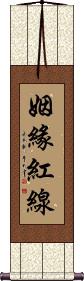
姻緣紅線 is the legendary red string of destiny that binds all soul mates or lovers together.
In ancient Chinese culture, a mythological matchmaker named 月老 (Yuè Lǎo) was the controller of the fate that led lovers to meet. He did this by tying a celestial red string to the ankle of each person. Sometime during their life, they will meet and marry as fate dictates.
While the origin of the red string comes from China, it has spread to other parts of Asia (such as Japan, where it's known as 赤い糸).
The Red String
Thread of Lover's Destiny / Fate
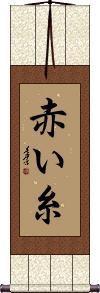
This literally translates as “the red string” or “the red thread” in Japanese, but the real meaning is much deeper...
In Japanese culture, it's believed that fate, destiny, or karma joins lovers by an unseen string, tied around one little finger of each. 赤い糸 is how soul mates find and are drawn to each other.
The Japanese concept of the red thread of fate, by most estimations, comes from Chinese folklore, where it's known as 姻緣紅線. The only difference is that in China, the celestial red thread is tied around the ankles of the lovers (versus what is usually represented as the pinky finger in Japan).
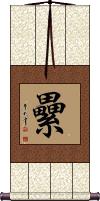
纍 is a word that means rope, to bind together, or to twist around.
It's also a Chinese surname Lei (one of several versions of Lei).
Relax
Chill Out
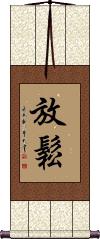
This means to relax in Chinese.
In most cases it's used to suggest that a person “relax,” “hang loose” or “chill out.”
In context where this word is not applied to a human, it can mean to loosen, as in to loosen a knot in a rope.
Daodejing / Tao Te Ching - Chapter 27
The Mastery of Effortless Skill

Chapter 27 of the Daodejing reveals a profound truth about mastery: the highest skill leaves no trace, requires no force, and appears almost invisible.
善行無轍跡,
善言無瑕謫,
善數不用籌策,
善閉無關鍵而不可開,
善結無繩約而不可解。
是以聖人常善救人,
故無棄人;
常善救物,
故無棄物。
是謂襲明。
故善人者,不善人之師;
不善人者,善人之資。
不貴其師,不愛其資,
雖智大迷,
是謂要妙。
The sage moves through life with such natural harmony that nothing seems imposed; doors need no locks, knots require no rope, and actions leave no mark behind.
This is the essence of wúwéi (effortless action), where true ability arises from deep alignment with the Tao rather than deliberate effort.
At its heart, this chapter teaches compassion without exception. The sage “abandons no one and nothing,” recognizing value in all people and all things. Even those who seem flawed or unrefined are not rejected, but understood as part of a greater whole with each person both a student and a teacher in the unfolding of life.
Laozi reminds us that wisdom is not about perfection or control, but about subtle awareness. The truly skilled individual does not rely on tools, rules, or rigid structures; instead, they embody an intuitive understanding that makes their actions naturally complete.
In this way, excellence becomes quiet, effortless, and beyond imitation.
This teaching also reflects a deeper philosophical insight: Opposites are interdependent. The “good” person learns from the “not good,” and the “not good” provides the material for growth. To reject either is to misunderstand the balance of existence itself.
As calligraphy, Daodejing Chapter 27 serves as a reminder to cultivate inner mastery rather than outward display. It is a meditation on refinement, humility, and the quiet power of skill perfected through harmony with the natural order.
Note: The Chinese text used here is based on the early Mawangdui silk manuscript tradition (2nd century BCE). The Guodian manuscripts do NOT preserve Chapter 27 in full form.
Undaunted After Repeated Setbacks
Persistence to overcome all challenges
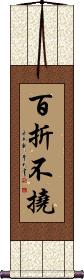
百折不撓 is a Chinese proverb that means “Be undaunted in the face of repeated setbacks.”
More directly translated, it reads, “[Overcome] a hundred setbacks, without flinching.” 百折不撓 is of Chinese origin but is commonly used in Japanese and somewhat in Korean (same characters, different pronunciation).
This proverb comes from a long, and occasionally tragic story of a man that lived sometime around 25-220 AD. His name was Qiao Xuan, and he never stooped to flattery but remained an upright person at all times. He fought to expose the corruption of higher-level government officials at great risk to himself.
Then when he was at a higher level in the Imperial Court, bandits were regularly capturing hostages and demanding ransoms. But when his own son was captured, he was so focused on his duty to the Emperor and the common good that he sent a platoon of soldiers to raid the bandits' hideout, and stop them once and for all even at the risk of his own son's life. While all of the bandits were arrested in the raid, they killed Qiao Xuan's son at first sight of the raiding soldiers.
Near the end of his career, a new Emperor came to power, and Qiao Xuan reported to him that one of his ministers was bullying the people and extorting money from them. The new Emperor refused to listen to Qiao Xuan and even promoted the corrupt Minister. Qiao Xuan was so disgusted that in protest, he resigned from his post as minister (something almost never done) and left for his home village.
His tombstone reads “Bai Zhe Bu Nao” which is now a proverb used in Chinese culture to describe a person of strong will who puts up stubborn resistance against great odds.
My Chinese-English dictionary defines these 4 characters as “keep on fighting despite all setbacks,” “be undaunted by repeated setbacks,” and “be indomitable.”
Our translator says it can mean “never give up” in modern Chinese.
Although the first two characters are translated correctly as “repeated setbacks,” the literal meaning is “100 setbacks” or “a rope that breaks 100 times.” The last two characters can mean “do not yield” or “do not give up.”
Most Chinese, Japanese, and Korean people will not take this absolutely literal meaning but will instead understand it as the title suggests above. If you want a single big word definition, it would be indefatigability, indomitableness, persistence, or unyielding.
See Also: Tenacious / Tenacity | Perseverance / Indomitable / Invincible Fortitude | With All the Strength of Your Heart | Perseverance | Persistence
Not the results for Rope that you were looking for?
Below are some entries from our dictionary that may match your Rope search:
| Characters If shown, 2nd row is Simp. Chinese |
Pronunciation Romanization |
Simple Dictionary Definition |
索 see styles |
suǒ suo3 so saku さく |
More info & calligraphy: Soe(counter) {mahj} counter for bamboo tiles; (given name) Saku Cord; to extort, express; the cord or noose of Guanyin by which she binds the good; the cord of the vajra-king by which he binds the evil; translit. sa. |
維 维 see styles |
wéi wei2 wei yuki ゆき |
More info & calligraphy: Vee(pronoun) (1) (kana only) this (indicating an item near the speaker, the action of the speaker, or the current topic); (2) (humble language) this person (usu. indicating someone in one's in-group); (3) now; (4) (archaism) here; (5) (archaism) I (me); (6) (archaism) certainly; (female given name) Yuki A carriage-curtain; a net; a corner, cardinal point; to tie or hold together, connect; a copula, also, but, whereas, now. |
纍 累 see styles |
léi lei2 lei |
More info & calligraphy: LeiSee: 累 |
ロップ see styles |
roppu ロップ |
More info & calligraphy: Loup |
ストランド see styles |
sutorando ストランド |
More info & calligraphy: Strand |
乼 see styles |
xx xx5 xx |
rope (Korean gugja) |
套 see styles |
tào tao4 t`ao tao |
to cover; to encase; cover; sheath; to overlap; to interleave; to model after; to copy; formula; harness; loop of rope; (fig.) to fish for; to obtain slyly; classifier for sets, collections; bend (of a river or mountain range, in place names); tau (Greek letter Ττ) |
憨 see styles |
hān han1 han |
silly; simple-minded; foolish; naive; sturdy; tough; heavy (of rope) |
攬 揽 see styles |
lǎn lan3 lan ran |
to monopolize; to seize; to take into one's arms; to embrace; to fasten (with a rope etc); to take on (responsibility etc); to canvass To seize, hold in the arms, embrace; monopolize. |
盤 盘 see styles |
pán pan2 p`an pan ban ばん |
tray; plate; dish; (finance) (bound form) market prices; (computing) (bound form) disk; to coil (a rope, pigtail etc); to check; to examine; to investigate; to transfer; to sell (property); to shift; to move (something big and heavy); classifier for things resembling a plate or dish; classifier for coils; classifier for games or matches (chess, table tennis etc) (1) board (in shogi, go, chess, etc.); (2) (phonograph) record; disc; disk; (suffix noun) (3) board; panel; plate; (personal name) Ban A dish, plate; round, to coil, wind up; to go about, travel, convey; to inquire about, interrogate. Translit. pa, ba, bha, va; cf. 般, 半, etc. |
笉 see styles |
qǐn qin3 ch`in chin |
smiling countenance; bamboo rope |
紲 绁 see styles |
xiè xie4 hsieh setsu せつ |
to tie; to bind; to hold on a leash; rope; cord (1) bonds (between people); (emotional) ties; relationship; connection; link; (2) tether; fetters; (given name) Setsu |
紼 绋 see styles |
fú fu2 fu |
heavy rope; rope of a bier |
綆 绠 see styles |
gěng geng3 keng |
(literary) well rope (for drawing water) |
綍 see styles |
fú fu2 fu |
heavy rope; ropes of a bier |
綱 纲 see styles |
gāng gang1 kang tsunashi つなし |
head rope of a fishing net; guiding principle; key link; class (taxonomy); outline; program (1) rope; cord; line; (2) {sumo} grand champion's braided belt; (given name) Tsunashi A net rope, bond, social nexus, constant obligation, the restraints of society. |
緡 缗 see styles |
mín min2 min sashi; bin さし; びん |
cord; fishing-line; string of coins (1) (See 緡縄・さしなわ) slender rope that goes through the hole in a coin; (n,ctr) (2) string of coins (usu. 100 mon) |
緪 see styles |
gēng geng1 keng |
a rope |
緱 缑 see styles |
gōu gou1 kou |
rope attached to a sword hilt; (archaic) hilt; sword |
縄 see styles |
shéng sheng2 sheng nawasaki なわさき |
Japanese variant of 繩|绳 (1) rope; cord; (2) (See 御縄) policeman's rope; (surname) Nawasaki |
縋 缒 see styles |
zhuì zhui4 chui |
to let down with a rope |
縲 缧 see styles |
léi lei2 lei |
(literary) thick rope used to restrain a prisoner |
縴 纤 see styles |
qiàn qian4 ch`ien chien |
boatman's tow-rope |
繘 see styles |
yù yu4 yü |
a well-rope |
繨 see styles |
dá da2 ta |
a knot (of a rope) |
繩 绳 see styles |
shéng sheng2 sheng nawa なわ |
rope; CL:根[gen1] (surname) Nawa String, cord. |
舫 see styles |
fǎng fang3 fang moyai もやい |
2 boats lashed together; large boat (irregular okurigana usage) painter; mooring rope |
お縄 see styles |
onawa おなわ |
policeman's rope |
三性 see styles |
sān xìng san1 xing4 san hsing sanshō |
The three types of character 善, 惡, 無記 good, bad and undefinable, or neutral; v. 唯識論 5. Also, 徧依圓三性 the three aspects of the nature of a thing— partial, as when a rope is mistaken for a snake; only partly reliable, i.e. incomplete inference, as when it is considered as mere hemp; all around, or perfect, when content, form, etc., are all considered. |
井綱 see styles |
izuchi いづち |
well rope; (surname) Izuchi |
Click here for more Rope results from our dictionary
The following table may be helpful for those studying Chinese or Japanese:
| Title | Characters | Romaji (Romanized Japanese) | Various forms of Romanized Chinese | |
| The Red Thread of Fate | 姻緣紅線 姻缘红线 | yīn yuán hóng xiàn yin1 yuan2 hong2 xian4 yin yuan hong xian yinyuanhongxian | yin yüan hung hsien yinyüanhunghsien |
|
| The Red String | 赤い糸 | akai ito / akaiito | ||
| Lei | 纍 累 | léi / lei2 / lei | ||
| Relax | 放鬆 放松 | fàng sōng fang4 song1 fang song fangsong | fang sung fangsung |
|
| Daodejing Tao Te Ching - Chapter 27 | 善行無轍跡善言無瑕謫善數不用籌策善閉無關鍵而不可開善結無繩約而不可解是以聖人常善救人故無棄人常善救物故無棄物是謂襲明故善人者不善人之師不善人者善人之資不貴其師不愛其資雖智大迷是謂要妙 善行无辙迹善言无瑕谪善数不用筹策善闭无关键而不可开善结无绳约而不可解是以圣人常善救人故无弃人常善救物故无弃物是谓袭明故善人者不善人之师不善人者善人之资不贵其师不爱其资虽智大迷是谓要妙 | shàn xíng wú zhé jì shàn yán wú xiá zhé shàn shù bù yòng chóu cè shàn bì wú guān jiàn ér bù kě kāi shàn jié wú shéng yuē ér bù kě jiě shì yǐ shèng rén cháng shàn jiù rén gù wú qì rén cháng shàn jiù wù gù wú qì wù shì wèi xí míng gù shàn rén zhě bù shàn rén zhī shī bù shàn rén zhě shàn rén zhī zī bù guì qí shī bù ài qí zī suī zhì dà mí shì wèi yào miào shan4 xing2 wu2 zhe2 ji4 shan4 yan2 wu2 xia2 zhe2 shan4 shu4 bu4 yong4 chou2 ce4 shan4 bi4 wu2 guan1 jian4 er2 bu4 ke3 kai1 shan4 jie2 wu2 sheng2 yue1 er2 bu4 ke3 jie3 shi4 yi3 sheng4 ren2 chang2 shan4 jiu4 ren2 gu4 wu2 qi4 ren2 chang2 shan4 jiu4 wu4 gu4 wu2 qi4 wu4 shi4 wei4 xi2 ming2 gu4 shan4 ren2 zhe3 bu4 shan4 ren2 zhi1 shi1 bu4 shan4 ren2 zhe3 shan4 ren2 zhi1 zi1 bu4 gui4 qi2 shi1 bu4 ai4 qi2 zi1 sui1 zhi4 da4 mi2 shi4 wei4 yao4 miao4 shan xing wu zhe ji shan yan wu xia zhe shan shu bu yong chou ce shan bi wu guan jian er bu ke kai shan jie wu sheng yue er bu ke jie shi yi sheng ren chang shan jiu ren gu wu qi ren chang shan jiu wu gu wu qi wu shi wei xi ming gu shan ren zhe bu shan ren zhi shi bu shan ren zhe shan ren zhi zi bu gui qi shi bu ai qi zi sui zhi da mi shi wei yao miao | shan hsing wu che chi shan yen wu hsia che shan shu pu yung ch`ou ts`e shan pi wu kuan chien erh pu k`o k`ai shan chieh wu sheng yüeh erh pu k`o chieh shih i sheng jen ch`ang shan chiu jen ku wu ch`i jen ch`ang shan chiu wu ku wu ch`i wu shih wei hsi ming ku shan jen che pu shan jen chih shih pu shan jen che shan jen chih tzu pu kuei ch`i shih pu ai ch`i tzu sui chih ta mi shih wei yao miao shan hsing wu che chi shan yen wu hsia che shan shu pu yung chou tse shan pi wu kuan chien erh pu ko kai shan chieh wu sheng yüeh erh pu ko chieh shih i sheng jen chang shan chiu jen ku wu chi jen chang shan chiu wu ku wu chi wu shih wei hsi ming ku shan jen che pu shan jen chih shih pu shan jen che shan jen chih tzu pu kuei chi shih pu ai chi tzu sui chih ta mi shih wei yao miao |
|
| Undaunted After Repeated Setbacks | 百折不撓 百折不挠 | hyaku setsu su tou hyakusetsusutou hyaku setsu su to | bǎi zhé bù náo bai3 zhe2 bu4 nao2 bai zhe bu nao baizhebunao | pai che pu nao paichepunao |
| In some entries above you will see that characters have different versions above and below a line. In these cases, the characters above the line are Traditional Chinese, while the ones below are Simplified Chinese. | ||||

Successful Chinese Character and Japanese Kanji calligraphy searches within the last few hours...



