Many custom options...


And formats...



Perseverance and Strength in Chinese / Japanese...
Buy a Perseverance and Strength calligraphy wall scroll here!
Personalize your custom “Perseverance and Strength” project by clicking the button next to your favorite “Perseverance and Strength” title below...
1. Always Striving for Inner Strength
3. Perseverance / Indomitable / Invincible Fortitude
6. Inner Strength / Self-Improvement
8. Strong Hearted / Strong Willed
9. Perseverance
10. Fortitude / Strength of Character
11. Power / Strength
15. Indomitable / Persistence / Fortitude
16. Unwavering
17. No Pain No Gain
19. Determination to Achieve / Will-Power
21. Dedication
22. Determination
23. Discipline
24. Self-Control
25. Self-Discipline / Will-Power
26. Well-Disciplined / Orderly
29. Discipline
31. Self-Control
Always Striving for Inner Strength
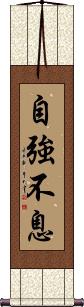
自強不息 is a proverb or idiom that suggests that the pursuit of self-improvement is eternal. It can also be a suggestion to strive unremittingly in life.
The first two characters mean inner strength with the idea of self-improvement. The last two characters mean “never rest” or “striving without giving up.”
Some will translate these four characters as “Exert and strive hard without any let-up.”
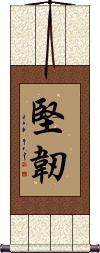
Perseverance / Fortitude
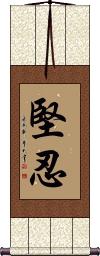
堅忍 means persistent, steadfast, fortitude, and/or perseverance.
The first character means strong, solid, firm, unyielding, or resolute.
The second character means to beat, endure, or tolerate.
Together they speak of the strength from within yourself. Some may also translate this as long-suffering in a more Biblical sense.
堅忍 is a common term in Chinese and Korean Hanja but a little less commonly used in modern Japanese Kanji. For that reason, this selection is best if your audience is Chinese or Korean.

 Note that when writing this as Kanji, Japanese will tend to write the second Kanji a little differently. If you select our Japanese master calligrapher, please expect the form where the little horizontal stroke crosses the vertical stroke. See differences in the images to the right. Technically, they are both the same character, and will be read the same in either language.
Perseverance / Indomitable / Invincible Fortitude

堅忍不抜 means determined, steadfast, unswerving, or unshakable in Japanese.
This is the Japanese version of an old Chinese 4-character perseverance proverb.
This would be understood in Chinese, but it's not commonly written this way in Chinese.
Note that when writing this as Kanji, Japanese calligraphers sometimes write the second Kanji in the form shown to the right. Yes,
it’s
just one stroke that is slightly different in location, crossing another stroke in this alternate Japanese Kanji form. If you have a preference, let us know when you order.
Due to some odd computer coding conventions, these two character forms were combined/merged into the same code point - thus, you will not see Kanji images of more Japanese form as you select options for your scroll.
Perseverance / Will-Power
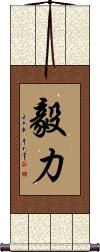
毅力 is a way to express “perseverance” with the idea of “willpower” in Chinese and old Korean Hanja. It can also mean “strong-willed.”
The first character means “strong” and “persistent,” while the second means “strength” and “power.”
Inner Strength
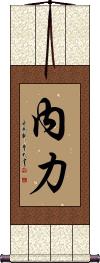
內力 is the shorter version of inner strength (can also be translated as “internal force”). The first character holds the meaning of “inner” or “internal.” The second character means “power,” “force,” or “strength.”
內力 is a Kung Fu way of talking about an inner power or strength from within. This is a way to express “inner chi.” This is something that you might hear in a real Chinese Kung Fu movie.
While understood in Chinese and Japanese, this can have a secondary meaning of “inner stress” in Japanese.
Inner Strength
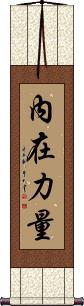
內在力量 is the slightly-verbose way to say inner strength.
The first two characters mean “intrinsic” or “inner.” The second two characters mean “power,” “force” or “strength” (especially physical strength). 內在力量 is more a short phrase rather than just a word in Chinese and Korean. This can sort of be understood in Japanese but it's not normal/proper Japanese.
Inner Strength / Self-Improvement
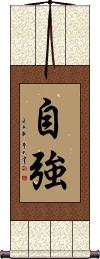
自強 is the kind of inner strength that applies to a person who has will-power and can inspire themselves to do great things.
自強 can also be the creed of a person that always pursues self-improvement.
Other translations: self-strengthening, striving for improvement, self-improvement, striving to become stronger, and self-renewal.
Indomitable / Unyielding
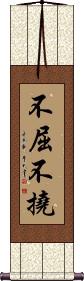
不屈不撓 means “Indomitable” or “Unyielding.”
不屈不撓 is a long word by Chinese standards. At least, it is often translated as a single word into English. It's actually a proverb in Chinese.
If you want to break it down, you can see that the first and third characters are the same. Both mean “not” (they work as a suffix to make a negative or opposite meaning to whatever character follows).
The second character means “bendable.”
The last means “scratched” or “bothered.”
So this really means “Won't be bent, can't be bothered.” I have also seen it written as “Will not crouch, will not submit.” This comes from the fact that the second character can mean “to crouch” and the last can mean “to submit” (as in “to give in” such as “submitting to the rule of someone else”). This may explain better why these four characters mean “indomitable.”
Notes:
Some will translate this as “indomitable spirit”; however, technically, there is no character to suggest the idea of “spirit” in this word.
Other translations include indefatigability, indomitableness, or unremitting tenacity.
The first two characters can be stand-alone words in Chinese.
In Japanese, this is considered two words (with very similar meanings). It's more common to see the word order flipped to 不撓不屈 in Japanese.
The same characters are used in old Korean Hanja. Just like in Japanese, the words are swapped to 不撓不屈 creating a word pronounced “불요불굴” in Korean.
See 不撓不屈
Strong Hearted / Strong Willed
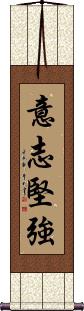
意志堅強 can mean either “strong-hearted,” “strong-willed” or “determination.”
The first two characters can be translated as “will,” “willpower,” “determination,” “volition,” “intention,” or “intent.” But, it should be noted that this first part possesses the element of “heart” in the lower portion of both characters (they also partially carry the meaning “with the whole heart”).
The last two characters mean “strong” or “staunch.”
Chinese word order and grammar are a bit different than English, so in this case, they are in reverse order of English but have the correct meaning in a natural form.
See Also: Strong Willed | Discipline | Will-Power
Perseverance
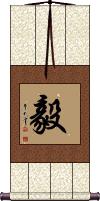
毅 is the simplest way to express perseverance in Chinese and Korean Hanja.
This single-character version leaves a bit of mystery about what kind of perseverance you might want to convey.
In Korean, this is usually associated with “strength of character.”
In Japanese, this character can be pronounced in a dozen different ways (so we have left out the Japanese pronunciation guide that normally appears above). In Japanese, this Kanji would usually be translated as “strong” (perhaps strong-willed).
Fortitude / Strength of Character
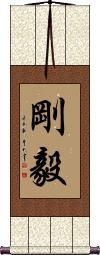
剛毅 is a Japanese and Chinese word that means resolute and firm, fortitude, firmness of character, hardihood, manliness, or macho.
See Also: Perseverance | Strength | Tenacity
Power / Strength
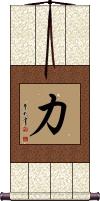
力 is the simplest form of “power” or “strength.”
In Japanese, it is pronounced “chikara” when used alone, and “ryoku” when used in a sentence (there are also a few other possible pronunciations of this Kanji in Japanese).
In some contexts, this can mean ability, force, physical strength, capability, and influence.
Perseverance / Fortitude
Physical Strength
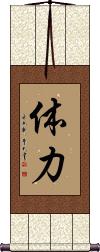
体力 means “physical strength” or “physical power.”
The first character was first simplified in Japan. Later, that simplified version became the standard in mainland China. Just in case you want this version, it is offered here. I suggest it if your audience is Japanese. Most Chinese know the older traditional version, which looks like 體力.
体力 can also be defined: stamina; endurance; physical strength; resilience; resistance to disease; clout; stability.
Strength / Vigor / Energy
Physical Strength
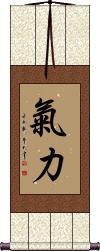
氣力 can mean any of the words in the title above, and in some contexts, can also mean effort, will-power, or talent.
This refers mostly to physical strength (as opposed to mental or spiritual).
 In modern Japan, they use a simplified first character for this word. If you want to order this title with that special Japanese version, click on the character to the right instead of the button above.
Indomitable / Persistence / Fortitude
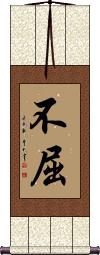
不屈 is the short form of a longer Chinese word and also a word used in Korean and Japanese to express the idea of being indomitable. It literally means “will not bend,” “will not crouch,” “will not yield,” “will not flinch,” or “will not submit.”
Note: Some will translate this as “indomitable spirit”; however, technically, there is no character to suggest the idea of “spirit” in this word.
Unwavering
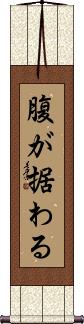
腹が据わる is a Japanese proverb that means to have guts or to be unwavering in one's resolution.
Note: Because this selection contains some special Japanese Hiragana characters, it should be written by a Japanese calligrapher.
No Pain No Gain
Literally: No Pain, No Strength
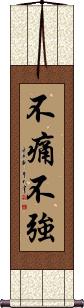
不痛不強 is a proverb that is close to our idea of “no pain, no gain” in English. It holds this meaning in the context of working out at the gym etc.
不痛不強 means “no pain, no strength,” meaning that if you don't experience a little pain, you will not gain any strength.
Will-Power / Self-Control
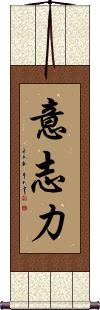
意志力 is a form of willpower or self-control and is about having the determination or tenacity to keep going.
In Japanese, this is the power of will, the strength of will, volition, intention, intent, or determination.
Determination to Achieve / Will-Power
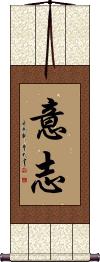
意志 is a Chinese, Korean, and Japanese word that means “determination to achieve.” It can also be translated as: will; willpower; determination; volition; intention; or intent.
In Japanese, this can also be the given name, Ishi.
Tenacious / Tenacity
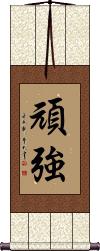
頑強 means “Tenacious,” “Hard to Defeat,” or “Dogged.”
Alone, the first character means mischievous, obstinate, or stubborn. But it loses some of the mischievous meaning when the second character is added.
The second character means strength, force, power, or better.
See Also: Determination | Dedication | Devotion | Never Give Up
Dedication
Dedicated to One Thing
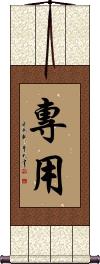
專用 is the dedication you might have to your job or a person.
Trivia: It is the same word used as an adjective in front of the word for “network” to say “dedicated network” in Chinese.
Please note: While this is a word in Korean, the meaning is private or “exclusive use.” So this is best if your audience is Chinese.
See Also: Devotion | Passion | Tenacious | Commitment
Determination
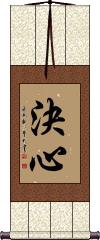
決心 is a Chinese, Japanese, and Korean word that holds the dictionary definition of determination but literally means determined heart.
The first character means to determine or determined.
The second character means heart, mind, or soul, so you can imagine that this form of determination partially means putting your heart into something. It can also be translated as resolve, resolution, or decision (as in a decision made and followed).
See Also: Devotion | Tenacious | Passion | Dedication | Will-Power
Discipline
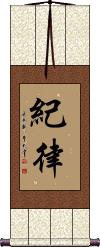
紀律 is a Chinese and Korean word that conveys the idea of extreme self-control and perhaps self-sacrifice, and obedience.
This word matches the kind of “discipline” I was in the Marine Corps. There is also an additional idea of maintaining order or being orderly in your tasks.
This idea would also fit an athlete training for the Olympics who gives up many pleasures to stay focused on their training.
See Also: Self-Control | Will-Power
Discipline
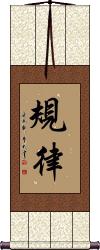
規律 is a Japanese word for discipline that relays the ideas of keeping order, and observance (of rules, laws, regulations).
This is also a word in Chinese and old Korean Hanja where it suggests that you are one who follows a certain law of behavior or has a regular and dependable pattern of behavior, personal regime, or rhythm.
See Also: Self-Control | Will-Power
Self-Control
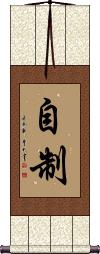
The short and sweet version of self-control.
Note: This can also mean self-restraint.
See Also: Will-Power | Discipline
Self-Discipline / Will-Power
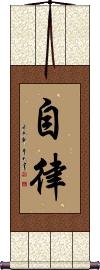
自律 means self-discipline and self-control.
It is doing what you really want to do rather than being tossed around by your feelings like a leaf in the wind. You act instead of reacting. You get things done in an orderly and efficient way. With self-discipline, you take charge of yourself.
Not sure if this one works for a Japanese audience.
See Also: Discipline | Self-Control
Well-Disciplined / Orderly
Special Military Term
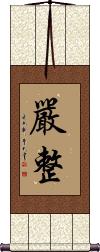
When reading an account of some battles in China, I came across the Chinese word, 嚴整. As it turns out, 嚴整 is only used in military circles to describe neat, orderly, and well-disciplined troops. Perhaps this is actually closer to the meaning I was taught while in the U.S. Marines.
The first character literally means stern, serious, strict, or severe (it can also mean airtight or watertight.
The second character means exact, in good order, whole, complete, and orderly.
Together, these two characters multiply each other into a word that expresses the highest military level of discipline.
See Also: Self-Control | Will-Power
Fortitude / Steadfast
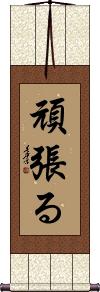
頑張る is a Japanese word that means to persevere, to persist, to keep at it, to hang on, to hold out, or to do one's best.
Depending on the context, it can suggest being stubborn or set on one's ways but generally has positive connotations.
Stamina / Tenacity
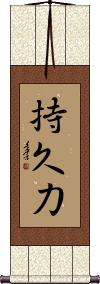
Discipline

鍛練 is the Japanese Kanji and Korean Hanja word used for discipline.
This has a meaning like “forging or creating something from lots of training and practice.” My Japanese dictionary translates this as “tempering, forging, hardening, disciplining, training.”
This is for Japanese and Korean only. In Chinese, these characters might be translated as (physical) “exercise.”


The modern form of the second Japanese Kanji looks like the first image to the right. There’s also an alternate modern form after that, and finally, an alternate traditional form. Because calligraphy is an art, the calligrapher could choose any of these possible forms. Let us know if you have a preference.
See Also: Self-Control | Will-Power
Tenacity / Indomitable
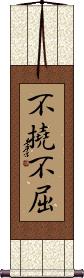
不撓不屈 is a Japanese and Korean word that means tenacity, indomitableness, or dauntlessness.
Self-Control
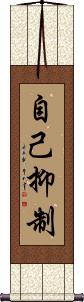
自己抑制 has a meaning like “to restrain oneself” in Chinese, Japanese, and old Korean.
The first two characters mean “regarding oneself,” and the second two mean “to refrain” or “to restrain.”
See Also: Discipline | Will-Power
Discipline / Training / Tempering Character
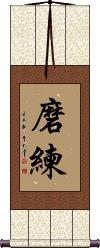
磨鍊 is a form of discipline which suggests training of the mind and character, aimed at producing self-control, obedience, etc.
One of my Chinese-English dictionaries even translates this as “tempering oneself” or turning yourself into hardened steel.
In old Korean Hanja, they use these characters in reverse order but with the same meaning. If you want the Korean version, please click this link instead of the button above: Korean version.
Indomitable Spirit / Indomitable Attitude
Fukutsu no Seishin
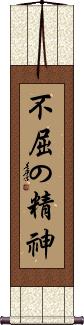
不屈の精神 is one of several versions or ways to write “Indomitable Spirit” in Japanese.
This one is the famous “Fukutsu no Seishin” phrase.
This in-stock artwork might be what you are looking for, and ships right away...
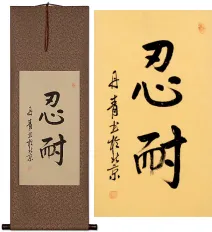
Gallery Price: $79.00
Your Price: $43.88
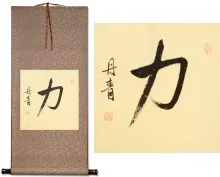
Gallery Price: $65.00
Your Price: $39.77

Gallery Price: $60.00
Your Price: $36.88
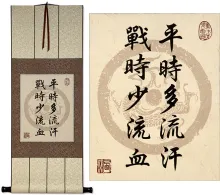
Gallery Price: $106.00
Your Price: $58.88
Gallery Price: $108.00
Your Price: $59.88

Gallery Price: $31.00
Your Price: $16.88

Gallery Price: $222.00
Your Price: $122.88

Gallery Price: $200.00
Your Price: $122.88
Gallery Price: $108.00
Your Price: $59.88
Gallery Price: $106.00
Your Price: $58.88
Gallery Price: $90.00
Your Price: $49.88
Gallery Price: $72.00
Your Price: $39.88
The following table may be helpful for those studying Chinese or Japanese...
| Title | Characters | Romaji (Romanized Japanese) | Various forms of Romanized Chinese | |
| Always Striving for Inner Strength | 自強不息 自强不息 | zì qiáng bú xī zi4 qiang2 bu2 xi1 zi qiang bu xi ziqiangbuxi | tzu ch`iang pu hsi tzuchiangpuhsi tzu chiang pu hsi |
|
| Perseverance Fortitude | 堅忍 坚忍 | ken nin / kennin | jiǎn rěn / jian3 ren3 / jian ren / jianren | chien jen / chienjen |
| Perseverance Indomitable Invincible Fortitude | 堅忍不抜 / 堅忍不拔 坚忍不拔 | kenninfubatsu | jiān rěn bù bá jian1 ren3 bu4 ba2 jian ren bu ba jianrenbuba | chien jen pu pa chienjenpupa |
| Perseverance Will-Power | 毅力 | yì lì / yi4 li4 / yi li / yili | i li / ili | |
| Inner Strength | 內力 内力 | nai ryoku / nairyoku | nèi lì / nei4 li4 / nei li / neili | |
| Inner Strength | 內在力量 内在力量 | nèi zài lì liàng nei4 zai4 li4 liang4 nei zai li liang neizaililiang | nei tsai li liang neitsaililiang |
|
| Inner Strength Self-Improvement | 自強 自强 | zì qiáng / zi4 qiang2 / zi qiang / ziqiang | tzu ch`iang / tzuchiang / tzu chiang | |
| Indomitable Unyielding | 不屈不撓 不屈不挠 | fu kutsu fu tou fukutsufutou fu kutsu fu to | bù qū bù náo bu4 qu1 bu4 nao2 bu qu bu nao buqubunao | pu ch`ü pu nao puchüpunao pu chü pu nao |
| Strong Hearted Strong Willed | 意志堅強 意志坚强 | yì zhì jiān qiáng yi4 zhi4 jian1 qiang2 yi zhi jian qiang yizhijianqiang | i chih chien ch`iang ichihchienchiang i chih chien chiang |
|
| Perseverance | 毅 | see note / seenote / se note | yì / yi4 / yi | i |
| Fortitude Strength of Character | 剛毅 刚毅 | gouki / goki | gāng yì / gang1 yi4 / gang yi / gangyi | kang i / kangi |
| Power Strength | 力 | chikara / ryoku | lì / li4 / li | |
| Perseverance Fortitude | 堅韌 坚韧 | jiān rèn / jian1 ren4 / jian ren / jianren | chien jen / chienjen | |
| Physical Strength | 體力 体力 | tairyoku | tǐ lì / ti3 li4 / ti li / tili | t`i li / tili / ti li |
| Strength Vigor Energy | 氣力 气力 / 気力 | kiryoku | qì lì / qi4 li4 / qi li / qili | ch`i li / chili / chi li |
| Indomitable Persistence Fortitude | 不屈 | fukutsu | bù qū / bu4 qu1 / bu qu / buqu | pu ch`ü / puchü / pu chü |
| Unwavering | 腹が据わる | haragasuwaru | ||
| No Pain No Gain | 不痛不強 不痛不强 | bú tòng bù qiáng bu2 tong4 bu4 qiang2 bu tong bu qiang butongbuqiang | pu t`ung pu ch`iang putungpuchiang pu tung pu chiang |
|
| Will-Power Self-Control | 意志力 | ishi ryoku / ishiryoku | yì zhì lì yi4 zhi4 li4 yi zhi li yizhili | i chih li ichihli |
| Determination to Achieve Will-Power | 意志 | ishi | yì zhì / yi4 zhi4 / yi zhi / yizhi | i chih / ichih |
| Tenacious Tenacity | 頑強 顽强 | gan kyou / gankyou / gan kyo | wán qiáng wan2 qiang2 wan qiang wanqiang | wan ch`iang wanchiang wan chiang |
| Dedication | 專用 专用 | zhuān yòng zhuan1 yong4 zhuan yong zhuanyong | chuan yung chuanyung |
|
| Determination | 決心 决心 | kesshin / keshin | jué xīn / jue2 xin1 / jue xin / juexin | chüeh hsin / chüehhsin |
| Discipline | 紀律 纪律 | jì lǜ / ji4 lv4 / ji lv / jilv | chi lü / chilü | |
| Discipline | 規律 规律 | kiritsu | guī / gui1 lu:4 / gui lu: / guilu: | kuei lü / kueilü |
| Self-Control | 自制 | jisei | zì zhì / zi4 zhi4 / zi zhi / zizhi | tzu chih / tzuchih |
| Self-Discipline Will-Power | 自律 | jiritsu | zì lǜ / zi4 lv4 / zi lv / zilv | tzu lü / tzulü |
| Well-Disciplined Orderly | 嚴整 严整 | yán zhěng yan2 zheng3 yan zheng yanzheng | yen cheng yencheng |
|
| Fortitude Steadfast | 頑張る | ganbaru | ||
| Stamina Tenacity | 持久力 | jikyuuryoku jikyuryoku | ||
| Discipline | 鍛練 / 鍛錬 锻练 | tan ren / tanren | duàn liàn duan4 lian4 duan lian duanlian | tuan lien tuanlien |
| Tenacity Indomitable | 不撓不屈 | fu tou fu kutsu futoufukutsu fu to fu kutsu | ||
| Self-Control | 自己抑制 | jikoyokusei | zì jǐ yì zhì zi4 ji3 yi4 zhi4 zi ji yi zhi zijiyizhi | tzu chi i chih tzuchiichih |
| Discipline Training Tempering Character | 磨練 / 磨鍊 / 磨鍊 磨练 | mó liàn / mo2 lian4 / mo lian / molian | mo lien / molien | |
| Indomitable Spirit Indomitable Attitude | 不屈の精神 | fu kutsu no sei shin fukutsunoseishin | ||
| In some entries above you will see that characters have different versions above and below a line. In these cases, the characters above the line are Traditional Chinese, while the ones below are Simplified Chinese. | ||||

Successful Chinese Character and Japanese Kanji calligraphy searches within the last few hours...



