I am shipping orders on Thursday this week. News and More Info
Not what you want?
Try other similar-meaning words, fewer words, or just one word.
Feel free to email me with your request. If it's easy, I'll translate it for free and add it to this database of calligraphy for you.
Buy an Open Your Heart calligraphy wall scroll here!
Personalize your custom “Open Your Heart” project by clicking the button next to your favorite “Open Your Heart” title below...
專心 makes a word that means “paying attention with your heart.”
It's often translated as “dedication,” as in “be absorbed in” or “concentrate one's efforts.” It's also used to mean “with the single mind,” “whole-heartedly,” “paying attention,” “undivided attention,” “concentration (-ed),” “engrossed,” “devotionally (listening/watching),” and/or “attentive.”
The first character means “for a particular person, occasion, or purpose,” “focused on one single thing,” “concentrated,” and sometimes, “special.”
The second character means “heart” or “mind” by itself.
My favorite translation, which comes from the Oxford Advanced Chinese/English Dictionary, is, “wholehearted devotion.”
If it seems like the meaning of this word is quite open, you are correct. The context in which the word is used matters a lot. It can mean different things depending on how you use it. This makes it kind of nice as you can decide what this means to you (within some limits). This is always positive in meaning, so even if a Chinese person reads it differently than you, it will still have a good meaning.
In Japanese, they tend to use a variation of the second character which has one less stroke. If you want your calligraphy written this Japanese form, please click on the Kanji shown to the right instead of the button above. Note: Japanese and Chinese people will recognize either form.
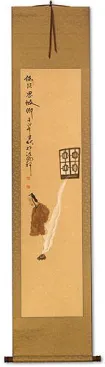
This in-stock artwork might be what you are looking for, and ships right away...
Gallery Price: $108.00
Your Price: $59.88
Below are some entries from our dictionary that may match your Open Your Heart search...
| Characters If shown, 2nd row is Simp. Chinese |
Pronunciation Romanization |
Simple Dictionary Definition |
虛心 虚心 see styles |
xū xīn xu1 xin1 hsü hsin koshin |
More info & calligraphy: Calm and Open MindWith humble mind, or heart. |
交心 see styles |
jiāo xīn jiao1 xin1 chiao hsin |
to open one's heart; to have a heart-to-heart conversation |
剖腹 see styles |
pōu fù pou1 fu4 p`ou fu pou fu |
to cut open the abdomen; to disembowel; to speak from the heart |
十心 see styles |
shí xīn shi2 xin1 shih hsin jisshin |
The ten kinds of heart or mind; there are three groups. One is from the 止觀 4, minds ignorant and dark; affected by evil companions; not following the good; doing evil in thought, word, deed; spreading evil abroad; unceasingly wicked; secret sin; open crime; utterly shameless; denying cause and effect (retribution)―all such must remain in the flow 流 of reincarnation. The second group (from the same book) is the 逆流 the mind striving against the stream of perpetual reincarnation; it shows itself in devout faith, shame (for sin), fear (of wrong-doing), repentance and confession, reform, bodhi (i.e. the bodhisattva mind), doing good, maintaining the right law, thinking on all the Buddhas, meditation on the void (or, the unreality of sin). The third is the 眞言 group from the 大日經疏 3; the "seed" heart (i.e. the original good desire), the sprout (under Buddhist religious influence), the bud, leaf, flower, fruit, its serviceableness; the child-heart, the discriminating heart, the heart of settled judgment (or resolve). |
胎藏界 see styles |
tāi zàng jiè tai1 zang4 jie4 t`ai tsang chieh tai tsang chieh taizō kai |
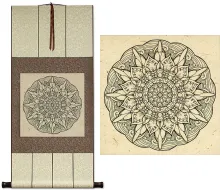
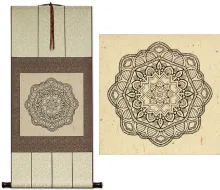
Garbhadhātu, or Garbhakośa-(dhātu), the womb treasury, the universal source from which all things are produced; the matrix; the embryo; likened to a womb in which all of a child is conceived— its body, mind, etc. It is container and content; it covers and nourishes; and is the source of all supply. It represents the 理性 fundamental nature, both material elements and pure bodhi, or wisdom in essence or purity; 理 being the garbhadhātu as fundamental wisdom, and 智 acquired wisdom or knowledge, the vajradhātu. It also represents the human heart in its innocence or pristine purity, which is considered as the source of all Buddha-pity and moral knowledge. And it indicates that from the central being in the maṇḍala, viz. the Sun as symbol of Vairocana, there issue all the other manifestations of wisdom and power, Buddhas, bodhisattvas, demons, etc. It is 本覺 original intellect, or the static intellectuality, in contrast with 始覺 intellection, the initial or dynamic intellectuality represented in the vajradhātu; hence it is the 因 cause and vajradhātu the 果 effect; though as both are a unity, the reverse may be the rule, the effect being also the cause; it is also likened to 利他 enriching others, as vajradhātu is to 自利 enriching self. Kōbō Daishi, founder of the Yoga or Shingon 眞言 School in Japan, adopted the representation of the ideas in maṇḍalas, or diagrams, as the best way of revealing the mystic doctrine to the ignorant. The garbhadhātu is the womb or treasury of all things, the universe; the 理 fundamental principle, the source; its symbols are a triangle on its base, and an open lotus as representing the sun and Vairocana. In Japan this maṇḍala is placed on the east, typifying the rising sun as source, or 理. The vajradhātu is placed west and represents 智 wisdom or knowledge as derived from 理 the underlying principle, but the two are essential one to the other, neither existing apart. The material and spiritual; wisdom-source and intelligence; essence and substance; and similar complementary ideas are thus portrayed; the garbhadhātu may be generally considered as the static and the vajradhātu as the dynamic categories, which are nevertheless a unity. The garbhadhātu is divided into 三部 three sections representing samādhi or quiescence, wisdom-store, and pity-store, or thought, knowledge, pity; one is called the Buddha-section, the others the Vajra and Lotus sections respectively; the three also typify vimokṣa, prajñā, and dharmakāya, or freedom, understanding, and spirituality. There are three heads of these sections, i. e. Vairocana, Vajrapāṇi, and Avalokiteśvara; each has a mother or source, e. g. Vairocana from Buddha's-eye; and each has a 明王 or emanation of protection against evil; also a śakti or female energy; a germ-letter, etc. The diagram of five Buddhas contains also four bodhisattvas, making nine in all, and there are altogether thirteen 大院 or great courts of various types of ideas, of varying numbers, generally spoken of as 414. Cf. 金剛界; 大日; 兩部. |
開心術 see styles |
kaishinjutsu かいしんじゅつ |
{med} open-heart surgery |
打明ける see styles |
uchiakeru うちあける |
(irregular okurigana usage) (transitive verb) to be frank; to speak one's mind; to open one's heart |
打解ける see styles |
uchitokeru うちとける |
(v1,vi) to open one's heart; to throw off reserve; to be frank |
うち解ける see styles |
uchitokeru うちとける |
(v1,vi) to open one's heart; to throw off reserve; to be frank |
打ち明かす see styles |
uchiakasu うちあかす |
(transitive verb) (See 打明ける) to be frank; to speak one's mind; to open one's heart |
打ち明ける see styles |
buchiakeru ぶちあける uchiakeru うちあける |
(transitive verb) (1) to forcefully open up a hole (in a wall, etc.); (2) to speak frankly, holding nothing back; (3) to throw out everything inside; (transitive verb) to be frank; to speak one's mind; to open one's heart |
打ち解ける see styles |
uchitokeru うちとける |
(v1,vi) to open one's heart; to throw off reserve; to be frank |
胸襟を開く see styles |
kyoukinohiraku / kyokinohiraku きょうきんをひらく |
(exp,v5k) (See 打ち明ける・うちあける) to be frank; to speak one's mind; to open one's heart; to have a heart-to-heart talk (with someone) |
Variations: |
kaikin かいきん |
(1) unbuttoning a collar; (2) opening up (one's heart); (3) (abbreviation) (See 開襟シャツ) open-necked shirt |
腹を割って話す see styles |
haraowattehanasu はらをわってはなす |
(exp,v5s) to speak frankly; to speak unreservedly; to open up to each other; to talk candidly; to speak by laying everything on the table; to talk straight from the gut; to have a heart-to-heart talk |
Variations: |
uchiakeru うちあける |
(transitive verb) to confide; to reveal; to disclose; to lay bare; to speak frankly; to open (one's heart) |
Variations: |
uchitokeru うちとける |
(v1,vi) to open one's heart; to throw off reserve; to be frank |
Variations: |
buchimakeru ぶちまける |
(transitive verb) (1) (kana only) to dump (e.g. onto the floor); to empty by overturning; to throw out (contents); (transitive verb) (2) (kana only) to tell everything; to reveal everything; to open one's heart; to spill out |
Variations: |
buchimakeru ぶちまける |
(transitive verb) (1) (kana only) to dump (e.g. onto the floor); to empty by overturning; to throw out (contents); (transitive verb) (2) (kana only) to tell everything; to reveal everything; to open one's heart; to spill out |
Variations: |
buchiakeru ぶちあける |
(transitive verb) (1) (rare) to forcefully open up (a hole; in a wall, etc.); (transitive verb) (2) (rare) (See 打ち明ける・うちあける) to speak frankly; to open one's heart; (transitive verb) (3) (rare) to throw out (everything inside); to empty (e.g. a box) |
Variations: |
buchimakeru ぶちまける |
(transitive verb) (1) (kana only) to dump (e.g. onto the floor); to empty by overturning; to throw out (the contents); (transitive verb) (2) (kana only) to tell everything; to open one's heart; to reveal (a secret, the truth, etc.); to vent (e.g. one's anger) |
Variations: |
buchimakeru; buchimakeru(sk) ぶちまける; ブチまける(sk) |
(transitive verb) (1) (kana only) to dump (e.g. onto the floor); to empty by overturning; to throw out (the contents); (transitive verb) (2) (kana only) to tell everything; to open one's heart; to reveal (a secret, the truth, etc.); to vent (e.g. one's anger) |
The following table may be helpful for those studying Chinese or Japanese...
| Title | Characters | Romaji (Romanized Japanese) | Various forms of Romanized Chinese | |
| Calm and Open Mind | 虛心 虚心 | ko shin / koshin | xū xīn / xu1 xin1 / xu xin / xuxin | hsü hsin / hsühsin |
| Devotion Dedication Attentive Focused | 專心 / 専心 / 耑心 专心 | sen shin / senshin | zhuān xīn zhuan1 xin1 zhuan xin zhuanxin | chuan hsin chuanhsin |
| In some entries above you will see that characters have different versions above and below a line. In these cases, the characters above the line are Traditional Chinese, while the ones below are Simplified Chinese. | ||||
Successful Chinese Character and Japanese Kanji calligraphy searches within the last few hours...

All of our calligraphy wall scrolls are handmade.
When the calligrapher finishes creating your artwork, it is taken to my art mounting workshop in Beijing where a wall scroll is made by hand from a combination of silk, rice paper, and wood.
After we create your wall scroll, it takes at least two weeks for air mail delivery from Beijing to you.
Allow a few weeks for delivery. Rush service speeds it up by a week or two for $10!
When you select your calligraphy, you'll be taken to another page where you can choose various custom options.
The wall scroll that Sandy is holding in this picture is a "large size"
single-character wall scroll.
We also offer custom wall scrolls in small, medium, and an even-larger jumbo size.
Professional calligraphers are getting to be hard to find these days.
Instead of drawing characters by hand, the new generation in China merely type roman letters into their computer keyboards and pick the character that they want from a list that pops up.
There is some fear that true Chinese calligraphy may become a lost art in the coming years. Many art institutes in China are now promoting calligraphy programs in hopes of keeping this unique form
of art alive.
Even with the teachings of a top-ranked calligrapher in China, my calligraphy will never be good enough to sell. I will leave that to the experts.
The same calligrapher who gave me those lessons also attracted a crowd of thousands and a TV crew as he created characters over 6-feet high. He happens to be ranked as one of the top 100 calligraphers in all of China. He is also one of very few that would actually attempt such a feat.
Check out my lists of Japanese Kanji Calligraphy Wall Scrolls and Old Korean Hanja Calligraphy Wall Scrolls.
Some people may refer to this entry as Open Your Heart Kanji, Open Your Heart Characters, Open Your Heart in Mandarin Chinese, Open Your Heart Characters, Open Your Heart in Chinese Writing, Open Your Heart in Japanese Writing, Open Your Heart in Asian Writing, Open Your Heart Ideograms, Chinese Open Your Heart symbols, Open Your Heart Hieroglyphics, Open Your Heart Glyphs, Open Your Heart in Chinese Letters, Open Your Heart Hanzi, Open Your Heart in Japanese Kanji, Open Your Heart Pictograms, Open Your Heart in the Chinese Written-Language, or Open Your Heart in the Japanese Written-Language.
16 people have searched for Open Your Heart in Chinese or Japanese in the past year.
Open Your Heart was last searched for by someone else on Oct 18th, 2025