Many custom options...


And formats...



Jun in Chinese / Japanese...
Buy a Jun calligraphy wall scroll here!
Personalize your custom “Jun” project by clicking the button next to your favorite “Jun” title below...
1. Zheng / Tei / Jeong / Trinh
5. June
6. Air Force
9. Gunther
10. Nobleman
12. Navy
14. Chinese or Korean Army General
16. Hwacheon
18. American Soldier / American Serviceman
20. Military Veteran / Retired Soldier
21. Shropshire
22. Marine Corps
23. Marine
Zheng / Tei / Jeong / Trinh
Chinese Japanese Korean Vietnamese Surname
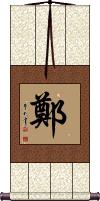
鄭 is the Chinese surname Zheng, Japanese surname Tei, Korean surname Jeong, and Vietnamese surname Trịnh.
This can also refer to the state of Zheng during the Warring States period of China.
In Korea, this can be the original way to write the surname Jeong in the old days (now it's 정 in modern Korea). Can also romanize from Korean as Chung or Jung.
In Japanese, this is the surname Tei. But can romanize as the following Japanese names/surnames: Ti; Te; Tsun; Dziyon; Chiyon; Chon; Chou; Chun; Chuu; Chien; Zen; Jiyon; Jon; Jou; Jun.
In Vietnamese, this is the name Trịnh from the time before Vietnam romanized the language.
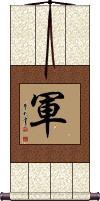
Army / Military
Art of Healing
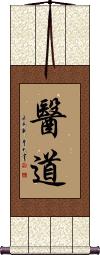
醫道 means the art of healing or medical skill.
This can also refer to a Korean TV show, Hur Jun about an ancient doctor. The Chinese-subtitled version of the show is also quite popular in China.
While this is a common title in Chinese and Korean, it's not used as often in Japanese where someone might read it as “medical course” or “the way of medicine.”
Tang Soo Do Tenets
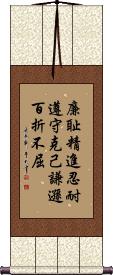
廉耻精進忍耐遵守克己謙遜百折不屈 are the tenets of Tang Soo Do.
| English | Old Hanja | Modern Hangul | Pronunciation |
| 1. Integrity | 廉耻 | 렴치 or 염치 | yeom ci |
| 2. Concentration | 精進 | 정진 | jeong jin |
| 3. Perseverance | 忍耐 | 인내 | in nae |
| 4. Respect & Obedience | 遵守 | 준수 | jun su |
| 5. Self-Control | 克己 | 극기 | geug gi |
| 6. Humility | 謙遜 | 겸손 | gyeom son |
| 7. Indomitable Spirit | 百折不屈 | 백절불굴 | baeg jeor bur gur |
After some research, it appears this list was compiled in English based on Taekwondo tenets. We filled in a few of the words that did not have a corresponding Hanja or Hangul. If someone else has a better list with characters included, please contact me.
June
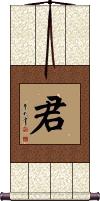
君 is a common transliteration to Mandarin Chinese for the name June.
This sounds like “June” in Chinese but does not mean the month of June at all.
Air Force
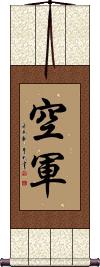
空軍 is “Air Force” in Chinese, Japanese Kanji, and old Korean Hanja.
If you're an airman, this could be the title for you.
Balance / Equilibrium
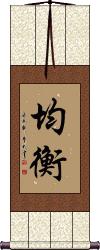
均衡 means balance or equilibrium.
This title is best for a Japanese audience where the word suggests that your life is in balance in all matters (or is a reminder for you to try and keep all matters in balance).
Champ / Champion
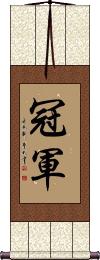
冠軍 is a Chinese word that means champ or champion.
Gunther
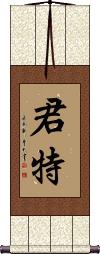
This is the second most common Mandarin Chinese transliteration for the male German name Günther or Gunther.
Nobleman
Junzi / chun-tzu / gunja / kunshi
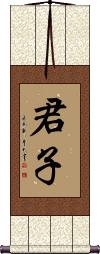
This means nobleman, person of noble character, man of virtue; wise man, or a true gentleman
君子 can be romanized as chün-tzu or jūnzǐ from Chinese and gunja from Korean. This has the same meaning in Japanese, but in another context, can be the female given name Kunshi.
Military Discipline
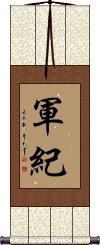
軍紀 means military discipline or military principles.
If maintaining your military discipline is important to you personally or important to your military unit, this is the wall scroll to have up behind your desk. In fact, it's the kind of thing I expect to see behind the desk of a First Sergeant or maybe a hardcore NCO.
Note: In some rare contexts, it could be extended to mean “morale,” but “discipline” is much closer to the commonly-held definition.
Note: This term is not well-known outside the military services in Asia (not used by the common person).
See Also: Self-Discipline
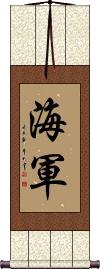
海軍 is the Chinese, Japanese Kanji, and Korean Hanja word for “Navy.” 海軍 is not country-specific, so it is the title for “naval service” from any country with a navy.
These two characters literally mean “sea military.”
A nice scroll for any sailor who likes Asian characters and has pride in their service.
Shogun / Japanese General
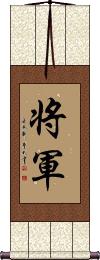
将軍 or Shogun, in the simplest definition, is a General, but you could also use words such as commander, lord, overlord, highest ranking, or commanding officer.
The title “Shogun” has held some slightly ambiguous meanings at times in Japanese history.
In the west, when someone mentions “Shogun,” we may be filled with thoughts of gallant warriors. Some might even think of the TV mini-series with Richard Chamberlain. Often westerners use the words, Samurai and Shogun interchangeably, but that's really not technically correct. In the case of the Samurai, the Shogun was a designated (by the emperor) leader of a gild of Samurai. In this context, the Shogun was a Samurai lord. Or effectively, a commanding officer of a company of Samurai - to put it in modern military terms.
Sometimes a Shogun was a general; other times, he was the leader of a military government in Japan - but not a front-line warrior like a Samurai.
Variants of the same characters are used in China for the rank and title of a General of the People's Liberation Army (and the same term and characters have been used for the last 2200 years since the Qin Dynasty).
Chinese or Korean Army General
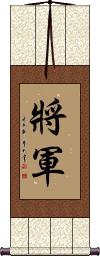
將軍 is the more Chinese and Korean Hanja version or General.
There is a slight variation in the way the first character is written compared to the Japanese Shogun (将軍) title.
So if you want to specifically refer to a Chinese or Korean General, this is the way. Japanese people would still easily identify this as “shogun.”
Note: This term is also used for Admiral in Korean in a certain context (if you need a better title for Admiral, just let me know).
Soldier / Serviceman
Hwacheon
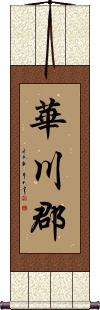
華川郡 is the name Hwacheon or Hwach'ŏn in Korean Hanja.
華川郡 usually refers to the Hwacheon County (Hwacheon-gun) county in Gangwon Province, South Korea.
Active Duty Military
Person on Active Duty
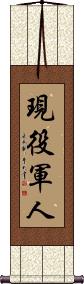
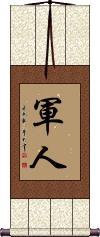
現役軍人 means “Active Duty Soldier” or literally “Active Duty Military Person.”
This title is a great way to show pride in being an active duty member of the armed forces.
The first two characters mean “active duty” and the second two characters can be translated as “military personnel,” “soldier,” or “serviceman” (it is unisex, so male or female is not indicated).
See Also: Military
American Soldier / American Serviceman
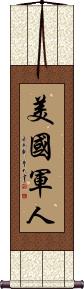
美國軍人 means “American Soldier” or literally “American Military Person.”
This can also be translated as “American military personnel,” or “American serviceman.” Gender is not specified in this title, so it's appropriate for male or female soldiers.
Military Intelligence
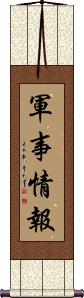
軍事情報 is the full way to say “Military Intelligence.”
The first two characters mean “military affairs.”
The second two characters mean “intelligence” or “information-gathering.”
If you work in the G2 section of your military unit, this is the wall scroll for you.
See Also: Military
Military Veteran / Retired Soldier
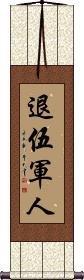
退伍軍人 is the Chinese title for a military veteran.
The first two characters mean “retired from the ranks,” or discharged.
The last two characters mean serviceman, soldier, or military personnel.
Shropshire

什羅普郡 is the name Shropshire in Chinese (Mandarin).
Marine Corps
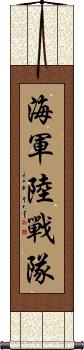
海軍陸戰隊 is the Chinese way to express “Marine Corps.” This could be the Marine Corps of virtually any country that has an amphibious military force.
Let me know if you want a more specific title, such as British Royal Marines or U.S. Marine Corps.
The Chinese title for Marines is very verbose...
Breaking down each character this means:
“ocean/sea military/arms shore/land fighting/war/battle corps/team/group.”
See Also: Military
Marine
Amphibious Warrior
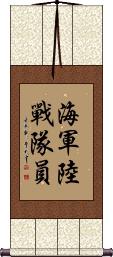
海軍陸戰隊員 is the Chinese way to express “Marine.” (as in a member of the Marine Corps). It is not country-specific, so it could be the Royal Marines, U.S. Marines, Chinese Marines, etc.
In Australian English, they would translate this as “Naval Infantryman.”
Breaking down each character this means:
“ocean/sea military/arms shore/land fighting/war/battle corps/team/group person/member.” Note that the first two characters are presented together but outside of this phrase mean “navy” (sea military).
See Also: Warrior | Military | Navy | Art of War
Not the results for Jun that you were looking for?
Below are some entries from our dictionary that may match your Jun search...
| Characters If shown, 2nd row is Simp. Chinese |
Pronunciation Romanization |
Simple Dictionary Definition |
君 see styles |
jun jun1 chün kunji くんじ |
More info & calligraphy: June(suffix) (1) (after the name of a male of equal or lower status) Mr; master; boy; (suffix) (2) (after the name of a female of lower status; used by males in formal settings) Ms; miss; (suffix) (3) (archaism) (still used among members of the Japanese Diet) sir; madam; (personal name) Kunji Prince, noble, ideal man or woman; translit. kun. |
軍 军 see styles |
jun jun1 chün susumu すすむ |
More info & calligraphy: Army / Military(1) (See 軍隊) army; armed forces; troops; (2) (See 軍部) military authorities; (3) (See 女性軍・じょせいぐん) team; group; troupe; (personal name) Susumu An army; military; martial; translit. kuṇ, cf. 君. |
冠軍 冠军 see styles |
guàn jun guan4 jun1 kuan chün |
More info & calligraphy: Champ / Champion |
君子 see styles |
jun zǐ jun1 zi3 chün tzu kunshi くんし |
More info & calligraphy: Nobleman(1) man of virtue; wise man; (true) gentleman; (2) person of high rank; (3) (See 四君子) the four gentlemen (plum, chrysanthemum, orchid, and bamboo); (female given name) Kunshi superior man |
均衡 see styles |
jun héng jun1 heng2 chün heng kinkou / kinko きんこう |
More info & calligraphy: Balance / Equilibrium(n,vs,vi) balance; equilibrium |
將軍 将军 see styles |
jiāng jun jiang1 jun1 chiang chün |
More info & calligraphy: Chinese or Korean Army General |
海軍 海军 see styles |
hǎi jun hai3 jun1 hai chün kaigun かいぐん |
More info & calligraphy: Navynavy; naval force; (personal name) Kaigun |
空軍 空军 see styles |
kōng jun kong1 jun1 k`ung chün kung chün kuugun / kugun くうぐん |
More info & calligraphy: Air Forceair force |
軍人 军人 see styles |
jun rén jun1 ren2 chün jen gunjin ぐんじん |
More info & calligraphy: Soldier / Servicemanserviceman; servicewoman; soldier; member of the armed forces; military personnel |
儁 俊 see styles |
jun jun4 chün shun しゅん |
variant of 俊[jun4] (obscure) excellence; genius |
均 see styles |
jun jun1 chün hitoshi ひとし |
(bound form) equal; uniform; even; (literary) without exception; all (surname, given name) Hitoshi Equal, in balance, all; used for kun. |
埈 see styles |
jun jun4 chün |
variant of 峻[jun4] |
峻 see styles |
jun jun4 chün taruoka たるおか |
(of mountains) high; harsh or severe (surname) Taruoka |
捃 see styles |
jun jun4 chün kun |
gather; to sort v. 君. |
攈 see styles |
jun jun4 chün |
old variant of 捃[jun4] |
攟 see styles |
jun jun4 chün |
old variant of 捃[jun4] |
晙 see styles |
jun jun4 chün |
(literary) early morning; (literary) bright; (used in names) |
濬 浚 see styles |
jun jun4 chün fukashi ふかし |
variant of 浚[jun4] (given name) Fukashi |
燇 see styles |
jun jun4 chün |
old variant of 焌[jun4] |
珺 see styles |
jun jun4 chün |
beautiful jade |
畯 see styles |
jun jun4 chün |
overseer; steppe |
皸 皲 see styles |
jun jun1 chün hibi ひび akagire あかぎれ |
to chap (noun - becomes adjective with の) (1) (kana only) crack; fissure; (2) (kana only) rift; split; (3) chaps; skin fissure; chaps; skin fissure |
竣 see styles |
jun jun4 chün munehiro むねひろ |
complete; finish (personal name) Munehiro |
箘 see styles |
jun jun4 chün |
bamboo shoots |
莙 see styles |
jun jun1 chün |
species of water plant |
菌 see styles |
jun jun4 chün kin きん |
mushroom (1) (See 菌類) fungus; (2) (See 細菌) germ; bacterium; bacillus |
郡 see styles |
jun jun4 chün mure むれ |
canton; county; region (1) (ぐん only) district; county; (2) (hist) (See 国郡里制) district (of 2-20 50-home neighbourhoods or townships, in the ritsuryō period); (3) (hist) commandery (in China); (surname) Mure |
鈞 钧 see styles |
jun jun1 chün hitoshi ひとし |
30 catties; great; your (honorific) (hist) ancient Chinese unit of weight equivalent to 30 catties (15 kg); (male given name) Hitoshi |
銞 see styles |
jun jun1 chün |
old variant of 鈞|钧[jun1] |
陖 see styles |
jun jun4 chün |
old variant of 峻[jun4] |
Click here for more Jun results from our dictionary
The following table may be helpful for those studying Chinese or Japanese...
| Title | Characters | Romaji (Romanized Japanese) | Various forms of Romanized Chinese | |
| Zheng Tei Jeong Trinh | 鄭 郑 | tei | zhèng / zheng4 / zheng | cheng |
| Army Military | 軍 军 | gun | jūn / jun1 / jun | chün |
| Art of Healing | 醫道 医道 | idou / ido | yī dào / yi1 dao4 / yi dao / yidao | i tao / itao |
| Tang Soo Do Tenets | 廉耻精進忍耐遵守克己謙遜百折不屈 / 廉恥精進忍耐遵守克己謙遜百折不屈 廉耻精进忍耐遵守克己谦逊百折不屈 | lián chǐ jīng jìn rěn nài zūn shǒu kè jǐ qiān xùn bǎi zhé bù qū lian2 chi3 jing1 jin4 ren3 nai4 zun1 shou3 ke4 ji3 qian1 xun4 bai3 zhe2 bu4 qu1 lian chi jing jin ren nai zun shou ke ji qian xun bai zhe bu qu | lien ch`ih ching chin jen nai tsun shou k`o chi ch`ien hsün pai che pu ch`ü lien chih ching chin jen nai tsun shou ko chi chien hsün pai che pu chü |
|
| June | 君 | jūn / jun1 / jun | chün | |
| Air Force | 空軍 空军 | kuugun / kugun | kōng / kong1 jun1 / kong jun / kongjun | k`ung chün / kungchün / kung chün |
| Balance Equilibrium | 均衡 | kin kou / kinkou / kin ko | héng / jun1 heng2 / jun heng / junheng | chün heng / chünheng |
| Champ Champion | 冠軍 冠军 | guàn / guan4 jun1 / guan jun / guanjun | kuan chün / kuanchün | |
| Gunther | 君特 | jūn tè / jun1 te4 / jun te / junte | chün t`e / chünte / chün te | |
| Nobleman | 君子 | kun shi / kunshi | jūn zǐ / jun1 zi3 / jun zi / junzi | chün tzu / chüntzu |
| Military Discipline | 軍紀 军纪 | gun ki / gunki | jūn jì / jun1 ji4 / jun ji / junji | chün chi / chünchi |
| Navy | 海軍 海军 | kaigun | hǎi jūn / hai3 jun1 / hai jun / haijun | hai chün / haichün |
| Shogun Japanese General | 將軍 将军 | shougun / shogun | jiāng jūn jiang1 jun1 jiang jun jiangjun | chiang chün chiangchün |
| Chinese or Korean Army General | 將軍 将军 | shougun / shogun | jiāng jūn jiang1 jun1 jiang jun jiangjun | chiang chün chiangchün |
| Soldier Serviceman | 軍人 军人 | gun jin / gunjin | jūn rén / jun1 ren2 / jun ren / junren | chün jen / chünjen |
| Hwacheon | 華川郡 华川郡 | huá chuān hua2 chuan1 jun4 hua chuan jun huachuanjun | hua ch`uan chün huachuanchün hua chuan chün |
|
| Active Duty Military | 現役軍人 现役军人 | geneki gunjin genekigunjin | xiàn yì jūn rén xian4 yi4 jun1 ren2 xian yi jun ren xianyijunren | hsien i chün jen hsienichünjen |
| American Soldier American Serviceman | 美國軍人 美国军人 | méi guó jūn rén mei2 guo2 jun1 ren2 mei guo jun ren meiguojunren | mei kuo chün jen meikuochünjen |
|
| Military Intelligence | 軍事情報 军事情报 | gunji-jouhou gunji-joho | jūn shì qíng bào jun1 shi4 qing2 bao4 jun shi qing bao junshiqingbao | chün shih ch`ing pao chünshihchingpao chün shih ching pao |
| Military Veteran Retired Soldier | 退伍軍人 退伍军人 | tuì wǔ jūn rén tui4 wu3 jun1 ren2 tui wu jun ren tuiwujunren | t`ui wu chün jen tuiwuchünjen tui wu chün jen |
|
| Shropshire | 什羅普郡 什罗普郡 | shí luó pǔ shi2 luo2 pu3 jun4 shi luo pu jun shiluopujun | shih lo p`u chün shihlopuchün shih lo pu chün |
|
| Marine Corps | 海軍陸戰隊 海军陆战队 | hǎi jūn lù zhàn duì hai3 jun1 lu4 zhan4 dui4 hai jun lu zhan dui haijunluzhandui | hai chün lu chan tui haichünluchantui |
|
| Marine | 海軍陸戰隊員 海军陆战队员 | hǎi jūn lù zhàn duì yuán hai3 jun1 lu4 zhan4 dui4 yuan2 hai jun lu zhan dui yuan haijunluzhanduiyuan | hai chün lu chan tui yüan haichünluchantuiyüan |
|
| In some entries above you will see that characters have different versions above and below a line. In these cases, the characters above the line are Traditional Chinese, while the ones below are Simplified Chinese. | ||||

Successful Chinese Character and Japanese Kanji calligraphy searches within the last few hours...



