Many custom options


And formats



Constant in Chinese / Japanese
Buy a Constant calligraphy wall scroll here!
Personalize your custom “Constant” project by clicking the button next to your favorite “Constant” title below.
Constant

康斯坦特 is the name Constant in Chinese (Mandarin).
Constant

コンスタント is the name Constant in Japanese Katakana.
Note: Because this title is entirely Japanese Katakana, it should be written by a Japanese calligrapher.
Dripping Water Penetrates Stone
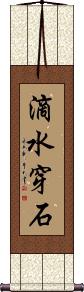
滴水穿石 is a Chinese proverb that means, dripping water penetrates stone.
The figurative meaning can mean:
Constant perseverance yields success.
You can achieve your aim if you try hard without giving up.
Persistent effort overcomes any difficulty.
While 滴水穿石 is the most common character order, you will likely see 水滴石穿, might see 滴水石穿, and will rarely see 小水穿石 in the wild.
Warriors Adapt and Overcome
Soldiers need a fluid plan
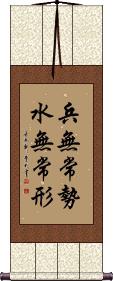
This literally translates as: Troops/soldiers/warriors have no fixed [battlefield] strategy [just as] water has no constant shape [but adapts itself to whatever container it is in].
Figuratively, this means: One should seek to find whatever strategy or method is best suited to resolving each individual problem.
This proverb is about as close as you can get to the military idea of “adapt improvise overcome.” 兵無常勢水無常形 is the best way to express that idea in both an ancient way, and a very natural way in Chinese.
Diligence
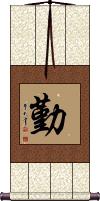
勤 is a single character that means diligence or “sense of duty” in Chinese and Korean (also understood in Japanese but not commonly seen as a stand-alone Kanji).
As a single character on a wall scroll, this will only be seen with this meaning. However, it can also mean industrious, hardworking, frequent, regular, constant, energy, zeal, fortitude, or virility.
In Buddhism, this can represent vīrya (viriya), the idea of energy, diligence, enthusiasm, or effort. It can mean an attitude of gladly engaging in wholesome activities, and it functions to cause one to accomplish wholesome or virtuous actions. Some Buddhists may even define this as “manliness” (a definition from a hundred years ago, before equality).
If you or someone you know is a hard worker (or needs a reminder to be diligent), then this is the wall scroll to have in your/their office.
See Also: Tenacious / Tenacity | Carry On | Undaunted
Frightful Demon / Asura
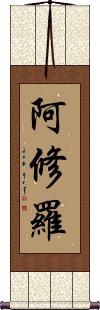
This demon title comes from the ancient Sanskrit word Asura.
阿修羅 is often used in Buddhism when describing various demons. Sometimes defined as “Fighting and battling a giant demon.”
In the context of Buddhism: This title originally meant a spirit, spirits, or even the gods (perhaps before 1700 years ago). It now generally indicates titanic demons, enemies of the gods, with whom, especially Indra, they wage constant war. They are defined as “not devas,” “ugly,” and “without wine.” There are four classes of asuras, separated according to their manner of rebirth. They can be egg-born, womb-born, transformation-born, and spawn- or water-born. Their abode is in the ocean, north of Sumeru but certain of the weaker dwell in a western mountain cave. They have realms, rulers, and palaces, as have the devas.
In terms of power, Asuras rank above humans but below most other deities. They live near the coastal foot of Mount Sumeru (on the northern side). Their domain is partially or wholly in the ocean.
These search terms might be related to Constant:
Confidence / Faithful Heart
Devout / Godly / Faithful
Endless / Without Limit
Even a Fool May Sometimes Come Up With a Good Idea
Even an Iron Bar Can Be Ground to a Needle
Even Monkeys Fall From Trees
Even the 100-Foot Bamboo Can Grow One More Foot
Faithful / Honorable / Trustworthy / Fidelity / Loyalty
Infinity / Infinite / Endless / Boundless
Integrity: Sincere Honest and Faithful
Loyalty / Faithful / Devoted
Relentless / Ruthless
Relentless / Stubborn
Samsara / Endless Cycle of Rebirth
Semper Fidelis / Always Faithful
Smooth and Steady
Stable - Mind at Peace
Unbroken
Unswerving Determination / Firm and Persistent
Not the results for Constant that you were looking for?
Below are some entries from our dictionary that may match your Constant search:
| Characters If shown, 2nd row is Simp. Chinese |
Pronunciation Romanization |
Simple Dictionary Definition |
佛 see styles |
fú fu2 fu hotoke ほとけ |
More info & calligraphy: Buddhism / Buddha(surname) Hotoke Buddha, from budh to "be aware of", "conceive", "observe", "wake"; also 佛陀; 浮圖; 浮陀; 浮頭; 浮塔; 勃陀; 勃馱; 沒馱; 母馱; 母陀; 部陀; 休屠. Buddha means "completely conscious, enlightened", and came to mean the enlightener. he Chinese translation is 覺 to perceive, aware, awake; and 智 gnosis, knowledge. There is an Eternal Buddha, see e.g. the Lotus Sutra, cap. 16, and multitudes of Buddhas, but the personality of a Supreme Buddha, an Ādi-Buddha, is not defined. Buddha is in and through all things, and some schools are definitely Pan-Buddhist in the pantheistic sense. In the triratna 三寳 commonly known as 三寳佛, while Śākyamuni Buddha is the first "person" of the Trinity, his Law the second, and the Order the third, all three by some are accounted as manifestations of the All-Buddha. As Śākyamuni, the title indicates him as the last of the line of Buddhas who have appeared in this world, Maitreya is to be the next. As such he is the one who has achieved enlightenment, having discovered the essential evil of existence (some say mundane existence, others all existence), and the way of deliverance from the constant round of reincarnations; this way is through the moral life into nirvana, by means of self-abnegation, the monastic life, and meditation. By this method a Buddha, or enlightened one, himself obtains Supreme Enlightenment, or Omniscience, and according to Māhāyanism leads all beings into the same enlightenment. He sees things not as they seem in their phenomenal but in their noumenal aspects, as they really are. The term is also applied to those who understand the chain of causality (twelve nidānas) and have attained enlightenment surpassing that of the arhat. Four types of the Buddha are referred to: (1) 三藏佛the Buddha of the Tripiṭaka who attained enlightenment on the bare ground under the bodhi-tree; (2) 通佛the Buddha on the deva robe under the bodhi-tree of the seven precious things; (3) 別佛the Buddha on the great precious Lotus throne under the Lotus realm bodhi-tree; and (4) 圓佛the Buddha on the throne of Space in the realm of eternal rest and glory where he is Vairocana. The Hīnayāna only admits the existence of one Buddha at a time; Mahāyāna claims the existence of many Buddhas at one and the same time, as many Buddhas as there are Buddha-universes, which are infinite in number. |
勤 see styles |
qín qin2 ch`in chin tsutome つとめ |
More info & calligraphy: Diligence(personal name) Tsutome vīrya, energy, zeal, fortitude, virility; intp. also as 精進 one of the pāramitās. |
阿修羅 阿修罗 see styles |
ā xiū luó a1 xiu1 luo2 a hsiu lo ashura あしゅら |
More info & calligraphy: Frightful Demon / Asura{Buddh} Asura; demigod; anti-god; titan; demigods that fight the Devas (gods) in Hindu mythology; (female given name) Ashura asura, 修羅 originally meaning a spirit, spirits, or even the gods, it generally indicates titanic demons, enemies of the gods, with whom, especially Indra, they wage constant war. They are defined as 'not devas', and 'ugly', and 'without wine'. Other forms are 阿須羅 (or 阿蘇羅, or 阿素羅); 阿修倫 (or羅須倫 or 阿修輪 or 羅須輪); 阿素洛; 阿差. Four classes are named according to their manner of rebirth-egg, born, womb-born, transformation-born, and spawn- or water-born. Their abode is in the ocean, north of Sumeru, but certain of the weaker dwell in a western mountain cave. They have realms, rulers, and palaces, as have the devas. The 阿修羅道 is one of the six gatis, or ways of reincarnation. The 修羅場 or 修羅巷 is the battlefield of the asuras against Indra. The 阿修羅琴 are their harps. |
滴水穿石 see styles |
dī shuǐ chuān shí di1 shui3 chuan1 shi2 ti shui ch`uan shih ti shui chuan shih |
More info & calligraphy: Dripping Water Penetrates Stone |
コンスタント see styles |
konsutanto コンスタント |
More info & calligraphy: Constant |
常 see styles |
cháng chang2 ch`ang chang hisashi ひさし |
always; ever; often; frequently; common; general; constant (prefix) constant; unchanging; eternal; (female given name) Hisashi nitya; śāśvata. Prolonged, constant, always, unceasing, permanent, perpetual, ever, eternal; normal, ordinary, regular. |
恆 恒 see styles |
héng heng2 heng hisashi ひさし |
permanent; constant; fixed; usual; ordinary; rule (old); one of the 64 hexagrams of the Book of Changes (䷟) (personal name) Hisashi always |
恒 see styles |
héng heng2 heng wataru わたる |
variant of 恆|恒[heng2] (given name) Wataru Constant; perseverance, persistence; translit. ga, ha. |
綱 纲 see styles |
gāng gang1 kang tsunashi つなし |
head rope of a fishing net; guiding principle; key link; class (taxonomy); outline; program (1) rope; cord; line; (2) {sumo} grand champion's braided belt; (given name) Tsunashi A net rope, bond, social nexus, constant obligation, the restraints of society. |
輪 轮 see styles |
lún lun2 lun run るん |
wheel; disk; ring; steamship; to take turns; to rotate; classifier for big round objects: disk, or recurring events: round, turn (counter) counter for wheels and flowers; (female given name) Run cakra; wheel, disc, rotation, to revolve; v. 研. The three wheels are 惑業苦illusion, karma, suffering, in constant revolution. The five are earth, water, fire, wind, and space; the earth rests on revolving spheres of water, fire, wind, and space. The nine are seen on the tops of pagodas, cf. 九輪.; The two wheels of a cart compared by the Tiantai school to 定 (or to its Tiantai form 止觀) and 慧 meditation and wisdom; see 止觀 5. Also 食 food and 法 the doctrine, i. e. food physical and spiritual. |
π日 see styles |
pài rì pai4 ri4 p`ai jih pai jih |
World Pi Day, a celebration of the mathematical constant π on March 14 each year |
一定 see styles |
yī dìng yi1 ding4 i ting kazusada かずさだ |
surely; certainly; definitely; fixed; settled; a certain ...; a given ... (vs,vt,vi) (1) to fix; to settle; to standardize; to regularize; (can be adjective with の) (2) constant; definite; uniform; defined; certain; prescribed; (given name) Kazusada |
一貫 一贯 see styles |
yī guàn yi1 guan4 i kuan kazutsura かづつら |
consistent; constant; from start to finish; all along; persistent (n,vs,vt,vi) (1) consistency; coherence; integration; (2) (See 貫・1) one kan (approx. 3.75 kg); (3) one piece of sushi; (male given name) Kazutsura |
三忍 see styles |
sān rěn san1 ren3 san jen sannin |
The tree forms of kṣānti, i.e. patience (or endurance, tolerance). One of the groups is patience under hatred, under physical hardship, and in pursuit of the faith. Another is patience of the blessed in the Pure Land in understanding the truth they hear, patience in obeying the truth, patience in attaining absolute reality; v. 無量壽經. Another is patience in the joy of remembering Amitābha, patience in meditation on his truth, and patience in constant faith in him. Another is the patience of submission, of faith, and of obedience. |
不変 see styles |
fuhen ふへん |
(adj-na,adj-no,n) (1) (ant: 可変) eternal; everlasting; unchangeable; immutable; immovable; constant; permanent; indestructible; (2) {math} invariant |
不断 see styles |
fudan ふだん |
(adj-no,adj-na,n) (1) constant; persistent; unremitting; ceaseless; (noun or adjectival noun) (2) indecisiveness; (adj-no,n,adv) (3) (now written as 普段) (See 普段・1) usual; normal; everyday; habitual; ordinary; (place-name, surname) Fudan |
不斷 不断 see styles |
bù duàn bu4 duan4 pu tuan fudan |
unceasing; uninterrupted; continuous; constant Without ceasing, unceasing. |
不渝 see styles |
bù yú bu4 yu2 pu yü |
constant; unchanging; abiding; faithful |
不變 不变 see styles |
bù biàn bu4 bian4 pu pien fuhen |
constant; unvarying; (math.) invariant immutable |
不輕 不轻 see styles |
bù qīng bu4 qing1 pu ch`ing pu ching fukyō |
Never Despise, 常不輕菩薩 a previous incarnation of the Buddha, as a monk whose constant greeting to all he met, that they were destined for Buddhahood, brought him much persecution; see the chapter of this title in the Lotus Sutra. |
二光 see styles |
èr guāng er4 guang1 erh kuang nikō |
The dual lights, i.e. 色光 the halo from a Buddha's body and 心光 the light from his mind. Also 常光 the constant halo from the bodies of Buddhas and 神通光 the supernatural light sent out by a Buddha (e.g. from between his eyebrows) to illuminate a distant world. |
五常 see styles |
wǔ cháng wu3 chang2 wu ch`ang wu chang gojou / gojo ごじょう |
the five cardinal virtues in traditional Chinese ethics: benevolence 仁[ren2], justice 義|义[yi4], propriety 禮|礼[li3], wisdom 智[zhi4] and honor 信[xin4]; alternative term for 五倫|五伦[wu3 lun2], the five cardinal relationships; alternative term for 五行[wu3 xing2], the five elements the five cardinal Confucian virtues (justice, politeness, wisdom, fidelity and benevolence); (place-name) Gojō five constant [virtues] |
係数 see styles |
keisuu / kesu けいすう |
(1) {math} coefficient; (2) {physics;chem} coefficient; factor; proportional constant; modulus |
助業 助业 see styles |
zhù yè zhu4 ye4 chu yeh jogou / jogo じょごう |
{Buddh} (See 浄土宗) auxiliary actions (in Jodo: recitation, observation, worship, praise and offering) Auxiliary karma, i.e. deeds or works, e.g. reciting the sutras about the Pure Land, worship, praise, and offering, as additional to direct karma 正業, i.e. faith in Amitābha, expressed by constant thought of him and calling on his name. |
十住 see styles |
shí zhù shi2 zhu4 shih chu jū jū |
The ten stages, or periods, in bodhisattva-wisdom, prajñā 般若, are the 十住; the merits or character attained are the 十地 q.v. Two interpretations may be given. In the first of these, the first four stages are likened to entry into the holy womb, the next four to the period of gestation, the ninth to birth, and the tenth to the washing or baptism with the water of wisdom, e.g. the baptism of a Kṣatriya prince. The ten stages are (1) 發心住 the purposive stage, the mind set upon Buddhahood; (2) 治地住 clear understanding and mental control; (3) 修行住 unhampered liberty in every direction; (4) 生貴住 acquiring the Tathāgata nature or seed; (5) 方便具足住 perfect adaptability and resemblance in self-development and development of others; (6) 正心住 the whole mind becoming Buddha-like; (7) 不退住 no retrogression, perfect unity and constant progress; (8) 童眞住 as a Buddha-son now complete; (9) 法王子住 as prince of the law; (10) 灌頂住 baptism as such, e.g. the consecration of kings. Another interpretation of the above is: (1) spiritual resolve, stage of śrota-āpanna; (2) submission to rule, preparation for Sakṛdāgāmin stage; (3) cultivation of virtue, attainment of Sakṛdāgāmin stage; (4) noble birth, preparation for the anāgāmin stage; (5) perfect means, attainment of anāgāmin stage; (6) right mind, preparation for arhatship; (7) no-retrogradation, the attainment of arhatship; (8) immortal youth, pratyekabuddhahood; (9) son of the law-king, the conception of bodhisattvahood; (10) baptism as the summit of attainment, the conception of Buddhahood. |
守恆 守恒 see styles |
shǒu héng shou3 heng2 shou heng |
conservation (e.g. of energy, momentum or heat in physics); to remain constant (of a number) See: 守恒 |
守節 守节 see styles |
shǒu jié shou3 jie2 shou chieh |
faithful (to the memory of betrothed); constant (of widow who remains unmarried) |
定圧 see styles |
teiatsu / teatsu ていあつ |
(noun - becomes adjective with の) constant pressure |
定数 see styles |
sadakazu さだかず |
(1) fixed number; quorum (for an assembly); (2) {math} (See 変数) constant; invariable; (3) {comp} literal; (4) (dated) fate; (male given name) Sadakazu |
定數 定数 see styles |
dìng shù ding4 shu4 ting shu |
constant (math.); quota; fixed number (e.g. of places on a bus); fixed quantity (e.g. load of truck); destiny See: 定数 |
Click here for more Constant results from our dictionary
The following table may be helpful for those studying Chinese or Japanese:
| Title | Characters | Romaji (Romanized Japanese) | Various forms of Romanized Chinese | |
| Constant | 康斯坦特 | kāng sī tǎn tè kang1 si1 tan3 te4 kang si tan te kangsitante | k`ang ssu t`an t`e kangssutante kang ssu tan te |
|
| Constant | コンスタント | konsutanto | ||
| Dripping Water Penetrates Stone | 滴水穿石 | dī shuǐ chuān shí di1 shui3 chuan1 shi2 di shui chuan shi dishuichuanshi | ti shui ch`uan shih tishuichuanshih ti shui chuan shih |
|
| Warriors Adapt and Overcome | 兵無常勢水無常形 兵无常势水无常形 | bīng wú cháng shì shuǐ wú cháng xíng bing1 wu2 chang2 shi4 shui3 wu2 chang2 xing2 bing wu chang shi shui wu chang xing | ping wu ch`ang shih shui wu ch`ang hsing ping wu chang shih shui wu chang hsing |
|
| Diligence | 勤 | kin | qín / qin2 / qin | ch`in / chin |
| Frightful Demon Asura | 阿修羅 阿修罗 | ashura | ē xiū luó e1 xiu1 luo2 e xiu luo exiuluo | o hsiu lo ohsiulo |
| In some entries above you will see that characters have different versions above and below a line. In these cases, the characters above the line are Traditional Chinese, while the ones below are Simplified Chinese. | ||||

Successful Chinese Character and Japanese Kanji calligraphy searches within the last few hours...



