Many custom options


And formats



Not what you want?
Try other similar-meaning words, fewer words, or just one word.
Be Brave in Chinese / Japanese
Buy a Be Brave calligraphy wall scroll here!
Personalize your custom “Be Brave” project by clicking the button next to your favorite “Be Brave” title below.
3. Brave Heart
9. Courage To Do What Is Right
10. Honor Courage
11. Inspire with redoubled courage
14. Learning leads to Knowledge, Study leads to Benevolence, Shame leads to Courage
15. England
18. Courage to do what is right
20. Adventure
23. No Fear
25. Unbeatable
27. Fierce and courageous training defeats the strong and protects the body.
28. Hero
29. Monkey
30. Warrior Soul / Heroic Spirit
31. Woman of Strong Character / Woman Hero
33. Great Ambitions
Brave Warrior
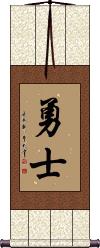
勇士 is the Chinese, Japanese Kanji, and old Korean Hanja for a brave warrior, a brave person, a hero, or a brave man.
In Japanese, this can be a given name, Yuuji.
Fortune Favors The Brave
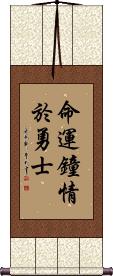
命運鐘情於勇士 means “Fortune favors the brave” in Chinese.
This is not the only way to express the idea of fortune favoring the bold or brave.
It's not originally a Chinese phrase, so it's been translated into Chinese in various ways.
Brave Heart
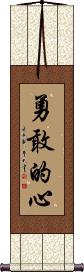
勇敢的心 is the title “Braveheart,” as in the movie starring Mel Gibson.
The character meanings break down this way:
勇敢 brave.
的 possessive particle.
心 heart/mind.
Strong and brave

剛健勇猛 can mean “Strong and brave.”
剛健 = Strong and healthy, or robust spirit/body.
勇猛 = Valor, fierce, and/or courage.
The Brave Have No Fears
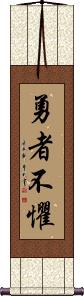
This proverb means “Brave people [are] without fear,” or “The brave are without fear.”
勇者不懼 is a proverb credited to Confucius. It's one of three phrases in a set of things he said.
This phrase is originally Chinese but has penetrated Japanese culture as well (many Confucian phrases have) back when Japan borrowed Chinese characters into their language.
This phrase has also been converted into modern Japanese grammar when written as 勇者は懼れず. If you want this version just click on those characters.
See Also: No Fear
Fortune favors the brave
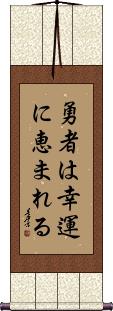
勇者は幸運に恵まれる is a Japanese proverb that suggests that in history, the brave or courageous tend to be the ones who win.
Note: Because this selection contains some special Japanese Hiragana characters, it should be written by a Japanese calligrapher.
Brave the Waves
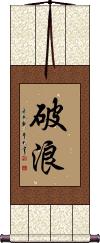
破浪 can be translated from Chinese as “braving the waves” or “bravely setting sail.”
It literally means: “break/cleave/cut [the] waves.”
破浪 is a great title to encourage yourself or someone else not to be afraid of problems or troubles.
Because of the context, this is especially good for sailors or yachtsmen and surfers too.
Note: While this can be understood in Japanese, it's not commonly used in Japan. Therefore, please consider this to be primarily a Chinese proverb.
Indomitable Courage

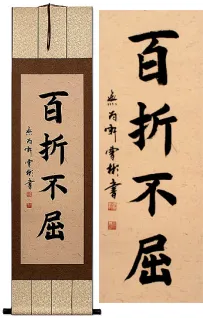
不屈勇氣 can mean “Unyielding,” “Unstoppable Bravery,” or “Indomitable Courage.”
In martial contexts, this phrase is often used as a motto emphasizing mindset, conduct, or training attitude.
Courage To Do What Is Right
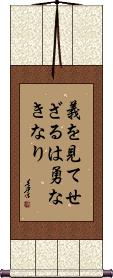
義を見てせざるは勇なきなり is a Japanese proverb that means “Knowing what is right and not doing is a want of courage.”
I've also seen it translated as:
To see what is right, yet fail to do so, is a lack of courage.
To know righteousness, but take no action is cowardice.
You are a coward if you knew what was the right thing to do, but you did not take action.
Knowing what is right without practicing it betrays one's cowardice.
Note: Because this selection contains some special Japanese Hiragana characters, it should be written by a Japanese calligrapher.
Honor Courage
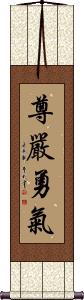
尊嚴勇氣 is a word list that means “Honor [and] Courage.”
Word lists are not common in Chinese, but we've put this one in the best order/context to make it as natural as possible.
We used the “honor” that leans toward the definition of dignity and integrity since that seemed like the best match for courage.
Inspire with redoubled courage
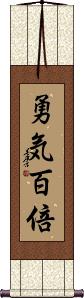
勇気百倍 means to inspire someone with fresh courage or redoubled courage in Japanese.
The Kanji breakdown:
勇気 (yuuki) courage; bravery; valour; valor; nerve; boldness.
百 (hyaku) 100; hundred.
倍 (bai) twice; double; 2-times; 2-fold.
Strength and Courage
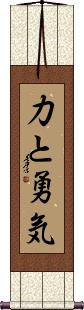
力と勇気 may not be the most common Japanese phrase, but this is how to write “strength and courage” or “power and bravery” in Japanese.
Strength and Courage
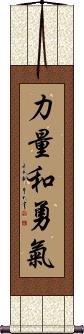
While 力量和勇氣 is not a typical Chinese phrase, this is how to write “strength and courage.”
If this is an important idea for you, we can make a great custom Chinese “strength and courage” wall scroll for you.
Honor Courage Commitment
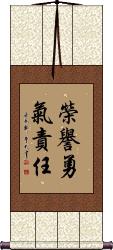
榮譽勇氣責任 is a word list that reads, “榮譽 勇氣 責任” or “honor courage commitment.”
If you are looking for this, it is likely that you are in the military (probably Navy or Marines).
We worked on this for a long time to find the right combination of words in Chinese. However, it should still be noted that word lists are not very natural in Chinese. Most of the time, there would be a subject, verb, and object for a phrase with this many words.
Honor Courage Commitment
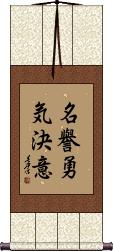
This means “Honor, Courage, Commitment” in Japanese.
名譽勇気決意 is a common military phrase in English used in the Navy and Marines.
This is a word list, which is not the most natural kind of composition in Japanese (usually there is a subject, object, and verb - or a single word).
Learning leads to Knowledge, Study leads to Benevolence, Shame leads to Courage
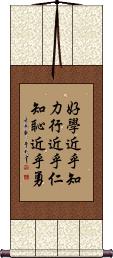
好學近乎知力行近乎仁知恥近乎勇 is a Saying from Confucius which relates certain actions to virtues.
A more verbose translation:
To love learning is akin to knowledge,
to study diligently is akin to benevolence,
to know shame is akin to courage.
England
Can mean: Courage / Bravery
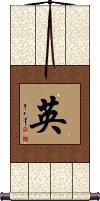
In Chinese, Japanese, and old Korean, 英 can often be confused or read as a short name for England (this character is the first syllable of the word for England, the English language, the British Pound, and other titles from the British Isles).
In some contexts, this can mean “outstanding” or even “flower.” But it will most often read as having something to do with the United Kingdom.
This is not the most common way to say hero, courage or bravery but you may see it used sometimes.
I strongly recommend that you choose another form of courage/bravery.
Courage and Strength
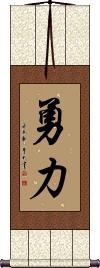
勇力 is a very short way to say “courage and strength” in Chinese and Japanese.
In Japanese, it's read more like “strong courage” or “powerful courage.” This can also be the personal name Yuri or Yuuri in Japanese.
Bravery / Courage
Courage in the face of Fear
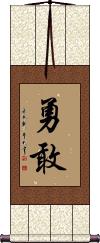
勇敢 is about courage or bravery in the face of fear.
You do the right thing even when it is hard or scary. When you are courageous, you don't give up. You try new things. You admit mistakes. This kind of courage is the willingness to take action in the face of danger and peril.
勇敢 can also be translated as braveness, valor, heroic, fearless, boldness, prowess, gallantry, audacity, daring, dauntless, and/or courage in Japanese, Chinese, and Korean. This version of bravery/courage can be an adjective or a noun. The first character means bravery and courage by itself. The second character means “daring” by itself. The second character emphasizes the meaning of the first but adds the idea that you are not afraid of taking a dare, and you are not afraid of danger.
勇敢 is more about brave behavior and not so much the mental state of being brave. You'd more likely use this to say, “He fought courageously in the battle,” rather than “He is very courageous.”
See Also: Bravery / Courage | Encourage
Courage to do what is right
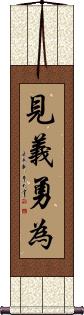
見義勇為 means the courage to do what is right in Chinese.
This could also be translated as “Never hesitate to do what is right.”
This comes from Confucian thought:
Your courage should head in an honorable direction. For example, you should take action when the goal is to attain a just result as, without honorable intent, a person’s gutsy fervor can easily lead them astray.
One who flaunts courage but disregards justice is bound to do wrong; someone who possesses courage and morality is destined to become a hero.
Some text above paraphrased from The World of Chinese - The Character of 勇
See Also: Work Unselfishly for the Common Good | Justice / Rectitude / Right Decision | Bravery / Courage
Bravery / Courage
Single Character for Courage
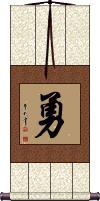
勇 can mean bravery, courage, valor, or fearless in Chinese, Japanese, and Korean.
勇 is the simplest form to express courage or bravery, as there is also a two-character form that starts with this same character.
勇 can also be translated as brave, daring, fearless, plucky, or heroic.
This is also a virtue of the Samurai Warrior
See our page with just Code of the Samurai / Bushido here
See Also: Bravery / Courage | Encourage
Adventure
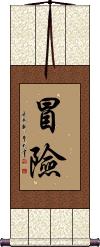
冒險 is another Chinese and Korean word for “Adventure.”
This is a more “risk-taking” sense of adventure.
The first character can mean “brave” and “bold.” The second character means “dangerous” and “rugged.” Together they can mean a word meaning “adventure” in Chinese and Korean.
Note: Some dictionaries translate these two characters as “take a risk.”
See Also: Bon Voyage | Traveler / Wanderer / Vagabond / Rolling Stone
Bravery / Courage
Courageous Energy
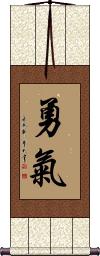
勇氣 is one of several ways to express bravery and courage in Chinese, Japanese, and Korean.
This version is the most spiritual. This is the essence of bravery from deep within your being. This is the mental state of being brave versus actual brave behavior. You'd more likely use this to say, “He is very courageous,” rather than “He fought courageously in the battle.”
The first character also means bravery or courage when it's seen alone. With the second character added, an element of energy or spirit is added. The second character is the same “chi” or “qi” energy that Kung Fu masters focus on when they strike. For this reason, you could say this means “spirit of courage” or “brave spirit.”
This is certainly a stronger word than just the first character alone.
Beyond bravery or courage, dictionaries also translate this word as valor/valour, nerve, audacity, daring, pluck, plucky, gallantry, guts, gutsy, and boldness.
This is also one of the 8 key concepts of tang soo do.
 While the version shown to the left is commonly used in Chinese and Korean Hanja (and ancient Japanese Kanji), please note that the second character is written with slightly fewer strokes in modern Japanese. If you want the modern Japanese version, please click on the character to the right. Both styles would be understood by native Chinese, Japanese, and many (but not all) Korean people. You should make your selection based on the intended audience for your calligraphy artwork. Or pick the single-character form of bravery/courage which is universal.
See Also: Bravery / Courage | Encourage
Fidelity Honor Courage
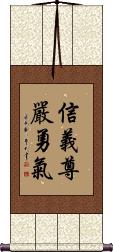
信義尊嚴勇氣 means fidelity, honor, and courage in Chinese.
This is a word list that was requested by a customer. Word lists are not common in Chinese, but we've put this one in the best order/context to make it as natural as possible.
We used the “honor” that leans toward the definition of “dignity” since that seemed the best match for the other two words.
Please note: These are three two-character words. You should choose the single-column format when you get to the options when you order this selection. The two-column option would split one word or be arranged with four characters on one side and two on the other.
No Fear
(four-character version)
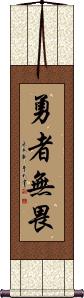
勇者無畏 is a complete sentence that means “Brave People Have No Fear” or “A Brave Person Has No Fear” (plural or singular is not implied).
We translated “No Fear” into the two variations that you will find on our website. Then we checked Chinese Google and found that others had translated “No Fear” in the exact same ways. Pick the one you like best. A great gift for your fearless friend.
See Also: Fear No Man / Fear Nothing
Fortune Favors the Bold
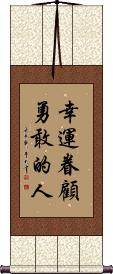
幸运眷顾勇敢的人 can mean “Fortune favors the brave/bold/courageous” in Chinese.
Unbeatable
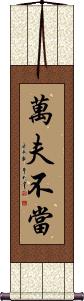
萬夫不當 is a Chinese proverb that literally means, “Unbeatable by even 10,000 men.”
This is understood to mean extremely brave and strong.
Seafarer / Sailor
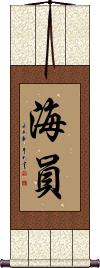
海員 is the Chinese, Japanese Kanji, and old Korean Hanja for a sailor, mariner, seafarer, or seaman.
If you sail the seas and brave the waves, this may be the title for you.
The literal meanings: 海 is “Sea” and 員 is “Person.”
Fierce and courageous training defeats the strong and protects the body.

This is a martial arts phrase that roughly translates as, “Fierce and courageous training defeats the strong and protects the body,” or “Brave and fierce training result in victory over the strong and defend the body.”
Hero
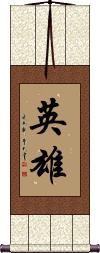
英雄 is the best way to write hero in Chinese and Japanese - especially for calligraphy.
英雄 is also the name of the Chinese movie titled Hero starring Jet Li.
The first character means brave (it can also mean British or English but not in this case).
The second character means heroic but also suggests a male person.
My Japanese dictionary also defines this as “a great man.”
Monkey
Year of the Monkey / Zodiac Sign
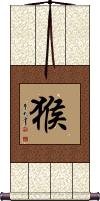
猴 is the monkey character in Chinese.
猴 means ape in Japanese due to an error made long ago as Japan absorbed Chinese characters.
If you were born in the year of the monkey, you . . .
Are smart, brave, active, and competitive.
Like new things.
Have a good memory.
Are quick to respond
Have an easy time winning people's trust.
Are, however, not very patient.
See also our Chinese Zodiac page.
Note: This character does have the meaning of monkey in Korean Hanja but is not used very often.
Warrior Soul / Heroic Spirit
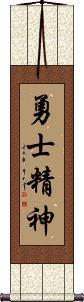
勇士精神 can mean the warrior's spirit or warrior's soul. The first two characters can mean “warrior” or literally “brave soldier/man,” although some will translate this word as “hero.” Therefore, this is also how to say “heroic spirit.”
The second two characters mean vigor, vitality, drive, spirit, mind, heart, mental essence, and psychological component. Basically “your soul.”
We have two versions of this phrase. The only difference is the first two and last two characters are swapped. The version here suggests that you admire or like the idea of the spirit of a warrior. The other version suggests that you are the warrior or hero.
Woman of Strong Character / Woman Hero
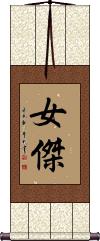
女傑 can mean brave woman, heroine, lady of character, distinguished woman, outstanding woman, and sometimes prominent woman.
Some people might use this to give a title to women like Amelia Earhart, Rosa Parks, Queen Elizabeth the First, Joan of Arc, Mulan Fa, Yevdokiya Nikolayevna Zavaliy, Harriet Tubman, Anne Frank, Clara Barton, and Jane Eyre.
I use it for a woman like Araceli Segarra (the first woman from Spain to climb Mt. Everest) and gave one of my daughters the middle name of Araceli.
Soul of a Warrior
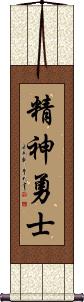
精神勇士 can mean the spirit or soul of a warrior. The first two characters can mean vigor, vitality, drive, spirit, mind, heart, mental essence, and psychological component. “your soul.”
The second two characters mean “warrior” or literally “brave soldier/man,” although some will translate this word as “hero.” Therefore, this is also how to say “soul of a hero.”
Note: This title is best for Chinese and old Korean. It does make sense in Japanese but is not a common or natural Kanji combination in Japanese.
We have two versions of this phrase. The only difference is the first two and last two characters are swapped. The version here suggests that you are the warrior or hero. The other version suggests that you admire or like the idea of the spirit of a warrior.
Great Ambitions
Brave the wind and the waves
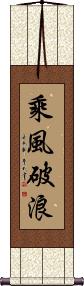
乘風破浪 is a Chinese proverb that represents having great ambitions.
The British might say “to plough through.” Another way to understand it is “surmount all difficulties and forge ahead courageously.”
This can also be translated as “braving the wind and waves,” “to brave the wind and the billows,” “to ride the wind and crest the waves,” or “to be ambitious and unafraid.”
Literally, it reads: “ride (like a chariot) [the] wind [and] break/cleave/cut [the] waves,” or “ride [the] wind [and] slash [through the] waves.”
乘風破浪 is a great proverb to encourage yourself or someone else not to be afraid of problems or troubles, and when you have a dream, just go for it.
There is an alternate version, 長風破浪, but 乘風破浪 is far more common.
Art of War: 5 Points of Analysis
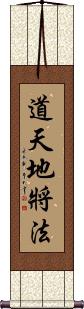
道天地將法 is a list of five key points to analyzing your situation from the first chapter of Sun Tzu's Art of War.
This reads like a 5-part military proverb. Sun Tzu says that to sharpen your skills, you must plan. To plan well, you must know your situation. Therefore, you must consider and discuss the following:
1. Philosophy and Politics: Make sure your way or your policy is agreeable among all of your troops (and the citizens of your kingdom as well). For when your soldiers believe in you and your way, they will follow you to their deaths without hesitation and will not question your orders.
2. Heaven/Sky: Consider climate / weather. This can also mean considering whether God is smiling upon you. In the modern military, this could be waiting for clear skies so that you can have air support for an amphibious landing.
3. Ground/Earth: Consider the terrain in which the battle will take place. This includes analyzing defensible positions, and exit routes, while using varying elevations to your advantage. When you plan an ambush, you must know your terrain and the best location from which to stage that ambush. This knowledge will also help you avoid being ambushed, as you will know where the likely places in which to expect an ambush from your enemy.
4. Leadership: This applies to you as the general and your lieutenants. A leader should be smart and be able to develop good strategies. Leaders should keep their word, and if they break a promise, they should punish themselves as harshly as they would punish subordinates. Leaders should be benevolent to their troops, with almost a fatherly love for them. Leaders must have the ability to make brave and fast decisions. Leaders must have steadfast principles.
5. [Military] Methods: This can also mean laws, rules, principles, models, or systems. You must have an efficient organization in place to manage both your troops and supplies. In the modern military, this would be a combination of how your unit is organized and your SOP (Standard Operating Procedure).
Notes: This is a simplistic translation and explanation. Much more is suggested in the actual text of the Art of War (Bing Fa). It would take many study to master all of these aspects. In fact, these five characters can be compared to the modern military acronyms such as BAMCIS or SMEAC.
CJK notes: I have included the Japanese and Korean pronunciations but in Chinese, Korean and Japanese, this does not make a typical phrase (with subject, verb, and object) it is a list that only someone familiar with Sun Tzu’s writings would understand.
This in-stock artwork might be what you are looking for, and ships right away...
The following table may be helpful for those studying Chinese or Japanese:
| Title | Characters | Romaji (Romanized Japanese) | Various forms of Romanized Chinese | |
| Brave Warrior | 勇士 | yuu shi / yuushi / yu shi | yǒng shì / yong3 shi4 / yong shi / yongshi | yung shih / yungshih |
| Fortune Favors The Brave | 命運鐘情於勇士 命运钟情于勇士 | mìng yùn zhōng qíng yú yǒng shì ming4 yun4 zhong1 qing2 yu2 yong3 shi4 ming yun zhong qing yu yong shi | ming yün chung ch`ing yü yung shih ming yün chung ching yü yung shih |
|
| Brave Heart | 勇敢的心 | yǒng gǎn de xīn yong3 gan3 de xin1 yong gan de xin yonggandexin | yung kan te hsin yungkantehsin |
|
| Strong and brave | 剛健勇猛 | gō ken yū mō gōkenyūmō | gāng jiàn yǒng měng gang1 jian4 yong3 meng3 gang jian yong meng gangjianyongmeng | kang chien yung meng kangchienyungmeng |
| The Brave Have No Fears | 勇者不懼 勇者不惧 | yuu sha fu ku yuushafuku yu sha fu ku | yǒng zhě bú jù yong3 zhe3 bu2 ju4 yong zhe bu ju yongzhebuju | yung che pu chü yungchepuchü |
| Fortune favors the brave | 勇者は幸運に恵まれる | yuusha ha kouun ni megumareru yusha ha koun ni megumareru | ||
| Brave the Waves | 破浪 | ha rou / harou / ha ro | pò làng / po4 lang4 / po lang / polang | p`o lang / polang / po lang |
| Indomitable Courage | 不屈勇氣 不屈勇气 | fukutsu-yūki | bù qū yǒng qì bu4 qu1 yong3 qi4 bu qu yong qi buquyongqi | pu ch`ü yung ch`i puchüyungchi pu chü yung chi |
| Courage To Do What Is Right | 義を見てせざるは勇なきなり | giomitesezaruhayuunakinari giomitesezaruhayunakinari | ||
| Honor Courage | 尊嚴勇氣 尊严勇气 | zūn yán yǒng qì zun1 yan2 yong3 qi4 zun yan yong qi zunyanyongqi | tsun yen yung ch`i tsunyenyungchi tsun yen yung chi |
|
| Inspire with redoubled courage | 勇気百倍 | yuuki hyaku bai yuukihyakubai yuki hyaku bai | ||
| Strength and Courage | 力と勇氣 力と勇気 | riki to yu ki rikitoyuki | ||
| Strength and Courage | 力量和勇氣 力量和勇气 | lì liàng hé yǒng qì li4 liang4 he2 yong3 qi4 li liang he yong qi liliangheyongqi | li liang ho yung ch`i lilianghoyungchi li liang ho yung chi |
|
| Honor Courage Commitment | 榮譽勇氣責任 荣誉勇气责任 | róng yù yǒng qì zé rèn rong2 yu4 yong3 qi4 ze2 ren4 rong yu yong qi ze ren rongyuyongqizeren | jung yü yung ch`i tse jen jungyüyungchitsejen jung yü yung chi tse jen |
|
| Honor Courage Commitment | 名譽, 勇気, 決意 名誉, 勇気, 決意 | meiyo yuuki ketsui meiyoyuukiketsui meiyo yuki ketsui | ||
| Learning leads to Knowledge, Study leads to Benevolence, Shame leads to Courage | 好學近乎知力行近乎仁知恥近乎勇 好学近乎知力行近乎仁知耻近乎勇 | hào xué jìn hū zhī lì xíng jìn hū rén zhī chǐ jìn hū yǒng hao4 xue2 jin4 hu1 zhi1 li4 xing2 jin4 hu1 ren2 zhi1 chi3 jin4 hu1 yong3 hao xue jin hu zhi li xing jin hu ren zhi chi jin hu yong | hao hsüeh chin hu chih li hsing chin hu jen chih ch`ih chin hu yung hao hsüeh chin hu chih li hsing chin hu jen chih chih chin hu yung |
|
| England | 英 | ei | yīng / ying1 / ying | |
| Courage and Strength | 勇力 | yuu ri / yuuri / yu ri | yǒng lì / yong3 li4 / yong li / yongli | yung li / yungli |
| Bravery Courage | 勇敢 | yuu kan / yuukan / yu kan | yǒng gǎn / yong3 gan3 / yong gan / yonggan | yung kan / yungkan |
| Courage to do what is right | 見義勇為 见义勇为 | jiàn yì yǒng wéi jian4 yi4 yong3 wei2 jian yi yong wei jianyiyongwei | chien i yung wei chieniyungwei |
|
| Bravery Courage | 勇 | isamu / yu- | yǒng / yong3 / yong | yung |
| Adventure | 冒險 冒险 | mào xiǎn / mao4 xian3 / mao xian / maoxian | mao hsien / maohsien | |
| Bravery Courage | 勇氣 勇气 / 勇気 | yuuki / yuki | yǒng qì / yong3 qi4 / yong qi / yongqi | yung ch`i / yungchi / yung chi |
| Fidelity Honor Courage | 信義尊嚴勇氣 信义尊严勇气 | xìn yì zūn yán yǒng qì xin4 yi4 zun1 yan2 yong3 qi4 xin yi zun yan yong qi xinyizunyanyongqi | hsin i tsun yen yung ch`i hsinitsunyenyungchi hsin i tsun yen yung chi |
|
| No Fear | 勇者無畏 勇者无畏 | yǒng zhě wú wèi yong3 zhe3 wu2 wei4 yong zhe wu wei yongzhewuwei | yung che wu wei yungchewuwei |
|
| Fortune Favors the Bold | 幸運眷顧勇敢的人 幸运眷顾勇敢的人 | xìng yùn juàn gù yǒng gǎn de rén xing4 yun4 juan4 gu4 yong3 gan3 de ren2 xing yun juan gu yong gan de ren | hsing yün chüan ku yung kan te jen | |
| Unbeatable | 萬夫不當 万夫不当 | wàn fū bù dāng wan4 fu1 bu4 dang1 wan fu bu dang wanfubudang | wan fu pu tang wanfuputang |
|
| Seafarer Sailor | 海員 海员 | kaiin / kain kain / kain | hǎi yuán / hai3 yuan2 / hai yuan / haiyuan | hai yüan / haiyüan |
| Fierce and courageous training defeats the strong and protects the body. | 剛勇之猛練勝強而保體 刚勇之猛练胜强而保体 | gāng yǒng zhī měng liàn shèng qiáng ér bǎo tǐ gang1 yong3 zhi1 meng3 lian4 sheng4 qiang2 er2 bao3 ti3 gang yong zhi meng lian sheng qiang er bao ti | kang yung chih meng lien sheng ch`iang erh pao t`i kang yung chih meng lien sheng chiang erh pao ti |
|
| Hero | 英雄 | ei yuu / eiyuu / ei yu | yīng xióng ying1 xiong2 ying xiong yingxiong | ying hsiung yinghsiung |
| Monkey | 猴 | hóu / hou2 / hou | ||
| Warrior Soul Heroic Spirit | 勇士精神 | yǒng shì jīng shén yong3 shi4 jing1 shen2 yong shi jing shen yongshijingshen | yung shih ching shen yungshihchingshen |
|
| Woman of Strong Character Woman Hero | 女傑 女杰 | joketsu | nǚ jié / nv3 jie2 / nv jie / nvjie | nü chieh / nüchieh |
| Soul of a Warrior | 精神勇士 | jīng shén yǒng shì jing1 shen2 yong3 shi4 jing shen yong shi jingshenyongshi | ching shen yung shih chingshenyungshih |
|
| Great Ambitions | 乘風破浪 乘风破浪 | chéng fēng pò làng cheng2 feng1 po4 lang4 cheng feng po lang chengfengpolang | ch`eng feng p`o lang chengfengpolang cheng feng po lang |
|
| Art of War: 5 Points of Analysis | 道天地將法 道天地将法 | dou ten chi shou hou doutenchishouhou do ten chi sho ho | dào tiān dì jiàng fǎ dao4 tian1 di4 jiang4 fa3 dao tian di jiang fa daotiandijiangfa | tao t`ien ti chiang fa taotientichiangfa tao tien ti chiang fa |
| In some entries above you will see that characters have different versions above and below a line. In these cases, the characters above the line are Traditional Chinese, while the ones below are Simplified Chinese. | ||||

Successful Chinese Character and Japanese Kanji calligraphy searches within the last few hours...



