Many custom options...


And formats...



Encourage in Chinese / Japanese...
Buy an Encourage calligraphy wall scroll here!
Personalize your custom “Encourage” project by clicking the button next to your favorite “Encourage” title below...
Encourage
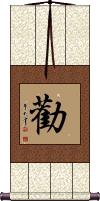
勸 is the simplest Chinese, Japanese Kanji, and old Korean Hanja word for encouragement or the act of encouraging someone.
This can also mean: to advise; to urge; to try to persuade; to exhort; to console; to soothe.
Bravery / Courage
Single Character for Courage
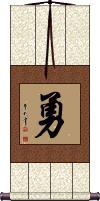
勇 can mean bravery, courage, valor, or fearless in Chinese, Japanese, and Korean.
勇 is the simplest form to express courage or bravery, as there is also a two-character form that starts with this same character.
勇 can also be translated as brave, daring, fearless, plucky, or heroic.
This is also a virtue of the Samurai Warrior
See our page with just Code of the Samurai / Bushido here
See Also: Bravery / Courage
Bravery / Courage
Courage in the face of Fear
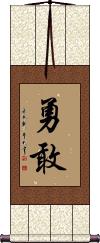
勇敢 is about courage or bravery in the face of fear.
You do the right thing even when it is hard or scary. When you are courageous, you don't give up. You try new things. You admit mistakes. This kind of courage is the willingness to take action in the face of danger and peril.
勇敢 can also be translated as braveness, valor, heroic, fearless, boldness, prowess, gallantry, audacity, daring, dauntless, and/or courage in Japanese, Chinese, and Korean. This version of bravery/courage can be an adjective or a noun. The first character means bravery and courage by itself. The second character means “daring” by itself. The second character emphasizes the meaning of the first but adds the idea that you are not afraid of taking a dare, and you are not afraid of danger.
勇敢 is more about brave behavior and not so much the mental state of being brave. You'd more likely use this to say, “He fought courageously in the battle,” rather than “He is very courageous.”
See Also: Bravery / Courage
No Fear
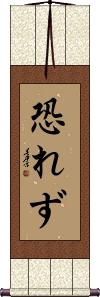
恐れず is probably the best way to express “No Fear” in Japanese.
The first Kanji and the following Hiragana character create a word that means: to fear, to be afraid of, frightened, or terrified.
The last Hiragana character serves to modify and negate the first word (put it in negative form). they carry a meaning like “without” or “keeping away.” 恐れず is almost like the English modifier “-less.”
Altogether, you get something like “Without Fear” or “Fearless.”
Here's an example of using this in a sentence: 彼女かのじょは思い切ったことを恐れずにやる。
Translation: She is not scared of taking big risks.
Note: Because this selection contains some special Japanese Hiragana characters, it should be written by a Japanese calligrapher.
See Also: Bravery / Courage
Bravery / Courage
Courageous Energy
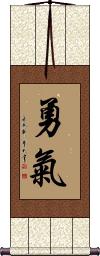
勇氣 is one of several ways to express bravery and courage in Chinese, Japanese, and Korean.
This version is the most spiritual. This is the essence of bravery from deep within your being. This is the mental state of being brave versus actual brave behavior. You'd more likely use this to say, “He is very courageous,” rather than “He fought courageously in the battle.”
The first character also means bravery or courage when it's seen alone. With the second character added, an element of energy or spirit is added. The second character is the same “chi” or “qi” energy that Kung Fu masters focus on when they strike. For this reason, you could say this means “spirit of courage” or “brave spirit.”
This is certainly a stronger word than just the first character alone.
Beyond bravery or courage, dictionaries also translate this word as valor/valour, nerve, audacity, daring, pluck, plucky, gallantry, guts, gutsy, and boldness.
This is also one of the 8 key concepts of tang soo do.
 While the version shown to the left is commonly used in Chinese and Korean Hanja (and ancient Japanese Kanji), please note that the second character is written with slightly fewer strokes in modern Japanese. If you want the modern Japanese version, please click on the character to the right. Both styles would be understood by native Chinese, Japanese, and many (but not all) Korean people. You should make your selection based on the intended audience for your calligraphy artwork. Or pick the single-character form of bravery/courage which is universal.
See Also: Bravery / Courage
No Fear
(2 characters)
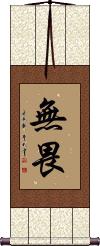
無畏 literally means “No Fear.” But perhaps not the most natural Chinese phrase (see our other “No Fear” phrase for a complete thought). However, this two-character version of “No Fear” seems to be a very popular way to translate this into Chinese when we checked Chinese Google.
Note: This also means “No Fear” in Japanese and Korean, but this character pair is not often used in Japan or Korea.
This term appears in various Chinese dictionaries with definitions like “without fear,” intrepidity, fearless, dauntless, and bold.
In the Buddhist context, this is a word derived from the word Abhaya, meaning: Fearless, dauntless, secure, nothing, and nobody to fear. Also, from vīra meaning: courageous, bold.
See Also: Never Give Up | No Worries | Carry On | Undaunted | Bravery / Courage | Fear No Man / Fear Nothing
Outstanding
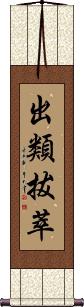
出類拔萃 means “one who stands out from their peers,” “stand out from the crowd,” or “standing out from others.” It can also mean “leaving your peers behind.”
A great way to tell yourself that you are outstanding (or give it to a friend you want to encourage to excel).
Brave the Waves
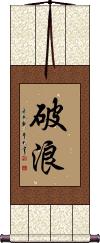
破浪 can be translated from Chinese as “braving the waves” or “bravely setting sail.”
It literally means: “break/cleave/cut [the] waves.”
破浪 is a great title to encourage yourself or someone else not to be afraid of problems or troubles.
Because of the context, this is especially good for sailors or yachtsmen and surfers too.
Note: While this can be understood in Japanese, it's not commonly used in Japan. Therefore, please consider this to be primarily a Chinese proverb.
Devotion to your Profession / Career
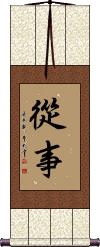
從事/従事 is often used to describe the devotion someone has to their profession - However, it can just mean career, depending on context.
We don't highly recommend this selection for a wall scroll.
In more simple terms, this word also means undertake / to deal with / to handle / to do. It does not have to refer to a career issue, as it could be used to encourage someone that is beginning their university studies etc.
This kind of makes sense in Japanese, however, there is a slight deviation in the way they write the first Kanji in Japanese.
 Please note that Japanese use an alternate version of the first character. Click on the character to the right if you want the Japanese version of this two-character Devotion-to-your-Profession calligraphy.
Great Ambitions
Brave the wind and the waves
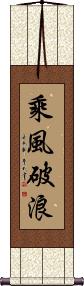
乘風破浪 is a Chinese proverb that represents having great ambitions.
The British might say “to plough through.” Another way to understand it is “surmount all difficulties and forge ahead courageously.”
This can also be translated as “braving the wind and waves,” “to brave the wind and the billows,” “to ride the wind and crest the waves,” or “to be ambitious and unafraid.”
Literally, it reads: “ride (like a chariot) [the] wind [and] break/cleave/cut [the] waves,” or “ride [the] wind [and] slash [through the] waves.”
乘風破浪 is a great proverb to encourage yourself or someone else not to be afraid of problems or troubles, and when you have a dream, just go for it.
There is an alternate version, 長風破浪, but 乘風破浪 is far more common.
Cutting and Polishing

切磋琢磨 literally means “cutting, filing, carving, polishing” in Chinese, Japanese Kanji, and old Korean Hanja.
Originally describing polishing jade, 切磋琢磨 became a metaphor for people refining one another through study or interaction.
This can have the following interpretations:
To learn by exchanging ideas or experiences.
Mutual encouragement (to improve).
Cultivating one's character by studying hard.
Peers improving each other.
Mutual refinement.
Diligent application.
Intellectual sharpening.
In the context of self-reflection, it can mean discussing and pondering.
切磋琢磨 is probably the closest philosophical equivalent to “iron sharpens iron.”
This in-stock artwork might be what you are looking for, and ships right away...
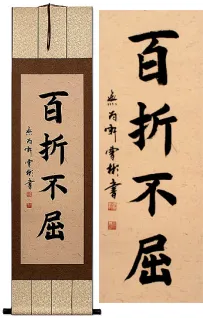
These search terms might be related to Encourage:
Advance Bravely / Indomitable Spirit
Push or Knock
The following table may be helpful for those studying Chinese or Japanese...
| Title | Characters | Romaji (Romanized Japanese) | Various forms of Romanized Chinese | |
| Encourage | 勸 劝 | kan | quàn / quan4 / quan | ch`üan / chüan |
| Bravery Courage | 勇 | isamu / yu- | yǒng / yong3 / yong | yung |
| Bravery Courage | 勇敢 | yuu kan / yuukan / yu kan | yǒng gǎn / yong3 gan3 / yong gan / yonggan | yung kan / yungkan |
| No Fear | 恐れず | oso re zu / osorezu | ||
| Bravery Courage | 勇氣 勇气 / 勇気 | yuuki / yuki | yǒng qì / yong3 qi4 / yong qi / yongqi | yung ch`i / yungchi / yung chi |
| No Fear | 無畏 无畏 | mui | wú wèi / wu2 wei4 / wu wei / wuwei | |
| Outstanding | 出類拔萃 出类拔萃 | chū lèi bá cuì chu1 lei4 ba2 cui4 chu lei ba cui chuleibacui | ch`u lei pa ts`ui chuleipatsui chu lei pa tsui |
|
| Brave the Waves | 破浪 | ha rou / harou / ha ro | pò làng / po4 lang4 / po lang / polang | p`o lang / polang / po lang |
| Devotion to your Profession Career | 從事 / 従事 从事 | jyuu ji / jyuuji / jyu ji | cóng shì / cong2 shi4 / cong shi / congshi | ts`ung shih / tsungshih / tsung shih |
| Great Ambitions | 乘風破浪 乘风破浪 | chéng fēng pò làng cheng2 feng1 po4 lang4 cheng feng po lang chengfengpolang | ch`eng feng p`o lang chengfengpolang cheng feng po lang |
|
| Cutting and Polishing | 切磋琢磨 | sessata kuma sessatakuma sesata kuma | ||
| In some entries above you will see that characters have different versions above and below a line. In these cases, the characters above the line are Traditional Chinese, while the ones below are Simplified Chinese. | ||||

Successful Chinese Character and Japanese Kanji calligraphy searches within the last few hours...



