Libra Zodiac Sign - Chinese / Japanese Calligraphy Art
We have many options to create artwork with the Chinese characters / Asian symbols / Japanese Kanji for Libra on a wall scroll or portrait.
The Libra is associated with balance and justice, so we've included some entries on those subjects too.
Check out our Chinese Zodiac page to learn what your Chinese animal sign is, and more!
Switched to secondary search mode due to lack of results using primary.
These secondary results may not be very accurate. Try a different but similar meaning word or phrase for better results. Or...
Look up in my Japanese Kanji & Chinese Character Dictionary(My dictionary is a different system then the calligraphy search you just tried)
If you want a special phrase, word, title, name, or proverb, feel free to contact me, and I will translate your custom calligraphy idea for you.
5. The Five Tenets of Confucius
6. Courage to do what is right
8. Daodejing / Tao Te Ching - Chapter 27
9. Drunken Fist
10. Eye for an eye
11. Fair / Impartial
12. Feng Shui
13. Giri
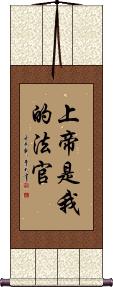
14. God is my Judge
16. Heijoshin / Presence of Mind
17. Faithful / Honorable / Trustworthy / Fidelity / Loyalty
18. Honesty
19. No Surrender
20. Immovable Mind
21. Impartial and Fair to the Brotherhood and Sisterhood of the World
23. One Justice Can Overpower 100 Evils
24. Justice / Rectitude / Right Decision
25. Life in Harmony / Balanced Life
26. Life in Balance / Balancing Life
27. Life in Harmony / Balanced Life
28. Lingering Mind
29. Love and Honor
31. Nature in Balance / Balanced Nature
32. Peace of Mind
33. Peace / Peaceful
34. Respect out of fear is never genuine; Reverence out of respect is never false
35. Righteousness
37. Tai Chi Chuan / Tai Ji Quan
38. The Universe in Balance / Balanced Universe
39. Unselfish: Perfectly Impartial
40. Yin Yang
41. Libra
Balance / Peace
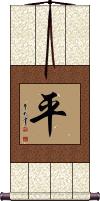
平 is a single character that means balance in Chinese but it's not too direct or too specific about what kind of balance.
Chinese people often like calligraphy art that is a little vague or mysterious. In this way, you can decide what it means to you, and you'll be right.
平 is also part of a word that means peace in Chinese, Japanese, and old Korean.
Some alternate translations of this single character include: balanced, peaceful, calm, equal, even, level, smooth, or flat.
Note that in Japanese, this just means “level” or “flat” by itself (not the best choice for balance if your audience is Japanese).
Balance / Equilibrium
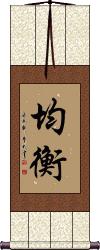
均衡 means balance or equilibrium.
This title is best for a Japanese audience where the word suggests that your life is in balance in all matters (or is a reminder for you to try and keep all matters in balance).
The Principles of Buddhism
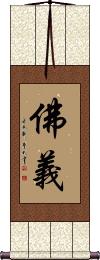
In short, 佛義 is the Principles of Buddhism, but there is more (especially for the second character):
佛 is the character for the Buddha and Buddhism.
義 has deeper meanings including justice, righteousness, morality, honour/honor, teachings, doctrine, right, proper, righteous, loyalty, purpose, or meaning. So the single word “principles” is often used to encompass all these ideas.
Engage with Confidence
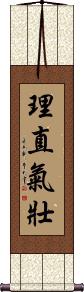
理直氣壯 is a Chinese proverb that means “to do something while knowing you’re in the right.”
This can also be translated as and is appropriate when you are:
“In the right and self-confident”
“Bold and confident with justice on one's side”
“Having the courage of one's convictions”
“Justified and forceful”
“To be confident and vigorous because reason and logic are on one's side”
“Justified and confident”
The Five Tenets of Confucius
The Five Cardinal Rules / Virtues of Confucius
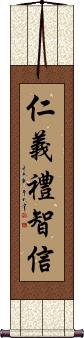
仁義禮智信 are the core of Confucius's philosophy.
Simply stated:
仁 = Benevolence / Charity
義 = Justice / Rectitude
禮 = Courtesy / Politeness / Tact
智 = Wisdom / Knowledge
信 = Fidelity / Trust / Sincerity
Many of these concepts can be found in various religious teachings. It should be clearly understood that Confucianism is not a religion but should instead be considered a moral code for a proper and civilized society.
This title is also labeled “5 Confucian virtues.”
 If you order this from the Japanese calligrapher, expect the middle Kanji to be written in a more simple form (as seen to the right). This can also be romanized as "jin gi rei satoshi shin" in Japanese. Not all Japanese will recognize this as Confucian tenets but they will know all the meanings of the characters.
See Also: Confucius Teachings | Ethics
Courage to do what is right
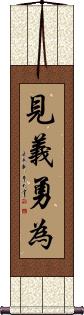
見義勇為 means the courage to do what is right in Chinese.
This could also be translated as “Never hesitate to do what is right.”
This comes from Confucian thought:
Your courage should head in an honorable direction. For example, you should take action when the goal is to attain a just result as, without honorable intent, a person’s gutsy fervor can easily lead them astray.
One who flaunts courage but disregards justice is bound to do wrong; someone who possesses courage and morality is destined to become a hero.
Some text above paraphrased from The World of Chinese - The Character of 勇
See Also: Work Unselfishly for the Common Good | Justice | Bravery
Daoism / Taoism
Literally: The Way or Road
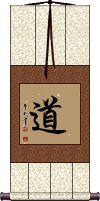
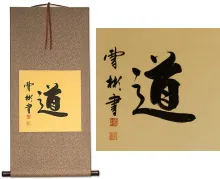
道 is the character “dao” which is sometimes written as “tao” but pronounced like “dow” in Mandarin.
道 is the base of what is known as “Taoism.” If you translate this literally, it can mean “the way” or “the path.”
Dao is believed to be that which flows through all things and keeps them in balance. It incorporates the ideas of yin and yang (e.g. there would be no love without hate, no light without dark, no male without female.)
The beginning of Taoism can be traced to a mystical man named
Lao Zi (604-531 BC), who followed, and added to the teachings of Confucius.
More about Taoism / Daoism here.
Note that this is pronounced “dou” and sometimes “michi” when written alone in Japanese but pronounced “do” in word compounds such as Karate-do and Bushido. It's also “do” in Korean.
Alternate translations and meanings: road, way, path; truth, principle province.
Important Japanese note: In Japanese, this will generally be read with the road, way, or path meaning. Taoism is not as popular or well-known in Japan so Daoist/Taoist philosophy is not the first thing a Japanese person will think of when they read this character.
See our Taoism Page
Daodejing / Tao Te Ching - Chapter 27
The Mastery of Effortless Skill

Chapter 27 of the Daodejing reveals a profound truth about mastery: the highest skill leaves no trace, requires no force, and appears almost invisible.
善行無轍跡,
善言無瑕謫,
善數不用籌策,
善閉無關鍵而不可開,
善結無繩約而不可解。
是以聖人常善救人,
故無棄人;
常善救物,
故無棄物。
是謂襲明。
故善人者,不善人之師;
不善人者,善人之資。
不貴其師,不愛其資,
雖智大迷,
是謂要妙。
The sage moves through life with such natural harmony that nothing seems imposed; doors need no locks, knots require no rope, and actions leave no mark behind.
This is the essence of wúwéi (effortless action), where true ability arises from deep alignment with the Tao rather than deliberate effort.
At its heart, this chapter teaches compassion without exception. The sage “abandons no one and nothing,” recognizing value in all people and all things. Even those who seem flawed or unrefined are not rejected, but understood as part of a greater whole with each person both a student and a teacher in the unfolding of life.
Laozi reminds us that wisdom is not about perfection or control, but about subtle awareness. The truly skilled individual does not rely on tools, rules, or rigid structures; instead, they embody an intuitive understanding that makes their actions naturally complete.
In this way, excellence becomes quiet, effortless, and beyond imitation.
This teaching also reflects a deeper philosophical insight: Opposites are interdependent. The “good” person learns from the “not good,” and the “not good” provides the material for growth. To reject either is to misunderstand the balance of existence itself.
As calligraphy, Daodejing Chapter 27 serves as a reminder to cultivate inner mastery rather than outward display. It is a meditation on refinement, humility, and the quiet power of skill perfected through harmony with the natural order.
Note: The Chinese text used here is based on the early Mawangdui silk manuscript tradition (2nd century BCE). The Guodian manuscripts do NOT preserve Chapter 27 in full form.
Drunken Fist
(A legitimate style of Kung Fu)
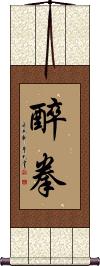
醉拳 is Drunken Fist, a traditional Chinese martial art/technique of Kung Fu.
It is a northern style of martial art that imitates a drunk person in its movements. Many staggering movements serve to deceive the opponent and keep them off-balance.
Some consider Drunken Fist to be among the more complex styles of martial arts due to the need for robust joints and fingers.
See Also: Drunken Monkey
Eye for an eye
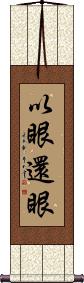
以眼還眼 is the same proverb that seems to be used in virtually every language and culture worldwide.
Whether you are Arab, Persian, Jewish, European, British, Asian, or American, this proverb is well known as the “original form of justice.”
Fair / Impartial
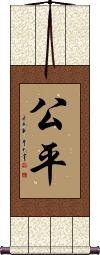
Feng Shui
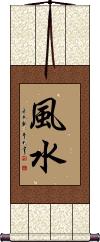
風水 is the famous technique and approach to arranging your home externally around natural features and internally to create balance and peace.
These two characters literally mean “wind water.” Obviously, the title is far more simple than the concept behind this subject.
It may enlighten you slightly to know that the character for “wind” can also mean style, custom, or manner in some contexts. This may apply somewhat to this title.
In a technical sense, this title is translated as Chinese geomancy.
Giri
(obligation or duty in Japanese)
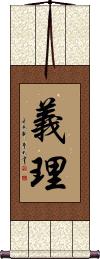
This term means an obligation or a sense of duty that one may have to their employer, country or culture.
義理 is a specifically Japanese term, as in Chinese, these two characters form a word that means “religious doctrine” or refers to the argument presented in an essay.
This term has a similar meaning in Korean, where it can be translated as justice, sense of duty, loyalty, integrity, or obligation.
義理 is kind of a weird selection for a wall scroll. So this entry is intended more for educational purposes.
God is my Judge
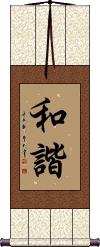
Harmony / Balance
Harmony / Balance
Cho Wa
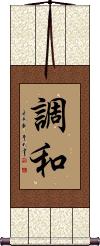
調和 is one of the several ways to express harmony in Chinese and Japanese.
Note: The first character means harmony but also suggests a musical meaning. It can also describe warriors marching in perfect cadence (in step) or to regulate something.
The second character carries the meaning of harmony and peace by itself.
Together, these characters create a word that can be defined as harmonious, to mediate, to reconcile, to compromise; mediation, temper, to mix, blend, blended, season, seasoning (getting the flavors of the food in balance), to placate, or be in harmonious proportion.
The meaning varies depending on the context. However, when hanging as a wall scroll, this will refer to the person (you) being balanced and in harmony while rational and under control simultaneously.
Heijoshin / Presence of Mind
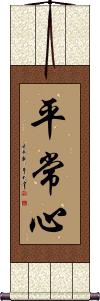
平常心 is the title Heijoshin, as associated with Kendo and Aikido schools of Japanese martial arts.
平常心 is also a word in Japanese that can be translated as “one's self-possession” or “presence of mind.”
In Chinese and Korean, this means “simplicity heart,” “composure,” “calmness,” or a “sense of orderliness.” In Chinese and Korean, this implies that you enjoy what you have, keep your heart in balance, and have no over-blown ambitions.
Faithful / Honorable / Trustworthy / Fidelity / Loyalty
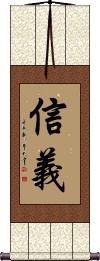
信義 is a word often used to describe a person with an honest and loyal reputation.
Simply put, this applies to somebody you can trust (with your life).
In Chinese, this is often defined as good faith, honor, trust, and justice.
In Korean, this word means fidelity, truthfulness, or faithfulness.
In Japanese: faith, fidelity, and loyalty. It's also a Japanese male given name when pronounced “Nobuyoshi.”
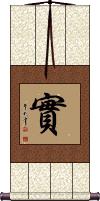
Honesty
No Surrender
Honor Does Not Allow Second Thoughts
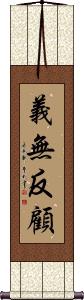
義無反顧 is a Chinese proverb that can be translated in a few different ways. Here are some examples:
Honor does not allow one to glance back.
Duty-bound not to turn back.
No surrender.
To pursue justice with no second thoughts.
Never surrender your principles.
This proverb is about the courage to do what is right without questioning your decision to take the right and just course.
Immovable Mind
fudoshin
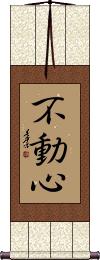
不動心 is one of the five spirits of the warrior (budo) and is often used as a Japanese martial arts tenet.
Under that context, places such as the Budo Dojo define it this way: An unshakable mind and an immovable spirit is the state of fudoshin. It is courage and stability displayed both mentally and physically. Rather than indicating rigidity and inflexibility, fudoshin describes a condition that is not easily upset by internal thoughts or external forces. It is capable of receiving a strong attack while retaining composure and balance. It receives and yields lightly, grounds to the earth, and reflects aggression back to the source.
Other translations of this title include unwavering mind, immovable mind, unwavering composure, imperturbability, steadfastness, keeping a cool head in an emergency, or keeping one's calm (during a fight).
The first two Kanji alone mean immobility, firmness, fixed, steadfastness, motionless, and idle.
The last Kanji means heart, mind, soul, or essence.
Together, these three Kanji create a title defined as “immovable mind” within the context of Japanese martial arts. However, in Chinese, it would mean “motionless heart,” and in Korean Hanja, “wafting heart” or “floating heart.”
Impartial and Fair to the Brotherhood and Sisterhood of the World
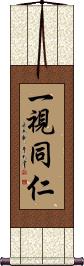
一視同仁 is how to write “universal benevolence.” This is also how to express the idea that you see all people the same.
If you are kind and charitable to everyone, this is the best way to state that virtue. It is the essence of being impartial to all mankind, regardless of social standing, background, race, sex, etc. You do not judge others, but instead, you see them eye to eye on the same level as you.
See Also: Benevolence | Compassion | Equality | Justice | Right Decision | Selflessness | Work Unselfishly for the Common
Justice / Righteousness
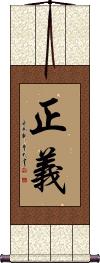
正義 means justice or righteousness in Chinese, Japanese Kanji, and old Korean Hanja.
Practicing justice and righteousness is being fair.
It solves problems, so everyone wins. You don't prejudge. You see people as individuals. You don't accept it when someone acts like a bully, cheats, or lies. Being a champion for justice takes courage. Sometimes when you stand for justice, you stand alone.
Note: This is also considered to be one of the Seven Heavenly Virtues.
One Justice Can Overpower 100 Evils
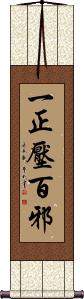
一正压百邪 is an ancient Chinese proverb and idiom that means “One Justice Can Overpower a Hundred Evils.”
While this proverb is famous in China, it has been around so long that its origins have been forgotten.
It could be something that Confucius or one of his disciples said, but no one can say for sure.
Justice / Rectitude / Right Decision
Also means: honor loyalty morality righteousness
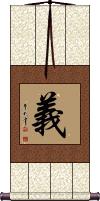
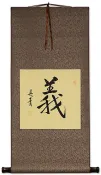
義 is about doing the right thing or making the right decision, not because it's easy but because it's ethically and morally correct.
No matter the outcome or result, one does not lose face if tempering proper justice.
義 can also be defined as righteousness, justice, morality, honor, or “right conduct.” In a more expanded definition, it can mean loyalty to friends, loyalty to the public good, or patriotism. This idea of loyalty and friendship comes from the fact that you will treat those you are loyal to with morality and justice.
義 is also one of the five tenets of Confucius's doctrine.
 There's also an alternate version of this character sometimes seen in Bushido or Korean Taekwondo tenets. It's just the addition of a radical on the left side of the character. If you want this version, click on the image to the right instead of the button above.
This is also a virtue of the Samurai Warrior
See our page with just Code of the Samurai / Bushido here
See Also: Judgment | Impartial | Confucius Tenets
Life in Harmony / Balanced Life
Harmonious Life
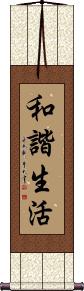
This 和諧生活 title suggests that you have, or want to get your life in balance.
The first two characters regard the idea of balance, harmony, and peace.
The second two characters mean “life.” More specifically this refers to your livelihood, career, and the daily activities that comprise your life or living. Some would translate those two characters as “one's daily existence.”
Note: We have a couple of titles for this idea. This version is more of a noun, thus "The Balanced Life" verses a verb form like "Balancing [Your] Life."
Life in Balance / Balancing Life
The art of balancing your life
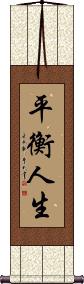
This 平衡人生 title suggests that you are actively trying to keep your life in balance.
Think of this as the action verb of seeking or having a balanced life.
The first two characters mean balance, equilibrium, or keeping things equal.
The last two characters mean “life.” Literally “human life.”
Life in Harmony / Balanced Life
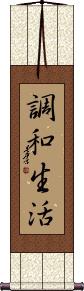
調和生活 is a Japanese title that suggests that you have, or want to get your life in balance.
The first two Kanji mean harmonious or in harmony.
The second two Kanji mean “life.” More specifically this refers to your livelihood, career, and the daily activities that comprise your life or living.
Lingering Mind
Zanshin
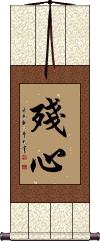
First off, 殘心 should only be used in the context of Japanese martial arts. In Chinese, it's a rather sad title (like a broken heart). In Chinese, the first character alone means destroyed, spoiled, ruined, injured, cruel, oppressive, savage, incomplete, or disabled. However, in Japanese, it's remainder, leftover, balance, or lingering.
The second character means heart, mind, soul, or essence in both languages.
殘心 is one of the five spirits of the warrior (budo) and is often used as a Japanese martial arts tenet. Under that context, places such as the Budo Dojo define it this way: The spirit of zanshin is the state of the remaining or lingering spirit. It is often described as a sustained and heightened state of awareness and mental follow-through. However, true zanshin is a state of focus or concentration before, during, and after the execution of a technique, where a link or connection between uke and nage is preserved. Zanshin is the state of mind that allows us to stay spiritually connected, not only to a single attacker but to multiple attackers and even an entire context; a space, a time, an event.
 In modern Japan (and Simplified Chinese), they use a different version of the first character, as seen to the right. Click on this character to the right instead of the button above if you want this modern Japanese version of lingering mind / zanshin.
Love and Honor
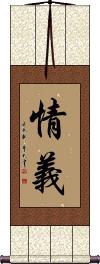
情義 means to love and honor in Chinese. 情義 is more or less the kind of thing you'd find in marriage vows.
The first character suggests emotions, passion, heart, humanity, sympathy, and feelings.
In this context, the second character means to honor your lover's wishes and treat them justly and righteously (fairly). That second character can also be translated as “obligation,” as in the obligation a husband and wife have to love each other even through difficult times.
In the context outside of a couple's relationship, this word can mean “comradeship.”
Japanese may see this more as “humanity and justice” than “love and honor.” It's probably best if your target is Chinese.
This is the short and sweet form, there is also a longer poetic form (you can find it here: Love and Honor if it’s not on the page you are currently viewing).
See Also: Love and Honor
Love and Honor
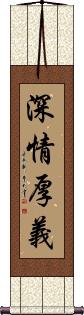
深情厚義 means to love and honor.
This is more or less the kind of thing you'd find in marriage vows.
The first two characters suggest deep love or deep emotions, passion, and feelings.
The last two characters mean generous justice or thick honor (the third character is an adjective that means generous or thick). It just means that you will honor your lover's wishes and treat them justly and righteously (fairly).
This is the longer four-character version, there is also a short and sweet two character version.
See Also: Love and Honor
Moderation / Temperance
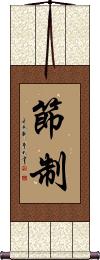
節制 means moderation or temperance in Chinese, Japanese Kanji, and old Korean Hanja.
Moderation is creating a healthy balance in your life between work and play, rest and exercise. You don't overdo or get swept away by the things you like. You use your self-discipline to take charge of your life and your time.
節制 can also be translated as sobriety or self-restraint.
This is often used as part of the Seven Heavenly Virtues to represent sobriety and/or temperance.
Nature in Balance / Balanced Nature
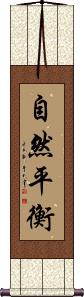
自然平衡 means “nature balanced.”
The first two characters mean nature (as in mother nature, or all biological life).
The second two characters mean balance or balanced.
Nature in Balance / Balanced Nature
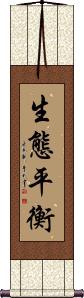
生態平衡 is a title about the way and balance of nature.
The first two characters mean nature or the way of life.
The second two characters mean balance or balanced.
Note: We have two versions of this title on our website. This is the one we recommend, as it is a little more natural (no pun intended).
Nature in Balance / Balanced Nature
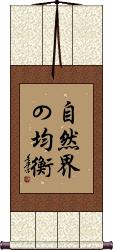
自然界の均衡 is a verbose way to say “nature in balance” in Japanese.
The first three Kanji have the meaning of “the natural world” or “the natural kingdom” (kind of like the animal kingdom but including plants and all things biological).
The third character is a Hiragana that acts to connect the two ideas here.
The last two Kanji mean equilibrium or balance.
Nature in Balance / Balanced Nature
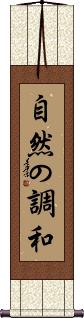
自然の調和 means “nature in harmony” in Japanese.
The first two Kanji mean nature (as in mother nature or the natural world).
The middle Hiragana is a possessive article that connects the two ideas.
The last two Kanji mean “in harmony” or “in balance.”
Peace of Mind
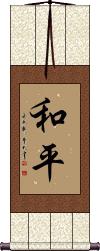
和平 is the Chinese order for these two characters, which means peace but can also be translated as amicability, specifically, or mildness. 和平 is often translated as a simple way to say “peace of mind.” This combination is used in Korean Hanja to mean “peace and harmony.”
Alone, the first character means peace and harmony.
The second character means balance when read by itself.
Note: 和平 are often seen in the opposite order in Japanese with the same meaning (You'll sometimes find them in this order in Japan, so either way is OK).
Peace / Peaceful
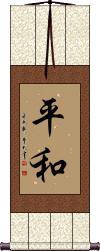
平和 is the Japanese and Korean order of these characters used most often to express the idea of peace, tranquility, and harmony.
It's just the reverse order of the Chinese. In this order in Chinese, it means takes the “mild” definition rather than “peace.” In Korean, the combination keeps the same meaning in either order.
The second character also means balance, so there is an element of harmony and balance along with peace.
Respect out of fear is never genuine; Reverence out of respect is never false
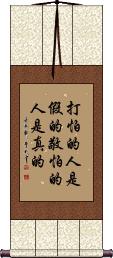
打怕的人是假的敬怕的人是真的 is a proverb that seems to be aimed at world leaders or others in power. Perhaps a suggestion to avoid the practice of “fear-mongering” opting instead for a policy of benevolence and justice.
An example: When the Bush administration told Pakistan they could either join America in the “war on terror,” or expect some bombs to be coming their way, Bush gained this kind of “less-than-genuine respect” from Pakistanis.
Leaders in places like North Korea and even Saudi Arabia reap the same bogus respect from their own citizens.
Note that calligraphers do not like to repeat the same characters in exactly the same way in the same piece of artwork. So expect the characters that are repeated to be written in different forms in the real artwork (unlike the way they are displayed to the left).
Righteousness
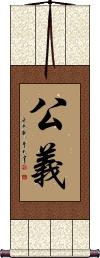
公義 means righteousness, justice, and/or equity in Chinese and Japanese.
Also a male given name, Masayoshi, in Japanese.
Seven Heavenly Virtues
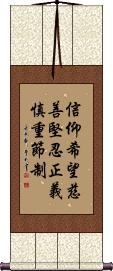
信仰希望慈善堅忍正義慎重節制 is a list in Chinese and Japanese Kanji of an interpretation of the Seven Heavenly Virtues.
1. Faith is belief in God, and the right virtues.
2. Hope is taking a positive future view that good will prevail.
3. Charity is a concern for, and active helping of, others.
4. Fortitude is never giving up.
5. Justice is being fair and equitable with others.
6. Prudence is care of and moderation with money.
7. Temperance is moderation of needed things and abstinence from things that are not needed.
The full list is here. 信仰希望慈善堅忍正義慎重節制 is a word list, not a common phrase. While all Chinese and Japanese people will recognize the words in the list, they may not understand what the list is about (unless they are familiar with the Seven Heavenly Virtues).
don’t get this as a tattoo or anything like that without first consulting a native translator in the target language. These are fine for a wall scroll but a long discussion is needed before you commit to this for a lifetime inking commitment.
Tai Chi Chuan / Tai Ji Quan
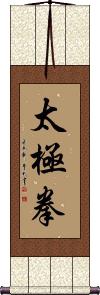
太極拳 is the famous Taoist meditation and martial art exercise. The direct translation of these characters would be something like “grand ultimate fist,” but that does not quite hit the mark for what this title really means.
An early-morning walk through any city in China near a park or an open area will yield a view of Chinese people practicing this ancient technique.
A typical scene is an old man of no less than 80 years on this earth, with a wispy white beard and perhaps a sword in one hand. He makes slow moves that are impossibly smooth. He is steady-footed and always in balance. For him, time is meaningless and proper form, and technique is far more important than speed.
For the younger generation, faster moves may look impressive and seem smooth to the casual observer. But more discipline and mental strength are needed to create perfectly smooth moves in virtual slow motion.
Note: There are two ways to Romanize these Chinese characters, as seen in the title above. The pronunciation and actual characters are the same in Chinese. If you really used English sounds/words to pronounce this, it would be something like “tie jee chew-on” (make the “chew-on” one flowing syllable).
The Universe in Balance / Balanced Universe
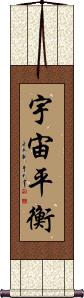
宇宙平衡 is a proverb that is simply Universe Balanced (we might say “Balanced Universe” in English).
The first two characters mean the Universe. However, in some contexts, it can mean cosmic, cosmos, or outer space.
The second two characters mean balance or balanced (can also mean equilibrium).
Unselfish: Perfectly Impartial
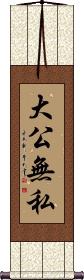
大公無私 is a Chinese proverb that comes from an old story from some time before 476 BC. About a man named Qi Huangyang, who was commissioned by the king to select the best person for a certain job in the Imperial Court.
Qi Huangyang selected his enemy for the job. The king was very confused by the selection, but Qi Huangyang explained that he was asked to find the best person for the job, not necessarily someone that he liked or had a friendship with.
Later, Confucius commented on how unselfish and impartial Qi Huangyang was by saying, “Da Gong Wu Si” which, if you look it up in a Chinese dictionary, is generally translated as “Unselfish” or “Just and Fair.”
If you translate each character, you'd have something like
“Big/Deep Justice Without Self.”
Direct translations like this leave out a lot of what the Chinese characters really say. Use your imagination, and suddenly you realize that “without self” means “without thinking about yourself in the decision” - together, these two words mean “unselfish.” The first two characters serve to drive the point home that we are talking about a concept that is similar to “blind justice.”
One of my Chinese-English dictionaries translates this simply as “just and fair.” So that is the short and simple version.
Note: This can be pronounced in Korean, but it's not a commonly used term.
See Also: Selflessness | Work Unselfishly for the Common Good | Altruism
Yin Yang
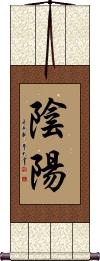
陰陽 literally means yin and yang in written form (versus the common yin-yang symbol). The first character has the element of the moon, while the second character has the element of the sun so that you can see, even in written form, they suggest the balance of opposites (of night and day). You could also translate this title as “sun and moon.”
Note: This title is often misspelled as Ying Yang instead of Yin Yang.
See Also: Taoism
Libra Zodiac Symbol / Sign
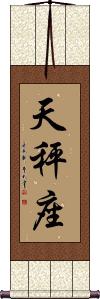
天秤座 is the Chinese and Japanese way to write Libra (scales) of western astrology.
See Also: Chinese Zodiac
This in-stock artwork might be what you are looking for, and ships right away...


The following table may be helpful for those studying Chinese or Japanese...
| Title | Characters | Romaji (Romanized Japanese) | Various forms of Romanized Chinese | |
| Balance Peace | 平 | hira | píng / ping2 / ping | p`ing / ping |
| Balance Equilibrium | 均衡 | kin kou / kinkou / kin ko | héng / jun1 heng2 / jun heng / junheng | chün heng / chünheng |
| The Principles of Buddhism | 佛義 佛义 | butsu gi / butsugi | fó yì / fo2 yi4 / fo yi / foyi | fo i / foi |
| Engage with Confidence | 理直氣壯 理直气壮 | lǐ zhí qì zhuàng li3 zhi2 qi4 zhuang4 li zhi qi zhuang lizhiqizhuang | li chih ch`i chuang lichihchichuang li chih chi chuang |
|
| The Five Tenets of Confucius | 仁義禮智信 仁义礼智信 | jin gi rei tomo nobu jingireitomonobu | rén yì lǐ zhì xìn ren2 yi4 li3 zhi4 xin4 ren yi li zhi xin renyilizhixin | jen i li chih hsin jenilichihhsin |
| Courage to do what is right | 見義勇為 见义勇为 | jiàn yì yǒng wéi jian4 yi4 yong3 wei2 jian yi yong wei jianyiyongwei | chien i yung wei chieniyungwei |
|
| Daoism Taoism | 道 | michi / -do | dào / dao4 / dao | tao |
| Daodejing Tao Te Ching - Chapter 27 | 善行無轍跡善言無瑕謫善數不用籌策善閉無關鍵而不可開善結無繩約而不可解是以聖人常善救人故無棄人常善救物故無棄物是謂襲明故善人者不善人之師不善人者善人之資不貴其師不愛其資雖智大迷是謂要妙 善行无辙迹善言无瑕谪善数不用筹策善闭无关键而不可开善结无绳约而不可解是以圣人常善救人故无弃人常善救物故无弃物是谓袭明故善人者不善人之师不善人者善人之资不贵其师不爱其资虽智大迷是谓要妙 | shàn xíng wú zhé jì shàn yán wú xiá zhé shàn shù bù yòng chóu cè shàn bì wú guān jiàn ér bù kě kāi shàn jié wú shéng yuē ér bù kě jiě shì yǐ shèng rén cháng shàn jiù rén gù wú qì rén cháng shàn jiù wù gù wú qì wù shì wèi xí míng gù shàn rén zhě bù shàn rén zhī shī bù shàn rén zhě shàn rén zhī zī bù guì qí shī bù ài qí zī suī zhì dà mí shì wèi yào miào shan4 xing2 wu2 zhe2 ji4 shan4 yan2 wu2 xia2 zhe2 shan4 shu4 bu4 yong4 chou2 ce4 shan4 bi4 wu2 guan1 jian4 er2 bu4 ke3 kai1 shan4 jie2 wu2 sheng2 yue1 er2 bu4 ke3 jie3 shi4 yi3 sheng4 ren2 chang2 shan4 jiu4 ren2 gu4 wu2 qi4 ren2 chang2 shan4 jiu4 wu4 gu4 wu2 qi4 wu4 shi4 wei4 xi2 ming2 gu4 shan4 ren2 zhe3 bu4 shan4 ren2 zhi1 shi1 bu4 shan4 ren2 zhe3 shan4 ren2 zhi1 zi1 bu4 gui4 qi2 shi1 bu4 ai4 qi2 zi1 sui1 zhi4 da4 mi2 shi4 wei4 yao4 miao4 shan xing wu zhe ji shan yan wu xia zhe shan shu bu yong chou ce shan bi wu guan jian er bu ke kai shan jie wu sheng yue er bu ke jie shi yi sheng ren chang shan jiu ren gu wu qi ren chang shan jiu wu gu wu qi wu shi wei xi ming gu shan ren zhe bu shan ren zhi shi bu shan ren zhe shan ren zhi zi bu gui qi shi bu ai qi zi sui zhi da mi shi wei yao miao | shan hsing wu che chi shan yen wu hsia che shan shu pu yung ch`ou ts`e shan pi wu kuan chien erh pu k`o k`ai shan chieh wu sheng yüeh erh pu k`o chieh shih i sheng jen ch`ang shan chiu jen ku wu ch`i jen ch`ang shan chiu wu ku wu ch`i wu shih wei hsi ming ku shan jen che pu shan jen chih shih pu shan jen che shan jen chih tzu pu kuei ch`i shih pu ai ch`i tzu sui chih ta mi shih wei yao miao shan hsing wu che chi shan yen wu hsia che shan shu pu yung chou tse shan pi wu kuan chien erh pu ko kai shan chieh wu sheng yüeh erh pu ko chieh shih i sheng jen chang shan chiu jen ku wu chi jen chang shan chiu wu ku wu chi wu shih wei hsi ming ku shan jen che pu shan jen chih shih pu shan jen che shan jen chih tzu pu kuei chi shih pu ai chi tzu sui chih ta mi shih wei yao miao |
|
| Drunken Fist | 醉拳 | suiken | zuì quán / zui4 quan2 / zui quan / zuiquan | tsui ch`üan / tsuichüan / tsui chüan |
| Eye for an eye | 以眼還眼 以眼还眼 | yǐ yǎn huán yǎn yi3 yan3 huan2 yan3 yi yan huan yan yiyanhuanyan | i yen huan yen iyenhuanyen |
|
| Fair Impartial | 公平 | kouhei / kohei | gōng píng gong1 ping2 gong ping gongping | kung p`ing kungping kung ping |
| Feng Shui | 風水 风水 | fuu sui / fuusui / fu sui | fēng shuǐ feng1 shui3 feng shui fengshui | |
| Giri | 義理 义理 | giri | yì lǐ / yi4 li3 / yi li / yili | i li / ili |
| God is my Judge | 上帝是我的法官 | shàng dì shì wǒ de fǎ guān shang4 di4 shi4 wo3 de fa3 guan1 shang di shi wo de fa guan shangdishiwodefaguan | shang ti shih wo te fa kuan shangtishihwotefakuan |
|
| Harmony Balance | 和諧 和谐 | hé xié / he2 xie2 / he xie / hexie | ho hsieh / hohsieh | |
| Harmony Balance | 調和 调和 | chou wa / chouwa / cho wa | tiáo hé / tiao2 he2 / tiao he / tiaohe | t`iao ho / tiaoho / tiao ho |
| Heijoshin Presence of Mind | 平常心 | hei jou shin heijoushin hei jo shin | píng cháng xīn ping2 chang2 xin1 ping chang xin pingchangxin | p`ing ch`ang hsin pingchanghsin ping chang hsin |
| Faithful Honorable Trustworthy Fidelity Loyalty | 信義 信义 | shingi | xìn yì / xin4 yi4 / xin yi / xinyi | hsin i / hsini |
| Honesty | 實 实 | shí / shi2 / shi | shih | |
| No Surrender | 義無反顧 义无反顾 | yì wú fǎn gù yi4 wu2 fan3 gu4 yi wu fan gu yiwufangu | i wu fan ku iwufanku |
|
| Immovable Mind | 不動心 | fu dou shin fudoushin fu do shin | ||
| Impartial and Fair to the Brotherhood and Sisterhood of the World | 一視同仁 一视同仁 | isshidoujin ishidojin | yí shì tóng rén yi2 shi4 tong2 ren2 yi shi tong ren yishitongren | i shih t`ung jen ishihtungjen i shih tung jen |
| Justice Righteousness | 正義 正义 | sei gi / seigi | zhèng yì / zheng4 yi4 / zheng yi / zhengyi | cheng i / chengi |
| One Justice Can Overpower 100 Evils | 一正壓百邪 一正压百邪 | yī zhèng yā bǎi xié yi1 zheng4 ya1 bai3 xie2 yi zheng ya bai xie yizhengyabaixie | i cheng ya pai hsieh ichengyapaihsieh |
|
| Justice Rectitude Right Decision | 義 义 | gi | yì / yi4 / yi | i |
| Life in Harmony Balanced Life | 和諧生活 和谐生活 | hé xié shēng huó he2 xie2 sheng1 huo2 he xie sheng huo hexieshenghuo | ho hsieh sheng huo hohsiehshenghuo |
|
| Life in Balance Balancing Life | 平衡人生 | hei kou jin sei heikoujinsei hei ko jin sei | píng héng rén shēng ping2 heng2 ren2 sheng1 ping heng ren sheng pinghengrensheng | p`ing heng jen sheng pinghengjensheng ping heng jen sheng |
| Life in Harmony Balanced Life | 調和生活 | cho wa sei katsu chowaseikatsu | ||
| Lingering Mind | 殘心 残心 | zan shin / zanshin | cán xīn / can2 xin1 / can xin / canxin | ts`an hsin / tsanhsin / tsan hsin |
| Love and Honor | 情義 情义 | qíng yì / qing2 yi4 / qing yi / qingyi | ch`ing i / chingi / ching i | |
| Love and Honor | 深情厚義 深情厚义 | shēn qíng hòu yì shen1 qing2 hou4 yi4 shen qing hou yi shenqinghouyi | shen ch`ing hou i shenchinghoui shen ching hou i |
|
| Moderation Temperance | 節制 节制 | sessei / sesei | jié zhì / jie2 zhi4 / jie zhi / jiezhi | chieh chih / chiehchih |
| Nature in Balance Balanced Nature | 自然平衡 | zì rán píng héng zi4 ran2 ping2 heng2 zi ran ping heng ziranpingheng | tzu jan p`ing heng tzujanpingheng tzu jan ping heng |
|
| Nature in Balance Balanced Nature | 生態平衡 生态平衡 | shēng tài píng héng sheng1 tai4 ping2 heng2 sheng tai ping heng shengtaipingheng | sheng t`ai p`ing heng shengtaipingheng sheng tai ping heng |
|
| Nature in Balance Balanced Nature | 自然界の均衡 | shizenkai no kinkou shizenkainokinkou shizenkai no kinko | ||
| Nature in Balance Balanced Nature | 自然の調和 | shizen no cho wa shizennochowa | ||
| Peace of Mind | 和平 | wa hei / wahei | hé píng / he2 ping2 / he ping / heping | ho p`ing / hoping / ho ping |
| Peace Peaceful | 平和 | hei wa / heiwa | píng hé / ping2 he2 / ping he / pinghe | p`ing ho / pingho / ping ho |
| Respect out of fear is never genuine; Reverence out of respect is never false | 打怕的人是假的敬怕的人是真的 | dǎ pà de rén shì jiǎ de jìng pà de rén shì zhēn de da3 pa4 de ren2 shi4 jia3 de jing4 pa4 de ren2 shi4 zhen1 de da pa de ren shi jia de jing pa de ren shi zhen de | ta p`a te jen shih chia te ching p`a te jen shih chen te ta pa te jen shih chia te ching pa te jen shih chen te |
|
| Righteousness | 公義 公义 | kou gi / kougi / ko gi | gōng yì / gong1 yi4 / gong yi / gongyi | kung i / kungi |
| Seven Heavenly Virtues | 信仰希望慈善堅忍正義慎重節制 信仰希望慈善坚忍正义慎重节制 | shinkou kibou jizen kennin seigi shinchou sessei shinko kibo jizen kennin seigi shincho sesei | xìn yǎng xī wàng cí shàn jiān rěn zhèng yì shèn zhòng jié zhì xin4 yang3 xi1 wang4 ci2 shan4 jian1 ren3 zheng4 yi4 shen4 zhong4 jie2 zhi4 xin yang xi wang ci shan jian ren zheng yi shen zhong jie zhi | hsin yang hsi wang tz`u shan chien jen cheng i shen chung chieh chih hsin yang hsi wang tzu shan chien jen cheng i shen chung chieh chih |
| Tai Chi Chuan Tai Ji Quan | 太極拳 太极拳 | tai kyoku ken taikyokuken | tài jí quán tai4 ji2 quan2 tai ji quan taijiquan | t`ai chi ch`üan taichichüan tai chi chüan |
| The Universe in Balance Balanced Universe | 宇宙平衡 | u chuu hei kou uchuuheikou u chu hei ko | yǔ zhòu píng héng yu3 zhou4 ping2 heng2 yu zhou ping heng yuzhoupingheng | yü chou p`ing heng yüchoupingheng yü chou ping heng |
| Unselfish: Perfectly Impartial | 大公無私 大公无私 | dà gōng wú sī da4 gong1 wu2 si1 da gong wu si dagongwusi | ta kung wu ssu takungwussu |
|
| Yin Yang | 陰陽 阴阳 | in you / inyou / in yo | yīn yáng / yin1 yang2 / yin yang / yinyang | |
| Libra Zodiac Symbol Sign | 天秤座 | tenbin-za | tiān chèng zuò tian1 cheng4 zuo4 tian cheng zuo tianchengzuo | t`ien ch`eng tso tienchengtso tien cheng tso |
| In some entries above you will see that characters have different versions above and below a line. In these cases, the characters above the line are Traditional Chinese, while the ones below are Simplified Chinese. | ||||



