Artwork
Search:

Exact
Phrase

Oriental Outpost LogoFlagTowerwatercolor
Chinese Calligraphy Search
ArtPaintingsAsian Art Gallery

Adventures in Asian Art

Didn't find what you want?
Try these methods:

1. Make your search more specific.
2. Use other similar-meaning words.
3. Use less words or just one word.
4. Post your request on our forum so that we can translate/create what you want.


Selections for Marines in Chinese and/or Japanese...

We'll build you a handmade custom "Marines" calligraphy wall scroll if you wish!


Quick links to words on this page...


Select

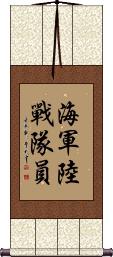
Marine

Amphibious Warrior (Chinese)

Mandarin: hǎi jūn lù zhàn duì yuán

海
軍
陸
戰
隊
員

This is the Chinese way to express "Marine". (as in a member of the Marine Corps). It is not country-specific, so it could be the Royal Marines, U.S. Marines, Chinese Marines, etc.
In Australian English, they would translate this as "Naval Infantryman".

Breaking down each character, this means:
"ocean/sea military/arms shore/land fighting/war/battle corps/team/group person/member". Note that the first two characters presented together, but outside of this phrase mean "navy" (sea military).

See Also...  Warrior | Military | Navy | Art Of War

Score: 100/100

Select

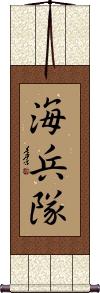
Marine Corps

Japanese & Korean

Japanese: kaiheitai
Korean: 해병대

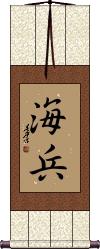
海
兵
隊

This is the Japanese and Korean way to express "Marine Corps" or simply "Marines". It is not specific, so this can be the Marine Corps of any country, such as the British Royal Marines to the U.S. Marines.

Breaking down each character, this means:
"ocean/sea soldiers/army corps/regiment/group".

Score: 100/100

Select

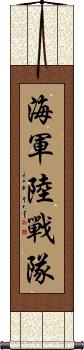
Marine Corps

Chinese

Mandarin: hǎi jūn lù zhàn duì

海
軍
陸
戰
隊

This is the Chinese way to express "Marine Corps". This could be the Marine Corps of virtually any country that has an amphibious military force.

Let me know you want a more specific title such as British Royal Marines or U.S. Marine Corps.

The Chinese title for Marines is very verbose...
Breaking down each character, this means:
"ocean/sea military/arms shore/land fighting/war/battle corps/team/group".

Score: 100/100

Select

Semper Fidelis / Always Faithful

U.S. Marines Slogan
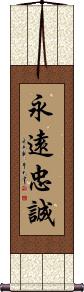
Mandarin: yǒng yuǎn zhōng chéng

永
遠
忠
誠

This is the clearest and most natural way to translate "Semper Fidelis" or "Always Faithful" into Mandarin Chinese. This is specifically meant for U.S. Marines who often use the shortened term "Semper Fi".

The first two characters are a word that means always, forever, and/or eternally.
The last two characters are a word that means fidelity, loyal, and/or devoted.

I spent 10 years in the Marines, so it was a no-brainer to add this to our calligraphy database.

Score: 79/100

Select

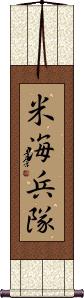
United States Marine Corps

Japanese Only

Japanese: bei kai hei tai
Korean: 미해병대

米
海
兵
隊

This is the Japanese way to write "United States Marine Corps" or simply "U.S. Marines".

Breaking down each Kanji, this means:
"rice (American) ocean/sea soldiers/army/military corps/regiment/group".

This title will only make sense in Japanese, it is not the same in Chinese! Make sure you know your audience before ordering a custom wall scroll.

If you are wondering about the rice, America is known as "rice country" or "rice kingdom" when literally translated. The Kanji for rice is often used as an abbreviation in front of words (like a sub-adjective) to make something "American". Americans say "rice-burner" for a Japanese car, and "rice-rocket" for a Japanese motorcycle. If you did the same in Japanese, it would be exactly the opposite meaning.

Note: I have not verified this, but I've found this title used for U.S. Marines in Korean articles, so it's most likely a normal Korean term as well (but only in Korean Hanja).

See Also...  Marine Corps | Navy | Army | Art Of War | Warrior

Score: 75/100

Select

Marine / Soldier of the Sea

Japanese / Korean

Japanese: kai hei
Korean: 해병

海
兵

This way to express "Marine" as in an individual "Soldier of the Sea" in Japanese Kanji and old Korean Hanja characters (not to be confused with Korean Hangul).

Breaking down each character, this means:
"ocean/sea soldier/army/warrior".

Please note that this Japanese/Korean version kind of means "sailor" or "navy" in Chinese.

Score: 65/100

Select

San Marino

Mandarin: shèng mǎ lì nuò

聖
馬
力
諾

This is the Chinese name for the country of San Marino

See Also...  Europe

Score: 65/100

Back to the top of this page

Select

Marina

feminine name

Mandarin: mǎ ruì nà

瑪
瑞
娜

This is the most common transliteration to Mandarin Chinese for the name Marina

Score: 55/100

Select

Marina

feminine name

Mandarin: mǎ lì nà

瑪
麗
娜

This is the second most common transliteration to Mandarin Chinese for the name Marina.

Score: 55/100

Select

Fighter

Warrior / Soldier

Mandarin: zhàn shì
Japanese: sen shi
Korean: 전사

戰
士

The first character means war, warfare, or battle.
The second character means soldier, officer, man or pawn.

This is how to write "fighter" in Chinese, ancient Japanese Kanji and old Korean Hanja. This word can also mean soldier or warrior, but there are better terms for those two ideas. This one is more specifically "fighter" or "one who fights". This is an odd selection for a wall scroll, unless you are a boxer, ultimate fighter, or otherwise participate in combat sports.

Other translations include combatant or champion.

戦Note that after WWII, the first Kanji was reformed/simplified. This modern Japanese version is shown to the right. If you want this version, click on the Kanji to the right, instead of the button above.

See Also...  Knight | Army | Samurai | Warrior | Soldier

Score: 45/100

Back to the top of this page

Select

Warrior

Mandarin: wǔ shì
Japanese: bu shi
Korean: 무사

武
士

The first character is the spirit or essence of a warrior. The second character means soldier, officer, or official. This character is also used appropriately enough to describe a piece of a chess game. This can also be translated as soldier, cavalier, palace guard, or samurai and sometimes as knight. I've occasionally seen this translated as strong man or tough man (gender not necessarily implied).

See Also...  Knight | Army | Samurai

Score: 35/100

Select

Warrior

Japanese: sen shi

戦
士

This is an alternate title for warrior, soldier, or combatant in Japanese. From Japanese, this is often romanized as "Senshi".

See Also...  Knight | Army | Samurai

Score: 35/100

Select

Military Discipline

Mandarin: jūn jì
Japanese: gunki
Korean: 군기

軍
紀

This word means military discipline or military principles.

If maintaining your military discipline is important to you personally, or important to your military unit, this is the wall scroll to have up behind your desk. In fact, it's the kind of thing I expect to see behind the desk of a First Sergeant or maybe a hardcore NCO.

Note: In some rare context, it could be extended to mean "morale", but "discipline" is much closer to the commonly-held definition.

Note: This term is not well-known outside of the military services in Asia (not used by the common person).

See Also...  Self-Discipline

Score: 28/100

Back to the top of this page

Select

Army / Military

Mandarin: jūn
Japanese: gun
Korean:

軍

This character means army, military, or arms.

This is also a character used in the compound word that means "army general". It's the "gun" in the well-known Japanese title "Shogun" which means general.

See Also...  Shogun | Navy | Marine | Military

Score: 23/100

Select

Active Duty

Mandarin: xiàn yì
Japanese: geneki
Korean: 현역

現
役

When I got off active duty in the Marines, I suddenly discovered that everyone who was on active duty seemed to be very proud of that fact. These Japanese / Chinese characters are offered to those servicemen with that pride.

Please note that there is a longer, yet more natural phrase that means "Active Duty Soldier" or literally "Active Duty Military Person" - see the next entry...

Score: 20/100

Select

Aikido (Japanese)

Defensive form of martial arts

Mandarin: hé qì dào
Japanese: ai ki dou
Korean: 합기도

合
気
道

Aikido is often referred to as the defensive martial art. While aikido was born in Japan, it has become a somewhat famous form of defensive tactics taught to soldiers and Marines, as well as some law enforcement officers in the west.

Looking at the characters, the first means "union" or "harmony".
The second character means "universal energy" or "spirit".
The third means "way" or "method".

Please note that while these Japanese Kanji characters can be pronounced in Chinese, this word is not well-known in China and is not considered part of the Chinese lexicon.

Note: It is somewhat accepted that this is the origin of Hapkido in Korea. And other than a modern simplification to the middle Kanji of this 3-Kanji word, it is written the same in Korean Hanja.

More aikido info.

See Also...  Martial Arts | Hapkido

Score: 20/100

Back to the top of this page

Select

Gung Ho

Working Together

Mandarin: gōng hé
Japanese: guai

工
合

This is one of those Asian words that is used more in English than it is in the original Chinese.

Gung Ho was originally used to speak of Carlson's Raiders, a group of "Gung Ho U.S. Marines who went on an island-hopping campaign of death during WWII.

A movie called Gung Ho came out in the mid-1940s and was later re-released in the 1950s depicting the 2nd Marine Raider Battalion, and brought this word to the mainstream.

It is still sometimes used today within the U.S. Marine Corps brotherhood to refer to a unit or group that works well together, or is otherwise efficient and motivated (has good moral).

In 1986, there was a movie called Gung Ho, about a Japanese company taking over an American automotive factory. They completely ignored the fact that this was a Chinese title.

It should be noted that this title actually means condition, state, manner, or health of something in Japanese.

Language and pronunciation notes:
Like many Asian words absorbed into common use in English, this one is drastically mispronounced. The official Romanization is "gong he", but that doesn't tell you enough. The vowel sound on the first character is like the English word "own", now just add the g-sounds to the beginning and end. The second character is misleading, as you might think it is like the English word "he". In reality, the vowel sound is more like the "u" in "up".

It should also be noted, that the current generation in China no longer uses, or recognizes this as a common word or slogan.

Score: 18/100

Select

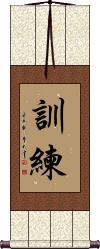
Training / Drill

Mandarin: xùn liàn
Japanese: kunren
Korean: 훈련

訓
練

If training or drill is important to you (especially for military drill and training), this might be just the thing for a drill master to hang behind his/her desk.

This term is universal in Chinese, Japanese Kanji, and old Korean Hanja. It can also mean practice or exercise, depending on context.

Score: 18/100

Select

Smooth Sailing

Mandarin: yī fán fēng shùn
Korean: 일범풍순

一
帆
風
順

This is just what you think it means. It suggests that you are on a trouble-free voyage through life, or literally on a sailing ship or sail boat. It is often used in China as a wish for good luck on a voyage or as you set out on a new quest or career in your life. Some may use this in lieu of "bon voyage".

The literal meaning is roughly, "Once you raise your sail, you will get the wind you need, and it will take you where you want to go". Another way to translate it is "Your sail and the wind follow your will".

This is a great gift for a mariner, sailor, adventurer, or someone starting a new career.

Note: Can be understood in Korean Hanja, but rarely used.

See Also...  Bon Voyage | Adventure | Travel

Score: 14/100

Back to the top of this page

Select

Discipline

Mandarin: jì lǜ
Korean: 기율

紀
律

Discipline: There are a few different ways to define this word in English. This Asian word conveys the idea of extreme self-control and perhaps self-sacrifice, and obedience. This matches what I was taught as the meaning of "discipline" when I was in the Marine Corps. There is also an additional idea of maintaining order or being orderly in your tasks.

This idea would also fit an athlete training for the Olympics who gives up many pleasures to stay focused on their training.

See Also...  Self-Control | Will-Power

Score: 14/100

Select

Pain is Weakness Leaving the Body

Mandarin: téng tòng jiù shì shuāi ruò lí nǐ ér qù de shí hòu

而
去
的
時
候
衰
弱
離
你
疼
痛
就
是


Characters shown
above are read
vertically, starting
from the right

I remember this being shouted a lot during U.S. Marine Corps boot camp. This is how to write that phrase in Chinese. At least, this is as close as we could compose/translate it, and hold the full original meaning and connotations.

The version shown here is really, "Pain is weakness leaving your body". Although, it's said in English both ways (the or your), it works better in Chinese with "your".

Score: 14/100

Select

The More We Sweat in Training,
The Less We Bleed in Battle

Mandarin:
píng shí duō liú hàn
zhàn shí shǎo liú xuè

戰
時
少
流
血
平
時
多
流
汗


Characters shown
above are read
vertically, starting
from the right

There is more than one way to translate this ancient Chinese military proverb. Here are a few interpretations:

A drop of sweat spent in a drill is a drop of blood saved in war.

More practice will give one a better chance of success in real situation.

The more you sweat in training, the less you bleed in battle.

I heard this many times when I was a U.S. Marine, but I had no idea at the time that it was actually an old Chinese proverb.

Score: 14/100

Back to the top of this page

Select

Sword

Mandarin: jiàn
Japanese: ken / tsurugi
Korean:

劍

This Character is pronounced "jian" in Chinese. When you say it, imagine that you are making the sound of a sword as it clashes with a metal shield. This might get you closer to the correct pronunciation in Chinese.

I actually wonder if this word came from the metallic ringing sounds of a sword in battle - but such knowledge is lost in history.

The sword is a symbol of a warrior. The one thing that a soldier in ancient China lived and died by. A warrior with his skills and sword proves himself of great value. A warrior who losses his sword instantly becomes worthless.

This is an excellent scroll for someone in the military (especially officers of all services - as well as enlisted NCO Marines since they still carry swords even if mainly for ceremonial purposes). Or perhaps someone who practices variations of kung fu or tai chi that involve weapons.

Please note that while this character is understood with the sword meaning in Japanese, you might be looking for the word "katana" which also means sword in Japanese, but means "knife" in Chinese.

There are other ways to write sword, and here are a few...
Common Japanese and rare Chinese traditional form of sword Typical traditional form of sword in Chinese Old/Alternative way to write sword in Chinese Old/Alternative way to write sword in Chinese Old/Alternative way to write sword in Chinese This one kind of means Typical traditional form of sword in Chinese Common Japanese and rare Chinese traditional form of sword Old/Alternative way to write sword in Chinese Old/Alternative way to write sword in Chinese Old/Alternative way to write sword in Chinese This one kind of means Typical traditional form of sword in Chinese Typical traditional form of sword in Chinese Common Japanese and rare Chinese traditional form of sword Old/Alternative way to write sword in Chinese Old/Alternative way to write sword in Chinese Old/Alternative way to write sword in Chinese This one kind of means Typical traditional form of sword in Chinese Common Japanese and rare Chinese traditional form of sword Old/Alternative way to write sword in Chinese Old/Alternative way to write sword in Chinese Old/Alternative way to write sword in Chinese This one kind of means Typical traditional form of sword in Chinese Common Japanese and rare Chinese traditional form of sword Old/Alternative way to write sword in Chinese Old/Alternative way to write sword in Chinese Old/Alternative way to write sword in Chinese This one kind of means
If you are particular about the version you receive, please let me know when you place your order (Note: Special styles are only available from one of our master calligraphers).

Score: 10/100

Select

Well-Disciplined

Special Military Term

Mandarin: yán zhěng

嚴
整

When reading an account of some battles in China, I came across this Chinese word. As it turns out, it's only used in military circles to describe neat, orderly, and well-disciplined troops. Perhaps this is actually closer to the meaning I was taught while in the U.S. Marines.

The first character literally means stern, serious, strict, or severe (it can also mean "air tight" or "water tight".
The second character means exact, in good order, whole, complete, and orderly.
Together, these two characters multiply each other into a word that expresses the highest military level of discipline.

See Also...  Self-Control | Will-Power

Score: 10/100

Select

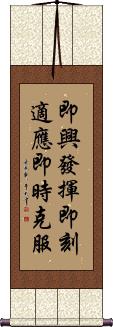
Maintain An Army For 1000 Days,
Use It For An Hour

Mandarin:
yǎng bīng qiān rì,
yàng bīng yì shí

Korean: 양병천일용병일시

用
兵
一
時
養
兵
千
日


Characters shown
above are read
vertically, starting
from the right

Nothing could be more true. When I was in the Marine Corps, we trained for years for combat that often lasts only hours.

This phrase also reminds me of a common phrase used in the military to describe combat: "Weeks of total boredom, punctuated with five minutes of shear terror".

This may have some roots in Sun Tzu's The Art of War. Though I can not find this passage in his writings.

On the subject of the Art of War, if you have a favorite passage, we can create a custom calligraphy scroll with that phrase.

Score: 4/100

Back to the top of this page


Wall scroll artwork shown on this page is priced as follows:

1 character $29.88 each

2-3 characters $39.88 each

4 characters $49.88 each

5-10 characters $59.88 each

11 or more characters $69.88 each


We dispatch any size order to any country worldwide for a flat rate US$9.80 P&P

After you select your calligraphy, our website will take you through the process of customizing your artwork.

Options for other mounting such as portraits are available for $13 less.

We also offer the services of a famous master calligrapher for a $40 fee on any scroll if you are looking for investment-quality calligraphy.

If you chose our famous master-calligrapher, you also get more choices for silk and paper colors and the option for larger artwork.


All of our calligraphy is completely done by hand in the ancient way.

When the calligrapher finishes creating your artwork, it is taken to our art mounting workshop in Beijing where a wall scroll is made by hand from a combination of silk, rice paper, and wood.

After we create your wall scroll, it takes at least two weeks for air mail delivery from Beijing to you.

Therefore, allow at least 3 weeks for delivery from the time you place your order.

When you select your calligraphy, you'll be taken to another page where you can choose various custom options.


A nice Chinese calligraphy wall scroll

The scroll that I am holding in this picture is a "regular size"
4-character wall scroll.
As you can see, it is a great size to hang on your wall.
(We also offer custom wall scrolls in larger sizes)

A professional Chinese Calligrapher

Professional calligraphers are getting to be hard to find these days.
Instead of drawing characters by hand, the new generation in China merely type roman letters into their computer keyboards and pick the character that they want from a list that pops up.

There is some fear that true Chinese calligraphy may become a lost art in the coming years. Many art institutes in China are now promoting calligraphy programs in hopes of keeping this unique form of art alive.

Trying to learn Chinese calligrapher - a futile effort

Even with the teachings of a top-ranked calligrapher in China, my calligraphy will never be good enough to sell. I will leave that to the experts.


A high-ranked Chinese master calligrapher that I met in Zhongwei

The same calligrapher who gave me those lessons also attracted a crowd of thousands and a TV crew as he created characters over 6-feet high. He happens to be ranked as one of the top 100 calligraphers in all of China. He is also one of very few that would actually attempt such a feat.


Successful Chinese and Japanese calligraphy searches within the last few hours...

If your search is not successful, just post your request on our forum, and we'll be happy to do research or translation for any reasonable request.

always
assassin
古道
believe
bible
brotherhood
chad
chloe
creativity
daisy
devotion
dragon
element
faith
felipe
forever
freedom
friend
god
happiness
honesty
hope
iaido
james
laugh
liberty
life
little
live
love
matt
max
meet
melissa
mell
mia
michael
mister
money
natalia
next generation
nice
ninja
owen
passion
peace
prayer
pussy
randy
ray
rosemary
sandra
sarah
shadow
shop
snow
strength
susan
tao
tea
thank you
truth
war
warrior
weed
wisdom
wolf
With so many searches, we had to upgrade to our own Linux server.
Of course, only one in 500 searches results in a purchase - Hey buy a wall scroll!!!


See: Our list of specifically Japanese Kanji Calligraphy Wall Scrolls. And, check out Our list of specifically old Korean Hanja Calligraphy Wall Scrolls.


The following table is only helpful for those studying Chinese (or Japanese), and perhaps helps search engines to find this page when someone enters Romanized Chinese or Japanese

Title
 
Characters
Simplified
Traditional
Japanese Romaji
(Romanized Japanese)
Various forms of Hanyu-Pinyin
(Romanized Chinese)
Marine海军陆战队员
海軍陸戰隊員
n/ahǎi jūn lù zhàn duì yuán
hai jun lu zhan dui yuan
hai3 jun1 lu4 zhan4 dui4 yuan2
haijunluzhanduiyuan
Marine Corps海兵队
海兵隊
kaiheitain/a
Marine Corps海军陆战队
海軍陸戰隊
n/ahǎi jūn lù zhàn duì
hai jun lu zhan dui
hai3 jun1 lu4 zhan4 dui4
haijunluzhandui
Semper Fidelis / Always Faithful永远忠诚
永遠忠誠
n/ayǒng yuǎn zhōng chéng
yong yuan zhong cheng
yong3 yuan3 zhong1 cheng2
yongyuanzhongcheng
United States Marine Corps米海兵隊
米海兵隊
bei kai hei tai
beikaiheitai
n/a
Marine / Soldier of the Sea海兵
海兵
kai hei
kaihei
n/a
San Marino圣马力诺
聖馬力諾
n/ashèng mǎ lì nuò
sheng ma li nuo
sheng4 ma3 li4 nuo4
shengmalinuo
Marina玛瑞娜
瑪瑞娜
n/amǎ ruì nà
ma rui na
ma3 rui4 na4
maruina
Marina玛丽娜
瑪麗娜
n/amǎ lì nà
ma li na
ma3 li4 na4
malina
Fighter战士 / 戦士
戰士
sen shi
senshi
zhàn shì
zhan shi
zhan4 shi4
zhanshi
Warrior武士
武士
bu shi
bushi
wǔ shì
wu shi
wu3 shi4
wushi
Warrior戦士
戦士
sen shi
senshi
n/a
Military Discipline军纪
軍紀
gunkijūn jì
jun ji
jun1 ji4
junji
Army / Military
gunjūn
jun
jun1
jun
Active Duty现役
現役
genekixiàn yì
xian yi
xian4 yi4
xianyi
Aikido (Japanese)合気道 (Modern Japanese)
合氣道 (Old Japanese/Chinese)
ai ki dou
aikidou
ai ki do
hé qì dào
he qi dao
he2 qi4 dao4
heqidao
Gung Ho工合
工合
guaigōng hé
gong he
gong1 he2
gonghe
Training / Drill训练
訓練
kunrenxùn liàn
xun lian
xun4 lian4
xunlian
Smooth Sailing一帆风顺
一帆風順
n/ayī fán fēng shùn
yi fan feng shun
yi1 fan2 feng1 shun4
yifanfengshun
Discipline纪律
紀律
n/ajì lǜ
ji lv
ji4 lv4
jilv
Pain is Weakness Leaving the Body疼痛就是衰弱离你而去的时候
疼痛就是衰弱離你而去的時候
n/aténg tòng jiù shì shuāi ruò lí nǐ ér qù de shí hòu
teng tong jiu shi shuai ruo li ni er qu de shi hou
teng2 tong4 jiu4 shi4 shuai1 ruo4 li2 ni3 er2 qu4 de shi2 hou4
The More We Sweat in Training, The Less We Bleed in Battle平时多流汗战时少流血
平時多流汗戰時少流血
n/apíng shí duō liú hàn zhàn shí shǎo liú xuè
ping shi duo liu han
zhan shi shao liu xue
ping2 shi2 duo1 liu2 han4
zhan4 shi2 shao3 liu2 xue4
Sword
ken / tsurugi
ken/tsurugi
jiàn
jian
jian4
jian
Well-Disciplined严整
嚴整
n/ayán zhěng
yan zheng
yan2 zheng3
yanzheng
Maintain An Army For 1000 Days, Use It For An Hour养兵千日用兵一时
養兵千日用兵一時
n/ayǎng bīng qiān rì, yàng bīng yì shí
yang bing qian ri yang bing yi shi
yang3 bing1 qian1 ri4 yang4 bing1 yi4 shi2
If you have not set up your computer to display Chinese, the characters in this table probably look like empty boxes or random text garbage.
This is why we spent hundreds of hours making images so that you could view the characters in the "marines" listings above.
If you want your Windows computer to be able to display Chinese characters you can either head to your Regional and Language options in your Win XP control panel, select the [Languages] tab and click on [Install files for East Asian Languages]. This task will ask for your Win XP CD to complete in most cases. If you don't have your Windows XP CD, or are running Windows 98, you can also download/run the simplified Chinese font package installer from Microsoft which works independently with Win 98, ME, 2000, and XP. It's a 2.5MB download, so if you are on dial up, start the download and go make a sandwich.


Some people may refer to this entry as Marines Kanji, Marines Characters, Marines in Chinese Writing, Marines in Japanese Writing, Marines in Asian Writing, Marines Ideograms, Chinese Marines symbols, Marines Hieroglyphics, Marines Glyphs, Marines in Chinese Letters, Marines Hanzi, Marines in Japanese Kanji, Marines Pictograms, Marines in the Chinese Written-Language, or Marines in the Japanese Written-Language.

All custom calligraphy items are made-to-order in our little Beijing artwork-mounting workshop.
Please note: Rush service can be as fast as two weeks, but regular service is over a month for delivery.


Key / Important Pages Information Pages "How To" Pages Search Engine & Tech Stuff
Home About Us Asian Art Questions & Answers How We Make Our Wall Scrolls Site Map
Asian Art Gallery About China How Chinese Paintings are Mounted How To Care For Wall Scrolls Asian Language Tools
New Asian Art Arrivals F.A.Q. Asian Art Adventures Framing Suggestions for Chinese Art Characters
Love in Chinese/Japanese Gary's Stories Japanese & Chinese Calligraphy Search How To Frame Asian Art Asian Art Index
Strength in Chinese/Japanese Contact Us Japanese Kakejiku   Chinese / Japanese Dictionary

Copyright Oriental Outpost 2002-2009   -   All Rights Reserved
Image Use Policy | Privacy Policy


This page of marines Chinese calligraphy dictionary search results was generated in 0.598073005676seconds.