Didn't find what you want?
Try these methods:
1. Make your search more specific.
2. Use other similar-meaning words.
3. Use less words or just one word.
4. Post your request on our forum so that we can translate/create what you want.
We'll build you a handmade custom "Army" calligraphy wall scroll if you wish!
Quick links to words on this page...
Check out all the Custom Calligraphy Options
Click on a![]()
to select your calligraphy and start customizing your artwork project...

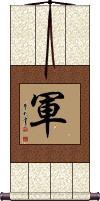
This character means army, military, or arms.
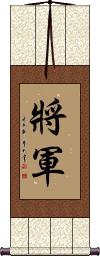
This is also a character used in the compound word that means "army general". It's the "gun" in the well-known Japanese title "Shogun" which means general.
See Also... Shogun | Navy | Marine | Military
Score: 100/100
Mandarin:
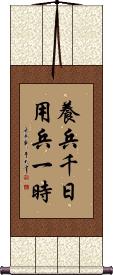
yǎng bīng qiān rì,
yàng bīng yì shí
Korean: 양병천일용병일시


Characters shown
above are read
vertically, starting
from the right
Nothing could be more true. When I was in the Marine Corps, we trained for years for combat that often lasts only hours.
This phrase also reminds me of a common phrase used in the military to describe combat: "Weeks of total boredom, punctuated with five minutes of shear terror".
This may have some roots in Sun Tzu's The Art of War. Though I can not find this passage in his writings.
On the subject of the Art of War, if you have a favorite passage, we can create a custom calligraphy scroll with that phrase.
Score: 100/100


There is a slight variation in the way the first character is written. This is the more Chinese and Korean Hanja version. So if you want to specifically refer to a Chinese or Korean General, this is the way. Japanese people would still easily identify this as "shogun".
Note: This term is also used for Admiral in Korean in certain context (if you need a better title for Admiral, just let me know).
Score: 100/100

This character can be used to express soldiers, troops, a force, an army, weapons, arms, military, warfare, tactics, strategy, or warlike. The final meaning depends on context. It's also part of the Chinese title for the Terracotta soldiers. In fact, this character is usually used in compound words (words of more than one character). Sometimes this single character is the title used for the pawns in a chess game (in a related issue, this is also a nickname for soldiers with the rank of Private).
See Also... Military | Warrior
Score: 67/100


This is the full way to say "Military Intelligence".
The first two characters mean "military affairs".
The second two characters mean "intelligence" or "information-gathering".
If you work in the G2 section of your military unit, this is the wall scroll for you.
Score: 60/100


In the west, when someone mentions "Shogun" we may be filled with thoughts of gallant warriors. Some might even think of the TV mini-series with Richard Chamberlain. Often westerners use the words Samurai and Shogun interchangeably. So I will clear it up really quickly...
Shogun in the simplest definition is a General. You could also use words such as commander, lord, overlord, highest ranking, or commanding officer, since "Shogun" has held some slightly ambiguous meanings at times in Japanese history.
Sometimes a Shogun was a general, other times he was the leader of a military government in Japan.
Variants of the same characters are used in China for the rank and title of a General of the People's Liberation Army (and the same term and characters have been used for the last 2200 years since the Qin Dynasty).
Score: 57/100


Perhaps a pacifist view or perhaps the best kind of victory; these characters reflect this idea:
The edges of the swords not being stained with blood.
You could also translate it as: Win victory without firing a shot.
The first character means army or force. The second character means without or none. The last two characters mean bloodstained knives. So it represents a returning victorious army without bloodstained knives. This is the very literal sense of this word/phrase. The title definition is more accurate to the way this phrase is understood.
Asking yourself why the direct or literal translation is different?
...Think of compound words in English such as "nevertheless" if we break it apart to "never the less" we will have trouble getting the real definition of "in spite of that". Similar things happen when multiple-characters are used to create a compounded word in Chinese.
Score: 39/100


This title means the "engineering corps" of the army or other branch of the military. The first character alone means work, worker, skill, profession, trade, craft, construction or labor. The second character means army, force or military.
See Also... Military
Score: 39/100


This can mean mighty, powerful, large, formidable, or strong.
This term is often used to describe soldiers/troops/warriors, and whole armies.
Score: 35/100


This is the Japanese way to write "United States Marine Corps" or simply "U.S. Marines".
Breaking down each Kanji, this means:
"rice (American) ocean/sea soldiers/army/military corps/regiment/group".
This title will only make sense in Japanese, it is not the same in Chinese! Make sure you know your audience before ordering a custom wall scroll.
If you are wondering about the rice, America is known as "rice country" or "rice kingdom" when literally translated. The Kanji for rice is often used as an abbreviation in front of words (like a sub-adjective) to make something "American". Americans say "rice-burner" for a Japanese car, and "rice-rocket" for a Japanese motorcycle. If you did the same in Japanese, it would be exactly the opposite meaning.
Note: I have not verified this, but I've found this title used for U.S. Marines in Korean articles, so it's most likely a normal Korean term as well (but only in Korean Hanja).
See Also... Marine Corps | Navy | Art Of War | Warrior
Score: 28/100


This is an alternate title for warrior, soldier, or combatant in Japanese. From Japanese, this is often romanized as "Senshi".
See Also... Knight | Marines | Samurai
Score: 25/100


The first character means war, warfare, or battle.
The second character means soldier, officer, man or pawn.
This is how to write "fighter" in Chinese, ancient Japanese Kanji and old Korean Hanja. This word can also mean soldier or warrior, but there are better terms for those two ideas. This one is more specifically "fighter" or "one who fights". This is an odd selection for a wall scroll, unless you are a boxer, ultimate fighter, or otherwise participate in combat sports.
Other translations include combatant or champion.
Note that after WWII, the first Kanji was reformed/simplified. This modern Japanese version is shown to the right. If you want this version, click on the Kanji to the right, instead of the button above.
See Also... Knight | Marines | Samurai | Warrior | Soldier
Score: 25/100


The first character is the spirit or essence of a warrior. The second character means soldier, officer, or official. This character is also used appropriately enough to describe a piece of a chess game. This can also be translated as soldier, cavalier, palace guard, or samurai and sometimes as knight. I've occasionally seen this translated as strong man or tough man (gender not necessarily implied).
See Also... Knight | Marines | Samurai
Score: 25/100


This means "Art of War". It also part of the title of a famous book of tactics by Sun Tzu. These characters could also be translated as "military strategy and tactics", "military skills" or "army procedures". If you are a military tactician, this is the wall scroll for you.
See Also... Military
Score: 16/100
military strategy, tactics, and procedure
Mandarin: sūn zǐ bīng fǎ
Japanese: son shi hyou hou
Korean: 손자병법


This is the full title of the most famous book about warfare in the history of the world. The English title is "Sun Tzu's The Art of War".
The last two characters have come to be known in the west as "The Art of War", but a better translation would be, "military strategy and tactics", "military skills" or "army procedures".
Note: Sometimes the author's name is Romanized as "Sun Zi" or "Sunzi".
It's written the same in Chinese, Japanese Kanji and Korean Hanja.
See Also... Military | Warrior
Score: 16/100


Characters shown
above are read
vertically, starting
from the right
This literally means: [Just as] soldiers/warriors [are valued for their] quality and not [just] for quantity, [so] generals [are valued] for their tactics, not [just] for [their] bravery.
This is a phrase that follows one about how it is better to have warriors of quality, rather than just a large quantity of warriors in your army/force.
See Also... 兵在精而不在多
Score: 10/100


This is how to write the name of the great sage, known in the west as Confucius. His real name is Kongzi (The name Confucius is a westernized version of his name - his family name is Kong, and "zi" was added as a title of distinction). He lived some 2500 years ago in Qufu, a town in modern day Shandong Province of Northern China (about 6 hours south of Beijing by bus). He was a consort to Emperors, and after his death, the impact of his philosophies still served to advise emperors, officials, and common people for generations. Also during these thousands of years, the Kong family remained powerful in China, and the Kong estate was much like the Vatican in Rome. The Kong estate existed as if on sovereign ground with its own small garrison of guards and privileges of a kingdom within an empire.
This was true up until the time the Kong family had to flee to Taiwan in 1949 when the Red Army took victory over the Nationalists during the Revolution. The home of Confucius was later razed and all statues defaced or stolen during the Cultural Revolution. Finally, after years of smearing his name and image, it is once again okay to celebrate the teachings of Confucius in mainland China.
Score: 10/100


This is the ancient way to write archer in both Chinese, Korean and Japanese. If you carried a bow into battle in an army of ancient Asia, this would be your title.
Note: This is an antiquated term that is rarely used in modern Chinese, Korean or Japanese. Beyond archer, this can also mean a ceremonial hunter in Japanese.
Note: This title is so old, that most Asian people will not recognize this as a normal word. It has not been in regular use for many generations.
Score: 10/100
Used in modern times for
divorced couples that come back together
Mandarin: pò jìng chóng yuán


A husband and wife separated and reunited.
About 1500 years ago in China, there lived a beautiful princess named Le Chang. She and her husband Xu De Yan loved each other very much. But when the army of the Sui Dynasty was about to attack their kingdom, disposed of all of their worldly possessions and prepared to flee into exile.
They knew that in the chaos, they might lose track of each other, so the one possession they kept was a bronze mirror which is a symbol of unity for a husband and wife. They broke the mirror into two pieces, and each of them kept half of the mirror. They decided that if separated, they would try to meet in the fair during the 15th day of the first lunar month (which is the lantern festival). Unfortunately, the occupation was brutal, and the princess was forced to become the mistress of the new commissioner of the territory, Yang Su.
At the Lantern Festival the next year, the husband came to the fair to search for his wife. He carried with him, his half of the mirror. As he walked through the fair, he saw the other half of the mirror for sale at a junk market by a servant of the commissioner. The husband recognized his wife's half of the mirror immediately, and tears rolled down his face as he was told by the servant about the bitter and loveless life that the princess had endured.
As his tears dripped onto the mirror, the husband scratched a poem into his wife's half of the mirror:
You left me with the severed mirror,
The mirror has returned but absent are you,
As I gaze in the mirror I seek your face,
I see the moon, but as for you, I see not a trace.
The servant brought the inscribed half of the mirror back to the princess. For many days, the princess could not stop crying when she found that her husband was alive and still loved her.
Commissioner Yang Su, becoming aware of this saga realized that he could never obtain the love of the princess. He sent for the husband and allowed them to reunite.
This phrase in Chinese is now used to describe a couple who has been torn apart for some reason (usually divorce), but have come back together (or remarried).
It seems to be more common these days in America for divorced couples to reconcile and get married to each other again. This would be a great gift if you know someone who is about to remarry their ex.
Score: 10/100


In 632 BC, Duke Wen of the Kingdom of Jin was about to lead an army against the forces of the Kingdom of Chu.
The Duke asked one of his advisers, Jiu Fan, how they could possibly win the impending battle, as they were drastically outnumbered.
Jiu Fan said, "All is fair in war", and went on to suggest a plan of dishonorable tactics (cheating).
The Duke was not sure of this advice, so he asked another adviser, Yong Ji, who replied, "If you catch fish by draining the pond, you can certainly get all the fish. But there will be no fish the following year. You can cheat this one time in battle, but such tactics can only be used once, as the enemy will be wise in future encounters".
The Duke heard the words of his wiser adviser, but cheated to gain victory in the battle. However, he rewarded Yong Ji more than Jiu Fan at the victory celebration, stating that while Jiu Fan's advice gained one victory, the wise words of Yong Ji would last forever.
This Chinese idiom/proverb is still used, over 2600 years later to remind people not to burn bridges, cheat, or dishonor oneself in exchange for a short term gain, while sacrificing the future.
This is very similar to the meaning of the English phrase, "Kill the goose that lays the golden eggs".
Score: 10/100


This is the Japanese and Korean way to express "Marine Corps" or simply "Marines". It is not specific, so this can be the Marine Corps of any country, such as the British Royal Marines to the U.S. Marines.
Breaking down each character, this means:
"ocean/sea soldiers/army corps/regiment/group".
Score: 6/100


This way to express "Marine" as in an individual "Soldier of the Sea" in Japanese Kanji and old Korean Hanja characters (not to be confused with Korean Hangul).
Breaking down each character, this means:
"ocean/sea soldier/army/warrior".
Please note that this Japanese/Korean version kind of means "sailor" or "navy" in Chinese.
Score: 6/100
Wall scroll artwork shown on this page is priced as follows:
1 character $29.88 each
2-3 characters $39.88 each
4 characters $49.88 each
5-10 characters $59.88 each
11 or more characters $69.88 each
After you select your calligraphy, our website will take you through the process of customizing your artwork.
Options for other mounting such as portraits are available for $13 less.
We also offer the services of a famous master calligrapher for a $40 fee on any scroll if you are looking for investment-quality calligraphy.
If you chose our famous master-calligrapher, you also get more choices for silk and paper colors and the option for larger artwork.
All of our calligraphy is completely done by hand in the ancient way.
When the calligrapher finishes creating your artwork, it is taken to our art mounting workshop in Beijing where a wall scroll is made by hand from a combination of silk, rice paper, and wood.
After we create your wall scroll, it takes at least two weeks for air mail delivery from Beijing to you.
Therefore, allow at least 3 weeks for delivery from the time you place your order.
When you select your calligraphy, you'll be taken to another page where you can choose various custom options.
More ARMY Asian artwork can be found here.
The scroll that I am holding in this picture is a "regular size"
4-character wall scroll.
As you can see, it is a great size to hang on your wall.
(We also offer custom wall scrolls in larger sizes)
Professional calligraphers are getting to be hard to find these days.
Instead of drawing characters by hand, the new generation in China merely type roman letters into their computer keyboards and pick the character that they want from a list that pops up.
There is some fear that true Chinese calligraphy may become a lost art in the coming years. Many art institutes in China are now promoting calligraphy programs in hopes of keeping this unique form
of art alive.
Even with the teachings of a top-ranked calligrapher in China, my calligraphy will never be good enough to sell. I will leave that to the experts.
The same calligrapher who gave me those lessons also attracted a crowd of thousands and a TV crew as he created characters over 6-feet high. He happens to be ranked as one of the top 100 calligraphers in all of China. He is also one of very few that would actually attempt such a feat.
Successful Chinese and Japanese calligraphy searches within the last few hours...If your search is not successful, just post your request on our forum, and we'll be happy to do research or translation for any reasonable request. | ||||||
|
abbey abundance alex aman amanda angelo assassin believe bible brave brotherhood caitlin chad chelsea clarity confucius | 福 desire destiny devotion dog dragon faith family fire football freedom gemini god good luck happiness harmony | honor hope i love you james japan jenni jesus john 3 john 3:6 judy laugh leo life life in harmony light live | live strong love luck max meet melissa mia michael mike music natalia nice night owen pablo passion | patience peace prayer pride rain randy respect rosemary ryan sarah shadow snow stars stephanie strength strong woman | susan tao tea true truth understanding war wind wish wolf wu wei yuki | |
| With so many searches, we had to upgrade to our own Linux server. Of course, only one in 500 searches results in a purchase - Hey buy a wall scroll!!! | ||||||
The following table is only helpful for those studying Chinese (or Japanese), and perhaps helps search engines to find this page when someone enters Romanized Chinese or Japanese
| Title | Characters Simplified Traditional |
Japanese Romaji (Romanized Japanese) | Various forms of Hanyu-Pinyin (Romanized Chinese) | |||
| Army / Military | 军 軍 | gun | jūn jun | jun1 jun | ||
| Maintain An Army For 1000 Days, Use It For An Hour | 养兵千日用兵一时 養兵千日用兵一時 | n/a | yǎng bīng qiān rì, yàng bīng yì shí yang bing qian ri yang bing yi shi | yang3 bing1 qian1 ri4 yang4 bing1 yi4 shi2 | ||
| Chinese or Korean Army General (Shogun) | 将军 將軍 | shougun shogun | jiāng jūn jiang jun | jiang1 jun1 jiangjun | ||
| Soldiers | 兵 兵 | hei | bīng bing | bing1 bing | ||
| Military Intelligence | 军事情报 軍事情報 | gunji-jouhou gunji-joho | jūn shì qíng bào jun shi qing bao | jun1 shi4 qing2 bao4 junshiqingbao | ||
| Shogun / Japanese General | 将军 將軍 | shougun shogun | jiāng jūn jiang jun | jiang1 jun1 jiangjun | ||
| Bloodless Victory | 兵不血刃 兵不血刃 | n/a | bīng bù xuè rèn bing bu xue ren | bing1 bu4 xue4 ren4 bingbuxueren | ||
| Military Engineering | 工兵 工兵 | kouhei kohei | gōng bīng gong bing | gong1 bing1 gongbing | ||
| Mighty / Powerful / Strong | 强大 強大 | kyoudai kyodai | qiáng dà qiang da | qiang2 da4 qiangda | ||
| United States Marine Corps | 米海兵隊 米海兵隊 | bei kai hei tai beikaiheitai | n/a | |||
| Warrior | 戦士 戦士 | sen shi senshi | n/a | |||
| Fighter | 战士 / 戦士 戰士 | sen shi senshi | zhàn shì zhan shi | zhan4 shi4 zhanshi | ||
| Warrior | 武士 武士 | bu shi bushi | wǔ shì wu shi | wu3 shi4 wushi | ||
| Art of War | 兵法 兵法 | hyou hou hyouhou hyo ho | bīng fǎ bing fa | bing1 fa3 bingfa | ||
| Sun Tzu - Art of War | 孙子兵法 孫子兵法 | son shi hyou hou sonshihyouhou son shi hyo ho | sūn zǐ bīng fǎ sun zi bing fa | sun1 zi3 bing1 fa3 sunzibingfa | ||
| Value of Warrior Generals | 兵在精而不在多将在谋而不在勇 兵在精而不在多將在謀而不在勇 | n/a | bīng zài jīng ér bù zài duō jiàng zài móu ér bù zài yǒng bing zai jing er bu zai duo jiang zai mou er bu zai yong | bing1 zai4 jing1 er2 bu4 zai4 duo1 jiang4 zai4 mou2 er2 bu4 zai4 yong3 | ||
| Confucius | 孔子 孔子 | koushi koshi | kǒng zǐ kong zi | kong3 zi3 kongzi | ||
| Archer | 弋人 弋人 | yokujin | yì rén yi ren | yi4 ren2 yiren | ||
| Broken Mirror Rejoined | 破镜重圆 破鏡重圓 | n/a | pò jìng chóng yuán po jing chong yuan | po4 jing4 chong2 yuan2 pojingchongyuan | ||
| Drain the pond to get all the fish | 竭泽而渔 竭澤而漁 | n/a | jié zé ér yú jie ze er yu | jie2 ze2 er2 yu2 jiezeeryu | ||
| Marine Corps | 海兵队 海兵隊 | kaiheitai | n/a | |||
| Marine / Soldier of the Sea | 海兵 海兵 | kai hei kaihei | n/a | |||
| If you have not set up your computer to display Chinese, the characters in this table probably look like empty boxes or random text garbage.
This is why we spent hundreds of hours making images so that you could view the characters in the "army" listings above. If you want your Windows computer to be able to display Chinese characters you can either head to your Regional and Language options in your Win XP control panel, select the [Languages] tab and click on [Install files for East Asian Languages]. This task will ask for your Win XP CD to complete in most cases. If you don't have your Windows XP CD, or are running Windows 98, you can also download/run the simplified Chinese font package installer from Microsoft which works independently with Win 98, ME, 2000, and XP. It's a 2.5MB download, so if you are on dial up, start the download and go make a sandwich. | ||||||
Some people may refer to this entry as Army Kanji, Army Characters, Army in Chinese Writing, Army in Japanese Writing, Army in Asian Writing, Army Ideograms, Chinese Army symbols, Army Hieroglyphics, Army Glyphs, Army in Chinese Letters, Army Hanzi, Army in Japanese Kanji, Army Pictograms, Army in the Chinese Written-Language, or Army in the Japanese Written-Language.
All custom calligraphy items are made-to-order in our little Beijing artwork-mounting workshop.
Please note: Rush service can be as fast as two weeks, but regular service is over a month for delivery.
Copyright Oriental Outpost 2002-2009 - All Rights Reserved
Image Use Policy | Privacy Policy
This page of army Chinese calligraphy dictionary search results was generated in 0.534381866455seconds.