Artwork
Search:

Exact
Phrase

Oriental Outpost LogoFlagTowerwatercolor
Chinese Calligraphy Search
ArtPaintingsAsian Art Gallery

Adventures in Asian Art

Didn't find what you want?
Try these methods:

1. Make your search more specific.
2. Use other similar-meaning words.
3. Use less words or just one word.
4. Post your request on our forum so that we can translate/create what you want.


Selections for Believer in Chinese and/or Japanese...

We'll build you a handmade custom "Believer" calligraphy wall scroll if you wish!


Quick links to words on this page...


Select

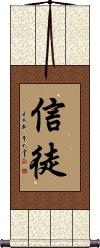
Believer

Mandarin: xìn tú
Japanese: shinto
Korean: 신도

信
徒

This is the Chinese, Japanese Kanji, and old Korean Hanja word for "believer".

Just as in English, this word can be used for a follower of virtually any religion.

This word can also be translated into English as layman, adherent, follower, laity, disciple, or devotee.

Score: 100/100

Select

Seeing is Believing

Mandarin: bǎi wén bù rú yí jiàn
Korean: 백문불여일견

如
一
見
百
聞
不


Characters shown
above are read
vertically, starting
from the right

This phrase literally means "Better to see something once rather than hear about it one hundred times" or "Telling me about something 100 times is not as good as seeing it once". In English, we have the similar phrase of "Seeing is believing", but this has a bit of the "A picture paints a thousand words" meaning too.

Score: 65/100

Select

Believe

Mandarin: xiāng xìn
Korean: 상신

相
信

This is the Chinese way to say believe. This specifically means to be convinced that something is true or to accept something as true or real. This can also be translated as "convinced of", "have trust in", "have faith in"

Score: 54/100

Select

Believe / Faith / Trust

(single character)

Mandarin: xìn
Japanese: shin
Korean:

信

This single character is often part of other words with similar meanings. Alone, this character can mean to believe, truth, faith, fidelity, sincerity, trust and confidence in Chinese, old Korean Hanja and Japanese Kanji.

It is one of the five basic tenets of Confucius.

In Chinese, it sometimes has the secondary meaning of a letter (as in the mail) depending on context, but it will not be read that way when seen on a wall scroll.

See Also...  Faith | Trust | Confucius

Score: 54/100

Select

Trust in God / In God We Trust

Mandarin: xiāng xìn shàng dì

相
信
上
帝

This means exactly what the title suggests. The first two characters mean "trust" or "believe" and the second two mean "God" (as in the God of Abraham and the God of Zion).

This is also how the American phrase "In God We Trust" as seen on U.S. Currency would be translated into Chinese. It would also be correct to say that this means "Believe in God", though in this arrangement/context, one would be more likely to interpret it as "trust".

Score: 30/100

Select

Trust in God

Mandarin: xìn kào shàng dì

信
靠
上
帝

This means "Trust in God", "Faith in God", "Rely upon God" and/or "Believe in God".

Score: 29/100

Select

Honesty / Fidelity

Mandarin: xìn
Japanese: shin
Korean:

信

This is another character that expresses the idea of honesty. It can also mean truth, faith, believe in, fidelity, sincerity, trust and/or confidence.

Some have included this in the list for the Bushido, although "makoto" is probably more common/popular.

Note: In some context, this character can mean letter; news or envoy. However, alone, it will generally be read with the honesty-meaning.

See our page with just Code of the Samurai / Bushido here

See Also...  Loyalty Trustworthiness Trustworthy

Score: 29/100

Back to the top of this page

Select

Faith is the bird that feels the light when the dawn is still dark

Mandarin: xìn niǎn shì zài lí míng qián de hēn àn zhōng néng gǎn dào guāng míng de niǎo

感
到
光
明
的
鳥
前
的
黑
闇
中
能
信
唸
是
在
黎
明


Characters shown
above are read
vertically, starting
from the right

This is a philosophical poem/quote from Indian Poet and Philosopher, Rabindranath Tagore.

Rabindranath Tagore

Rabindranath Tagore, 1915


This quote is not sourced, and therefore several variations exist in English. Some suggest the original was in the Bengali language.

This of course is the Chinese translation which has the meaning of, "Faith is the bird that feels the light and sings when the dawn is still dark".

Score: 28/100

Select

Devotion (Religious)

Mandarin: xìn yǎng
Japanese: shin kou
Korean: 신앙

信
仰

This means firm belief, faith, persuasion, conviction, and sometimes religion or creed in Chinese, Japanese Kanji and old Korean Hanja.

This word clearly fits religious connotation of the English word "devotion".

See Also...  Faith | Trust

Score: 28/100

Select

Faith

Mandarin: xìn niàn
Japanese: shinnen
Korean: 신념

信
念

These characters express the idea of "having a belief", or "trusting in the unseen".

This word could also be translated as beliefs or convictions.

Note: Also considered to be one of the Seven Heavenly Virtues.

See Also...  Devotion | Dedication | Trust

Score: 28/100

Back to the top of this page

Select

Faith (Religious)

Mandarin: xìn yǎng
Japanese: shinkou
Korean: 신앙

信
仰

This is the more religious form of "faith". It has this same meaning in Chinese, Korean Hanja and Japanese Kanji. This is often used to refer to a person of faith or a religious person. Can be directly translated as "firm belief", "creed", "conviction" or simply as "religious" depending on context.

See Also...  Devotion | Trust

Score: 28/100

Select

Tiger Rumor

Mandarin: sān rén chéng hǔ
Korean: 삼인성호

三
人
成
虎

These four characters together relay the meaning that can be expressed in English as, "When three people say there's a tiger running in the street, you believe it".

Of course, there is an ancient story behind this phrase...

This is actually an idiom that resulted from a conversation that occurred around 300 B.C.

The conversation was between the king of the Wei kingdom and one of the king's ministers named Pang Cong.

It was near the end of one of many wars, this time with the Zhao kingdom. Pang Cong was to be sent by the king to the Zhao kingdom with the king's son who was to be held hostage. It was common at the time for a king to make his son a hostage to secure stable peace between warring kingdoms.

Before minister Pang Cong departed, he asked his king, "If one person told you there was a tiger running in the street, would you believe it?".

"No", the king said.

The minister continued, "What if two people told you?"

The king replied, "Well, I would have my doubts, but I might believe it".

The minister continued, "So, what if three people told you that there is a tiger running in the streets?"

The king replied, "Yes, I would believe it, it must be true if three people say it".

The minister then reminded the king, "Your son and I are now traveling far away to live in the distant Zhao kingdom - much farther from your palace than the street. Rumors may fly about me in my absence, so I hope your majesty will weight such rumors appropriately".

The king replied, "I have every trust in you, do not worry"

While the minister was gone, the king's enemies gossiped about minister Pang Cong on many occasions. At first, the king thought nothing of these comments and rumors. But slowly as the rumors mounted, the king began to suspect ill of his minister.

Some time later when peace was well-established, the minister and prince were freed and returned to the kingdom of Wei. The king received his son, BUT DID NOT EVEN SUMMON MINISTER PANG CONG TO THE PALACE!

Hopefully this story will help you see how dangerous words can be when used to promote rumors, or create ill will. And perhaps will inspire you to not believe everything you hear.

There is also a secondary suggestion in this idiom that gossip is as ferocious as a tiger. Some Chinese people who don't know the ancient story above may believe that this scroll means that rumors are as vicious as three tigers.

Note: This phrase appears in my Korean dictionary, but is not well-known in Korea.

Score: 19/100

Select

Shorin-Ryu (Japanese)

Little Forest Style

Mandarin: shào lín liú
Japanese: shou rin ryu

少
林
流

This is a specific type of martial arts (Karate) from Okinawa, Japan.

The first two characters mean "Little Forest". This happens to be the exact title of Shaolin (the famous place in China that many believe to be the birthplace of Kung Fu).

The last character can mean a flow or movement, but in the context of martial arts, refers to a style, method, or in the extended meaning, a school.

Note: This title can be pronounced in Chinese, but would only be used or well-known by Chinese people who practice this Japanese martial art (rare). In most cases, consider this to be a "Japanese only" title.

小Note: This title is sometimes written with a different first character. It can be written with a character that means "little/small" (see first character to the right).

松But it can also be written with a first character which means "pine" (see second character to the right).

Click on the character above (instead of the button above) of your choice if you want one of these alternate forms.

Score: 14/100

Back to the top of this page

Select

John 3:16


Mandarin: shén ài shì rén shèn zhì jiāng tā de dú shēng zǐ cì gè tā mén jiào yí qiè xìn tā de bú zhì miè wáng fǎn dé yǒng shēng

他
的
不
至
滅
亡
反
得
永
生
生
子
賜
給
他
們
叫
一
切
信
神
愛
世
人
甚
至
將
他
的
獨


Characters shown
above are read
vertically, starting
from the right

This is the full translation of John 3:16 into Chinese.

This translation comes from the Chinese Union Bible which comes from a revised version of the King James. This Chinese Bible was originally translated and printed in 1919 (several revisions since then).

Because of the origin being the KJV, I'll say that in English, this would be, "For God so loved the world, that he gave his only begotten Son, that whosoever believeth in him should not perish, but have everlasting life".

As with any translation, there are interesting cultural and linguistic issues. For instance, the word used for "world" in Chinese can also mean "common people". So you could say that it means "For God so loved the common people..."
This does not take away from the text, as it will be understood with the same meaning and connotation.

There is no direct Greek to Chinese translation in print (that I know of), so this is the best available. Of course, you can ask any Greek person of faith, and they will claim that a bit is lost from the original Greek of the New Testament to any of the English versions of the Bible in print.

Score: 14/100

Select

Honesty

Mandarin: zhèng zhí
Japanese: shoujiki
Korean: 정직

正
直

Honesty is being truthful and sincere. It is important because it builds trust. When people are honest, they can be relied on not to lie, cheat or steal. Being honest means that you accept yourself as you are. When you are open and trustworthy, others can believe in you.

Japanese jikiPlease note that the second Kanji sometimes has an alternate form in Japanese. Let us know if you want the alternate form shown to the right.

Note: This entry is cross-listed as "integrity" because it also fits that definition.

See Also...  Truth | Trust | Integrity

Score: 14/100

Select

Forgive

Mandarin: liàng
Korean:

諒

This single character means "forgive" in Chinese. In Korean, this kind of means forgive, but also has slightly different definitions of consider, excuse, faithful, believe.

Score: 14/100

Back to the top of this page

Select

Fate / Opportunity / Chance

(Buddhism)

Mandarin: yīn yuán
Japanese: innen
Korean: 인연

因
緣

This is the Buddhist concept of a chance meeting or an opportunity that presents itself by fate.

Sometimes this is used to describe a cosmic chain of events or cause and effect.

It also is used to describe predestined relationships between people - and sometimes married couples (although if you want one about marriage, try this: Fate / Destiny of Lovers.

This word can also be translated as origin, karma, destiny, affinity, connection, and relation. This all depends on context - seen alone on a wall scroll, this will be read with a "fate / chance" meaning by a Chinese person, or Korean who can read Hanja.

This is a rather uncommon word in Japanese, so I recommend it only if your audience is Chinese, Korean or maybe devout Buddhist Japanese.


This concept is known as nidana in the original Sanskrit. Also sometimes presented as hetupratyaya which I believe is Pali.

See Also...  Buddhism | Opportunity

Score: 14/100

Select

Commitment

Mandarin: chéng nuò
Japanese: shoudaku
Korean: 승낙

承
諾

Commitment is caring deeply about something or someone. It is deciding carefully what you want to do, and then giving it 100%, holding nothing back. You give your all to a friendship, a task, or something you believe in. You finish what you start. You keep your promises.

In Chinese, this word directly means to undertake something or to make a promise to do something.

Within the idea of commitment, this word also means to make a big effort, or undertaking a great task. Outside of the commitment idea, this particular word can also mean approval, acceptance, consent, assent, acquiescence, or agreement depending on context (especially in Japanese and Korean). Therefore this word is probably best if your audience is Chinese.

See Also...  Partnership | Hard Work | Dedication

Score: 14/100

Select

Daoism / Taoism

Literally: The Way or Road

Mandarin: dào
Japanese: michi / -do
Korean:

道

This is the character "dao" which is sometimes written as "tao" but pronounced like "dow" in Mandarin.

This is the base of what is known as "Taoism". If you translate this literally, it can mean "the way" or "the path".

Dao is believed to be that which flows through all things, and keeps them in balance. It incorporates the ideas of yin and yang (e.g. there would be no love without hate, no light without dark, no male without female.)

The beginning of Taoism can be traced to a mystical man named
Lao Zi (604-531 BC), who followed, and added to the teachings of Confucius.

More about Taoism / Daoism here.

Note that this is pronounced "dou" and sometimes "michi" when written alone in Japanese, but pronounced "do" in word compounds such as Karate-do and Bushido. It's also "do" in Korean.

Alternate translations and meanings: road, way, path; truth, principle province.

Important Japanese note: In Japanese, this will generally be read with the road, way, or path meaning. Taoism is not as popular or well-known in Japan, so that Daoist/Taoist philosophy is not the first thing a Japanese person will think of then they read this character.

See our Taoism Page

Score: 14/100

Back to the top of this page

Select

Five Elements

Mandarin: wǔ xíng
Japanese: gogyou
Korean: 오행

五
行

This is the title of the five elements which are: wood, fire, water, earth and metal. The first character means "5" and the second character is simply "elements".

According to ancient Chinese science, all matter in the world is made up of these elements. One idea presented with the five elements is that when energy is added, matter is believed to expand. When energy is removed, matter contracts. Oddly, this concept is not far from Einstein's theories, and modern science. Just a few thousand years before Einstein.

See more on our Five Elements page. Also a Wikipedia entry for Five Elements (Wu Xing).

See Also...  Wood | Fire | Water | Earth | Metal

Score: 14/100

Select

Heart / Mind / Spirit

Mandarin: xīn
Japanese: kokoro
Korean:

心

This word would often be translated as “heart”. However, because it was believed in Chinese culture thousands of years that your consciousness and thoughts came from the big red organ in the middle of your chest, it also means “mind” or “spirit” and sometimes even “soul”.

In Korean, beyond heart, mind, and spirit, this character can mean moral, nature, mind, affections, intentions, core, and center. In fact, it is used in Chinese to mean "center" as well, but only with another character in front of it. For instance, "medical center" or even "shopping center". Separately and alone, it will not be read with that "center" meaning unless thought of as "the center of your soul".

Score: 14/100

Select

House of Red Delights

Mandarin: yí hóng yuàn

怡
紅
院

This is from "The Story of the Stone" by Cao Xueqin.

For some reason, this phrase was translated as "House of Green Delights" when the novel was published in English. The translator took some liberties, and believed that "green" had a more positive feel than red, to a western audience. Therefore, the phrase shown to the right is "House of Red Delights" (which is the most original and correct way).

Score: 14/100

Back to the top of this page

Select

Life Energy / Spiritual Energy

Essense of Life

Mandarin:
Japanese: ki
Korean:

氣

Qi which is also Romanized as Chi in Chinese or Ki in Japanese, is a fundamental concept of traditional Asian culture. Qi is believed to be part of everything that exists, as in “life force” or “spiritual energy”. It is most often translated as “energy flow,” or literally as “air” or “breath”.

The character itself is a representation of steam (or breath) rising from rice.
米This was apparently seen as the release of energy from the rice when this concept was first developed. To clarify, the character for rice is shown to the right. The Qi / Chi / Ki character is still used in compound words to mean steam or vapor.

The idea of Qi / Chi / Ki is really a philosophical concept. It's often used to refer to the “flow” of metaphysical energy that sustains living beings. Yet there is much debate that has continued for thousands of years as to whether Qi / Chi / Ki is pure energy, or consists partially, or fully of matter.

You can also see the character for Qi / Chi / Ki in common compound words such as Tai Chi / Tai Qi, Aikido, Reiki and Qi Gong / Chi Kung.

In the modern Japanese Kanji, the rice radical has been changed into two strokes that form an X.

The original and traditional Chinese form is still understood in Japanese, but we can also offer that modern Kanji form in our custom calligraphy. If you want this Japanese Kanji, please click on the character to the right, instead of the “Select and Customize” button above.

More language notes: This is pronounced like “chee” in Mandarin Chinese, and like “key” in Japanese.
This is also the same way to write this in Korean Hanja where it is Romanized as “gi” and pronounced like “gee”, but with a real G-sound, not a J-sound.
Though Vietnamese no longer use Chinese characters in their daily language, this character is still widely known in Vietnam.

See Also...  Life Force | Vitality | Life | Birth | Soul

Score: 14/100

Select

Antiwar / Anti-War

Mandarin: fǎn zh n
Korean:

反
戰

This means just what the title suggests. This means antiwar, as in what a pacifist believes in.

China doesn't tend to go to war very often so it's rare to need this word. But it's the kind of word that war protesters would write on their signs. If you add the word for "protest" after this word in Chinese, you have the subject that gets a lot of press lately in China:
Anti-War protests in America.

Score: 3/100

Select

Art of War: 5 Points of Analysis

Mandarin: dào tiān dì jiàng fǎ
Japanese: dou ten chi shou hou
Korean: 도천지장법

道
天
地
將
法

The first chapter of Sun Tzu's Art of War lists five key points to analyzing your situation. Sun Tzu says that to sharpen your skills, you must plan. To plan well, you must know your situation. Therefore, you must consider and discuss the following:

1. Philosophy and Politics: Make sure your way or your policy is agreeable among all of your troops (and the citizens of your kingdom as well). For when your soldiers believe in you and your way, they will follow you to their deaths without hesitation, and will not question your orders.

2. Heaven/Sky: Consider climate / weather. This can also mean to consider whether God is smiling on you. In the modern military, this could be waiting for clear skies so that you can have air support for an amphibious landing.

3. Ground/Earth: Consider the terrain in which the battle will take place. This includes analyzing defensible positions, exit routes, and using varying elevation to your advantage. When you plan an ambush, you must know your terrain, and the best location from which to stage that ambush. This knowledge will also help you avoid being ambushed, as you will know where the likely places in which to expect an ambush from your enemy.

4. Leadership: This applies to you as the general, and also to your lieutenants. A leader should be smart and be able to develop good strategies. Leaders should keep their word, and if they break a promise, they should punish themselves as harshly as they would punish subordinates. Leaders should be benevolent to their troops, with almost a fatherly love for them. Leaders must have the ability to make brave and fast decisions. Leaders must have steadfast principles.

5. [Military] Methods: This can also mean laws, rules, principles, model, or system. You must have an efficient organization in place to manage both your troops and supplies. In the modern military, this would be a combination of how your unit is organized, and your SOP (Standard Operating Procedure).

Notes: This is a simplistic translation and explanation. Much more is suggested in the actual text of the Art of War (Bing Fa). It would take a lot of study to master all of these aspects. In fact, these five characters can be compared to the modern military acronyms such as BAMCIS or SMEAC.

CJK notes: I have included the Japanese and Korean pronunciations, but in Chinese, Korean and Japanese, this does not make a typical phrase (with subject, verb and object) it is a list that only someone familiar with Sun Tzu's writings would understand.

Score: 3/100

Back to the top of this page

Select

Listen to Both Sides and be Enlightened,
Listen to One Side and be in the Dark

Mandarin: jiān tīng zé míng, piān tīng zé àn
Korean: 겸청칙명편청칙암

兼
聽
則
明
偏
聽
則
暗

A man named Wei Zheng lived between 580-643 AD. He was a noble and wise historian and minister in the court of the early Tang Dynasty.

The emperor once asked him, "What should an emperor do to understand the real-world situation and what makes an emperor out-of-touch with reality?"

Wei Zheng replied, "Listen to both sides and you will be enlightened; listen to only one side and you will be left in the dark."

Then Wei Zheng went on to site examples of leaders in history that were victorious after heeding both sides of the story, and other leaders that met their doom because they believed one-sided stories which often came from flattering lips.

Please note that there is an unwritten rule when the same character appears twice in the same phrase, the calligrapher will alter the appearance so that no two characters are exactly alike in the same piece. This calligraphy has two repeating characters that will be written differently than they appear here.


Score: 14/100

Select

Loyalty

Japanese Chinese Korean

Mandarin: zhōng chéng
Japanese: chuu sei
Korean: 충성

忠
誠

Loyalty is staying true to someone. It is standing up for something you believe in without wavering. It is being faithful to your family, country, school, friends or ideals, when the going gets tough as well as when things are good. With loyalty, you build relationships that last forever.

Notes:
1. This written form of loyalty is universal in Chinese, Japanese Kanji, and old Korean Hanja.

2. There is also a Japanese version that is part of the Bushido Code which may be more desirable depending on whether your intended audience is Japanese or Chinese.

3. This version of loyalty is sometimes translated as devotion, sincerity, fidelity, or allegiance.

See Also...  Honor | Trust | Integrity | Sincerity

Score: 14/100

Select

Nothingness

Mandarin: kōng wú
Japanese: kuumu
Korean: 공무

空
無

This is "nothingness" in Buddhist context.

The first character means empty, but can also mean air or sky (air and sky have no form).

The second character means have not, no, none, not or to lack.

Together these characters reinforce each other into a word that means "absolute nothingness".

I know this is a term used in Buddhism, but I have not yet figured out the context in which it is used. I suppose it can be the fact that Buddhists believe that the world in a non-real illusion, or perhaps it's about visualizing yourself as "nothing" and therefore leaving behind your desire and worldliness.
Buddhist concepts and titles often have this element of ambiguity or rather "mystery". Therefore, such ideas can have different meanings to different people, and that's okay. If you don't get it right in this lifetime, as there will be plenty more lifetimes to master it (whatever "it" is, and if "it" really exists at all).

Soothill defines this as "Unreality, or immateriality, of things, which is defined as nothing existing of independent or self-contained nature".

Score: 14/100

Back to the top of this page

Select

Profound / Powerful Words

Mandarin: rù mù sān fēn

入
木
三
分

These four characters together translate in English to a strong form of "profound" or "written with a forceful hand".

But there is much more to the story...

The deep meaning behind this phrase comes from a man named Wan Xizhi who lived in the third century.

He was a great writer and calligrapher whose writing style influenced generations of other writers and calligraphers.

He once wrote words on a piece of wood to be taken to an engraver.
When the engraver began to carve the characters into the wood, he found that Wang Xizhi's writing had penetrated the wood about 3/8 of an inch.

Thus people believed that his words were so powerful, and so profound this it caused the ink from his brush to penetrate the wood deeply.

The phrase literally means "penetrated wood three fen" (fen is an ancient Chinese measurement a little over to 1/8 of an inch or almost 4mm).

Score: 14/100

Select

Sincere Heart

Mandarin: xuě xīn
Korean: 혈심

血
心

When you take this word apart, you find the sum is a little different than the parts. The first character means blood and the second means heart. It is important to note that for thousands of years, it was believed that your heart was both your soul and your mind in Asian culture. When you add blood to the heart, it is your whole being - it is pure and clean dedication with your whole soul.

Most Chinese dictionaries define this as sincerity of heart or a MEDICAL TERM!!!
Please think carefully before ordering this selection - it was only added as others have used this for coffee cups and other novelties (though perhaps naively).

Score: 14/100

Select

In Wine there is Truth

Mandarin: jiǔ hòu tǔ zhēn yán
Korean: 주후토진언

酒
后
吐
真
言

This is a nice one if you know a vintner or wine seller - or wine lover - although the actual meaning might not be exactly what you think or hope.

The literal meaning is that someone drinking wine is more likely to let the truth slip out. It can also be translated as, "People speak their true feelings after drinking alcohol".

It's long-believed in many parts of Asia that one can not consciously hold up a facade of lies when getting drunk, and therefore the truth will come out with a few drinks.

I've had the experience where a Korean man would not trust me until I got drunk with him (I was trying to gain access to the black market in North Korea which is tough to do as an untrusted outsider) - so I think this idea is still well-practiced in many Asian countries.

VS

Please note that there are two common ways to write the second character of this phrase. The way it's written will be left up to the mood of the calligrapher, unless you let us know that you have a certain preference.

See Also...  Honesty | Truth

Score: 14/100

Back to the top of this page

Select

Turtle

...also means tortoise

Mandarin: guī
Japanese: kame
Korean:

龜

This is the generic term for turtle in Chinese, and old Korean Hanja. It's like saying "turtle" (or "tortoise") without being specific about species of turtle.

Please note that there are many special characters in Chinese and a few in Japanese that denote specific species of turtle, and do not include this character. We can't possibly cover all of these species, but if you want a certain one, such as "loggerhead" or a "leatherback", just post your request for a special Chinese / Japanese Kanji / Korean Hanja calligraphy word and we'll do our best to research your special species.

If you noticed, I said species names that do not include this character. This is because, in much the same way we can do it in English by just saying, "loggerhead", instead of "loggerhead turtle", the same can be done in Chinese and Japanese.

亀This may be hard to believe, but the image shown to the right is an alternate version of this character, which is currently used in Japan. This was originally an alternate form in ancient China for turtle - but it's so obscure now, that most Chinese people would just think this is the Japanese version of turtle (I did a lot of research on this). The version shown in the upper left is traditional Chinese (also used in Korea, prior to 100 years ago). It will generally not be recognized by the new generation of Japanese people. If your audience is Japanese, please click on the Kanji image shown to the right to have the calligrapher write that version (instead of clicking the button above).

Score: 14/100

Select

Aries Zodiac Symbol / Sign

(Alternate / Chinese)

Mandarin: bái yáng zuò

白
羊
座

This is an alternate Chinese way to write Aries (ram) of western astrology. I don't believe it is used at all in Japanese, so the other version is probably better or at least more universal.

See Also...  Chinese Zodiac

Score: 14/100

Select

Capricorn Zodiac Symbol / Sign

(Alternate / Chinese)

Mandarin: mó jié zuò

摩
羯
座

This is an alternate Chinese way to write Capricorn (horned goat) of western astrology. I don't believe it is used at all in Japanese, so the other version is probably better or at least more universal.

See Also...  Chinese Zodiac

Score: 14/100

Back to the top of this page

Select

Jew / Jewish

Mandarin: yóu tài

猶
太

This is the title for Jews or the adjective for being Jewish in Chinese.

You may be surprised to learn that there are still a few native Jews in China (though many ethnic Jews moved to Israel). It's believed that they are descendants of traders who traveled the silk road between the Middle East and the Orient.

Score: 14/100

Select

Karate

Mandarin: táng shǒu
Japanese: kara te

唐
手

This is a very seldom-used title for Karate. This title uses a character which represents the Tang Dynasty of China. Thus, this is often translated as the "Tang Hand" or incorrectly, "Tang Fist". I have also seen some call it "China Hand".

There is not a lot of information on this title, but some believe that a simplified form of Kung Fu that started in China, and ended up very popular in Japan used this title initially. It was later changed in Japan to a different Karate title which means "Empty Hand" (as in, without weapons).

I am sure that some will suggest a different history or argue a different origin. I think that nobody can be sure.

Note: Just like the more conventional Karate title, this one can have the "way" or "method" character added to the end, as in Karate-Do.

Score: 14/100


Wall scroll artwork shown on this page is priced as follows:

1 character $29.88 each

2-3 characters $39.88 each

4 characters $49.88 each

5-10 characters $59.88 each

11 or more characters $69.88 each


We dispatch any size order to any country worldwide for a flat rate US$9.80 P&P

After you select your calligraphy, our website will take you through the process of customizing your artwork.

Options for other mounting such as portraits are available for $13 less.

We also offer the services of a famous master calligrapher for a $40 fee on any scroll if you are looking for investment-quality calligraphy.

If you chose our famous master-calligrapher, you also get more choices for silk and paper colors and the option for larger artwork.


All of our calligraphy is completely done by hand in the ancient way.

When the calligrapher finishes creating your artwork, it is taken to our art mounting workshop in Beijing where a wall scroll is made by hand from a combination of silk, rice paper, and wood.

After we create your wall scroll, it takes at least two weeks for air mail delivery from Beijing to you.

Therefore, allow at least 3 weeks for delivery from the time you place your order.

When you select your calligraphy, you'll be taken to another page where you can choose various custom options.


A nice Chinese calligraphy wall scroll

The scroll that I am holding in this picture is a "regular size"
4-character wall scroll.
As you can see, it is a great size to hang on your wall.
(We also offer custom wall scrolls in larger sizes)

A professional Chinese Calligrapher

Professional calligraphers are getting to be hard to find these days.
Instead of drawing characters by hand, the new generation in China merely type roman letters into their computer keyboards and pick the character that they want from a list that pops up.

There is some fear that true Chinese calligraphy may become a lost art in the coming years. Many art institutes in China are now promoting calligraphy programs in hopes of keeping this unique form of art alive.

Trying to learn Chinese calligrapher - a futile effort

Even with the teachings of a top-ranked calligrapher in China, my calligraphy will never be good enough to sell. I will leave that to the experts.


A high-ranked Chinese master calligrapher that I met in Zhongwei

The same calligrapher who gave me those lessons also attracted a crowd of thousands and a TV crew as he created characters over 6-feet high. He happens to be ranked as one of the top 100 calligraphers in all of China. He is also one of very few that would actually attempt such a feat.


Successful Chinese and Japanese calligraphy searches within the last few hours...

If your search is not successful, just post your request on our forum, and we'll be happy to do research or translation for any reasonable request.

alison
angelica
barry
battle
believe
best
bliss
carter
catherine
cesar
courage
daisy
derek
diana
family
federica
fighter
free
freedom
grace
harmony
hell
honesty
in the beginning was the word
jacob
jason
jeff
jefferson
john
jujitsu
learn
leo
life
live
love
loyalty
luca
marion
marisa
matthew
ninja
norah
peace
pride
prosperity
respect
rice
rose
rosy
sergio
strength
success
sun
unity
With so many searches, we had to upgrade to our own Linux server.
Of course, only one in 500 searches results in a purchase - Hey buy a wall scroll!!!


See: Our list of specifically Japanese Kanji Calligraphy Wall Scrolls. And, check out Our list of specifically old Korean Hanja Calligraphy Wall Scrolls.


The following table is only helpful for those studying Chinese (or Japanese), and perhaps helps search engines to find this page when someone enters Romanized Chinese or Japanese

Title
 
Characters
Simplified
Traditional
Japanese Romaji
(Romanized Japanese)
Various forms of Hanyu-Pinyin
(Romanized Chinese)
Believer信徒
信徒
shintoxìn tú
xin tu
xin4 tu2
xintu
Seeing is Believing百闻不如一见
百聞不如一見
n/abǎi wén bù rú yí jiàn
bai wen bu ru yi jian
bai3 wen2 bu4 ru2 yi2 jian4
baiwenburuyijian
Believe相信
相信
n/axiāng xìn
xiang xin
xiang1 xin4
xiangxin
Believe / Faith / Trust
shinxìn
xin
xin4
xin
Trust in God / In God We Trust相信上帝
相信上帝
n/axiāng xìn shàng dì
xiang xin shang di
xiang1 xin4 shang4 di4
xiangxinshangdi
Trust in God信靠上帝
信靠上帝
n/axìn kào shàng dì
xin kao shang di
xin4 kao4 shang4 di4
xinkaoshangdi
Honesty / Fidelity
shinxìn
xin
xin4
xin
Faith is the bird that feels the light when the dawn is still dark信念是在黎明前的黑暗中能感到光明的鸟
信唸是在黎明前的黑闇中能感到光明的鳥
n/axìn niǎn shì zài lí míng qián de hēn àn zhōng néng gǎn dào guāng míng de niǎo
xin nian shi zai li ming qian de hen an zhong neng gan dao guang ming de niao
xin4 nian3 shi4 zai4 li2 ming2 qian2 de hen1 an4 zhong1 neng2 gan3 dao4 guang1 ming2 de niao3
Devotion (Religious)信仰
信仰
shin kou
shinkou
shin ko
xìn yǎng
xin yang
xin4 yang3
xinyang
Faith信念
信念
shinnenxìn niàn
xin nian
xin4 nian4
xinnian
Faith (Religious)信仰
信仰
shinkou
shinko
xìn yǎng
xin yang
xin4 yang3
xinyang
Tiger Rumor三人成虎
三人成虎
n/asān rén chéng hǔ
san ren cheng hu
san1 ren2 cheng2 hu3
sanrenchenghu
Shorin-Ryu (Japanese)少林流
少林流
shou rin ryu
shourinryu
sho rin ryu
shào lín liú
shao lin liu
shao4 lin2 liu2
shaolinliu
John 3:16神爱世人甚至将他的独生子赐给他们叫一切信他的不至灭亡反得永生
神愛世人甚至將他的獨生子賜給他們叫一切信他的不至滅亡反得永生
n/ashén ài shì rén shèn zhì jiāng tā de dú shēng zǐ cì gè tā mén jiào yí qiè xìn tā de bú zhì miè wáng fǎn dé yǒng shēng
shen ai shi ren shen zhi jiang ta de du sheng zi ci gei ta men jiao yi qie xin ta de bu zhi mie wang fan de yong sheng
shen2 ai4 shi4 ren2 shen4 zhi4 jiang1 ta1 de du2 sheng1 zi3 ci4 gei3 ta1 men2 jiao4 yi2 qie4 xin4 ta1 de bu2 zhi4 mie4 wang2 fan3 de2 yong3 sheng1
Honesty正直
正直
shoujiki
shojiki
zhèng zhí
zheng zhi
zheng4 zhi2
zhengzhi
Forgive
n/aliàng
liang
liang4
liang
Fate / Opportunity / Chance因缘
因緣
innenyīn yuán
yin yuan
yin1 yuan2
yinyuan
Commitment承诺
承諾
shoudaku
shodaku
chéng nuò
cheng nuo
cheng2 nuo4
chengnuo
Daoism / Taoism
michi / -do
michi/-do
dào
dao
dao4
dao
Five Elements五行
五行
gogyou
gogyo
wǔ xíng
wu xing
wu3 xing2
wuxing
Heart / Mind / Spirit
kokoroxīn
xin
xin1
xin
House of Red Delights怡红院
怡紅院
n/ayí hóng yuàn
yi hong yuan
yi2 hong2 yuan4
yihongyuan
Life Energy / Spiritual Energy气 / 気
ki
qi
qi4
qi
Antiwar / Anti-War反战
反戰
n/afǎn zh n
fan zhan
fan3 zhan4
fanzhan
Art of War: 5 Points of Analysis道天地将法
道天地將法
dou ten chi shou hou
doutenchishouhou
do ten chi sho ho
dào tiān dì jiàng fǎ
dao tian di jiang fa
dao4 tian1 di4 jiang4 fa3
daotiandijiangfa
Listen to Both Sides and be Enlightened, Listen to One Side and be in the Dark兼听则明偏听则暗
兼聽則明偏聽則暗
n/ajiān tīng zé míng, piān tīng zé àn
jian ting ze ming, pian ting ze an
jian1 ting1 ze2 ming2, pian1 ting1 ze2 an4
Loyalty忠诚
忠誠
chuu sei
chuusei
chu sei
zhōng chéng
zhong cheng
zhong1 cheng2
zhongcheng
Nothingness空无
空無
kuumu
kumu
kōng wú
kong wu
kong1 wu2
kongwu
Profound / Powerful Words入木三分
入木三分
n/arù mù sān fēn
ru mu san fen
ru4 mu4 san1 fen1
rumusanfen
Sincere Heart血心
血心
n/axuě xīn
xue xin
xue3 xin1
xuexin
In Wine there is Truth酒后吐真言
酒后吐真言 / 酒後吐真言
n/ajiǔ hòu tǔ zhēn yán
jiu hou tu zhen yan
jiu3 hou4 tu3 zhen1 yan2
jiuhoutuzhenyan
Turtle龟 / 亀
kameguī
gui
gui1
gui
Aries Zodiac Symbol / Sign白羊座
白羊座
n/abái yáng zuò
bai yang zuo
bai2 yang2 zuo4
baiyangzuo
Capricorn Zodiac Symbol / Sign摩羯座
摩羯座
n/amó jié zuò
mo jie zuo
mo2 jie2 zuo4
mojiezuo
Jew / Jewish犹太
猶太
n/ayóu tài
you tai
you2 tai4
youtai
Karate唐手
唐手
kara te
karate
táng shǒu
tang shou
tang2 shou3
tangshou
If you have not set up your computer to display Chinese, the characters in this table probably look like empty boxes or random text garbage.
This is why we spent hundreds of hours making images so that you could view the characters in the "believer" listings above.
If you want your Windows computer to be able to display Chinese characters you can either head to your Regional and Language options in your Win XP control panel, select the [Languages] tab and click on [Install files for East Asian Languages]. This task will ask for your Win XP CD to complete in most cases. If you don't have your Windows XP CD, or are running Windows 98, you can also download/run the simplified Chinese font package installer from Microsoft which works independently with Win 98, ME, 2000, and XP. It's a 2.5MB download, so if you are on dial up, start the download and go make a sandwich.


Some people may refer to this entry as Believer Kanji, Believer Characters, Believer in Chinese Writing, Believer in Japanese Writing, Believer in Asian Writing, Believer Ideograms, Chinese Believer symbols, Believer Hieroglyphics, Believer Glyphs, Believer in Chinese Letters, Believer Hanzi, Believer in Japanese Kanji, Believer Pictograms, Believer in the Chinese Written-Language, or Believer in the Japanese Written-Language.

All custom calligraphy items are made-to-order in our little Beijing artwork-mounting workshop.
Please note: Rush service can be as fast as two weeks, but regular service is over a month for delivery.


Key / Important Pages Information Pages "How To" Pages Search Engine & Tech Stuff
Home About Us Asian Art Questions & Answers How We Make Our Wall Scrolls Site Map
Asian Art Gallery About China How Chinese Paintings are Mounted How To Care For Wall Scrolls Asian Language Tools
New Asian Art Arrivals F.A.Q. Asian Art Adventures Framing Suggestions for Chinese Art Characters
Love in Chinese/Japanese Gary's Stories Japanese & Chinese Calligraphy Search How To Frame Asian Art Asian Art Index
Strength in Chinese/Japanese Contact Us Japanese Kakejiku   Chinese / Japanese Dictionary

Copyright Oriental Outpost 2002-2009   -   All Rights Reserved
Image Use Policy | Privacy Policy


This page of believer Chinese calligraphy dictionary search results was generated in 0.674787044525seconds.