Many custom options...


And formats...



Reason for Being in Chinese / Japanese...
Buy a Reason for Being calligraphy wall scroll here!
Personalize your custom “Reason for Being” project by clicking the button next to your favorite “Reason for Being” title below...
Wisdom
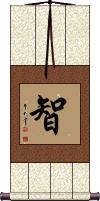
智 is the simplest way to write wisdom in Chinese, Korean Hanja, and Japanese Kanji.
Being a single character, the wisdom meaning is open to interpretation, and can also mean intellect, knowledge or reason, resourcefulness, or wit.
智 is also one of the five tenets of Confucius.
智 is sometimes included in the Bushido code but is usually not considered part of the seven key concepts of the code.
See our Wisdom in Chinese, Japanese and Korean page for more wisdom-related calligraphy.
See Also: Learn From Wisdom | Confucius
Ikigai

生き甲斐 is a Japanese word that means something one lives for, a reason for being, a purpose in life, or French, raison d'etre.
Everyone has an ikigai. Finding it requires a deep and often lengthy search for self. Finding your Ikigai is the way to also find satisfaction and meaning in life.
Your Ikigai could be almost anything. For some, it is running for president. For others, satisfaction is found in raising children.
Ikigai is why you get up in the morning; bringing meaning to your life and pursuing your Ikigai makes life worthwhile.
Bravery / Courage
Courageous Energy
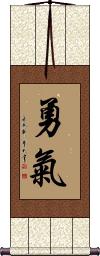
勇氣 is one of several ways to express bravery and courage in Chinese, Japanese, and Korean.
This version is the most spiritual. This is the essence of bravery from deep within your being. This is the mental state of being brave versus actual brave behavior. You'd more likely use this to say, “He is very courageous,” rather than “He fought courageously in the battle.”
The first character also means bravery or courage when it's seen alone. With the second character added, an element of energy or spirit is added. The second character is the same “chi” or “qi” energy that Kung Fu masters focus on when they strike. For this reason, you could say this means “spirit of courage” or “brave spirit.”
This is certainly a stronger word than just the first character alone.
Beyond bravery or courage, dictionaries also translate this word as valor/valour, nerve, audacity, daring, pluck, plucky, gallantry, guts, gutsy, and boldness.
This is also one of the 8 key concepts of tang soo do.
 While the version shown to the left is commonly used in Chinese and Korean Hanja (and ancient Japanese Kanji), please note that the second character is written with slightly fewer strokes in modern Japanese. If you want the modern Japanese version, please click on the character to the right. Both styles would be understood by native Chinese, Japanese, and many (but not all) Korean people. You should make your selection based on the intended audience for your calligraphy artwork. Or pick the single-character form of bravery/courage which is universal.
Better Late Than Never
It's Never Too Late Too Mend
Long ago in what is now China, there were many kingdoms throughout the land. This time period is known as “The Warring States Period” by historians because these kingdoms often did not get along with each other.
Sometime around 279 B.C. the Kingdom of Chu was a large but not particularly powerful kingdom. Part of the reason it lacked power was the fact that the King was surrounded by “yes men” who told him only what he wanted to hear. Many of the King's court officials were corrupt and incompetent which did not help the situation.
The King was not blameless himself, as he started spending much of his time being entertained by his many concubines.
One of the King's ministers, Zhuang Xin, saw problems on the horizon for the Kingdom, and warned the King, “Your Majesty, you are surrounded by people who tell you what you want to hear. They tell you things to make you happy and cause you to ignore important state affairs. If this is allowed to continue, the Kingdom of Chu will surely perish, and fall into ruins.”
This enraged the King who scolded Zhuang Xin for insulting the country and accused him of trying to create resentment among the people. Zhuang Xin explained, “I dare not curse the Kingdom of Chu but I feel that we face great danger in the future because of the current situation.” The King was simply not impressed with Zhuang Xin's words.
Seeing the King's displeasure with him and the King's fondness for his court of corrupt officials, Zhuang Xin asked permission from the King that he may take leave of the Kingdom of Chu, and travel to the State of Zhao to live. The King agreed, and Zhuang Xin left the Kingdom of Chu, perhaps forever.
Five months later, troops from the neighboring Kingdom of Qin invaded Chu, taking a huge tract of land. The King of Chu went into exile, and it appeared that soon, the Kingdom of Chu would no longer exist.
The King of Chu remembered the words of Zhuang Xin and sent some of his men to find him. Immediately, Zhuang Xin returned to meet the King. The first question asked by the King was “What can I do now?”
Zhuang Xin told the King this story:
A shepherd woke one morning to find a sheep missing. Looking at the pen saw a hole in the fence where a wolf had come through to steal one of his sheep. His friends told him that he had best fix the hole at once. But the Shepherd thought since the sheep is already gone, there is no use fixing the hole.
The next morning, another sheep was missing. And the Shepherd realized that he must mend the fence at once. Zhuang Xin then went on to make suggestions about what could be done to reclaim the land lost to the Kingdom of Qin, and reclaim the former glory and integrity of the Kingdom of Chu.
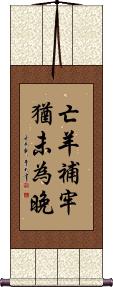
The Chinese idiom shown above came from this reply from Zhuang Xin to the King of Chu almost 2,300 years ago.
It translates roughly into English as...
“Even if you have lost some sheep, it's never too late to mend the fence.”
This proverb, 亡羊补牢犹未为晚, is often used in modern China when suggesting in a hopeful way that someone change their ways, or fix something in their life. It might be used to suggest fixing a marriage, quitting smoking, or getting back on track after taking an unfortunate path in life among other things one might fix in their life.
I suppose in the same way that we might say, “Today is the first day of the rest of your life” in our western cultures to suggest that you can always start anew.
Note: This does have Korean pronunciation but is not a well-known proverb in Korean (only Koreans familiar with ancient Chinese history would know it). Best if your audience is Chinese.
This in-stock artwork might be what you are looking for, and ships right away...
Gallery Price: $300.00
Your Price: $109.88

Gallery Price: $60.00
Your Price: $39.88

Gallery Price: $100.00
Your Price: $35.00

Gallery Price: $53.00
Your Price: $29.00

Gallery Price: $31.00
Your Price: $17.00

Gallery Price: $51.00
Your Price: $28.00

Gallery Price: $29.00
Your Price: $16.00


Gallery Price: $42.00
Your Price: $23.00

Gallery Price: $71.00
Your Price: $39.00

Gallery Price: $35.00
Your Price: $19.00

Gallery Price: $38.00
Your Price: $21.00

Gallery Price: $38.00
Your Price: $21.00


Gallery Price: $26.00
Your Price: $14.00
Not the results for reason for being that you were looking for?
Below are some entries from our dictionary that may match your reason for being search...
| Characters If shown, 2nd row is Simp. Chinese |
Pronunciation Romanization |
Simple Dictionary Definition |
ので see styles |
node ので |
(particle) that being the case; because of ...; the reason is ....; given that... |
事理 see styles |
shì lǐ shi4 li3 shih li jiri じり |
reason; logic reason; facts; propriety; sense Practice and theory; phenomenon and noumenon, activity and principle, or the absolute; phenomena ever change, the underlying principle, being absolute, neither changes nor acts, it is the 眞如 q. v. also v. 理. For 事理法界 (事理無礙法界) v. 四法界. |
因同品 see styles |
yīn tóng pǐn yin1 tong2 pin3 yin t`ung p`in yin tung pin in dōhon |
(The example in logic must be) of the same order as the reason. |
曼荼羅 曼荼罗 see styles |
màn tú luó man4 tu2 luo2 man t`u lo man tu lo mandara まんだら |
(Buddhism) (loanword from Sanskrit) mandala mandala; Buddhist visual schema of the enlightened mind; (given name) Mandara 曼怛羅; 曼特羅; 曼陀羅; 曼拏羅; 蔓陀囉; 滿荼邏 maṇḍala, a circle, globe, wheel ring; "any circular figure or diagram" (M.W.); a magic circle; a plot or place of enlightenment; a round or square altar on which buddhas and bodhisattvas are placed; a group of such, especially the garbhadhātu and vajradhātu groups of the Shingon sect; these were arranged by Kōbō Daishi to express the mystic doctrine of the two dhātu by way of illustration, the garbhadhātu representing the 理 and the 因 principle and cause, the vajradhātu the 智 and the 果 intelligence (or reason) and the effect, i.e. the fundamental realm of being, and mind as inherent in it; v. 胎 and 金剛. The two realms are fundamentally one, as are the absolute and phenomenal, e.g. water and wave. There are many kinds of maṇḍalas, e.g. the group of the Lotus Sutra; of the 觀經; of the nine luminaries; of the Buddha's entering into nirvana, etc. The real purpose of a maṇḍala is to gather the spiritual powers together, in order to promote the operation of the dharma or law. The term is commonly applied to a magic circle, subdivided into circles or squares in which are painted Buddhist divinities and symbols. Maṇḍalas also reveal the direct retribution of each of the ten worlds of beings (purgatory, pretas, animals, asuras, men, devas, the heavens of form, formless heavens, bodhisattvas, and buddhas). Each world has its maṇḍala which represents the originating principle that brings it to completion. The maṇḍala of the tenth world indicates the fulfilment and completion of the nine worlds. |
狡休み see styles |
zuruyasumi ずるやすみ |
(noun/participle) playing hookey; being away from work without a good reason |
金剛界 金刚界 see styles |
jīn gāng jiè jin1 gang1 jie4 chin kang chieh kongoukai / kongokai こんごうかい |
(1) {Buddh} (See 胎蔵界・たいぞうかい・1) Vajradhatu; Diamond Realm; (2) (abbreviation) {Buddh} (See 金剛界曼荼羅・こんごうかいまんだら) Vajradathu Mandala; Diamond Realm Mandala vajradhātu, 金界 The 'diamond', or vajra, element of the universe; it is the 智 wisdom of Vairocana in its indestructibility and activity; it arises from the garbhadhātu 胎藏界q.v., the womb or store of the Vairocana 理 reason or principles of such wisdom, v. 理智. The two, garbhadhātu and vajradhātu, are shown by the esoteric school, especially in the Japanese Shingon, in two maṇḍalas, i.e. groups or circles, representing in various portrayals the ideas arising from the two, fundamental concepts. vajradhātu is intp. as the 智 realm of intellection, and garbhadhātu as the 理 substance underlying it, or the matrix; the latter is the womb or fundamental reason of all things, and occupies the eastern position as 'cause' of the vajradhātu, which is on the west as the resultant intellectual or spiritual expression. But both are one as are Reason and Wisdom, and Vairocana (the illuminator, the 大日 great sun) presides over both, as source and supply. The vajradhātu represents the spiritual world of complete enlightenment, the esoteric dharmakāya doctrine as contrasted with the exoteric nirmāṇakāya doctrine. It is the sixth element 識 mind, and is symbolized by a triangle with the point downwards and by the full moon, which represents 智 wisdom or understanding; it corresponds to 果 fruit, or effect, garbhadhātu being 因 or cause. The 金剛王五部 or five divisions of the vajradhātu are represented by the Five dhyāni-buddhas, thus: centre 大日Vairocana; east 阿閦 Akṣobhya; south 寶生Ratnasambhava; west 阿彌陀 Amitābha; north 不 空 成就 Amoghasiddhi, or Śākyamuni. They are seated respectively on a lion, an elephant, a horse, a peacock, and a garuda. v. 五佛; also 胎. |
ずる休み see styles |
zuruyasumi ずるやすみ |
(noun/participle) playing hookey; being away from work without a good reason |
共不定過 共不定过 see styles |
gòng bù dìng guō gong4 bu4 ding4 guo1 kung pu ting kuo gū fujō ka |
fallacy of the reason being shared by both positive and negative examples |
十二因緣 十二因缘 see styles |
shí èr yīn yuán shi2 er4 yin1 yuan2 shih erh yin yüan jūni innen |
Dvādaśaṅga pratītyasamutpāda; the twelve nidānas; v. 尼 and 因; also 十二緣起; 因緣有支; 因緣率連; 因緣棘園; 因緣輪; 因緣重城; 因緣觀; 支佛觀. They are the twelve links in the chain of existence: (1) 無明avidyā, ignorance, or unenlightenment; (2) 行 saṃskāra, action, activity, conception, "dispositions," Keith; (3) 識 vijñāna, consciousness; (4) 名色 nāmarūpa, name and form; (5) 六入 ṣaḍāyatana, the six sense organs, i.e. eye, ear, nose, tongue, body, and mind; (6) 觸 sparśa, contact, touch; (7) 受 vedanā, sensation, feeling; (8) 愛 tṛṣṇā, thirst, desire, craving; (9) 取 upādāna, laying hold of, grasping; (10) 有 bhava, being, existing; (11) 生 jāti, birth; (12) 老死 jarāmaraṇa, old age, death. The "classical formula" reads "By reason of ignorance dispositions; by reason of dispositions consciousness", etc. A further application of the twelve nidānas is made in regard to their causaton of rebirth: (1) ignorance, as inherited passion from the beginningless past ; (2) karma, good and evil, of past lives; (3) conception as a form of perception; (4) nāmarūpa, or body and mind evolving (in the womb); (5) the six organs on the verge of birth; (6) childhood whose intelligence is limited to sparśa, contact or touch; (7) receptivity or budding intelligence and discrimination from 6 or 7 years; (8) thirst, desire, or love, age of puberty; (9) the urge of sensuous existence; (10) forming the substance, bhava, of future karma; (11) the completed karma ready for rebirth; (12) old age and death. The two first are associated with the previous life, the other ten with the present. The theory is equally applicable to all realms of reincarnation. The twelve links are also represented in a chart, at the centre of which are the serpent (anger), boar (ignorance, or stupidity), and dove (lust) representing the fundamental sins. Each catches the other by the tail, typifying the train of sins producing the wheel of life. In another circle the twelve links are represented as follows: (1) ignorance, a blind woman; (2) action, a potter at work, or man gathering fruit; (3) consciousness, a restless monkey; (4) name and form, a boat; (5) sense organs, a house; (6) contact, a man and woman sitting together; (7) sensation, a man pierced by an arrow; (8) desire, a man drinking wine; (9) craving, a couple in union; (10) existence through childbirth; (11) birth, a man carrying a corpse; (12) disease, old age, death, an old woman leaning on a stick. v. 十二因緣論 Pratītya-samutpāda śāstra. |
存在意義 see styles |
sonzaiigi / sonzaigi そんざいいぎ |
reason of being; raison d'être; meaning of one's existence |
存在理由 see styles |
sonzairiyuu / sonzairiyu そんざいりゆう |
reason for being; raison d'être |
道理至極 see styles |
dourishigoku / dorishigoku どうりしごく |
(noun or adjectival noun) very reasonable; being perfectly consistent with reason; standing to reason |
そんな訳で see styles |
sonnawakede そんなわけで |
(expression) (kana only) therefore; for that reason; such being the case |
だけあって see styles |
dakeatte だけあって |
(exp,conj) (1) (used to express admiration or praise) as one would expect from ...; given that ... (naturally ...); because ...; being ...; (exp,conj) (2) for good reason; there is a (good) reason that ... |
と言うのは see styles |
toiunoha というのは |
(exp,conj) (1) (kana only) because ...; for ...; the reason being ...; (exp,conj) (2) (kana only) as for ...; when it comes to ...; regarding ...; how about ... |
然るが故に see styles |
shikarugayueni しかるがゆえに |
(conjunction) as such; that being so; for that reason |
しかるが故に see styles |
shikarugayueni しかるがゆえに |
(conjunction) as such; that being so; for that reason |
レゾンデートル see styles |
rezondeetoru レゾンデートル |
raison d'etre (fre:); reason for living; reason for something being so |
レーゾンデートル see styles |
reezondeetoru レーゾンデートル |
raison d'etre (fre:); reason for living; reason for something being so |
レゾン・デートル |
rezon deetoru レゾン・デートル |
raison d'etre (fre:); reason for living; reason for something being so |
レーゾン・デートル |
reezon deetoru レーゾン・デートル |
raison d'etre (fre:); reason for living; reason for something being so |
Variations: |
teganai てがない |
(exp,adj-i) (1) (idiom) not having enough workers; being understaffed; being undermanned; (exp,adj-i) (2) (idiom) having nothing one can do about something; having no options; (exp,adj-i) (3) (idiom) (after neg. verb) no reason not to ...; can't afford not to; why don't you? |
Variations: |
shikarugayueni しかるがゆえに |
(conjunction) as such; that being so; for that reason |
Variations: |
reezondeetoru; rezondeetoru; reezon deetoru; rezon deetoru レーゾンデートル; レゾンデートル; レーゾン・デートル; レゾン・デートル |
raison d'être (fre:); reason for being |
The following table may be helpful for those studying Chinese or Japanese...
| Title | Characters | Romaji (Romanized Japanese) | Various forms of Romanized Chinese | |
| Wisdom | 智 | chi / tomo | zhì / zhi4 / zhi | chih |
| Ikigai | 生き甲斐 | ikigai | ||
| Bravery Courage | 勇氣 勇气 / 勇気 | yuuki / yuki | yǒng qì / yong3 qi4 / yong qi / yongqi | yung ch`i / yungchi / yung chi |
| Better Late Than Never | 亡羊補牢猶未為晚 亡羊补牢犹未为晚 | wáng yáng bǔ láo yóu wèi wéi wǎn wang2 yang2 bu3 lao2 you2 wei4 wei2 wan3 wang yang bu lao you wei wei wan | wang yang pu lao yu wei wei wan wangyangpulaoyuweiweiwan |
|
| In some entries above you will see that characters have different versions above and below a line. In these cases, the characters above the line are Traditional Chinese, while the ones below are Simplified Chinese. | ||||

Successful Chinese Character and Japanese Kanji calligraphy searches within the last few hours...



