Many custom options


And formats



Lotus in Chinese / Japanese
Buy a Lotus calligraphy wall scroll here!
Personalize your custom “Lotus” project by clicking the button next to your favorite “Lotus” title below.
1. Lotus
2. Blue Lotus
3. Wisdom Lotus
4. Mystic Lotus Wisdom of Amitabha
5. White Lotus
6. Star Lotus
7. Namu Myoho Renge Kyo / Homage to Lotus Sutra
8. Great Lotus Wisdom - Samadhi Wisdom
9. Selflessness
10. Caring
11. Charity
12. Love for Humanity / Brotherly Love
13. Benevolent Heart
14. Generosity
15. Benevolence
17. Selflessness
18. Unselfish: Perfectly Impartial
19. Work Unselfishly for the Common Good
20. Cambodia
Lotus
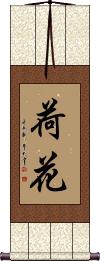
荷花 is one of two ways to write/say “lotus” or “lily” in Chinese.
It will make a nice wall scroll if you are fond of lotus flowers and/or lotuses have a special meaning to you.
Lotus
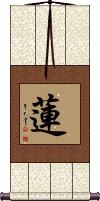
蓮 is another name for “lotus.”
This happens to be a single character that expresses “lotus” in Chinese, and the common name of “lotus” in Japanese and Korean (note that there are two ways to pronounce this character in Korean).
Blue Lotus
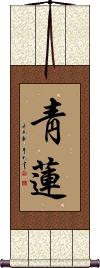
靑蓮 is a common title for Blue Lotus.
靑蓮 is often used in a Buddhist context for blue lotus from the Sanskrit “utpala.” This often refers to the clarity and purity of the lotus blue eyes possessed by a Living Buddha. It can also represent the purity of mind (without desire, suffering, fear, etc.).
Wisdom Lotus
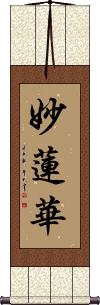
妙蓮華 means the wonderful lotus and the symbol of the pure wisdom of Buddha.
This lotus is unsullied in the midst of the impurity of the world.
Mystic Lotus Wisdom of Amitabha
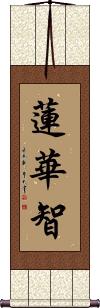
蓮華智 is the lotus or mystic wisdom of Amitābha.
It's one of the five kinds of wisdom in Buddhism.
White Lotus
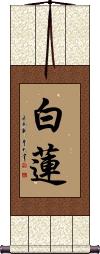
白蓮 is the title for the white lotus (flower) or a short name for the White Lotus society.
The white lotus represents purity or a pure heart and is often associated with Buddhism.
Notes: This can be the Japanese given name Byakuren. In the Buddhist context, the white lotus represented by these characters is originally puṇḍarīka in Sanskrit.
Star Lotus
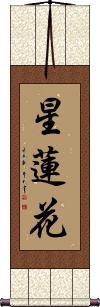
星蓮花 is the title Star Lotus in Chinese.
For star lotus, some may write 星荷 instead - especially in Taiwan for reasons I am not sure of. 星荷 is sometimes romanized as “sing he” or “sing ho” though it would be “xīng hé” in mainland pinyin romanization. If you need a particular version or more info, please get in touch with me.
Namu Myoho Renge Kyo / Homage to Lotus Sutra
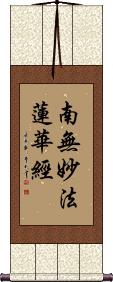
南無妙法蓮華經 is sometimes translated as the “Devotion to the Law of the Lotus Flower Scripture.”
This is a meditation chant and homage to the Lotus Sutra, used by Nichiren Buddhists in Japan.
This is also a chant used in China by certain sects of Buddhism that celebrate the deity Guanyin.
Also romanized as “Nam Myōhō Renge Kyō” or without accents as “Nam Myoho Renge Kyo.”


Original
Traditional
Version
The last character was originally written as seen on the left. Sometimes, you will see it written in the Japanese variant form as shown on the right. If you want this Japanese variant, click on the “Modern Japanese Variant” text instead of the button up by the main title of this entry.
Great Lotus Wisdom - Samadhi Wisdom
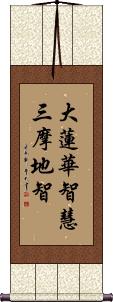
大蓮華智慧三摩地智 is the title for “The wisdom of the great lotus, samādhi-wisdom.”
This is also the penetrating wisdom of Amitābha.
Selflessness
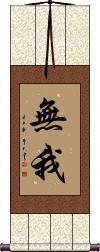
無我 is a more common way to say selflessness in Japanese. This literally means “no self,” or a better translation might be “not thinking of oneself.” 無我 is also understood in Chinese and Korean. 無我 is a very old word in CJK languages.
無我 is the word a Buddhist would use to express the idea of selflessness or unselfishness. For Korean Buddhists, it can mean self-renunciation.
Caring
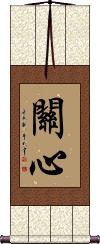
關心 means caring in Chinese.
Caring is giving love and attention to people and things that matter to you and anyone who needs help. When you care about people, you help them. You do a careful job, giving your very best effort. You treat people and things gently and respectfully. Caring makes the world a safer place.
Note: 關心 is also a word in Korean Hanja, but in Korean, it means taking interest or concern. In Korean, it's still a good word, but it doesn't quite have the “caring for a person” meaning that it does in Chinese.
See Also: Benevolence
Charity
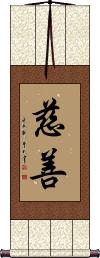
There are a few different words used to express charity in Chinese characters, Japanese Kanji and old Korean Hanja but 慈善 is the most common.
Some of the other words describe acts such as “giving alms” etc.
Note: Sometimes this is translated as benevolence or benevolent.
Also, this considered to be one of the Seven Heavenly Virtues.
If you need a different meaning, just contact me.
See Also: Benevolence
Love for Humanity / Brotherly Love
benevolence, love
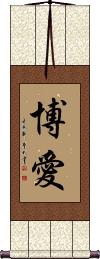
In Chinese and Korean, 博愛 means a universal fraternity, brotherhood, or universal love.
In Japanese, this means charity, benevolence, philanthropy, or love for humanity.
Please note these subtle differences and take that into account depending on your intended audience (Chinese, Korean or Japanese).
See Also: Benevolence
Benevolent Heart
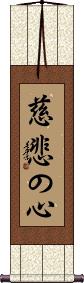
慈悲の心 means benevolent heart, compassionate heart, or merciful heart in Japanese.
This is a Japanese-only phrase and should be ordered from our Japanese master calligrapher. This is because the third character is unique Hiragana.
Chances are you are into Inuyasha and are seeking the title of chapter 471 which is often translated as “Merciful Heart.”
See Also: Love
Generosity
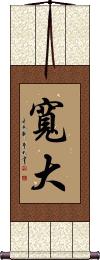
寬大 is a Chinese, Japanese, and Korean word that means Generosity.
Generosity is giving and sharing. You share freely, not with the idea of receiving something in return. You find ways to give others happiness and give just for the joy of giving. Generosity is one of the best ways to show love and friendship.
寬大 can also be translated as charitable, magnanimity, liberality, or in some contexts, broad-mindedness.
Note: There is a tiny deviation in the first character when written in Japanese. If you choose our Japanese master calligrapher, the little dot on the lower right of the first character will be omitted. With or without the dot, this can be read in Chinese, Japanese Kanji, and old Korean Hanja.
See Also: Benevolence | Charity
Benevolence
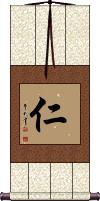
Beyond benevolence, 仁 can also be defined as “charity” or “mercy” depending on context.
The deeper meaning suggests that one should pay alms to the poor, care for those in trouble, and take care of his fellow man (or woman).
仁 is one of the five tenets of Confucius. In fact, it is a subject that Confucius spent a great deal of time explaining to his disciples.
I have also seen this benevolent-related word translated as perfect virtue, selflessness, love for humanity, humaneness, goodness, goodwill, or simply “love” in the non-romantic form.
This is also a virtue of the Samurai Warrior
See our page with just Code of the Samurai / Bushido here
Kindness / Benevolence
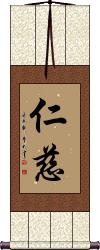
仁慈 word is used in Chinese, Korean, Japanese, and Asian Buddhism to relay the important idea of loving kindness.
仁慈 can also be defined as: benevolent; charitable; kind; merciful; kind-hearted; benevolence; kindness; humanity; mercy.
In Japanese, this can also be the given name Hitoji. This would also be a good Mandarin Chinese given name romanized as Jentzu (in Taiwan) or Renci (which sounds like ren-tsuh).
Selflessness
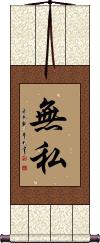
無私 would be literally translated as “none self” in Chinese, Korean, and Japanese.
It is used to express “selflessness” or “unselfish.”
無私 is a popular term for the idea of being selfless or unselfish in modern China and Japan.
This term is not as commonly used in Korea but still has good meaning.
See Also: Work Unselfishly for the Common Good
Unselfish: Perfectly Impartial
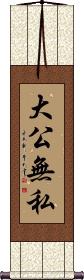
大公無私 is a Chinese proverb that comes from an old story from some time before 476 BC. About a man named Qi Huangyang, who was commissioned by the king to select the best person for a certain job in the Imperial Court.
Qi Huangyang selected his enemy for the job. The king was very confused by the selection, but Qi Huangyang explained that he was asked to find the best person for the job, not necessarily someone that he liked or had a friendship with.
Later, Confucius commented on how unselfish and impartial Qi Huangyang was by saying, “Da Gong Wu Si” which, if you look it up in a Chinese dictionary, is generally translated as “Unselfish” or “Just and Fair.”
If you translate each character, you'd have something like
“Big/Deep Justice Without Self.”
Direct translations like this leave out many what the Chinese characters really say. Use your imagination, and suddenly you realize that “without self” means “without thinking about yourself in the decision” - together, these two words mean “unselfish.” The first two characters serve to drive the point home that we are talking about a concept that is similar to “blind justice.”
One of my Chinese-English dictionaries translates this simply as “just and fair.” So that is the short and simple version.
Note: This can be pronounced in Korean, but it's not a commonly used term.
See Also: Selflessness | Work Unselfishly for the Common Good
Work Unselfishly for the Common Good
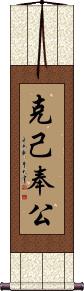
克己奉公 is a Chinese proverb that is often used to express how one should act as a government official. Most of us wish our public officials would hold themselves to higher standards. I wish I could send this scroll, along with the meaning to every member of Congress, and the President (or if I was from the UK, all the members of Parliament, and the PM)
This can also mean: “Place Strict Standards on Oneself in Public Service.”
The story behind this ancient Chinese idiom:
Cai Zun was born in China a little over 2000 years ago. In 24 AD, he joined an uprising led by Liu Xiu, who later became the emperor of the Eastern Han Dynasty.
Later, the new emperor put Cai Zun in charge of the military court. Cai Zun exercised his power in strict accordance with military law, regardless of the offender's rank or background. He even ordered the execution of one of the emperor's close servants after the servant committed a serious crime.
Cai Zun led a simple life but put great demands on himself to do all things honorably. The emperor rewarded him for his honest character and honorable nature by promoting him to the rank of General and granting him the title of Marquis.
Whenever Cai Zun would receive an award, he would give credit to his men and share the reward with them.
Cai Zun was always praised by historians who found many examples of his selfless acts that served the public interest.
Sometime long ago in history, people began to refer to Cai Zun as “ke ji feng gong.”
See Also: Work Unselfishly for the Common Good | Selflessness
Cambodia
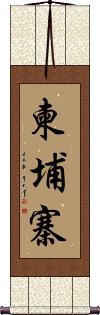
柬埔寨 is a universal way to write Cambodia in Chinese characters and Japanese Kanji.
Note: There are other names and nicknames for Cambodia in both languages.
See Also: Violet | Asian Pride / Oriental Pride / AZN Pryde
Cambodia
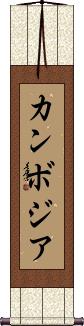
This is Cambodia in Japanese Katakana.
Note: Because this title is entirely Japanese Katakana, it should be written by a Japanese calligrapher.
See Also: Violet | Asian Pride / Oriental Pride / AZN Pryde
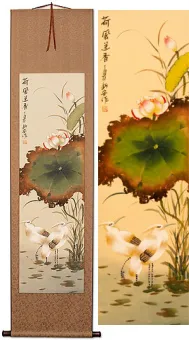
This in-stock artwork might be what you are looking for, and ships right away...





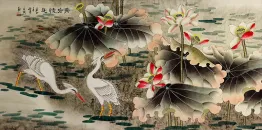

The following table may be helpful for those studying Chinese or Japanese:
| Title | Characters | Romaji (Romanized Japanese) | Various forms of Romanized Chinese | |
| Lotus | 荷花 | hé huā / he2 hua1 / he hua / hehua | ho hua / hohua | |
| Lotus | 蓮 莲 | hasu | lián / lian2 / lian | lien |
| Blue Lotus | 靑蓮 靑莲 | seiren | qing lián / qing lian2 / qing lian / qinglian | ch`ing lien / chinglien / ching lien |
| Wisdom Lotus | 妙蓮華 妙莲华 | myō renge / myōrenge | miào lián huá miao4 lian2 hua2 miao lian hua miaolianhua | miao lien hua miaolienhua |
| Mystic Lotus Wisdom of Amitabha | 蓮華智 莲华智 | renge chi / rengechi | lián huá zhì lian2 hua2 zhi4 lian hua zhi lianhuazhi | lien hua chih lienhuachih |
| White Lotus | 白蓮 白莲 | byakuren | bái lián / bai2 lian2 / bai lian / bailian | pai lien / pailien |
| Star Lotus | 星蓮花 星莲花 | xīng lián huā xing1 lian2 hua1 xing lian hua xinglianhua | hsing lien hua hsinglienhua |
|
| Namu Myoho Renge Kyo Homage to Lotus Sutra | 南無妙法蓮華經 / 南無妙法蓮華経 南无妙法莲华经 | na mu myou hou ren ge kyou namumyouhourengekyou na mu myo ho ren ge kyo | nán wú miào fǎ lián huá jīng nan2 wu2 miao4 fa3 lian2 hua2 jing1 nan wu miao fa lian hua jing nanwumiaofalianhuajing | nan wu miao fa lien hua ching nanwumiaofalienhuaching |
| Great Lotus Wisdom - Samadhi Wisdom | 大蓮華智慧三摩地智 大莲华智慧三摩地智 | dai renge chie sanmajichi dairengechiesanmajichi | dà lián huá zhì huì sān mó dì zhì da4 lian2 hua2 zhi4 hui4 san1 mo2 di4 zhi4 da lian hua zhi hui san mo di zhi | ta lien hua chih hui san mo ti chih |
| Selflessness | 無我 无我 | muga | wú wǒ / wu2 wo3 / wu wo / wuwo | |
| Caring | 關心 关心 | guān xīn / guan1 xin1 / guan xin / guanxin | kuan hsin / kuanhsin | |
| Charity | 慈善 | ji zen / jizen | cí shàn / ci2 shan4 / ci shan / cishan | tz`u shan / tzushan / tzu shan |
| Love for Humanity Brotherly Love | 博愛 博爱 | hakuai | bó ài / bo2 ai4 / bo ai / boai | po ai / poai |
| Benevolent Heart | 慈悲の心 | ji hi no kokoro jihinokokoro | ||
| Generosity | 寬大 宽大 | kandai | kuān dà / kuan1 da4 / kuan da / kuanda | k`uan ta / kuanta / kuan ta |
| Benevolence | 仁 | jin | rén / ren2 / ren | jen |
| Kindness Benevolence | 仁慈 | jin ji / jinji | rén cí / ren2 ci2 / ren ci / renci | jen tz`u / jentzu / jen tzu |
| Selflessness | 無私 无私 | mushi | wú sī / wu2 si1 / wu si / wusi | wu ssu / wussu |
| Unselfish: Perfectly Impartial | 大公無私 大公无私 | dà gōng wú sī da4 gong1 wu2 si1 da gong wu si dagongwusi | ta kung wu ssu takungwussu |
|
| Work Unselfishly for the Common Good | 克己奉公 | kè jǐ fèng gōng ke4 ji3 feng4 gong1 ke ji feng gong kejifenggong | k`o chi feng kung kochifengkung ko chi feng kung |
|
| Cambodia | 柬埔寨 | kanbojia | jiǎn pǔ zhài jian3 pu3 zhai4 jian pu zhai jianpuzhai | chien p`u chai chienpuchai chien pu chai |
| Cambodia | カンボジア | kan po ji a kanpojia | ||
| In some entries above you will see that characters have different versions above and below a line. In these cases, the characters above the line are Traditional Chinese, while the ones below are Simplified Chinese. | ||||

Successful Chinese Character and Japanese Kanji calligraphy searches within the last few hours...



