Many custom options


And formats



Zion in Chinese / Japanese
Buy a Zion calligraphy wall scroll here!
Personalize your custom “Zion” project by clicking the button next to your favorite “Zion” title below.
1. Zion
2. God of Zion / God of Abraham
3. Christian / Disciple of Christ
Zion
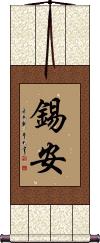
錫安 is the Chinese title for Zion.
While 錫安 is supposed to sound like the western word Zion, it also has meaning.
錫 means to bestow or grant (but can mean tin in chemistry).
安 means peace, calm, safety, and tranquility.
God of Zion / God of Abraham
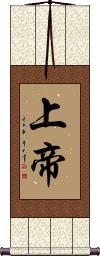
上帝 is how Chinese Christians and Jews refer to God, AKA The Judeo-Christian God.
There are Chinese Jews whose ancestry dates back to Jewish traders on the silk road. They are known as the Kaifeng Jews. Most have left China for Israel now.
There are also plenty of Christians in China of the Protestant and Catholic varieties. However, the churches are basically run by the government, and the Chinese Catholic church does not recognize the Pope.
Oddly, in my experience, I found the Chinese Protestant church to be much less political compared to Baptist and other Protestant churches that I have visited in America.
上帝 is also the typically-used title for God in Japanese.
While you may find this term in old Korean dictionaries, it is an obscure and rarely-used title for God in modern Korean.
See Also: Christ | Jesus Christ
Christian / Disciple of Christ
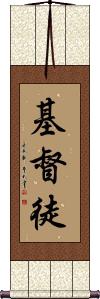
基督徒 is a very strong and direct word in Chinese for “Christian.”
The literal translation of the first two characters is “Christ.”
The last character means apprentice, follower, or disciple.
Altogether these three characters mean “Christ's Disciple” or “Christ's Apprentice.” 基督徒 is a pretty cool title to hang on your wall if you are a devout Christian.
Also used by Japanese Christians (but may be unfamiliar to non-Christian Japanese people).
See Also: Jesus Christ | God of Zion / God of Abraham
Christianity / Christian
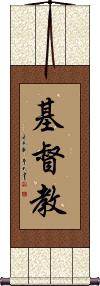
基督教 is the Chinese, Japanese, and Korean word for “Christianity.”
Just as in English, this word is often used to mean “Protestant” but includes Catholics in the true definition.
It is the word used to refer to the whole “Christian religion” or “Christian Faith,” and therefore, it can mean “Christianity.” However, used as an adjective in regard to a person, it would translate as “Christian.” But more like saying, “His religion is Christianity,” rather than a noun form.
If you break it apart, the characters mean Base/Foundation Leading/Supervising Religion/Teaching. It makes more sense in Japanese, Chinese, and Korean. The first two characters together are translated as “Christ.” So you can also say this means “Christ's Religion” or “Christ's Teachings” when directly translated, or in reverse, “The Religion of Christ” or “The Teaching of Christ.”
Notes: The last character has a slight difference in one stroke - however, in calligraphic form, this will not be apparent. This entry can easily be read by any Korean person who knows Hanja characters (Chinese characters used in Korean).
See Also: Jesus Christ | God of Zion / God of Abraham
Disciple of Christianity
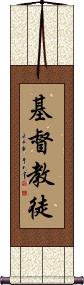
基督教徒 is the most verbose (longest) word for “Christian” in the Chinese and Japanese languages.
The literal translation of the first two characters is Christ.
The third Character means “Religion” or “Teaching.”
The last character means “apprentice” or “disciple.”
Altogether these three characters mean “Christ's Teaching Disciple” or “Christ's Religion Apprentice.”
Note: The last two characters are sometimes translated together as “follower (of a religion),” so you could also say it means “Follower of Christ.”
This four-character title makes it very clear what you are talking about in Chinese.
See Also: Jesus Christ | God of Zion / God of Abraham
Word of God / The Gospel
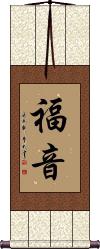
福音 is the Chinese, Korean and Japanese word for “Gospel” or “Word of God.”
福音 is a specifically Christian word in Asia (not used for any other religion).
The first character means blessing, good fortune, or good luck. This first character is a special character used throughout China to bring good tidings and fortune - especially during Chinese New Year. The second character means sound, noise, or news.
Together, these characters create a word that means “The Good News” or “The Sound of Good Fortune.”
When read by a Chinese or Japanese person, this word is always perceived as “The Christian Gospel,” “Word of God,” or even “The Voice of God.”
See Also: Christ | Jesus Christ | God of Zion / God of Abraham
Resurrection / Re-Birth
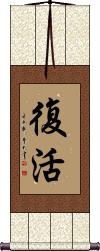
復活 is the Chinese, Japanese, and Korean word for resurrection or rebirth.
復活 literally means “return to life.”
It is the term used in most Asian Bibles to refer to the resurrection of Christ. In Japanese, it is sometimes used to mean a Christian Revival. In some contexts, it can mean resuscitation.
See Also: Christ | Jesus Christ | God of Zion / God of Abraham
God Bless You / May God Protect You
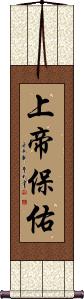
上帝保佑 is a blessing exchanged between Chinese Christians.
The first two characters mean God (The God of Zion). The second two characters express the idea of giving protection. Another way to translate this is “May God protect you.”
See Also: Guardian Angel
Trust in God / In God We Trust
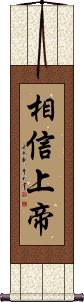
相信上帝 means exactly what the title suggests. The first two characters mean “trust” or “believe,” and the second two mean “God” (as in the God of Abraham and the God of Zion).
Thisis also how the American phrase “In God We Trust” as seen on U.S. Currency would be translated into Chinese. It would also be correct to say that this means “Believe in God,” though, in this arrangement/context, one would be more likely to interpret it as “trust.”
The following table may be helpful for those studying Chinese or Japanese:
| Title | Characters | Romaji (Romanized Japanese) | Various forms of Romanized Chinese | |
| Zion | 錫安 锡安 | xī ān / xi1 an1 / xi an / xian | hsi an / hsian | |
| God of Zion God of Abraham | 上帝 | joutei / jotei | shàng dì / shang4 di4 / shang di / shangdi | shang ti / shangti |
| Christian Disciple of Christ | 基督徒 | kirisuto | jī dū tú ji1 du1 tu2 ji du tu jidutu | chi tu t`u chitutu chi tu tu |
| Christianity Christian | 基督教 | kirisutokyou kirisutokyo | jī dū jiào ji1 du1 jiao4 ji du jiao jidujiao | chi tu chiao chituchiao |
| Disciple of Christianity | 基督教徒 | kirisutokyouto kirisutokyoto | jī dū jiào tú ji1 du1 jiao4 tu2 ji du jiao tu jidujiaotu | chi tu chiao t`u chituchiaotu chi tu chiao tu |
| Word of God The Gospel | 福音 | fukuin | fú yīn / fu2 yin1 / fu yin / fuyin | |
| Resurrection Re-Birth | 復活 复活 | hukkatsu / hukatsu | fù huó / fu4 huo2 / fu huo / fuhuo | |
| God Bless You May God Protect You | 上帝保佑 | shàng dì bǎo yòu shang4 di4 bao3 you4 shang di bao you shangdibaoyou | shang ti pao yu shangtipaoyu |
|
| Trust in God In God We Trust | 相信上帝 | xiāng xìn shàng dì xiang1 xin4 shang4 di4 xiang xin shang di xiangxinshangdi | hsiang hsin shang ti hsianghsinshangti |
|
| In some entries above you will see that characters have different versions above and below a line. In these cases, the characters above the line are Traditional Chinese, while the ones below are Simplified Chinese. | ||||

Successful Chinese Character and Japanese Kanji calligraphy searches within the last few hours...



