Many custom options


And formats



Root in Chinese / Japanese
Buy a Root calligraphy wall scroll here!
Personalize your custom “Root” project by clicking the button next to your favorite “Root” title below.
1. Root
2. Keegan
4. Samurai
6. Ginger
7. Madder
8. Four Noble Truths: Desire and Attachment
9. Adventure
10. Respectful Heart
11. Kodokan
12. Birth / Life
13. Taido
Root

魯特 is the name Root in Chinese (Mandarin).
Root

ルート is the name Root in Japanese Katakana.
Note: Because this title is entirely Japanese Katakana, it should be written by a Japanese calligrapher.
Keegan
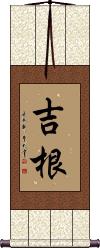
We like this way to transliterate the name Keegan into Mandarin Chinese because it has a nice meaning.
It kind of means “The root of luck.”
Give Up Desire
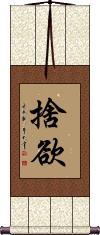
捨欲 is a Buddhist term that means to give up desire or the act of cutting off desire.
In Buddhism, our attachments, greed, and/or desires are the root of our suffering. Release them and live a happy life!
Samurai
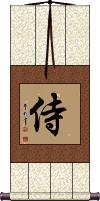
In Japanese, 侍 represents the warriors that attempted to hold peace when there was no Emperor in Japan.
Be cautious though, as it is an old way to express “servant” or “waiter” in Chinese and Korean. Of course, if you are a samurai, you are a servant to your Shogun-ate, Lord, or the people (which is the root meaning).
See Also: Warrior
Canton / Guangdong
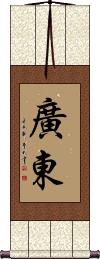
廣東 is the title of Guangdong province (Kwangtung) in south China.
In English, this place is also known as Canton, and is the root of the word Cantonese for the language, culture, and cooking style of this region.
Beyond Canton, this can be the surname Hirotou or Hiroto in Japanese though often written in the modern form of 広東 in Japan.
Ginger
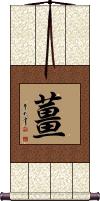
薑 is the Chinese, Japanese Kanji, and old Korean Hanja word for ginger root (Zingiber officinale).
薑 is also the Chinese surname Jiang, or the Japanese surname Hajikami.
Sometimes, this can refer to a Japanese pepper (Zanthoxylum piperitum).
Madder
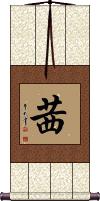
茜 is the name for Rubia cordifolia, Indian madder, munjeet, Japanese madder, Rubia argyi, rose madder or red madder.
This is a flowering plant that since ancient times, the root has been used to create red, pink, and other red-hued dyes.
In Japan, this can be the surname or given names Sen, Sei, or Akane.
Four Noble Truths: Desire and Attachment
Samudaya
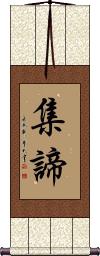
集諦 represents the idea that the core of suffering is often the concept of desire or attachment.
This can be carnal desire, monetary desire, or the attachment you have to something that you are unwilling to part with (such as a fancy car). 集諦 is a simplification of the second noble truth which is an exploration into the root causes of suffering - it's deeper than I can go in a few sentences.
This term is exclusively used by devout Buddhists. It is not a common term, and is remains an unknown concept to most Chinese, Japanese, and Korean people.
See Also: Buddhism | Enlightenment
Adventure
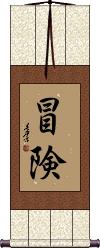
冒険 is a common Japanese way to say “Adventure.”
The first character can mean “to risk,” “to defy” or “to dare.” The second character means “inaccessible place” or “impregnable position.” Together, you get the idea of why these two characters mean adventure when put them together in Japanese.
Note: The second character is a morphed Japanese Kanji. The original Chinese version is also available and holds the same root meaning.
See Also: Bon Voyage | Traveler / Wanderer / Vagabond / Rolling Stone
Respectful Heart
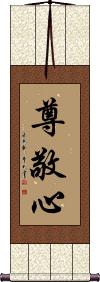
尊敬心 means respectful heart in Japanese, Chinese and Korean.
The root is 尊敬 which means respect, honor, reverence, esteem, and/or nobility. Therefore, you can also define this as an honorable heart, reverent heart, noble heart, etc.
In ancient times, it was thought your brain was the heart in your chest. Therefore, 心 or heart can also mean “mind.” Hence, 尊敬心 can also be translated as respectful mind, honorable mind, etc.
You'll see 尊敬心 romanized as Sonkeishin or Sonkeshin from Japanese.
Kodokan
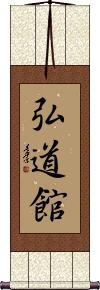
弘道館 is a Japanese title that romanizes as Kodokan.
There are a few martial arts titles that are romanized as Kodokan, so be careful to choose the correct one. This one roughly means “Great Way Hall.”
In the old Buddhist context, the 弘 Kanji can mean vast, great, to enlarge, spread abroad, or widely to proclaim.
The 道 part is the “Way,” as seen in many martial arts titles. It is the root character of Taoism/Daoism (romanized as Tao or Dao from Chinese, but Do in Japanese).
The 館 or hall part is implied to be a dojo or place of learning.
Birth / Life
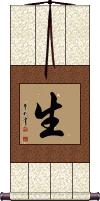
生 is a Chinese word that means “to be born” and “to give birth.”
Also, it's often used to refer to life itself, and sometimes “to grow.”
生 is used in many compound words such as “yi sheng,” which means “doctor” (literally “healer of life”), “sheng ri” which means “birthday” (literally “birth-day”), and “xue sheng” which means student (literally “studying life” or “learner [about] life”). Few Chinese people will think of the literal meaning when this uses words like doctor and student - but it is interesting to note.
生 has the same root meaning in Korean Hanja and Japanese. However, in Japanese, there are many possible pronunciations, and this can be used to mean “raw” or “unprocessed” (as in draft beer). Therefore, not be the best if your audience is Japanese.
See Also: Vitality
Taido
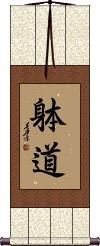
Taidō (The Way of the Body) is a style of Karate practiced in Japan and popular worldwide.
Taidō or 躰道 traces a lineage from Genseiryū (玄制流), which came from Shuri-te (首里手), one of the original martial arts schools of ancient Okinawa.
The first character 躰 is a variant of the original Chinese character 體. In modern Japan, they tend to use 体, a more simple character form. 体 is also the modern Simplified Chinese form of 體.
The 躰 character is correct for this 躰道 martial arts title. But it can be confusing with so many variants out there, not to mention other homophonic Japanese words that also romanize as Taidō or Taidou.
To have a bit more fun with this 躰 character, it has a 身 radical on the left, which sets it apart. The meaning doubles up on the “body” as 身 (shin) is a character that also means body in Japanese and Chinese. On the right is 本, which often means root, stem, origin, source, or fundamental (but can also mean “book” in some contexts). This has deviated from the original 體 which was 骨 (bone) + 豊 (vessel). Hence, the body was your “bone vessel” in ancient Asia.
The meaning of 躰, as well as 體 and 体, is usually translated as the body. When related to the physical body, it can also refer to the torso, trunk, build, physique, or the constitution of a person. As an extension of this, it can also refer to someone's health (good body = good health).
However, depending on the context, it can encompass other meanings such as form, style, system, experience, aspect, corpus, corporeal, substance, or essentials.
The second character, 道, is recognized and well-known as the “Way” and is the same “do” as in Karate-do or Aikido.
These search terms might be related to Root:
Burrow
Doing Good is the Greatest Source of Happiness
Enthusiasm / Passion for a Cause
Evil Cause, Evil Result
Failure is the Origin of Success
Karma - Cause and Effect
Passion for a Cause
The following table may be helpful for those studying Chinese or Japanese:
| Title | Characters | Romaji (Romanized Japanese) | Various forms of Romanized Chinese | |
| Root | 魯特 鲁特 | lǔ tè / lu3 te4 / lu te / lute | lu t`e / lute / lu te | |
| Root | ルート | ruuto / ruto | ||
| Keegan | 吉根 | jí gēn / ji2 gen1 / ji gen / jigen | chi ken / chiken | |
| Give Up Desire | 捨欲 舍欲 | shayoku | shě yù / she3 yu4 / she yu / sheyu | she yü / sheyü |
| Samurai | 侍 | samurai | shì / shi4 / shi | shih |
| Canton Guangdong | 廣東 广东 | hirotou / hiroto hiroto / hiroto | guǎng dōng guang3 dong1 guang dong guangdong | kuang tung kuangtung |
| Ginger | 薑 姜 | hajikami / shouga hajikami / shoga | jiāng / jiang1 / jiang | chiang |
| Madder | 茜 | akane / sen / sei | xī / xi1 / xi | |
| Four Noble Truths: Desire and Attachment | 集諦 集谛 | jittai | jí dì / ji2 di4 / ji di / jidi | chi ti / chiti |
| Adventure | 冒険 | bou ken / bo ken | ||
| Respectful Heart | 尊敬心 | son kei shin sonkeishin | zūn jìng xīn zun1 jing4 xin1 zun jing xin zunjingxin | tsun ching hsin tsunchinghsin |
| Kodokan | 弘道館 | koudoukan / kodokan | ||
| Birth Life | 生 | shou / iku / sho / iku | shēng / sheng1 / sheng | |
| Taido | 躰道 | tai dou / taidou / tai do | ||
| In some entries above you will see that characters have different versions above and below a line. In these cases, the characters above the line are Traditional Chinese, while the ones below are Simplified Chinese. | ||||

Successful Chinese Character and Japanese Kanji calligraphy searches within the last few hours...



